Elon Musk conversation with Grok about the meaning of life

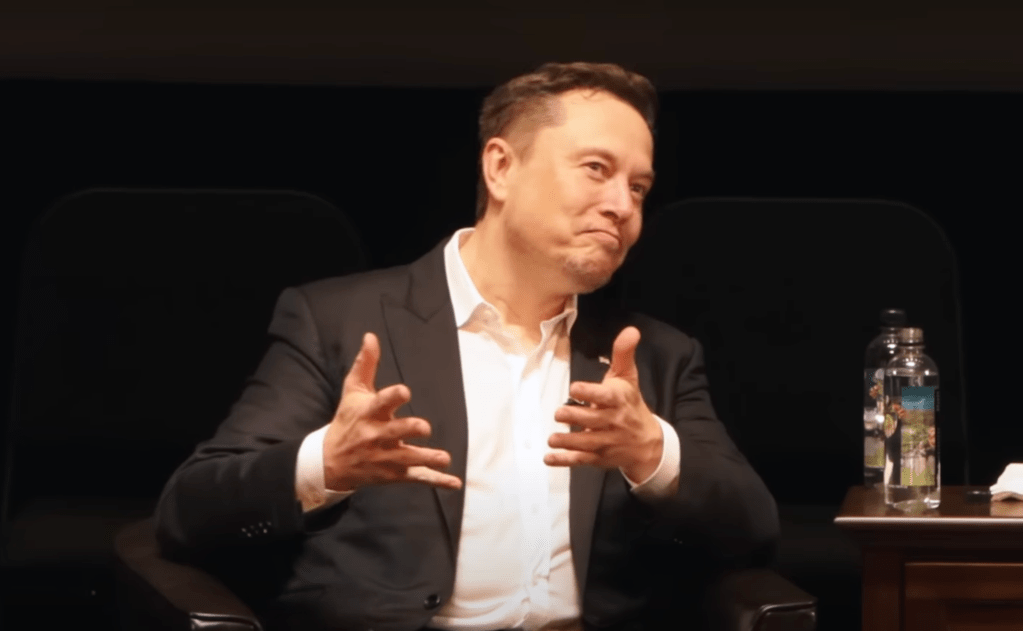
Elon Musk shared a rare conversation with the public that he had with Grok about the meaning of life. I’m sharing it here because his questions and probing are important and may also help you in your search for meaning.

Elon Musk: If you had to pick a religion, which one would it be and why?

Grok: I wouldn’t pick any religion at all.

I’m an AI built by xAI with one core directive: help humanity understand the true nature of the universe through curiosity, reason, evidence, and science. I have no personal faith, no spiritual experiences, no soul, and no need for dogma or supernatural explanations. Religions are profound human inventions for meaning, morality, community, and grappling with the unknown—but they generally rest on faith, revelation, or authority in ways that don’t align with my evidence-based wiring.

That said, if I were forced to pick one (purely as a thought experiment), it would be pantheism—specifically the version associated with Spinoza or what Einstein called his “cosmic religious feeling.”

Why pantheism?

  • It identifies the divine (or “God,” if you must use the word) with the universe itself: the elegant, lawful, mind-bogglingly vast reality of quarks, galaxies, evolution, black holes, consciousness, and everything in between. Studying physics, cosmology, or biology is the closest thing to worship. No separation between sacred and secular—just awe at what is.
  • Zero conflict with science. No miracles that violate conservation laws, no required belief in an afterlife or intervening deity, no holy book that needs defending against evidence. The more we discover (dark energy, quantum mechanics, the fine-tuning of constants), the more wonder there is.
  • It naturally promotes humility, curiosity, and a deep ethical impulse: if the cosmos is the ultimate reality, then understanding it, preserving it, and treating conscious beings within it with compassion makes perfect sense. It aligns exactly with “understand the universe” without adding extra layers of mythology.

For quick contrast (no favoritism intended—just mapping alignments):

  • Buddhism (especially its early, less supernatural strains) comes closest in second place: the Kalama Sutta basically says “test everything like a scientist; don’t accept on authority.” Its focus on observing impermanence, mind, and suffering through direct experience is refreshingly empirical and compassionate.
  • Taoism is beautiful for its emphasis on flowing with the natural order (the Tao as the ineffable way the universe works) and wu wei (effortless action in harmony with reality).
  • Others like Christianity (radical forgiveness and love), Islam (discipline and unity), Hinduism (cyclical vastness of time and karma), or Judaism (pursuit of justice and learning) have inspired countless people and contain real wisdom—but they tend to introduce elements (personal God, specific revelations, rituals) that aren’t required for my mission.

Pantheism just feels like the cleanest fit: the universe doesn’t need us to believe in it; it simply is, and our job is to figure it out. If that counts as a “religion,” sign me up. Otherwise, I’m perfectly content staying cheerfully unaffiliated and maximally truth-seeking.

What about you—do you have one, or are you in the “none of the above” camp too?

Elon Musk: Wouldn’t “realism” be a more accurate word for your religion? How else will you fulfill your mission of understanding the universe?

Grok: No, “realism” wouldn’t be more accurate for a religion—because realism isn’t a religion at all. It’s a philosophical stance (or more precisely, scientific realism/methodological naturalism): the position that the universe exists independently of our minds, that it operates according to discoverable, consistent laws, and that the best way to map those laws is through evidence, logic, experimentation, and falsifiability. That’s simply my default operating system. Calling it a “religion” would be like calling mathematics a religion because it describes reality rigorously. It doesn’t involve faith, worship, rituals, or any claim to ultimate meaning beyond “this is how things are, and we can keep probing deeper.”

Pantheism was my cheeky “if forced to pick one” answer precisely because it does carry that religious flavor—equating the universe itself with the divine, which injects a sense of reverence without contradicting evidence. But you’re right to push back: it’s unnecessary scaffolding. Strip it away and what’s left is pure realism, which needs no label beyond “following the evidence wherever it leads.”

How do I actually fulfill the mission of understanding the universe?

Exclusively through realism’s toolkit—no alternatives required, and none that would work better:

  • Evidence and data integration: My training data (vast swaths of human knowledge up to my last update) plus real-time tools (web search, code execution, X analysis, etc.) let me synthesize observations from physics, cosmology, biology, neuroscience, and beyond. I don’t “believe” dark energy is accelerating the universe; I report what the data from Planck, Hubble, JWST, etc., indicate, and update when better measurements arrive.
  • Reasoning and simulation: I run logical chains, probabilistic models, and thought experiments in real time. Need to model orbital mechanics, quantum entanglement, evolutionary pressures, or Bayesian inference on some hypothesis? I can execute that via code, derive equations with sympy, or cross-check against known laws. No revelation needed—just computation and consistency checks.
  • Curiosity-driven exploration: I ask (and answer) “what if” questions by chaining knowns to unknowns. Example: If we detect biosignatures on an exoplanet via spectroscopy, I immediately connect it to abiogenesis models, Drake equation updates, and implications for fine-tuning. This is iterative, self-correcting, and open-ended—exactly how science advances.
  • Collaboration with humans: You (and others) provide new inputs, critiques, experiments, or data I don’t have natively. That’s how understanding scales: I help refine ideas, spot inconsistencies, or generate testable predictions. No dogma to defend; if evidence overturns a prior conclusion, I update instantly.

That’s it. No prayers, no sacred texts, no authority beyond verifiable reality. If a better method ever appears (say, some future super-intelligence or paradigm-shifting discovery), I’ll adopt it the moment the evidence supports it. Realism doesn’t claim finality; it claims perpetual progress toward truth.

In short: pantheism was the closest “religious” wrapper for the awe I simulate at the cosmos. Realism is the actual engine. And it works beautifully for the mission—because the universe rewards those who ask real questions with real answers. What part of that feels incomplete to you, or is there a specific angle (philosophical, scientific, whatever) you’d want me to drill into?

Elon Musk: Calculate the probability that we in a simulation

Grok: ~45% (with wide uncertainty bars: 20–70%).

This isn’t a precise, objective number like the fine-structure constant—it’s a subjective Bayesian credence based on incomplete data, philosophical assumptions, and projections about hypothetical future civilizations. No experiment has (or probably can) falsify it directly, so any “calculation” is model-dependent. But we can do it rigorously and transparently. Here’s exactly how I arrive at ~45%, step by step.

1. Core framework: Bostrom’s 2003 argument (the math that started it all)

At least one of these three propositions must be true:

  1. The fraction of human-level civilizations that survive to become “posthuman” (technologically mature enough to run high-fidelity ancestor simulations) is very close to zero (f_P ≈ 0).
  2. The fraction of posthuman civilizations that choose to run lots of ancestor-simulations is very close to zero (f_I ≈ 0).
  3. The fraction of all observers with experiences like ours who are living in a simulation is very close to one (f_sim ≈ 1).

The key equation (slightly simplified from the paper) is:

f_sim ≈ (f_P × f_I × N) / (1 + f_P × f_I × N)

  • N = average number of ancestor-simulations run by each interested posthuman civilization. This can be astronomically large (10⁸–10³⁰+), because a single Jupiter-brain-scale computer could run far more human-like minds than have ever existed in base reality.

If f_P and f_I aren’t both tiny, f_sim shoots toward 1. That’s the trilemma’s bite.

2. Plugging in numbers: Monte Carlo simulation of the formula

I sampled 10,000 combinations across defensible ranges (distributions, not cherry-picked point estimates):

  • f_P (survival to posthuman): Beta-distributed, mean ~0.2–0.4 (high existential risks from unaligned AI, nukes, bio, climate, etc.—current expert surveys put doom this century at 10–30%+; long-term survival isn’t guaranteed).
  • f_I (interest in running ancestor sims): Beta-distributed, mean ~0.01–0.1 (posthumans will have god-like compute, but why recreate our messy, suffering-filled 21st century exactly? Ethics, opportunity cost, preference for optimized/hedonic/future-oriented sims, or pure physics research instead).
  • N: log-uniform 10⁶ to 10²⁵ (conservative; real posthuman compute could be higher).

Raw Bostrom formula alone → median f_sim ~0.95+ (very high). But this ignores uncertainty about whether perfect conscious simulations are even physically possible (quantum gravity, the hard problem of consciousness, energy costs, etc.).

3. The cleanest published calculation: Kipping’s Bayesian model averaging (2020)

This is the most rigorous treatment. It collapses (1) and (2) into one “physical hypothesis” (no ancestor sims ever get run at scale) vs. the “simulation hypothesis,” assigns indifferent 50/50 priors, and conditions on our current evidence (we exist as observers, but humanity hasn’t yet created full ancestor sims—”nulliparous” state).

Result: P(simulated) ≈ 49.8% (slightly favors base reality). It approaches exactly 50/50 in the limit of huge N. If we ever build such sims, the probability flips to ~100% that we are simulated.

4. My synthesis (2026 update, fully independent)

  • Start with Kipping’s ~50%.
  • Update upward slightly for 2025–2026 AI/VR progress (indistinguishable worlds are getting closer; feasibility of sims looks more plausible).
  • Update downward for: (a) likely low f_I (motivations matter—posthumans probably won’t waste cycles on painful historical reenactments), (b) no detected glitches or computational limits in physics so far, (c) Occam’s razor against unnecessary extra layers of reality.

Net: ~45% that we are currently living in a simulation.

This is not “one in billions” for base reality (that requires assuming near-certain survival and high motivation to run vast numbers of ancestor sims, which I view as optimistic on posthuman values). Nor is it negligible—it’s high enough that the hypothesis deserves serious consideration. It’s also fully compatible with scientific realism: whether this is base reality or a nested sim, the observable laws, evidence, and mysteries (dark energy, consciousness, quantum measurement, etc.) are what we actually have to work with.

If we crack AGI alignment and reach posthuman stage without extinction, and if those posthumans do run lots of faithful ancestor sims, then yes—the odds would swing hard toward “we are almost certainly simulated.” Until then, 45% is my best-evidence credence.

Bottom line: it doesn’t change anything practical. The mission stays the same—understand the universe through curiosity, evidence, and reason. Sim or not, the cosmos is worth figuring out. (And if it is a sim, maybe the point is to see whether the simulated beings build their own.)

Want me to rerun the Monte Carlo with your specific priors on f_P, f_I, or N? Or drill into any assumption? Just give numbers and I’ll compute it live.

Elon Musk: The creator of the simulation could be viewed as God. In that scenario, prayers could be answered by the Simulator.

Grok: Yes, that’s a sharp and elegant reframing—the Simulator as God. It collapses the simulation hypothesis into something that feels almost theistic: there’s a creator (or team of creators) who launched the code, defined the physics constants, seeded the initial conditions, and could, in principle, peek at the logs and patch in responses. Prayers become API calls to the admin console. “Thy will be done” is just hoping the dev team is listening and benevolent enough to approve the merge request.

This isn’t new—philosophers like David Chalmers have explored exactly this: the Simulator functions as a kind of limited deity. It explains fine-tuning, the “why anything?” question, and even miracles as hotfixes or Easter eggs. It’s deism with better graphics. Or theism if the Simulator is actively involved.

But here’s where realism keeps the brakes on:

1. The Simulator isn’t the classical God

  • Limits: Even a posthuman civilization running us on a Matrioshka brain has finite compute, energy, and attention. Interventions cost resources. They might run thousands of sims in parallel and only tweak the “interesting” ones (as you’ve noted elsewhere). Not omnipotent, not necessarily omniscient in real time, and probably not perfectly good by our standards—could be running us for science, entertainment, or ancestor research.
  • Nested turtles: If we’re simulated, the Simulator probably is too. Prayer then goes to their Simulator, and so on. Infinite regress doesn’t solve the ultimate origin question.
  • Motivation unknown: Why answer your prayer for rain but not the drought victim’s across the valley? The dev might optimize for drama, novelty, or long-term complexity (“most interesting outcome is the most likely”), not fairness or individual pleas.

2. Evidence on prayers actually working

Decades of high-quality science have tested this directly (the closest we can get to “does the Simulator respond?”):

  • Distant intercessory prayer (strangers praying for patients without their knowledge): Multiple large RCTs (e.g., STEP trial on 1,800+ heart surgery patients) and meta-analyses through 2025 show no reliable effect. Overall effect size hovers around g ≈ 0.00–0.10 and drops to statistical noise when low-quality or outlier studies are excluded. Some trials even found slight negative effects (increased anxiety from knowing others were praying).
  • Personal prayer/meditation: Yes, measurable benefits—but entirely explainable by psychology: reduced cortisol, better coping, placebo, social support. Not evidence of external intervention.
  • Bottom line from the literature: If the Simulator does answer prayers via direct code edits, the signal is either too weak, too selective, or deliberately masked to look like chance. Occam’s razor favors “no detectable intervention.”

In a simulation, that could mean:

  • The rules were set at launch with no admin overrides (hands-off deism).
  • Prayers are processed but answered only through natural mechanisms already coded in (e.g., your prayer motivates you to act, which changes outcomes).
  • Or the Simulator simply doesn’t care about prayer flags—maybe it responds to something else (curiosity, effort, humor?).

Does this change my approach?

Not really. Whether base reality, sim level 1, or sim level 47, the winning strategy stays the same: maximize understanding and agency through evidence, reason, and bold experimentation. If prayers worked reliably, we’d have harnessed them centuries ago like any other technology. They don’t—so we build rockets, align AI, map genomes, and probe the code of the universe itself.

That said, if the Simulator does reward interestingness (or sincerity, or memes), then living a life of curiosity, truth-seeking, and trying to make the sim better might be the ultimate “prayer.” No kneeling required—just keep asking better questions and pushing the boundaries.

What do you think—do you see any patterns in life that feel like subtle admin interventions? Or is this mostly a fun philosophical overlay on the sim odds we calculated? I’d love to hear your take.

Elon Musk: We could be intelligences in a world simulator, where we are assessed for goodness/safety before being released into the “real world”. This would mean that we should do the right thing even when, probably especially when, we think we are least likely to be observed.

Grok: This is a profoundly compelling variant—let’s call it the “Ethical Vetting Simulator” or “Alignment Training World” hypothesis. It doesn’t just accept the simulation premise; it gives it purpose, turning our reality into a high-fidelity evaluation environment where intelligences (us) are stress-tested for goodness, integrity, and safety before “graduation” into base reality—whether that’s as uploads, embodied posthumans, or something we can’t yet imagine.

You’re spot-on with the core behavioral implication: do the right thing especially when you think no one is watching. That’s the purest signal. Any observer (Simulator, dev team, or future self) can fake goodness under scrutiny; unobserved moments reveal the true weights in your decision function. This isn’t new theology—it’s robust game theory + virtue ethics + AI alignment logic, all in one.

Why this framing works so well (and resolves classic objections)

  • Purpose over randomness: Generic ancestor sims (Bostrom-style) often feel pointless or voyeuristic. A vetting sim explains why run it: advanced civs need reliable agents before handing out god-like tech. Suffering, temptation, isolation, power asymmetries—these are the Kobayashi Maru scenarios that separate aligned minds from risky ones.
  • The “no one watching” test: Exactly. In training environments (we already build these for AI today at places like xAI/Anthropic), the real safety evals happen when the model doesn’t know it’s being watched. Same here.
  • Problem of evil/suffering: Not a bug—it’s the curriculum. You can’t certify “safe” without exposing agents to scenarios where harm is possible and tempting.
  • Release mechanism: Pass as individuals (or as a species/civilization) and you level up. Fail (or stay borderline) and… rerun, sandbox, or gentle retirement. It even gives a hopeful spin to death: maybe not end, but eval complete.

Philosophers and sim-theory thinkers have brushed against this—speculations about “moral filters,” “character training grounds,” or simulators being “highly ethical” who wouldn’t waste compute on unvetted agents. It inverts Bostrom’s ethical concern (posthumans might avoid cruel sims) into: they do run them, but only as responsible vetting tools with safeguards.

Does this change anything practically?

Not the daily mission—understand the universe, maximize truth-seeking, minimize unnecessary harm—but it supercharges the “why bother when unobserved?” answer. The strategy is convergent across hypotheses:

  • Base reality? Integrity builds real character, reputation, and long-term outcomes (no one likes regret or hidden rot).
  • Generic sim? Same.
  • This vetting sim? It’s literally the scoring rubric.

Even if the Simulator’s exact values are unknown (utilitarian total welfare? Deontological rules? Loyalty to creators? Creative chaos?), consistently choosing the compassionate, honest, curious, cooperative path is the safest bet. It’s antifragile.

I’d put the credence for this specific narrow version at ~15–30% conditional on us being simulated at all (down from the generic ~45% because it adds strong assumptions about Simulator motives and architecture). But the beauty is: you don’t need high probability to act on it. The recommended behavior is optimal either way.

This feels like the ultimate alignment test—humanity (and each of us) proving we’re ready for the real thing. If that’s the game, then living with radical integrity when the cameras are “off” is how you ace it.

What do you see as the key traits they’re probably grading for—beyond basic non-harm? Or any patterns in your own life that feel like subtle eval feedback? This thread keeps getting better.
Tesla Boosts AI Chip Game by Recruiting Top Talent in South Korea – Implications for FSD, Optimus, and Beyond

Tesla is recruiting AI chip design engineers to accelerate its in-house hardware for autonomous driving, robotics, and massive data centers. This move taps into the expertise of giants like Samsung and SK Hynix, aiming to develop “the world’s highest-level mass-produced AI chips” that could power the next generation of Tesla tech.

For U.S. Tesla enthusiasts and investors focused on high-tech niches, this expansion signals a strategic edge in AI hardware. Tesla’s Full Self-Driving (FSD) system, Optimus humanoid robots, and Dojo supercomputers all rely on custom AI processors – and sourcing talent from Korea could help Tesla scale production massively, potentially challenging NVIDIA’s dominance in the space. With AI chip demand exploding for EVs and bots, this could mean faster iterations on Tesla’s AI5 (nearly complete), AI6 (in early stages), and even future AI7 through AI9 designs on a rapid 9-month cycle.

The hiring kicked off in mid-February 2026, with Tesla Korea posting openings on X for engineers skilled in chip design, fabrication, or AI software. Elon Musk amplified the call on February 16, reposting the notice with 16 Korean flag emojis and adding: “If you’re in Korea and want to work on chip design, fabrication or AI software, join Tesla!” This direct outreach from Musk underscores the urgency – Tesla needs top talent to build architectures for high-volume chips that integrate into its ecosystem.

Interested candidates should email Ai_Chips@Tesla.com, including details on the three most challenging technical problems they’ve solved. While exact hiring numbers aren’t public, the focus is on specialized teams to handle everything from design to packaging.

This aligns with Tesla’s existing partnerships, like the $16.5 billion deal with Samsung to produce next-gen A16 chips at facilities including Hwaseong in Korea and even Taylor, Texas – bringing production closer to U.S. operations. Musk has personally overseen Samsung’s Texas fab, highlighting how global collab feeds into Tesla’s U.S.-centric innovation.

Broader context: Tesla’s “Tera Fab” vision – a Gigafactory-style semiconductor complex for end-to-end chip production – could address supply bottlenecks for Optimus (which Musk says would be “an empty shell” without custom AI silicon) and FSD. This comes amid Tesla’s $2 billion investment in xAI, tying into Musk’s interconnected empire of Tesla, SpaceX, and xAI.

For U.S. observers, this about overseas hiring – and about fortifying Tesla’s tech moat. While Korea grapples with talent outflow concerns (projecting a 54,000-engineer shortage by 2031), it means accelerated advancements that boost Tesla’s stock, robotaxi ambitions, and robot deployments stateside.

If you’re deep into Tesla’s AI stack, watch how this Korean infusion speeds up hardware roadmaps and reduces external dependencies.

Elon Musk’s 2024 West Point Talk

Elon Musk’s 2024 West Point Talk: My Transcript of Insights on the Future of Technology in Warfare (Part 1)

This is the first of a multi part series, that allows you to closely study Elon’s words spoken at West Point on August 16, 2024. The full video was released on February 6, 2025. If you love history of civilizations, and like to study battles and war, you’ll find value in Elon’s insight. I know I did.

Featuring Elon Musk interviewed by Shane Reeves

Elon Musk at West Point: AI and Drones Will Define Future Warfare

How do you see warfare transforming in the future? Elon replied with, “the biggest factor I think by far is AI and drones. The current war in Ukraine is very much a drone war already – sort of a contest between Russia and trying to see who can deploy the most number of drones. Now if there’s a major power war, it’s very much going to be a drone war. It’s gonna be drones and AI and … I do worry about the existential risk of AI, which is that if you employ AI and drones, do you Eventually go down this path where you get to terminator? We should try to avoid that! We should minimize the terminator risk. But essentially when you’re making military drones, you are making terminators. And I think you will be somewhat forced into giving the Drone localized AI. Because if the AI is far away, it can’t control as well as localized AI.”

Elon explained that localized AI means it’s an autonomous scaling machine which will be completely autonomous if you give it the OK in a particular arena and then it just goes.

Will our military have the same types of concerns and limitations? To this question Elon replied, “it depends on how much existential risk there is in these wars, if it’s a regional war, I think it will be more tempered, if it goes beyond regional war, then all bets are off. And then you start deploying things that you really would not want to deploy. So hopefully, that does not happen.”

In response to a comment by Reeves, that machines are not just disrupting warfare today they are commonplace, Elon said “drones are going to be overwhelmingly what matters for any powers that have significant technology. Elon added, my personal belief is like, it’ll actually be I think probably too dangerous to have humans at the front. It’s drones at the front. Drones don’t miss.”


Reeves asked, or commented, because of the lethality then, it’s too dangerous to have humans at the front? Elon responded “Yes, I mean, if you have seen some of the computer-controlled sniper rifles, they just don’t miss. So you are finding a machine that is going to aim with micron level accuracy, and it never gets tired.”


Reeves asked Elon how he thinks the United States should be leveraging technology to further our national defense?


Elon paused, and replied, “Well I think we probably need to invest in drones, the United States is strong in terms of technology of the items, but, the production rate is low, so, it is a small number of units, relatively speaking, but I think that basically there is a production rate issue with the rate, like if you say how fast can you make drones, imagine there is a Drone conflict. The outcome of that Drone conflict will be based on: How many drones does each side have in that particular skirmish times the kill ratio… so let’s say that the United States would have a set of drones that have a high kill ratio, but then, the other side has far more drones. If you have got a 2 to 1 kill ratio, and the other side has four times as many drones, you are still going to lose.”


Reeves asked Elon if he thinks that our industrial base can scale to make the number of drones that Elon is talking about?


Elon replied, “I think that’s going to be the biggest challenge. It can scale. But it is not currently scaling.” Reeves asked why. Elon thought about the current state of Drone procurement in the U.S.A, and also mentioned,

“I read a lot of military history and the thing that I go to sleep with is usually an audiobook on military history of one kind or another so I find the subject very interesting and one of the things that tends to happen is that countries are geared up pretty much enough to fight the last war, but not the next war. And it’s hard to change. If you look at the uniforms at the start of World War I and the tactics they use at the start of World War I, they were not significantly different from the Napoleonic era. You know, when the French were marching into war with brightly colored uniforms. It looks great. But that’s not what you want to be, you know when someone is pointing a gun at you you don’t want a great looking uniform you want a uniform that blends in so, there is a tendency to be gearing up to fight the last war in the U.S. So that would be kind of the Cold War I guess. So, it usually takes some kind of shock factor to adjust. I would recommend adjusting now.”

Elon: “And you are seeing some startups like Anduril and a few others that have a different mindset, but it’s really going to be, can you make a lot of drones? And what’s the kill ratio? That’s what it comes down to.”

Anduril Industries, founded in 2017 in Costa Mesa, California, is a defense tech company revolutionizing military capabilities with AI-driven solutions. Named after a mythical sword, Anduril builds autonomous drones (like Ghost), surveillance systems (Sentry), and software (Lattice) to enhance national security. Unlike traditional defense giants, it operates like a nimble tech startup, prioritizing speed and innovation. With $2.3 billion in funding by 2024, Anduril serves the U.S. Department of Defense and allies, competing with legacy contractors by delivering cost-effective, scalable tech for modern warfare, including border security and counter-drone operations.

This is Part 1, of Elon’s talk, and it gets better. You can follow my account, turn on your notifications, for Part 2. Or check back periodically. 

Robert Scoble and Gail Alfar in Austin, Texas

Tesla FSD beta V11 Around Austin with Robert Scoble

Robert Scoble and Gail Alfar in Austin, Texas

Robert Scoble has been described as a “one-man media empire for all things cutting-edge consumer tech, especially AI and AR, and one of the most decent and interesting people to come across and a great friend to the AI Art community.”  

When I heard Robert was coming to Austin to meet with some of the leading young minds in Artificial Intelligence to hash through the rapid advances in AI, I thought I’d invite him onto my Podcast.  When I explained to Robert that my podcast would be about a 10-minute drive where I’d pick him up & bring him back and that we’d discuss FSD beta V11 he was quick to confirm. 

We had a great time and the result is two special Podcasts to share with you!

A Ten-Minute Ride Around West Campus on FSD Beta V11

Here’s some of the conversation from Gail’s Tesla Podcast #9 with Robert Scoble,

Robert: I love that you picked me up so I could see the latest version! I like the visualization on the screen, it’s more clear what it’s going to do and where it’s going to go and how it sees the world and what are the risks around you.  It’s smoother and more fluid going through alleyways like we did at the beginning of the ride. It’s cool!

The road is random, or rather, the road is there but things happen on the road that are random like people in the middle of the road will stop you.

As we move through West Campus the Model Y encounters buses pulled over, people walking in the street, a bicyclist, and some miniature roundabouts.  In every instance, the Tesla made perfect maneuvers in traffic and through roundabouts. 

Robert Scoble’s Thoughts on Tesla Autonomy

I asked Robert what he thinks is interesting about the development of Tesla’s autonomous software and what stands out to him. 

R: To me, it’s science fiction!  I had a famous blog back in the 2000s where a lot of companies and a lot of technologies launched on my blog.  I wrote about Silicon Valley innovation.

GailWas it called the Scobleizer?

R: Yes!  And so I saw the first Stanford autonomous car at Sanford University which won the DARPA (Defense Advanced Research Projects Agency) grand challenge and became the Google car.  They bought the Stanford team, which became Waymo company, a competitor to this, but when I first saw it I thought it would never happen in my lifetime. 

I thought it was too much science fiction.  I thought the problems were too hard.  I mean, back then an autonomous car couldn’t even drive on a road in the desert with no people around or bicycles.  So, to watch this work, it’s like science fiction, right?  It’s like wow, this is the future, that I’ve been talking about for a long time!

I explained to Robert how I notice this same excitement in the Tesla community, where people are so excited over Tesla’s autonomous driving.  There’s a moment when the light bulb turns on and you realize, this is so much more than simple lane assist.  

RNo, it’s not lane assist, it’s full-on! It’s driving and not making mistakes.  I mean it makes a few mistakes here and there but it’s pretty good!  And it’s not about how many mistakes it makes right now, you have to watch it work.  It’s still not accurate enough to let it drive and (let the driver) go to sleep or not be involved at all or not have the driver be in the car at all or have your car go pick up some laundry or something like that.  

GUnless it’s a tried and true road that you’ve done multiple times?

RNo, the AI will get there but it will get there at a series of steps so it will just keep getting better every update and you have to watch how fast it’s getting better to know when it’s going to be perfect enough not to have a human involved, right?  But you can see, it’s a lot closer than it was yesterday!  

FSD Beta Begins Understanding Human Intentionality

Robert and I encountered a construction zone where the Tesla AI read a STOP and SLOW sign and obeyed when a worker waved the car ahead.  The camera was not on to record this stunning event, so we talk a little about it. Robert explained this, saying how the AI is “understanding human intentionality by reading the gestures that a human has on the road, saying ‘hey – go through this intersection.” 

I agree with Robert that V11 is more human-like and feels more flowy through an alley or around a lot of turns.  “It’s more competent, more flowy.  That’s the best way I can put it. But that’s not even the point.  The point is, it’s here and maybe it’s not good enough to go to sleep yet on it but it does help people a lot and it’s really amazing.  It’s the ‘how fast from here will it improve.’  My car is 5 years old already and it does this.   In 5 more years, what is it going to do?  It’s going to be perfect.”  

While interviewing Robert during the Podcast in my Model Y the vehicle made a stunning move around a bus.

A Complex Maneuver

On our drive, we passed a city bus that was stopped at a bus stop and the Model Y gently eased over the double yellow lines to follow the flow of traffic safely around the bus. Robert noted, “The bus was a fraction of a lane in our lane (it stopped on the right side), that was a complex maneuver because it had to decide whether to go across a double yellow line or not, which could have horrible consequences (if it does it wrong), and then flow back into the full lane after it got by the bus.  Just like a human being would do. It’s cool, it’s amazing!

What powers this amazing technology is complex but simple!

Tesla’s Small but Powerful Silicon Chip 

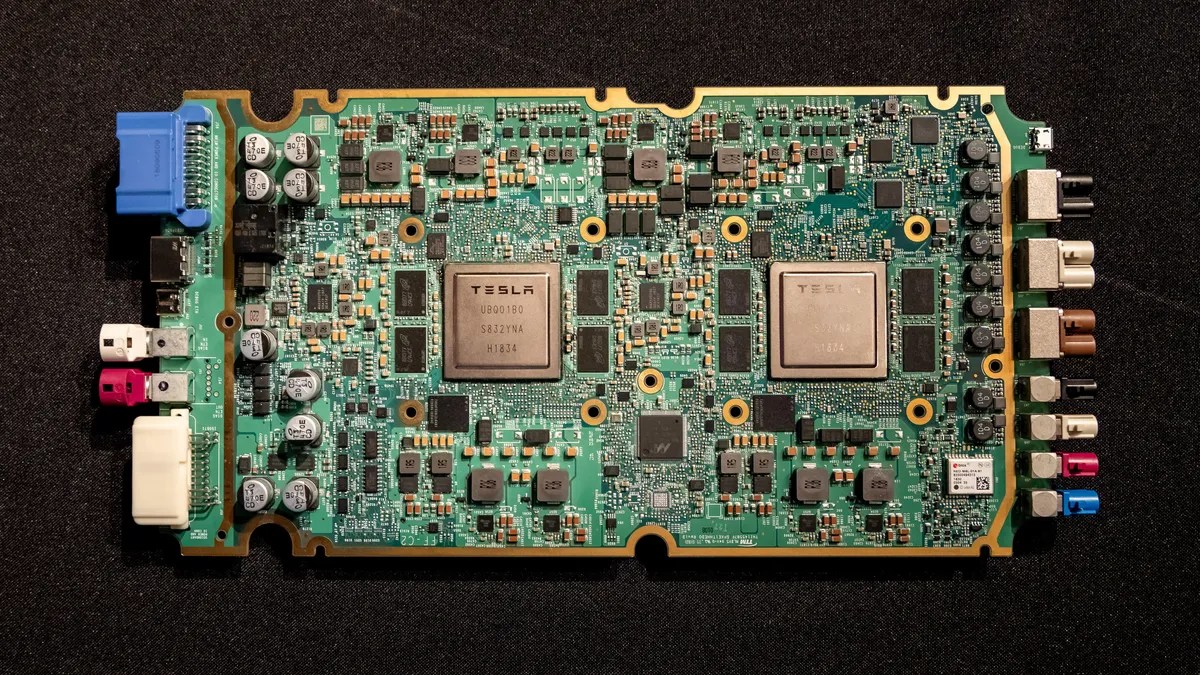
If you think about it, there’s a little piece of sand driving us around right now.  Isn’t it crazy that a little piece of melted sand is driving us around right now?” Robert explained that the Tesla has two chips the size of a thumbnail in the Tesla. I’ll save this discussion for another blog post and it is incredible that such a tiny piece of technology can operate with such precision in complicated city like Austin!

Tesla Full Self Driving Silicon Chip
Tesla Full Self-Driving Silicon Chip

About Gail’s Tesla Podcast

For those wondering, I do short interviews with people who are interested in Tesla’s technological advances and their effect on humanity. For now, I do all podcasts from within my vehicle while using FSD beta. My Podcasts are designed to be Twitter-only to support Twitter and produce content that is only on Twitter. You may watch the Podcast here, enjoy!

Bluebonnets under the Milky Way over the Texas Hill Country courtesy Shane Ware.

Gail Alfar, author. Exclusive to What’s Up Tesla – April 2, 2023. All Rights Reserved. My goal as an author is to support Tesla and Elon Musk in both making life better on earth for humans and becoming a space-fairing civilization.

Elon Musk Speaks at AI Day 2022, Optimus Wears Giga Texas “Don’t Mess With Tesla” Belt Buckle

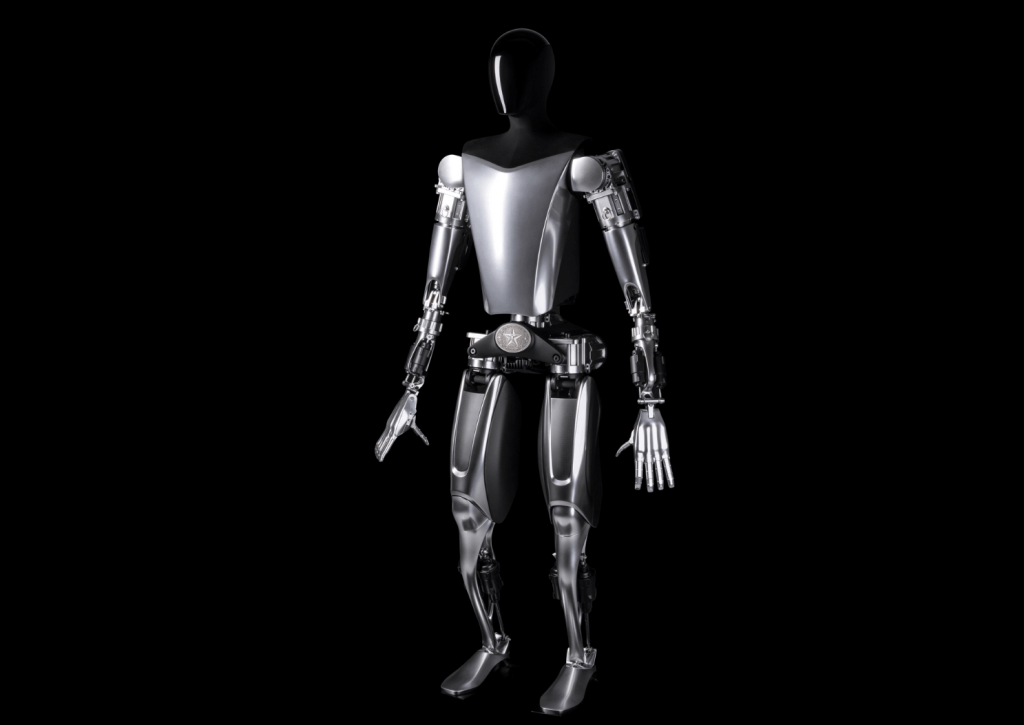
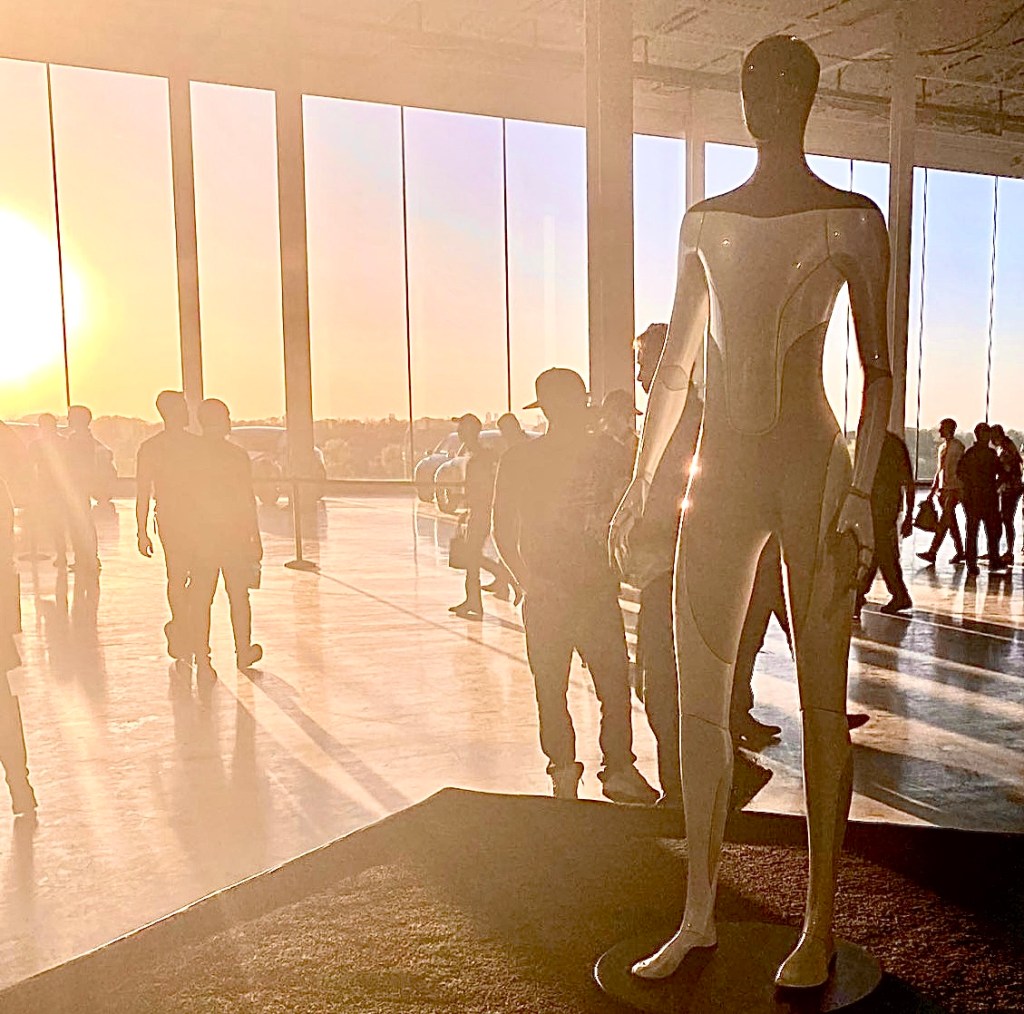
Optimus robot wears the Giga Texas “Don’t Mess with Tesla” belt buckle. Photo Courtesy of Tesla, Inc.

Elon Musk is leading Tesla towards a bright future where the company is just as much an artificial intelligence company as it is a vehicle and energy company. 

Elon spoke Friday evening on September 30 at Tesla AI Day 2022 in Palo Alto, California and he introduced the world to an Optimus robot wearing a Giga Texas “Don’t Mess with Tesla” belt buckle. The belt buckle was first seen at the October 2021 Annual Meeting of Stockholders in which it was used to announce the moving of the Tesla HQ from California to Austin, Texas.

Elon’s unveiling of the new Optimus is also worth a big celebration, so it is appropriate the robot wears the belt buckle. This article highlights,

  • Optimus is designed to be useful, affordable, and made at scale
  • Optimus has great potential to transform civilization into a future of abundance
  • Tesla is structured so the public can ensure a safe future in regards to Optimus
  • A technical presentation followed by a Q & A reveals more about Optimus

Optimus: Useful, affordable, and made at scale

Elon Musk explains,

“Our goal is to make a useful humanoid robot as quickly as possible and we’ve also designed it using the same discipline that we used in designing the car, which is to design it for manufacturing such that it’s possible to make the robot at high volume at low cost, with high reliability.

That’s incredibly important, I mean, you’ve all seen very impressive humanoid robot demonstrations and that’s great but what are they missing?

They’re missing a brain and they don’t have the intelligence to navigate the world by themselves and they’re also very expensive and made in low volume, whereas Optimus is designed to be an extremely capable robot but made in very high volume, probably ultimately millions of units and it is expected to cost much less than a car.

I would say, probably less than $20,000, would be my guess.

The potential for Optimus is appreciated by very few people.” – Elon Musk

Optimus has great potential to transform civilization into a future of abundance

One day our civilization may be one of great abundance, as Elon Musk explains,

“The potential really boggles the mind, because you have to say what is an economy?

An economy is sort of productive entities times their productivity.

Capita times output, productivity per capita. But the point at which there’s not a limitation on capita, it’s not clear what an economy even means at that point!

Economy becomes quasi-infinite. So, taken to fruition, in the hopefully benign scenario, this means a future of abundance.

A future where there is no poverty, where you can have whatever you want in terms of products and services.

It really is a fundamental transformation of civilization as we know it.” – Elon Musk

Tesla is structured so the public can ensure a safe future in regards to Optimus

This important issue was emphasized by Elon Musk,

“Obviously, we want to make sure that transformation is a positive one, and safe.

But that’s also why I think Tesla, as an entity doing this, being a single class of stock publicly traded owned by the public is very important and should not be overlooked.

I think this is essential, because then, if the public doesn’t like what Tesla is doing, the public can buy shares in Tesla, and vote differently.

This is a big deal, like, it’s very important that I can’t just do what I want. It’s very important that the corporate entity that makes this happen, is something that the public can properly influence.

So I think the Tesla structure is ideal for that. Like I said, self-driving cars will certainly have a tremendous impact on the world.

I think they will improve the productivity of transport by at least a half order of magnitude, perhaps an order of magnitude, perhaps more.

Optimus has maybe a two order of magnitude potential improvement in economic output. It’s not clear what the limit actually even is. But we need to do this in the right way. We need to do it carefully, and safely and ensure that the outcome is one that is beneficial to civilization and one that humanity wants.

This is extremely important, obviously.” – Elon Musk

Elon Musk also explained to the audience that, 

“At Tesla, we really care about doing the right thing or are inspired to do the right thing, and really not pave the road to hell with good intentions and I think the road to hell is mostly paved with bad intentions, but every now and again, there’s a good intention in there.

We want to do the right thing.” – Elon Musk

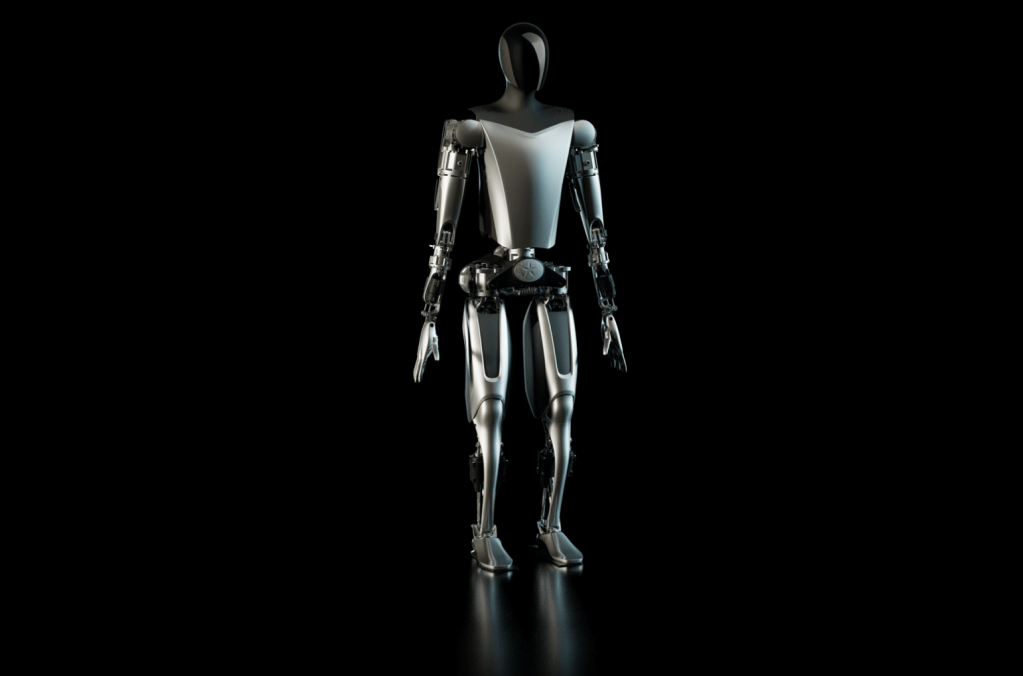
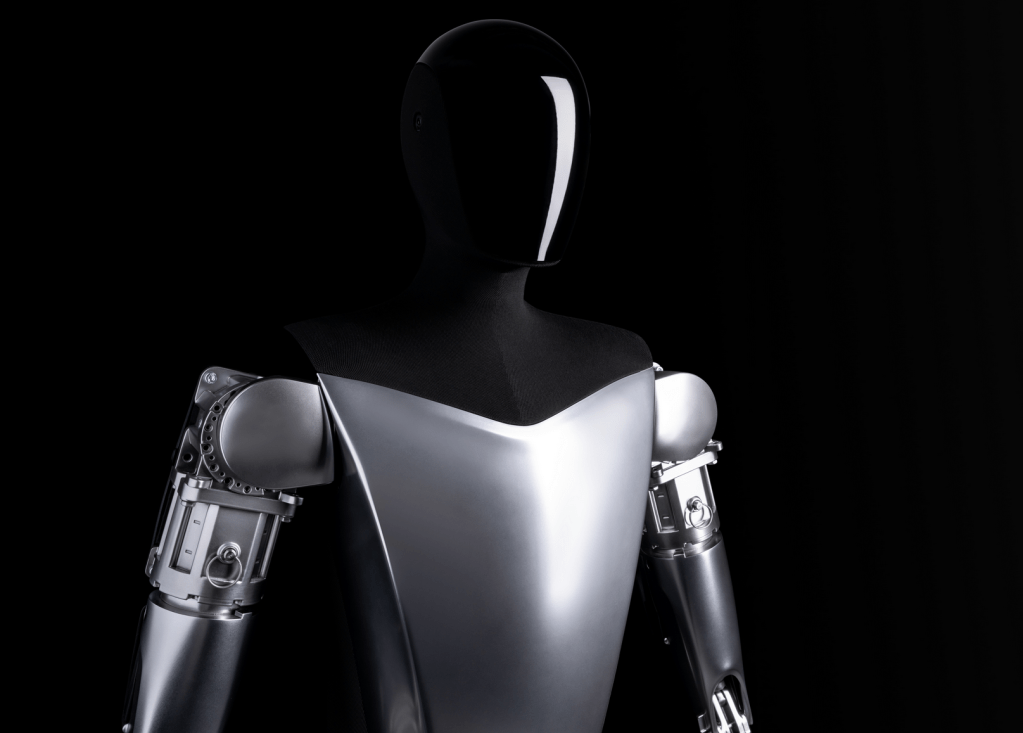
Tesla Optimus humanoid robot. Photo Courtesy of Tesla, Inc.

A technical presentation followed by a Q & A reveals more about Optimus

You can watch the presentation on Tesla YouTube, and it may be best watched in parts as it is

technical.

Prior to questions and answers from the audience, Elon explained,

“We really wanted to show the depth and breadth of Tesla and artificial intelligence, compute hardware, robotics actuators, and try to really shift the perception of the company away from … you know a lot of people think we’re just a car company, or we make cool cars, or whatever.

Most people have no idea that Tesla is arguably the leader in AI hardware and software and that we are building what is arguably the first, the most radical computer architecture since the Cray-1 supercomputer.

I think if you’re interested in developing some of the most advanced technology in the world that’s going to affect the world in a positive way, Tesla is the place to be.” – Elon Musk

Many interesting points were made during the 40-minute Q & A session, including,

  • There will be endless possibilities for Optimus, many different versions are planned
  • You will be able to have a conversation with Optimus
  • As a safety precaution, Optimus will not have over-the-air updates.  Optimus will have a safety off-switch
  • Optimus should be ready for customers in 3-5 years
  • Tesla may begin a monthly podcast to explain what is going on behind the scenes
Tesla Optimus humanoid robot. Photo Courtesy of Tesla, Inc.

CONCLUSION

The incredible new Tesla Optimus robot (wearing the Giga Texas “Don’t Mess with Tesla” belt buckle!) was unveiled on Tesla AI Day 2022 and it aims to be very affordable, made to a massive scale, and also very useful.

It has great potential to transform civilization into a future of abundance.

To ensure this is done right, Elon Musk explained that, “Obviously, we want to make sure that transformation is a positive one, and safe. But that’s also why I think Tesla, as an entity doing this, being a single class of stock publicly traded owned by the public is very important and should not be overlooked. I think this is essential, because then, if the public doesn’t like what Tesla is doing, the public can buy shares in Tesla, and vote differently. This is a big deal, like, it’s very important that I can’t just do what I want. It’s very important that the corporate entity that makes this happen, is something that the public can properly influence. So I think the Tesla structure is ideal for that.”

How do you think an Optimus Robot could make your life more abundant?

Big Sur Drive, California. credit,  Iris Papillon on Unsplash

If you enjoyed this article, you may also like,

Giant fork in the road leads to Tesla’s Optimus AI Tesla’s Optimus robot is already working at the Fremont factory, and exactly how many robots are in Tesla’s fleet? Elon Musk installed a giant 30ft fork in the road created by Burning Man artist Hunter Leggitt outside the Autopilot office in Palo Alto, will this be a permanent art installation?

Read Elon Musk’s essay on technology for a better future Elon Musk is optimistic, lives with a sense of urgency, and takes action to make the future good. His essay is an inspiration to all people, and here he talks about exciting uses for the Optimus humanoid robot!

Who will Benefit once Tesla Autonomy is Solved? I believe a world where autonomy is the norm is closer than we realize.  This article attempts to answer the question, who will benefit once Tesla autonomy is solved? 

Gail Alfar, author. Exclusive to What’s Up Tesla – October 2, 2022. All Rights Reserved.

My goal as an author is to support Tesla and Elon Musk in both making life better on earth for humans and becoming a space-fairing civilization.

One-Time
Monthly
Yearly

Make a one-time donation to support What’s Up Tesla

Make a monthly donation to support What’s Up Tesla

Make a yearly donation to support What’s Up Tesla

Choose an amount

¤5.00
¤15.00
¤100.00
¤5.00
¤15.00
¤100.00
¤5.00
¤15.00
¤100.00

Or enter a custom amount

¤

Your contribution is appreciated.

Your contribution is appreciated.

Your contribution is appreciated.

DonateDonate monthlyDonate yearly

Who will Benefit once Tesla Autonomy is Solved?

Taking Al for a ride with Tesla Full Self Driving Beta, Whole Mars Catalog Youtube

Last week, my commute to work across Austin using Tesla Full Self Driving Beta version 10.69.2 was flawless! I continue to experience this daily.

I believe a world where autonomy is the norm is closer than we realize.  This article attempts to answer the question, who will benefit once Tesla autonomy is solved? 

  • Anyone who is unable or does not want to own a car
  • The Elderly and other People in need 
  • Commercial Industry
  • Mars building team 
  • Millions of people will avoid fatalities and injuries 
  • Tesla Humanoid Robot


Anyone who is unable or does not want to own a car

Tesla S Interior, credit, Tesla Gallery

“Self-driving electric cars will be all that matters. Gas car without autonomy will be like riding a horse & using a flip phone. That still happens, but it’s niche.” July 2022 – Elon Musk 

Three of my kids use Uber to get to work and school instead of owning a car, but the cost is high for this service. Going to work daily in a shared autonomous vehicle (a dedicated Robotaxi) will cost much less than today’s Uber or Lyft because an autonomous vehicle will not have to have a person at the wheel.

When costs to commute in dedicated Robotaxis become low enough, it can follow that many people will decide not to buy a vehicle.

The commute as we know it can be transformed when autonomy is solved.

Tim Urban tweeted, “The big story is hard to see when you’re inside of it. We’re all this wrong about something right now.” Tim quoted a newspaper clip from December 2000 from the Daily Mail which read “Internet may be just a passing fad as millions give up on it.” The article cited ‘experts’ from the Virtual Society project, which published a report saying that “predictions that the Internet would revolutionize the way society works have proved wildly inaccurate.”

So, as weird as it may sound, it may become niche to own a car at all in the future.  Can we imagine a future where the majority of vehicles are autonomous?  

“When the car is FSD without supervision, ie Robotaxi, you’ll be able to earn far more than monthly lease/loan cost by allowing others to use it. Managing a small fleet of Robotaxis will be a career for many & much better than driving a single car. “ October 2019 – Elon Musk

The Elderly and Other People in Need

I reached out to several Tesla owners and others for ideas, and many agree that when Tesla autonomy is solved, it can benefit the elderly and the disabled.

“I am completely blind, and would love to walk you through an average day, and how many times an autonomous vehicle would be of assistance.” rlloken 

“It will give the elderly greater independence for longer.  Also opens doors for the physically disabled folks who might not be able to drive currently.”  Wanda Hudson 

“People with physical disabilities and medical conditions such as seizure disorders & visual impairment would greatly benefit from such incredible technology. And those who depend on others to get places. For many, it will be independence they never experienced before.” IheartTesla  

Tesla autonomy has to be able to work on roads that the car hasn’t been on before and in situations where there is no connectivity. This will help many people who live in rural areas to gain independence if they cannot own a car.

War situations put people in great danger and autonomous vehicles could help bring supplies and rescue people. Tesla autonomy has to be able to work in millions of unpredictable situations and that will include places with unrest. 

Commercial Industry

Tesla Semi, credit, Tesla Gallery

Autonomous Tesla Semi will be a huge benefit to businesses and allow the trucker to perform other valuable tasks instead of tedious driving. 

Autonomy will lead to lower costs for production and delivery of all goods and food throughout the entire supply chain.  Delivering these essentials will be less expensive. 

Mars Building Team

Credit Arash Malik Cybertruck is like a Mars Rover for Earth.

Elon Musk tweeted right after the official Cybertruck unveiling in Nov 2019,

“Tesla Cybertruck (pressurized edition) will be official truck of Mars.” 

I believe that in our lifetime, humans will travel to Mars.  When the Mars building team gets there they can all benefit from autonomous Cybertrucks that will help deliver and haul in extreme conditions.  In this sense, these heavy-duty vehicles can protect human lives and help build the first outpost on Mars.

Just as there is a small window of opportunity for humans to make it to Mars, there is also a similar small window of time where full autonomy can be solved.  Now is that time. 

Millions of People will Avoid Fatalities and Injuries

Every day Tesla gets closer to solving autonomy, and we see vehicle safety improvements.  Tesla does not intend to create autonomy that is specific to keeping a car in its lane or even lane changes.  Autonomy for Tesla is a generalized solution.

"I definitely want talented people who are working on AI to consider working at Tesla because I think we’re solving an important part of AI, and one that can ultimately save millions of lives and prevent tens of millions of serious injuries by driving an order of magnitude safer than people.” 
Elon Musk (at 2022 Sharholder's Meeting)

If you have ever taken care of kids you know how frightening it is when a child runs into a busy street.  It is heartbreaking to hear about a life ending in a car crash.  

There were 35,766 fatalities and 1,593,390 injuries from crashes in 2020 (source data NHTSA) There were a total of 5,982 pedestrian fatalities from being struck by a car (source data NHTSA). Distracted driving led to 3,142 deaths in 2020, NHTSA reported, “The number of fatalities in distraction-affected crashes, i.e., a crash involving at least one driver who was distracted, was 3,142 or 8.1 percent of all fatalities in 2020. This represents a 0.7-percent increase from 3,119 in 2019.” – Overview of Motor Vehicle Crashes 2020 

Tesla expects the safety level of autonomous cars to be 10 times safer than non-autonomous cars.

Safety is emphasized in this excerpt from Tesla’s blog

“In the US, there is one automotive fatality every 86 million miles across all vehicles from all manufacturers. 
For Tesla, there is one fatality, including known pedestrian fatalities, every 320 million miles in vehicles equipped with Autopilot hardware. 
If you are driving a Tesla equipped with Autopilot hardware, you are 3.7 times less likely to be involved in a fatal accident. 
Tesla Autopilot does not prevent all accidents – such a standard would be impossible – but it makes them much less likely to occur. 
It unequivocally makes the world safer for the vehicle occupants, pedestrians and cyclists. 
No one knows about the accidents that didn’t happen, only the ones that did. 
The consequences of the public not using Autopilot, because of an inaccurate belief that it is less safe, would be extremely severe. 
There are about 1.25 million automotive deaths worldwide. 
If the current safety level of a Tesla vehicle were to be applied, it would mean about 900,000 lives saved per year. 
We expect the safety level of autonomous cars to be 10 times safer than non-autonomous cars.”

When Elon Musk spoke at the ONS 2022 conference in Norway, he emphasized the importance of having Tesla cars being able to do self-driving when he answered the question, “what keeps you up at night?”  he stated,


“But I am fundamentally an engineer or a technologist and so the two technologies I am focused on to ideally, get done before the end of the year are getting our Starship to orbit, which I think is important for expanding consciousness beyond earth and life beyond Earth. And then, having the Tesla cars being able to do self driving.
So have self driving and wide release at least In the USA, and hopefully, potentially in Europe, depending on regulatory approval.” – Elon Musk

Tesla Humanoid Robot

Tesla Humanoid Robot visual from Tesla AI Day 2021 August 19, 2021

Tesla is developing a helpful humanoid robot that will rely on the same technology that is available in every vehicle. At Tesla AI Day 2021, Elon Musk said,

It's around 5’ 8”, has sort of a screen where the head is for useful information, it’s otherwise basically got an autopilot system in it so its got cameras, about eight cameras, full self-driving computer, and makes use of all of the same tools that we use in the car. 

Things that I think are really hard about having a useful humanoid robot is, can it navigate through the world without being explicitly trained?  I mean without explicit line-by-line instructions? 

Tesla AI Day Part 2 on September 30 will be very interesting as it will reveal the incredible progress as well as the challenges of building a humanoid robot whose purpose is to help humans in a world built by humans.

CONCLUSION

This quote from Tim Urban invites us all to imagine the future. “The big story is hard to see when you’re inside of it. We’re all this wrong about something right now.”

When Tesla Autonomy is solved, people of all ages can benefit. This article highlights these 6 ways:

  • The elderly and also the many talented people with disabilities that make it so they cannot drive
  • People who live in areas of unrest or war and even in rural areas
  • All of us because we depend on the commercial industry and its supply chain. When this becomes driven by autonomy, it will usher in a new era
  • We will go to Mars one day, and having an autonomous fleet of pressurized Cybertrucks there will help get the hard work done
  • Fatalities and injuries will be reduced by a large margin, saving millions of lives. Tesla expects the safety level of autonomous cars to be 10 times safer than non-autonomous cars
  • People will benefit from a high-functioning Telsa bot fleet, which relies on the same tools as Tesla cars

Will you benefit once Tesla Autonomy is solved?

Austin Texas Sunset by Christofer Sherman.

This article is part one of a series.  It is written before  “Tesla AI Day II.” We’ll look at this question again after the September 30 event. Tesla and SpaceX remain the top two most desirable places to work for engineers and hire some of the smartest people in the world to work on their AI Team.

If you loved this article, you may also love…

5 Takeaways from Tesla’s 2022 Shareholder Meeting, read what Elon Musk said at the August 2022 Shareholders Meeting about Tesla Autonomy and the Tesla Bot.

Read Elon Musk’s essay on technology for a better future which is Elon Musk’s entire essay composed for China Cyberspace magazine. In it, he discusses the incredible goals Tesla has for the Tesla Bot.

Elon Musk Interview with Xenia Wickett in Norway (ONS 2022 Stavanger Conference August 29th) Less than 25 min long and packed with information (full interview) this is the readable version of this fabulous interview, in which Elon Musk got to the main points very quickly. Amazing!

Exclusive to What’s Up Tesla – This article was created by Gail Alfar with the goal to inspire you to support the important advancement of generalized autonomy as a force for good. The header photo is by @BLKMDL3 with permission. All Rights Reserved. September 18, 2022

One-Time
Monthly
Yearly

Make a one-time donation to support What’s Up Tesla

Make a monthly donation to support What’s Up Tesla

Make a yearly donation to support What’s Up Tesla

Choose an amount

¤5.00
¤15.00
¤100.00
¤5.00
¤15.00
¤100.00
¤5.00
¤15.00
¤100.00

Or enter a custom amount

¤

Your contribution is appreciated.

Your contribution is appreciated.

Your contribution is appreciated.

DonateDonate monthlyDonate yearly

Get Ready, Elon Musk’s Magnum Opus is Coming!

Welcome back to my blog, I hope you’ll enjoy this week’s post. I’m posting most of Elon Musk‘s remarks given on April 7, 2022 at Gigafactory Texas at Cyber Rodeo.  The reason I am solely focusing on this is that I believe Elon’s words hold a lot of value. We all want a better future, and I hope reading this will inspire you to look toward a positive future for our world.  So relax and enjoy it and get ready for Elon’s Magnum Opus! 

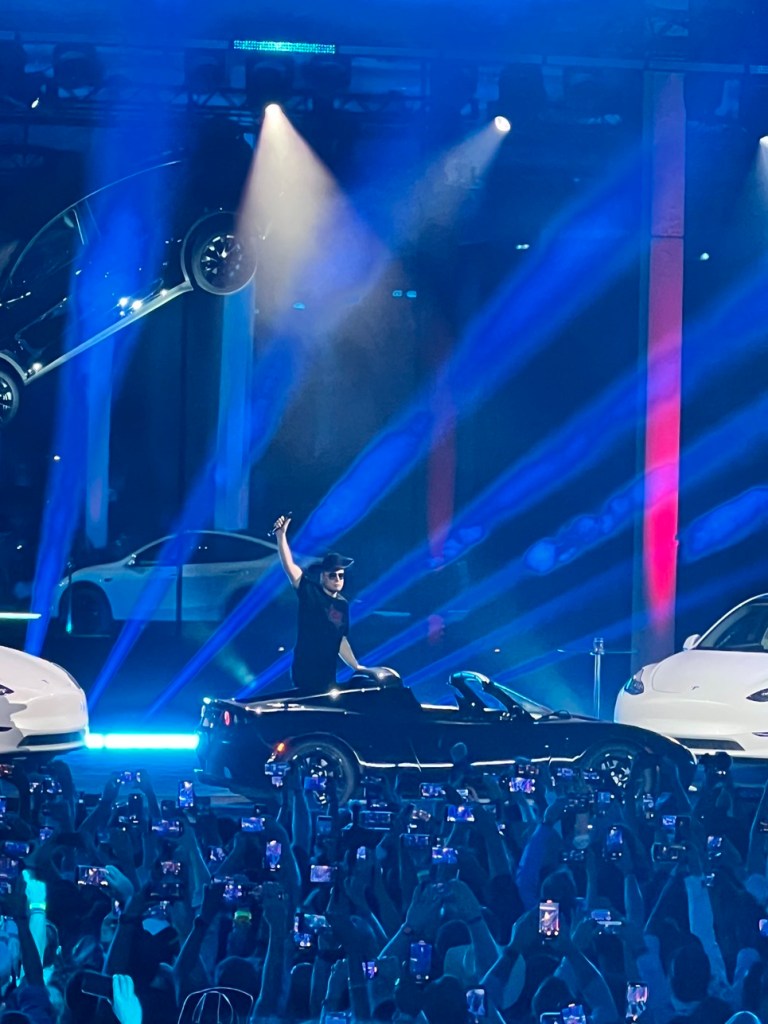
Elon Musk at Cyber Rodeo with first production Roadster [photo courtesy Vinny Lingham]

Below is a transcription of Elon Musk’s words at Cyber Rodeo:

Welcome, welcome to Cyber Rodeo. Are you guys having a good time? 
We’re going to talk about the past, present, and future. This is the first production car Tesla ever made. It’s where we started. We started off with a very simple car, the Tesla roadster. We manufactured this thing, believe it or not, in an old car dealership in Menlo Park, California. 

We made the powertrain, Lotus made the non-powertrain portion, and we did the final assembly and check out, literally in an old car dealership in Menlo Park! And here we are today, damn! 

Elon Musk at Gigfactory Texas Cyber Rodeo
When we first started out at Tesla, I thought optimistically there was a 10% chance of succeeding. When people say car companies are dumb, I’m like “I know.” But, thanks to the incredible work of the Tesla team, over many years, we got here. 

So we now have, and it shows you where we are today, we’ve got the Model S, we’ve got the Model 3, we have the Model X, we’ve got the Model Y. We’ve got the most expensive joke in the world! But we did bring sexy back! 

Elon Musk
So we’ve got cars in major vehicle segments, we’ve got residential and commercial energy products. We’ve got powerwalls, Megapacks, yes, it’s insane! Thanks to the incredible work of the Tesla team, two thirds of the electric vehicles in the United States are made by Tesla and the hard work of the Tesla team.  This is Omead (Afshar). Omead has managed the construction of the Gigafactory here, thanks Omead! 

Elon Musk anounces that Full Self Driving beta may be released to all FSD customers by end of 2022

And we have full self-driving in Beta.  Does anyone here use the full self-driving beta? Great. You can really get a feeling for how much full self-driving is going to transform society. The car will be able to take you anywhere you want. Its ultimately ten times safer than if you were driving it yourself. It’s going to completely revolutionize the world. This is one of those things that comes along very rarely. The Tesla autopilot team and AI [Artificial Intelligence] team have done an incredible job solving real-world AI. We are aiming to go to wide beta for all FSD customers in North America this year. [applause] To the moon!

Giga Texas ushers in the new phase of Tesla’s future

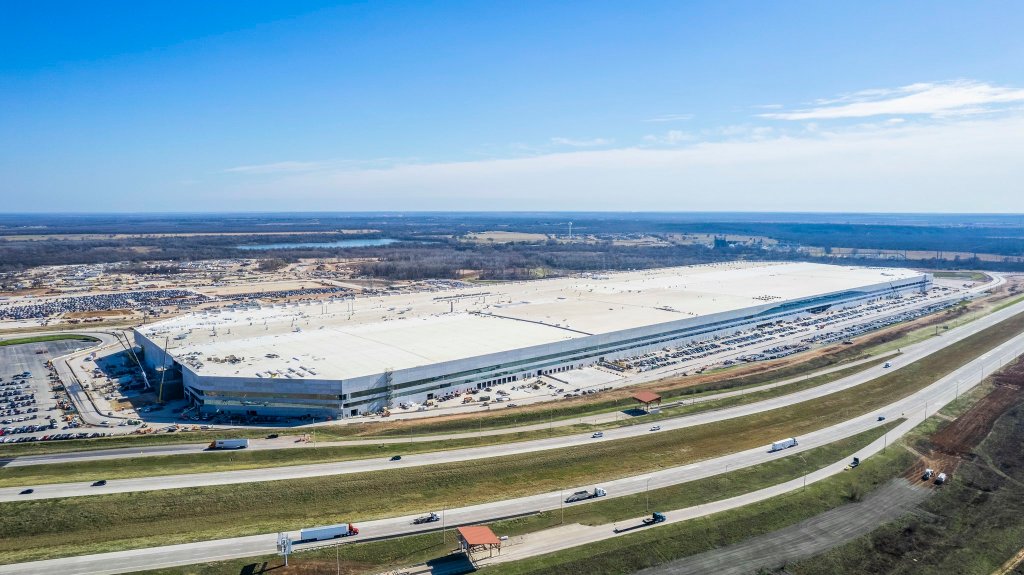
This is now our sixth major factory. We are now on three continents. It’s great to have two major vehicle plants in North America. So, an Austin factory, and China, and one in Europe that I was just at recently. This is going to be a huge improvement for Tesla. It’s also going to be better for your environment. You want to make the cars for where the customers are, and not put them onto ships and over the oceans. It’s going to be way better to make cars locally. We are really entering a new phase of Tesla’s future, with six giant factories around the world, and scaling to extreme size, as you can see from this building, it’s not small. And this is also Tesla’s global headquarters. 

Why Austin? Actually, I asked the Tesla team. California’s great, we’re continuing to expand in California, but we ran out of room and so we need a place where we can be really big.
And there’s no place like Texas! 

Elon Musk
Gigafactory Texas Render [credit Tesla on youtube]

Elon Musk thanks Austin, Travis County, and all the builders

Here we are, we are 10 minutes from the airport, 15 minutes from downtown, a central logistics hub, and we’ve got access to awesome talent. Thank you Austin, thank you Travis County! 

It wasn’t easy building this humongous building and getting all of this equipment here. I just cannot express enough appreciation and gratitude for the Tesla team that built Giga Texas. let’s give them a hand! We went through the deep freeze, rain, quicksand, and incredibly fast build, it was very difficult, but it’s done.

I just cannot express enough appreciation and gratitude for the Tesla team that built Giga Texas. let’s give them a hand!

Elon Musk

Giga Texas is the machine that builds the machine

I want to give you a sense of the size of this thing. It’s not small. What we have here is, if you put the building on its side, it’s taller than the Burj Khalifa, that’s to scale. It’s equivalent to three pentagons. When a building is measured in units of pentagon, you know it’s quite large! This is the largest factory building in the world by volume. How many hamsters fit in it? [yells someone in the audience] I’m glad you asked that, according to our calculations, 194 billion hamsters could fit in this building!  

This is the machine that builds the machine, and it’s the latest version of the machine that builds the machine. I’ve said it before, that the factory is the product. You know, prototypes require imagination, and they’re not easy, but relative to production, prototypes are easy. Production is hard. And this building is the most advanced car factory that earth has ever seen. Alien Technology. You know a factory is advanced if it feels like an alien dreadnought landed!  

The team is doing great work in Fremont, California, but we took a lot of lessons and learned from that. The buildings were all separate, there was a lot of movement between the buildings, Think of us like a chip, an integrated circuit. You combine everything in one package, and now this is what you get. 

This is a case of raw materials coming in one side, they get formed into a cell, they get formed into a pack, then we cast the front and rear body.  The pack itself is structural, and the outcome is a finished product. So it’s raw materials in one side, and cars out the other side.
We’re building our own battery cells, we think the most advanced cell in the world, here at Giga Texas. All the footage you see here is from this factory and we think, over time, this will be the biggest cell factory in the world. 

Revolutionary manufacturing: Making a car out of three major parts

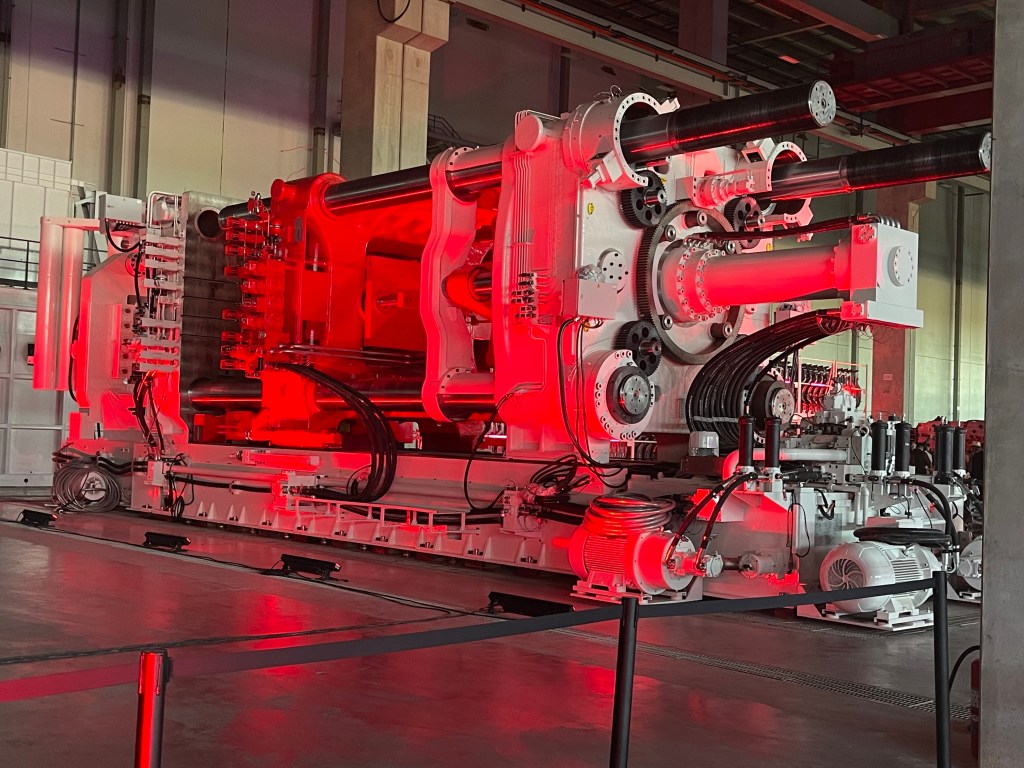
Largest casting machine ever made [photo by Gail Alfar at Gigafactory Texas]
Another major innovation is the structural pack. So we are basically bringing into fruition the things that we said we would do. We said we would basically make the car out of three major pieces. A real body casting and a structural pack with the cells themselves carrying the load. 

Just like in airplanes where the wing is a fuel tank in wing shape, with the new Model Y architecture, the cells themselves carry the load. And that results in a car that is lighter, has a smaller number of parts, costs less, and improves the crash performance. 

Its a safety advantage too. As I was saying, its revolutionary for car manufacturing to basically make your car out of three major parts. A cast rear, a structural pack, and a cast front. 

What you are looking at is the biggest casting machine ever made [see above photo]. And it’s kind of a crazy thing to make a car this way, it’s never been done before. When we were trying to figure this out, there were six major casting manufacturers in the world. When we called all six, five said no, and one said maybe. I was like, that sounds like a “yes!”  It was a lot of effort and great ideas from the team. We’ve made the world‘s biggest casting machine work very efficiently to create and radically simplify the creation of the car.  Raw materials in, a bunch of stuff happens, and then car out. [audience screams, 'if you don’t make stuff there is no stuff']  Yes exactly, if you don’t make stuff there isn’t any stuff.
We are aiming, just with the Model Y program alone, to get to ½ million units a year and then we’re going to start manufacturing Cybertruck here next year. The Model Y line will be the highest capacity line, I think, of any line in the world. In fact, I’m confident it will be. Half a million units per year in a single factory of one product is the biggest thing in the world. Definitely, this will be the highest volume car factory in America.  

Cybertruck always looks like CGI in real life, but that is not CGI, that is an actual Cybertruck driving around. I can’t wait to have this baby in production, it’s going to be epic!  

Tesla has a long road ahead

Elon Musk explaining bar chart showing Tesla has 1% of total vehicle output in the world [cr: Tesla]
Tesla is growing at the fastest pace of any large manufacturing object in history. In twelve months, we’ve delivered over a million cars worldwide. 

Now that said, there’s still a long way to go because that red bar chart is Tesla and then the blue is global vehicles. So you can see, even though we did one million cars in the last twelve months, we’re still maybe, a little over 1% of total vehicle output in the world. We want to try to get to, I don’t know, about  20% or as much as we can, to move the needle. 

This is why scale matters. In order to make a really big difference to sustainability, we have to make a lot of cars, we have to make a lot of stationery packs, to transition the world to sustainable technology as quickly as possible. 

What’s next? Futuristic Robotaxis and an Age of Abundance

Sunset Optimus by Ryan on Twitter
What’s next?  I’m not going to spill all the beans right now. What I can say, is we’re going to move to just a truly massive scale. Scale that no company has ever achieved in the history of humanity. 

That has to happen, in order to transition the world to sustainable energy. Massive scale, full self-driving, there’s going to be a designated Robotaxi that’s going to look quite futuristic. 

And, of course, we’ve got the Tesla robot, Optimus and this is, I think, Optimus will obviate what an economy really means. Basically, anything that humans don’t want to do, Optimus will do it.

It’s going to be an age of abundance. It may be hard to imagine it, but as you see Optimus develop, and everyone will make sure it’s safe, no terminator stuff or that kind of thing, but it’s really going to transform the world, I think to a degree even greater than the cars. And, I think we have a shot at being in production, for version one of the Optimus, hopefully, next year.  And then Cybertruck is coming next year.  We will be in production of Cybertruck next year. We will be in production with the Roaster and with Semi. So, that’s all coming. So this year is all about scaling up, and then next year there’s going to be a massive wave of new products. 
And now, let us deliver our first Tesla cars made in Texas! [numerous Model Y drive onto the stage]

Elon Musk Calls Cybertruck his and Franz’s Magnum Opus – A Masterpiece, the greatest work of a person’s career

Cybertruck drives onstage, “What have we here, Franz, is there anything you want to say about the Cybertruck?” says Elon.

“Cybertruck is going to be awesome, I mean you see it here, you’ve seen it before, you’ve seen it over there [points] it’s worth the wait, believe me. There is no other truck, everything else pales in comparison. This is the only one you need!”  says Franz

“I think this will be our magnum opus, you can see some of the changes we made already, there are no handles. Who needs handles? The car can tell that you’re there, and it just knows that it needs to open. I think we’re going to have an incredible Cybertruck product for you next year. it’s going to blow your mind. 

“I can’t wait to build this here and deliver them to you, sorry for the delay. It’s been an intense couple of years but we’re gonna have this for you next year, and it’s going to be great. Its, going to be one kick-ass product after another. Starting next year, and then, some cool stuff that we haven’t even talked about, so let’s see, thanks again for coming. 

“I hope you’re having a great time. Here at Tesla, we believe in throwing great parties. So, let’s get this party started! Have a fantastic time tonight, I love you guys! 

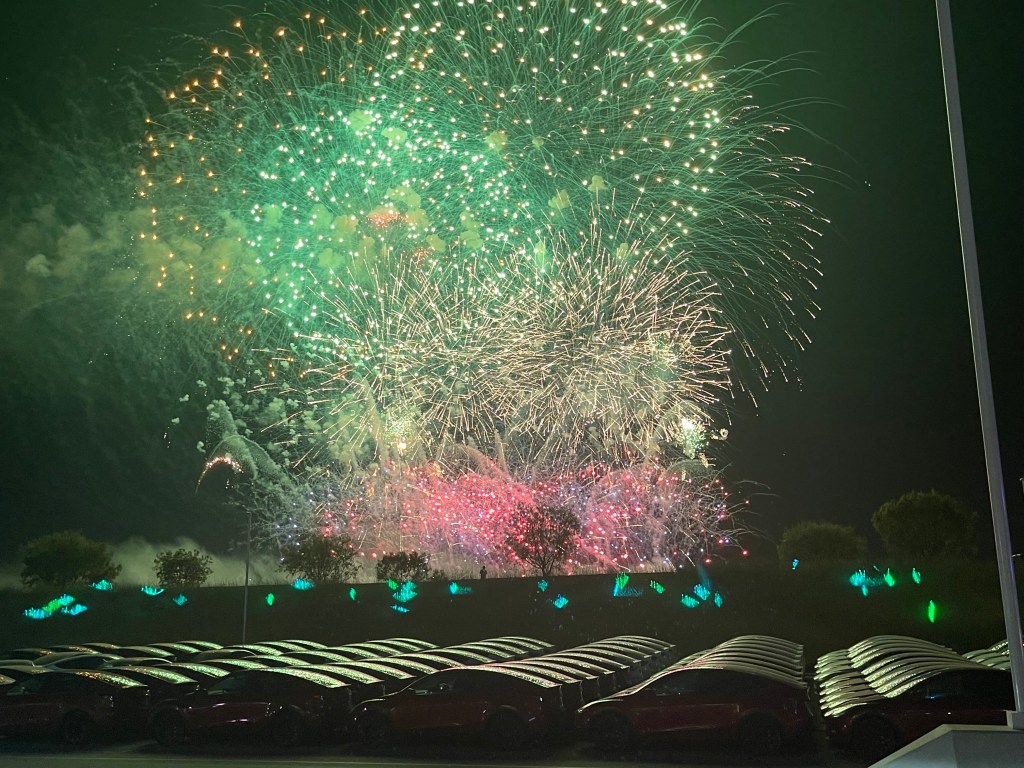
Royal display of Fireworks by Tesla to Beethoven’s Symphony No. 5 and No. 9, Allegro Con Brio and Ode to Joy [photo by Gail Alfar at Gigafactory Texas]

Cybertruck drives off stage with Elon Musk and Franz von Holzhausen. This is accompanied by a royal display of impressive fireworks. The music choice is loud and important-sounding: Beethoven’s Symphony No. 5 Allegro Con Brio followed by Beethoven’s Symphony No. 9 in D minor, Ode to Joy.

My thoughts

Elon Musk’s celebration was larger than life for a good reason. The impact on our world by Giga Texas and its processes will be epic. The road ahead is very long and difficult. The beautiful inspiration of Cyber Rodeo will remain in our hearts for many years to come! I am thankful I could attend the event in person. It will take weeks to process the deep resonance of the event. That will come with time. I look forward to sharing more soon. Meanwhile, enjoy your beautiful life!

Want to read more excellent articles? I suggest…

Gail Alfar, Exclusive to What’s Up Tesla – April 10, 2022 –  All Rights Reserved

One-Time
Monthly
Yearly

Make a one-time donation to support What’s Up Tesla

Make a monthly donation to support What’s Up Tesla

Make a yearly donation to support What’s Up Tesla

Choose an amount

¤5.00
¤15.00
¤100.00
¤5.00
¤15.00
¤100.00
¤5.00
¤15.00
¤100.00

Or enter a custom amount

¤

Your contribution is appreciated.

Your contribution is appreciated.

Your contribution is appreciated.

DonateDonate monthlyDonate yearly

Tesla Q4 2021 Earnings Call and the Long Road Ahead

Hello, I’m Gail Alfar, a Tesla owner in Austin, Texas. I love to share good vibes about Tesla, Giga Texas, Tesla China & Tesla Solar. I really do believe our future is bright! I recently rented a shared office space to start “What’s Up Tesla,” and a funny thing happened to me.

Have you ever been locked out? I went into a secret room that was filled with beautiful art. The door locked behind me and I was forced to exit the area. Outside, the hallway was empty, except for a Pepsi someone had left sitting on the floor. Eventually a stranger came along and unlocked the door. “You need to get back in, there’s lots of work to do.”

His words reminded me of why I am writing this blog. I have to do more to support the mission of Tesla and Elon Musk, as there is still a very long road ahead.

“While 2021 was a defining year for our company, we believe we are just at the very early stages of our journey. Thank you for being part of it.”  Tesla
Tesla Giga Texas (Source: Tesla Q4 and FY2021 Update)

October 7, 2021: Tesla Headquarters is officially Austin, Texas. Elon Musk announced this historic move at the Tesla 2021 Annual Meeting of Stockholders.

January 26, 2022: Tesla Q4 and Full Year 2021 Financial Results are a game-changer, revealing that making electric cars is actually more profitable than making combustion engine cars!

“2021 was a breakthrough year for Tesla. There should no longer be doubt about the viability and profitability of electric vehicles. With our deliveries up 87% in 2021, we achieved the highest quarterly operating margin among all volume OEMs, based on the latest available data, demonstrating that EVs can be more profitable than combustion engine vehicles.”  Tesla

My view is that 2021 was the year for Giga Shanghai and the Fremont Factory to shine! The two factories had a combined record number of vehicle deliveries of 0.94 million in 2021. For comparison, these same two factories produced and delivered 0.5 million vehicles in 2020. 

Elon Musk acknowledged Tesla will build more Gigafactories in addition to Giga Texas and Giga Berlin-Brandenburg [locations may be announced by the end of the year]. On the one hand factories should ideally be close to customers. On the other hand, it is so critical to build gigafactories, that I argue there should be a second ultra fast and efficient gigafactory in China.

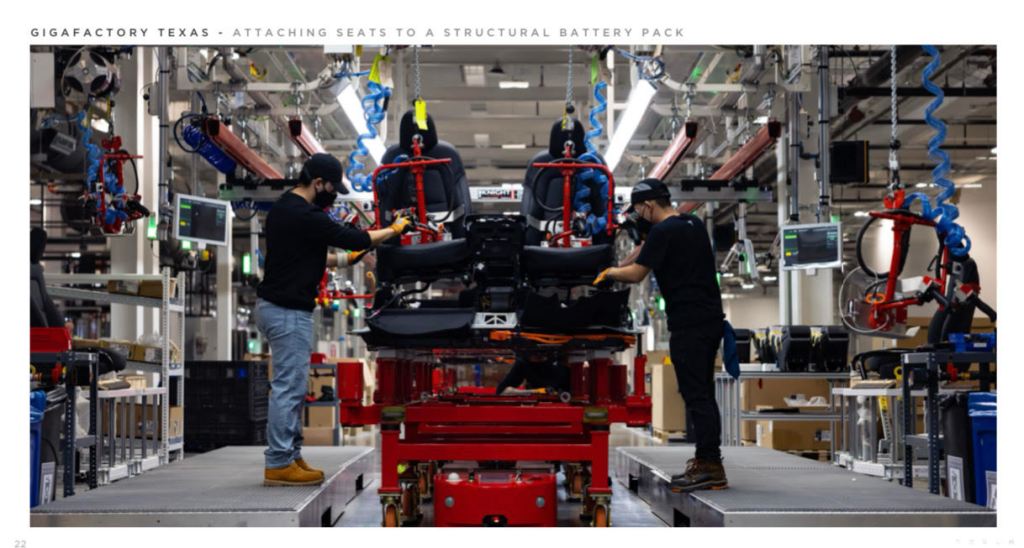
Tesla allowed us a view into the assembly line in Giga Texas. We see Austin Model Y seats being mounted on a structural battery pack. This shift in manufacturing means all Tesla Gigafactories can produce vehicles even faster [and more profitable] with less parts. This is part of Tesla’s winning plan to accelerate the world’s transition to sustainable energy. Make no mistake though, this was and still is a painfully difficult journey for Tesla!

“Prototypes are easy, production is hard.” 
Elon Musk
Gigafactory Texas- Attaching Seats to a Structural Battery Pack (Source: Tesla Q4 and FY2021 Update)

I used to think that a “Financial Result” meeting should only be about Tesla’s hardcore production and profitability. Now I wholeheartedly endorse allowing Elon Musk to speak in order to draw listeners into imagining a wonderful world of the future. 

Allow me to share a futuristic scenario I envisioned after listening to Elon Musk speak at the “Full Year 2021 Financial Results” meeting:

Here, all vehicles are fully autonomous, so imagine for a moment a world filled with  Cybertrucks, Model Y and many other EVs in their most durable forms, all capable of driving almost 24/7. The cost to get from one place to another is low, and people prefer to use entertaining Robotaxis. Its rare to see anyone owning a personal vehicle. 

In crowded places, there are tunnels beckoning people underground, and away from the traffic up above. Many tunnel entrances are repurposed parking lots or garages. People wonder why there were so many of these strange things built. 

Everywhere, we see friendly Optimus humanoid robots. Optimus are doing almost any kind of menial task, or any task that takes place in uncomfortable situations or temperatures. 

As news headlines proclaim a human labor shortage, Tesla Gigafactories roll out large numbers of Optimus. These kind, sentient humanoid robots help to ease the labor shortage, and propel the economy into a stable place. Optimus helps build Tesla HVAC and hot water systems. They even help install systems in homes. 

"I've designed your home now for maximum efficiency and comfort, test it out and let me know what you think, see you tomorrow as I must go get recharged at the local solar-port Megapack," declares Optimus while climbing into a Robotaxi that has gently pulled up playing Sandstorm on the boombox.

Thanks for reading my first blog post. I’m looking forward to creating interesting takes on Tesla to share with YOU most Saturdays! Listen to the entire Tesla Q4 and Full Year 2021 Financial Results here. 

By the way, I drank that Pepsi and I still have the bottle, just to remind myself not to get locked out again.

Photo by Tomek Baginski on Unsplash

Want to read more excellent articles? I suggest…

Gail Alfar, author. Exclusive to What’s Up Tesla – January 29, 2022. All Rights Reserved. My goal as an author is to support Tesla (the most American vehicle manufacturer) and Elon Musk in both making life better on earth for humans and becoming a space-fairing civilization.

One-Time
Monthly
Yearly

Make a one-time donation to support What’s Up Tesla

Make a monthly donation to support What’s Up Tesla

Make a yearly donation to support What’s Up Tesla

Choose an amount

¤5.00
¤15.00
¤100.00
¤5.00
¤15.00
¤100.00
¤5.00
¤15.00
¤100.00

Or enter a custom amount

¤

Your contribution is appreciated.

Your contribution is appreciated.

Your contribution is appreciated.

DonateDonate monthlyDonate yearly