Episode 146 takes you into Giga Texas during the epic 2025 shareholder meeting—we start on the Tesla bus ride, and there is so much to see. We’ll sign the shareholder banner, watch Optimus demos, and even hear Elon talking (we’ll sit in the front row — even if it is off to the side). Watch the video for the full tour, especially the Optimus dexterity at 03:13 and Elon’s humane robot policing talk at 08:14.
Podcast Ep. 146 Come along with me to the 2025 Tesla shareholder general meeting! 01:08 Giga data center 01:48 Fork in Road 02:28 signing @TeslaBoomerMama banner 02:38 Model Ys birthplace 03:13 Optimus’ dexterity 03:36 Solar + Batteries 04:03 TESLA LITHIUM 06:20 Powered by… pic.twitter.com/m2Cr1SeNgG
At 03:13 in the livestream, Optimus shows off insane hand dexterity!
Live from Giga Texas: NOT a boring Shareholder Meeting
Giga Texas 2025 meeting.
I rolled up to Giga Texas for the 2025 meeting—shuttles buzzing, fans everywhere, food trucks powered by Cybertrucks. I attempted to capture the energy as shareholders overwhelmingly approved Elon’s comp package.
Tour Highlights
The real magic starts early: the massive Tesla AI data center (01:08), symbolic “Fork in the Road” (01:48), signing @TeslaBoomerMama’s banner (02:28), Model Y self drives right off the assembly line (02:38), solar + battery setups (03:36), lithium refinery progress (04:03), and Cybertruck power demos (06:20).
Showstopper at 08:14—Elon on humane Optimus police bots in a post-scarcity world: preventive, ethical, no jails needed.
Wraps with golden farewell (09:15) and approvals.
At 08:14 in the livestream, Elon envisions Optimus as compassionate enforcers—game-changer for humanity!
Tech Takeaways
Giga Data Center : Huge AI training clusters; billions in compute for Optimus.
Optimus Dexterity : Advanced hands for fine tasks; scale to $20K units, safer than humans, abundance potential.
I was sitting front row, stage left at the Austin, Texas 2025 Tesla Shareholder’s General Meeting, when Elon Musk walked onstage the room was filled with applause for this genius man. Our small wooden black folding chairs could barely keep us down and we all stood up to applaud Elon. What an experience for a girl from North Dakota who raised her family in Texas! Here’s the transcript which I share with you as I stand by my belief that Elon’s words are historical. And how blessed are we all, to live in his time?
I was lucky to attend Tesla’s 2025 General Meeting
Elon Musk’s Remarks
ELON MUSK: Welcome. So what we’re going to… yeah. And those bots are just dancing. There are no wires. Those are actual robots. Thanks, guys.
First of all, I’d like to just give a heartfelt thanks to everyone who supported shareholder votes. I super appreciate it. Thank you, everyone. I’d like to thank the Tesla Board for their immense support. We have a fantastic Board, fantastic group of shareholders. Thank you all.
And what we’re about to embark upon is not merely a new chapter of the future of Tesla, but a whole new book. And I’m going to talk about that. So this really is going to be quite the story, and Optimus is a fundamental part of that.
The Scale and Vision of Optimus
The sheer scale of Optimus… I mean, I’m going to say a bunch of things that probably I shouldn’t say, but that’s what keeps it interesting. I mean, have you watched any other Annual Shareholder Meeting? I mean, honestly, was like… I mean, if you need to go to sleep, sure. I mean, shareholder meetings are like snooze fest. I mean, ours are bangers. I mean, look at this. This is sick.
And we got, like, the cyberpunk nightclub here with real robots just standing there and milling around and dancing. And, you know, around our engineering headquarters in Palo Alto, the robots are just walking around the office twenty four seven with no one minding them. They’re just… and then they go charge themselves. And yeah.
So the scale of Optimus, like I said, that’s really going to be something else. I think it’s going to be the biggest product of all time by far. Yeah. So, like, bigger than cell phones, bigger than anything. I guess the way to think about it is that every human on earth is going to want to have their own personal R2-D2 C-3PO. So who wouldn’t?
But actually, Optimus will be even better than them. Like R2-D2, it’s kind of would beep at you, and it’s kind of hard to figure out what he’s got talking about. You need C-3PO to translate. But Optimus is going to be like everyone’s going to want one.
I think in terms of industry providing products and services, I think it’s probably, I don’t know, three to five robots in industry for every one that’s a personal robot. I think there could be tens of billions of Optimus robots out there.
Now obviously, it’s very important we pay close attention to safety here because we do want the Star Wars movie, not the Jim Cameron movie. I love Jim Cameron’s movies, but you know what I mean. So yes.
Production Plans and Future Impact
So we’re going to launch on the fastest production ramp of any product of any large complex manufactured product ever, starting with building a one million unit production line in Fremont. And that’s Line one. And then a ten million unit per year production line here on the… I don’t know where we’re going to put the one hundred million unit production line. Maybe on Mars, I don’t know.
But I think it’s going to literally get to one hundred million a year, maybe even a billion a year. And, you know, people often talk about, like, eliminating poverty, giving everyone amazing medical care. Well, there’s actually only one way to do that, and that’s with the Optimus robot.
With humanoid robots, you can actually give everyone amazing medical care. In terms of Optimus will be more precise. Optimus will ultimately be better than the best human surgeon with a level of precision that is beyond human. So I think that’s a pretty wild concept to say, okay, you… there’s always people always talked about eliminating poverty, but actually, Optimus will actually eliminate poverty. Optimus will actually give people incredible medical care.
So I mean and so you start getting, like, sort of some pretty wild sci-fi sort of scenarios where in some of these things I say will obviously be taken out of context and using snippets and, you know, sitting around, but whatever. I’m still going to say them.
You know, like, I think we may… we might may be able to give people a more… if somebody’s committed crime, a more humane form of containment of future crime, which is if you… you say, like, you now get a… you now get a free Optimus, and it’s just going to follow you around and stop you from doing crime. But other than that, you get to do anything. It’s just going to stop you from committing crime. That’s really it. You don’t have to put people in like prisons and stuff, I think.
It’s pretty wild to think of the various of all the possibilities, but I think it’s clearly the future. And, you know, my book recommendation for the maybe the best, mostly utopian sci-fi future are the Ian Banks books, the culture books. So if you’re curious, like, what do I think the future is probably like? I think it’s probably a bit like that. Or, you know, Asimov to some degree, but I think it’s… and Heinlein. But in Banks, if you’re like saying, what does Elon think the future probably will be like for AI and robots? It’s kind of Banksian.
Economic Transformation
So now and things do get kind of wild from an economic standpoint because at a certain point, with AI and robotics, you can actually increase the global economy by a factor of ten or maybe one hundred. There’s not like an obvious limit. So like Optimus is kind of like an infinite money glitch. And maybe there won’t even be money in the future. Money might be measured in terms of wattage, like how much power can you bring to bear from an electrical standpoint.
So I guess what I’m saying is hang on to your Tesla stock. So, yes, man, it’s pretty wild. You’re welcome.
Let’s see. I think we’ve got some slides to go through. I’m going to ad lib a lot of this stuff, but so the… you know, when we started Tesla, the goal was to accelerate the advent of sustainable energy, and that is that’s what we’ve done. I think Tesla has really led the way with electric vehicles, with battery packs, with a lot of solar, and many other companies have then followed our lead and done that.
And electric cars, which used to be nonexistent, are now prevalent. And the Model Y, for example, is the number one selling car of any kind on earth. Obviously, now with AI and robotics, we need to update our mission.
Updated Mission: Sustainable Abundance
And our mission, I think it’s a good… it’s a great mission, which is to achieve sustainable abundance, which is… it’s like because I often ask people like, what is the future that you want? What’s the best future you can imagine? Because we want to try to make that future, like make the best future you can imagine.
And I guess probably the best future is if people can have whatever they want from a goods and services standpoint or medical standpoint. And but at the same time, we don’t destroy nature, and we keep the rainforests and the beautiful national parks and all that stuff.
And so that’s what I mean by sustainable abundance, is that people can have whatever they want, have all their needs met, but we still keep all of the natural beauty that we want. I mean, if somebody can think of a better future, I’m all ears. But I think that’s probably the best way to go. So, yeah. Let’s see.
Full Self-Driving Technology
So, yes, as you know, every Tesla is designed to be autonomous. So the… it’s sometimes difficult to explain to people if they have not… or in fact, I’m sure you’ve all encountered this, where you try to tell people that the Tesla can drive itself, and they think you’re crazy or something. I mean, especially, like, apart from the Cybertruck, our cars look pretty normal. I mean, they’re good looking cars, but they don’t look super… they look normal.
But I guess it’s kind of like having a cat or like… and cat’s just sitting… let’s say you’ve got a cat and it’s like just sitting there on the couch. And you try to tell people that the cat can actually… it’s actually Puss in Boots and it can actually put on boots and a hat and swashbuckle and sing and dance. And people are like, no way, man, that’s a cat. Until the cat does all those things. And you’re like, damn, what the…?
So we’ve got millions of Tesla cars out there that are the kind of like Puss in Boots. They’re intelligent, but people don’t know that they’re intelligent. They look like normal cars, but actually, they’re super smart and can drive themselves. So I think that’s probably the single biggest thing we need to do is to educate potential customers that you can either have a cat that’s like normal cat or you can have Puss in Boots. And Puss in Boots is very cool.
That’s so we’ve… these days, when people come to our stores or even people that have the car haven’t turned it on, we find. And sometimes people have paid for FSD and haven’t turned it on. We’re like, what? You should at least try it once.
And so now we’re like the sales team and service team will actually sit with customers and say, look, let us show you how it works and how easy it is. And then once they’ve tried it for even just a few days, they can’t live without it.
And now with version fourteen, we’re actually getting to the point where we almost feel comfortable allowing people to text and drive, which is kind of the killer app because that’s really what people want to do and do do. And actually, now, the version’s… the car is a little strict about keeping your eyes on the road. And but I’m confident that in the next month or two, we should… we’re going to look closely at the safety statistics, but we will allow you to text and drive essentially. So yes.
It’s certainly been in the current situation, which often people will actually turn off FSD to text then turn it back on, which is less safe. So yes, that’s probably the single biggest thing is just get people aware of FSD.
Regulatory Approval Challenges
And then obviously, we need to get it approved in Europe. So we certainly appreciate the support of our customers in Europe pushing the regulators to approve FSD because you can’t even get a super… even just normal supervised FSD is not allowed in Europe currently, which doesn’t make any sense.
And I’ve had these like crazy conversations with the regulators that seem like a Franz Kafka novel, where I’m like, well, look, we have billions of kilometers of data that shows that FSD increases safety. And they’re like, well, we have to have all these committee meetings. I’m like, yes, but people’s lives are at stake here.
So definitely, a pressure from our customers in Europe to push the regulators to approve would be appreciated. And then we have partial approval in China, and we hopefully will have full approval in China around February or March or so. That’s what they’ve told us. Yeah.
But yeah. The fact that every Tesla car is capable of full self driving, every car we build and have built for the last several years is capable of full self driving is pretty wild, and most people don’t know that. So…
Cybercab: The Autonomous Robotaxi
And then we’ve got the first car that is specifically built for unsupervised full self driving to be a robotaxi. It’s called a Cybercab. It doesn’t even have pedals or steering wheel. Yeah. So there’s no side view mirrors. There’s no… yes. So it’s very much optimized for the lowest cost per mile in an autonomous mode.
And that production is happening right here in this factory, and we’ll be starting production in April next year.
So the way that Cybercab is designed is it’s designed, obviously, for a purely autonomous world. But also, the manufacturing system is unlike any other car. The manufacturing system of the Cybercab, it’s sort of… it’s closer to a high volume consumer electronics device than it is a car manufacturing line.
So the net result is that I think we should be able to achieve, I think, ultimately, less than a ten second cycle time, basically a unit every ten seconds. Maybe ultimately take a few years to get there, but it’s theoretically possible to get to a five second production time.
Tesla’s Production Capabilities and Future Vision
And so what that would mean is you could get on a line that would normally produce, say, five hundred thousand cars a year at a one minute cycle time, Model Y. This would be maybe as much as two million or three million, maybe ultimately it’s theoretically possible to achieve a five million unit production line if you can get to the five second cycle time. It’s a lot of cars. So these will be everywhere in the future. And we want to look futuristic, so it changes the look of the roads.
Optimus: The Humanoid Robot
The ingredients, when you look at what Optimus is, what’s required to make Optimus and the various ingredients, what do you need to do to make high volume humanoid robot production? I think it’s worth considering that really the cars we make are already robots, but they’re four wheeled robots. So Tesla is already the biggest robot manufacturer in the world because every car we make is a robot.
And when you break it down to the fundamental elements, you’ve got batteries, power electronics, motors, gearboxes. You’ve got connectivity. You’ve got a vision based AI. Hi, Optimus. And you know, all the various pieces that you need for a humanoid robot, you need the AI chip, you need the AI software, you need to be able to manage a large fleet. And so really, Optimus is a robot with arms and legs as opposed to a robot with wheels. So, you know, Tesla’s ideally suited, I think, to succeed in this arena.
You will see certainly many companies showing demonstration robots. There’s really three things that are super difficult about robots. One is the engineering of the forearm and hand because the human hand is an incredible thing, actually. It’s super dexterous. So engineering the hand really well, the real world AI, and then volume manufacturing. Those are generally the things that are missing. One or more of those things are missing from other companies. So Tesla is the only one that has all three of those.
Optimus Production and Development
So this is the Optimus kind of initial, it’s kind of a prototype production line. The high volume production line will be very automated, obviously, but this is really the production line that we use to make the prototypes. So you can get a sort of rough sense for what it takes to build the robot. Still pull the finger.
And then as I’ve said before, I think once we reach about one million units per year of sustained production or in excess of that, I think probably the cost of production is around twenty thousand dollars in current year dollars. So this will be certainly very affordable. And, yeah, like I said, I think Optimus will ultimately increase the size of the economy probably by a factor of ten or more.
You know, next year, we start production with Optimus version three. This is what you’re seeing here is Optimus version two point five. Optimus three is an incredibly good design. The Tesla engineering team is amazing. When you see Optimus three, it will seem as though that there’s someone like a person in a robot outfit, which is how we started with Optimus. Really, it’s going to be something special.
And then Optimus four, that hopefully starts production in twenty seven. And then Optimus five in twenty eight. So it’s kind of like an annual release cycle with significant improvements with each one and gigantic increases in the scale of production.
Full Self-Driving Progress
Sustainable abundance via AI and robotics. That’s the future we’re headed for. And as I think most people here know, the safety statistics show that miles driven on FSD are much safer than miles driven without it. So what this will translate to ultimately is saving the lives of millions of people and preventing hundreds of millions of accidents. So a massive increase in lives saved and tragedies avoided. It’s going to be amazing.
How many people here have tried fourteen point one? Okay. All right. Cool. Yeah. You can see that even with the point releases, it’s getting quite a bit better. It should be pretty smooth at this point. But really, fourteen point two, there are major changes to fourteen point two and then fourteen point three. And I think by fourteen point three is when we’re really going to be at the point where you can just pretty much fall asleep and wake up at your destination.
AI Chip Development
And then I’ve been putting a lot of time into the new Tesla chip design, because in order to have a functional robot, you have to have a great AI chip. And it needs to be an inexpensive chip, and it needs to be very power efficient. So we believe the AI5 chip will be probably about a third of the power of, say, something like a Blackwell, NVIDIA Blackwell, which is a great chip, for roughly comparable performance and much less than ten percent of the cost.
So this is a chip that is very much optimized for the Tesla AI software stack. It’s not meant to be a general purpose chip. It’s meant to be an amazing chip for the Tesla AI software. And I mean, a couple of things that I think make, how is Tesla able to achieve such an improvement? I think it is because we are specialized. We’re not trying, NVIDIA has to serve the superset of all past and future customers. So all of their requirements, all of the software that they’ve written has to work, which is a very difficult problem, whereas we just need to make it work for our software. And so we were able to simplify the chip dramatically.
And then we also, I think we’re unique in this, but we have an integer based system. Integer operations are fundamentally more efficient than floating point operations. So we can do floating point, but the vast majority of our inference is done in integer, which is, if you’re familiar with sort of logic gates, the simplicity of integer, integer is much more power efficient, much more silicon efficient. But you actually have to train for integer inference, which everyone else is training for floating point. That’s kind of a niche technical detail, but it’s actually very important.
So, yes, this is going to be a great chip. So this chip will be made in basically in four places: TSMC Taiwan, Samsung Korea, TSMC Arizona and TSMC Texas. And we already know what improvements to make for AI6. So I’m hopeful that we can within less than a year of AI5 starting production, we can actually transition in the same fab to AI6 and double all of the performance metrics.
I’m super hardcore on chips right now, as you may be able to tell. I have chips on the brain. I dream about chips, literally. I can draw the, you know, the at least the broad brush stroke physical design of the AI five chip by heart at this point. It’s a good chip. It’s a good chip, sir.
Chip Production Challenges
So this is really key. Now one of the things I’m trying to figure out is how do we make enough chips? So I have a lot of respect for the Tesla partners, TSMC and Samsung. Maybe we’ll do something with Intel. We haven’t signed any deal, but it’s probably worth having discussions with Intel.
But even when we extrapolate the best case scenario for chip production from our suppliers, it’s still not enough. So I think we may have to do a Tesla TeraFab. So it’s like Giga, but way bigger. I can’t see any other way to get to the volume of chips that we’re looking for. So I think we’re probably going to have to build a gigantic chip fab. Got to be done.
Sustainable Energy Vision
So anyway, some of the stuff I’ve already talked about. Yep. We’ve done a tremendous amount for sustainable energy, and that is only going to grow over time. The world is moving towards a solar battery economy, which is ultimately where it was going to go anyway, but what Tesla does is accelerate that outcome.
Sometimes people don’t understand quite how much energy comes from the sun. So the sun is ninety nine point eight percent of all mass in the solar system. Jupiter being point one percent and then point one percent is miscellaneous, Earth being in the miscellaneous category. So the total amount of energy, the sun, people would say, well, we’ll build fusion reactors on Earth. It’s like, well, actually, the giant fusion reactor in the sky is basically impossible to beat to such a degree that even if you could burn Jupiter in a thermonuclear reactor, the amount of energy produced by the sun would still round up to a hundred percent. That’s how much energy the sun produces.
So solar power is necessarily the future. And I think there’s going to be a lot of solar powered AI satellites. And I think Tesla’s going to play a role in that.
Product Line Updates
We’ve obviously refreshed the product line, so S three X Y. If people haven’t tried the model S, three, X or Y or the Cybertruck, I recommend at least getting a test drive or a test ride as the case may be. Try out the full self driving, and I think you’ll be blown away. So those who do not, if you might be listening and don’t have a Tesla, you should try one.
And, of course, we’ve got the Cybertruck, which is the toughest truck of all time. It’s literally bulletproof, faster than a Porsche nine eleven, and can out tow a Ford F three fifty. So it’s a great car, great truck.
And then starting next year, we manufacture the Tesla Semi. So this, we already have a lot of prototype Tesla Semis in operation. PepsiCo and other companies have been using the Tesla Semi for quite some time. But we will start volume production at our Northern Nevada factory in twenty twenty six. So we got two big products or three, three massive products starting production next year. We got Optimus. We got Tesla Semi, and we got the CyberCab.
Battery Technology and Energy Storage
And then battery packs. So if you look at total US power generation capability, it’s roughly a terawatt. But the average power usage is less than half a terawatt. And that’s because there are big differences in power usage between day and night. So the daily and seasonal variations in power consumption mean that the United States and really every country is only using about half, is only producing about half as much electrical energy as it could.
Because without batteries, there’s no effective way to buffer the energy. So what batteries actually enable is even if you don’t build any incremental power plants, you could double the energy output of the United States just with batteries. This is a super big deal. And in fact, I think that’s really where most of the incremental energy production in the United States is going to come from, is literally batteries. So a bigger deal than it may seem.
And then we keep improving the battery design, so the MegaBlock, which makes it really easy to deploy utility scale batteries. So we’ve just simplified and brought more of the components to be internal to the batteries. So you can just show up and drop off a battery and it works.
And then hopefully with, well, not hopefully. Over time, we will actually add more and more of the power electronics so that MegaPack will actually be able to output up to thirty five kilovolts directly. So you won’t need a substation is what I’m saying. You can just literally drop it off, kind of like the way that a Powerwall you just connect it to the house. The utility wires go on one side and the other side goes to the house mains, and that’s it. So we want to get mega pack to the point where you just literally take the utility wires and you plug them in, and it just works.
Supercharger Network Expansion
Then we’ve also built the world’s largest supercharger network. So we do a lot of things here at Tesla. That’s the biggest supercharger network in the world by far. And ultimately, you’ll be able to go anywhere on earth using a Tesla supercharger. And it’s all pretty close to anywhere on earth, but it’s going to be ultimately just anywhere. It will just work anywhere.
So the supercharger team has done great work expanding that and improving the efficiency of the supercharger network. And in North America, they did such a good job that the other car companies basically said, well, we’ll just use the Tesla supercharger network. Like, okay, sounds good to us.
Factory Safety and Company Culture
It’s always important to have a plan on safety in the factory. So we continue to improve safety for our factory workers. We care a lot about their well-being. And, you know, one way you can just tell if a company is a good company or not, if you just walk through the factory or walk through the office and catch the vibe. And the vibe in the Tesla factory is good. People are happy. That’s how you know it’s a good company.
Supply Chain and Raw Materials
We’ve also put a lot of investment into raw materials. So we’ve built in South Texas and Corpus Christi the biggest lithium refinery outside of China, I believe. So it’s going to, it’s starting off at about fifty gigawatt hours of lithium, and we’ll expand from there. So this is very important to have in a worst case scenario that we have the ingredients necessary to make a battery. Very important.
And then we’ve got here on this site the cathode factory, which is just the sort of giant building about a half mile that way. And we’re just making sure that we, from a supply chain standpoint, are resilient against any potential geopolitical challenges.
Tesla’s 4680 Cell Production and Future Applications
And then also at this factory, we also make the 4680 cell, which is getting better and better. And that 4680 cell will be used in the CyberCab – it is being used in the CyberTruck and will be used in the CyberCab and also in Optimus. So that’s going well. But we continue, obviously, to get sales from many suppliers. It’s kind of like the chip fab thing.
We’ll take as many chips as our suppliers can provide us. But then beyond that, if they can’t provide us with any incremental cells or chips, we kind of have to make them ourselves or we get stuck. That’s the Tesla Semi Factory. So it’s going to be pretty cool to see these going down the road in scale.
So that’s basic plan. Sustainable abundance for all.
Q&A Session Begins
ELON MUSK: All right. So yes, I guess we can go into Q and A now. Maybe at the next Annual Shareholder Meeting, we’ll have Optimus take some of the questions. That would be cool. So I see Alexander, well, thank you for your help, by the way. Please go ahead.
AUDIENCE QUESTION: Thank you. Is that a mic? Is it no. Let me hold it. It’s okay. Well, what a year it’s been. Right? I mean, just a year ago, President Trump got elected on the same day. These twelve months have been a heck of twelve months. Thank you to the board because I think they had to weather quite some storms with institutional investors and obviously thank you to you. And we stand with you. I think we showed it – we will show it.
So we would like to express a wish, please. This is a nice venue. We love coming to the factory and I think it’s actually great we’re doing this at the factory. But there are thousands of retail investors who are crying because they cannot. They come to me. I love playing the mama, but I now give it to you. Please organize a bigger venue. We’re bigger than Berkshire, and we will do better than Berkshire. Okay.
ELON MUSK: Sure. And we can pay.
Yeah. Actually, Tesla will be way, way, way bigger than Berkshire long term. It’s going to be kind of nutty. So, all right. We’ll do the next one. Maybe we’ll do it in the – yeah. Like, yeah. Maybe the downtown arena or the soccer stadium or something like that. And get your security checked. We want to make sure that you’re safe.
AUDIENCE QUESTION: What if I just want all been weaved. But we want to party. And if you can bring the other Elon companies there as well, investors would really appreciate it.
ELON MUSK: All right. Sounds good. Thank you very much for listening to us.
FSD Transfer and Ownership Questions
AUDIENCE QUESTION: All right. Elon, as a father, I just want to first thank you for the everything you’re doing in the world, especially freedom of speech. Thank you. And one question. Will you or Tesla ever consider FSD tied to an owner’s account rather than a vehicle to encourage more frequent upgrades provided the transfer is to only a brand new Tesla vehicle while fostering brand loyalty? If the vehicle is sold or traded without upgrade to another Tesla, FSD ownership would end?
ELON MUSK: Well, we have done that a few times. I guess we could extend it again. I will extend it for at least another quarter and then play it by ear after that.
Bitcoin and Wheelchair Accessible Vehicles
AUDIENCE QUESTION: All right. Howdy, Elon. Congrats on not having to show up to work for free anymore. We now have over a $40 billion war chest. We’re cash flow positive and remain – we know how you feel about fiat already. Is it time to take a look at Bitcoin? What’s your belief on that? Also, you’ve hinted towards that there’s a wheelchair accessible model in the works. Were you referring to the Robovan? And if so, can we please speed up production to help the least fortunate?
ELON MUSK: Sure. Yeah. Obviously, we need a vehicle that’s big enough to fit a wheelchair accessible. So I think is the Robovan or robust or whatever we call it. I mean, it’s not like we’re slowing down because we want to slow down. It’s like we’re spinning like a zillion plates here.
So but I do think it would be very cool because I think aesthetically as well, it just would change the look of the roads and make it feel like the future. So it won’t be long before we make that. But since we do have Optimus, we’ve got CyberCab, Optimus and Semi all next year. It will probably have to be maybe the year – a couple of years from now or something like that. But we certainly will make a wheelchair accessible vehicle.
Dry Cathode Production Update
AUDIENCE QUESTION: It’s Patoshi. I was privileged enough to attend the Investor Day. And you’ve also talked about the factory being a product. I saw the dry cathode method and so forth, and I wanted to know the progress in that. And also would Optimus be working on that in the future production line in the future?
ELON MUSK: Yes. I guess the dry cathode, man, that’s turned out to be a lot harder than we thought. So I mean, it does look like it’s going to be successful, and it will have some cost advantage relative to wet cathode. But if I had to wind the clock back, I would probably have gone with wet cathode instead of dry cathode because it just turned out to be a lot harder to make it high capable of high volume production with super high reliability. So yes.
But we will be scaling up battery cell production at Tesla and looking for cell production from our suppliers as well because we’re going to be ramping up production very dramatically at Tesla.
Production Ramp Plans and Autonomy
Now that we believe we have full self-driving, that we have autonomy solved or at least within a few months of having it unsupervised autonomy solved at a reliability level significantly better than human – that means it’s time to ramp up production because the value proposition is now much greater than a regular car.
The killer app really is for people, can you text and drive? Or can you sleep and drive? Can the car take you to your destination? Or do you need to pay attention and be and have to drive it? And before we allow the car to be driven without paying attention, we need to make sure it’s very safe. Like I said, we’re on the cusp of that. I know I’ve said that a few times, we really are at this point. And you can feel it for yourselves with the 14.1 release.
So we’re going to try to – we’re going to push to expand vehicle production as fast as we possibly can. So aspirationally, we’d aim to increase vehicle production by about 50% by the end of next year. So that’s – it’s very hard to increase production, but that’s roughly – I don’t know, maybe we get to like – I’m just guessing, at exit rate by the end of next year of around 2.6 million, 2.7 million vehicles annualized production and then aim to get to maybe 4 million by the annualized rate by the end of ’27 and then maybe 5 million by the end of ’28.
Those are rough – those are our aspirational goals. So these are – this is a gigantic increase in output, which means that the entire supply chain has to move in unison with that increase in volume. And the nature producing a large complex product is that it moves as fast as the least lucky, dumbest element in the entire system, and there’s 10,000 plus items.
But like I said, this really is a new – it’s not just a new chapter for Tesla, it’s a new book. And that new book is massively increasing vehicle production and ramping up Optimus production faster than anything’s ever been ramped up before in history.
Roadster Unveil and Founder’s Series
AUDIENCE QUESTION: Awesome. Elon, thank you. Thank you from all of us. The retail shareholders really care, and so I echo the sentiment of a larger venue where more can come. As a testament to that, I was here – I was fortunate enough to be here last year. And since then, touring the factory, talking to people that work here, I’m just a retail shareholder, but increased my holdings twelve times. So I know it’s really engaging and gives people confidence. And so thank you for having us. I do echo that I hope it grows.
Last year, I’m the one that asked you about your well-being and safety. Oh, yes. It’s all live. It was a broad general question and it was before some of the uncertainty that’s unfolded since then. So I hope it had a positive impact and we all care. And so my question this year, you’ve talked recently about the most mind-blowing product demo of all time and I shot it being the most memorable product ever. Roadster. Yes, yes.
And I have patiently been waiting on my Founder’s Series Roadster reservation. Yes. So on behalf of the Founder’s Series guys that have stuck in there, can we be invited to this unveil?
ELON MUSK: Oh, yes. Sure. Absolutely. Definitely. Okay. Yes. So all Founder Series can be invited?
Yes, yes. I mean, it’s the least we could do, frankly, for people that have – our long suffering Roadster reservation holders. I feel confident in saying it will be the most exciting product unveil ever. And I hope that – whether it goes well or doesn’t go well.
AUDIENCE QUESTION: Since I’m up here, can I get the first one?
ELON MUSK: Well, I guess it’s according to whoever put down their deposit in that sequence. So that’s the – but you’ll get a very early one. And I mean, the new Roadster is very much sort of like – it’s not even the icing on the cake, it’s the cherry on the icing on the cake. So I mean, it’s really kind of like – it’s not essential for sustainable abundance, let me put it that way.
But I do think there should be very cool technology in the world that is – you know, it’s way beyond anything that’s ever existed. And I think I’d like those – like, even if I could never have access to those things, I’d like to know that they exist and see the future happening. So I think it will be inspiring to a lot of people. And just it’s – it’s like the coolest car, if it even is a car, that has ever – that will probably ever exist.
Chip Production and Tera Factory Plans
AUDIENCE QUESTION: Hi, Elon. Congrats on the proposal plan. That was amazing, the compensation. Question back to chips. So chips, chips, chips. Chips will be the limiting factor to the future. So on that –
ELON MUSK: Yes. Chips and electricity are the two limiting factors.
AUDIENCE QUESTION: Yeah. And we got the energy and power and energy packs ready to roll. So I think on the chips, I think you said TSMC, Samsung, perhaps Intel 14A and several different sites. I heard a couple of U.S. factory sources, which is mean, we’re like everyone.
ELON MUSK: Everyone. It’s like – yeah. Yeah.
AUDIENCE QUESTION: And so I guess – is there an open door in the future of investing directly into some of those boundaries? And second question, how big is a Tera factory? Can you put that in scale?
ELON MUSK: Oh, yes, yes. That’s a point. A semiconductor Tera factory? Yes. Well, I mean, thing is that we actually have agreed to buy all the chips that are made from the fab. So it’s basically a money printing machine for TSMC and Samsung. It’s like literally the faster you make the chips, the faster we send them money. But it’s still not going at just fast enough.
So that’s why I think, as far as I can see, the only option is to go build some like very big chip fab. And then you go to solve memory and packaging too. But otherwise, you just tap out at whatever the chip production rate is. And so I guess, Tera would be – you’d want to say it’s got to be at least 100,000 wafer starts per month size fab. And maybe that would be one of ten in a complex. So it would ultimately be one million wafer starts per month.
Yeah. Exactly. You can tell when it gets the giggle factor, that’s probably a good sign that we’re onto something special. But I wouldn’t be surprised if long term, it’s like a million wafers a month.
Tesla on Mars and Moon
AUDIENCE QUESTION: Hi, Elon. I’m a long-term investor, so I’ve been holding the shares for twelve years. I worked at the autopilot team development for ten years, and brought my dad here from Brazil. We actually won the Tesla Vision contest with the Cybertruck BVL. So I hope you get to see that at some point. So thanks for the free Model Y.
And my question is about, obviously, market expansion, but not only South America, Brazil, but also into Mars, like, with the upcoming rendezvous of Mars and Earth. What’s going to be in the payload? You know? Where are we going to send there?
ELON MUSK: Well, Optimus is going to play a big role. Optimus and, I think, Tesla vehicles will play a big role on the moon and Mars. So for a moon base and a Mars city, Tesla vehicles and Optimus robots are natural fit for building and operating a moon base than a Mars city.
AUDIENCE QUESTION: So sorry? Cybertruck also?
ELON MUSK: Yeah. Yeah. It’s a Cybertruck. We’ll need to drive around in a pressurized vehicle if there’s a person inside. But, yeah, it’ll be something cool, next level moon buggy or Mars buggy.
Autonomy and Deflationary Impact
AUDIENCE QUESTION: So all right. Hi, Mr. Musk, Gorev. Been a fan of yours since 2006. I think I saw a piece in Popular Science Magazine. It was really cool, and I think I was fifteen at the time. Shareholder since ten years now. It’s been really, really rewarding. It’s changed my life. So thank you very much to you and Tesla.
My question is regarding Tesla’s mission for a sustainable future as it pertains to autonomy. I personally fully expect a deflationary period after – well, unlocked by autonomy basically, both in moving humans and goods and whatnot, excluding Optimus even.
Cost Per Mile and Economic Viability
What efforts is Tesla going to focus on to reduce the dollar per mile? Rough math, I think like $0.30 a mile would be really nice. $0.50 is pretty good too, I mean, looking at inflation later on. And then I guess the second part of that, how low does it have to be for people to just stop buying cars like where it doesn’t make economic sense to do that? I expect that to affect economies of scale and then further increase the pricing of vehicles thereon out. So like what is that node at which inflection happens?
ELON MUSK: Well, in terms of cost per mile, I mean, we do see a path with a lot of work to get below $0.20 a mile in current year dollars. And I somewhat agree that things will probably be deflationary, as productivity increases because you can think of money supply as being the ratio of goods and services to like what’s the growth in goods and services versus the growth in the money supply? That ratio is basically inflation. And so if the output of goods and services grows faster than the money supply, then you necessarily have deflation or vice versa.
They try to make it sound complicated, but it’s not. So I’m not sure that even government overspending can actually—I think government overspending will be lower than the increase in productivity of goods and services, which would imply deflation as you expect.
AUDIENCE QUESTION: What about economies of scale and the impact it has to how you respond as an automotive company when people stop potentially buying cars?
ELON MUSK: Economies—sorry, economies of scale? In like auto manufacturing, for instance, it only makes sense if lots of people buy your vehicles. Oh, the total number of vehicles will decrease. The sort of vehicle fleet out there is about two billion cars. Two billion if you add up old cars and trucks that are not at a scrap yard, I think it’s around two billion. But that number would decrease with autonomous vehicles.
So the total fleet size would drop. I actually think miles driven will increase because it is now much less painful to travel somewhere. So if somebody is thinking about traveling across a busy city, then they’ll take into account, well, how much pain do I have to deal with if I have to go through two hours of traffic? I probably won’t do it. But if you’re just, say, sitting in a Cybercab watching a movie or doing some work, then it’s just like sitting in a little lounge.
And so I think you’ll see probably a significant increase in total miles driven, but at the same time, a decrease in the total active fleet of vehicles.
Cybercab Production and Regulatory Approval
AUDIENCE QUESTION: I’d just like to reiterate how grateful we all are to have you onboard and ready to lead us to another seven trillion dollars in market cap, at least. Obviously. Thank you. My question is, how much of a concern is it that when Cybercab starts production in Q2 next year, that regulation won’t be there yet to where you can deploy Cybercabs being produced? Or are you guys confident that every Cybercab you guys make, you’ll be able to deploy?
ELON MUSK: Yeah. I think the rate at which we receive regulatory approval will roughly match the rate of Cybercab production. It will be maybe a little tight, but it’s about right. And I’d like to thank Waymo for paving the path here. It’s very helpful. So, yeah, but I think we’ll be able to deploy all the Cybercabs that we produce.
And the other thing is, like, once it becomes extremely normal in cities, it’s just going to become like, the regulators will have just fewer and fewer reasons to say no. And then you’ve got this—you know, you’ve got the accident statistics at scale and you can show that autonomous miles save lives, then and you’ve got unequivocal, you know, billions of miles to prove it, then I think it’s hard for regulators to say no.
Optimus and Consciousness Transfer
AUDIENCE QUESTION: First of all, Elon, thank you so much for everything you do for the Tesla shareholders. Thank you. Do you see a path for Optimus to have consciousness downloaded to it? You mean human consciousness?
ELON MUSK: Yeah. I mean, it’s not immediate. But if you say that down the road, would you be able to, say, with the Neuralink, have a snapshot of or what is an approximate snapshot of somebody’s mind and then upload that approximate snapshot to an Optimus body, I think that at some point, that technology becomes possible. And it’s probably less than twenty years.
But of course, you won’t quite be the same. You’re a little different because you’ll be in a robot body. And the mental snapshot will not be precise. It’ll be probably pretty close, but not exactly the same. On the other hand, are you the same person that you were five years ago? Nope. I mean, a lot of things have changed. So yeah, but I guess at some point, if you want to be uploaded to a robot body, my guess is that becomes possible.
Space-Based Solar Power
AUDIENCE QUESTION: Hi, Elon. Space-based data center is a great idea, and I agree with that. Yeah. I was curious on your views on space-based solar power, the idea of beaming down microwave energy down to earth so that you can just point it to where it needs to go without transmission, without distribution lines, and it’s more energy dense, so, you know, less land use. Just curious on your views.
ELON MUSK: Well, space solar power—until the advent of something like Starship, where the cost per ton to orbit drops by orders of magnitude, the cost of getting payload to orbit is so high that there was no possibility of space solar power solving anything, really.
Now with Starship, like, I see a path to Starship cost per ton to orbit being lower than air flight. Like, if you were to fly, you know, do a long distance air flight with cargo, like, say, took a 747 from here to Sydney, Australia or something like that, I think, ultimately, Starship will be able to do that trip for less cost per ton than an aircraft. So then you—so now you’ve got that opens up a very wide range of possibilities.
Like, the most obvious one, I think, is actually solar powered AI satellites, sort of to move the AI to orbit and essentially deep space over time. Because you can actually access over a billion times more energy from the sun in deep space than you can on Earth, scaling if you—to scale to Kardashev—to make any progress on a Kardashev Type II scale, which is using some nontrivial amount of energy from the sun, you kind of have to do space solar power.
Now you could only beam a tiny amount of that back to Earth or you would melt Earth. So Earth actually receives a very, very tiny amount of the sun’s energy. We’re—I mean, Earth is a tiny dust mote. We see that Earth to scale with the sun, we look like a little crumb. So to scale civilization, like I said, to be at all relevant on a Kardashev Type II scale, like to even use a millionth of a percent of the sun’s energy, you really have to have use solar power in deep space.
And you could beam some of that back to Earth too, but you can only beam a tiny bit of it back or you’d melt Earth.
SpaceX Investment Opportunities for Tesla Shareholders
AUDIENCE QUESTION: Elon, look around you. This is a very, very small sample of Tesla soldiers. Maybe, actually, I should say, Elon Musk’s soldiers.
ELON MUSK: Well, thank you for your support.
AUDIENCE QUESTION: And thank you, everyone. So I’d just like to say thank you from the bottom of my heart for your support. Thank you. And thank you, everyone out there. So I know for sure a lot of them sold the farm to buy Tesla. And they stuck with Tesla through thick and thin, good days and bad days. Yes. My question to you is, how do you feel about repeating the success but in a safer way where you get qualified Tesla retail investor only to invest in SpaceX, avoiding all these market manipulator, those crooks, and these short sellers.
ELON MUSK: Yeah. It is a tough problem that you highlight. I mean, basically, unfortunately, over time, the parasitic load of being a public company has just grown over time. And so you get all these spurious lawsuits, obviously, and they just make it very difficult to operate effectively as public company. So but I do want to try to figure out some way for Tesla shareholders to participate in SpaceX. That would be very cool.
I’ve been giving a lot of thought to how to give people access to SpaceX stock because I do want supporters to have SpaceX stock. But there’s a sort of 2,500 shareholder threshold before you become a de facto public company. But I don’t know. Maybe at some point Tesla—maybe at some point SpaceX should become a public company despite all the downsides of being public.
Elon’s Strategic Thinking and AI Development
AUDIENCE QUESTION: First of all, thank you very much, Elon. Just an amazing job you’re doing, not only for Tesla shareholders, but the humanity in general. So we’ve got a couple of questions many of us are asking. Like we want to know, many of us think you are one of the most consequential business people on earth ever. And we want to understand how do you think, like, for example, like a couple of—one, how did you know in the Master Plan Part Two, this is like 2018 or something like that, you calculated at that point it takes six billion miles of FSD miles driven before maybe the world, the regulatory, would approve it.
And then the second is like when you were deciding if Tesla is going to have the hardware chips, AI chips, did you know at that time that at some point when you get the AI5, it’s going to be used not only for cars but for bots and for AI data centers? Like was that luck a little bit? Or was it like you kind of knew that that was going to happen?
ELON MUSK: Well, generally, I mean, in terms of the estimates, like for the self-driving stuff, generally try to get things to within an order of magnitude. So it seemed to me like probably—and this was technically in kilometers, but it would be closer to ten billion kilometers, which is roughly six billion miles, than it would be to one billion. But I thought it would not take one hundred billion kilometers. So it’s really just you’re trying to—when you’re trying to guess something where there’s a lot of uncertainty, just try to get the estimate to the nearest order of magnitude, closest factor of ten. And that’s why I said probably around ten billion kilometers or six billion miles.
And then, yeah, chip—the reason Tesla created a chip team, and it’s important to note, like, Tesla is like a dozen startups in one. And, you know, we’ve only really done one major acquisition, which is SolarCity, and then some very small ones. So all of this is almost all of this is organic. So I built the chip team from scratch and the AI team from scratch. It was just because it became a limiting factor.
So for Hardware 2, we used NVIDIA. But NVIDIA was, at that time, focused on making really AI server hardware, which obviously was a smart bet. They’re currently the most valuable company in the world. And Jensen Huang and his team have done an incredible job at NVIDIA. My hats off to them. I’m a huge admirer of Jensen and NVIDIA. They’ve done amazing work.
But they didn’t want to do a low cost, power efficient car computer at the time, AI car computer. So I was like, well, okay, I guess we need to start a chip team to solve that. So then that’s when I hired Jim Keller, and we built the chip team and did AI3, then AI4. And then we—to be honest, we made some mistakes there with AI5, but now AI5 is back on track. And we’ll have a very rapid cadence to AI6 and so forth.
And this is really necessary for the car to—like with AI4, I think we can get to 200 or 300 percent better than human safety, maybe 400 percent better. But with AI5, I think we can do 1,000 percent better or maybe even better than that than human safety. So at a point, actually, it might be too much intelligence for a car.
So, like, I was thinking, what if you get stuck in a car and you have too much intelligence? But then one of the things we could do is when the car is idle is use the car as a massive distributed AI inference fleet. So with the concerned customers, we’re like, do you want your car to earn money for you while it’s sitting in your garage at night? I don’t know. We’ll pay $100 a month or $200 a month or whatever the right number is. If you allow Tesla to do AI inference workloads when you’re not using your car.
So that will also help the AI in the car not get bored. Because, like, I sort of imagined, like, what if I got stuck in a car? You know? And then—well and the highlight of your day was driving. It’s like, you know—but they don’t always want to drive.
Distributed AI Inference and Future Computing Power
So then what do you do the rest of the time? So I think Tesla could actually end up having the largest—Tesla might end up having the most amount of AI inference compute in the world. Like, if you think, maybe if we had one hundred million car fleet, and at some point, we may have more than one hundred million car fleet, and they’ll have AI six, AI seven, you know. And if you’re able to run a kilowatt of inference on a one hundred million car fleet, now you’ve got one hundred gigawatts of distributed inference with built in cooling and power electronics and distributed power.
Probably the market is valuing that as zero point zero right now is my guess. But it seems like an obvious thing to do. If you’ve got distributed inference AI and you’ve got the power and the cooling, which is very difficult to do the power and the cooling, and one hundred gigawatts is a lot. I mean, the average power consumption in the U.S., I think, is around four sixty gigawatts for the—that’s the entire electrical consumption of the U.S.
So if you do it one hundred gigawatts, that would be a pretty big number. But, yeah, it’s basically something as a limiting factor, and then we take actions to address the limiting factor.
AUDIENCE QUESTION: A quick follow-up. Thank you for that very much. A request for you. So you guys just unveiled the Cyber Bear. Looks fabulous.
ELON MUSK: Oh, yeah.
AUDIENCE QUESTION: We’d like to—it’s beautiful. We’d want you guys or maybe do a Cyber Bull here in Giga, Texas. My name is Herbert. I’ve got a Brighter with Herbert channel on YouTube. This is the Cyber Bulls. We are representing the Tesla Bulls, we stand with you, Elon. But wouldn’t it be cool to have a Cyber Bull right here in—
ELON MUSK: Like a Cyber Longhorn?
AUDIENCE QUESTION: Cyber longhorn.
ELON MUSK: All right. We’ll do a cyber longhorn for the factory.
AUDIENCE QUESTION: All right.
Tesla Giveaway and Roadster Updates
AUDIENCE QUESTION: Good afternoon. I’m very excited to ask this question. I’ve dreamed of giving away a Tesla for a very, very long time, and I finally wore EV Jack down enough that they’re willing to foot the bill for it. But it turns out to give away a Tesla, I have to have your permission to say we’re giving away a Tesla.
ELON MUSK: Yep. My permission. Get away. Perfect. You don’t have to do anything. Tesla does energy. We’re going to go through the normal channels. We’ll buy it from a store. All that—sure. If you can give away Tesla, it’s totally cool. Certainly, you don’t need my permission to give away a car.
We’ll take, like, maybe a couple more questions and then call it a night. Okay. All right.
AUDIENCE QUESTION: Hi, Elon. My name is Jonathan. You mentioned that the Roadster will have more tech than all the James Bond vehicles combined. Do you think that any of that tech will make it into the current vehicle lineup?
ELON MUSK: No.
AUDIENCE QUESTION: And to follow-up on that, do you have any estimate of production or delivery time lines for the Roadster?
ELON MUSK: I guess, well, so we’re aiming for the—so the product unveiled will be of the Roadster two, which will be very different from what we’ve shown previously. That demo event will be April one of next year. I have some deniability because, like, I could say I was just kidding. But we are actually tentatively aiming for April first for what I think will be the most exciting, whether it works or not, demo ever of any product.
And then I guess production is probably about twelve to eighteen months after that. I think production is probably a year or so after that. Well, I can’t give away secrets, but you won’t be disappointed.
All right. We’ll take one last question, I guess.
Future of Abundance and AI Governance
AUDIENCE QUESTION: All right. Hi, Elon. I’m really excited about this future of sustainable abundance that we’re talking about. I mean, you’re going to be saving a lot of lives with FSD, but the number of lives that will be saved and improved with this future vision you have is really inspiring and very exciting.
So even today, you’ve mentioned that in a post scarcity world, the role of money could diminish or become obsolete. Given that much of today’s power, including yours, is tied to wealth, do you think achieving this abundance would require powerful people to relinquish their power? And how might we address resistance from those who hold power to make this vision a reality?
ELON MUSK: Well, I mean, I think actually long term, the AI is going to be in charge, to be totally frank, not humans. If artificial intelligence vastly exceeds the sum of human intelligence, it is difficult to imagine that any humans will actually be in charge. So we just need to make sure that AI is friendly.
AUDIENCE QUESTION: Thank you. Is that the question?
ELON MUSK: Go ahead. Sure. Yes. Okay.
Insurance Challenges and Solutions
AUDIENCE QUESTION: Sorry, Elon. Okay. Yes. So I’m CyberKat on X, and I’m doing YouTube and content creators. There’s one thing I always heard about Tesla owners or people who want to buy Tesla complain about that is about a super expensive insurance, right? And the thing is Tesla, I know Tesla also do insurance. However, it’s not cover every place, right? Like based on Boston, I don’t have too much options. It’s super expensive.
And the other point is the FSD is very safe right now. I’ve been using FSD for about four years. Right? It’s getting to a point. It’s like almost unsupervised. However, the insurance still does not take this into consideration. They don’t ask you whether you have FSD or not. And they don’t know how much you travel with FSD. And that is not a part of the risk prediction kind of thing. So I feel like what is—what’s your thought about insurance going forward, especially when we’re getting close to the autonomy? What is—like either using your own or with the external partnership. For example, there is a company called Laminate.
ELON MUSK: Need to not have the questions be super long. I mean, Tesla Insurance is trying to expand as quickly as possible, but the regulatory structure for insurance is extremely complex and works on a state by state basis. So it’s really somewhat of a racket. And the rules for insurance are different with every state. It’s a very, very complicated thing.
So yes, there’s—but I’m aware that insurance often is too expensive and doesn’t take the right things into account. But so all I can say to that is, yes, we’ll keep expanding Tesla Insurance. When the car is operating as the cybercab, Tesla will simply self insure. So that kind of solves that. But insurance is a real pain in the neck for sure.
But okay, I do need to end this at some point. I’ll take one question and one question there.
Optimus Training and XAI Partnership
AUDIENCE QUESTION: All right. Thanks, Elon, for taking my question. I appreciate it. My question has to do with compute and what the build out or how much is necessary to train Optimus and actually get them to a very household, meaningful robot that can do things, and if the partnership with xAI would help accelerate that?
ELON MUSK: Yeah. There’s a lot of training compute needed for Optimus. And because the AI chip in the robot is relatively weak because it’s really limited on power, you can make up with that with a lot of training to have a lot of training result in a very efficient AI that can run on a low power chip in robot. So we will actually have to spend a lot of money on training. Like, ultimately, it will be tens of billions of dollars on training compute. So it’s a big number.
AUDIENCE QUESTION: Would a partnership with xAI help accelerate that?
ELON MUSK: Yeah, I think potentially. Yeah, I think could—yeah, I think there’s potential for accelerating that. So, yeah, did the xAI investment thing get approved? Yes. No? Yes? Okay. Okay. Whatever. You know, whatever, like, it’s like, Tesla and some other company that I have an interest in, and it’s like always quite complicated to do things. It has to go through a lot of hoops to happen.
But I do think there’s a lot of potential for collaboration with xAI in the future and with SpaceX. All right. Okay. This is the last one. Yeah.
App Language Support
AUDIENCE QUESTION: Sorry. Thank you so much. Captain Eli on X, I support you. Thanks so much for everything you do. Very simple question. I’m from Israel. I don’t represent a lot of people, but people do ask me, and I’m going to ask you. Any chance to have the app in other languages like Hebrew, for example? Some people struggle with—
ELON MUSK: You mean the app?
AUDIENCE QUESTION: The app itself. Yeah. Just the app. And a lot of people don’t speak English, so it’s not—
ELON MUSK: Shoot. I thought we had it in all languages. Okay. Well, definitely, the app needs to be in all languages. All right.
Elon Musk explains why we’ll have to move AI to deep space.
Elon Musk: “I see a path to Starship cost-per-ton-to-orbit being lower than air flight. That opens up a very wide range of possibilities.
The most obvious one I think is actually solar-powered AI satellites. So, to move the AI to orbit and essentially deep space over time, because you can actually access over a billion times more energy from the sun in deep space than you can on Earth.
To scale to Kardashev, to make any progress on a Kardashev 2 scale, which is using some non-trivial amount of energy from the sun, you kind of have to do space solar power.
You could only beam a tiny amount of that back to Earth or you would melt Earth. Earth actually receives a very, very tiny amount of the sun’s energy. I mean, Earth is a tiny dust mote.
Earth, to scale with the sun, we look like a little crumb.
So, to scale civilization, to be at all relevant on a Kardashev 2 scale, like to even use a millionth of a percent of the Sun’s energy, you really have to have your solar power in deep space.”
Elon at Tesla Shareholder Meeting, November 6, 2025
The first post I wrote covering Tesla was in January 2022. I wrote about Tesla’s Q4 2021 earnings call. On that day I was locked out of my office (my laptop was locked inside) and there was a Pepsi just sitting there for me to enjoy. I remember calling my friend Johnna Crider that day and we talked until someone opened the doors. I still have that Pepsi bottle to remind me that “there is a lot of work to do, don’t get locked out!” I’ve been writing ever since about one of the best companies in the world: Tesla.
Tesla Q4 Earnings Call
Cybertruck owners love the feel and utility of their vehicles. Tesla built a truck with safety, speed, luxury, utility and performance in mind. You might wonder about deliveries. Are people taking delivery who made reservations years ago? The answer is yes, a Tesla executive explained that Cybertruck’s reservation-to-order conversion rate has been very promising, and if the trend continues, “it is expected that all 2024 builds will be sold out soon. New orders are also anticipated after the launch. The order numbers are increasing, and the team is working hard to ramp up production to fulfill the demand and decrease wait times.”
“Obviously,” Elon Musk said, “we could dramatically raise the price, but that doesn’t feel right to us to (price) gouge people for early delivery.” Elon estimates Tesla will produce around a quarter million Cybertrucks per year in North America, possibly more.
2024 is the year of the Cybertruck, and it is a head-turner
Image Courtesy Tesla, Inc.
“You know, there’s some very good trucks on the road, but if you were to switch out the brand name, you wouldn’t hardly know which company made them. But you definitely would know the Cybertruck. That’s our best product ever.” – Elon Musk
Mini-Timeline: October 7, 2021: Elon Musk officially announces that the Tesla HQ will be located in Austin, Texas.
January 26, 2022: Full-year 2021 financial results reveal that making electric cars is more profitable than making combustion engine cars.
January 25, 2023: Uncertain times did not slow down Tesla. Giga Berlin and Giga Texas joined Giga Shanghai in the production of Model Y, and within months the vehicle became a top seller!
January 25, 2024: Cybertrucks hit the roads in the USA. Model Y surpassed expectations and became the global best-selling car. Gasoline cars fell behind for the first time.
Tesla Energy
Exciting News: Tesla announced that moving forward they will start reporting Tesla Energy volumes in their production and delivery releases. This is good because Tesla Energy has demand signals globally for their Megapack. Growth is almost guaranteed to be strong and consistent through 2024 and 2025. Tesla expressed gratitude to their partners throughout the world for their trust in the Megapack team and gave personal thanks to the engineering and production teams for their outstanding 2023 performance. The Lathrop facility will double its capacity from 20 to 40-gigawatt hours by the end of the year with the operation of a second final assembly line.
Growth for big battery production has been much faster than the car business. Elon emphasized, “The energy storage business delivered nearly 15-gigawatt hours of batteries in 2023, compared to 6.5 gigawatt hours the year before. Tremendous year-over-year growth, triple digits. I think we’ll continue to see very strong growth in storage as predicted.”
Image Courtesy Tesla, Inc.
Many people are pleased that Elon Musk speaks often about Tesla’s progress and plans. This transparency is rare for big companies. Enjoy his opening remarks.
“The Tesla team did an incredible job in 2023. We achieved a record production and deliveries of over 1.8 million vehicles, in line with our official guidance. And in Q4, we’re producing vehicles at an annualized run rate of almost 2 million cars a year.
This was a phenomenal achievement. Looking at just the Fremont Factory alone, we made 560,000 cars. This is a record. In fact, it’s the highest-output automotive plant in North America.
And people are often surprised that the highest-output car factory in North America is in the San Francisco Bay area. It’s a little counterintuitive, perhaps. And it’s had an incredibly positive impact on that entire area. What would have been a rundown strip mall is the highest-productivity car plant in the Americas.
Think about that. It was derelict when we got it, and now, it’s the most productive plant in this entire part of the world, and it’s enriched the community in so many different ways. It’s really a gem. I’m super proud of the people that work there.
Model Y became the best-selling vehicle globally as predicted, and the best-selling vehicle of any kind, not just electric vehicles, with over 1.2 million units delivered. There’s a lot to look forward to in 2024. Tesla is currently between two major growth waves. We’re focused on making sure that our next growth wave driven by next-gen vehicle, energy storage, full self-driving, and other projects is executed as well as possible.
To close this blog post, I’d like to share with you my imaginary futuristic scenario, inspired by listening to the live stream.
In the year 2032, the world has entered an era of sustainable living and tech advancement, thanks to the visionary leadership of Tesla, Elon Musk, and its pioneering innovations. The family of the future is happier and more connected than ever before, as they enjoy the fruits of an earth transformed by clean energy and intelligent automation.
Thomas and Victoria arrive home in their sleek, self-driving Cybertruck, accompanied by four of their children. The family’s home is a testament to the power of technology, with a clean and inviting atmosphere that has been meticulously maintained by their trusty Tesla Optimus bot.
As the sun sets on the horizon, Victoria opens the smart curtains, revealing a breathtaking view of the city skyline. The temperature is a comfortable 65°, and the family decides to enjoy their dinner on the patio by the pool. The pool is heated by solar energy, a resource that powers the entire city through a network of Tesla Megapacks strategically placed on the outskirts. These big batteries store energy when the sun is not shining and the wind is not blowing, ensuring a constant supply of electricity.
After a delicious meal, the family of eight disperses to pursue their passions. The children immerse themselves in reading, creating art, and engaging in virtual reality gaming experiences, all powered by renewable energy. Meanwhile, the fully charged Optimus bot cheerfully takes care of the post-dinner cleanup, leaving the kitchen spotless and preparing the coffee machine for the next day’s caffeine fix.
As we reflect on this futuristic scenario, it’s clear that Tesla’s groundbreaking innovations have not only made our lives more convenient but also more sustainable and connected. The future is bright, and we have Tesla to thank for helping us to live in harmony with our planet and one another.
Gail Alfar, author. Exclusive to Gail Alfar. All Rights Reserved. My goal as an author and podcaster is to support Tesla (the most American vehicle manufacturer) and Elon Musk in both making life better on Earth for humans and becoming a space-fairing civilization.
FOR MEDIA USE ONLY News media is welcome to use my material in connection with a story or article. By downloading any content I create, you understand and hereby agree and represent that: (1) you are a member of the news media; (2) use of the content is in connection with a story or an article appearing in newspapers, periodicals, digital publications or television; (3) all images and rights thereto remain the property Gail Alfar.; and (4) use of the image is not for publication covers, advertising, promotion or otherwise for commercial purposes. Furthermore, use of any and all images and content appearing on this page must each include the notice “Courtesy of Gail Alfar” Use of materials copied from this website is at your own risk. You must obtain prior written consent from Gail Alfar for uses that exceed the above parameters.
Image Courtesy Tesla, Inc. Cybertrucks arriving at Tesla AI and Engineering HQ in Palo Alto.
(Austin, Texas) This blog post highlights the Tesla Q3 earnings call in which Elon Musk spoke. This is a historical livestream because it signifies the first-ever earnings call that was livestreamed on X. The Q2 earnings call was live-streamed on Twitter on July 19, 2023. On July 23, 2023, Elon Musk rebranded Twitter to X, marking the historical day with a beautifully lit X atop the HQ in SF.
The second reason this earnings call is historical is because it hailed in the official delivery date of Tesla’s anticipated Cybertruck. November 30 was announced at the date slated for the first delivery. This momentous occasion is planned to be marked with a short celebration at Giga Texas, in which an undisclosed number of people will be invited, and the event will be livestreamed on X to the world.
On Wednesday, October 18, Elon Musk and top executives gathered in the conference room of Giga Texas and commenced the earnings call at 4:30pm CT.
NEW FACTORIES ARE A PRIORITY AND FSD BETA HAS LOGGED OVER .5 BILLION MILES
Elon Musk began by stating Tesla is prioritizing the “ramp-up of new factories”, and he believes there’s meaningful room for improvement. He then talks about Autopilot
Elon: “Regarding Autopilot and AI, our vehicle has now driven over 0.5 billion miles with FSD Beta, Full Self-driving Beta, and that number is growing rapidly. We recently completed a 10,000 GPU cluster of H100s. We think we’re probably bringing it into operation faster than anyone’s ever brought that much compute per unit time into production since training is the fundamental limiting factor on progress with full self-driving and vehicle autonomy.
We’re also seeing significant promise with FSD V12. This is the end-to-end AI where it’s a photon count in, controls out, or, you can think of it as there’s just a large midstream coming in and a tiny bit stream going out, impressing reality into a very small set of outputs, which is actually kind of how humans work. The vast majority of human data input is optics from our eyes. And so, we are like the car: Photons, and controls out with all that’s in the middle.
It’s interesting to think about that. We will continue to invest significantly in AI development as this is really the massive game changer, and I mean, success in this regard in the long term, I think has the potential to make Tesla the most valuable company in the world by far. If you have fully autonomous cars at scale and fully autonomous humanoid robots that are truly useful, it’s not clear what the limit is. Regarding energy storage, we deployed four-gigawatt hours of energy storage products in Q3.”
Tesla Lathrop Megapack Factory.
ENERGY AND SERVICE NOW CONTRIBUTE OVER $0.5 BILLION TO QUARTERLY PROFIT
Elon continued,
“And as this business grows, the Energy division is becoming our highest-margin business. Energy and service now contribute over $0.5 billion to quarterly profit.
CYBERTRUCK FIRST DELIVERIES SLATED FOR NOVEMBER 31
ELON: “The Cybertruck, a lot of people are excited about Cybertruck. I am too.
I’ve driven the car. It’s an amazing product. I do want to emphasize that there will be enormous challenges in reaching volume production with the Cybertruck and then in making a Cybertruck cash flow positive. This is simply normal for when you’ve got a product with a lot of new technology or any brand-new vehicle program, but especially one that is as different and advanced as the Cybertruck, you will have problems proportionate to how many new things you’re trying to solve at scale.
So, I just want to emphasize that one. I think this is potentially our best product ever. And I think it is our best product ever. It is going to require immense work to reach volume production and be cash flow positive at a price that people can afford.
Often, people do not understand what is truly hard. That’s why I say prototypes are easy. Production is hard. People think it’s the idea or you make a prototype.
You design a car. And as soon as designing car is — just anyone can do it. It does require taste. It does require effort to design a prototype.
But this difficulty going from a prototype to volume production is like 10,000% harder to get to volume production than to make the prototype in the first place. And then it is even harder than that to reach positive cash flow. That is why there have not been new car start-ups that have been successful for 100 years apart from Tesla. So, I just want to temper expectations for Cybertruck.
It’s a great product, but financially, it will take, I don’t know, a year to 18 months before it is a significant positive cash flow contributor. I wish there was some way for that to be different, but that’s my best guess. So, really, the demand is off the charts. We have over 1 million people who have reserved the car.
So, it’s not a demand issue, but we have to make it, and we need to make it at a price that people can afford.
In conclusion, we continue to focus on ramping production while maintaining positive cash flow, and we continue to target or expect to have around 1.8 million vehicle deliveries as stated earlier this year. The Tesla AI team is, I think, one of the world’s best, and I think it is actually by far the world’s best when it comes to real-world AI.
But I’ll say this again, Tesla has the best real-world AI team on earth, period, and it’s getting better.
And lastly, I wanted to thank all of our employees who are making a lot of extra effort during uncertain times. Thank you very much for your hard work and the impact that you’re making.”
During all Tesla earnings calls, questions are taken from both investors and analysts. What follows are Elon’s responses to the questions.
Retail Investor: How many Cybertruck deliveries do you anticipate for 2024?
Elon: “It’s difficult to make an accurate guess at this point. Going back to what I said earlier, the ramp is going to be extremely difficult. And like I said, there’s no way around that. If you try to make — if we just try to do some copycat vehicle design, of which there are literally 200 models that are slight variations on a theme in the combustion engine world, just a distinction without a difference, then it’s really not that hard.
But if you want to do something radical and innovative and something really special like the Cybertruck, it is extremely difficult because there’s nothing to copy. You have to invent not just the car but the way to make the car. So, the more uncharted the territory, the less predictable the outcome. Now, I can say that if you say, well, where will things end up, I think we’ll end up with roughly 0.25 million Cybertrucks a year, but we’re not — I don’t think we’re going to reach that output rate next year.
I think we’ll probably reach it sometime in 2025. That’s my best guess.”
Investor: Could you provide an update on capacity expansion plans for factories in Berlin and Austin, and the opening schedule of Giga Mexico?
Elon: “And in Mexico, we’re laying the groundwork to begin construction and doing all the long lead items, but I think we want to just get a sense of the global economy before we go full tilt on the Mexico factory. I am worried about the high-interest rate environment that we’re in.
I just can’t emphasize this enough, that the vast majority of people buying a car is about the monthly payment. And as interest rates rise, the proportion of that monthly payment that is interest increases naturally.”
ELON MUSK’S CONCERN OVER LACK OF AFFORDABILITY
If interest rates remain high or if they go even higher, it’s that much harder for people to buy a car. They simply can’t afford it. And we are tracking, I believe, at this point for Model Y to be the best-selling car out, not just in revenue but in unit value. If you compare that to the other vehicles that are No. 2 and No. 3 and whatnot, they cost much less than our car. So, we’re just hitting a law of large numbers situation here.
Telsa Giga Shanghai builds it’s 1 Millionth Tesla Model Y.
I know people want us to advertise. We are advertising. I think there is some — something — there is something to be gained on the advertising front. I don’t think it’s anything, but informing people of a car that is great but they cannot afford doesn’t really help. So, that is really the thing that must be sold, is to make the car affordable, or the average person cannot buy it for any amount of money. They can’t afford it. They can’t afford it, so this is a great deal.”
Investor: Do you have an approximate timeline in mind for Robotaxi, driven or nondriven? What excites you most about how this project is progressing?
Elon: “Well, robotaxi is necessarily nondriven. I guess I’m very excited about our progress with autonomy, the end-to-end, nothing but net. Self-driving software is amazing, drives me around Austin with no interventions. So, it’s clearly the right move.
OPTIMUS WILL LEARN HOW TO DO THINGS SIMPLY BY LOOKING
So, it’s really pretty amazing. And obviously, that same software and approach will enable Optimus to be useful things and enable Optimus to learn how to do things simply by looking. So, extremely exciting in the long term. As I mentioned before, given that economic output is a number of people times productivity, if you no longer have a constraint on people, effectively, you’ve got a humanoid robot that can do as much as you’d like, your economy is wisely infinite or infinite for all intents and purposes.
So, I don’t think anyone is going to do it better than Tesla by a long shot. Boston Dynamics is impressive, but their robot lacks a brain.
You also need to be able to design the humanoid robot in such a way that it can be mass manufactured.
And then at some point, the robots will manufacture the robots. Now, obviously, we need to make sure that it’s a good place for humans in the future. We do not create some variance of the terminator outcome. So, we’re going to put a lot of effort into localized control of the humanoid robot.
So, basically, anyone will be able to shut it off locally, and you can’t change that even if you put in a software update, you can’t change that. It has to be hard-coded.”
Investor: Why was the price dropped on FSD if it is getting better and robotaxi is expected so soon?
Elon: “Well, we just wanted to make it more affordable as more people try it. Yes, I think, over time, the price of FSD will increase proportionate to its value. So, with regard to the current price, think of it as a kind of a temporary low.”
Investor: Mercedes is accepting legal liability for when it’s Level 3 autonomous driving system drive pilot is active. Is Tesla planning to accept legal liability for FSD? And if so, when?
Elon: “Well, there’s a lot of people that assume we have legal liability judging by the lawsuits. We’re certainly not being let off the hook on that front whether we’d like to or wouldn’t like to.
I think some people understand the profundity of the Tesla AI system. Mostly, it’s very, very few. It’s basically baby AGI. It has to understand reality in order to drive, baby AGI.”
Investor: Will Optimus be working on Gigafactory lines next year? If so, how many would you guess will be deployed?
Elon: “I think at this point, we are not ready to discuss details of the Optimus program, but we will make — provide periodic updates online. So, as you can see, Optimus, a year ago, could barely walk and now it can do Yoga. So, a few years from now, it can probably do Ballet.”
FSD BETA NOT YET READY TO BE DEPLOYED GLOBALLY
Investor: Neural Net path planning represents a significant advance in capability and safety for FSD. What steps is Tesla taking to make this technology available outside the U.S.?
Elon: “Yeah. Our approach has been that the more places we’re trying to make it work, the harder the problem is. So, the reason we don’t do it in all countries simultaneously is that it would take much longer to make it work anywhere at all. So, that’s why it’s just North America.
And also, for most parts of the world, you have to get approval before deploying things, whereas in the U.S., you can deploy things at risk or at least you take liability for what you’re deploying. Most countries require some sort of extensive approval program. We only want to go through that extensive approval program when we think it’s kind of ready for prime time in that country. I apologize it’s not in those countries, but we keep plenty of ways to make it better.
And it really needs to drive such that it exceeds the — even unsupervised, significantly exceeds the probability of entry of a human or significantly better, a lower probability of entry than a human by far. I think we’re tracking to that point very quickly. Obviously, in the past, I’ve been overly optimistic about this. The reason I’ve been overly optimistic is that the progress tends to sort of look like a log curve, which is that you have kind of rapid initial improvements that if you were to extrapolate that looks rapid fairly linear rate of improvement, you get to self-driving quite quickly, but then the rate of improvement curves over logarithmically as such to asymptote.
That’s not happened several times. I would characterize our progress in real-world AI as a series of stacked log curves. I think that’s also true in other parts of AI, like AI Lens and whatnot, a series of stacked log curves. Each log curve is higher than the last one.
So, if you keep stacking them, keep stacking logs, you eventually get to FSD.”
THE COMPLEXITY OF CYBERTRUCK EXPLAINED
Analyst Will Stein, Truist Securities asked if Elon expected a slow start for the Cybertruck until its third year, and is he expects a similar ramp-up timeline for the NextGen platform, and is there a reason to be more optimistic or pessimistic about it?
Elon: “Yeah. I mean, to be clear, it’s not really the third year of production. It’s kind of like the 18th month of production is roughly my guess. So, it’s just that they happen — it will happen — is that the — it starts this year, spans next year, and gets to 2025.
So, technically, there are three calendar years in there, but there’s actually only 18 months, not three years. I would be very disappointed if it took us — and that would be shocking if it took us three years. But 18 months from initial deliveries to have — to reach volume and reach prosperity with an immense — I can’t tell you how much the blood, sweat, and tears level required to achieve. That is just staggering.
I have been through it many times. And here we go again. There is unique complexity to Cybertruck.I mean, we dug our own grave with the Cybertruck. You know, nobody, in general, probably nobody digs a grave better than themselves. Cybertruck’s one of those special products that comes along only once in a long while.
And special products that come along once in a long while are just incredibly difficult to bring to market to reach volume, to be prosperous. It’s fundamental to the nature of the newness. So, now the sort of high-volume, low-cost smaller vehicle is actually much more conventional.
We’re doing everything possible to simplify [Cybertruck] in order to achieve a units-per-minute level that is unheard of in the auto industry. Just to be clear, it will be cool, but it’s utilitarian. It’s not meant to, you know, fill you with magic. It’s to get you from A to B. It will be still beautiful, but it’s utility.”
Pierre Ferragu, New Street Research enquired about how Tesla plans to approach the different tiers and pricing of FSD, considering that not everyone may be interested in the ultimate Robotaxi version, and there could be a simplified version available earlier from a technical perspective. How will this affect the financial contribution of FSD over time and increase its adoption?
Elon: “Yeah. I mean, a fully autonomous vehicle, I think, Pierre, your sort of the economics of autonomous vehicle are truly astounding in a positive way. When you look at passenger vehicles today, they only get about 10 to 12 hours of usage per week. If you drive an hour and a half a day on average, that’s roughly 10 hours a week out of 168 hours.
And then there’s also you’re going to have parking and insurance. You got to take care of the car. It’s like there’s a lot of overhead. So, I mean, yes, it’s like the economics of the system are just insanely positive given that the car — like all of the cars we’re making and have made for a while, we believe, are capable of full autonomy.
So, then if you’re able to increase the utility of that car by a factor of five, which only means that it’s being used for maybe 50 hours a week out of 168, that still assumes less than a third of the hours of the week it is doing something useful. You’ve increased the value of that by five, but it still costs the same, like you have something — then we’re a hardware company with software margins.
Rod Lache, Wolfe Researchasked how Elon is thinking about price elasticity just at this point in this macro environment.
Elon: “I think that there’s very significant price elasticity. I mean, to be totally frank, if our car costs the same as a RAV4, nobody would buy a RAV4 or at least they’re very unlikely to. It’s worth noting that a lot of these incentives like the tax credit and whatnot, they’re actually very difficult for the average person to access because they — most people do not have $10,000 or even $7,500 burning a hole in their bank account.
A lot of, a large number of people are living paycheck to paycheck, and with a lot of debt. They’ve got credit card debt, mortgage debt. So, yes, that’s a reality for most people. It’s sometimes difficult for people who are high income and I’d say high to be like someone who’s earning over $200,000 a year to understand what life is like for someone who is earning $50,000 or $60,000 or $70,000 a year, which is most people.
So, like for a lot of people, like this tax credit just — they can’t front $7,500 for 18 months or even six months to get the tax credit, and they actually don’t in some cases, even have that $7,500 in taxes. So, it’s really just the best regard to people is how much money they have to pay immediately and how much per month. That’s it. I think you stop right there.
And that far is still much more expensive than a RAV4 when you look at it that way.”
COMPASSION, AND UNDERSTANDING FOR HARD-WORKING PEOPLE: TESLA WILL NEVER SAY, “LET THEM EAT CAKE”
Elon continued, showing compassion and understanding for working people.
Elon: “Honestly, I would say this somewhat correlates with the Why doesn’t everyone work from home crowd?
I’m like — I mean, this is like some real Marie Antoinette vibes from people who say why is there no work from home. What about all the people that have to come to the factory and build the cars or all the people that have to go to the restaurant and make your food and deliver your food? It’s like what are you talking about? I mean, how detached from reality does the work-from-home crowd have to be? While they take advantage of all those who cannot work from home. So, I mean, you have to say like why did I sleep in the factory so many times? Because it mattered.
So, I just can’t emphasize again how important cost is — it’s not an optional thing for most people. It is a necessary thing. We have to make our cars more affordable that people can buy it. And I keep harping on this interest thing, but I mean, it just raises the cost of the car.
I mean, we’re looking in internal analysis, which we think is more or less on track that when you look at the cost — or the price reductions we’ve made in, say, the Model Y, and you compare that to how much people’s monthly payment has risen due to interest rates, the price of the Model Y is almost unchanged. The thing that matters is how much money do people have to put down and do they literally have that in their bank account or their check balance and then what is the monthly payment? And it doesn’t matter how, if that monthly payment is principal interest or whatever, it’s just a number, and that number has to not cause their bank account to go negative. So, going from near-zero interest rates to kind of the current very high-interest rates, the actual monthly payment is basically the same.
It’s just a bunch more of it is going to interest. And there are some incremental challenges beyond that, which is the difficulty of getting credit at all has increased. And so, the number of people who simply cannot get credit, period, even if they’ve got a job and everything is solid, the banks are a little gun shy on handing out credit, given that a bunch of them kicked the bucket earlier this year. Digital banks still exist. Well, if your bank does not exist, you have to establish a relationship with a new bank. And so, a lot of regional banks died, and I mean, even Credit Suisse, I mean, geez, that was a shocker! A 160-year-old-ish Swiss institution that doesn’t exist anymore.
That’s mind-blowing. And I think there are still quite a few shoes to drop on the bad credit situation. I mean, commercial real estate obviously is in terrible shape. Credit card debt has been rising significantly.
The credit card interest rates are usurious. It’s over 20% interest rates, meaning like — which over time is just it becomes obviously extremely punishing because if somebody’s paying 20% interest on their credit cards, means they cannot pay them off. You can’t pay them off and you’re still accruing interest of 20%, you’re at best headed to a bad place.”
George Gianarikas, Canaccord Genuity asks what factors will drive the cost per vehicle down in future quarters and if it is primarily due to scale, factory utilization, material cost reductions, or technologies like Gigacasting. He also asks if radar is being offered as an option in some Model Ys in China, and if so, why?
Elon: “We’ve not included radar. We have radar as — a Tesla-designed radar is an experiment in Model S and X. That’s it. We’ll see whether that experiment is worth it, but there are no plans to integrate radar into 3 or Y.
Just as humans drive well, and in fact, an excellent human driver can drive with amazing safety simply with their eyes, the car will far exceed the average human safety just with visual by far because, I mean, the car is looking at all directions all at once. We don’t have eyes on the back of my head. And the computer never gets tired and never gets distracted, get drunk, hopefully. And so, radar is… what really matters is how much does it affect the probability of an accident.
And in order for the radar to be effective, you have to be able to do radar-only braking — you have to do actions that are radar-only. Otherwise, you get this disambiguation problem between vision and radar. That’s why we actually turned off the radar in cars historically that we had — all 3 and Y used to have radar, but we turned it off because the radar actually generated more noise than signal. Now, the Tesla-designed radar is a high-resolution radar that has some potential to be useful, but the jury is still very much out on whether that is in fact the case.”
ELON COMPARES COST REDUCTION TO GAME OF THRONES
Elon: “It’s like Game of Thrones but pennies. I mean, first approximation, if you’ve got a $40,000 car, and roughly 10,000 items in that car, that means each thing, on average, costs $4. So, in order to get the cost down, say, by 10%, you have to get $0.40 out of each part on average. It is a game of pennies. We’ve done it many, many times. And even something as simple as a sticker, like there are too many stickers internally in the car that nobody ever sees. There’s something as simple as a QR code. You may think, well, putting a QR code on a part. We don’t just put them on there, like, well, are we actually going to use that QR code? Inevitably, somehow, the QR code doesn’t go on properly, or you can’t read it properly, and it stops the line. So, it does feel like digging a tunnel with a spoon at times. Very much escaping prison.
TESLA WILL NOT SACRIFICE QUALITY NOR SAFETY, EVER
But there’s not like some accidentally – you know, some brick of gold that we’ve got left in the car, unfortunately. We’re trying to be very rigorous about improving the quality and capability of the car because it’s like any fool can reduce the cost of a car by making it worse and just deleting functionality and capability and that’s how I call this sort of any fool like, if you want to lose weight and you said, well, I need to lose over 15 pounds right away, well, you could chop your arm off, but then you’re sitting with one arm. You know, you’re still fat.
So, sort of like, yes, you actually have to eat less food and work out. That’s the actual way. And doctor’s advice. Yeah.
It’s not super fun because food is delicious. And personally, I’m not, I don’t love working out. I know say do. I wish I did, but I don’t.
Unless moving the mouse consists of working out. In which case, I love moving the mouse.”
Colin Langan, Wells Fargo Securities asked if Tesla can continue at a 50% CAGR without Giga Mexico, where would that come from, and if Giga Mexico could get delayed indefinitely.
Elon: “No, we’re definitely making the factory in Mexico. We feel very good about that. We put a lot of effort into looking at different locations, and we feel very good about that location, and we are going to build a factory there. And it’s going to be great.
The question is really just one of timing. And there’s going to be a broken record on the interest front. It’s just the interest rates have to come down. Like if interest rates keep rising, you just fundamentally reduce affordability.
It is just the same as increasing the price of the car. So, I just don’t have visibility into — if you can tell me what the interest rates are, I can tell you when we should build the factory. We’re going to build it. And I mean, I think we’ll start the initial phases of construction next year.
WHY ELON MUSK IS CAUTIOUS WITH TESLA, INC., A REFLECTION ON TESLA’S NEAR-BRUSH WITH BANKRUPTCY IN 2009
But I am still somewhat scarred by 2009 when General Motors and Chrysler went bankrupt. While that’s now 14 years ago, it’s — that is seared into my mind with a branding iron because Tesla was just hanging on by a thread during that entire time and we closed a financing round 2008 at 6 p.m. December 24, Christmas Eve. And if we had not closed that financing round, we would have bounced payroll two days after Christmas.
Why is Elon Musk cautious with Tesla? “But I am still somewhat scarred by 2009 when GM & Chrysler went bankrupt. While that’s 14 y ago, it’s seared into my mind with a branding iron. Tesla was hanging on by a thread during that time, we closed a financing round 2008 at 6 p.m. December 24, Christmas Eve. If we had not closed that financing round, we would have bounced payroll two days after Christmas” – Elon Musk explains this at Q3 2023 TSLA earnings call.
So, we actually closed that around the last hour, the last day that it was possible, stressful to say the least, and then barely made it through 2009. I don’t want to be going at top speed into uncertainty. A lot of wars going on in the world obviously as well, and we have room here [Giga Texas]. We have 2,000 acres here. We’re actually only occupying a tiny corner of the land that we have. So, we could technically do all the scaling just here. So, I mean, personnel is our biggest challenge and that’s the greater Austin area only has, generously, the greater Austin area only has 2 million people. So, people are moving here and they’re willing to move here, but there is somewhat of a housing crisis. They have got to live somewhere.
TESLA IS A STRONG SHIP, THE WEAKER SHIPS WILL SINK IN THE STORM
So, yes. I don’t know. I mean, I’m just curious. Like I just, I’m not saying things will be bad. I’m just saying they might be. And I think like Tesla is an incredibly capable ship, but we need to make sure that if the macroeconomic conditions are stormy, even the best ship is still going to have tough times. The weaker ships will sink.
We’re not going to sink. But even a great ship in a storm has challenges. Now, that storm will apply to everyone, not just us and not just the auto industry. It will apply to everyone, I think.
So, apart from necessary sort of staples like food and stuff, but I don’t know. If interest rates start coming down, we will accelerate.
If anybody’s got any good guesses on this, I’d love to be less wrong. And I apologize if I’m perhaps more paranoid than I should be because that might also be the case because I have PTSD from 2009 big time. And 2017 through 2019 was not a picnic either. That was very tough going.
So, the auto industry is also somewhat cyclic because people hesitate to buy a new car if there’s uncertainty in the economy. So, product companies do very well in good economic times, and they don’t do as well in tough economic times, whereas if somebody is selling bread, then I think that people still eat bread. We need bread. We need to eat all the time. But new cars, you don’t have to have new cars.”
Vaibhav Tanejam Tesla’s Chief Financial Officer added, “Especially if there are wars going on and then that impacts your sentiment.” and Elon agreed, “Yes. I mean, people are reading about wars all over the world at this — buying a new car tends to not be front of mind.”
My Thoughts
Elon Musk has a deep level of commitment to increase the happiness of humanity and if Tesla should make hasty or unwise financial decisions, with disregard to the consequences, there well could be a risk of danger or bankruptcy.
Clearly, the cost of ramping up Cybertruck is manageable, but would the cost of immediately commencing the build of Giga Mexico on top of Cybertruck ramp be equally manageable? Why start something when there clearly is no rush? If the housing issue in Austin can get closer to being solved, then it will clear the way for more production at Giga Texas. I believe Austin can solve its housing issues. Austin is currently building an abundance of housing units. Since Giga Texas is not being built up (as before), these talented construction crews can shift towards building more housing in Austin. Thus, the jobs remain, and the housing issues are alleviated. Every time I see a new freeway being constructed, or a housing complex being erected, I actually recognize the same cranes, geo-pier tools, cement trucks, etc. that were previously used to build at 1 Tesla Road. The housing issue is being solved, every day.
Austin Texas electric night, photo Courtesy Shane Ware.
Gail Alfar, Author, US Army Military Veteran and Sharpshooter. Exclusive to What’s Up Tesla – October 21, 2023. All Rights Reserved. My goal as an author is to support Tesla (the most American vehicle manufacturer) and Elon Musk in both making life better on Earth for humans and becoming a space-fairing civilization.
Tesla is doing a lot of good in this world, much of which was shared in the Tesla Q2 2023 Update on July 19, 2023. I hope you enjoy this article, and that it leaves you with optimism & hope for the future!
(Austin, Texas) On Investor Day 2023, Elon Musk and the Tesla team explained how a global sustainable economy is within reach through these six actions:
1. Repower the Existing Grid with Renewables
2. Switch to Electric Vehicles
3. Switch to Heat Pumps in Residential, Business & Industry
4. Electrify High Temperature Heat Delivery and Hydrogen Production
5. Sustainably Fuel Planes & Boats
6. Manufacture the Sustainable Energy Economy
I’m confident that many companies around the world are making progress towards these actions and I believe Tesla is showing and leading the way!
REPOWER THE EXISTING GRID WITH RENEWABLES
Success is imminent in this arena. Thus far, ½ million Tesla Powerwalls have been installed on homes by customers. I personally installed 3 Powerwalls recently and am excited to be a part of what will make Texas become a strong force in the energy economy. I believe that being solid in energy, or defying the odds in these times of climate extremes, means Texas can lead. Last year, I spoke to the ERCOT board of directors in Texas, urging the leadership to do everything they can to promote Virtual Power Plants (VPPs) in Texas. I watched the Tesla Energy team spend years getting to the point where they are now in Texas. Tesla Electric started in Texas and will one day reach to all states.
VPP regulatory challenges are hard, as mentioned during the Tesla Q2 2023 Update, and that cannot and does not stop Tesla Energy from meeting the challenges. The best case for VPPs is they are much cheaper and much faster to respond to grid weakness than traditional fossil fuel peakers.
ENERGY AND SERVICES & OTHER BUSINESSES
Tesla has deployed 3653 MWh of energy storage Megapacks. This is an incredible 222% increase over last year, where 113 MWh were deployed. This is a testament to the incredible work of the Megapack manufacturing plant in Lathrop, California.
The current Tesla Electric pilot program for charging for Model 3 owners will expand to all Tesla owners in Texas later this year.
SWITCH TO ELECTRIC VEHICLES
Image Model Y credit Tesla, Inc.
When looking at the current business, Tesla’s number one priority is investment, and that includes investment AI and capacity expansion. The second top priority is to maximize volume in a way that can support expansion.
Has volume been expanding? Yes, Elon Musk thanked Tesla owners for making the Model Y become a best-seller over cars like the Toyota Corolla. This is important, given Tesla is just getting started with production at scale because Tesla will maximize volume in a way that can support even more expansion. Tesla had the best-ever vehicle production and deliveries in a single quarter, with a total of 466,140 deliveries, and they are just getting started!
— Remember, in Q2-2022 (just 12 months ago), there were a total of 254,695 vehicle deliveries.
To accelerate the switch to EVs, Tesla makes Full-Self driving (FSD) software and hardware available to other OEMs. It is now known that Tesla is in serious talks with another OEM to license their FSD software and hardware. This is exciting news as it means it will make that other carmaker an alluring competitor to other traditional gasoline cars.
SUPERCHARGING AND THE NACS
As you may know, Supercharging in the Tesla Network is a seamless experience. The Tesla Charging standard – or the “NACS” is part of Tesla’s way to help accelerate the EV revolution. Many other automakers have already announced they will adopt the NACS so that their EVs can supercharge in the Tesla Network. This includes Ford, Mercedes, Rivian, Volva, Polestar, and Nissan! You’ll see a level playing field, meaning all EVs will be welcomed.
Q3 is an important time for doing some critical upgrades to all of Tesla’s gigafactories. These upgrades will mean that production rates will improve dramatically.
Elon explained the real-time pulse updates he gets. He said there are challenges in increasing interest rates, making it important to therefore decrease the price of the car to make up for increased interest rates.
ROBOTAXI
Elon Musk carefully explained that “Every car may be worth 5X as much as today due to autonomy.” He compared Robotaxi to Airbnb and discussed a step-change in history.
Elon Musk on vehicle order intake: “Demand has roughly tracked production, which is what we aim for; we have real-time demand and real-time production data.”
Lars Moravy of Vehicle Engineering said there’s a misconception about giga castings, which are in Model 3 and Y. Giga casting is 3X faster and much cheaper. Collision repair is in a closed (in-house) loop so when collisions occur, inserts can be replaced in the castings and this is done often and easily.
Elon commented that the referral program is and will continue to be effective. He also said that many people (potential customers) are not breaking even every month, and macroeconomic conditions are impossible to control. He’s correct, I have spoken to many people who struggle every day to meet bills. Elon is well aware of this and thankfully is engineering solutions for people.
Giga Texas 4680 battery cell production increased by 80% in Q2 over Q1. The Giga Texas team produced over 10M cells, there was a beautiful image shared of the team by the Tesla X account.
Tesla is creating a unique Cybercell to bring energy density and cost improvements. Drew Baglino, SVP of Powertrain and Energy Engineering at Tesla, said Tesla is scaling their Cybercell 4680 battery for use in Cybertruck.
Elon Musk has been key to Cybertruck’s engineering and development, walking the production line and driving it around Austin, Texas. He said Cybertruck is the first truck that we’re aware of that will have four doors, over a 6-foot bed, and will fit into a 20-foot garage. So, it’s sort of biggest on the outside, but it’s even bigger on the inside.”
In more good news, Tesla has seen a reduction in pricing, across the across-the-board for all commodities, such as nickel, cobalt and graphite. This is good not only for Tesla but also for many other companies involved in the transition to a sustainable energy economy.
CONCLUSION
Finding ways to power our world with sustainable energy is necessary for maximum happiness for humanity.
While short-term stock fluctuations are fun to play with, that’s like candy in a candy shop. The serious meat is accelerating the transition to a world economy that is powered by sustainable energy. That’s why this article is about what progress is being made towards Master Plan 3, as communicated by Elon Musk and Tesla leadership at the Q2, 2023 Update.
I am rooting for a continued switch to heat pumps in residential, business & industry, the electrification of high-temperature heat delivery and hydrogen production, and sustainably fueled planes & boats.
Giga Texas Cybertruck Production Line, Image Credit Tesla, Inc.
Elon Musk recommends people follow @fintwit_news on X and look at the analysis by ARK Invest. Article by Gail Alfar, please credit accordingly.
Cybertruck, 2023 Shareholder’s Meeting. Photo Courtesy Sarah Alfar.
(May 20, 2023 Austin, Texas)
“The goal is to give people hope, realistic hope, and simply to say that there is a path to a fully sustainable global economy, that we are on that path, that we are accelerating that path, and so long as we don’t get complacent about it, it will happen.” – Elon Musk at Shareholder Meeting on Master Plan 3
At the heart of Tesla’s success lies Elon Musk, the incredible Tesla team, and a dedicated community of individuals who are passionate about the company and its mission.
For this article, you’ll get to come along with me to the shareholders meeting and we’ll start in the line of cars and then meet some awesome people! Let’s set the time machine back to May 16, 2023, and hop in my Tesla.
IMAGINING YOU ARE WITH ME AT THE SHAREHOLDER’S MEETING
Joining a long line of cars, we are very close to Gigafactory Texas and we see production at scale in action in front of us. Numerous deliveries on large, semi flatbeds are pouring in as we wait, car carriers leave the factory loaded with new Model Y. The battery cathode plant and die shop are huge. The employee parking lot is overflowing.
You get the window seat once we’re on the bus ride to the entrance. The bus lumbers off around the Gigafactory. I say I could do this ride over again 50 times and you tell me I’m a little extreme (I disagree, haha).
We see a holding lot filled with Model Y as far as the eye can see. Model Y are charging at a George Jetson style charging bay shaded by solar panels. Next up, a loading lot where inspections are being done, then cars line up to wait for their turn onto a car carrier. There are long lines of car carriers.
You pass several employee parking lots, they are bigger than you expected.
The tour bus drives closer to the Gigafactory, and a cool shadow is cast over the bus as you gaze up. We both gasp. The bus feels tiny as we crane our necks to look up to the rooftop. The roof is covered with solar panels that spell out “TESLA,” but you already know that from when you flew into Austin.
While we wait to tour the Tesla Semi, a graffiti artist is creating Cybertruck art on the side of a shipping container. The day is perfect, 80 degree weather, a few puffy clouds, we’re lucky to be here!
You think you almost lost me after the Semi tour but then find me ogling the Cybertruck and the German-made Model Ys on the other side of the street. The size of the truck is bigger than you expect. The Berlin Model Y paint is glamorous under the sun to say the least!
TOUR
As we enter the Gigafactory Tour, it’s apparent it’s in full production and did not shut down at all for this event, rather it looks like it’s under an even higher pace than imagined. Employees are actively working on model Y, and the production line is visible and moving along fast. We hear occasional happy beeps from Model Y under production and it sounds like they’re saying, “hey, I’m glad you came to see us.”
We’re able to see the ground floor and then climb up stairs to the second floor and look down, which is incredible. The factory is so big and everything looks so clean and everybody working looks like they have purpose and order in what they do.
As a tour guide instructs us on the manufacturing processes in a video, you and I are more interested in listening to the sounds in the factory and watching the production line below, it’s an all inspiring vision, seeing these vehicles being brought to production at scale, and being there in person, is an experience that feels like the future. It inspires us to think about how incredible it is to be a part of Tesla’s success just by being a supporter and investor.
Reality kicks us in the face while the security guard says “hey ma’am, your tour is leaving.”
༛༛ ༛ ༛༺༻༛ ༛ ༛༛
I hope this gave you a feel for if you had been at the Tesla shareholder Meeting. For the remainder of this article, I’ll introduce you to three inspiring people I had conversations with.
FROM TESLA OWNER TO INVESTOR
Winston was wearing a Longhorn shirt and the “Don’t Mess with Tesla” belt buckle which caught my eye. He and his daughter Anne were waiting in line at the Tesla store.
Winston told me he bought a Model 3 in 2020. He said the minute he stepped into his Tesla, the experience was so incredible that right away, knew he needed to invest.
He now uses FSDbeta all over Houston, and he would not travel around any other way.
I told him I had also used FSD beta in Houston and it was flawless. (My Podcast #14 is all in Baytown & Houston)
WITNESSING THE NEW EVOLUTION OF NORMALCY
I always respect the confidentiality and privacy of Tesla employees, so I’ll just briefly share with you what one employee said while keeping him private. Without mentioning his position at Tesla, I can say he looked at Tesla with a blend of optimism and amazement. He told me he loves working at Tesla and compared it to what he knew about car manufacturing before he was hired. As a kid, he grew up in Detroit and his father worked in automotive manufacturing. He would visit the factory and remembers it for the awful smell of toxic fumes.
At Tesla, “you can actually walk through it and breathe clean air. It doesn’t even seem like a car factory at times. I am experiencing the new evolution of normalcy.”
SUPPORT FOR ELON MUSK FROM NORTH CAROLINA
Just outside the Tesla Gigafactory, near some oak trees, there was a handful of food and beverage trucks. I ordered a grilled cheese sandwich and a slushie and looked for a shady place to eat. This is how I met the Whitley family. Dan Whitley’s love for Elon and Tesla was evident in his commitment to being a part of the Tesla mission.
Dan explained to me that he supports Elon Musk because, “I think he’s a believable person and I think he’s got a kind heart and I believe in his mission and believe in him and just try to support him the best I can.” Laughing, Dan said, “And I’ve got 8 Tesla’s so I’m supporting him!” I asked if this was normal for N. Carolina, and he said. “The company spoke to me, they have a good mission and I want to support them.”
CONCLUSION
The conversations I had with people at the shareholder meeting offer a glimpse into the passion and devotion people have for Tesla and in the vision of Elon Musk. for some, it even made them rethink their future. William Cross from Connecticut was at the Shareholder Meeting. I caught up with him later, and he told me how the experience left an impact on him. “It really made me rethink what I’m doing here. I fell in love with the South. I want to learn more and one day work for Tesla or SpaceX.”
The company Tesla as a whole inspires many people, and Elon is highly respected and supported by many. When you hear negative talk about Elon Musk, please realize that is a small minority. A small, very vocal minority. They, in no way, represent what most people truly think.
༛༛ ༛ ༛༺༻༛ ༛ ༛༛
Article by Gail Alfar. please credit accordingly. Thanks to Tesla for being amazing. Thanks to Elon Musk and all my subscribers and readers on Twitter who support my writing in many different ways, I appreciate you very much. Video Courtesy @Tesla Inc., Pic credits Sarah Alfar and Greggortruck.
Elon Musk spoke at the 2022 Annual Shareholder Meeting on August 4th. I attended in order to experience the event firsthand so I could write about my impressions for you.
This article features highlights of what Elon Musk said about Tesla Gigafactories, AI, Cybertruck, Optimus robot, how we can help support the mission, and more.
Elon Musk at GIgafactory Texas, credit: Tesla
Elon Musk and Tesla, Inc. are grateful to you as a Shareholder
The Cyber Roundup was Tesla’s kind way of saying thanks to you as a retail TSLA shareholder. This year’s meeting was the largest in-person meeting ever and it provided an opportunity to see products up close, take a factory tour, and even speak with Elon Musk.
Towards the end of this article, I will share info with you on how you can attend in the future. Martin Viecha, Tesla’s Investor Relations, opened the meeting and he later joked on Twitter, “It’s not a Shareholder Meeting, it’s really a rock concert for TSLA supporters.”
Cyber Roundup felt like this because it was a way for Tesla supporters to thank Elon Musk and Tesla directly. This was evident as I observed many people cheering, clapping [sometimes standing], and even whistling after every informational slide, statement, or joke that Elon Musk made.
A new way of thinking about a factory
Model Y front hoods as Art Installation at Gigafactory Texas, credit: the author
Cybernetics is a term coined by American mathematician Norbert Wiener to refer to the general analysis of control systems and communication systems in living organisms and machines. At the meeting, Elon explained how Tesla went from a small start-up to what it is today, with factories as a giant cybernetic collective,
“When we started out here, we were told electric cars were impossible and if you could make an electric car with a couple hundred miles range then nobody would buy it anyway because people just love gasoline cars.
You know, when we started out it was down to a start-up company and then down a square to an electric car company, and we were told you are never going to make money, etc. and we didn’t for a while, but now we have the highest operating margin in the whole industry.
Tesla is not just a car company, Tesla is many companies in one and we’re as much a software company as we are a hardware company and that’s really going to be obviously essential for the future.
Software in the car, and in neural net training, but also software in the factory as well.
You can think of the factory as a giant cybernetic collective. So the factory is just an enormous cybernetic collective of humans and machines and software, and the better that software is, the better that cybernetic collective works. I don’t think other OEMs think like that! but that’s what it is.” – Elon Musk at 2022 Shareholders Meeting
Tesla is close to solving an important part of AI and Welcomes Talented People to Apply
Elon Musk shares the hands of the Tesla Optimus robot for the first time. credit: the author
Fully autonomous driving is an incredibly difficult problem to solve. Elon‘s positive outlook at the meeting gives us hope that autonomy will be solved. Elon stated,
“It’s really interesting because we are effectively solving an important aspect of artificial intelligence, real-world AI for self driving, which, when you think about it, is what’s needed to solve self-driving because how was the road system designed?
Its designed for a biological neural net and eyes, and so naturally the thing that would therefore work for the silicon analog is therefore cameras and silicon neural net.
So, sort of by accident, we’re actually solving an important and very useful element of artificial intelligence.
I definitely want talented people who are working on AI to consider working at Tesla because I think we’re solving an important part of AI, and one that can ultimately save millions of lives and prevent tens of millions of serious injuries by driving an order of magnitude safer than people.” – Elon Musk
Elon Musk talks about upcoming products Cybertruck and Optimus
Cybertruck at Gigafactory Texas, credit: the author
On Cybertruck, Elon said,
“What I can say is that the Cybertruck will be one hell of a product, and it’s going to be like a damn fine machine, and we’re on track to be in production middle of next year from this factory.
So we’re going to be installing the production equipment, the tooling and all starting the next couple months we will begin the installation so aiming to be in volume production middle of next year.” – Elon Musk
Elon Musk spoke about Optimus,
“I’m sort of surprised that people, or at least analysts out there are not understanding the importance of the Optimus robot.
My guess is that Optimus will be more valuable than the car long term.
In fact, I think it will turn the whole notion of what an economy is on its head.
The point at which you have no shortage of labor. You know, the economy is capita, if you don’t have capita constrain then the economy will be arbitrarily huge, so it’s crazy.” – Elon Musk
The Mission to Accelerate the Transition to Clean Energy and How you Can Help
Tesla let shareholders sign a Model Y, credit: the author
The shareholder’s meeting took on a Town Hall vibe towards the end, where people formed two lines and were given microphones to ask Elon questions. That portion starts at 51 minutes into the video, and it was delightful to experience. A total of nine lucky people had the chance to comment, suggest, and or ask Elon a question.
The last question was by a young man who said he simply wanted to thank Elon for everything he has done for the earth and the community and ask, aside from working for Tesla, being a shareholder, or purchasing a Tesla, how can the masses help push your vision? Elon replied,
“Well I think just generally encouraging sustainable energy and being supportive of that, I think is really helpful.
I say, you’re doing great so far! Without your support, Tesla wouldn’t be where it is.
Its people like yourself, and everyone in this room and out there and the 3 million people who bought our cars, and the millions who have gotten solar, that all really helps make the world a better place for the future.
I’d like to sort of convey a message about optimism about the future. If we work really hard to accelerate sustainable energy and sustainable transport, the future will be good!
Just make sure people know that, I’m not suggesting complacency at all, I’m literally saying, if we work hard towards a sustainable future, we will achieve it!
And the future is bright!” – Elon Musk
CONCLUSION
5 Takeaways
Tesla goes above and beyond to show appreciation to shareholders, the Cyber Roundup was a unique event that was well planned out and a delight to attend in person.
Elon Musk is advancing the concept of a giant cybernetic collective, saying, “the factory is just an enormous cybernetic collective of humans and machines and software, and the better that software is, the better that cybernetic collective works.”
Once again, Elon asked for people talented in the field of AI to consider applying to work at Tesla. Elon also said, “I think we’re solving an important part of AI, and one that can ultimately save millions of lives and prevent tens of millions of serious injuries by driving an order of magnitude safer than people.”
The exciting news about Cybertruck was that the production equipment will be installed in the next couple of months. About Optimus, Elon said it, “will turn the whole notion of what an economy is on its head. The point at which you have no shortage of labor.”
Finally, Elon thanked all of Tesla’s customers and shared a positive message about the future, “I’d like to sort of convey a message about optimism about the future. If we work really hard to accelerate sustainable energy and sustainable transport, the future will be good!”
As a Tesla shareholder, you can become involved by voting. Tesla has shared information about how you can vote on their website.
Tesla Investor Relations has shared that the new Tesla Shareholder Platform has been launched. You can join the program to participate in Tesla events and receive updates about events by logging into your account at this link.
Tesla Semi awaits outside the doors of Gigafactory Texas, credit: the author


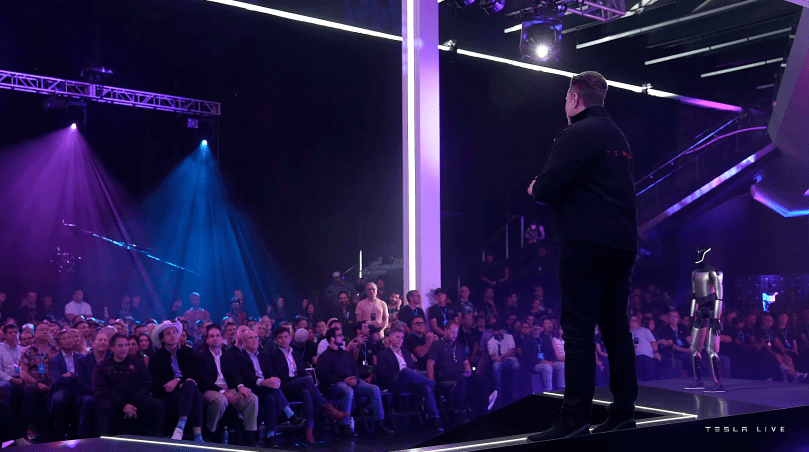
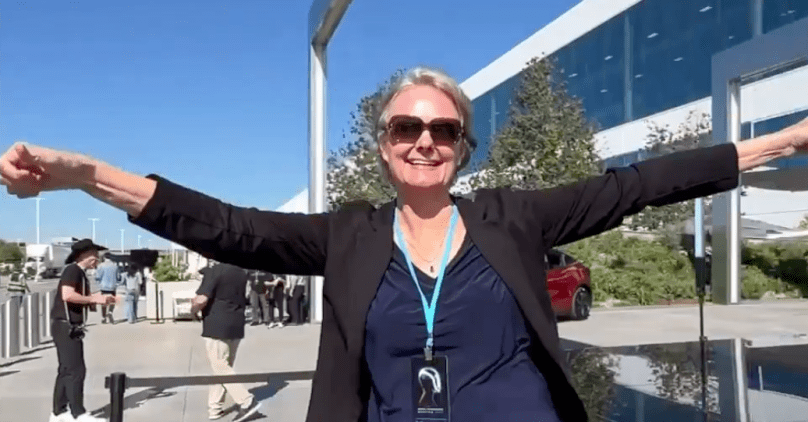
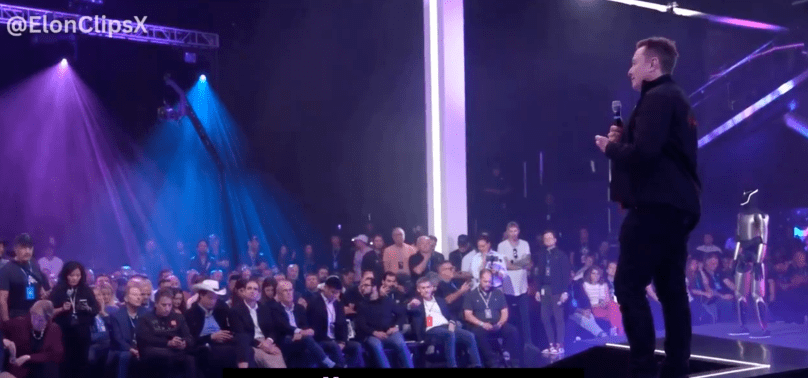
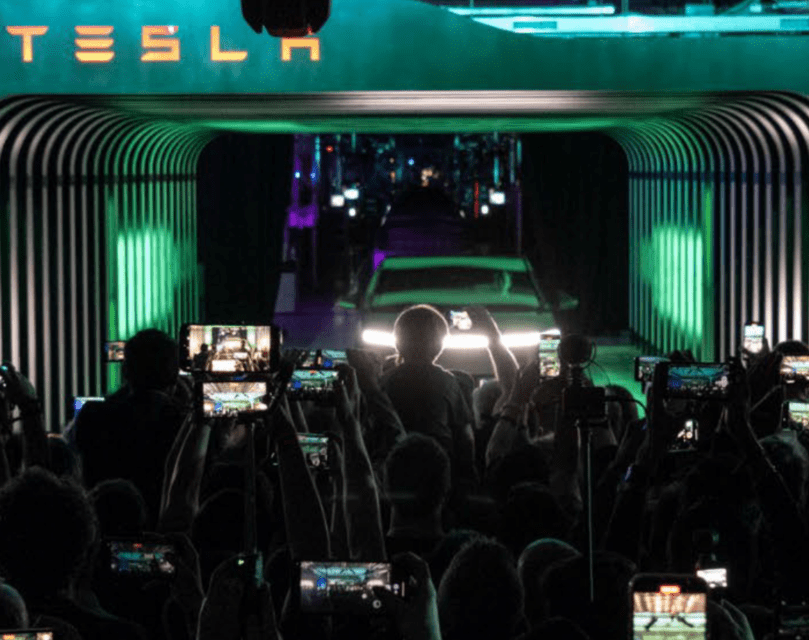
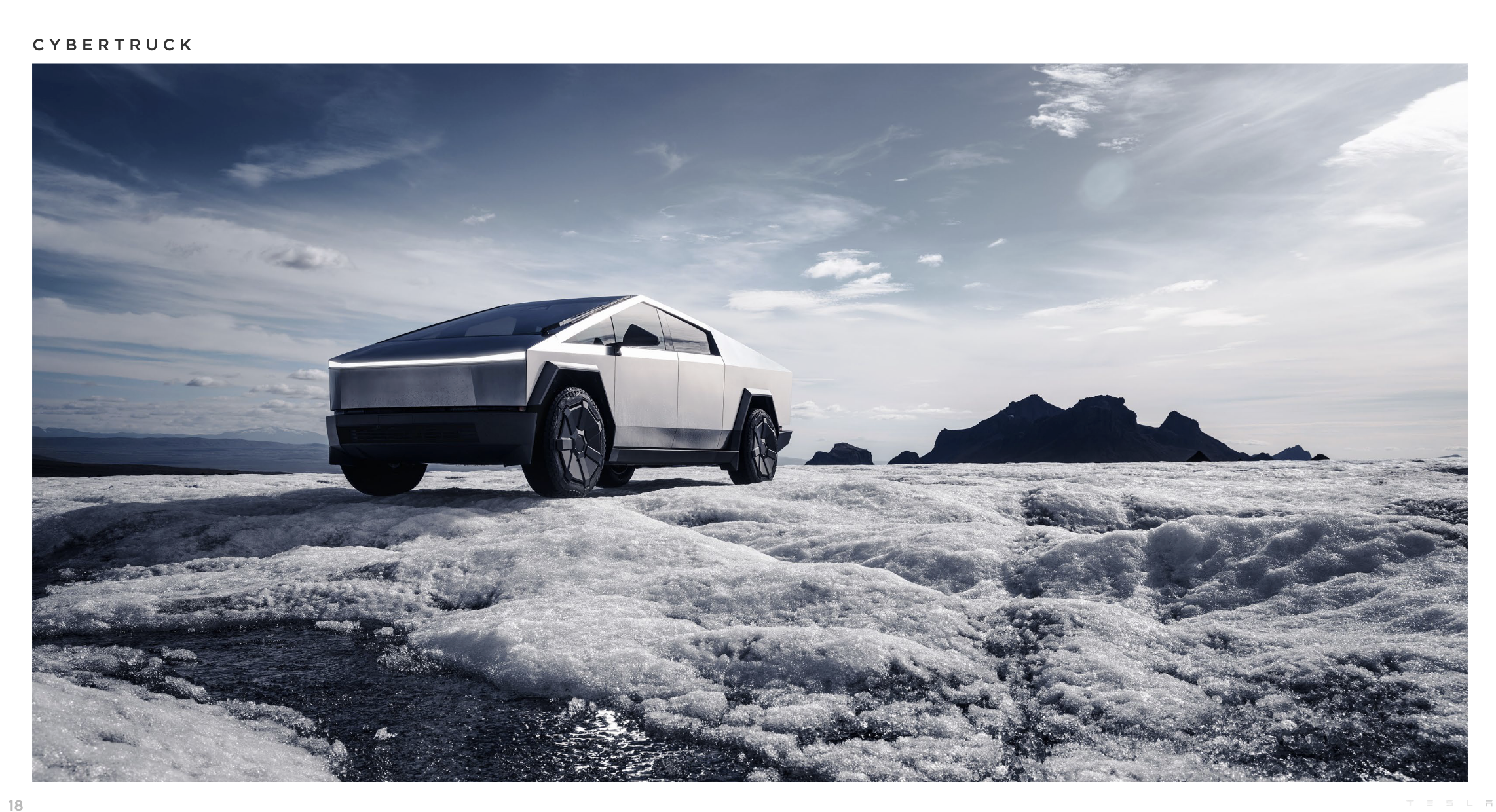
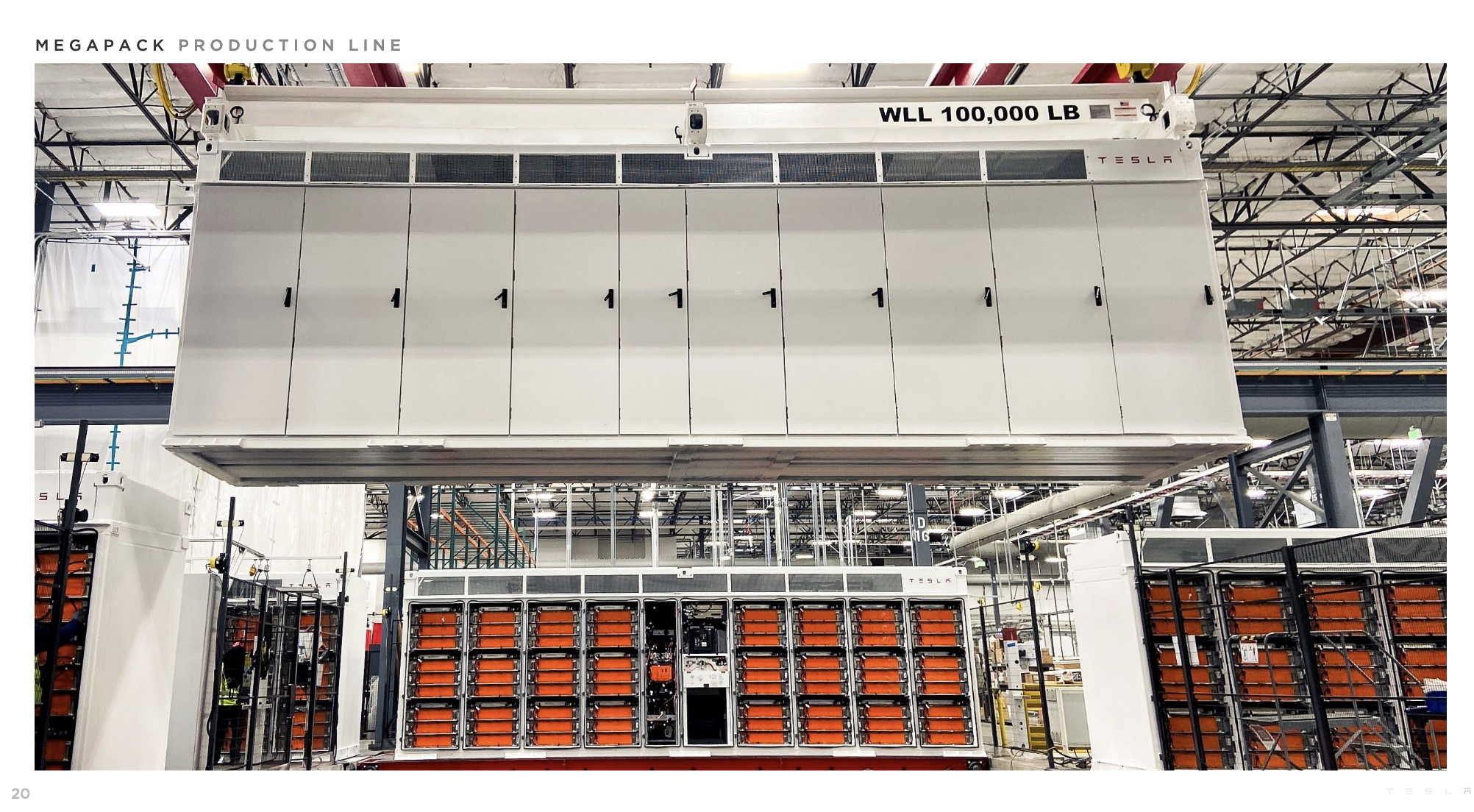
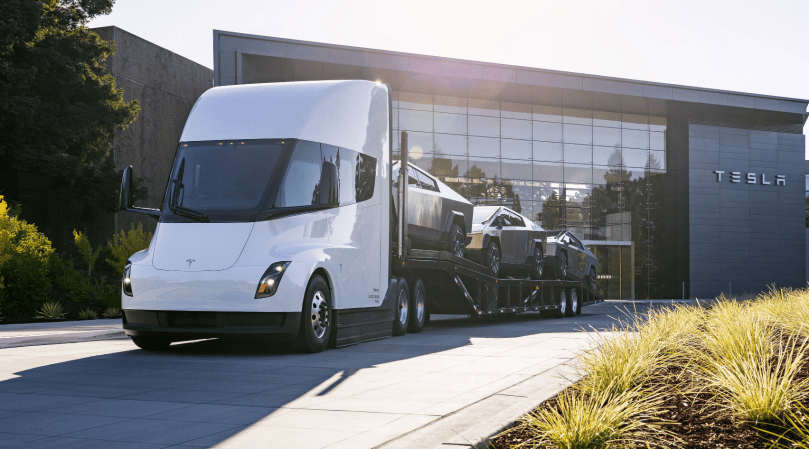
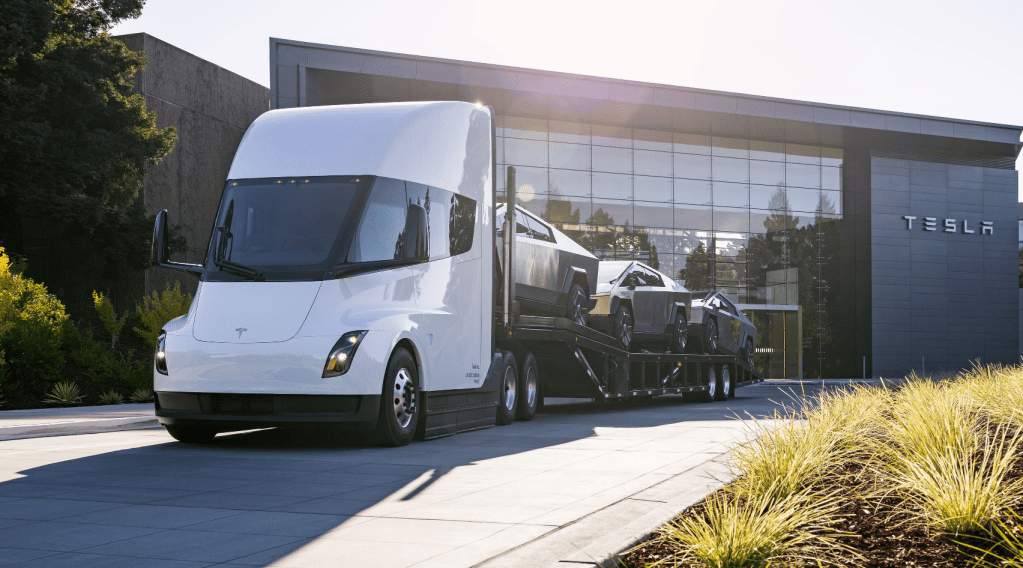
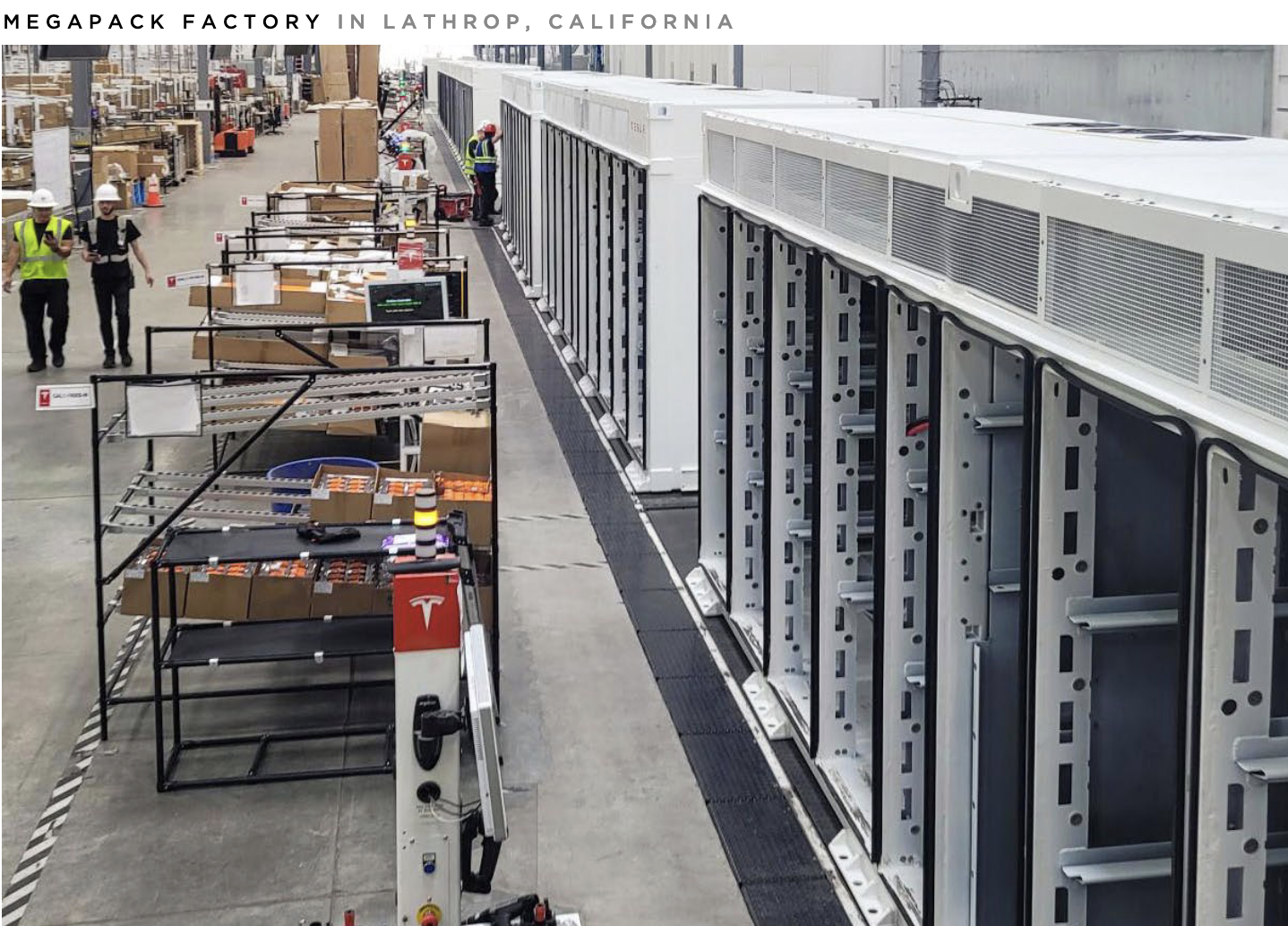
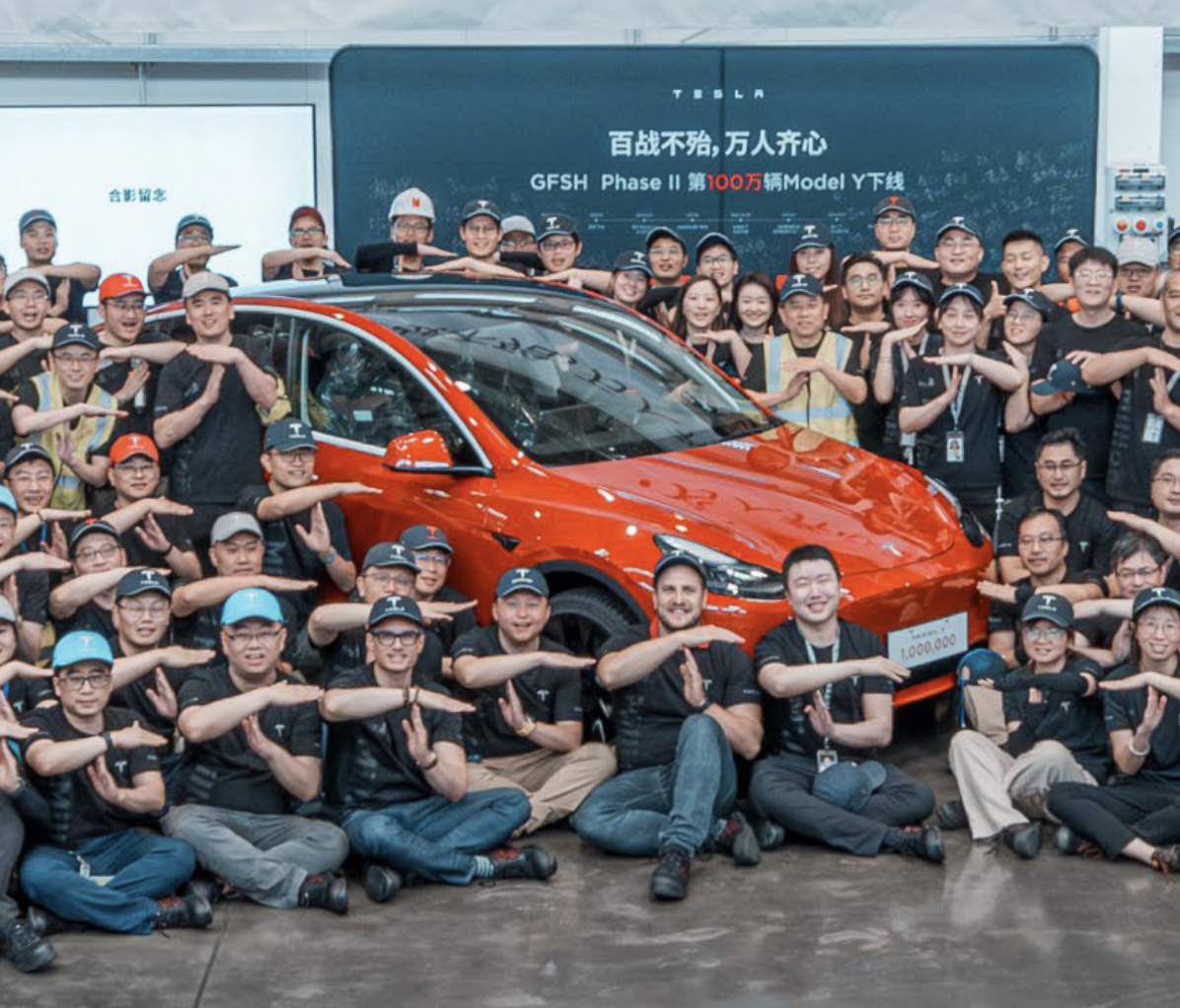
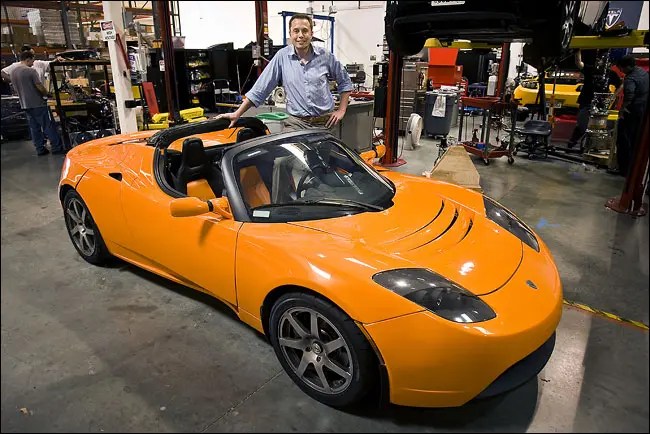
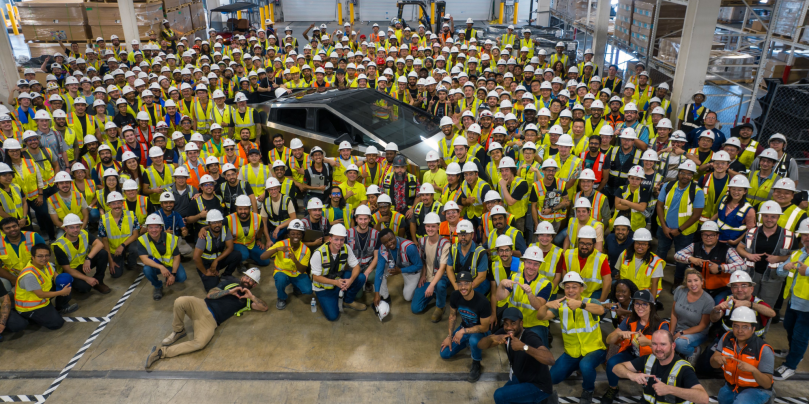
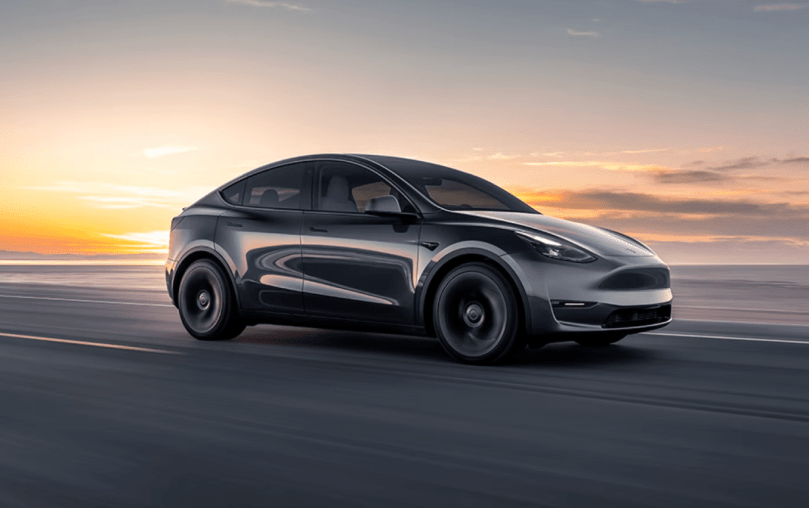
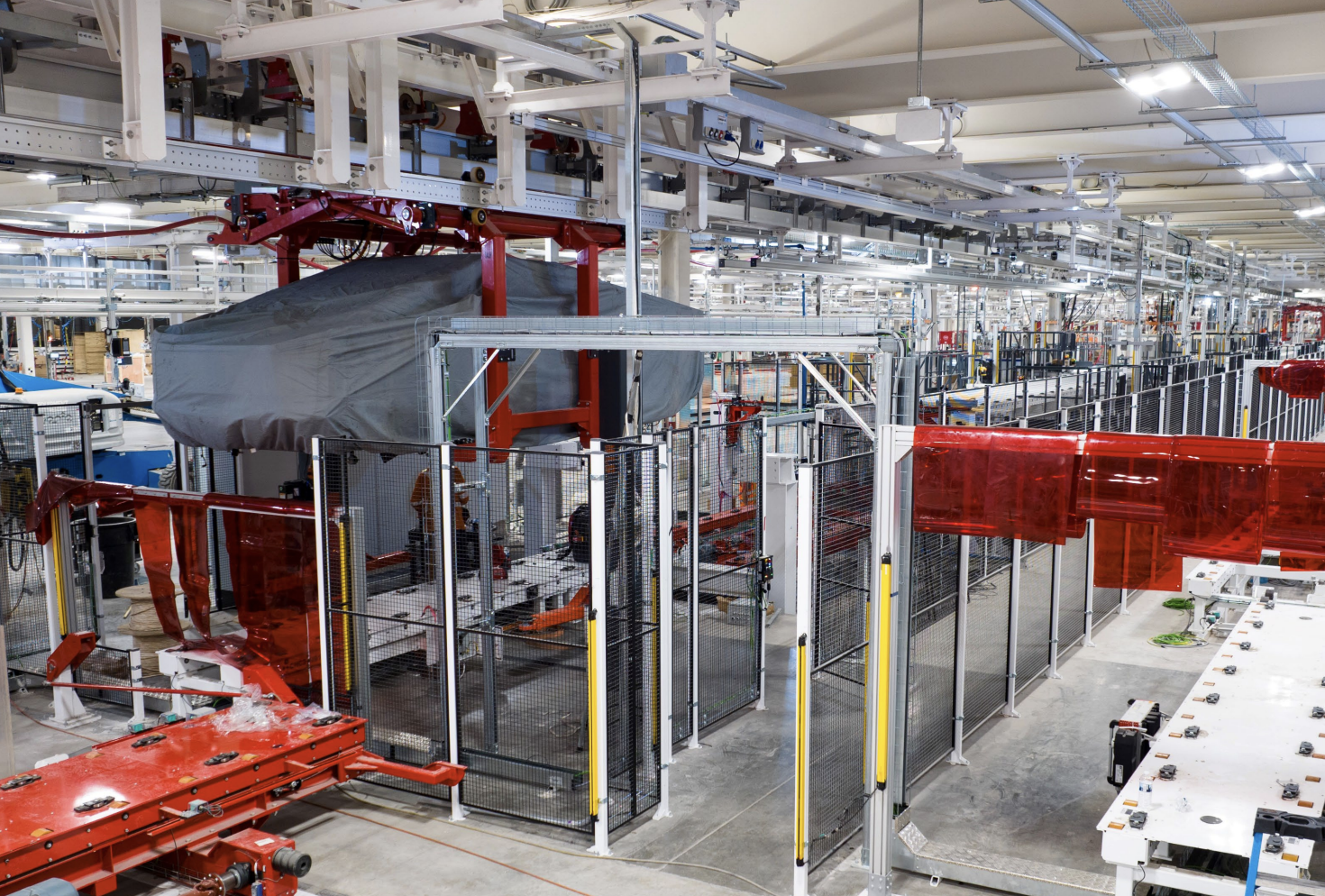
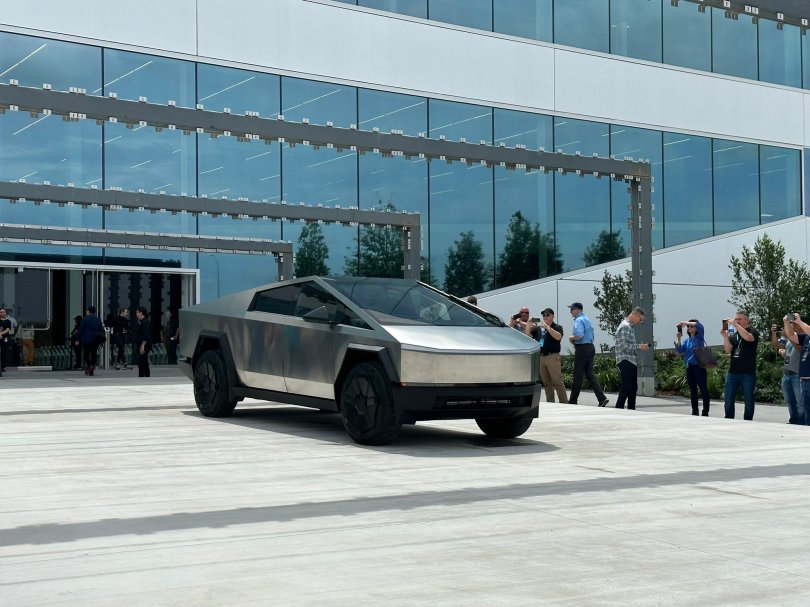
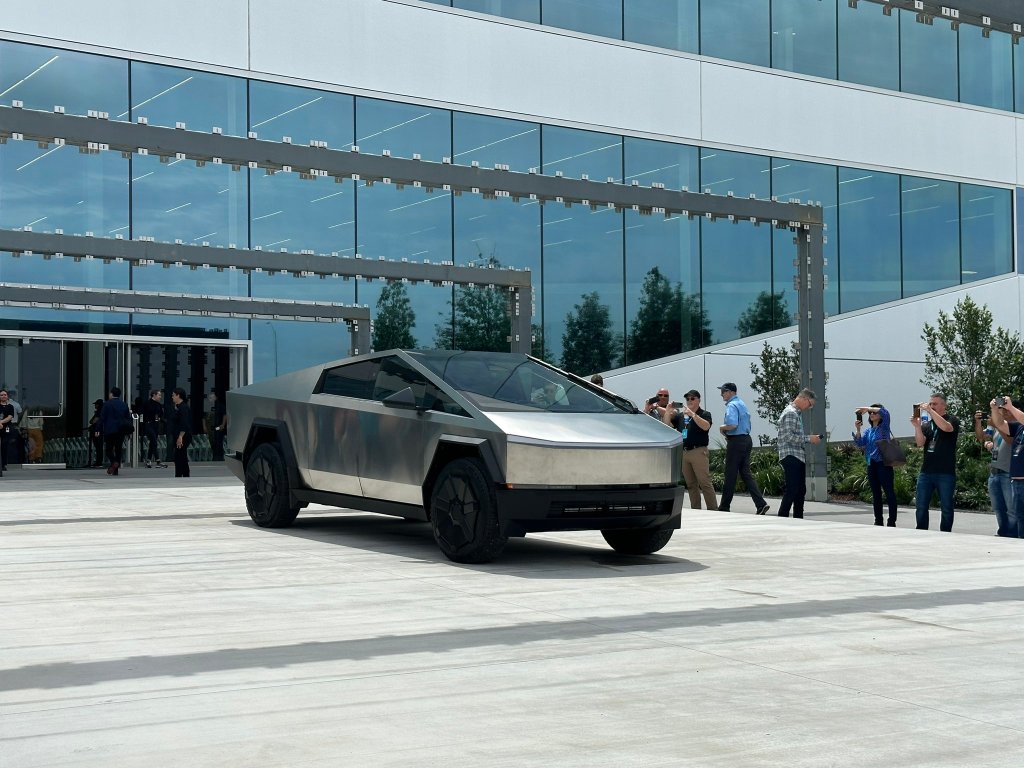
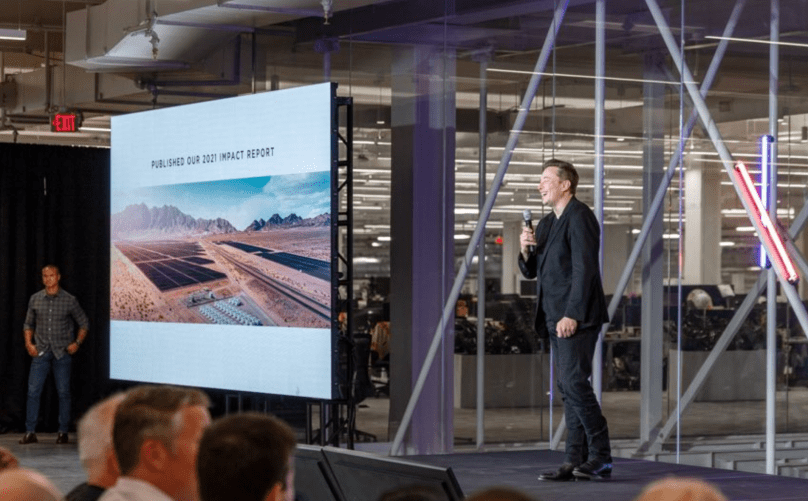
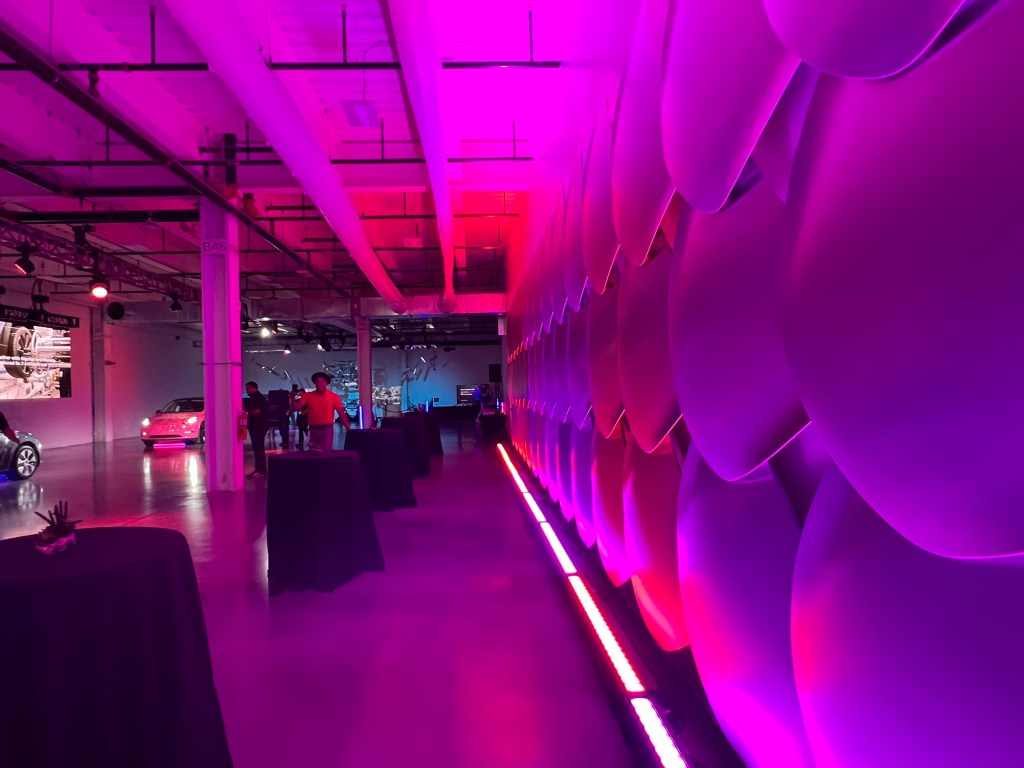
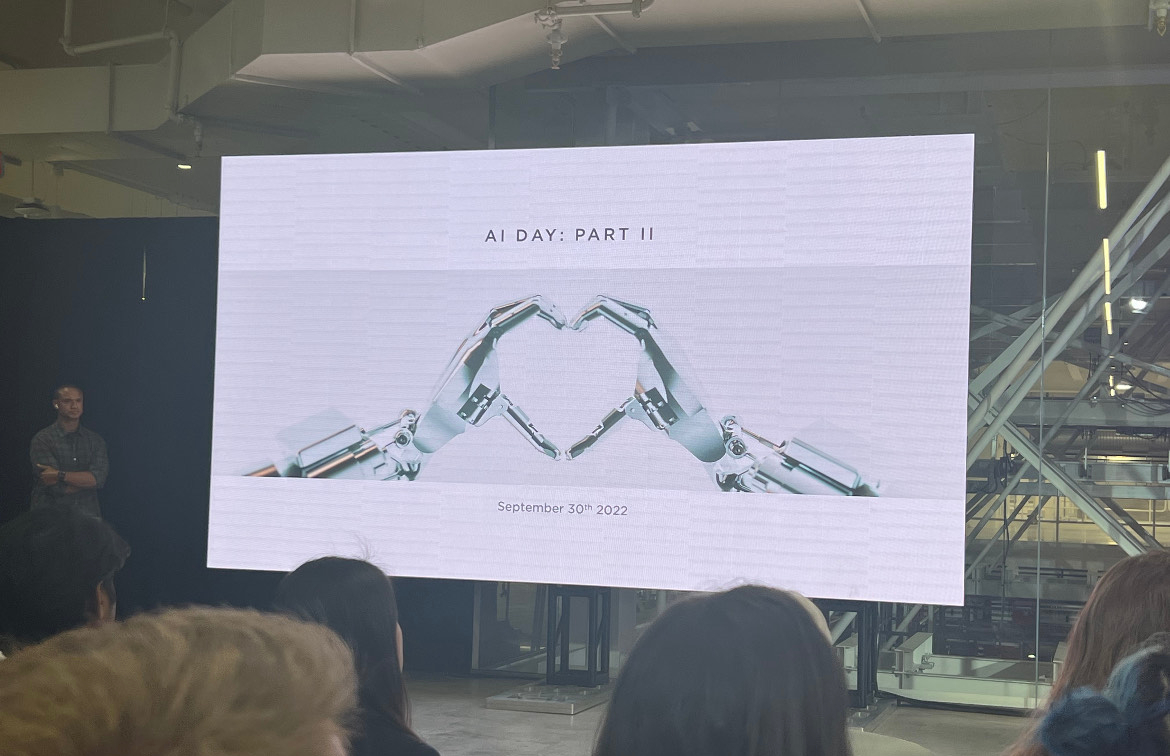
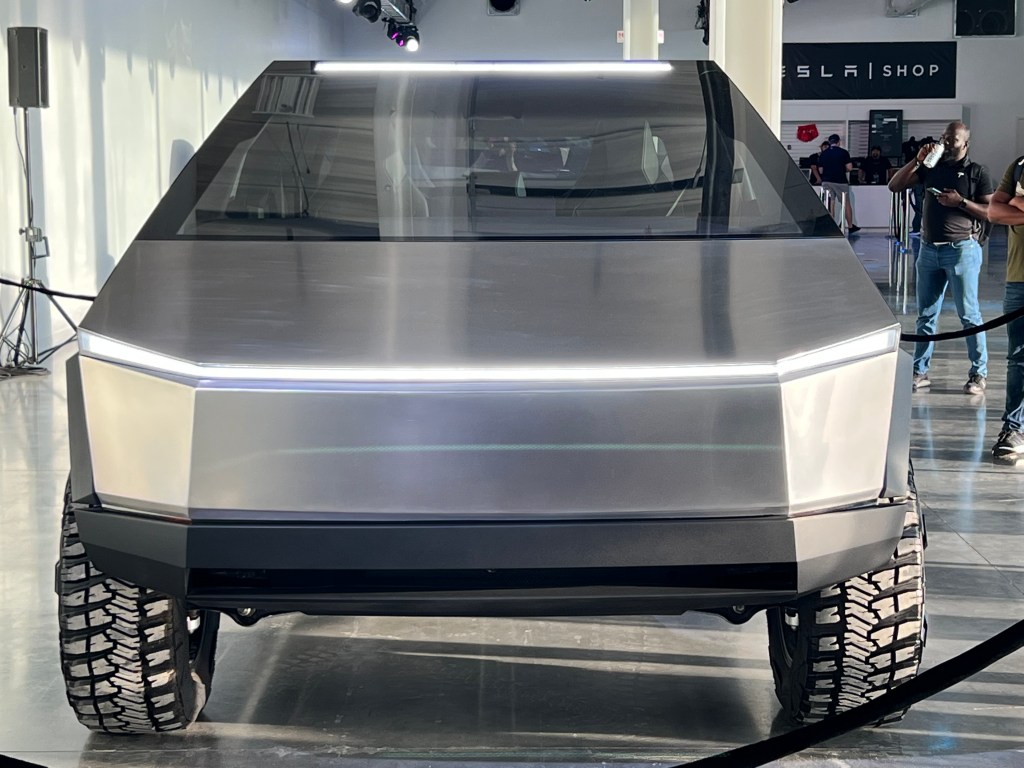
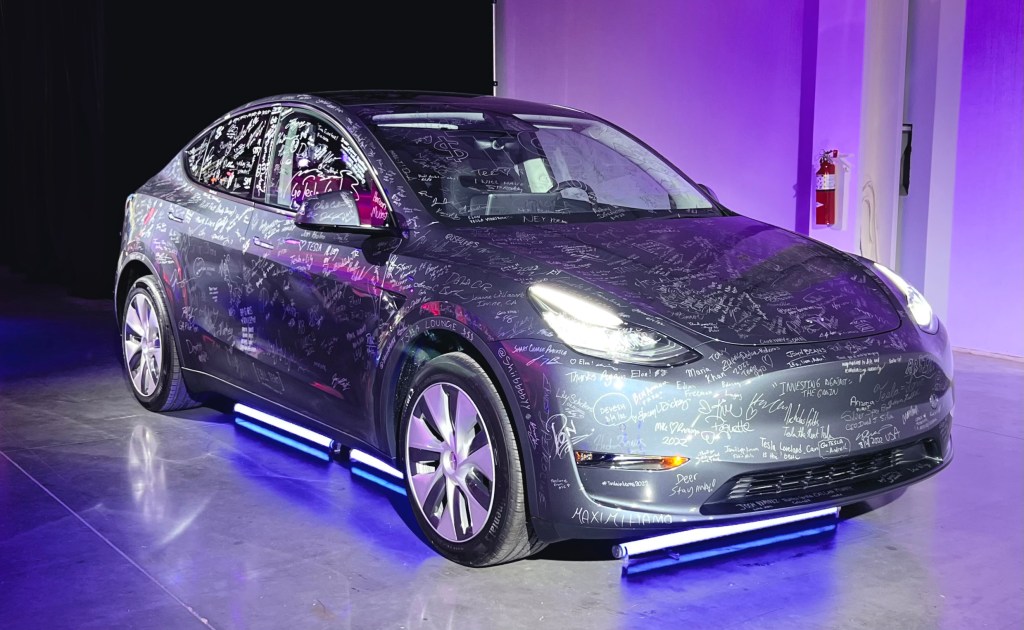
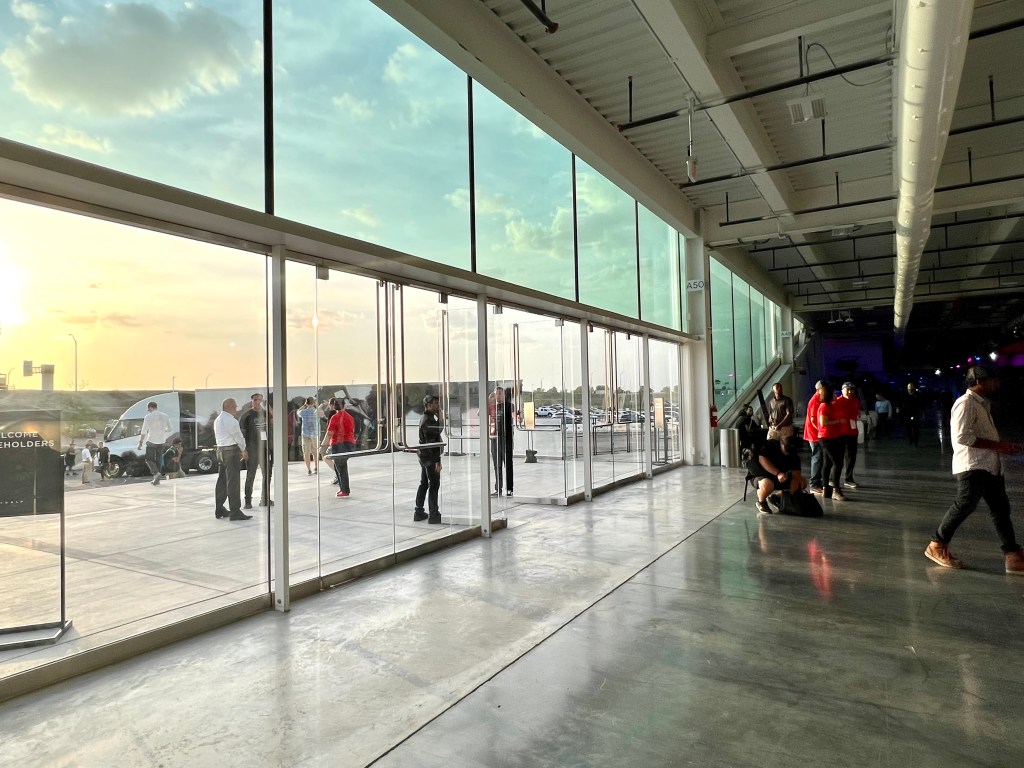
 whatsuptesla.com