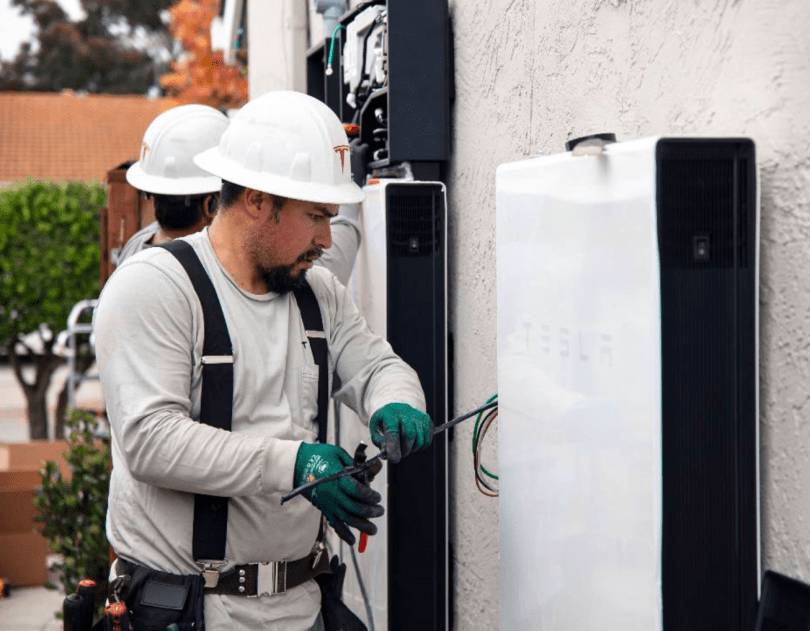
Tesla Japan announced on X the nationwide launch of a Virtual Power Plant (VPP), offering free Powerwall installations to eligible participants. A sign-up link is provided on Tesla Japan’s website. A VPP is similar to a conventional power plant in that it provides energy to businesses and homes. It connects many Powerwalls to form a larger power source, stabilizing the grid and supplying power to individual homes or businesses.
What are DERs? Distributed Energy Resources (DER) combine with Tesla’s advanced software and infrastructure to aggregate energy, ensuring reliable power during blackouts.
Tesla partners with Global Engineering and Fuyo General Lease to deliver this DER aggregation service, potentially supported by Japanese government subsidies through the Long-Term Decarbonization Auction (up to 90% cost coverage for battery storage). This aligns with Elon Musk’s Master Plan 3 for global sustainable energy.
The energy landscape in the USA is evolving rapidly, driven by the urgent need to transition to cleaner, more reliable, and sustainable sources of power. In this pursuit, the Federal Energy Regulatory Commission (FERC) is taking steps to facilitate the integration of renewable energy sources, such as wind and solar, into the national electricity grid. Joining forces with FERC in this transformative journey is Tesla, Inc., a trailblazer in energy solutions.
Order No. 2023: Effective 11/6/2023
It’s important to note that the changes discussed in this article stem from Order No. 2023, published in the Federal Register and set to take effect on November 6, 2023. This landmark order marks a significant turning point in the quest for a more efficient and accessible energy grid [link below].
Tailoring Project Controls for Efficiency
Tesla’s involvement in these reforms goes beyond advocacy—it’s about driving actionable change. Tesla recognizes that not all energy projects are created equal, especially when it comes to non-synchronous generating facilities. In a bid to enhance efficiency and enable smarter decision-making, Tesla has requested crucial information from developers. This data includes intricate details about the number of generating facilities, power control devices, and technical specifications specific to each project. Armed with this information, developers can tailor their project controls, reducing costs and optimizing performance.
Collaboration for Knowledge Sharing
Tesla, in collaboration with American Electric Power (AEP) and the American Council on Renewable Energy (ACORE), has initiated a groundbreaking collaborative initiative. They’ve called on FERC to launch a comprehensive proceeding and host a technical conference, gathering industry experts and stakeholders. The primary objective is to identify valuable information tools, establish consistent and transparent study assumptions, share best practices, and provide guidance to less experienced interconnection customers. This collaborative effort aims to empower all players in the clean energy sector, fostering knowledge sharing and driving progress.
Batteries as Virtual Transmission
Tesla’s innovative thinking extends to considering batteries as virtual transmission resources. This visionary concept unlocks a multitude of benefits, such as providing:
emergency capacity for congested transmission lines,
efficient management of surplus energy generation, and
valuable contributions to grid stability
By embracing this concept, the energy industry can optimize existing infrastructure and bolster grid reliability, all thanks to Tesla’s forward-thinking approach.
Advanced Modeling for Precision
In collaboration with the Solar Energy Industries Association (SEIA), Tesla advocates for the widespread adoption of user-defined library RMS (root mean square current/voltage) positive sequence dynamics models. These models offer a significantly more accurate representation of the technology used by energy resources, resulting in enhanced modeling precision. This advancement is pivotal in supporting the increased adoption of renewable resources. Tesla further encourages FERC to gather comprehensive information from transmission providers about the software tools and resources required to effectively integrate user-defined RMS modeling.
A Novel Approach to Validation
Tesla introduces a pioneering approach to validation for non-synchronous generating facilities. In place of relying solely on attestations or test data, Tesla suggests a more comprehensive “model-to-model” and “product-to-model” benchmarking data submission process. This innovative method promises to streamline the validation process, ensuring greater efficiency and accuracy for both interconnection customers and regulators.
Conclusion
FERC and Tesla, Inc., are at the forefront of a clean energy revolution. Their collaborative efforts transcend advocacy, driving tangible change that benefits both the energy industry and the environment. As they continue to work hand in hand and champion cleaner energy solutions, the possibilities for a greener, more sustainable energy landscape are limitless. Order No. 2023 marks a significant leap towards a brighter, greener energy future, ushering in a new era of accessibility and efficiency in the energy sector.
In the rapidly evolving world of renewable energy and distributed resources, Tesla, Inc. has emerged as a leader in customer care and innovation through its groundbreaking participation in the ERCOT Aggregated Distributed Energy Resource (ADER) Pilot Project in the State of Texas. Over the course of just one year, Tesla has achieved remarkable milestones, showcasing its unwavering commitment to providing exceptional service to its customers and driving the transition towards a more sustainable and reliable energy grid.
The ADER Pilot Project was initiated following discussions and directives laid out in a memorandum dated July 13, 2022, in Project No. 51603. This visionary project aimed to explore the integration of distributed energy resources into the ERCOT grid, transforming them into virtual power plants (VPPs) capable of providing essential energy and reserves. Tesla, Inc. took on the challenge with gusto, and the results are nothing short of impressive.
Pioneering the Future of Energy Participation
One of the most significant accomplishments of the ADER Pilot Project is the establishment of a mechanism for controllable Distributed Energy Resources (DERs) to actively participate in ERCOT’s 5-minute dispatch. Unlike traditional demand-side response programs, Tesla’s innovation allows individual devices to act as electricity injectors or non-injectors, responding dynamically to grid conditions with the precision expected of conventional generation resources.
Tesla’s engineers developed an ADER control system that anticipates availability and influences response every five minutes. This revolutionary system takes into account the unique characteristics, constraints, and preferences of each site and device, ensuring a response that matches or exceeds the capabilities of traditional generation or storage resources.
Setting New Standards for Grid Integration
The ADER Pilot Project also achieved milestones in collaboration with distribution utilities, ensuring safe and reliable integration of DERs. Distribution utilities played a crucial role in commissioning and operating ADERs, working closely with Tesla to develop a registration and qualification process. In under a year, Tesla established a functional process to identify potential participants, validate interconnections, maintain precise customer premise information, and verify non-overlapping demand response program participation.
This work has not only facilitated the integration of ADERs into the grid but has also provided distribution utilities with unprecedented visibility into the impacts of ADERs on their systems. This level of detailed information exchange is a testament to Tesla’s dedication to transparency and cooperation in its customer care approach.
Empowering Customers through Real-time Engagement
Customer engagement and transparency have been cornerstones of Tesla’s approach to the ADER Pilot Project. Tesla Electric customers have been empowered with knowledge about ERCOT prices, energy sellback rates, and grid conditions. They understand the significance of ERCOT’s high offer cap and the role it plays as dispatchable capacity during peak periods. Tesla’s ADER pilot has enhanced customer engagement by providing real-time information through its Tesla app.
Customers are not only connected to ERCOT markets through their devices but also through the Tesla app, which offers notifications about Tesla Powerwall deployment based on ERCOT Load Zone Price. Tesla has even introduced dynamic price settings and web-based/mobile notifications, giving customers more control and awareness of their energy consumption.
Creating Innovative Customer Incentives
Innovation doesn’t stop at grid integration; Tesla has also been at the forefront of developing customer incentives. Customers participating in the ADER Pilot Project can now receive monthly bill credits reflecting their contributions to the program. These bill credits can often exceed the value created by each customer, making it a financially attractive proposition.
Tesla’s forward-looking approach aims to retain customer engagement with consistent revenue streams while creating additional incentives for peak demand periods. By continually rewarding customers for their participation, Tesla ensures a mutually beneficial relationship with its customers, aligning their interests with grid reliability.
Paving the Way for Future Participation
Tesla’s commitment to innovation extends beyond its own customer base. The company has worked to enable third-party participation in the ADER Pilot Project, recognizing the importance of expanding ADER populations to create a sustainable and meaningful impact on ERCOT.
The project has also led to the development of precise measurement and verification processes, ensuring accurate load curtailment at a device level. This level of detail is critical for maintaining grid reliability and optimizing the use of DERs.
Challenges and the Road Ahead
While Tesla has achieved remarkable success in the first year of the ADER Pilot Project, challenges remain. The company has identified the need for higher caps to make ADERs economically viable on a larger scale. Additionally, the introduction of the Dispatchable Reliability Reserve Service (DRRS) poses new considerations for ADERs’ future revenue potential. Tesla remains dedicated to addressing these challenges and ensuring the long-term viability of ADERs in the ERCOT market.
In conclusion, Tesla, Inc.’s efforts in the ADER Pilot Project exemplify its unwavering dedication to customer care and innovation. By pioneering new standards for grid integration, empowering customers through real-time engagement, creating innovative incentives, and enabling future participation, Tesla is driving the transition towards a more sustainable and reliable energy future. As the ADER Pilot Project progresses, Tesla’s commitment to customer care and innovation will undoubtedly continue to shine as a beacon of progress in the energy industry.
ADER Task force Chair Jason Ryan and Co-Chair Arushi Sharma Frank at the PUC in Austin, Texas.
Castillo San Felipe del Morro, Calle Norzagaray, San Juan, Puerto Rico by Zetong Li | Unsplash
Prepare to be amazed as Puerto Rico sets its course toward a future brimming with energy independence and sustainable growth. In a swift and impactful move, the Energy Bureau of the Public Service Regulatory Board of Puerto Rico has unleashed an era of transformation that promises to bring positive change to every doorstep on the island.
If you’re short on time but high on enthusiasm, this article is a concise breakdown of the remarkable legislative breakthrough.
Powering the Future with Clean Energy
Picture a Puerto Rico where clean energy is no longer a distant dream, but a reality that’s taking shape before our eyes. On August 11, 2023, the Energy Bureau issued a groundbreaking Order that set in motion a series of events bound to revolutionize how we harness power. This Order put into motion a process that would require LUMA Energy, LLC and LUMA Energy ServCo, LLC (collectively referred to as “LUMA”) to provide crucial information about the Emergency Demand Response (“Emergency DR”) Program.
Accelerating Renewable Energy Adoption
Fast forward to August 23, 2023, and history was made yet again. LUMA responded to the Energy Bureau’s call by submitting a Motion that detailed the costs associated with the Emergency DR Program. The plan is nothing short of ingenious: a surge in renewable energy adoption powered by solar panels on rooftops and wind farms along the coastlines. Imagine harnessing the sun’s rays and the ocean’s breezes to fuel our lives – a dream that’s now a step closer to reality.
Ensuring Resilience and Reliability
Gone are the days of power outages casting a shadow over Puerto Rico. The program’s design ensures resilience in the face of adversity. Microgrids will step in during emergencies, guaranteeing an uninterrupted power supply when the grid falters. This means quicker recovery times and stronger communities that can weather any storm.
Fostering Economic Prosperity
Hold onto your hats – the journey towards energy independence is also an economic boon! This masterstroke is projected to generate a wave of employment opportunities, boosting local economies. Skilled professionals will be at the forefront, building, operating, and maintaining the renewable energy infrastructure that’s about to change the game.
A Commitment to Communities
But it doesn’t stop at technology and economics. This visionary legislation places communities at its core. Education takes center stage, as residents will be informed about the benefits of renewable energy, fostering a deeper understanding of the world-changing shift underway.
Unveiling the Road Ahead
What’s next? Brace yourselves for the incredible journey ahead. As the Emergency DR Program unfolds, expect to see program terms issued through the PowerAdvocate platform, agreements between LUMA and participants, customer enrollment, and even a test event. The road to a sustainable future is paved with exciting milestones!
Your Role in the Revolution
It’s time to be part of the change. Join Puerto Rico on this thrilling journey towards energy independence and environmental harmony. As this historic endeavor takes flight, it’s not just about power sources; it’s about powering our lives, our communities, and our dreams.
Stay tuned for more updates on how Puerto Rico is turning a new leaf in the realm of energy. The island is poised to become a global example of innovation, resilience, and progress – a beacon of hope in a world that’s constantly evolving.
Read RESOLUTION AND ORDER | CASE NO: NEPR-Ml-2022-0001 | LUMA August 23, 2023, Motion Filing its Emergency Demand Response Program Cost and Timeline.
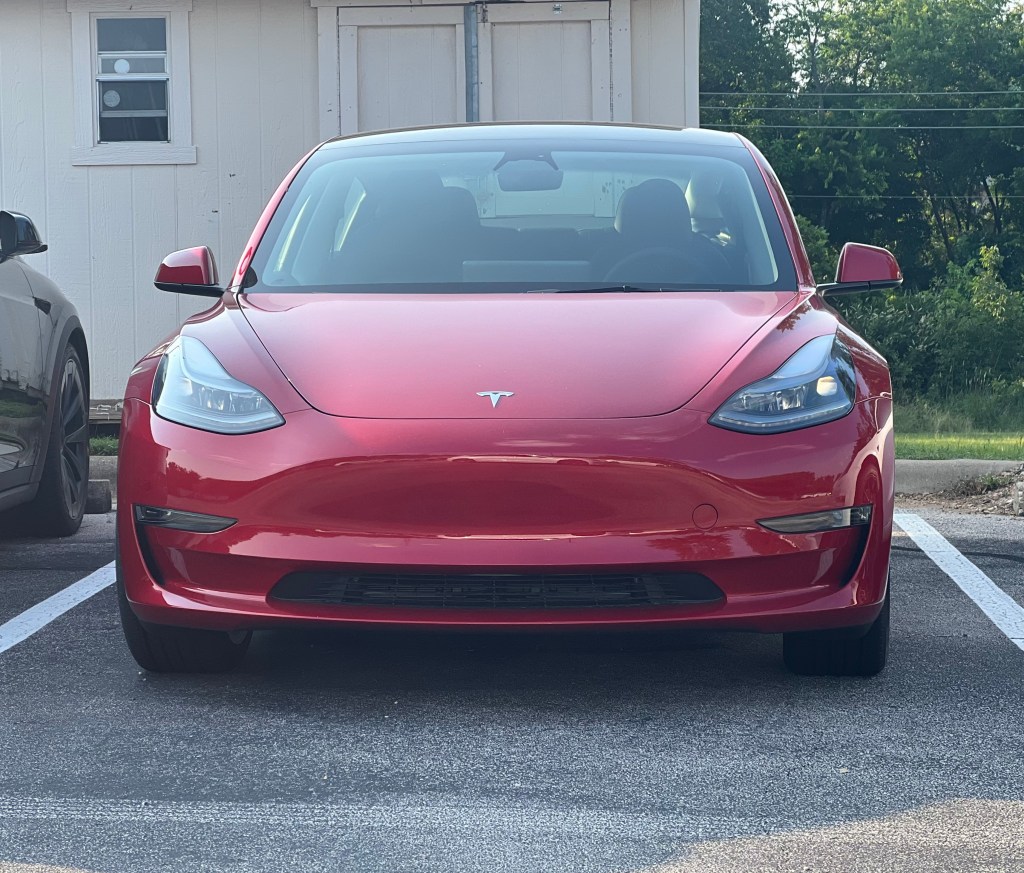
(Austin, Texas) If you’re in Texas & taking delivery of your new Model 3 between May 26 and June 30, 2023 then you are in for some good luck!
Tesla Electric has unveiled a sweet home charging plan and qualifying customers in Texas will seamlessly charge their new Model 3 at home and have their overnight charging fee waived for a year.
UNVEILING THE TESLA ELECTRIC HOME CHARGING PLAN
Tesla Electric has gone above and beyond to cater to the needs of Texas Tesla owners. With the charging plan, eligible customers can seamlessly charge their new Model 3 at home without incurring any overnight charging fees for an entire year.
This plan provides financial savings & also eliminates the hassle of locating and utilizing charging stations, giving owners freedom and convenience. I expect this plan will expand soon.
To take advantage of this remarkable opportunity right now, Texas residents must meet specific eligibility criteria. Those who are taking delivery of a new Model 3 between May 26 and June 30, 2023, fall within the qualifying window. Link on details below.
This limited offer is an amazing chance for Texas Tesla owners to save money and maximize the benefit of owning an EV while minimizing their carbon footprint
THE FUTURE OF SUSTAINABLE TRANSPORTATION
The introduction of the Tesla Electric Home Charging Plan reinforces the strong commitment Tesla has to accelerate the transition to sustainable energy. By incentivizing home charging, Tesla aims to simplify the charging process and promote the use of renewable energy sources.
I expect this plan to roll out to more Tesla owners over time.
SEIZING OPPORTUNITY
If you are a lucky Texas resident patiently awaiting the arrival of your new Model 3, do seize the opportunity. Participating in Tesla Electric Home Charging Plan means you will enjoy the convenience of charging your vehicle overnight at home, free of charge, for an entire year.
(Austin, Texas) On March 10, 2023, an important event unfolded as Department of Energy Secretary Jennifer Granholm visited key stakeholders in Texas to discuss the groundbreaking Aggregated DER Pilot Project and the ADER Task Force. This visit marked the initiation of a series of Virtual Power Plant (VPP) listening sessions aimed at fostering deeper collaboration and information exchange. The primary goal is to explore how the Department of Energy can accelerate the deployment of VPPs, positioning them as essential tools for achieving national energy goals.
The Setting: Aggregated DER Pilot Project and ADER Task Force
During the visit, Secretary Granholm met with sponsors of the Aggregated DER Pilot Project and the leadership of the ADER Task Force, along with local Texas leaders and various stakeholders who are actively involved in advocating for distributed energy reliability solutions. These solutions, treated as virtual power plants, hold the potential to revolutionize energy affordability, grid resilience, decarbonization efforts, and energy justice.
Roundtable Discussion and Insights
The roundtable discussion, facilitated by Jigar Shah, Director of the Department of Energy’s Loan Programs Office, delved into several crucial aspects of the ADER Task Force’s efforts. Participants engaged in a comprehensive discourse on the rapid launch of the ADER pilot program and its accelerated timeline. This pilot program seeks to enhance energy affordability while bolstering the resilience of the energy grid. The roundtable served as a platform for participants to share valuable insights, best practices, and success stories that can be adapted across the United States.
Collaborative Governance and Essential Reforms
A distinctive aspect of the ADER Task Force’s work is the collaborative governance approach. This approach involves a dynamic partnership between sponsoring Commissioners, ERCOT (Electric Reliability Council of Texas) staff, private sector entities, institutional stakeholders, and committees dedicated to organizing and mobilizing progress. This collaborative effort signifies a commitment to accountability and progress, aiming to catalyze essential reforms within electric markets policies.
Texas’ National Influence in Energy Innovation
The Department of Energy’s engagement with ERCOT and Commission leadership, research institutions, and energy reform advocates showcased the remarkable impact Texas is making on the national stage. By innovating solutions and driving investments where they are most needed, Texas is leading the way in shaping the future of energy reliability.
Gemstone of Progress: Illuminating the Brilliance of Virtual Power Plant
The visit of Secretary Granholm and the subsequent roundtable discussion underscored the significance of virtual power plants as a transformative solution for achieving energy affordability, grid resilience, decarbonization, and energy justice on a national scale. The collaborative efforts of stakeholders in Texas, coupled with the Department of Energy’s involvement, spotlighted the role of innovation in addressing pressing energy challenges. As the nation strives for a more sustainable and resilient energy landscape, the potential of virtual power plants shines brightly on the horizon.
Secretary of Energy Jennifer Granholm and ERCOT CEO Pablo Vegas
Article Exclusive to What’s Up Tesla – March 14, 2023. All Rights Reserved. “My goal as an author is to support Tesla and Elon Musk in both making lives better on earth for humans and becoming a space-faring civilization.” – Gail Alfar
Tesla Powerwall + owners and more can join Tesla Electric in many areas of Texas. Photo courtesy Tesla, Inc.
When President Lyndon Baines Johnson asked his driver why it took so long for him to drive from Texas to Washington DC, his driver asked him if he knew about the *green book.
Lyndon’s communication with his driver is one of the things that drove him to push for & pass multiple policies for civil rights. I believe Lyndon may have thought, “I’m the damn president, I can make change, so this doesn’t have to happen! “
In February 2021, Elon Musk and part of his family were in Texas. Storm Uri happened, and there were nearly 5 days in that deep winter freeze where there was no water or power for most people, including Elon and his family.
Elon received a lot of sympathy for suffering through that, but I’m actually glad he experienced it. When people in great positions of power realize the discomfort that other people are going through, they are the ones who can act to make change.
Johnson passed the Civil Rights Act, Equal Housing Act and Voting Rights Act. He declared a “war on poverty.”
Since storm Uri, Elon Musk has made sure that Tesla has poured resources into Tesla Energy for Texas. Talented people, and I’ve met some of them, have been given support to build up the Texas grid. I know firsthand that Tesla Energy policy leader, Arushi Sharma Frank has dedicated time to leading efforts in Texas since 2020 to establish new ways to power up the Texas grid with sustainable energy.
Good things don’t come easy. Just like it took an extraordinary amount of people working together through unimaginable challenges to enact the Civil Rights Act and many other laws to help humanity, it is taking monumental efforts to strengthen the Texas grid. Tesla Electric is the beautiful result of the blood, sweat and tears of many.
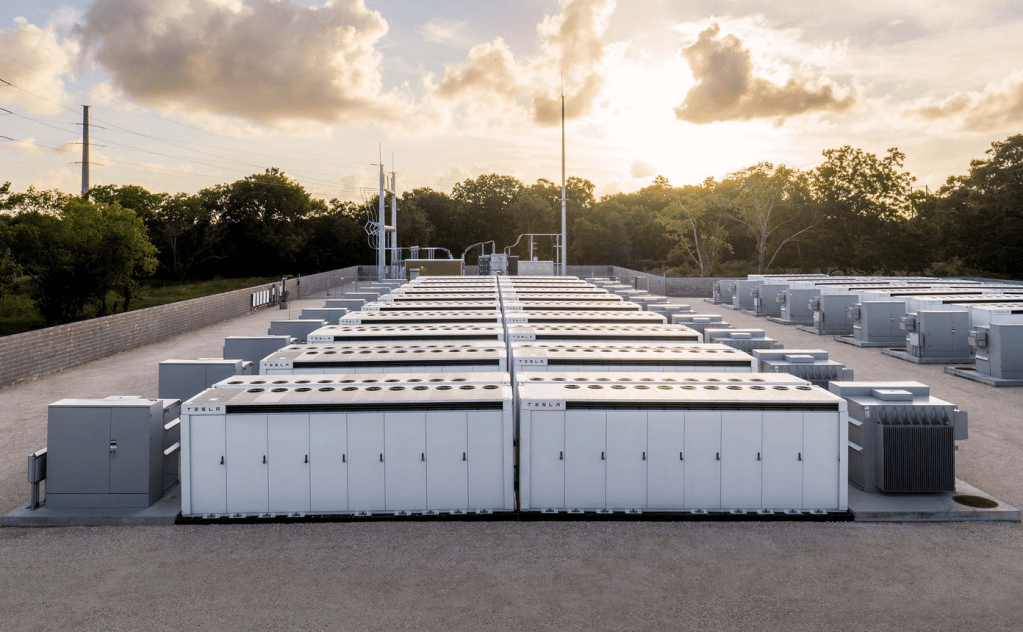
Angleton Texas now has 81 Tesla Megapacks that support the Texas grid.
Tesla ran a successful virtual power plant pilot program involving at least 64 Texan homes, keeping the lights and AC on during high demand in the summer.
I spoke at the Tesla Energy Virtual Powerplant Workshop advocating for people’s health. “As a healthcare provider, I advocate for people in need. Having power is important to people’s health.” (reported on by Johnna Crider here)
And now Tesla has unveiled Tesla Electric here in Texas. Tesla Electric is a new product offering. Just like you can buy a Tesla vehicle or purchase Tesla solar + Powerwalls, now many people in the state of Texas can purchase their electricity exclusively from Tesla Electric.
At first, I asked myself how this could help people who do not own a Powerwall or Tesla solar?
I view this as one of the many steps that it is going to take to transition the state of Texas, and ultimately the rest of the USA to sustainable energy.
TESLA ELECTRIC
To accomplish this in Texas is significant. I once saw Texas as the epicenter for big oil in the USA and that is shifting thanks to Elon Musk. Now I envision Texas becoming the epicenter for sustainable energy. The home of Tesla Electric. The Headquarters of Tesla.
So before you think of dismissing the significance of this new product by Tesla, think about how impossible it felt to so many people in the south that the Civil Rights Act could be passed. Nothing is impossible if it’s designed for good.
I met Elon Musk in July 2022 and asked him about protecting the Gigafactory with sustainable energy in the event of another storm. But Elon’s concern clearly was not about keeping his business running in a storm. He turned quiet, taking some time to answer and his answer was clearly based on how people in the state could be helped in the event of another severe winter storm.
I’ll leave you with that recording, linking to it on my Twitter account here so you can listen for yourself.
Elon Musk talks to Gail Alfar during an interview. He wants to keep the lights on for people.
In this world when powerful people live through the same difficulties that regular people live through, that’s when we see change. We can see change for the better.
*The annual guidebook was first published in 1936 and helped African Americans safely navigate the roads of a segregated country. Green wrote this guide to identify services and places relatively friendly to African Americans so they could find lodgings, businesses, and gas stations that would serve them along the road.
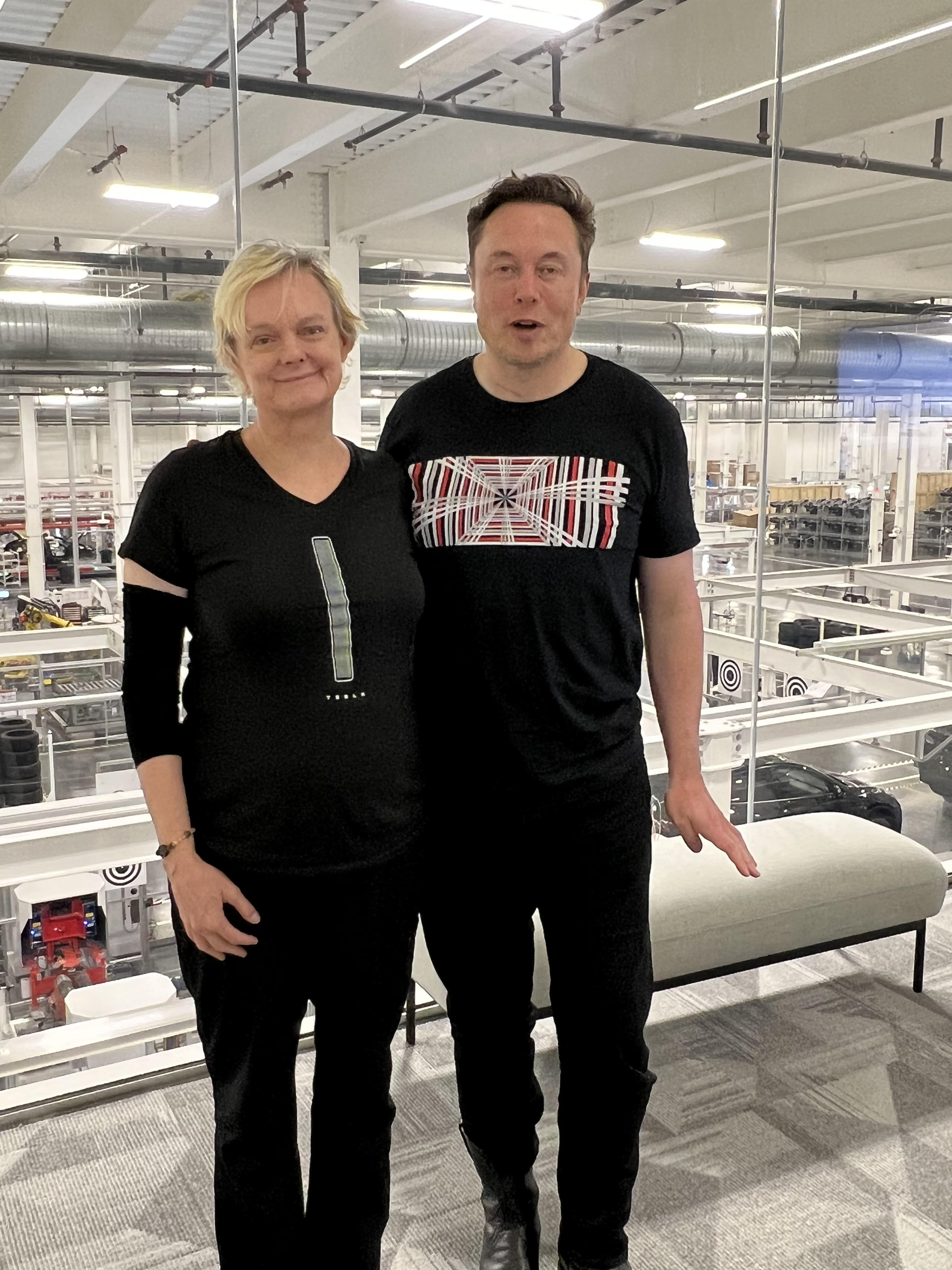
Gail Alfar and Elon Musk after an interview at Giga Texas, June 25, 2022.
Gail Alfar, author. Exclusive to What’s Up Tesla – December 18, 2022. All Rights Reserved. My goal as an author is to support Tesla and Elon Musk in both making life better on earth for humans and becoming a space-fairing civilization. Header image Courtesy Tesla, Inc.
One-Time
Monthly
Yearly
Make a one-time donation to support What’s Up Tesla
Make a monthly donation to support What’s Up Tesla
Tesla Megapacks at Alaska’s Kenai Peninsula. Credit: Tesla
You are living in the early stages of the transition to clean energy. In the coming years, expect most gas and coal peaker plants to close. These will be replaced with battery storage of mostly solar energy.
This article is about four challenges that will be overcome for this incredible transition to succeed.
UPDATE: Elon Musk saw this article on Twitter, and replied to it on July 25, 2022, calling it a “Good article.” I hope that you’ll enjoy it as well!
#1 Increasing Supply of Refined Lithium
There is currently not enough refined Lithium, and this provides a challenge in the transition to clean energy. Tesla is working to scale battery production with refined Lithium at Giga Nevada and the new Megafactory in Lathrop, California.
At the Q2 2022 Earnings call, Elon Musk emphasized the need for more refined Lithium, the component needed for batteries. Elon said,
“I’d like to, once again, urge entrepreneurs to enter the lithium refining business.” Elon Musk
Elon Musk revealed in a recent interview with Johnna Crider that extremely pure battery-grade lithium hydroxide or lithium carbonate is needed to prevent breakdown in the battery cell,
“For example, with lithium, it’s more lithium refinement than it is the actual mining. So you better take the ore that contains lithium, and you’ve got to refine it and get it to battery-grade lithium hydroxide or lithium carbonate. And it has to be extremely pure. Otherwise, you could have a breakdown in the cell.” Elon Musk
#2 Scaling Battery Manufacturing
Scaling battery production is a constant challenge as processes must always be flexible enough to improve.
Building batteries faster and at larger scale will occur in order for our world to transition to clean energy. Tesla is addressing this challenge and currently building batteries ranging in size from 13.5 kWh Powerwall to 3000 kWh (3 MWh) Megapack. Large and small batteries are needed to combine with others to form massive power plants, replacing old-style gas and coal energy with solar.
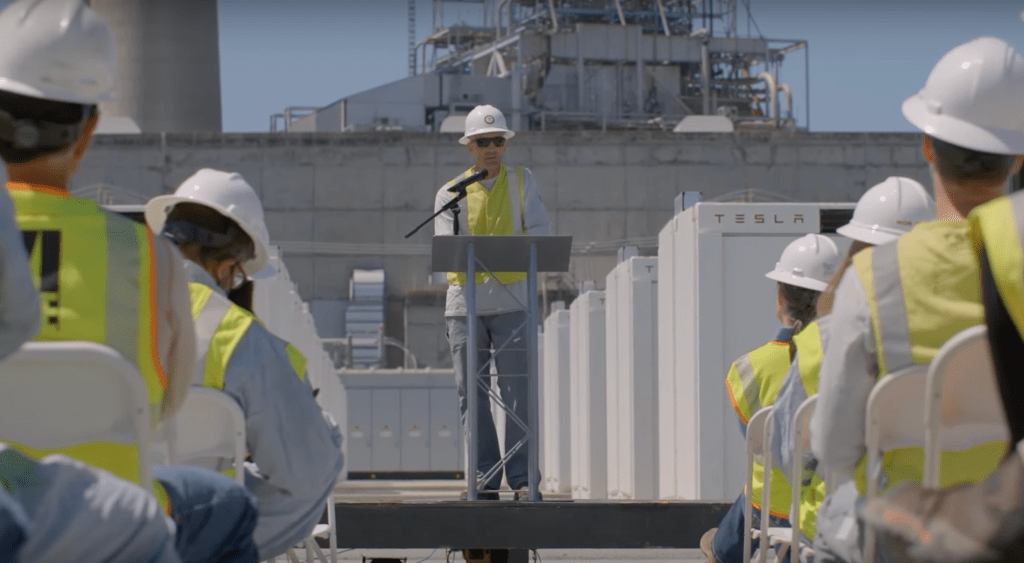
Tesla Energy Engineer Mike Snyder speaks against the backdrop of 256 Tesla Megapack battery units on 33 concrete slabs at Moss Landing
Mike Synder of Tesla Energy, spoke at the opening of Moss Landing Elkhorn Battery last month, saying Megafactory Lathrop will produce ~ 40 GW hours of Megapacks a year,
“The Megafactory fully ramped can produce up to 40 GW hours of Megapacks per year. For context, 40 Gigawatt hours is approximately 50 of the projects you see behind us here, being produced each year here in California and really around the world.”
#3 Working with Existing Infrastructure to Streamline Clean Energy Installations
Tesla Megapacks, Angleton, Texas. cr: Tesla
It is difficult to integrate the existing older infrastructure seamlessly with Tesla’s new hardware and software system, and it has to be done. Moss Landing near Monterey, California is a location known for decades as exclusively a gas peaker plant site. Thus, it contains physical infrastructure needed to wire energy to customers. Snyder spoke about this challenge,
“There’s a lot of work and figuring out how to integrate these large projects into our existing infrastructure.
As the projects become larger and larger and more powerful those problems become more nuanced and more complicated to solve, and we all have to work to do that together.
Its about landing the wires here at a critical substation, like Elkhorn, or it’s about assessing the grid impacts at different interconnection points in the grid.
All of those problems become much more interesting for engineers and much more complicated to solve, and we need to be doing that together.
And really, as we grow we need to collectively assess how best to leverage such a flexible, fast-acting, bidirectional resource like we’ve never really had. It’s truly an exciting time to be in the industry!”
#4 Updating Local Policy to Encourage Virtual Power Plants
As Tesla Energy works to meet the demand for battery storage systems with Megapacks, another way to meet demand is through aggregating together Tesla Powerwalls that individual people like you and I own to form Virtual Power Plants.
It takes time and effort to change old ways of thinking at state and local levels. Tesla’s Energy Policy team is working in my home state of Texas to help get virtual power plants online. I wrote about that last month in “Tesla’s Texas Virtual Power Plant ASAP.” Although the process might seem slow as molasses in wintertime, eventually it will happen, and there are things you can do to support these efforts! (I list some at the end of this article).
It was a change in policy for PG&E to allow ~1500 California residents who own home Tesla Powerwall batteries to volunteer to join together to form a virtual power plant. PG&E announced they will “call load management events for participating customers, directing their battery to discharge when there is high demand for electricity.”
A positive policy change led to the “Emergency Load Reduction Program [ELRP]” which aims to discharge stored battery energy to the grid during high electricity demand. Tesla Powerwall owners are the foundation of this program. According to a news release, the ELRP is managed by PG&E, San Diego Gas & Electric, and Southern California Edison.
These programs and similar ones will eventually be seen in many states and in countries around the world over time.
CONCLUSION
Having a constant and reliable source of refined grade lithium is a challenge. This must be achieved in order to scale battery manufacturing.
Tesla Energy leader Mike Synder voiced the challenge of working with existing infrastructure. “There’s a lot of work and figuring out how to integrate these large projects into our existing infrastructure. As the projects become larger and larger and more powerful those problems become more nuanced and more complicated to solve, and we all have to work to do that together.”
Local policies are a challenge. Transitioning to clean energy means giving up the old ways of relying on gas peaker plants. Tesla Energy Policy team aims to continue to work with local policy leaders in order to speed up the transition to sustainable energy.
Here are a few ways you can help:
If you own a Tesla Powerwall, sign up to participate in a pilot program if it is available in your state. Currently, Texas has a three-year pilot program in the planning stages!
Join the Bros. for Decarb. Their motto is “just a group of Bros who care about decarbonizing the global economy as fast, cheap and reliable as possible.” They can be found on twitter and they also sell t-shirts with LFDECARB to subtly remind us that the Southeast is often ignored in DECARB. All their profits go to @energyalabama
Tesla’s Texas Virtual Power Plant ASAP details how Tesla is offering a proven solution to the fragile Texas grid currently operated by ERCOT. Tesla has proved that its Virtual Power Plant can work extremely well.
Article by Gail Alfar. Exclusive to What’s Up Tesla – This blog post was created utilizing STARLINK satellite services. All Rights Reserved. July 24, 2022. If you can support this blog financially, info is at “How You Can Support.”
One-Time
Monthly
Yearly
Make a one-time donation to support What’s Up Tesla
Make a monthly donation to support What’s Up Tesla
Welcome back to What’s Up Tesla! I’m celebrating today with you the fantastic opportunity I had to meet Elon Musk at Gigafactory Texas this past week. I was invited to be present during Johnna Crider’s interview for her podcast, “Getting Stoned: Interview With Elon Musk.” So let’s have a slice of Pecan Pie, and enjoy!
Elon Musk explained details about Master Plan Part 3 and making sure the power stays on in an easy-to-understand way. I am excited to share his words with you in this article!
3 Pillars to a Sustainable Energy Future
In the interview, Elon Musk said
“There are three pillars to a sustainable energy future.
One is electric transport, the other is sustainable power generation, primarily through solar and wind, and then the third is stationary battery energy storage because the sun doesn’t shine all the time and the wind doesn’t blow all the time.
You’ve got to store the energy while the sun is shining and the wind is blowing in the stationary batteries and then those batteries provide power to the grid.
We can have a fully sustainable energy earth just with those three things.
Tesla is working on all those three things.”
“There are three pillars to a sustainable energy future.” – Elon Musk
“The stationary battery part is a big deal and we are ramping that up.
It’s going to be a very big part of our business long term. It’s a very important part of the total energy solution for earth.
Our estimate is that you need about 300 Terawatt hours of energy storage or 300,000 Gigawatt hours. Other people may come up with different numbers but in order to fully transition the earth including all electricity, transport and heating, I think it’s probably around that number.
So, that’s a lot of batteries that need to get made. And if you assume a battery life, before it gets recycled, of 20 years roughly, then you need 15 Terawatt hours a year of annual production at steady state. So, 15,000 Gigawatt hours a year.
Our current production is much less than that. I think we might be approaching 1000 Gigawatt hours or thereabouts at this point.”
Giga Texas Battery Cell Production [credit: Tesla]
Master Plan Part 3
“And this is like my, sort of, my Masterplan Part 3. It’s about scaling. How do we scale?
How do we get to that fully sustainable energy economy?
And what tonnage do we need of what materials?
And what is maybe the best way to get all of those materials and turn them into batteries?
But the fundamental governor of the rate at which we can transition to sustainability is the rate at which we can grow the output of lithium-ion batteries.”
In response to Johnna’s comment that the weakest part of Texas is the grid, and here comes Tesla trying to strengthen that weakest part, Elon replied
“The batteries are helpful even without sustainable energy because they can sort of load balance the grid so if you have power spikes the batteries can absorb the power spike.
If it dips or there’s a drop in power or an increase in power, like power fluctuations, the batteries can smooth it out.
And so the Tesla Megapack and Powerwalls and stuff can be really helpful for stabilizing the grid even in the absence of sustainable energy.”
Making Sure the Power Stays on in Texas
I asked Elon Musk if he could talk a little about Distributed Energy Resources [DERs] and if Gigafactory Texas could be protected in the event of an emergency, Elon replied,
“Well, I think this is going to be in terms of batteries, a combination of large batteries, sort of utility-scale batteries with very big installations. Like we just did a big thing with PG&E at Moss Landing in California which is going to be very important for maintaining power in California. There is a number of other installations happening. And then at the local level, you’ve got the Powerwalls that collectively can stabilize the grid within a neighborhood. So, the combination of centralized batteries with Megapack and distributed batteries at homes and businesses with powerwall working together can have a very positive effect in making sure the power stays on.” – Elon Musk
Tesla Megapacks at Moss Landing with PG&E [credit PG&E]
I stated that I think it brings people hope when we think about how much people depend on energy for just about everything. Elon replied,
Absolutely, energy is the foundation of the economy. Civilization would crumble immediately if we didn’t have it. There would be mass starvation. Terrible. – Elon Musk
Conclusion
Elon Musk wastes no time explaining that Tesla is working on the three pillars to a sustainable energy future. These are electric transport, sustainable power generation, and stationary battery energy storage. Elon’s Master Plan Part 3 aims to quickly solve the problem of how to get to a sustainable energy economy. Elon said, “the fundamental governor of the rate at which we can transition to sustainability is the rate at which we can grow the output of lithium-ion batteries.” Energy is the foundation of the economy. Elon stated, “the combination of centralized batteries with Megapack and distributed batteries at homes and businesses with powerwall working together can have a very positive effect in making sure the power stays on.”
My thoughts
My impression of Elon Musk is that he’s extremely focused and dedicated. His attitude was one of genuine kindness and enthusiasm about doing the interview. Several times he also expressed a sense of urgency about wanting to get to work with the Tesla Team at Giga Texas that day.
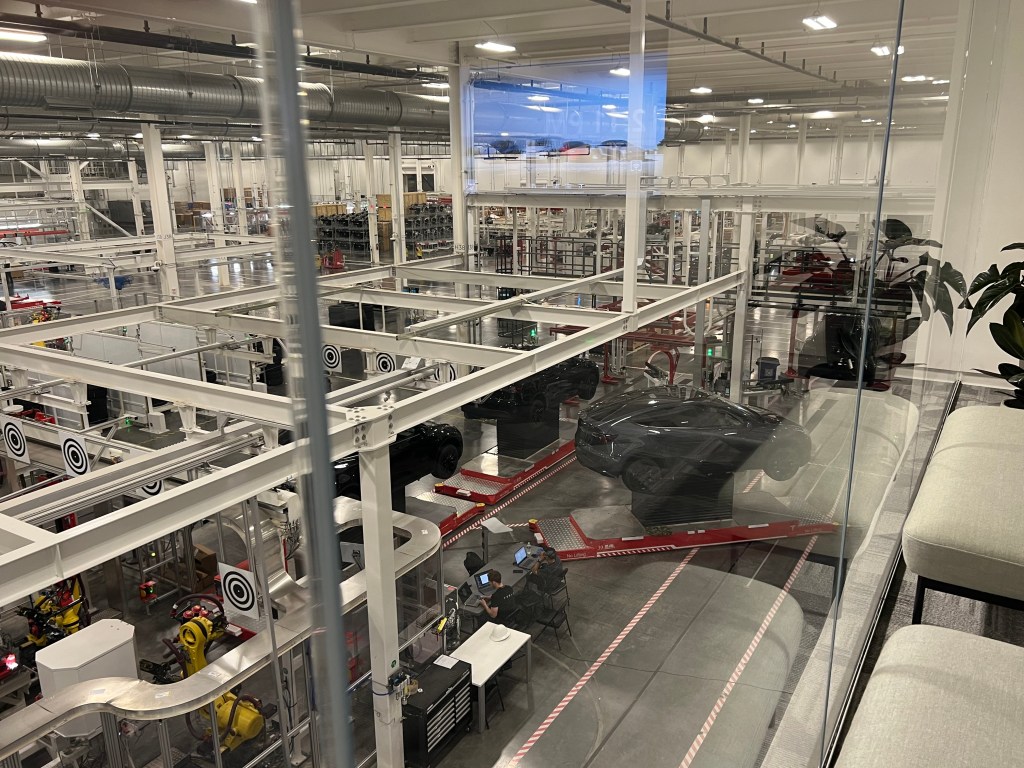
The conference room the interview was in gives you a floor-to-ceiling view of the inside of the gigafactory [see below]. Factory sounds were present, including Model Y horns beeping beyond the glass. We are all a witness to the beginning of something very big. Gigafactory Texas will soon produce an unprecedented number of Model Y, batteries, and Cybertrucks at a steady, fast pace.
Many people are interested in learning more about energy storage, so to have the chance to ask Elon a question about Distributed Energy Resources [DERs] and keeping Gigafactory Texas’ power on was a real honor!
What would you ask Elon Musk if you had the chance?
Gigafactory Texas as seen from the interview conference room. [credit Gail Alfar, All Rights Reserved, June 25, 2022]
5 Takeaways from Tesla’s 2022 Shareholder Meeting This article features highlights of what Elon Musk said about Tesla Gigafactories, AI, Cybertruck, Optimus robot, how we can help support the mission, and more.
Reasons Why Tesla Has the Best Factory Safety in the Industry This article will bring you along with me as we look into how Tesla has become a leader in job site safety in manufacturing. Our focus will be on statements about workplace safety from Elon Musk at the 2022 Shareholder’s meeting and the Tesla 2021 Impact Report.
You can subscribe to this blog here, and you can listen to the entire interview with Elon Musk here and on Spotify or Apple Podcasts.
Gail Alfar. Exclusive to What’s Up Tesla – This blog post was created utilizing STARLINK satellite services. All Rights Reserved. July 3, 2022
One-Time
Monthly
Yearly
Make a one-time donation to support What’s Up Tesla
Make a monthly donation to support What’s Up Tesla
Welcome back to my blog. I am excited to write about Tesla Energy. This week I was honored to host Johnna Crider in Austin when she was here to interview Elon Musk for her podcast, “Getting Stoned.” She invited me along, and even let me ask questions to Elon Musk about Tesla Energy. I will share more about that in the future after she releases her podcast. In this article, I will give a little background on the developments related to Tesla Energy in Texas. In November 2021, Elon Musk said,
“Tesla Megapack batteries will help stabilize the grid this winter” – Elon Musk
Tesla Working with ERCOT at Full Speed
Arushi Sharma Frank, US Energy Markets Policy Lead at Tesla, spoke about something few people know. Tesla has been working successfully for nearly three years with ERCOT. Here is part of what she said in public comments to the ERCOT Board of Directors on June 21, 2022. Arushi said,
"Tesla has been working with ERCOT in Texas to support its efforts to improve the resiliency and innovation of the grid.

In 2020 Tesla approached ERCOT for the first time to come up with the language in the nodal protocols that will allow Tesla Megapack to interconnect in the state.

We participated and collaborated with all stakeholders, utilities, independent generators, the consumer segment, and the whole group, and within a year we were able to pass changes that allowed a 100 Megawatt battery to interconnect timely the following summer.

For perspective, this was just a few months after storm Uri when the battery went live in June ... and support the grid immediately the next summer.

The one-year time period is incredible.

There is no other market where I think our company or any other company could change market rules, implement them and interconnect a 100 Megawatt battery in one year.

That was an incredible success! I want to make sure that everybody knows that it is an incredible precedent and that precedent must continue in how ERCOT addresses and how stakeholders address innovation in this market.

In 2021 Tesla sponsored another NPRR [Nodal Protocol Revision Request] which is happily on your agenda today as unanimously supported by the Technical Advisory Committee.

That is NPRR 1100. We came up with NPRR 1100 in its infancy when we realized that we had the ability to build another large battery on land that is contiguous with the Gigafactory Texas and we had more than one use case for how that battery could be used.”
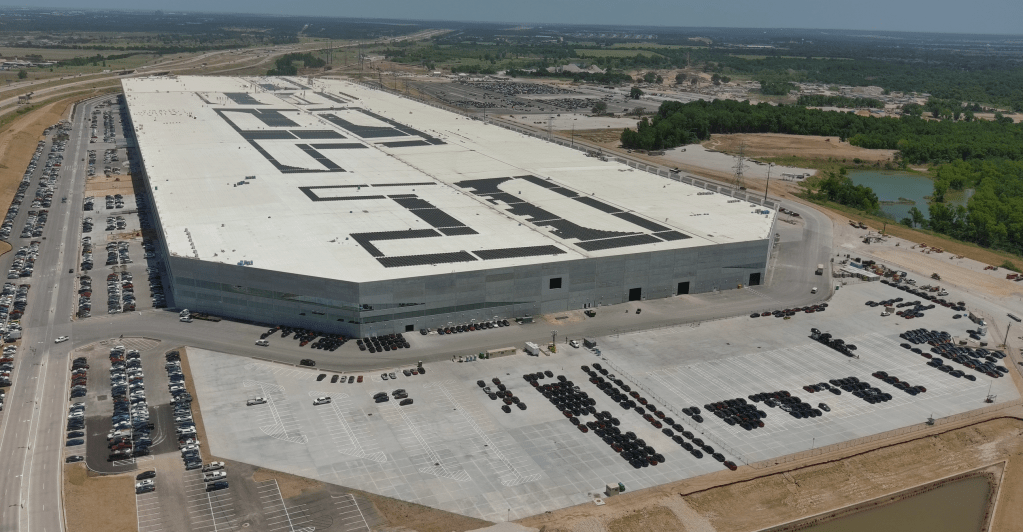
Gigafactory Texas Solar Roof spells TESLA June 23, 2022 Credit Jeff Roberts
Arushi explained that in the simplest case, the big battery can participate for its full nameplate value in the energy and ancillary services market and provide grid reliability services.
In another case, she explained,
“If the substation or the connection to the grid is down, and the battery just cannot get its energy out to the system, the battery could still be used and be connected locally as a microgrid to another load to help that load with its operations,” or to put it another way, when the grid is in a crisis and a substation is down and the load can’t get power from anywhere else, NPRR 1100 will allow that battery to provide that power.
In the case of Gigafactory Texas, Arushi explained that NPRR 1100 would allow the gigafactory to receive backup power for some functions such as the safe shutdown of critical equipment if there was a grid failure impacting the electric substation.
Protecting People and Businesses in the next Critical Emergency
I interpret that what Tesla is offering to the grid will help protect people and businesses in the next critical emergency. Arushi explains it this way,
“The reason this NPRR is so important is that it creates a brand new value proposition for large batteries which could be essential to a lot of large critical loads in the state.

Think hospitals, think companies that make toilet paper, think anything that can suffer from a grid emergency and allow those companies to enter into contracts with developers of large batteries, and that contract is still economic for the developer, because on a good day they can participate in the market and get that value from the ERCOT but on a bad day they can turn around and use that large capacity the system to support safe operations at a very large facility.  We're talking facilities with loads of 50 to 100 megawatts.
DERs [Distributed Energy Resources]
The Texas grid can become even more stable with the help of individual powerwall owners’ contributions. Arushi explained Tesla’s next step,
“I want to end it by talking about Tesla’s next initiative, and that is something you’ve heard about in the news I’m sure, as well as from ERCOT directly - and that is figuring out the reliability of the distributed energy system. Tesla’s first initiative in 2020 was about Tesla participating as an independent generator in the market. Tesla’s second initiative was about Tesla participating as an industrial consumer in this market.

This initiative is about Tesla’s customers.  And it is also about the retail energy offer that Tesla can bring to this market that relies primarily on the reliability and the innovation that is waiting on the distributed system, to the tune of gigawatts.

It is going to be a lot of work and we know it is because DER  [Distributed energy resources] integration has taken work in every market. It is probably going to take three or four years.

But the efforts that Tesla has led over the past year not only speed things up but will allow this market to dip its toe in the water and do so by using private companies like us to take the front load of the efforts to support the studies that are needed to change the system for the better.

If the board has questions or if you believe the ERCOT staff should be working on these specific issues we would love the board's support and the public support to unlock this next step of resiliency on the grid. Thank you.”
You can listen to Arushi Sharma Frank’s comments at the Texas Public Utility Council Board meeting here.
A brief summary and my thoughts
Tesla is ramping up its participation in strengthening the Texas grid with big batteries, and soon with DERs that include powerwalls from Tesla customers. Tesla has already helped support the grid, and has done it faster than expected. We depend on power all the time, for our devices, our apartments, food storage, and just about everything. Power requirements are increasing, not decreasing. All people, globally, will one day rely on energy stored in giant batteries.
Here are two ways you can support these efforts, and you do not need to own a Tesla or Powerwalls to do it.
Send an email to your state’s utility commission or power provider expressing your support for a strong energy grid based on battery storage.
Take the opportunity to learn about Virtual Power Plants and Distributed Energy Resources.
Here is a link to information about Tesla Powerpack [Utility and Business Energy Storage]
Tesla’s Texas Virtual Power Plant ASAP details how Tesla is offering a proven solution to the fragile Texas grid currently operated by ERCOT. Tesla has proved that its Virtual Power Plant can work extremely well.
Gail Alfar [Edited by Sarah Alfar] Exclusive to What’s Up Tesla – This blogpost was created utilizing STARLINK satellite services. All Rights Reserved. June 26, 2022
One-Time
Monthly
Yearly
Make a one-time donation to support What’s Up Tesla
Make a monthly donation to support What’s Up Tesla












 whatsuptesla.com