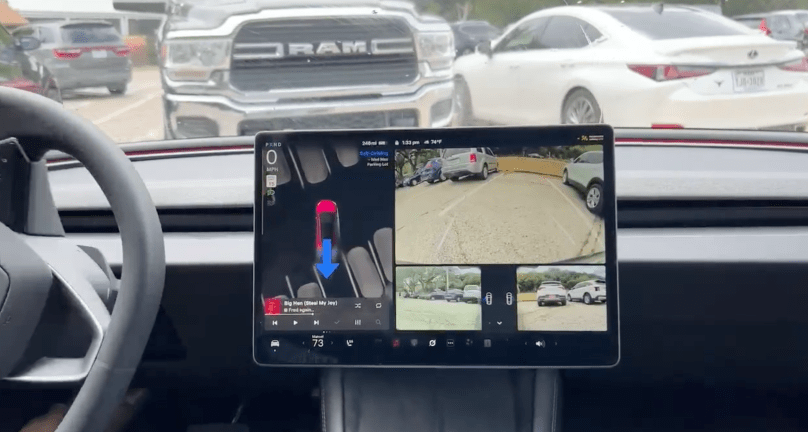
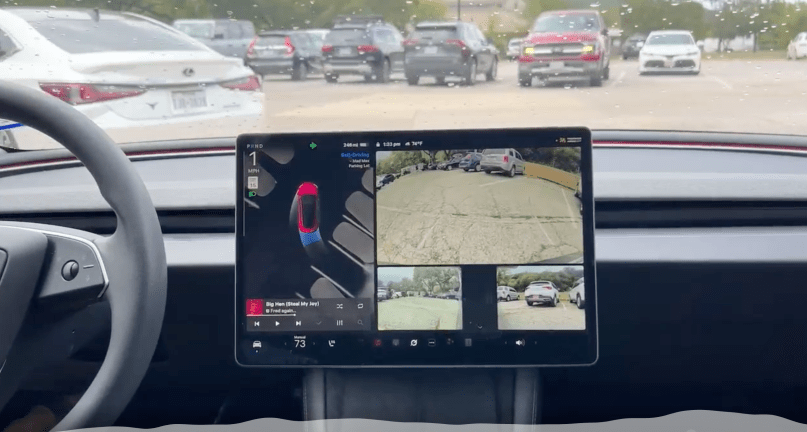
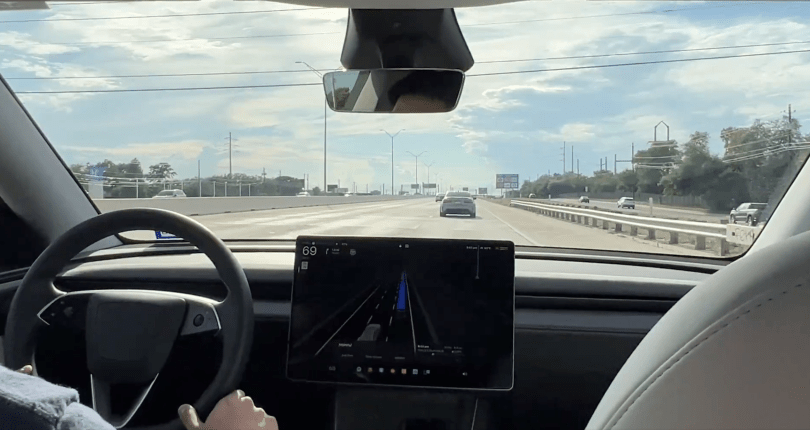
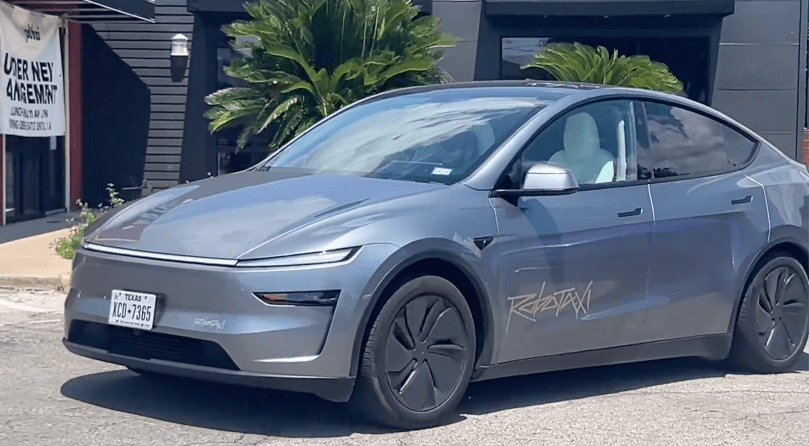
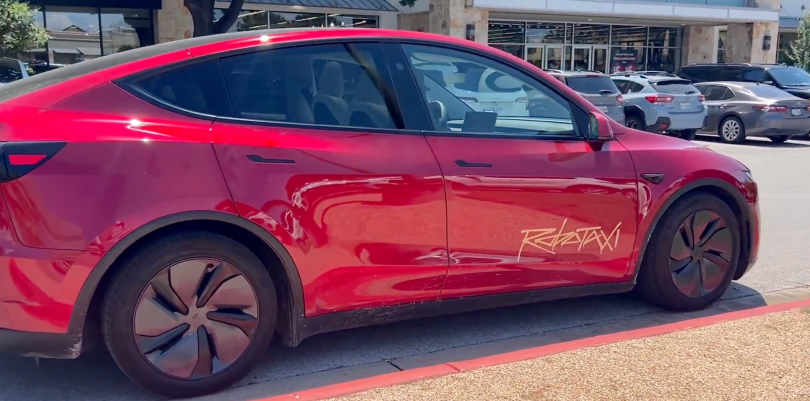
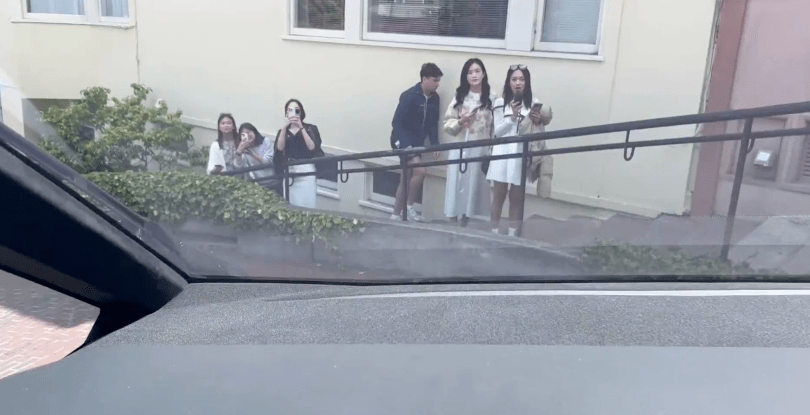
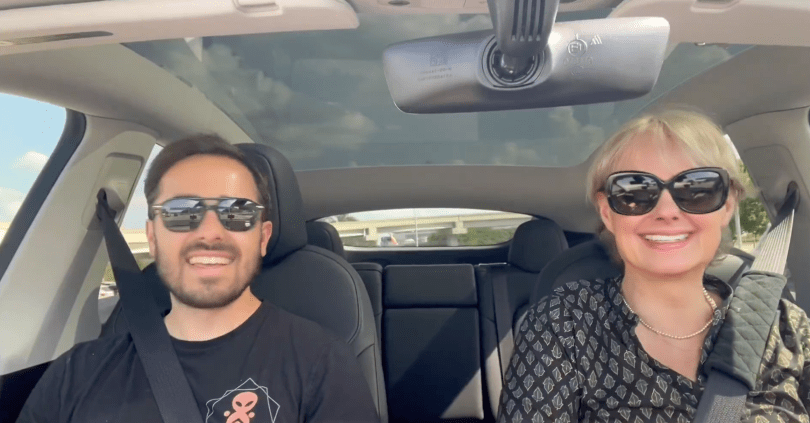
Austin, Texas. Join Gali and I in a conversation about the exciting future of Robotaxi. Gali is a Tesla OG & my fav YouTuber! He’s got a lot of positive energy and his takes are widely appreciated!
Watch here:
Ep 122 of Gail’s Podcast is here! 🎙️ Chatting with HyperChange’s @Gfilche Tesla OG & my fav YouTuber! 🚗⚡️ Epic stories & bold takes from the Tesla world. A must-listen! 🌟 pic.twitter.com/JTdraJdCPP
FOR MEDIA USE ONLY News media is welcome to use my material in connection with a story or article. By downloading any content I create, you understand and hereby agree and represent that: (1) you are a member of the news media; (2) use of the content is in connection with a story or an article appearing in newspapers, periodicals, digital publications or television; (3) all images and rights thereto remain the property Gail Alfar.; and (4) use of the image is not for publication covers, advertising, promotion or otherwise for commercial purposes. Furthermore, use of any and all images and content appearing on this page must each include the notice “Courtesy of Gail Alfar” Use of materials copied from this website is at your own risk. You must obtain prior written consent from Gail Alfar for uses that exceed the above parameters.
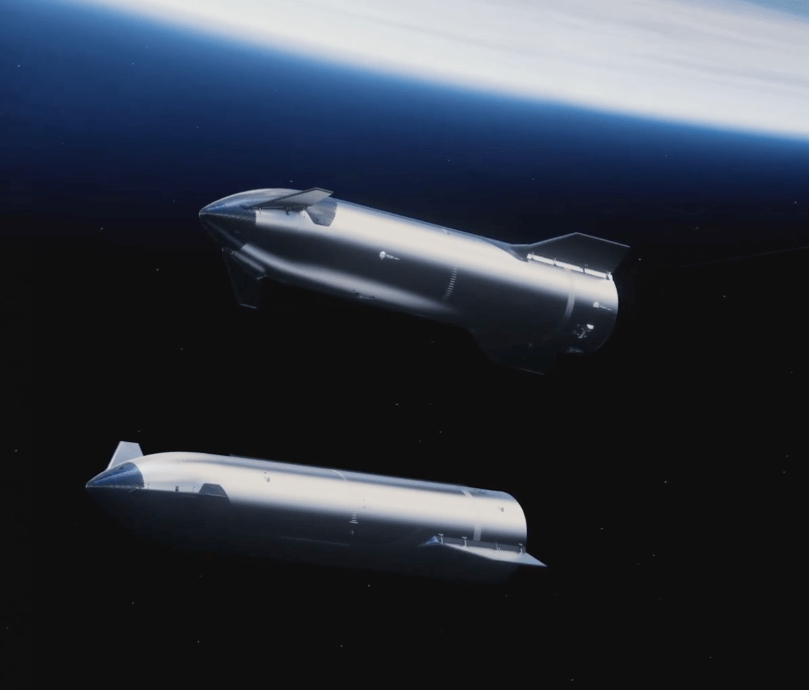
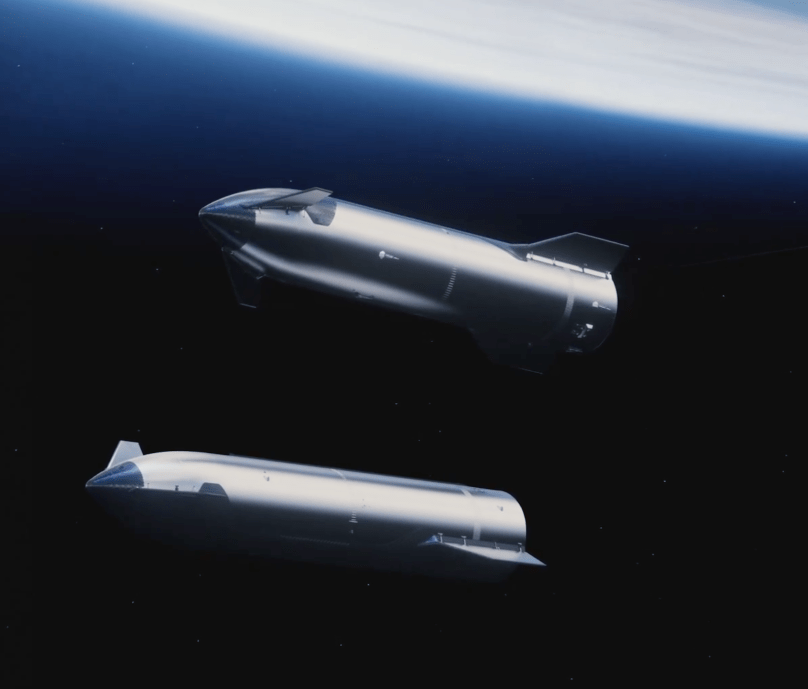
“A key technology for Mars is orbital propellant transfer, like aerial refueling for airplanes, but for rockets. It’s never been done but is technically feasible”
Elon: And one of the technologies that is key for Mars, is doing orbital propellant transfer. So you can think of this like, similar to aerial refueling for airplanes, but in this case it’s orbital refilling of rockets, which has never been done before, it is technically feasible. I always feel like these things are a little NSFW (laughter), sort of.
Listen, you’ve got to transfer fluid somehow, it’s just got to be done! So the two Starships would get together, and one Starship would transfer fuel and oxygen, and most of the mass is oxygen. It is almost 80% oxygen that gets transferred. A little over 20% fuel and so you send a Starship to orbit that is full of payload and then you send up a bunch of other Starships up and then you would refill the propellant on that Starship. And once the propellant tanks are mostly full then you can depart for Mars or the Moon.
This is important technology, which we should hopefully demonstrate next year.
Source: Video from Elon Musk’s 2026 Mars Company Talk
“Raptor 3 requires no basic heat shield, saving mass and improving reliability”
Elon: This is the new Raptor 3, an awesome engine! Big hand to the Raptor team. Raptor 3 requires no basic heat shield, saving mass and improving reliability. A small fuel leak will leak into the flaming plasma and not matter, unlike a boxed engine where it’s scary. It’ll take a few tries, but it’ll massively increase payload capability, efficiency, and reliability. It’s alien technology.
Industry experts thought an incomplete Raptor 3 picture wasn’t firing, but it was at unprecedented efficiency.
[Lots of cheers and applause for Raptor 3 at Elon’s Mars 2023 Company Talk]
Elon: We hope to demonstrate this later this year, maybe in two or three months. The ship would be placed on the booster, refilled, and flown again. The ship takes longer because it orbits Earth a few times until the ground track returns to the launchpad. It’s intended to be reflown multiple times per day.
[Video during Elon’s Mars 2026 Company Talk shows a render of a Starship gently caught by chopsticks.]
Elon: There’s a person next to it that looks like a tiny ant. That’s our Giga Bay!
[Elon points to a render of a massive building]
We’re expanding integration to produce 1,000 per year. The Giga Bay hasn’t been built yet, but we’re building it. It’s a truly enormous structure, one of the biggest in the world by some measures, designed for 1,000 Starships per year. We’re also building a Giga Bay in Florida, so we’ll have two facilities—one in Texas and one in Florida. It’s difficult to gauge the size of these buildings because you need a human for scale. When you see how tiny a human is next to it, you realize how enormous it is.
Elon: We’re now at the point where we can produce a ship roughly every two or three weeks. We don’t always produce a ship every two or three weeks because we’re making design upgrades, but ultimately we’re aiming for the ability to produce 1,000 ships a year, so three ships a day.
[On the video, birds chirp, water glistens, and a hovercraft pulls gently away from Starbase Beach.]
Elon (smiling): That’s our hovercraft. We’re driving the booster down the road to the launch site. You see the Megabays. The cool thing for those watching is you can literally come here, drive down the road, and see it. This is the first time in history that’s been possible. That highway on the left is public. You can just come and see it, which I recommend. It’s very inspiring.
Elon: We started with basically nothing. Starbase started as a sandbar with nothing.
Elon: Even those little things we built. That’s the original Mad Max rocket!
[Looking at the rocket from 2019, six years ago, the camera pans around it. The sun hits the side, revealing a gorgeous, surreal piece of steel.]
Elon: You know, lighting is very important for that Mad Max rocket.
[Elon is smiling, with his hand in a determined fist. He’s not afraid of silence; this is a tribute to that incredible rocket. Many employees in the audience may not have seen it in person; it’s six years old. Some may have been in high school at the time.]
Elon: Not long ago, there was basically nothing here. In about five or six years, thanks to the incredible work of the SpaceX team, we’ve built a small city. We built two gigantic launchpads and a gigantic rocket factory for a gigantic rocket. The cool thing is, anyone watching can come visit because our entire production facility and launch site are on a public highway. Anyone in South Texas can see the rocket up close, see the factory, and anyone interested in the largest flying object on Earth can drive down the public highway and see it! Pretty cool!
Welcome to Part 3 of my series on Elon’s August 16, 2024, West Point talk, released on February 6, 2025. If you missed the earlier parts, you can catch up here: Part 1 and Part 2.
In this final installment, Brigadier General Shane Reeves explores in detail the future of warfare, the role of space, and Elon’s approach to leadership and innovation.
Drones and the Battlefield: A New Reality
Reeves asked Elon about integrating technology with human pilots and its implications for warfare. Elon responded:
“At the front of the battle line, it’s just going to be drones. Any humans caught in that crossfire are going to be killed.”
Elon elaborated, painting a vivid picture of drone warfare:
“If you’ve got drones constantly scanning—thousands of them, maybe a million, like Ukraine’s planning—you don’t want to be there trying to take out drones with an assault rifle. It’s not a good situation.”
He proposed an unexpected countermeasure:
“If you go fully analog with mechanical controls and do an electromagnetic pulse (EMP) blast, you could take out all electronics. A fully analog fighter plane could be a role—like a Tom Cruise movie where he flies an analog aircraft, and all the drones fall from the sky.”
Elon Musk inspires West Point graduates, “Try. Just try thinking of interesting ideas. Read about many fields and cross-fertilize ideas. For example, SpaceX used automotive mass-manufacturing techniques, and Tesla applied space industry materials optimization. That’s a superpower.”
Building Trust with Industry
Reeves raised concerns about industry reluctance to develop technology for the Department of Defense, emphasizing the need for trust with the industrial base and society. Elon, a solid supporter of the military, responded:
“I’m very pro-military, to be clear.” (Met with loud applause.)
He drew parallels to historical shifts:
“If there’s a significant conflict, the US industrial base will switch quickly to military production, just as it did in World War II. Will it be quick enough? I don’t know. AI and drones—that’s the future of warfare.”
Space: The Ultimate High Ground
On the role of space in warfare, Elon was emphatic:
“Space is the ultimate high ground. It’s big. Real big. Earth is like a tiny dust mote floating in space.”
He stressed the importance of space-based communications:
“Ground-based communications—fiber optics, cell towers—will be destroyed. All you’ve got are analog radios and space-based data communications. GPS is easily jammed because it’s a weak signal. A next-generation positioning system is critical.”
Elon also touched on space-based weaponry:
“You could have kinetic weapons—like tungsten cannonballs, known as rods from God—or space-based lasers. Starlink technically has lasers, but they’re low-powered… for now.” (Laughter)
Leadership: The Cavalry Captain Must Ride
Reeves connected military history to Elon’s businesses, asking about the traits he seeks in leaders. Elon emphasized technical competence:
“If someone’s leading a complex engineering project, they must be good at engineering. They don’t need to be the best, but they must be competent. It’s like a cavalry captain who can’t ride a horse—great in every way, but falls off in battle. That’s not inspiring.”
Elon critiqued leadership mismatches:
“Take Boeing’s CEO—he’s got a degree in accounting. If you’re running an airplane company, you should know how airplanes work, how they’re designed. That’s vital.”
Fostering Innovation
Reeves asked how Elon cultivates innovative intuition. Elon suggested:
“Try. Just try thinking of interesting ideas. Read about many fields and cross-fertilize ideas. For example, SpaceX used automotive mass-manufacturing techniques, and Tesla applied space industry materials optimization. That’s a superpower.”
On balancing caution and risk, Elon said:
“If you’re not failing sometimes, you’re not trying hard enough. Nobody bats 1000, but you can’t bat zero either.”
Elon’s First-Principles Algorithm
Elon shared a practical framework for problem-solving:
“1. Make the requirements less dumb. Even if they come from the smartest person, they’re still dumb. Military procurement often starts with excessive requirements. 2. Delete parts or process steps. If you’re not adding back 10% of what you deleted, you haven’t deleted enough. 3. Optimize what remains. 4. Go faster. 5. Automate—only after the above steps.”
He cautioned against common pitfalls:
“Smart engineers often optimize things that shouldn’t exist—like perfecting a cloth biplane when we need jet airplanes.”
Elon gives great advice on fostering learning: “Curiosity. Read as much as possible, learn across fields, and apply critical thinking to everything you’re told.”
Curiosity: The Key Attribute
As the interview closed, Reeves asked Elon for the one attribute critical for future officers. Elon’s answer was succinct:
“Curiosity. Read as much as possible, learn across fields, and apply critical thinking to everything you’re told.”
Elon concluded with a powerful metaphor:
“America is like Atlas holding up the free world, and you—the graduating class—are the arms of Atlas.”
Applause erupts.
My Thoughts
Elon’s West Point talk was a masterclass in his visionary thinking, he made sense of the reality of modern warfare and combines it with practical leadership expectations.
IMPORTANT: Elon’s emphasis on drones and space as the future of conflict is a wake-up call for military strategists.
NOTE: Elon’s insistence on curiosity and first-principles problem-solving resonates most. Our world is rapidly changing, and Elon’s call for leaders who are technically competent and relentlessly curious is a blueprint for success—not just in warfare, but in any field.
As you reflect on his words, perhaps you will be struck by the urgency of adapting to this new era while staying grounded in critical thinking and innovation.
Austin, Texas. On Episode 119 of Gail’s TESLA Podcast on 𝕏: FSD tackles a tricky lot (supervised), and we look at some of Elon Musk’s quotes from tonight’s Austin all-hands meeting & I demo FSD basics!
Watch here:
Ep 119 of Gail’s TESLA Podcast on 𝕏: FSD tackles a tricky lot (supervised), Elon Musk’s quotes from tonight’s Austin all-hands, & I demo FSD basics! pic.twitter.com/9RiXeyayAP
FOR MEDIA USE ONLY News media is welcome to use my material in connection with a story or article. By downloading any content I create, you understand and hereby agree and represent that: (1) you are a member of the news media; (2) use of the content is in connection with a story or an article appearing in newspapers, periodicals, digital publications or television; (3) all images and rights thereto remain the property Gail Alfar.; and (4) use of the image is not for publication covers, advertising, promotion or otherwise for commercial purposes. Furthermore, use of any and all images and content appearing on this page must each include the notice “Courtesy of Gail Alfar” Use of materials copied from this website is at your own risk. You must obtain prior written consent from Gail Alfar for uses that exceed the above parameters.
Whether I am at headed to work, doing errands, or heading out to see a friend, I’m using Tesla FSD for every mile driven. In this video podcast episode, you’ll join me as we go to a classic Estate Sale in Austin, Texas.
We will start Tesla FSD from the moment we are parked. So, from PARK to arrival, the while drive is fully autonomous.
FOR MEDIA USE ONLY News media is welcome to use my material in connection with a story or article. By downloading any content I create, you understand and hereby agree and represent that: (1) you are a member of the news media; (2) use of the content is in connection with a story or an article appearing in newspapers, periodicals, digital publications or television; (3) all images and rights thereto remain the property Gail Alfar.; and (4) use of the image is not for publication covers, advertising, promotion or otherwise for commercial purposes. Furthermore, use of any and all images and content appearing on this page must each include the notice “Courtesy of Gail Alfar” Use of materials copied from this website is at your own risk. You must obtain prior written consent from Gail Alfar for uses that exceed the above parameters.