
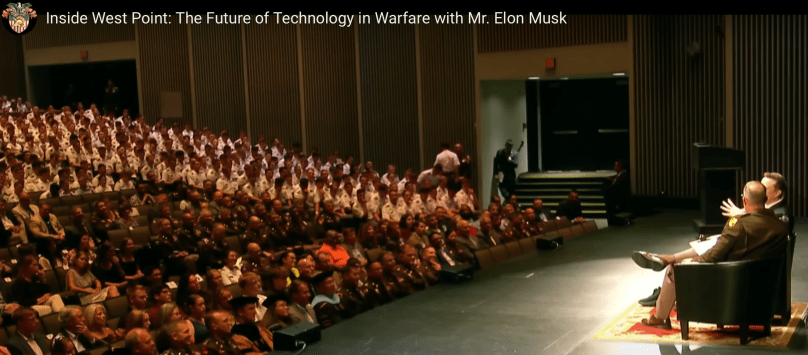
Welcome to Part 3 of my series on Elon’s August 16, 2024, West Point talk, released on February 6, 2025. If you missed the earlier parts, you can catch up here: Part 1 and Part 2.
In this final installment, Brigadier General Shane Reeves explores in detail the future of warfare, the role of space, and Elon’s approach to leadership and innovation.
Drones and the Battlefield: A New Reality
Reeves asked Elon about integrating technology with human pilots and its implications for warfare. Elon responded:
“At the front of the battle line, it’s just going to be drones. Any humans caught in that crossfire are going to be killed.”
Elon elaborated, painting a vivid picture of drone warfare:
“If you’ve got drones constantly scanning—thousands of them, maybe a million, like Ukraine’s planning—you don’t want to be there trying to take out drones with an assault rifle. It’s not a good situation.”
He proposed an unexpected countermeasure:
“If you go fully analog with mechanical controls and do an electromagnetic pulse (EMP) blast, you could take out all electronics. A fully analog fighter plane could be a role—like a Tom Cruise movie where he flies an analog aircraft, and all the drones fall from the sky.”
Building Trust with Industry
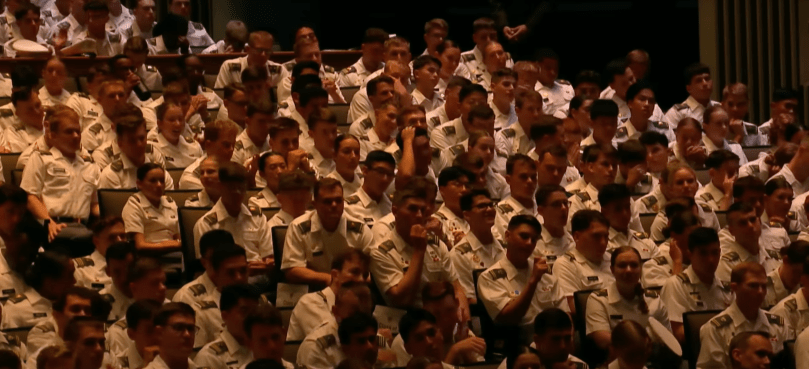
Reeves raised concerns about industry reluctance to develop technology for the Department of Defense, emphasizing the need for trust with the industrial base and society. Elon, a solid supporter of the military, responded:
“I’m very pro-military, to be clear.” (Met with loud applause.)
He drew parallels to historical shifts:
“If there’s a significant conflict, the US industrial base will switch quickly to military production, just as it did in World War II. Will it be quick enough? I don’t know. AI and drones—that’s the future of warfare.”
Space: The Ultimate High Ground
On the role of space in warfare, Elon was emphatic:
“Space is the ultimate high ground. It’s big. Real big. Earth is like a tiny dust mote floating in space.”
He stressed the importance of space-based communications:
“Ground-based communications—fiber optics, cell towers—will be destroyed. All you’ve got are analog radios and space-based data communications. GPS is easily jammed because it’s a weak signal. A next-generation positioning system is critical.”
Elon also touched on space-based weaponry:
“You could have kinetic weapons—like tungsten cannonballs, known as rods from God—or space-based lasers. Starlink technically has lasers, but they’re low-powered… for now.” (Laughter)
Leadership: The Cavalry Captain Must Ride
Reeves connected military history to Elon’s businesses, asking about the traits he seeks in leaders. Elon emphasized technical competence:
“If someone’s leading a complex engineering project, they must be good at engineering. They don’t need to be the best, but they must be competent. It’s like a cavalry captain who can’t ride a horse—great in every way, but falls off in battle. That’s not inspiring.”
Elon critiqued leadership mismatches:
“Take Boeing’s CEO—he’s got a degree in accounting. If you’re running an airplane company, you should know how airplanes work, how they’re designed. That’s vital.”
Fostering Innovation
Reeves asked how Elon cultivates innovative intuition. Elon suggested:
“Try. Just try thinking of interesting ideas. Read about many fields and cross-fertilize ideas. For example, SpaceX used automotive mass-manufacturing techniques, and Tesla applied space industry materials optimization. That’s a superpower.”
On balancing caution and risk, Elon said:
“If you’re not failing sometimes, you’re not trying hard enough. Nobody bats 1000, but you can’t bat zero either.”
Elon’s First-Principles Algorithm
Elon shared a practical framework for problem-solving:
“1. Make the requirements less dumb. Even if they come from the smartest person, they’re still dumb. Military procurement often starts with excessive requirements. 2. Delete parts or process steps. If you’re not adding back 10% of what you deleted, you haven’t deleted enough. 3. Optimize what remains. 4. Go faster. 5. Automate—only after the above steps.”
He cautioned against common pitfalls:
“Smart engineers often optimize things that shouldn’t exist—like perfecting a cloth biplane when we need jet airplanes.”
Elon gives great advice on fostering learning: “Curiosity. Read as much as possible, learn across fields, and apply critical thinking to everything you’re told.”
Curiosity: The Key Attribute
As the interview closed, Reeves asked Elon for the one attribute critical for future officers. Elon’s answer was succinct:
“Curiosity. Read as much as possible, learn across fields, and apply critical thinking to everything you’re told.”
Elon concluded with a powerful metaphor:
“America is like Atlas holding up the free world, and you—the graduating class—are the arms of Atlas.”
Applause erupts.
My Thoughts
Elon’s West Point talk was a masterclass in his visionary thinking, he made sense of the reality of modern warfare and combines it with practical leadership expectations.
IMPORTANT: Elon’s emphasis on drones and space as the future of conflict is a wake-up call for military strategists.
NOTE: Elon’s insistence on curiosity and first-principles problem-solving resonates most. Our world is rapidly changing, and Elon’s call for leaders who are technically competent and relentlessly curious is a blueprint for success—not just in warfare, but in any field.
As you reflect on his words, perhaps you will be struck by the urgency of adapting to this new era while staying grounded in critical thinking and innovation.
 whatsuptesla.com