Many people might be ready to hand over car keys for good at age 93. And Dan Doyle’s mother is doing the opposite and she’s doing it beautifully.
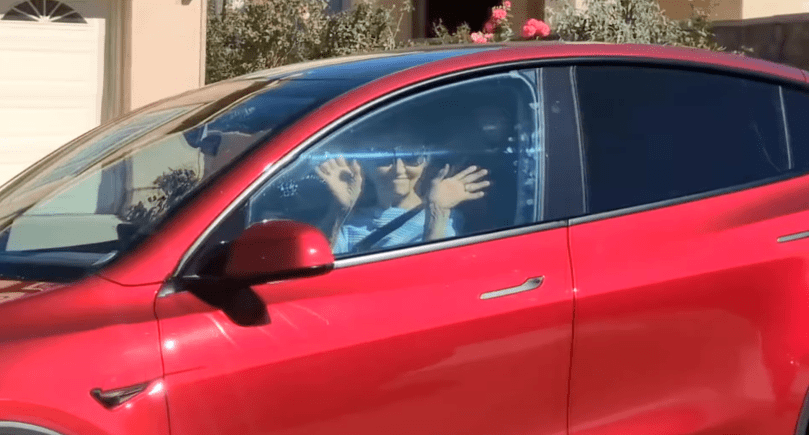
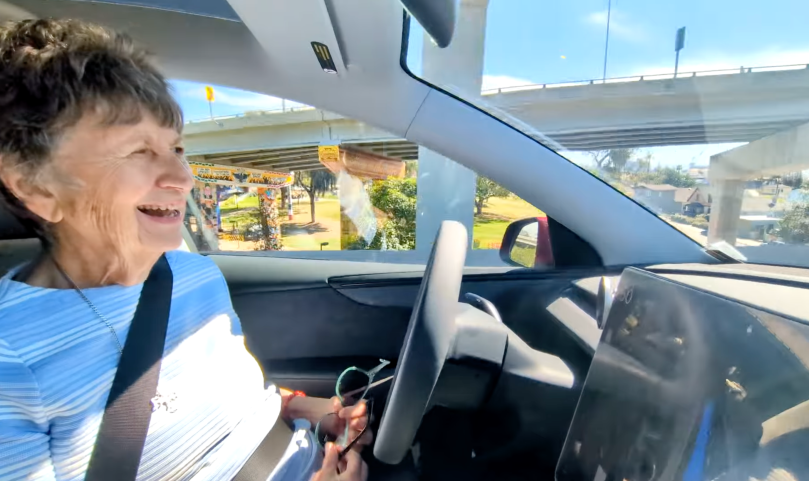
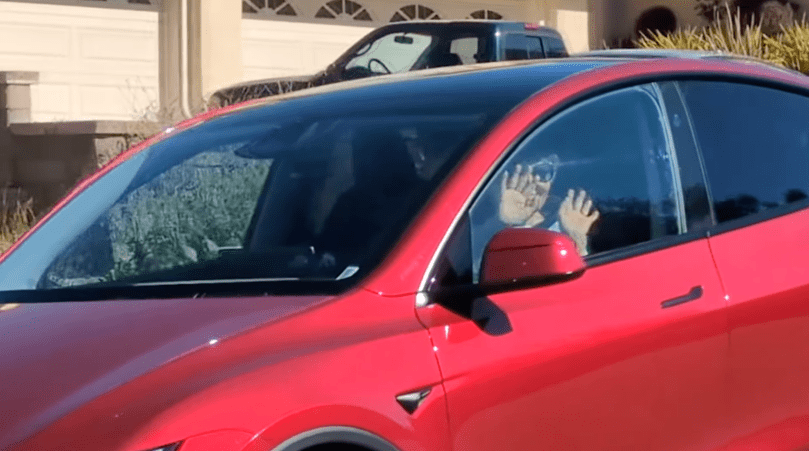
In a lovely video posted on Dan Doyle’s Family Channel, we get to see Dan’s 93-year-old mom behind the wheel of her brand-new Tesla Model Y with Full Self-Driving (FSD). The footage shows her relaxed and smiling as the car smoothly handles real roads, including the scenic Coronado Bridge drive.
When Dan asks how one of her recent trips went, her simple, perfect response is: “Uneventful.”
That single word says so much. For many seniors, longer drives often come with growing anxiety and fatigue. But with FSD doing the hard work, those worries melt away.
During one drive, Dan playfully tells the car, “Hey, if the worship isn’t good, could you go a little slower?” The Tesla’s Grok voice (Ara) replies with humor: “Huh? Nice one. Hope the worship rocks so we don’t have to slow down.”
Laughing and smiling, his mom immediately adds, “I love that lady.”
Later, while enjoying gelato together, Dan asks, “Life is good, right Mom?” Her bright smile says it all: “Life is good.”
As Dan shares in the video:
“Although she has always been a good driver, my mom can now drive without the fear or fatigue that can naturally come with age. No more relying on others for every trip. No more feeling stuck. This is true mobility.”
The story was first shared on X by citizen journalist Sawyer Merritt, and Dan later confirmed on his X account that his mom still holds a valid driver’s license and owns two other vehicles. She’s simply enjoying the freedom her new Tesla brings.
That's a valid question… She can drive…. She has her driver's license, she owns two other vehicles and simply switched over to this one. She's been driving her whole life and she's doing wonderfully. My mother is amazing!
As someone who uses FSD every day myself, especially lately while recovering from a third-degree ankle sprain, I can personally relate to how meaningful this technology is. When your body isn’t cooperating, having a car that can reliably and safely handle the driving gives you back a piece of your independence.
This is what FSD looks like in real life: not just futuristic tech, but a quiet, powerful tool that helps real people, including a joyful 93-year-old woman, keep living life on their own terms.
Sometimes the most important stories are the simplest ones.
Joyful 93-year-old mom smiling while using Tesla FSD. ‘Life is good,’ she says from the driver’s seat of her Tesla Model Y.
Tesla Model Y with Full Self-Driving smoothly navigating suburban roads for a confident 93-year-old senior driver.
On 23 March 2026, Daniel Geiger posted a 22-second screen-recording that quietly went viral. The California driver, who is deaf, showed his Tesla’s Full Self-Driving feature automatically detecting an approaching ambulance’s lights, pulling over safely and stopping, all before the vehicle reached him. “I’m deaf and can’t hear sirens,” he wrote, “but my Tesla FSD pulled over instantly for an ambulance. … This is why FSD is huge for deaf drivers: it ‘hears’ what I can’t and keeps everyone safer.”
Geiger is an ordinary working professional, not an influencer or company employee. A Long Island native from Moriches, New York, he played college lacrosse at Sacred Heart University (class of 2005) and earned a degree in Information Technology. He now lives in Auburn, California, and works as an IT security specialist for the California Department of Social Services. On social media he talks about sports, state taxes, potholes and, occasionally, how technology intersects with disability.
I'm deaf and can't hear sirens, but my Tesla FSD pulled over instantly for an ambulance. I caught it on the app screen record. This is why FSD is huge for deaf drivers: it “hears” what I can't and keeps everyone safer. 🚑🤖 #Tesla#FSD#DeafCommunity#Accessibilitypic.twitter.com/LDZbt5QJPT
The incident occurred on 23 March 2026 during a normal drive in the greater Sacramento area. The car’s multimodal sensors (cameras plus the audio-siren detection rolled out in late 2024) handled the situation smoothly. Geiger simply shared the app recording to illustrate one benefit for deaf drivers.
For Americans the context is immediate. Under California Vehicle Code 21806, drivers must yield the right of way to any emergency vehicle using lights and siren: move to the right edge of the road and stop until it passes. Failure to do so is an infraction carrying a base fine of about $490 plus one point on your DMV record. Similar “move-over” or yield laws exist in every state because seconds can mean lives. Deaf drivers follow the same rules but cannot hear the siren that usually alerts everyone else. Geiger’s video shows how one vehicle system can fill that sensory gap while still obeying the same traffic laws everyone else must follow.
He posted the clip because he wanted to highlight a practical safety tool, not to sell cars. The response from other deaf drivers and everyday motorists suggests the story resonated beyond brand loyalty: it showed technology quietly making an existing legal obligation easier to meet for people who otherwise rely on visual cues alone.
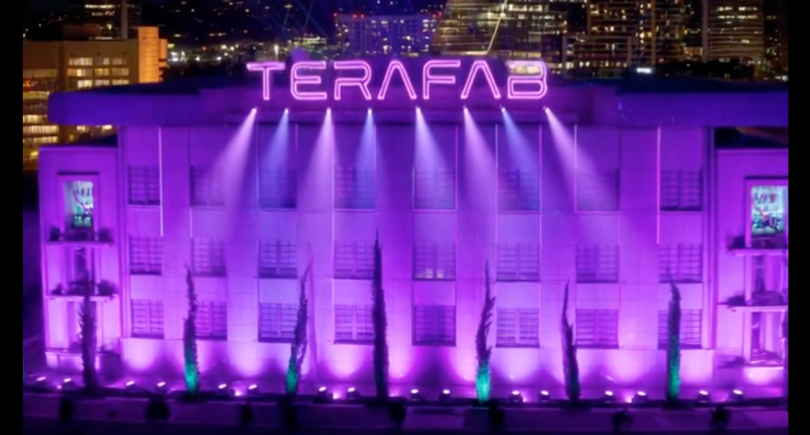
On March 21, 2026, at the historic Seaholm Power Plant in Austin, Elon Musk unveiled Terafab: a $20–25 billion semiconductor factory, the result of cooperation between Tesla, SpaceX, and xAI. The stated objective: to produce more than one terawatt of computing power per year, equivalent to nearly the entire current electric power capacity of the United States.
Eighty percent of this capacity would be dedicated to orbital data centers, powered by space-based solar energy via SpaceX launchers. The remainder would supply Tesla’s autonomous vehicles, Optimus humanoid robots, and xAI’s artificial intelligence models. Musk summed it up bluntly: “Either we build Terafab, or we won’t have the chips.”
This project marks a new stage in the vertical integration of the entrepreneur’s companies. While no formal rapprochement has been confirmed, the pooling of resources between a publicly traded company (Tesla) and a private enterprise (SpaceX) is fueling speculation about a deeper merger. Analysts such as Gary Black warn of dilution risks for Tesla shareholders and regulatory obstacles.
For Europe, which is investing heavily through the Chips Act to reduce its dependence on Asian foundries, Terafab illustrates both a threat and a strategic question. An unprecedented concentration of computing capacity in private American hands could disrupt global supply chains. Musk, for his part, presents the project as a response to Earth’s energy limits and a means of ensuring that human knowledge can survive beyond the planet.
The challenges remain immense: Tesla and SpaceX have no experience manufacturing 2-nanometer chips, the capital expenditure is colossal, and timelines remain unclear. The market reacted cautiously: Tesla’s share price barely moved.
Whether Terafab succeeds or not, one thing is clear: Musk’s ecosystem is evolving toward unprecedented industrial integration. Europe, which has always believed in large collective adventures—Airbus, Ariane, ITER—is watching this new form of private competition closely. The future will show whether it can respond.
Austin will have an advanced technology fab. TERAFAB location is TBD. Elon confirmed it is far too massive for Giga Texas and would dwarf everything there combined. Multiple sites are being evaluated, as it requires thousands of acres and over 10 GW of power at full scale. https://t.co/RV6Sj2JJuSpic.twitter.com/LPGKXKaatC
Tesla CEO Elon Musk just dropped news: the long-awaited next-gen Tesla Roadster will be unveiled “hopefully next month, probably in late April.” He called it a “banger next-level” vehicle, directly tying it back to the groundbreaking 2008 original that launched Tesla’s electric revolution. Far from any reason for doubt, this is a genuinely hopeful moment, a celebration of high performance that fills many with hope to deliver powerful acceleration and speed.
In a wide-ranging January 2026 interview on the Moonshots podcast with Peter Diamandis and Dave Blundin, Elon made the new Roadster vision clear. “Safety is not the main goal,” he explained. If maximum safety is your top priority, this is not the car for you. The Roadster is built for pure fun and thrill instead. He also stressed it won’t be the cheapest vehicle Tesla makes, because that isn’t the objective either. The goal is simple: create the best of the last great human-driven cars, a pure performance machine that puts smiles on faces.
The goal is simple: create the best of the last great human-driven cars, a pure performance machine that puts smiles on faces.
Hints dropped in that conversation (and reinforced by the CEO’s recent posts) are being monitored by many. Base performance is already staggering: approximately 1.9-second 0-60 mph acceleration, a top speed over 250 mph, and impressive range. Add the optional SpaceX cold-gas thruster package and you’re looking at sub-1-second sprints, possible short-hover capability, and driving experiences that feel straight out of science fiction.
The base model is expected to start around $200,000, positioning it as a more accessible luxury sports car compared to traditional hypercars in its class (many of which start well above $300,000–$500,000). The SpaceX thruster upgrade will add a significant premium for those seeking the ultimate extremes, but the core Roadster remains a thrilling entry into next-level electric performance without the ultra-exotic price tag.
NEWS: Tesla has filed new trademark applications for its next-generation Roadster, hinting that the unveil is drawing closer.
The first application includes a stylized “Roadster” wordmark, while the second includes what seems to be the Roadster’s new design.
This isn’t going to be another typical car launch. Sometimes we all need a joyful reminder that electric vehicles can be wildly exciting. The Roadster will give drivers that pure, exhilarating connection to the road while staying zero-emission and sustainable. Late April can’t come soon enough and when the new Roadster arrives, it will quietly show that Tesla’s products are not hype, they may be late, but they always come through.
My first time driving the first gen Roadster – June 2024 at the Tesla Takeover Europe Event 😀 pic.twitter.com/XlsHDmrR0Q
Living here in Austin, Texas, where traffic on Mopac can flip from smooth to nightmare in a heartbeat (especially when there’s an accident or some surprise Texas rain), safety is always on my mind. That’s why I got so excited when Tesla announced this massive milestone on February 18, 2026!
Tesla drivers around the world have now driven more than 8 billion miles (nearly 13 billion km) using Full Self-Driving Supervised. Even more mind-blowing? They added 1 billion miles in just the first 50 days of 2026 alone!
That huge pile of real-world driving data is letting Tesla’s AI learn and improve faster than ever. According to Tesla’s own published safety stats, a vehicle on FSD Supervised experiences a major accident only once every 5.3 million miles. This is roughly eight times safer than the average across all vehicles on U.S. roads.
Behind those numbers are real-life moments that matter: the system putting on hazard lights and gently pulling over for emergency services help on its own if a driver has a medical emergency, applying the brakes or moving aside to avoid a crash, or gently guiding you through inclement weather. These are the reasons supervised autonomy is already saving lives by taking human error out of the equation. We all know human error causes the vast majority of accidents.
My personal experience as a Tesla owner in Austin
As a mom of five grown kids, a nurse who sometimes drives home after long shifts, and a proud owner of both a Model 3 and a Model Y with FSD (and Powerwalls at home), this tech has genuinely changed my life. I use FSD every single day here in Austin — whether I’m heading out to record a podcast episode, running errands around the Hill Country (my fav is to visit Buc-ees), or just daily commuting to work on highways where many drivers get distracted (driving and texting is everywhere in Austin!)
Just last month during a heavy downpour on Mopac Loop 1, FSD smoothly handled hydroplaning risks, kept perfect lane position, and even slowed for a sudden slowdown ahead that I hadn’t spotted yet. It gives me such peace of mind. I think about older family members or anyone who might feel tired or unwell behind the wheel. I feel that “co-pilot” protection in real time, and it’s one of the main reasons I’m so passionate about Tesla’s mission.
This progress fits perfectly into Elon Musk’s bigger vision of using AI to move humanity forward. At xAI, the team is building Grok with that same dedication to truth and excellence to speed up scientific discovery and help us all better understand the universe. This is a positive, open approach that truly benefits everyone.
With this kind of rapid acceleration, Tesla is proving the future of mobility isn’t coming someday… it’s already here on our roads right now.
Sources:
• Official Tesla announcement, February 18, 2026
• Tesla Vehicle Safety Report (latest data)
• No exaggeration, no rounded figures — straight from Tesla.
Love Tesla? Share this post, keep spreading the good news!
Gail Alfar, Austin, Texas
(US Army Veteran, RN, Mom of 5, and founder of What’s Up Tesla)
This is my verbatim transcript of Elon Musk’s recent Davos interview at the World Economic Forum, based directly on his live conversation. I’ve formatted it for your readability with Elon talking with Larry Fink of BlackRock, and I have kept it as close to word-for-word as possible (including natural speech patterns, ums, and repetitions), and made minor fixes only for obvious auto-transcription errors to ensure accuracy without changing meaning.
Elon Musk: We are going to make this interesting!
Larry Fink: How many quotes are you going to want that are after this session?
Elon Musk: I don’t know, five, haha!
Larry Fink: Good afternoon everyone, it’s great to see everybody here. It has been an amazing week. Thrilled Elon Musk come from California. Thank you, Elon.
Elon Musk: You’re most welcome. I heard about the formation of the Peace Summit, and it’s like, is that P-I-E-C-E, a little piece? Haha. Or Greenland? A little piece of Venezuela? All we want is peace.
Larry Fink: Okay. As they said, I’m pretty proud CEO BlackRock. Since we went public, the compounding return of BlackRock to our shareholders was 21%. Since Elon took Tesla public, his compounded return is 43%. This is just another advertisement for everybody, especially for Europeans. This is why more citizens should be investing with growth, investing in their countries. Imagine if a lot of pension funds invested with Elon when Tesla went public, and how much return would be with all the pension funds that invested side-by-side with Elon and the growth. So a spectacular return. There’s very few companies—well, I don’t think there is any other company as large as Tesla today that has compounded returns. Congratulations.
Elon Musk: We have an incredible team at Tesla. and so thats the reason!
Larry Fink: I want to get into the meaningful component about technology, the possibilities. I want to talk about AI and robotics, energy, space, and the progress ultimately coming down to engineering. Engineering discipline, scale, execution. Few people, if not anyone, has the experience, and the fortitude to confront these issues head-on—not just ideas, but execution across so many different technologies. Elon, that’s why it is important for us to have this dialogue here in Davos. So you are presently building on AI and robotics, space, energy—all at the same time. When you look across those efforts, what do they have in common from an engineering standpoint?
Elon Musk: Well, they’re all very difficult technology challenges. But the overall goal of my companies is to maximize the future of civilization—like basically maximizing the probability that civilization has a great future. And to expand consciousness beyond Earth. S
o if you take SpaceX, for example, SpaceX is about advancing rocket technology to the point where we can extend life and consciousness beyond Earth—to the Moon, Mars, eventually other star systems. I think we should always view consciousness, life, as precarious and delicate. Because to the best of our knowledge, we don’t know if life is anywhere else. You know, I’m often asked, are there aliens among us? And I’ll say that I am one. They don’t believe me.
Okay. So I think if anyone would know there are aliens among us, it would be me. And 9,000 satellites up there, and not once have we had to maneuver around an alien spaceship. So like, I don’t know. Bottom line is, we need to assume that life and consciousness is extremely rare, and it might only be us. And if that’s the case, then we do everything possible to ensure the light of consciousness is not extinguished.
Because effectively, the image in my mind is of a tiny candle in a vast darkness—tiny candle of consciousness that could easily go out. And that’s why it’s important to make life multiplanetary. Such that if there is a natural disaster or man-made disaster on Earth, that consciousness continues. That’s the purpose of SpaceX.
Tesla is obviously about sustainable technology. And also at this point, we’ve sort of added to our mission sustainable abundance. So with robotics and AI, this is really the path to abundance for all. If you say, you know, people often talk about solving global poverty, or essentially how do we give everyone a very high standard of living—I think the only way to do this is AI and robotics. Which doesn’t mean that it’s without its issues. We need to be very careful with AI. We need to be very careful with robotics. We don’t want to find ourselves in a James Cameron movie—you know, Terminator. He’s great. Great movies. Love his movies. But well, we don’t want to be in Terminator, obviously.
But if you have ubiquitous AI that is essentially free or close to it, and ubiquitous robotics, then you will have an explosion in the global economy—an expansion in the global economy that is truly beyond all precedent.
Larry Fink: Can that expansion be broad? Or is it narrow? And how can it be broadened the global economy?
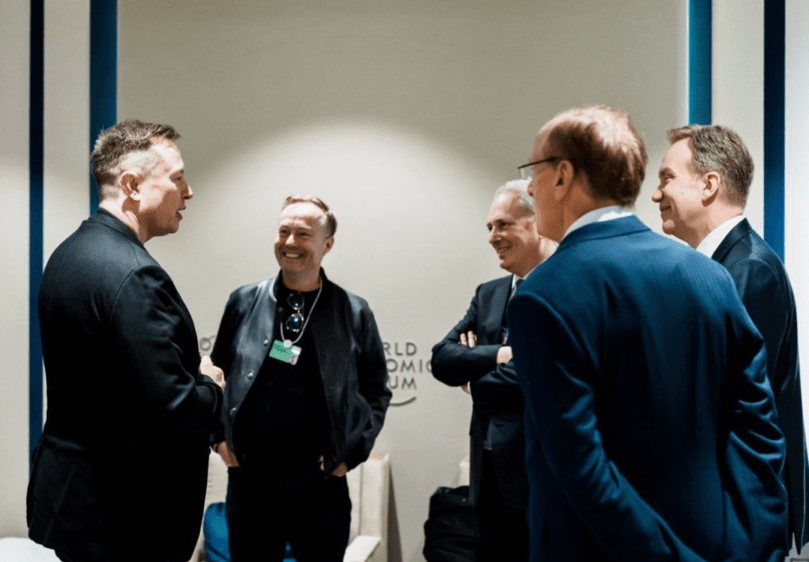
Elon Musk with Jason Calacanis, Børge Brende and Larry Fink in Davos.
Elon Musk: Way to think of it is that if you have a large number of humanoid robots, the economic output is the average productivity per robot times the number of robots. And actually my prediction is in the benign scenario of the future that we will—the robots will actually make so many robots and AI that they will actually saturate all human needs. Meaning you won’t be able to even think of something to ask the robot for at a certain point. Like there would be such an abundance of goods and services. Because my predictions are there’ll be more robots than people.
Larry Fink: So but how do you then have human purpose in that scenario?
Elon Musk: Yeah, I mean, you know, there are—nothing’s perfect. But I mean, it is a necessary… Like, you can’t have both. You can’t have work that has to be done and amazing abundance for all. Because if it’s work that has to be done, and only some people can do it, then you can’t have abundance. It’s narrow.
Larry Fink: Narrow.
Elon Musk: Exactly. So but if you have billions of humanoid robots—I think there will be… I think everyone on Earth is going to have one and gonna want one. Because who wouldn’t want a robot to, you know, assuming it’s very safe—watch over your kids, take care of your pet? If you have elderly parents—a lot of friends of mine have elderly parents, it’s very difficult to take care of them. Expensive. Yeah, it’s expensive, and there just aren’t enough people to take care of the old people. So if you—if they had a robot that could take care of and protect elderly parents, I think that would be a great, amazing thing to have. And I think we will have those things. So overall, I’m very optimistic about the future. I think we’re headed for a future of amazing abundance, which is very cool. And definitely we are in the most interesting time in history. I don’t think there is a more interesting time in history!
AGING
Larry Fink: Can we reverse aging in this new history? Or are we going to see it?
Elon Musk: You know, haven’t put much time into the aging stuff, but I do think it is a very solvable problem. Like, you can—I think when we figure out what causes aging, I think we’ll find it’s incredibly obvious, that it’s not a subtle thing. The reason I say it’s not a subtle thing is because all the cells in your body pretty much age at the same rate. You have never seen someone with an old left arm and a young right arm ever in my life. So why… You know, there is some benefit to death, by the way. It’s like, there’s a reason why we don’t actually have a longer lifespan. Because if people do live forever or for a very long time, I think there’s some risk of an ossification of society—of things just getting kind of locked in place. And yeah, it just may become stultifying, a lack of vibrancy. But that’s it. Do I think we’ll figure out ways to extend life and maybe even reverse aging? I think that’s highly likely.
Larry Fink: Looking forward to that. So in the future you talk about—their AI models, autonomous machines, rockets—depends on massive increases of compute, massive increases in energy. Expensive energy, manufacturing scale. What are the bottlenecks to get there? And once again, with all that expenditures, how can we make sure it is broad, not narrow?
Elon Musk: I just think the natural thing will be very broad because AI companies will seek as many customers as they possibly can. And the cost of AI is already low and plummeting every year—almost the cost of AI is meaningfully changing on a month basis.
Larry Fink: There are open models now everywhere.
Elon Musk: Yes. Very good open models. The open models only lack what may be a year behind the closed models. So I think, yeah, AI companies will seek as many customers as possible, which means they’ll provide AI to the world.
Larry Fink: But the cost of getting to their compute chips, the fab, power—powering that. To me, what are those? It is a huge factor.
Elon Musk: I think the limiting factor for AI deployment is fundamentally electrical power.
Larry Fink: It’s energy. Yeah.
Elon Musk: We were seeing the rate of AI chip production increase exponentially, but the rate of electricity being brought online is….
Larry Fink: 5%, 4% a year max.
Elon Musk: Yes, it’s clear very soon—maybe later this year—we will be producing more chips than we can turn on. Except for China. China’s growth in electricity is tremendous.
Larry Fink: They are building 100 gigawatts of nuclear as we speak.
SOLAR
Elon Musk: Actually solar is the biggest thing in China. So China is—I believe Chinese production capacity on solar is 1,500 gigawatts a year, and they’re deploying over 1,000 gigawatts a year of solar. Now, you know, for continuous solar load, you divide that by roughly 4 or 5. Call it around 250 gigawatts of steady-state power paired with batteries.
And that’s a very big number—half the average power usage in the US. US power usage on average is 500 gigawatts. China. just with solar, solar that can provide steady-state power and batteries can do half of the US electricity output per year just from solar.
Solar’s by far the bigger source of energy. And actually when you look beyond Earth—or even on Earth, but certainly beyond Earth—the sun rounds up to 100% of all energy. This is an important thing to consider. So the sun is 99.8% of the mass of the solar system. Jupiter is about 0.1%, and everything else is miscellaneous. Now even if you were to burn Jupiter in a thermonuclear reactor, this up the amount of energy produced by the sun would still round to 100%, because Jupiter is only 0.1%. If you teleported three more Jupiters into our solar system and burnt three more Jupiters and everything else in the solar system, the sun’s energy would still round up to 100%. So it is really all about the sun. And that is why one of the things we are doing with SpaceX within a few years is launching solar-powered AI satellites. Because space is really the source of immense power. Then you don’t need to take any room on Earth. There is so much room in space and can scale to hundreds of terawatts a year.
Larry Fink: Elon and I have had these conversations before, but why don’t you tell the audience what would it take for the United States in what geography would it take that solar field electrify the United States? Let me ask a question: why aren’t we doing it?
Elon Musk: So rough way is 100 miles by 100 miles—160 kilometers by 160 kilometers—on solar is enough to power the entire United States. So 100-mile by 100-mile area. You can take a small corner of Utah, Nevada, New Mexico—obviously wouldn’t want it all in one place—but there was very small percentage of area of US to generate all electricity that US uses. And same is true actually for Europe. You could take a small part of your energy—take relatively unpopulated areas of say Spain and Sicily, and generate all electricity power that Europe needs.
Larry Fink: Why don’t you think there is a movement towards it here and in the United States? As there is in China?
Elon Musk: Well, unfortunately, US tariff barriers for solar are extremely high and this makes economics deploying solar artificially high. Because China makes almost all the solar.
Larry Fink: And what would it take for Europe or US to build it commercially if it is at scale?
Elon Musk: Yeah, I think—well, I can tell you what we are going to do at SpaceX and Tesla. We’re building up large-scale solar. So the SpaceX and Tesla teams both separately are working to build to 100 gigawatts a year of solar power in the US (of manufactured solar power). That will probably take us about three years. But these are pretty big numbers. And I encourage others to do the same. We obviously don’t control US tariff policy. But China makes solar cells that are incredibly low cost. And I think it would be worth doing large-scale solar.scale solar.
Larry Fink: So I know you’re going to be having a couple of big announcements on robotics and what it can do. I mean, when we went to the factory, you showed me those robots. We talked about billions of robots, but how quickly can they be deployed in your manufacturing setting, be utilized and be functional, and create that abundance you talked about?
Elon Musk: Well, humanoid robotics will advance very quickly. We do have some of the Tesla Optimus robots doing simple tasks in the factory. Probably later this year—by the end of this year—I think they will be doing more complex tasks, but still deployed in an industrial environment. And probably sometime next year—I would say that by the end of next year—I think we will be selling humanoid robots to the public.
Larry Fink: Like you’re already seeing in Tesla cars, software changes every quarter now. A software change upgrades the ability of the robot within the car.
Elon Musk: Yes, the Tesla full self-driving software—we update sometimes once a week. So I think some of the insurance companies have said that it is actually so safe when Tesla uses full self-driving—so safe that they’re offering customers half-price insurance if they use Tesla full self-driving in their car.
Larry Fink: And that can be monitored by the insurance company because it’s part of the agreement?
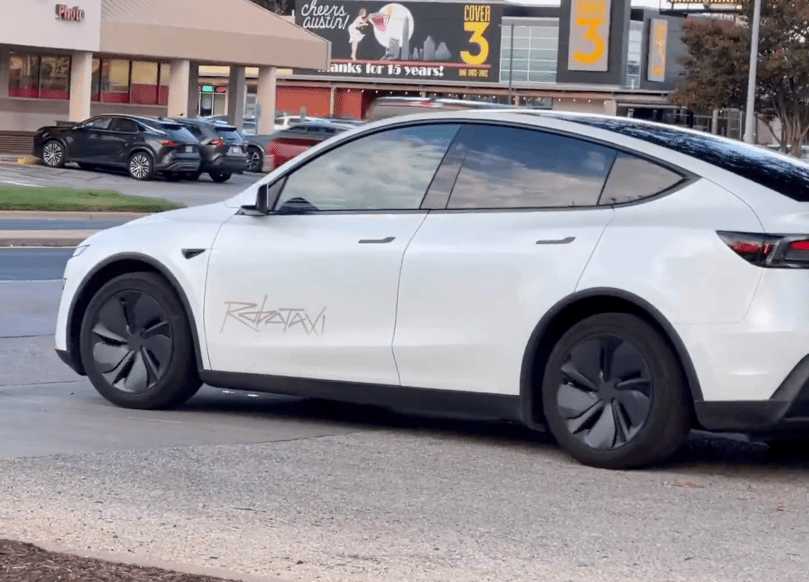
Elon Musk: Yeah, but I think self-driving cars is essentially a solved problem at this point. Tesla has rolled out Robotaxi service in a few cities, and it will be very widespread by the end of this year within US. Then we hope to get supervised full self-driving approval in Europe hopefully next month.
Larry Fink: Really that quickly!?
Elon Musk: Yeah. And then maybe similar timing for China hopefully.
SPACE
Larry Fink: I want to move to space because historically space is very capital intensive. Historically been done by governments. Obviously SpaceX changed the whole model. But we have seen it slow to scale. And now I am starting to see ramping up in what you are doing. Talk about the automation—how is it changing economics in building and preparing for operating in space?
Elon Musk: Sure. Well, the key breakthrough that SpaceX hopes to achieve this year: full reusability. No one has ever achieved full reusability of a rocket, which is very important for the cost of access to space. We have achieved partial reusability with Falcon 9 by landing the boost stage over 500 times. But we have to throw away the upper stage that burns up on reentry. And the cost of it is equivalent to a small- to medium-size jet.
So with Starship—which is a giant rocket, the largest flying machine ever made—that’s the rocket you’re using for the idea of going to Mars, right?
Larry Fink: Yeah.
Elon Musk: Mars and the Moon as well, and for high-volume satellite stuff. So Starship—hopefully this year—we should prove full reusability for Starship, which will be a profound invention. Because the cost of access to space will drop by a factor of 100 when you achieve full reusability. It is the same economic difference that you would expect between, say, a reusable aircraft and a non-reusable aircraft. Like if you have to throw your aircraft away after every flight, there will be expensive flights. But if you only refuel, then it’s the cost of fuel.
So that’s really the fundamental breakthrough that gets the cost of access to space—we think—below the cost of freight on aircraft. So you know, under $100 a pound type thing easily. It makes putting large satellites into space very low, very cheap.
And then when you have solar in space, you get five times more effectiveness—maybe even more than that—than solar on the ground. Because it’s always sunny, no clouds. Yeah, it’s always sunny. So you don’t have a day-night cycle or seasonality or weather. And you get about 30% more power in space because you don’t have atmospheric attenuation of the power. That net effect is solar is five times more—any given solar panel will do five times the energy in space than on the ground.
Larry Fink: There is any capacity in doing that then taking that power, bringing back to Earth? Is there any way of doing that? Or you just taking the power and utilizing it for needs like building AI data centers in space?
Elon Musk: I think the case is a no-brainer for building AI solar power to AI data centers in space. Because as mentioned, it’s also very cold in space. If you’re in shadow, then it’s very cold in space—3 degrees Kelvin. So you have solar panels facing the sun, and then a radiator that is like pointed away from the sun so it has no sun incidence. And then it’s just cooling—it’s a very efficient cooling system. Net effect is that the lowest-cost place to put AI will be space. And that will be true within 2 years, maybe 3 at latest.
Larry Fink: Looking 10 or 20 years out, how would you describe success with AI or space technology? And where do you see it? Can—are more certain what will happen in the next 3 years, 5, 10?
Elon Musk: I don’t know what’s going to happen in ten years. But the rate at which AI is progressing—we might have AI that is smarter than any human by end of this year, and no later than next year. And probably 2030 or 2031—5 years from now—AI will be smarter than all of humanity collectively.
Larry Fink: We only have a number of minutes left, but I want to humanize you for a second. So there’s no speculation that you’re the most successful entrepreneur, industrialist in the 21st century—maybe beyond. What inspired you? Who inspired you? What was the foundation of your curiosity? And importantly, why? Was there an aha moment, epiphany at any time in your life and career?
Elon Musk: Well, I mean, as a kid I read a lot of science fiction, sci-fi, fantasy books, comic books. And always like technology. Didn’t expect to be where I am today—seems incredibly implausible. But yeah, I was inspired by reading books about the future of science fiction. And I guess want to make science fiction not fiction forever. At some point, turn science fiction into fact. And you know, we wanna have like Starfleet as in Star Trek really for real—where we actually have giant spaceships traveling through space, going to other planets, traveling to other star systems.
Larry Fink: Beamed up to go back to New York?
Elon Musk: I would like beaming back to New York instead of flying. Yeah. You know about Star Trek. So I guess my essential what we call the philosophy of curiosity. And I would like to understand the meaning of life. Is the standard model of physics correct regarding the beginning of existence at the end of the universe? What questions do we not know to ask that we should ask? And AI will help us with these things. So I just try to understand: how did we get here? What’s going on? What is real? Are there aliens? Maybe they are. If you have spaceships traveling to other star systems, we may encounter aliens or find many long-dead alien civilizations. But I just want to know what’s going on—curious about the universe. And that is my philosophy.
Larry Fink: Do you see yourself going to Mars in your lifetime?
Elon Musk: Yes. Like that’s a long commitment, isn’t it? Three years each way?
Larry Fink: Six months.
Elon Musk: But the planets only align every two years. So yeah. Been asked a few times: do I want to die on Mars? And I’m like, yes—just not on impact.
Larry Fink: That’s a good answer. Anyway, we are out of time. Hopefully everybody enjoyed this. And there are so many myths around Elon Musk. I can tell you he is a great friend, and I constantly learn so much from him. And I’m totally inspired by what he has done, have been inspired by who he is, and I’m totally inspired by his vision of the future. And don’t think it’s such a bad future.
Elon Musk: And I think generally my last words would be: I encourage everyone to be optimistic and excited about the future. Good. And generally for quality of life, it is better on being an optimist rather than a pessimist, right?
(End of video – applause and wrap-up.)
This verbatim transcript is important and inspiring for everybody. Because it is so wide-ranging on technology, energy, AI, space, and optimism, it can lift you up if you’re ever down.
When I bought my first Tesla, a Model 3 in 2019, I joined a community of many people who love Elon Musk and Tesla. Every time I drive my Tesla around my hometown Austin, Texas, or take a Robotaxi here, I’m reminded of the extraordinary effort that is put into making Tesla succeed. Elon puts in maximum effort into all his companies.
In January 2022, I started this blog to write positive things about Tesla and Elon Musk. It has since grown to include many transcripts of Elon’s talks. I’m thankful to Johnna Crider for supporting and encouraging me to start this blog.
In Part 3, Elon revealed how xAI is forcing a gigawatt-scale breakthrough in AI training power. Now Peter’s son Jet (age 14) inspires the next turn: gaming and AI’s role in it.
Peter D.: My other son Jet, who’s 14, wanted to know about your AI gaming studio and the impact of AI in the gaming world. What are your thoughts?
Elon’s origin story surfaces.
Elon: Yeah, that’s why I started programming computers… Civ was actually a very— in terms of games that educate you while you have fun, Civ is epic at that.
Dave jumps in.
Dave B.: The only way I ever win is getting off the planet… Tech victory to Alpha Centauri.
Elon: I guess I am sort of aiming for the Alpha Centauri tech victory essentially.
The analogy is perfect: civilization’s true win condition isn’t domination — it’s escape velocity.
Elon: Aspirationally [building an AI gaming studio].
Because:
Elon: The vast majority of AI compute is going to go to video consumption and generation… Real-time video generation. That’s going to be the vast majority of AI compute. Photon processing.
Peter floats an X Prize for Universal High Income governance. Elon is open but skeptical on measurement.
Then the conversation ascends to simulation theory.
Elon: The most interesting outcome is the most likely… Only the simulations that are the most interesting will survive. Because when we run simulations, we truncate the ones that are boring.
Terrible things can still happen — they keep it engaging. Like watching a war movie while eating popcorn.
Dave B.: So the guys running the simulation have immensely boring lives compared to us.
Elon: Yeah, because when we create simulations, they’re a distillation of what’s interesting.
Are we in Act 3? The room leaves it open.
This segment closes on the biggest frame possible: Reality as a game where the win condition is expansion, energy mastery, and keeping it interesting.
My two cents: Think about what you can remember from your past. You’re probably like me and mostly recall just the spicy parts of your life. So what were you doing on March 3, 2023? Good question—and a troubling one.
Our minds are made of a string of memorable events. For myself, I sought to create the most vivid memories possible when I was young. Soon, I’ll be publishing a book for you that will include some very vivid experiences I had living in Italy when I was 21–22 years old.
I encourage you to create your most important memories when you’re younger—and then you’ll carry those memories with you for your entire beautiful life. But you’re never too old to create memories!
Join my conversation with @elonmusk on AGI timelines, energy, robots, and why abundance is the most likely outcome for humanity's future, alongside my Moonshot Mate @DavidBlundin!
(00:00) – Navigating the Future of AI and Robotics (04:54) – The Promise of Abundance and Optimism… pic.twitter.com/4e4Lstx4ox
In Part 2, Elon dropped a bold bet on ultra-clean chip fabs where you could eat a cheeseburger without contaminating wafers. Now the conversation shifts to our future of abundance: energy.
Sitting in the glorious front lobby of Gigafactory Texas in Austin, Peter steers toward the concerns people in America are thinking about today: energy, health and education. Elon doesn’t hesitate because it is right in sync with his Master Plan 4 for Tesla.
Peter D.: I want to talk about energy, health, education, because those are people’s concerns. So on the energy front, the innermost loop of everything that you’re building and…
Elon: Doing right now, energy is the foundation.
Peter D.: What’s your vision for energy abundance? The sun in the next, you know, this decade. The sun. Yeah.
Elon: I mean, so the sun is everything.
Elon drives the point home with scale that rewires your brain
Elon: People just don’t understand how solar is everything. So everything compared to the sun, all other energy sources are like cavemen throwing some twigs into a fire.
The sun is over 99.9% of the solar system’s mass. Burn Jupiter? Still rounds to 100%. Burn four Jupiters? Same story.
Fusion?
Peter D.: Any interest in fusion?
Elon: Yeah, you know, coming— never going to guess how the sun works.
Peter D.: Giant coal plants.
Elon: I mean we have a giant free fusion reactor that shows up every day 93 million miles away. It’s farcical for us to create little fusion reactors. That would be like having a tiny ice cube maker in the Antarctic and saying, “Hey look, we made ice.”
Solar is the only scalable path
Dave narrows to the immediate bottleneck: powering the Memphis supercluster.
Dave B.: If you just narrow the question to the Memphis timeline. Between a gigawatt and 10 gigawatt. You’re not going to pull 10 gigawatts out of Memphis.
Elon: Maybe two or three.
They’re still in “Toyland” at 10 GW scale — yet xAI is already pushing boundaries.
Peter drops a plug for his Metatrends research, then presses on China’s solar dominance.
Peter D.: China has done an incredible job… They put in 500 terawatt hours in the last year, 70% solar. And they’re just scaling.
Elon: China has done an incredible job on solar. Yeah, it’s amazing. Production capacity around 1,500 gigawatts per year of solar.
The US lags. Energy = GDP = quality of life. The group agrees: America must scale solar aggressively. Tesla and SpaceX are already all-in.
The discussion turns to the GPU power crunch — why TSMC worries about overproducing chips.
Elon: If chip output is growing exponentially, but power harnessed is growing in a slow, linear fashion, then chip production can exceed the rate at which the AI chips can be turned on.
You need transformers, cooling, liquid-cooled racks. One burst pipe? A billion dollars gone.
xAI is solving it first
Elon: xAI is going to have the first gigawatt training cluster at Colossus 2 in Memphis… Mid-January will be a gigawatt… then 1.5 gigawatts probably April-ish.
My 2 Cents
It is amazing that xAI brought together natural gas turbines + Tesla Megapacks to smooth massive power swings for the data center ijn Memphis, and soon to be expanded to Southhaven, Mississippi. It is a symphony of engineering miracles! The finest engineers in Austin and Palo Alto, some even from SpaceX, and the future vision to seek only truth, beauty, and stay curious!
Part 4 dives into gaming, Civilization’s tech victory, and simulation theory.
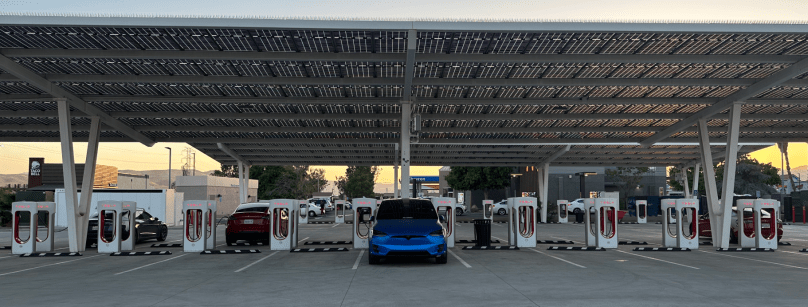
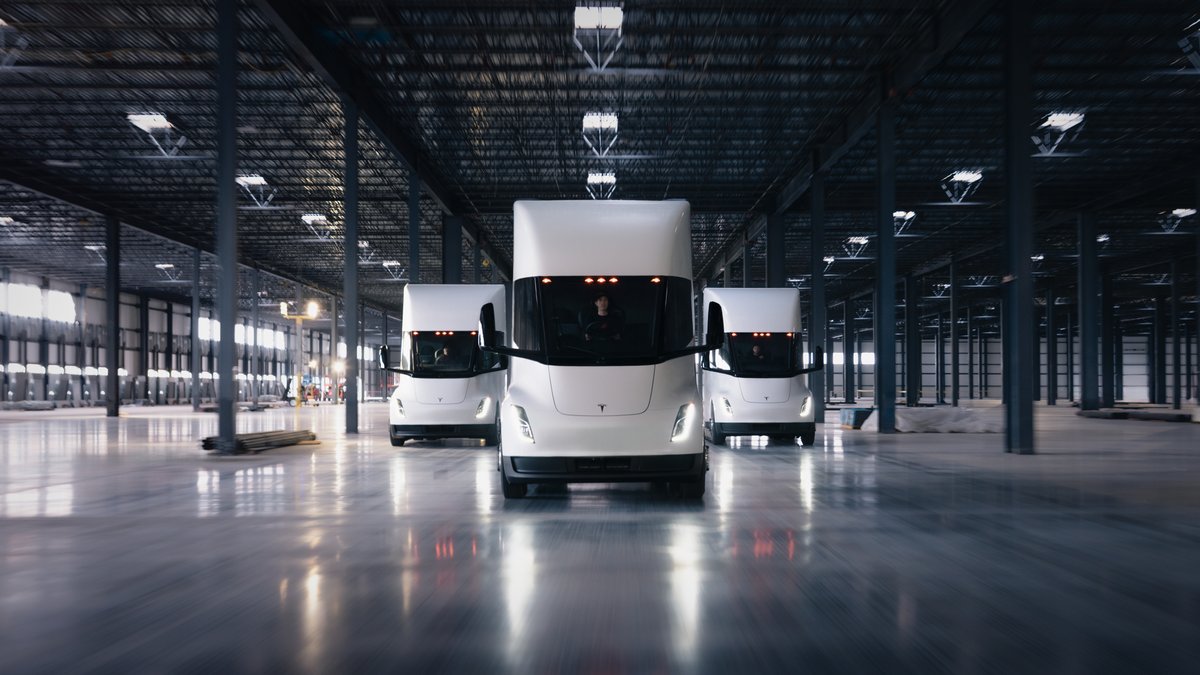
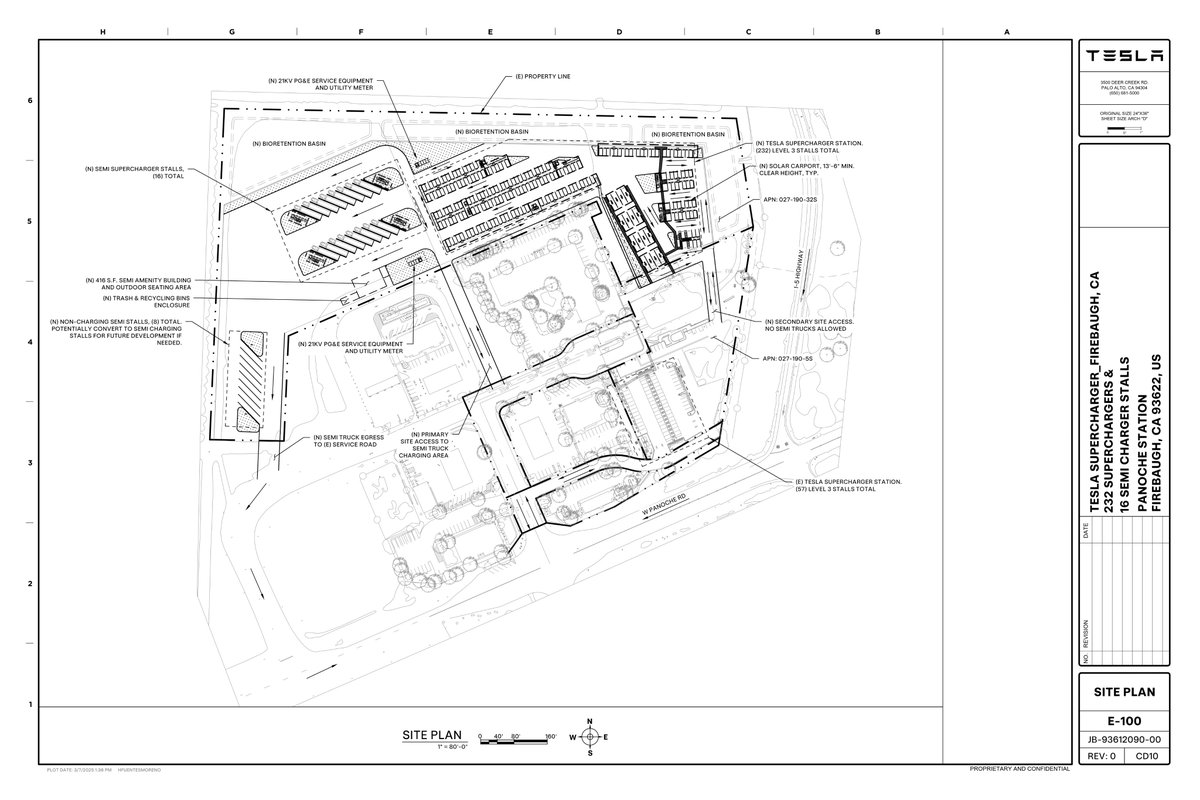
Tesla plans to build the world’s largest Supercharger station with 304 stalls, including 16 for Tesla Semis, in Firebaugh, California.
Tesla plans to expand its existing Supercharger site in Firebaugh, California, into the world’s largest with a total of 304 stalls — 288 for passenger vehicles and 16 dedicated for Tesla Semis — once complete.
This represents an 85% increase over Tesla’s current largest site (164 stalls at Oasis in Lost Hills, California). The project, approved via a conditional use permit last month, adds 232 new car stalls to the existing 56 (some sources note the current count as around 72, but the core expansion figure holds). It includes a separate area for Semi operations with its own access routes, plus an amenity building and outdoor seating primarily for truck drivers.
Here are examples of large-scale Tesla Supercharger sites for context:
— Tesla Owners Silicon Valley (@teslaownersSV) March 13, 2021
Firebaugh sits along Interstate 5, a key corridor connecting Southern California ports to Central Valley and Bay Area distribution hubs. This strategic spot has made it a priority since the original site opened in 2020 as Tesla’s then-largest in the US with 56 stalls.
Why Firebaugh and why now
The expansion reflects long-term planning by Tesla’s charging team, coordinated with local utilities and jurisdictions. It accounts for forecasted EV adoption growth, with built-in flexibility to adjust pace based on real demand.
A Tesla Charging team member with years of experience emphasized this deliberate approach.
Here is the post from Tesla’s Max DeZegher, who has been building Superchargers since 2014:
Projects like Firebaugh are years in the making, and happen in coordination with the utility and jurisdiction.
It takes long-term forecasting, planning and flexibility (decelerating/accelerating based on demand), but @TeslaCharging will keep up with EV adoption. https://t.co/MVKbBHGQeE
The site’s location supports both consumer travel and commercial trucking, especially as Tesla ramps up the Semi program. Dedicated Megachargers for Semis signal confidence in heavy-duty electric transport along this major freight route.
Reactions from Tesla enthusiasts and observers
Enthusiasts and Tesla-focused accounts quickly highlighted the scale as a bold step in infrastructure for EVs and trucking.
Sawyer Merritt broke down the details early, noting the existing 56 stalls.
Here are key posts capturing the excitement:
NEWS: Tesla plans on building the largest Supercharger station in the world, with a whopping 304 charging stalls in total, including 16 Tesla Semi charging stalls.
• 288 charging stalls for cars • 16 stalls for Tesla Semis • Amenity area
This move positions Tesla far ahead in high-capacity charging, especially as more non-Tesla EVs gain access to Superchargers and Semi deployments increase. It underscores the company’s commitment to scaling ahead of demand along critical corridors, potentially reducing wait times and supporting broader EV and electric trucking adoption in California and beyond.
Firebaugh’s rural setting along I-5 provides ample space for this growth.
Elon is a builder. We know him for his rockets, incredible vehicles, and satellite networks that connect the far reaches of Mongolia and people stranded in floods in North Carolina.
Some people don’t like it when he posts his thoughts about justice on X. But I do. I love it. I’ve learned so much about keeping society fair, safe, and free, and how critical it is to preserve Western civilization.
I went from thinking it was OK to welcome any immigrant who looked like they needed help, to understanding we must have secure borders and stop crime. Whether helping people in Europe, America, or Britain, Elon clearly wants to protect everybody and keep our world from falling apart.
I stand with Elon on immigration. I know firsthand most immigrants are decent, hard-working people. Even immigrants I’ve met say unchecked flows, no vetting, no proper screening, are the wrong way. With wide-open borders, vicious criminals slip right in with them. That’s not how to build a better America.
Elon has highlighted how Poland, with tight border controls, has stayed much safer. Meanwhile, my own city, Austin, gets more dangerous.
I love Elon for raising awareness about Iryna Zarutska from Ukraine, murdered in cold blood on video on a light-rail train in Charlotte, North Carolina, with nobody reaching out to help this poor woman right away. As beautiful murals go up around the country (funded in part by Elon’s $1M pledge), I think of his deep drive to keep everybody safe, he wants to make sure that we don’t have to bear the pain of another Iryna Zarutska. Her death should not be forgotten, it’s how we can pledge to do better in America.
In the UK, there’s also huge room for improvement. Elon raises awareness about how it’s sliding toward a police state: people jailed for things they write online, serious criminals released early. I wouldn’t know this without him.
Now, with jury trials being eroded in the UK, I see Elon’s renewed heart for helping Britain. That’s what Elon does best, help humanity. (Never stop, Elon!)
I’ve also filtered out cynics (I don’t meet many, but Elon warned against them). In a Lex Fridman interview, he said never trust a cynic, stay away from people who see bad in everybody, because they’ll excuse their own bad behavior by claiming everyone else is bad too.
Elon is wonderful when he says most people are “medium good.” He has real trust in humanity. I’d never heard of “suicidal empathy” until him. He raised my awareness of how it’s destroying Western civilization. Allowed me to examine myself and readjust my views.
Elon has highlighted Gad Saad and how suicidal empathy will destroy Western civilization, and he’s right. It deserves to be defended, not tried. If we lose it, everybody loses something valuable.
Past the rockets and cars (which are great), there won’t be an America around to enjoy them unless we preserve it. Since Americans built these wonders, future generations deserve to enjoy them too.
We don’t want to be complicit in the banishment of Western civilization, instead we should work hard to defend it.
Elon doesn’t preach from an ivory tower. He’s the most in-touch, high-position leader I’ve ever met, reaching out to all corners of humanity like no one else.





 whatsuptesla.com