San Juan, 5 December 2025. The first ship carrying Tesla Megapacks slipped into San Juan’s industrial port yesterday. No speeches, no ribbon-cutting, just 40-foot powder-white boxes that quietly begin the end of Puerto Rico’s decade-long blackout nightmare.
Eight years after Maria wiped out 100 % of the grid, the island is deploying the largest battery rollout in its history: 430 MW of instant power and 1.72 GWh of storage across six plants. Total cost $767 million, paid entirely with pre-allocated FEMA/HUD recovery funds. Zero new taxes, zero new debt.
Tesla won the contract the old-fashioned way: an open international bid in October 2024 against 130 competitors. Best total cost of ownership, fastest delivery, highest round-trip efficiency. As Elon once said, “The best part is no part.” Here the only subsidy is the one physics already gave lithium-ion – no special handouts were needed because the tech is simply that good.
The first containers are already rolling north to Cambalache in Arecibo, where 68 Megapacks will add 52 MW / ~208 MWh beside an aging oil plant. When solar over-produces at noon or a hurricane knocks out lines at midnight, the batteries respond in milliseconds – no spinning reserve, no smoke, no fuel trucks racing through flooded roads.
Elon’s other favorite line fits perfectly: “I’d rather be optimistic and wrong than pessimistic and right.” This project is optimism made hardware.
By 2027 the island expects up to 90% improved grid stability and up to $100 million a year saved on diesel alone.
For anyone who has ever modeled a grid, sized a frequency response curve, or watched a peaker plant burn $150/barrel oil in real time, this hits home.
It’s not charity. It’s not politics. It’s engineering eating a 60-year-old problem and turning it into clean electrons.
Puerto Rico just became the proof point many of us have been waiting for: when the hardware is finally good enough, resilience becomes cheaper than fragility.
The lights are about to stay on. Not because someone wished it, but because someone built it. And that feels pretty darn good.
Weather extremes. We’ve seen fires in California, rolling blackouts across most of the country, and hurricanes in the Southeast.
This article is about big battery storage, specifically, Tesla Megapacks and why they are increasingly the choice for public utilities and companies. I’ll also discuss margin, or ROI (return on investment).
We will specifically look at three entities that have recently built or plan to build big battery storage.
Powering Florida’s Only Rice Mill: A Single Tesla Megapack
When the sun sets over Palm Beach County, Florida, one Tesla Megapack is helping power Florida’s only rice mill.
Florida Crystals Corp, had the foresight to plan to generate energy with a 900 panel solar array and order a Tesla Megapack. On May 31, they announced on Twitter that their Megapack is up and running, supplying electricity to the mill after dark and ensuring the power stays on around hurricane season to protect valuable rice.
Megapack is estimated to reduce carbon by 250 tons annually and is 1.8 MWh.
Remarkably, this Megapack is also the first one in Florida!
Arizona’s Giant Clean Energy Storage: Strata To Build 255MW/1GWh Tesla Megapack Project
Big projects are needed to transition our world to sustainable energy. APS or Arizona Public Service is a utility that serves more than 1.3 million homes and businesses in 11 of Arizona’s 15 counties. This requires a lot of electricity!
Private company, Strata Build, plans to build, own and operate a huge 255MW/1GWh Tesla Megapack clean energy storage system with a value of $500M. Strata will then provide power to APS.
Australia’s Power Revolution: Megapacks Keeping Power on Across the Continent
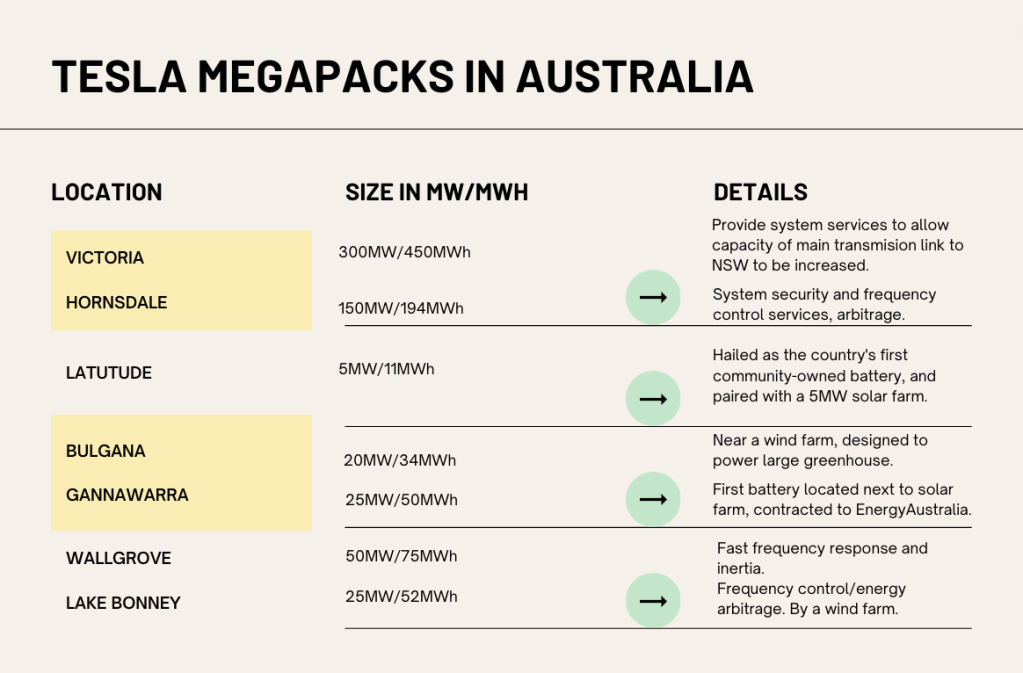
As sure as the sun shines and the wind blows over the splendid continent of Australia, Tesla Megapacks are keeping the power on for millions of people.
I created a chart of Tesla Megapacks that are currently operating in Australia. There are many more Battery storage plans proposed, announced, and under construction. Other companies are also building big battery storage for Australians.
Information accessed from Renew Economy Big Battery Storage Map of Australia accessed on June 2, 2023.
Powering Growth: The Compelling Case for Investing in Tesla Megapacks
One of the probing questions I had from a reader of mine, was about margins. For this, I like to look at the future benefits to humanity. We can measure the value of Tesla or other big battery storage by its capability to keep the power on when the sun is not shining in the wind is not blowing.
Let’s imagine a public utility that serves 1M people that undergoes several power outages a year. Now visualize Megapacks stepping in and keeping power on for schools, hospitals, living spaces, and companies (the rice mill in Florida).
Speaking of the rice mill, a value can be assigned to the 90M lbs/year of rice that Florida Crystals Corp. is trusted to mill for its many clients. The volume of rice is enough for 4 million people annually. Businesses that have reliable power can thrive, grow, and expand, that’s a great ROI.
Every person benefits, including the many people that are employed in installing and maintaining Megapacks.
Another great value, which is hard to assign a dollar amount to, is in the essential concept that people stay safe and healthy.
Tesla’s website (accessed on June 3, 2023) allows you to reserve one Megapack to a max of 1000 Megapacks, with planned delivery in 2025. The base cost of one is around $2,8M (including installation).
Tesla’s Master Plan 3 includes Megapacks, Lithium refining, and Tesla Energy
Tesla Lithium refining in Corpus Christi, Texas, will enable Megapacks to be built faster. (It’s much easier to build a Megapack than to build a vehicle.) Megapacks, built at a certain volume now, will increase in scale.
Although it may seem a small step forward, Tesla Energy is putting programs together starting in Texas for charging Tesla vehicles during times when there’s excess wind production at night.
My take is that It’s worth following Tesla Energy carefully, in my opinion, Tesla starts off with what looks like small moves, and then those moves grow exponentially. Today, for example, buyers of a new Model 3 may apply to charge at home for free for 1 year with Tesla Energy. Late December 2022, Tesla Energy began an electricity plan in Texas designed for Powerwall owners. What will we see tomorrow?
I hope your summer is cool, memorable, and filled with adventures led by your hearts’ desires!
Thanks as always for supporting my writing. Article by Gail Alfar please credit accordingly. Thanks to Tesla Energy, Arushi Sharma Frank, Tesla Megapack, and reader Darrell Park for suggesting this topic.
Welcome back to my blog. I am excited to write about Tesla Energy. This week I was honored to host Johnna Crider in Austin when she was here to interview Elon Musk for her podcast, “Getting Stoned.” She invited me along, and even let me ask questions to Elon Musk about Tesla Energy. I will share more about that in the future after she releases her podcast. In this article, I will give a little background on the developments related to Tesla Energy in Texas. In November 2021, Elon Musk said,
“Tesla Megapack batteries will help stabilize the grid this winter” – Elon Musk
Tesla Working with ERCOT at Full Speed
Arushi Sharma Frank, US Energy Markets Policy Lead at Tesla, spoke about something few people know. Tesla has been working successfully for nearly three years with ERCOT. Here is part of what she said in public comments to the ERCOT Board of Directors on June 21, 2022. Arushi said,
"Tesla has been working with ERCOT in Texas to support its efforts to improve the resiliency and innovation of the grid.

In 2020 Tesla approached ERCOT for the first time to come up with the language in the nodal protocols that will allow Tesla Megapack to interconnect in the state.

We participated and collaborated with all stakeholders, utilities, independent generators, the consumer segment, and the whole group, and within a year we were able to pass changes that allowed a 100 Megawatt battery to interconnect timely the following summer.

For perspective, this was just a few months after storm Uri when the battery went live in June ... and support the grid immediately the next summer.

The one-year time period is incredible.

There is no other market where I think our company or any other company could change market rules, implement them and interconnect a 100 Megawatt battery in one year.

That was an incredible success! I want to make sure that everybody knows that it is an incredible precedent and that precedent must continue in how ERCOT addresses and how stakeholders address innovation in this market.

In 2021 Tesla sponsored another NPRR [Nodal Protocol Revision Request] which is happily on your agenda today as unanimously supported by the Technical Advisory Committee.

That is NPRR 1100. We came up with NPRR 1100 in its infancy when we realized that we had the ability to build another large battery on land that is contiguous with the Gigafactory Texas and we had more than one use case for how that battery could be used.”
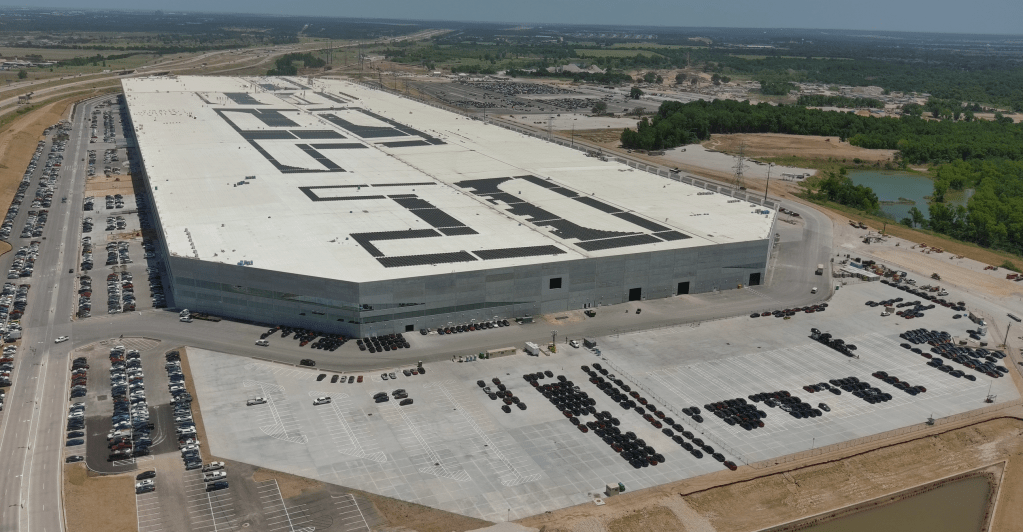
Gigafactory Texas Solar Roof spells TESLA June 23, 2022 Credit Jeff Roberts
Arushi explained that in the simplest case, the big battery can participate for its full nameplate value in the energy and ancillary services market and provide grid reliability services.
In another case, she explained,
“If the substation or the connection to the grid is down, and the battery just cannot get its energy out to the system, the battery could still be used and be connected locally as a microgrid to another load to help that load with its operations,” or to put it another way, when the grid is in a crisis and a substation is down and the load can’t get power from anywhere else, NPRR 1100 will allow that battery to provide that power.
In the case of Gigafactory Texas, Arushi explained that NPRR 1100 would allow the gigafactory to receive backup power for some functions such as the safe shutdown of critical equipment if there was a grid failure impacting the electric substation.
Protecting People and Businesses in the next Critical Emergency
I interpret that what Tesla is offering to the grid will help protect people and businesses in the next critical emergency. Arushi explains it this way,
“The reason this NPRR is so important is that it creates a brand new value proposition for large batteries which could be essential to a lot of large critical loads in the state.

Think hospitals, think companies that make toilet paper, think anything that can suffer from a grid emergency and allow those companies to enter into contracts with developers of large batteries, and that contract is still economic for the developer, because on a good day they can participate in the market and get that value from the ERCOT but on a bad day they can turn around and use that large capacity the system to support safe operations at a very large facility.  We're talking facilities with loads of 50 to 100 megawatts.
DERs [Distributed Energy Resources]
The Texas grid can become even more stable with the help of individual powerwall owners’ contributions. Arushi explained Tesla’s next step,
“I want to end it by talking about Tesla’s next initiative, and that is something you’ve heard about in the news I’m sure, as well as from ERCOT directly - and that is figuring out the reliability of the distributed energy system. Tesla’s first initiative in 2020 was about Tesla participating as an independent generator in the market. Tesla’s second initiative was about Tesla participating as an industrial consumer in this market.

This initiative is about Tesla’s customers.  And it is also about the retail energy offer that Tesla can bring to this market that relies primarily on the reliability and the innovation that is waiting on the distributed system, to the tune of gigawatts.

It is going to be a lot of work and we know it is because DER  [Distributed energy resources] integration has taken work in every market. It is probably going to take three or four years.

But the efforts that Tesla has led over the past year not only speed things up but will allow this market to dip its toe in the water and do so by using private companies like us to take the front load of the efforts to support the studies that are needed to change the system for the better.

If the board has questions or if you believe the ERCOT staff should be working on these specific issues we would love the board's support and the public support to unlock this next step of resiliency on the grid. Thank you.”
You can listen to Arushi Sharma Frank’s comments at the Texas Public Utility Council Board meeting here.
A brief summary and my thoughts
Tesla is ramping up its participation in strengthening the Texas grid with big batteries, and soon with DERs that include powerwalls from Tesla customers. Tesla has already helped support the grid, and has done it faster than expected. We depend on power all the time, for our devices, our apartments, food storage, and just about everything. Power requirements are increasing, not decreasing. All people, globally, will one day rely on energy stored in giant batteries.
Here are two ways you can support these efforts, and you do not need to own a Tesla or Powerwalls to do it.
Send an email to your state’s utility commission or power provider expressing your support for a strong energy grid based on battery storage.
Take the opportunity to learn about Virtual Power Plants and Distributed Energy Resources.
Here is a link to information about Tesla Powerpack [Utility and Business Energy Storage]
Tesla’s Texas Virtual Power Plant ASAP details how Tesla is offering a proven solution to the fragile Texas grid currently operated by ERCOT. Tesla has proved that its Virtual Power Plant can work extremely well.
Gail Alfar [Edited by Sarah Alfar] Exclusive to What’s Up Tesla – This blogpost was created utilizing STARLINK satellite services. All Rights Reserved. June 26, 2022
One-Time
Monthly
Yearly
Make a one-time donation to support What’s Up Tesla
Make a monthly donation to support What’s Up Tesla

 whatsuptesla.com