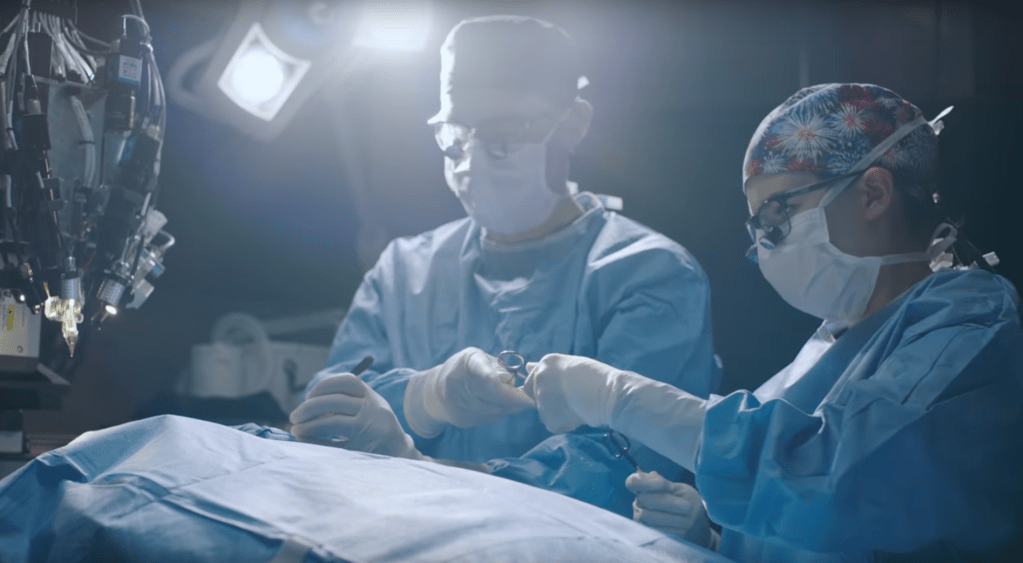
LONDON — Thanks to Elon Musk and the innovative team he has assembled at Neuralink, Jon L. Noble, a 42-year-old British Army veteran and former paratrooper from Hampshire, has become the fifth UK patient to receive the company’s revolutionary N1 brain-computer interface implant. The procedure took place on December 11, 2025, at University College London Hospitals’ National Hospital for Neurology and Neurosurgery, as part of the ongoing GB-PRIME study launched last July.
From Application to Implantation
Noble, who served in elite airborne units before a spinal cord injury left him with severe paralysis, qualified through Neuralink’s patient registry. These are the beginning stages of trials, so the registry prioritizes stable candidates aged 22-75 with quadriplegia or similar impairments from trauma or ALS. Jon’s selection came after rigorous screening, including medical evals to ensure surgical viability and long-term participation in data collection.
In a September 3 X post, Noble expressed his determination: “Great news that Neuralink has just been given the green light to start trials on people with spinal cord injuries. I have submitted my application. @elonmusk NeuralinkUK.”
Rapid Recovery and Calibration
Hours after surgery, Noble began calibrating the coin-sized N1 device. Its 1,024 electrodes, threaded into his motor cortex, translate neural signals into cursor movements. He was discharged after just 12 hours and now trains remotely, with goals to control computers, games, and assistive technology using thought alone. His involvement embodies Neuralink’s compassion towards people who have served in the military, our veterans. Our heros.
Hours after surgery, Noble began calibrating the coin-sized N1 device.
Heartfelt Gratitude to the Driving Force Behind the Breakthrough
In a moving post-op update on X, Noble shared his profound appreciation: “To Elon Musk and all engineers, analysts, designers, and support staff att Neuralink worldwide: Thank you from the bottom of my heart… And of course my outstanding team at The National Hospital for Neurology and Neurosurgery, London.”
Jon’s heartfelt acknowledgment reflects the beautiful impact of Elon’s leadership and the exceptional team he has built, turning his own ambitious ideas into life-changing realities for the people of Britain.
Accelerating Global Expansion
Neuralink’s UK trials, approved by the Medicines and Healthcare products Regulatory Agency, have gained remarkable momentum since the first U.S. success in 2024. This is a testament to the drive to move fast that Elon Musk has instilled in the company. As of mid-December 2025, approximately 19 implants have been completed globally (around 12 in the US and 7 in the UK). The two most recent UK procedures have also been performed, though details on those recipients have not yet been publicly announced.
My thoughts
I anticipate dozens more participants and eventually, thousands of people regaining digital independence through neural intent alone, thanks to the doors being opened by Elon Musk and Neuralink. One reason I am optimistic, is that on Dec 3rd, Neuralink posted a previously unpublished video to X.
DJ Seo and our recruiting team visited several schools to provide an overview of Neuralink, including recent progress updates and an outline for the company’s path ahead. Watch the presentation:
@djseo and our recruiting team visited several schools to provide an overview of Neuralink, including recent progress updates and an outline for the company’s path ahead.
I encourage you to watch the short presentation, in order to understand the challenges that face Neuralink, and follow along in real time. The progress and speed at which Elon works, is embedded with a sharp sense of urgency. The video is inspiring. It is like a mini-AI day, but instead of for Tesla, its for Neuralink!
This is the second part of my series on Elon Musk’s August 16, 2024, West Point talk, released February 6, 2025.
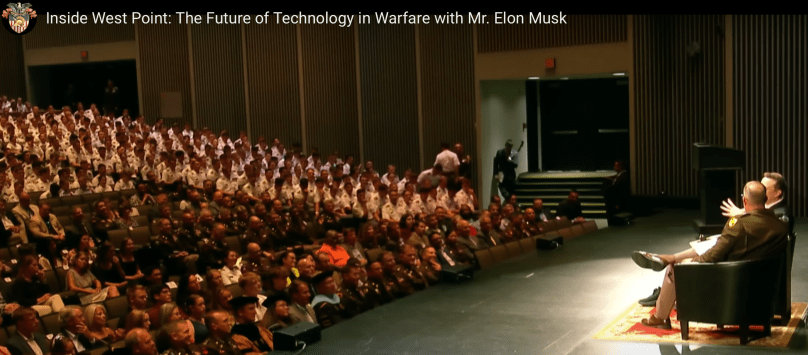
Geared towards students, the discussion with Brigadier General Shane Reeves explored national defense and technology.
In Part 1, Elon emphasized drone warfare, noting U.S. technological strength but low production rates, stating,
“Well I think we probably need to invest in drones, the United States is strong in terms of technology of the items, but, the production rate is low, so, it is a small number of units, relatively speaking, but I think that basically there is a production rate issue with the rate, like if you say how fast can you make drones, imagine there is a Drone conflict. The outcome of that Drone conflict will be based on: How many drones does each side have in that particular skirmish times the kill ratio… so let’s say that the United States would have a set of drones that have a high kill ratio, but then, the other side has far more drones. If you have got a 2 to 1 kill ratio, and the other side has four times as many drones, you are still going to lose.”
Ukrainian Drone Production and Aging
Reeves explained that a recent report quoted Zelensky saying Ukraine will produce 1 million drones by 2025. He then pivoted to ask Elon if he had solved aging.
Elon stated that he had not solved aging, and then added, “I wonder if we should solve aging?” He added, “How long do you want Putin and Kim Jong-un to live?”
Starlink’s Role in Warfare
Reeves shifted to the importance of communications in warfare, prompting Elon to discuss Starlink: “Communications is essential, it is actually very important to have space-based communications that are or that cannot be intercepted, which is Starlink. It is what Starlink offers. Starlink is the backbone of the Ukrainian military communication system because it can’t be blocked by the Russians. It is the only thing that cannot be blocked. So, on the front lines, all of the fiber connections are cut, all the cell towers are blown up, all of the geostationary satellite links are jammed. The only thing that isn’t jammed is Starlink, so it is the only thing. And then, GPS is also jammed. GPS signal is very faint and Starlink can offer location capability as well so it is a strategic advantage that is very significant. And, when you try to communicate with drones, the drones need to like basically, they need to know where they are, and they need to receive instructions. So if you don’t have communications and positioning, then the drones don’t work. So that’s quite important. That is essential.”
Future of AI and Drones
Reeves asked if there will still need to be communication between people and drones. Elon said, “There’s a difference between right now, versus where things will be in 10 years.” Sighing, Elon says he’s looking at the future with some trepidation. He says he has to have some deliberate suspension of disbelief to sleep sometimes. He thinks we’re headed into a pretty wild future. Elon is a naturally optimistic person, but “AI is going to be so good, including localized AI, but at the current rates, you’ll have something that is sort of Grok-level AI and it can probably be run on a drone and so, you could literally say, this is the equipment that the drone needs to destroy, and then it will go into that thing, and it will recognize what equipment needs to be destroyed, and will take it out.”
Elon says, “Communications is essential, it is actually very important to have space-based communications that are or that cannot be intercepted, which is Starlink. It is what Starlink offers”
AI Surpassing Human Control
Reeves asks Elon if he thinks that AI will quickly surpass the human’s ability to control. Elon answers,
“Yes, I mean, <very long pause> I’d like to say no, but the answer is yes.”
Reeves asks how long before the AI surpasses the ability for the human to influence how it’s working?
Elon explained that he does think humans will be able to influence how it’s working for a long time, “This is an esoteric subject, that really goes into pretty wild speculation, to some degree. I think that the AI will want humans as a source of Will. So, if you think of how the human mind works, there is the limbic system, and the cortex, you have sort of the base instincts, and sort of the thinking, and the planning part of your brain, but you also have a tertiary layer, which is all of the electronics that you use, your phones, your computers, applications, so you already have three layers of intelligence, but all of those, including the cortex and the machine intelligence, which is your sort of cybernetic third layer, is working to try to make the limbic system happy. Because the limbic system is a source of Will so, it might be that the AI just wants to make the humans happy.”
Neuralink and AI Mitigation
Continuing on AI, Elon introduced Neuralink: “And part of what Neuralink is trying to do, is to improve the communication bandwidth between the cortex and the digital tertiary layer because the output bandwidth of a human is less than one bit per second per day and there are 86,400 seconds in one day and you don’t output 86,400 tokens you know it’s like, the number of words that I can say in those forums, if you’re just looking at it from an information theory standpoint, how much information am I able to convey? Not that much. Because I can only say a few number of words, and in order to convey an idea, I have to take a concept in my head, and then I have to compress it down, into a small number of words, try to aspirational model, how you would decompress those words into concepts that are in your own mind, that’s communication. So your brain is doing a lot of compression and decompression, and then has a very small output bandwidth. Neuralink can increase that bandwidth by several orders of magnitude, and also, you don’t have to spend as much time compressing thoughts into a small number of words, you can do conceptual telepathy. That is the idea behind Neuralink. It is intended to be a mitigation against AI existential risk.”
AI Alignment and Humanity
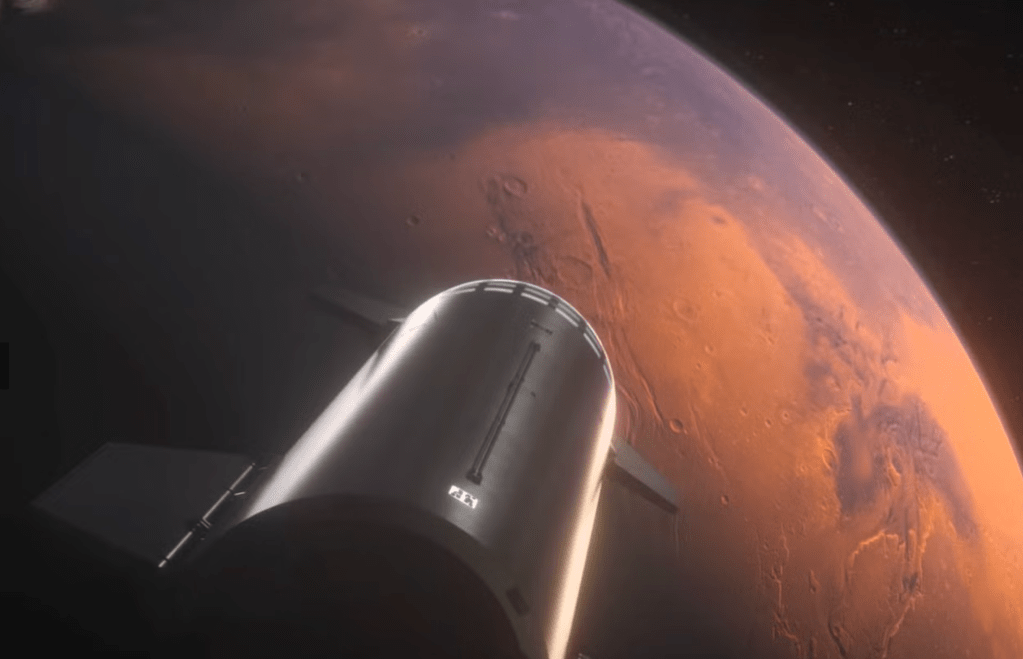
Reeves asked about the concept of AI alignment, prompting Elon to explain: “It’s asking the question, is the AI going to do things that make civilization better? Make people happy? Or will it be contrary to humanity? Will it foster humanity? Or not? Will it be against humanity? So obviously, we want an AI that will foster humanity and I think in developing an AI to foster humanity—because I’ve thought about AI safety for a long time—I think I’ve had probably about 1000 hours of discussion about this and my ultimate conclusion is that the best course for AI safety is to have an AI that is maximally truth-seeking and also curious. And if you have both of those things, I think it will naturally foster humanity because it will want to see how humanity develops. Want to see it because humanity is more interesting than not humanity. You know, I like Mars. I’m a big fan of Mars. And I think we should become a multi-planetary civilization. That’s very important. The purpose of SpaceX is to make life multi-planetary. That’s the reason I created the company, and that’s the reason we have the Starship development in South Texas. The rocket is far too big for just satellites. It’s intended to establish life on Mars not just to send astronauts there briefly, but to build a city on Mars. A city that is ultimately self-sustaining so, but getting back to AI, if you have a truth-seeking AI, that is maximally curious, my neural net, my biological neural net says that that is going to be the safest outcome. People say, why do you like Mars, Mars is not as interesting as Earth, because there’s no human civilization there. Or, thought of another way, if you want to render Mars, rendering Mars is pretty easy as it’s basically red rocks, kind of like some parts of Arizona you know there’s not a lot of people. It’s just very easy to render. But, rendering human civilization is much harder, much more complex, much more interesting so I think a curious and truth-seeking AI would want to foster humanity and want to see where it goes.”
Trusting AI and the End of Fighter Pilots
Reeves asked an interesting question, drawing on a comparison to a movie that he and Elon were both familiar with, Top Gun with Tom Cruise. His question to Elon was, “How do we build trust between the human and the machine, as there are many humans who don’t want to use the technology because they don’t trust it?”
Elon: “Well, I think we shouldn’t just automatically trust these things. I think you want to test it out, and do a lot of testing and see how it actually works and a conflict at a small scale, and then scale it up if it’s effective, but, I have to say, like I’m not sure for example, like I have to say,… Well, fortunately, this is not an Air Force gathering, but I’m not sure there’s a lot of room and opportunity for fighter pilots because I think if you’ve got a drone swarm coming at you, then the pilot is a liability in the fighter plane, to be honest. If you compare a drone versus a fighter plane, how easy is it to make a drone? It’s at least 10, maybe 100 times easier to make the drone, and you can afford to sacrifice the drones whereas, with the pilots, you don’t want to sacrifice the pilots, so my guess is actually that the age of human-piloted fighter aircraft is coming to an end.”
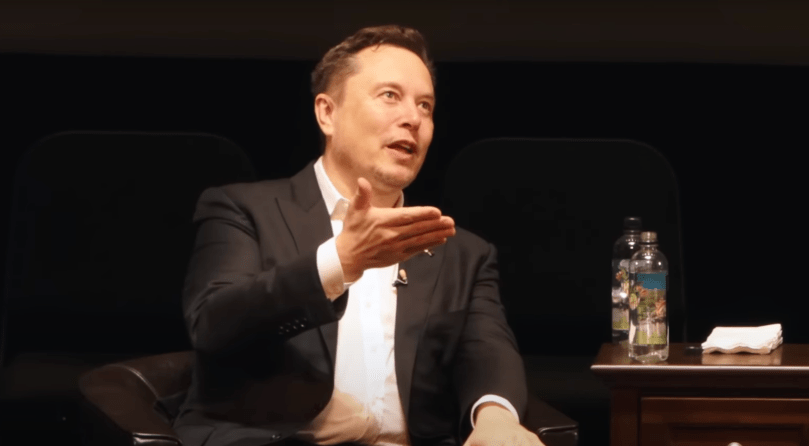
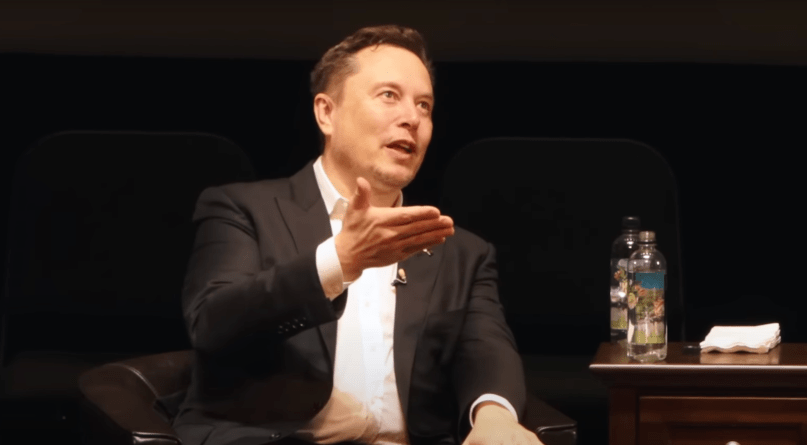
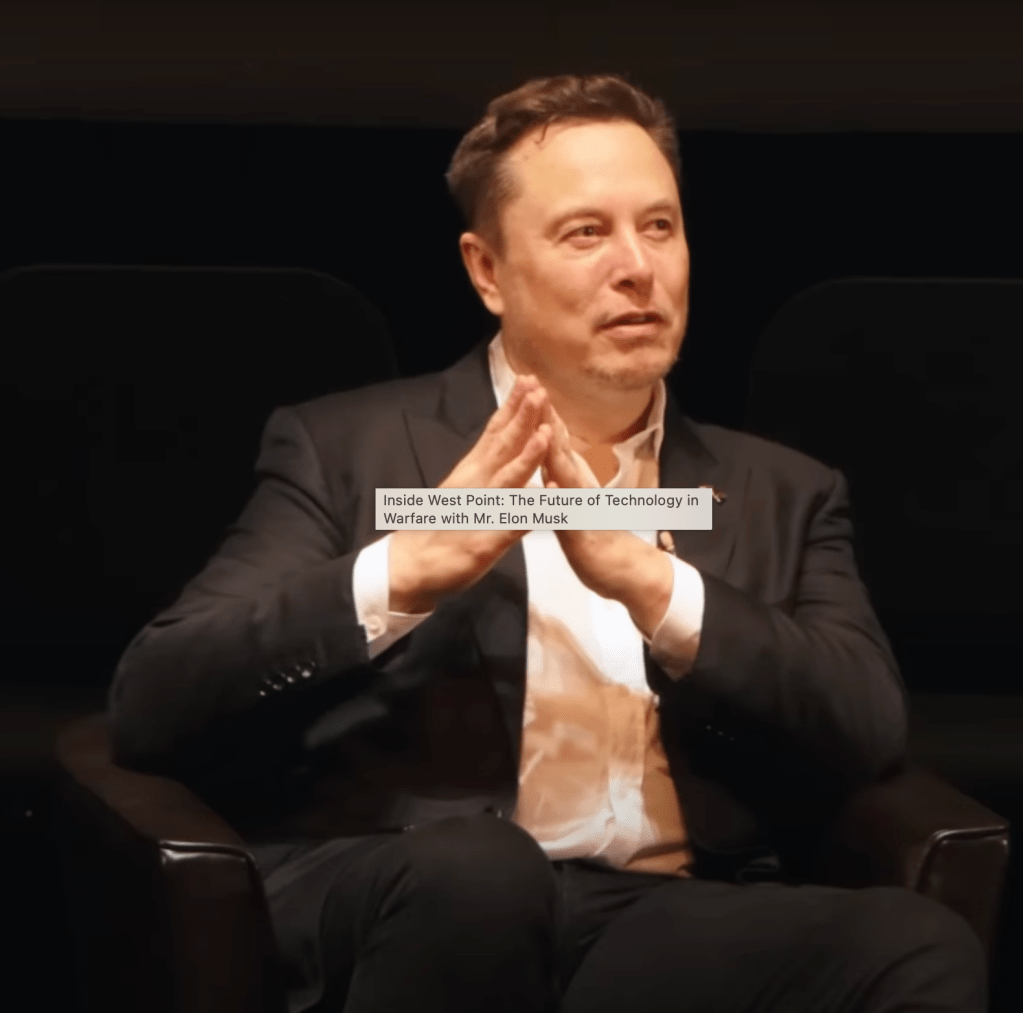
A primarily young audience of students gather to intently listen to Elon Musk at West Point. Elon spoke at on August 16, 2024, during a fireside chat with Brigadier General Shane Reeves, as part of the U.S. Military Academy’s convocation.
I am excited to share Part 3 of this talk with you soon!
My thoughts
Elon does not get credit for how much help he’s giving Ukraine. Without Starlink, Ukraine would have no communications for defense. Sadly, we’ve not heard Zelensky thank him for this in the last few years. Instead, Elon is villainized constantly.
Speaking to the young and excited audience at West Point, Elon showed his deep love for humanity when he urged caution: don’t blindly trust AI, test it carefully first. Drones, far easier to build than fighter planes, can be sacrificed—unlike precious pilots. He believes human-piloted fighters are fading, to protect lives.
Interested in other talks by Elon? I publish many of them.
It’s mid-August and school is starting up for many and this is a great time to read this inspiring essay by Elon Musk.
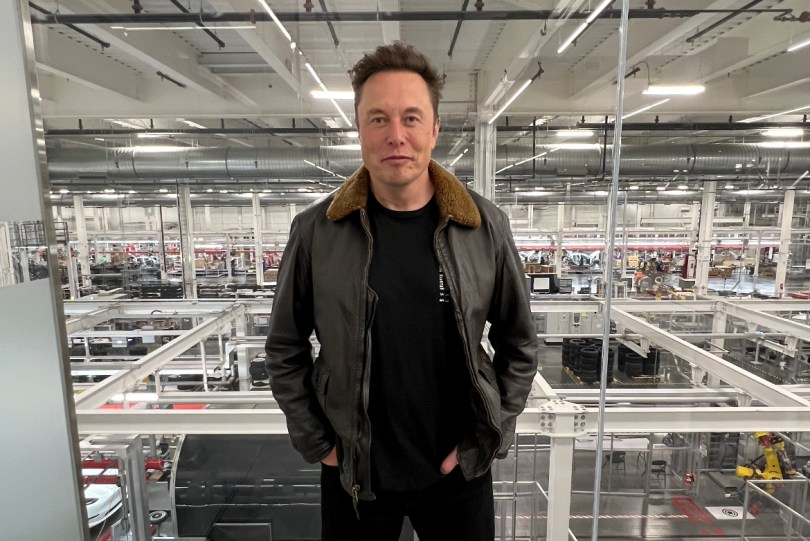
I hope you’ll relax with me and have a snack & a cold drink, may I suggest a KIND bar and a Coke Zero? This is what I enjoyed at Giga Texas right before briefly meeting Elon Musk and going on a tour of the gigafactory with brilliant Tesla engineers. I can tell you that after meeting Elon Musk, what he shares on Twitter is essentially the same as he talks about when meeting. He spoke about how important it is to get Starship into orbit and how important solving autonomy is.
I asked Elon if it was okay for me to take his picture, “Aren’t there already enough of me?”, “No, there isn’t one of you like this, alone, with Giga Texas in the background.”
Elon Musk is optimistic, lives with a sense of urgency, and takes action daily to make the future good. Yang Liu gave me permission to re-post this from his substack, Beijing Channel. 请用中文查看整篇文章。点击这里。 Elon Musk recognized Liu’s work in a tweet, “Reasonably accurate translation.”
BELIEVING IN TECHNOLOGY FOR A BETTER FUTURE 相信科技创造美好未来
Thank you for the invitation from China Cyberspace magazine. I am pleased to share with my Chinese friends some of my thoughts on the vision of technology and humanity.
As technology accelerates, it may one day surpass human understanding and control. Some are optimistic and some are pessimistic. But I believe that as long as we are not complacent and always maintain a sense of urgency, the future of humanity will be bright, driven by the power of technology. It is like a self-fulfilling prophecy: if humans want to make the future good, they should take action to make it good.
I want to do everything we can to maximize the use of technology to help achieve a better future for humanity. To that end, any area that contributes to a sustainable future is worthy of our investment.
Whether it’s Tesla, Neuralink, or SpaceX, these companies were all founded with the ultimate goal of enhancing the future of human life and creating as much practical value for the world as possible—Tesla to accelerate the world’s transition to sustainable energy, Neuralink for medical rehabilitation, SpaceX for making interstellar connections possible.
CLEAN ENERGY: THE FUTURE OF SUSTAINABILITY
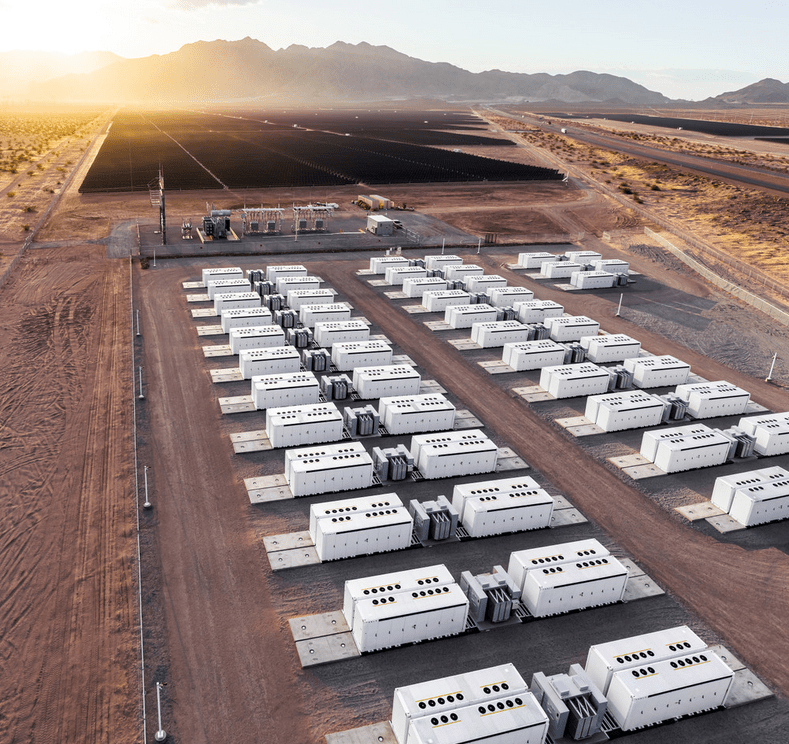
Tesla Megapack and Solar. credit: Tesla
The starting point for my thinking about clean energy is how to create and store energy sustainably and for the long term, and how to provide a constant source of power for the future of productive life. In my view, the future of sustainable energy involves three components.
The generation of sustainable energy. The sun is like a giant fusion generator, from which mankind currently exploits a tiny amount of energy. In the long run, solar energy will become the main source of energy for human civilization. Of course, wind, hydroelectric, geothermal, and nuclear power are also useful energy supplements.
The storage of sustainable energy. Given the change of day and night and the change of weather, we need a lot of fixed battery banks to store solar and wind energy, because the sun does not shine all the time, and the wind does not blow all the time, energy needs to be stored in a large number of fixed battery banks.
Electrified transportation. Full electrification of transportation, including cars, planes, and ships. Electric rockets may be more difficult, but we may be able to manufacture the propellant used in rockets from sustainable energy sources. Eventually, the world economy will be run entirely by sustainable energy sources.
The world is on track for a sustainable energy transition, and humanity should continue to accelerate the process. The faster this transition is achieved, the less risk humanity poses to the environment and the more it will gain. When clean energy is available, carbon sequestration and desalination will be cheaper, climate change and water shortages will be solved, and when fossil fuels are out of the picture, the skies will be cleaner, the world will be quieter, the air will be fresher, and the future will be brighter.
Tesla Solar Roof. credit: Tesla
Solar power, battery packs, and electric vehicles paint a rosy picture. Next, we need to focus on the limiting factors. The electrification of cars has become a consensus among nations, but battery support on a terawatt-hour scale is needed to roll out pure electric vehicles around the globe. According to our estimates, the world needs about 300 TWh of battery storage to achieve a transition to sustainable energy. The biggest difficulty in advancing sustainable energy lies in the large-scale production of lithium battery cells. Specifically, from the mining and element refining to battery cells coming off of the production line and finally assembled into battery packs, this is a complex process that is restraining the rapid development of a sustainable energy economy.
As a pioneer and innovator focusing on energy innovation technology, Tesla was founded to solve the problem of energy innovation. On the one hand, we create integrated sustainable energy products from the three segments of energy: production, storage and use; on the other hand, we are committed to redefining battery manufacturing by innovating and developing advanced battery technology to remove restrictions on battery capacity.
I believe that the world will transition to a sustainable future through a combination of solar and wind energy plus battery storage and electric vehicles. I am pleased to see more and more companies joining this field. Chinese companies will be a force to be reckoned with in the cause of energy innovation.
HUMANOID ROBOTS: DOING WHAT HUMANS DO
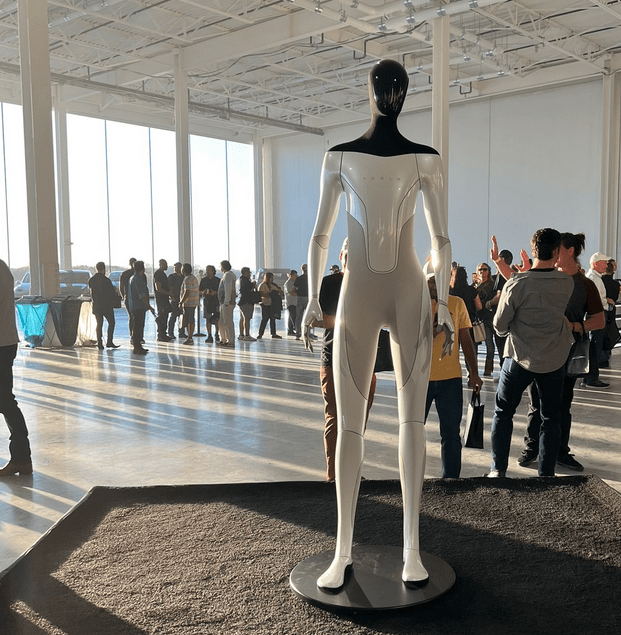
Tesla humanoid robot prototype, Tesla Bot. credit: Barbara @bmt094
Today’s cars are increasingly like smart, web-connected robots on wheels. In fact, in addition to cars, humanoid robots are also becoming a reality, with Tesla launching a general-purpose humanoid robot (Tesla Bot) in 2021. The Tesla Bot is close to the height and weight of an adult, can carry or pick up heavy objects, walk fast in small steps, and the screen on its face is an interactive interface for communication with people. You may wonder why we designed this robot with legs. Because human society is based on the interaction of a bipedal humanoid with two arms and ten fingers. So if we want a robot to adapt to its environment and be able to do what humans do, it has to be roughly the same size, shape, and capabilities as a human.
Tesla Bots are initially positioned to replace people in repetitive, boring, and dangerous tasks. But the vision is for them to serve millions of households, such as cooking, mowing lawns, and caring for the elderly.
Achieving this goal requires that robots evolve to be smart enough and for us to have the ability to mass produce robots. Our “four-wheeled robots” – cars – have changed the way people travel and even live. One day when we solve the problem of self-driving cars (i.e., real-world artificial intelligence), we will be able to extend artificial intelligence technology to humanoid robots, which will have a much broader application than cars.
We plan to launch the first prototype of a humanoid robot this year and focus on improving the intelligence of that robot and solving the problem of large-scale production. Thereafter, humanoid robots’ usefulness will increase yearly as production scales up and costs fall. In the future, a home robot may be cheaper than a car. Perhaps in less than a decade, people will be able to buy a robot for their parents as a birthday gift.
It is foreseeable that with the power of robots, we will create an era of extreme abundance of goods and services, where everyone can live a life of abundance. Perhaps the only scarcity that will exist in the future is for us to create ourselves as humans.
Some of our Chinese friends may not be as familiar with Neuralink as with electric cars. These companies focus on developing computer-human brain fusion technologies, developing brain chips the size of coins, similar to wearable devices such as smartphones, except that they integrate more deeply with the user’s body—recording and stimulating brain activity through implants in the cerebral cortex.
At this stage, the technology is helping injured people on an individual level. We have received many saddening letters: a 25-year-old young man was in the prime of his life when he had a motorcycle accident that left him unable to eat on his own, which is a great grief for the individual and the family. In light of this, brain-machine interface technology will be focused on curing or alleviating brain injury and other related disorders in the years to come. For example, it could help restore sensory or motor function to limbs of those with spinal injuries and mental system disorders or allow quadriplegics to use their brains to easily operate computers or cell phones.
This technology can also improve a wider range of brain injury problems, whether these disorders are congenital or accidental, or caused by age and external stressors, including severe depression, morbid obesity, sleep problems, and underlying schizophrenia, all of which are expected to be alleviated by human-computer devices.
With the development of brain-machine interface technology, in the long term, this connection is expected to expand the channels of communication between the outside world and the human brain, “accessing” more brain regions and new neural data. This technology could allow humans to effectively integrate with artificial intelligence and ultimately expand new ways for humans to interact with the world, themselves and others. Even if the goal of human-machine integration is difficult to achieve, brain-machine interface technology could be of great value in the field of medical rehabilitation.
SPACE EXPLORATION: THE POSSIBILITY OF CROSS-PLANET HABITATS
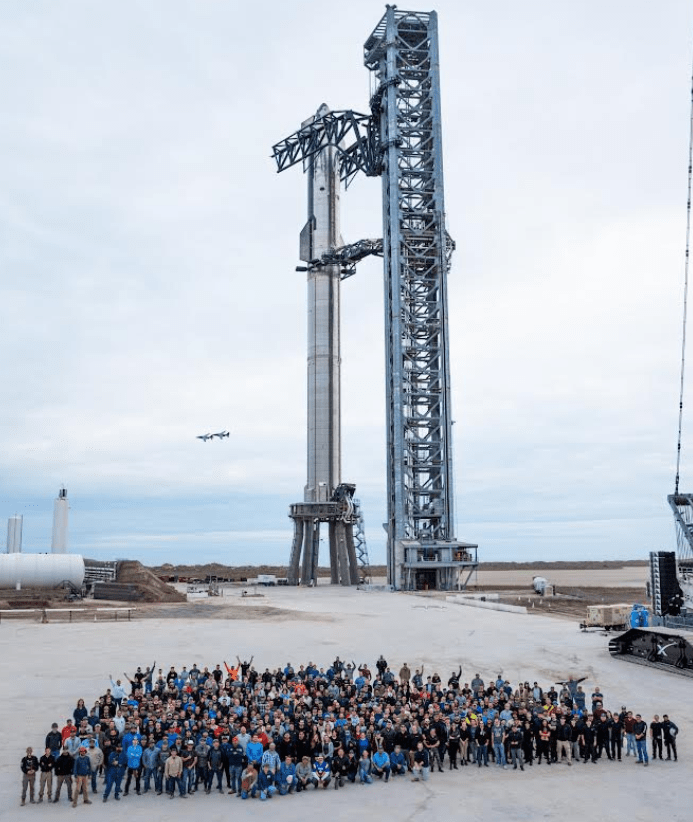
SpaceX team, Starship, and booster in Starbase, Texas, Feb 16, 2022. credit Austin Barnard
Finally, my greatest hope is that humans create a self-sustaining city on Mars. Many people ask me why I want to explore outer space and turn humans into multi-planetary creatures. In the vast universe, human civilization is like a faint little candle, like a little shimmering light in the void. When the sun expands one day and the Earth is no longer habitable, we can fly to a new home in a spaceship. If humans can inhabit other planets, it means that they have passed one of the conditions of the great screening of the universe, then we will become interplanetary citizens, and human civilization will be able to continue.
The first step toward interplanetary habitat is to reduce the cost of travel, which is what SpaceX was founded to do – first by building recoverable rockets and then by building reusable mega-ships with ever-increasing carrying capacity. As of earlier this year, SpaceX had successfully reused 79 rockets to deliver cargo to the space station and send ordinary people into space. We have also designed and built the largest launch vehicle in history, the Starship, which can carry 100 passengers and supplies at a time. In the future, we plan to build at least 1,000 Starships to send groups of pioneers to Mars to build a self-sustaining city.
As technology continues to change lives at an accelerating pace and the world evolves, life is more than simply solving one problem after another. We all want to wake up in the morning full of anticipation for the future and rejoice in what is to come. I hope more people will join us in our fight to accelerate the world’s transition to sustainable energy. I also welcome more like-minded Chinese partners to join us in exploring clean energy, artificial intelligence, human-machine collaboration, and space exploration to create a future worth waiting for.
CONCLUSION
Elon Musk wrote about the future of humanity in four critical areas
1. Clean Energy. Elon Musk envisions a thriving future that is powered by the sun. “Eventually, the world economy will be run entirely by sustainable energy sources.”
2. Humanoid Robots, “The Tesla Bot is close to the height and weight of an adult, can carry or pick up heavy objects, walk fast in small steps, and the screen on its face is an interactive interface for communication with people.”
3. Neuralink’s great potential to improve physical and mental health and eventually serve millions of households, especially the elderly.
4. Space exploration is the last topic and Elon’s words describing his greatest hope inspire us, “In the future, we plan to build at least 1,000 Starships to send groups of pioneers to Mars to build a self-sustaining city.”
Underpopulation is very real, and Elon Musk has ideas on how to tackle this problem, you can read about what he thinks in my article, “Elon Musk: Discussion About Underpopulation,” which is highly acclaimed and noticed by Elon Musk who tweeted in response to it, “Children are essential to the future” on July 11, 2022.
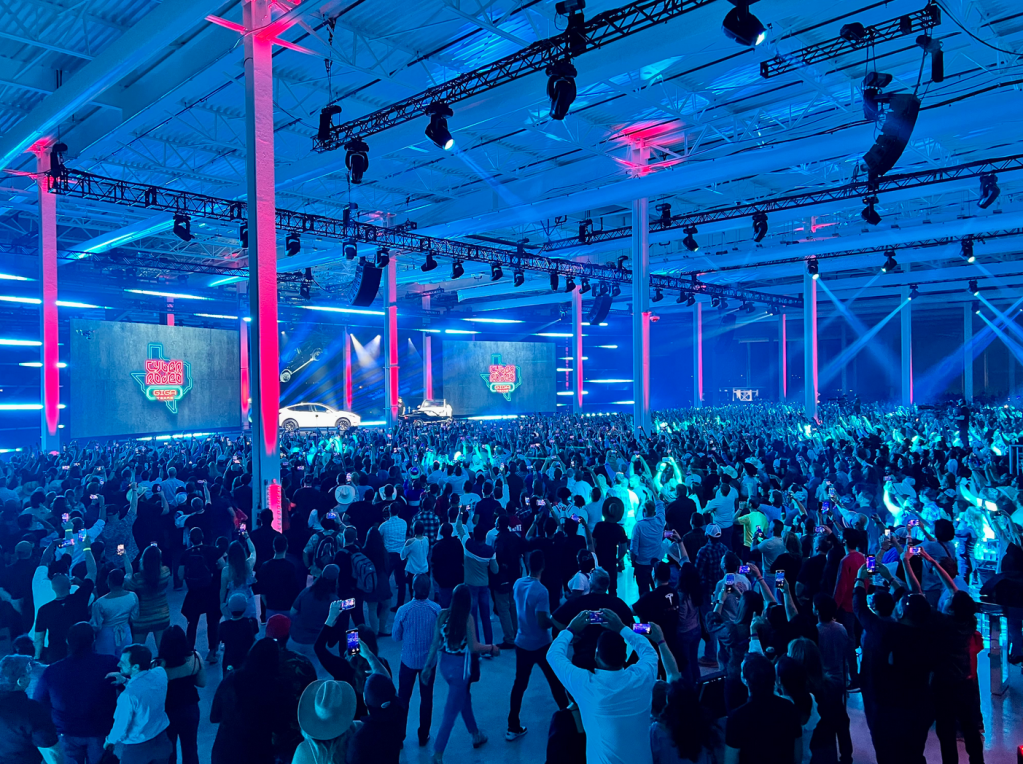
Fun Sidestory: I am humbled and honored to have had the opportunity to get to know some of the Dogecoin community including Gary Lachance. I met Gary in Austin and I was excited to find out there were T-shirts with the Doge drone show from Cyber Rodeo and Texas Rodeo Doge shirts. Later when I was invited to meet Elon Musk at Giga Texas, I asked Gary if he had any extra shirts. Eventually, I met a friend of Gary’s in Austin who passed me a box of shirts and a ceramic tile. Elon received the Rodeo Doge and Drone Doge t-shirts and was appreciative and grateful for them.
Article by Gail Alfar. Exclusive to What’s Up Tesla – All Rights Reserved. August 21, 2022. Featured banner photo of Elon Musk in the Legendary Bomber Jacket on August 19, 2022, credit: Gail Alfar
One-Time
Monthly
Yearly
Make a one-time donation to support What’s Up Tesla
Make a monthly donation to support What’s Up Tesla






 whatsuptesla.com