
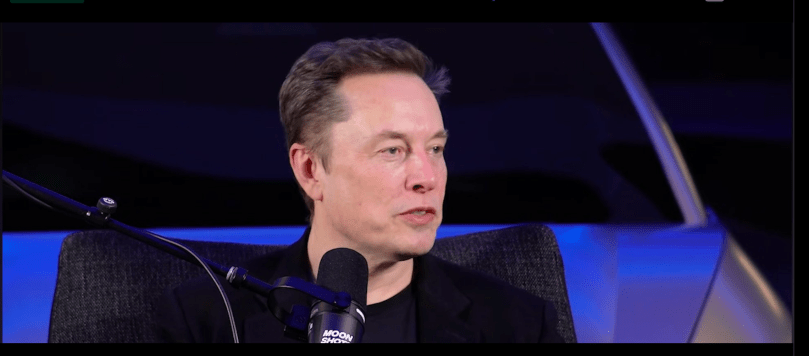
(Austin) Education is the focus in this exciting part of the interview. There is a lot to learn from Elon’s wisdom. This transcript is from Moonshots with Peter Diamandis, Episode #220: Elon Musk on AGI Timeline, US vs China, Job Markets, Clean Energy & Humanoid Robots. Recorded December 22, 2025, at Tesla’s Giga Texas factory in Austin, Texas. Released January 6, 2026. I have painstakingly worked hard to make sure this is the best possible transcipt for you.
HIGHLIGHTS
- SHIFT IN EDUCATION
- ELON WANTED TO BE USEFUL TO HUMANITY
- GUIDE ON HOW TO CREATE MORE ELON MUSKS
- AI POWERED EDUCATION, EL SALVADOR
- ENTREPRENEURSHIP
- IRON MAN
- GROK AI EDUCATION IN EL SALVADOR
- EDUCATION AS A SOCIAL EXPERIENCE
SHIFT IN EDUCATION
Peter Diamandis: All right, I want to talk about education. So here’s the numbers—they’re abysmal.
Elon Musk: Right.
Peter Diamandis: The importance of college in the United States. Back in 2010, 75% of Americans said it’s important to go to college. That number is now down to 35%.
Elon Musk: All right.
Peter Diamandis: College graduates as a group turn out to be the group that’s out of work the longest. And still, tuition has increased 900% since 1983.
Elon Musk: Yeah. The administrative expenses at universities have gotten out of control. I think I saw some stat that, like, there’s 1 administrator for every 2 students at Brown or something like that. And I’m like, this seems a little high.
ELON MUSK’S COLLEGE PATHWAY
Dave Blundin: Elon, what was your college journey?
Elon Musk: I went to college in Canada for a couple years at Queen’s University. So I had Canadian citizenship through my mom, who was born in Canada, and my grandfather was actually American. But for some reason, I don’t know, my mom couldn’t get U.S. citizenship, but she was born in Canada, so I got Canadian citizenship and I didn’t have any money, so I could only go to a Canadian University at first.
Peter Diamandis: People forget that about you. You didn’t have this giant social network or huge amount of wealth coming into all of this.
Elon Musk: No, no. I arrived in Montreal at age 17 with I think around $2,500 in Canadian traveler’s checks, back when traveler’s checks were a thing. And one bag of books and one bag of clothes. That was my starting point. That was my spawn point in North America.
ELON WANTED TO BE USEFUL TO HUMANITY
Elon Musk: And then I went to Queen’s University for a couple years, and then University of Pennsylvania. Did a dual degree in physics and economics and graduated undergraduate at UPenn. UPenn-Wharton. And then I was going to do a PhD at Stanford working on energy storage technologies for electric vehicles. Potentially material science, I guess, fundamentally, the idea that I had was to try to create a capacitor with enough energy density that you get high range in an electric car.
Dave Blundin: It’s funny, I invested in an ultracapacitor company and then—Yeah, didn’t go well.
Elon Musk: Well, it’s one of those things where, you know, you could definitely get a PhD, but it wasn’t clear that you could make a company or do something useful like this. Most PhDs, I mean, I hate to say it, but most PhDs do not turn into something that’s going to turn into something useful. Like you could add a leaf to the tree of knowledge, but it’s not necessarily a useful leaf.
You could add a leaf to the tree of knowledge, but it’s not necessarily a useful leaf – Elon Musk
Dave Blundin: An enormous fraction of great entrepreneurs are dropping out of grad school or undergrad. But nowadays the sense of urgency is off the charts. But I mean, they’re popping out everywhere.
Peter Diamandis: Yeah, because, you know, don’t waste your time going to grad school. Start a company.
Dave Blundin: Curriculum is nowhere near caught up to what’s actually going on in technology and I don’t have time. And we talked about that.
Peter Diamandis: It’s like, you know, this is the moment.
Elon Musk: I think this is the moment. Like it’s not clear to me why somebody would be in college right now unless they want the social experience.
GUIDE ON HOW TO CREATE MORE ELON MUSKS
Peter Diamandis: So the question is, how would you redesign the educational program? If I could be so blunt as to create more Elon Musks. You know, if you want to create an Elon Musk factory of people who start with very little but are able to drive breakthroughs, what’s involved there? What drove you?
Elon Musk: Curiosity about the nature of the universe. So I’m curious about the meaning of life and, you know, what is this reality that we live in?
Peter Diamandis: My son Dax wanted to know what was it like for you in middle school and high school? He’s 14 years old. He’s in that age range now.
Elon Musk: Well, I found school to be quite painful and it was very boring. And South Africa was very violent. So it was like, it was like that book, “Ender’s Game.” Yes, but in real survival IRL—Ender’s Game IRL. It was like that, but not as fun.
Peter Diamandis: So your goal was escape?
Elon Musk: Yes, escape from the present.
Peter Diamandis: So that’s a question I have. Do you think most successful people have had a lot of hardship early in life? Do you need to have that level of hardship?
Elon Musk: Probably needs a little bit of hardship, I suppose, yeah. And then it’s always tricky, like what are you supposed to do with your kids? You know, create artificial adversity.
Dave Blundin: That’s a Warren Buffett topic actually.
Elon Musk: What do you do? But seriously, it’s not easy to create artificial adversity because if you love your kids, you don’t want to do that. So. Sure. So I had a lot of adversity. It probably was good. Probably, you know, helped somewhat. What does not kill you, makes you stronger type of thing. At least I didn’t lose a limb. I think what doesn’t maim you—makes you stronger.
ENTREPRENEURSHIP
Dave Blundin: For the last five years, I’ve been helping teach this class Foundations of AI ventures at MIT. And every year when you survey the students, they go up a lot in their desire to start a company. And so it’s now up to 80% of the incoming class.
Elon Musk: Everyone’s just going to—It’s just going to be like one person company. Well, that’s—
Dave Blundin: With AI, that’s viable, I guess. But no, they want to co-found. Yeah. They don’t want to be the founder. They want to be part of a founding team. So it still works out. But when Peter and I were in school at MIT, it was, I’m guessing, maybe 10%, and they all wanted to be—And they’ve been doing the survey.
Elon Musk: I didn’t know anyone who wanted to start a company, I mean, yeah, I don’t remember any conversations about with people saying they wanted to start anything…
Dave Blundin: Even at Stanford at the time?
Elon Musk: I actually, a few days into the semester, or I should say the quarter, I called Bill Nix, who is the head of the material science department, and said, I’d like to just put it on deferment.
Peter Diamandis: He said, is my class that bad?
Elon Musk: No. And he said, that’s okay, you can put it on deferment. But he said, this is probably the last conversation we’ll have. And he was right. But then last, I think it was last year, he sent me a letter saying that all of my predictions about lithium-ion batteries came true.
Peter Diamandis: And did he also say you could still come back and finish your PhD?
Elon Musk: Yeah, several times Stanford has said that I can come back for free.
IRON MAN
Dave Blundin: Every time an Iron Man movie came out, it notched up another probably 10% or so in terms of everybody wanting to be Tony Stark. And so that’s the image. And I didn’t know till today that the new Tony Stark, the modern Iron Man, Tony Stark—I always thought Tony Stark was modeled on Charles Stark Draper and Howard Hughes. It was Charles Stark Draper’s education and his, you know, scientific endeavors married with Howard Hughes’s ambition. And that created the original character. But then when Robert Downey Jr. wanted to reinvent it, it’s modeled on Elon.
Elon Musk: Yeah, he came to see me.
Dave Blundin: This is a Grokipedia fact.
Elon Musk: All right.
Dave Blundin: Yeah, Fantastic. Yeah. So they came to you, Jon Favreau and Robert—
Peter Diamandis: I like the name Grok. I would like Jarvis as well.
Elon Musk: At some point, if Grok gets good enough, we’re going to call it Encyclopedia Galactica.
GROK AI EDUCATION IN EL SALVADOR
Peter Diamandis: So going back to education, I guess the social experience, like you said, is important there, but what would you do for education? You know, middle, and high school? You just came back from an announcement with President Bukele, who’s a friend. I think he’s an amazing, amazing visionary.
Elon Musk: Yeah.
Peter Diamandis: Incredible what he did with his nation.
Elon Musk: Yeah. Remarkable.
Peter Diamandis: Remarkable and gutsy.
Elon Musk: Yeah. I was like, how are you still alive?
Peter Diamandis: (referring to President Bukele of El Salvador) Besides putting everybody with a gang sign in jail, I don’t know if you know, the second thing he did, he went to all of the graves of all the gang members out there and destroyed the graves and said, “Your memory will not be remembered in this nation.” That’s just badass. And it worked.
Elon Musk: I mean, you have to be badass motherf*er to take on all the gangs and win and live. Yeah. And still be alive and live.
Peter Diamandis: He’s got great guards at his palace there. But what did you announce with him in El Salvador?
Elon Musk: It was just basically to use Grok for education, like personalized education.
Peter Diamandis: Hopefully not the vulgar version of it.
Elon Musk: Yeah, we would have like, you know, the kid-friendly version of Grok. But obviously AI can be an individualized teacher that is infinitely patient and answers all your questions. (pauses) Now you still need to be curious and you still need to want to learn. Grok can’t make you want to learn. It can make learning more interesting.
Peter Diamandis: You could probably gamify and incentivize it.
Elon Musk: Right. You can make learning more interesting and less of a production line. But kids do need to have to—they need to want to learn. You know, people should just think of the brain as a biological computer.
Peter Diamandis: It’s a neural net.
Elon Musk: Yeah, it’s a biological computer with a number of neurons and neural efficiency. And so what you can’t do is turn any arbitrary kid into Einstein. This is not realistic because Einstein had a very good meat computer, like an outstanding meat computer. So you can’t just make a Shakespeare, Newton, or, you know, an Einstein type of thing, unless the meat computer is an exceptional one.
Peter Diamandis: So what do you think? So when people say we need to solve education in the United States because it’s fundamentally broken, I think what’s really broken, I’m curious, is the old social contract that says do well in high school, get in a good college, get a degree and then get a job. And I don’t know that that’s going to be valid in the future. We talk about this on the pod a lot. That the career of the future isn’t getting a job, it’s being an entrepreneur. It’s finding a problem and solving it.
Elon Musk: Yeah.
Peter Diamandis: Do you agree with that?
EDUCATION AS A SOCIAL EXPERIENCE
Elon Musk: Right now I’d say it feels just, you know, go to school for the social experience, use more AI. The conventional schooling experience I think could be a lot better. What we’re going to do in El Salvador and hopefully other places, just have individualized teachers. It’s going to be much better. And you could go to a school with a bunch of other kids, I guess if you want to hang out with other kids. But you don’t need to. Right. You could do it on your phone at home.
So that’s why I say like at this point education is a social experience. When I talk to my kids who are in college, they do recognize that they can learn just as much independently. In fact, they would learn more in a work situation. They are there for the social experience and to be around a bunch of people of their own age. Sort of a coming-of-age social experience.
Peter Diamandis: Sure, sure. Being on your own, learning how to lead or defend yourself as the case may be.
Elon Musk: Well, yeah, I mean if you join the workforce, you know, from the perspective of like, you know, a 19-year-old with a bunch of old people and if you’re doing engineering with a bunch of middle-aged dudes, it’s like do you really want to do that or do you want to hang out with, you know, where there’s at least some girls your age type of thing.
My thoughts
It is February 2026, about 2 months since this interview, and so much has happened. Kids in El Salvador have received their laptops and are ready to start their AI Grok education, while students in failing grade schools in Austin, Texas, have been walking out of class to protest against having safe, secure borders. The irony is real. What I see for the future is a future where the whole earth lives in pure abundance—so much so that the USA does not become the craved destination for people who live in currently failing countries. They can stay in their own places because they too will have unlimited abundance. The future is going to be amazing.
This transcript is from Moonshots with Peter Diamandis, Episode #220: Elon Musk on AGI Timeline, US vs China, Job Markets, Clean Energy & Humanoid Robots. Recorded December 22, 2025, at Tesla’s Giga Texas factory in Austin, Texas. Released January 6, 2026.
 whatsuptesla.com