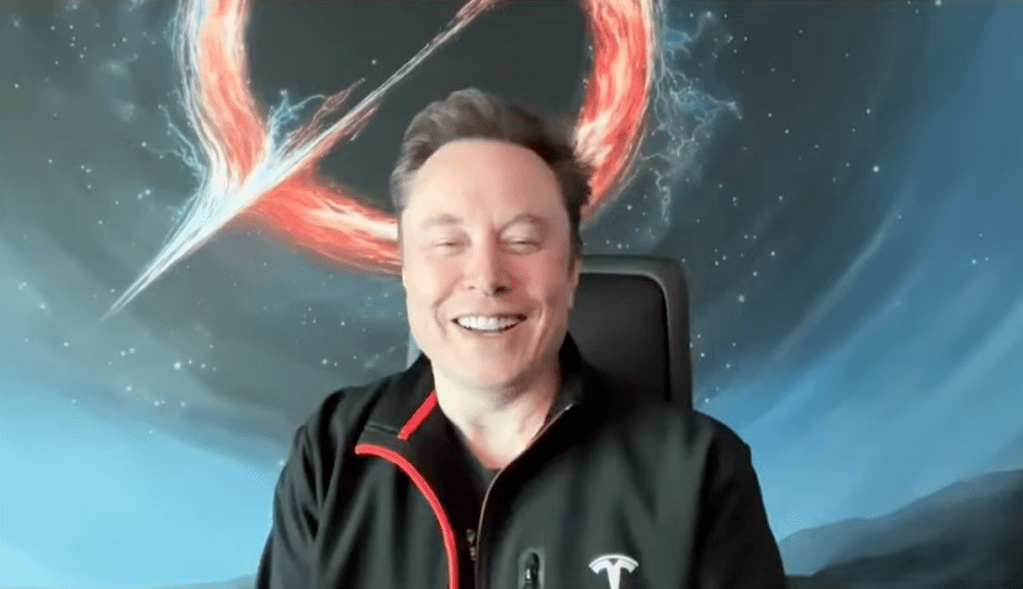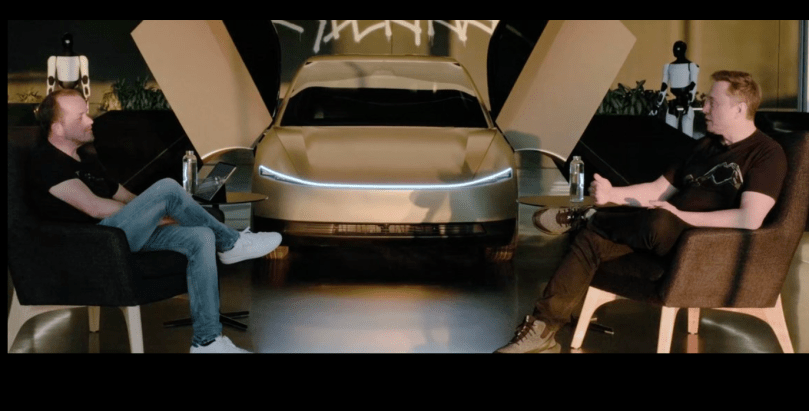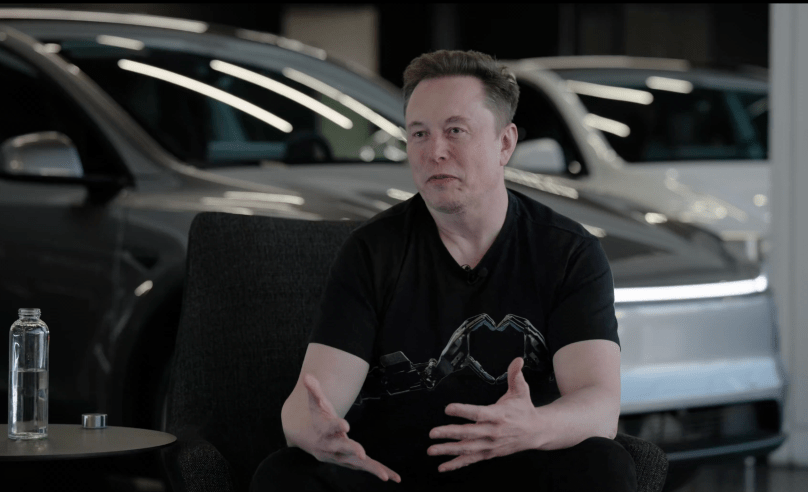
View of Giga Texas factory floor from the conference room where the Getting Stoned podcast interview with Elon Musk took place, July 2022 [Photo by Gail Alfar]

Elon Musk Full Transcript: “This is Getting Stoned” Podcast at Giga Texas (July 2022)

Video: https://youtu.be/rQI2Ls32b80

In July 2022, podcaster Johnna Crider invited me, Gail Alfar, to join her for a relaxed, wide-ranging conversation with Elon Musk at Tesla’s Giga Texas factory. The chat was recorded for Johnna’s show Getting Stoned.

The three of us talked about some of the biggest ideas facing humanity: why we should make life multi-planetary with real urgency, the declining birth rate and its risks to civilization, poverty and homelessness, the power of internet access and education, Starlink’s role in disaster relief, Tesla Energy (including Megapacks), and the future of AI and Full Self-Driving.

It was a candid, unscripted discussion full of big-picture thinking and personal stories — including a memorable moment when Elon directly addressed the shadowbanning I was experiencing on Twitter (now X).

This cleaned-up transcript captures the full conversation exactly as it happened — easy to read and understand for anyone, no matter their background. (Elon even invited Johnna back for a Part 2 because we didn’t have time to cover every question!)

Full Verbatim Transcript

Elon: This is Getting Stoned. It’s a podcast about gems and minerals and I am not your host.

Johnna: This is Getting Stoned. It’s a podcast about gems and minerals and I am your host, Johnna Crider. On today’s episode we have a very special guest. Thank you, Elon Musk, for joining me.

Elon: All right.

Johnna: So Elon, I always find it inspiring when you talk about the light of consciousness. What does consciousness mean to you?

Elon: To the best of our knowledge, the only conscious life we’re aware of is on Earth. I’m conscious in the sense that I think I have self-awareness. We’ve never found microbial life anywhere else in the solar system, though it’s possible we might find some under the ice of Europa.

According to the geological record, Earth is about 4.5 billion years old and the universe is about 13.8 billion years old. It’s odd that only very recently has life evolved that can talk, write, and communicate sophisticated ideas. And only now has civilization reached the point where we can send life to another planet. A lot of people think Moon landings are fake. They’re not.

Johnna: I don’t think they’re fake.Yeah, they’ve actually brought back some cool minerals from the Moon and I kind of have one in my collection. 

Elon: I actually have a slice of a Moon meteor — a chunk of Moon that was hit by a meteor, smashed a bunch of Moon rocks, and some of the Moon rocks landed on Earth. And I’ve got a segment of one of them.

Johnna Crider: The Apollo mission brought back some Tranquilityite. And up until 2011, it’s called that because of the Sea of Tranquility. Yeah, and there was none found on Earth and then in 2011 some deposits were found in Australia. 

So I have a friend of mine sent me some deposits and it broke. And so it had big chunks and two little pieces, so I made the other two little pieces into art. 

Elon: But I mean it’s crazy how old the rock is. It’s like billions of years old. 

Johnna: That shungite I just gave you, that’s over two billion years old. 

Elon: That’s a long time, you know. Don’t hold your breath (laughter)

Elon: I mean it’s hard to even wrap your mind around that kind of time scale. A billion years — our lifespans are a flash in the pan. That’s true. Just like that. Shorter than a flash in the pan compared to galactic time scales.

So there are much things that one could say, or at least appear to be likely, which is that it appears that consciousness is rare. And it takes a long time for it to arise. And so, like I said, to the best of our knowledge we are alone. And so we have to accept the possibility that we may be it — at least in this sector of the galaxy or in the Milky Way perhaps. And if we’re it and this is the only little candle in a vast darkness of a little light of consciousness that got us lit, then we should really try to make sure that life does not go out. And we can’t take it for granted that it won’t. So we want to try to make it last as long as possible.

Elon: And I think we also want to try to understand the nature of the universe, meaning of life, where is it going, what does the future hold, just find out what’s going on in the universe. And so that means the more that we can expand the scope and scale of consciousness, the more we’re likely to understand the fundamental questions around the meaning of life and nature of the universe. And so I think that’s a good goal to have. And it’s a goal that I think can unite humanity because it’s a common goal as opposed to sort of infighting and “I want this big field of ice, I want this piece of land.” No, I want this piece of land. Well, you know, there’s a lot of land out there. There’s a lot of planets with nothing on them. How about those ones? Why fight over the little pieces when there’s entire planets out there and solar systems and stuff?

Elon: So I think it is a philosophy that withstands reason. I think there’s a solid reasoning basis for it. It’s really just a philosophy of curiosity, I would call it. And it’s also exciting, you know. If you think like… I mean the happy reasons when you wake up in the morning that you’re excited to be alive and you look forward to the future. And it can’t just be solving one sad problem after another. You know, what the hell’s the point? There’s no point like that.

Johnna: Right.

Elon: This is the first time in history that the window of opportunity has been open for life to become multi-planetary. It may stay open for a long time or a short time, but I think it would be wise to assume it will be open for a short time and take action now.

We don’t need to spend a huge amount of resources on it. Less than one percent of our resources would be enough to make life multi-planetary. We should be life’s steward in that sense, because the other creatures can’t build spaceships but we can.

This isn’t about abandoning Earth. We need to make Earth as good as possible. That’s what Tesla is about, making a good future for Earth. SpaceX is about making life multi-planetary. We need to do both.

Johnna: You would not believe what my cats can do. That’s all I’ve got to say about that! But seriously, I think we have a responsibility to protect the rest of the creatures on Earth too.

Elon: I completely agree. A reasonable approach would be to spend about one percent of our resources on making life multi-planetary and ensuring the long-term survival of consciousness and life as we know it. Tesla’s goal is to help ensure a good future for Earth. SpaceX’s goal is to make life multi-planetary and ensure the long-term survival of consciousness. Those are awesome goals.

Gail: Happiness.

Elon: I’ve mostly talked about the defensive, protective reasons for becoming multi-planetary. But what actually gets me most excited is the sense of adventure and possibility. It would be the greatest adventure ever, exciting and inspiring to see it happen.

Johnna: What you and SpaceX have done in Ukraine with Starlink inspires a lot of deep respect. You also helped Saint Charles Parish in my state after Hurricane Ida, as well as the villages of Tango. What role do you see Starlink playing in disaster relief? We’re going to have a lot of disasters. They’re predicting more hurricanes in my area this year.

Elon: In general, Starlink is not dependent on any ground-based infrastructure, so it can provide internet connectivity to areas hit by floods, fires, or earthquakes where the ground infrastructure has been destroyed. That’s extremely helpful for rescue operations. When people are stranded, they need to be able to say “I need help” or “I need rescue.” Starlink has provided that in a number of situations.

Johnna: When we had Ida, my power was out for a week. Communications in southeast Louisiana were completely wiped out. It just made me think Starlink would definitely help organizations like the Cajun Navy as well as others to communicate better, especially with government.

Elon: Yeah.

Johnna: The Musk Foundation has done a lot of good work. About a month ago I made this really long list of everything you guys are doing. What you did for Lake Charles after Hurricane Laura was phenomenal and saved lives. How do you see the Musk Foundation helping charities, especially toward disaster relief, in the next few years as the effects of climate change continue?

Elon: We try hard with the foundation to give away money in ways that are actually useful. Maximum number of cents on the dollar actually helping people in need. It’s way harder to give away money than you think if you care about it actually doing good. We’re scaling up more personnel in the foundation to go through fewer intermediaries so we can have the shortest path to helping people.

Johnna: Would you consider grants that help organizations that focus on disaster relief?

Elon: Yeah, we do provide grants to organizations that work on disaster relief.

Johnna: Last year you donated 100 million dollars for the XPRIZE competition to fight climate change. Which of the four categories, air, land, ocean, or rocks, do you feel needs the most work?

Elon: The larger problem is getting the parts-per-million level of CO2 in the atmosphere down. We’re going to have to pull it out of the air and store it somewhere. I think storing it in a solid form makes sense. The energy to do that has to come from renewables, solar, wind, geothermal. I’m actually pro-nuclear as well, except in locations prone to natural disasters.

Johnna: There’s a company called Project Vesta that uses peridot to do that, and some diamond companies are making lab-grown diamonds with carbon from the air.

Elon: I don’t think that scales very well, but it is cool to think about.

Johnna: Would you consider doing another XPRIZE when this one closes?

Elon: Yeah, absolutely. We’re constantly looking for highly effective ways to spend money for general social good.

Johnna: What accomplishments of the Musk Foundation are you most proud of?

Elon: We funded a literacy XPRIZE to figure out the best software on a low-cost tablet to teach people to read. If you can improve literacy, you improve everything about a society. That’s probably the best thing we’ve done so far.

Johnna: The declining birth rate. You often talk about this problem. It is a real problem. But there’s another problem I think plays a major role, and that’s poverty. What actions do you think need to be taken toward solving poverty that would help relieve some of that issue with the declining birth rate?

Elon: The declining birth rate is somewhat counter-intuitive, but generally the wealthier someone is, the fewer kids they have. I’m an exception, but it’s quite rare. It’s not really a money thing. In fact, it seems to be the opposite.

Even someone living at what we consider the poverty level in 2022 has access to things the richest person on Earth didn’t have 100 years ago.

Johnna: I’ve been homeless before while working two jobs. The idea of having a kid in that situation would terrify me. You can’t just throw money at it and solve it. There’s a lot of trauma involved. From my own experience, trauma is the number one cause of homelessness. That’s why I was asking what ideas you have that could point toward a real solution.

Elon: Literacy and access to the internet are fundamentally helpful. We have to think beyond just the United States. There are billions of people who have no internet access at all, or it’s very low bandwidth and insanely expensive.

These days you can learn almost anything online. MIT has all their lectures available, and many other universities do the same. You can literally have access to all the world’s information using just a simple phone or an old tablet.

Elon: This fact is really underappreciated. Before the internet, if you wanted to learn a skill you had to go to a specific school, get the exact books, or visit a library that might not even have what you needed. A few hundred years ago books were rare and expensive. The improvement in access to information is truly remarkable.

Johnna: I can’t imagine not having books! Google teaches really well, especially when I go to gem and mineral shows and have to look things up. Do you have any other thoughts on how to reverse population decline?

Elon: The population decline problem is possibly the biggest risk to civilization. A lot of people still think there are too many humans on the planet. That is absolutely not true. We could double the world’s population without any meaningful damage to the environment.

You could fit every single human on Earth inside the city of New York on just one floor. Earth is actually very sparsely populated with humans. There are not enough humans, far from being too many. Last year we had the lowest birth rate in recorded history.

Gail: Wow, yeah. I saw the statistics on your Twitter account.

Johnna: Yeah, so I don’t even see all your tweets half the time, even though I follow you. That’s the crazy part.

Elon: If you have the latest tweets? Because you have to switch because of the algorithm?

Johnna: I do switch.

Gail: I’m totally deboosted on Twitter. I’m everything bad. Search ghostban.

Elon: Are you serious?

Johnna: Yeah, shadow banning is crazy. It’s really bad.

Elon: What the heck’s going on?

Gail: I don’t know. I tweet really nice things but…

Elon: Exactly. You’re not like a hate monger. You’re the furthest thing from it. You’re obviously a super nice person. So what the heck are they doing?

Johnna: She got shadowbanned when she replied to me with a heart. It was you or Kristen. They replied with something really nice and got shadowbanned.

Johnna: Oh, it was you.

Gail: Lots of lots of love.

Johnna: Yeah.

Elon: It really sounds like someone on Twitter is doing something shady. That’s not cool.

Elon: Whoever’s doing that on Twitter, shame on you!

Johnna: Right, y’all need to stop! (laughter)

Elon: That’s not cool.

Johnna: Yeah, don’t shadowban Gail. She’s awesome.

Elon: Yeah, that’s so totally messed up.

Johnna: Alright, so let’s talk Tesla. There’ve been quite a lot of bills that have been kind of anti-EV or anti-Tesla going through state governments. What are your thoughts on how dealerships are trying to preserve their way of life instead of evolving with the market?

Elon: It’s to be expected that incumbents will oppose a new entrant. If they can’t win a fair fight, they’ll try an unfair fight. But if we have the people on our side and strong customer support, I think we’ll win most of the battles.

Johnna: Tesla Insurance is making a difference for customers who switch, and Louisiana has the highest average cost of car insurance in the nation. When will Tesla Insurance expand to all 50 states and Canada? And when will Louisiana get it?

Elon: Insurance is regulated primarily at the state level, so it’s a state-by-state thing. You have to jump through a lot of hoops in every state, and those hoops take a long time.

Johnna: …and the weakest part of Texas is the grid, and here comes Tesla trying to strengthen that weakest part.

Elon: The batteries are helpful even without sustainable energy because they can load-balance the grid. Power spikes, dips, fluctuations. The batteries can smooth it all out. The Tesla Megapack and Powerwalls can be really helpful for stabilizing the grid.

Gail: Could you talk a little bit about Distributed Energy Resources (DERs) and if Gigafactory Texas could be protected in the event of an emergency?

Elon: In terms of batteries, this is going to be a combination of large utility-scale batteries with very big installations like the one we did with PG&E at Moss Landing, and then at the local level the Powerwalls that collectively can stabilize the grid within a neighborhood. The combination of centralized Megapacks and distributed Powerwalls can have a very positive effect in making sure the power stays on.

Johnna: …and then we also touched upon AI.

Elon: On the AI front, Tesla is doing a lot with AI for Autopilot and Full Self-Driving. We’re making good progress. The goal is to make the car safer than a human driver, and in many situations it’s already safer. There have been cases where the car saved someone’s life because the driver had a seizure or was unconscious and the car pulled over safely.

Autonomy is going to be a huge benefit to society because over a million people die every year in car accidents. I think we can reduce that by at least a factor of 10.

On the broader AI front, we’re working toward artificial general intelligence. AGI. It’s not there yet, but progress is being made. Eventually digital intelligence could exceed human intelligence, and I think we need to be careful because AI could be an existential risk if not handled properly. So some regulatory oversight as a public safety measure makes sense.

But overall, I’m optimistic that we’ll be able to have AI that is beneficial to humanity. Optimus, the humanoid robot, is also powered by the same AI tech. So that’s another big thing.

Johnna: Wow. Well, thank you so much, Elon, for taking the time to talk with me today. I really appreciate it. And thank you to everyone at Giga Texas for making this possible. You’ve inspired so many people. Thank you.

Elon: All right. Thank you.

Johnna: And Elon did invite me to come back since I didn’t get to ask all my questions, so there will eventually be a Part 2. Thank you again.

View of Giga Texas factory floor from the conference room where the Getting Stoned podcast interview with Elon Musk took place, July 2022 [Photo by Gail Alfar]
Gigafactory Texas as seen from the interview conference room. [Credit: Gail Alfar, All Rights Reserved, June 25, 2022]

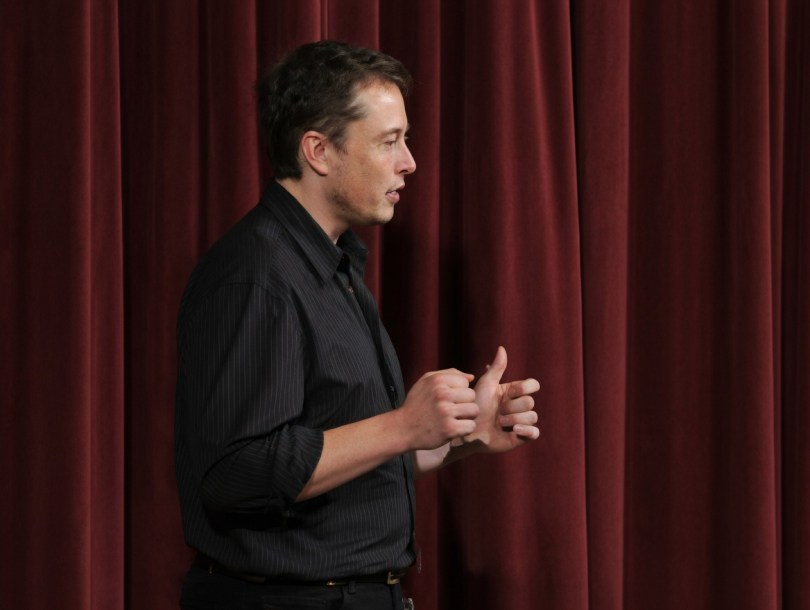
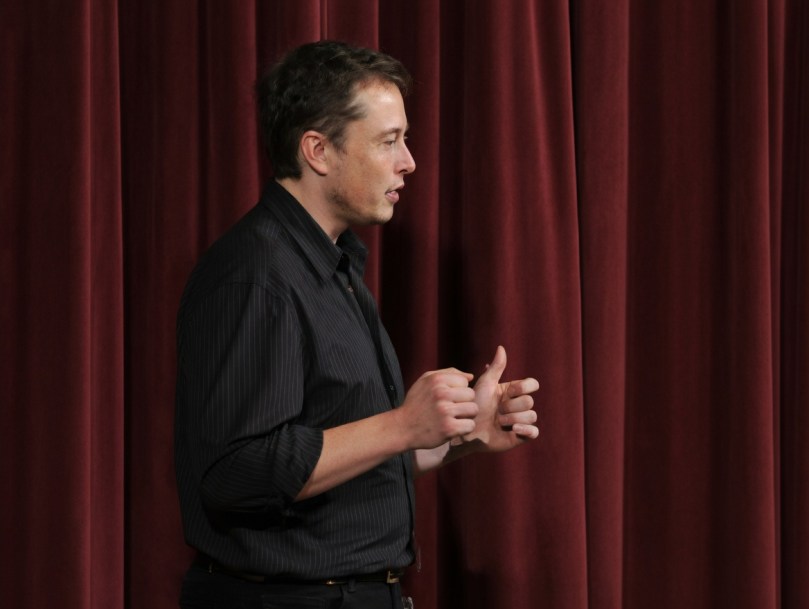
Elon Musk gesturing while speaking at Stanford – October 8, 2003 - Profile view of Elon Musk passionately explaining his ideas at his first documented public talk at Stanford University in 2003. Just 32 years old, he was already thinking in decades. Original screen grab enhanced for clarity using Grok Imagine.

Elon Musk 2003 Stanford Lecture: Full Transcript

On October 8, 2003, 32-year-old Elon Musk, gave what is widely regarded as his first documented public talk. He had been invited by Stanford’s Entrepreneurial Thought Leaders series, organized by the Stanford Technology Ventures Program as part of their e-Corner initiative. At the time, Elon had recently sold PayPal to eBay, SpaceX was barely a year old with roughly 30 employees, and no Falcon rocket had yet flown.

The original recording was split into many short clips on Stanford’s site. In 2013 it was consolidated into a single ~47-minute video on YouTube, and it was uploaded by “Shazmosushi,” which has accumulated approximately only 169,000 views as of April 2026.

This talk remains a quiet historical artifact. It is a raw, unpolished insight from young engineer and business magnet Elon Musk, who was already thinking in decades, not quarters.

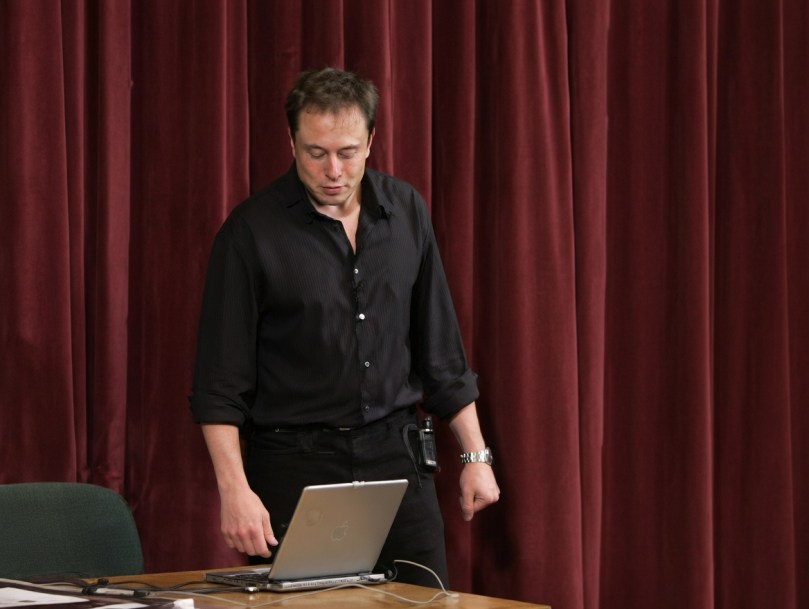
We never see the audience in this video, and they must have been amazed to listen to Elon talk in 2003. Little did they know the man standing in front of them would do so much! In the video, Elon wears a black jeans, and a black button up shirt, he’s is classic Elon with a 2003 pager on his waist, and his laptop close at hand. The video image quality is classic 2003, and Stanford’s classic maroon velour curtains serve as the backdrop for this great man.

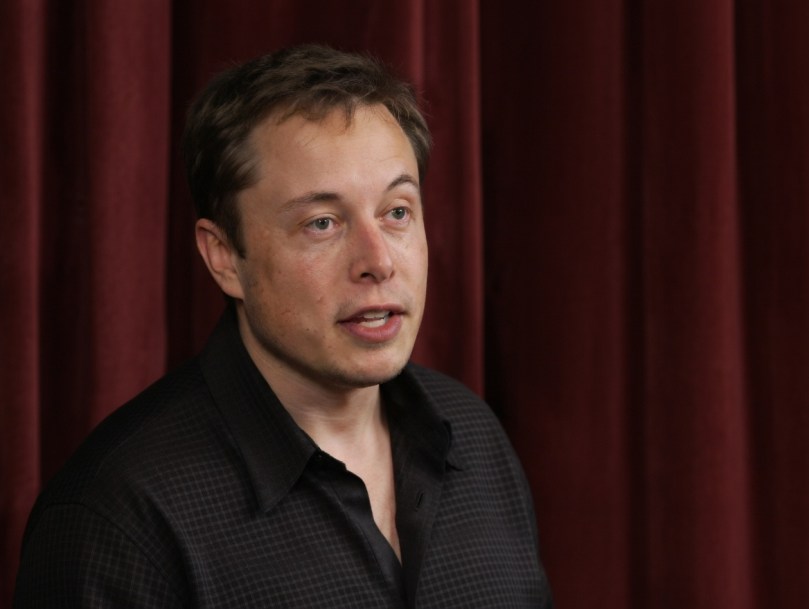
Elon Musk at 32 presenting at Stanford University – October 2003 Entrepreneurial Thought Leaders Series - Elon Musk stands at the podium during his rarely seen 2003 Stanford talk. At the time, SpaceX was only one year old and no Falcon rocket had flown yet. Screen grab from the original recording, enhanced for clarity by Grok Imagine.
Elon Musk at 32 presenting at Stanford University – October 2003 Entrepreneurial Thought Leaders Series –
Elon Musk stands at the podium during his rarely seen 2003 Stanford talk. At the time, SpaceX was only one year old and no Falcon rocket had flown yet. Screen grab from the original recording, enhanced for clarity by Grok Imagine.

Elon’s full talk


I’ll try to make this as interesting as possible. If you like space, you’ll like this talk.

My background in brief: I’ll talk a little bit about Zip2 and PayPal, and then mostly about space and what we’re doing in space.

I originally came to California to do energy physics at Stanford. I ended up deferring in 1995 and putting that on hold to start Zip2. In 1995 it wasn’t at all clear that the internet was going to be a big commercial thing. In fact, most of the venture capitalists that I talked to hadn’t even heard of the internet, which sounds bizarre on Sand Hill Road.

I wanted to do something and I thought it would be a pretty huge thing. I thought it was one of those things that only came along once in a very long while. So I got a deferment at Stanford. I thought I’d give it a couple of quarters and if it didn’t work out — which I thought it probably wouldn’t — then I’d come back to school.

When I talked to my professor and told him this, he said, “Well I don’t think you’ll be coming back.” And that was the last conversation I had with him.

There weren’t a lot of ways to get involved with the internet in 1995 that I could think of, other than to start a company, because there weren’t a lot of companies to go and work for apart from Netscape, maybe one or two others.

I didn’t have any money, so I thought we had to make something that was going to return money very quickly. We thought the media industry would need help converting its content from print media to electronic, and they clearly had money. If we could find a way to help them move their media to the internet that would be an obvious way of generating revenue. There was no advertising revenue on the internet at the time.

That was really the basis of Zip2. We ended up building quite a bit of software for the media industry, primarily the print media industry. We had as investors and customers Hearst Corporation, Knight Ridder, and most of the major US print publishers. We built that up and then we had the opportunity to sell to Compaq in early 1999 and basically took that offer. It was for a little over 300 million dollars in cash. And that’s a currency I highly recommend.

After that I wanted to do something more. Post the sale — in fact immediately post the sale — I didn’t really take any time off. I was trying to think of where the opportunities remained on the internet, and it seemed to me that there hadn’t been a lot of innovation in the financial services sector.

When you think about it, money is low bandwidth. You don’t need some sort of big infrastructure improvement to do things with it. It’s really just an entry in a database. The paper form of money is really only a small percentage of all the money that’s out there. So it should lend itself to innovation on the internet.

We thought of a couple of different things we could do. One was to combine all of somebody’s financial services needs into one website so you could have banking, brokerage, insurance and all sorts of things in one place. That was actually quite a difficult problem to solve, but we solved most of the issues associated with that.

Then we had a little feature which took us about a day: the ability to email money from one customer to another. You can type in an email address or actually any unique identifier and transfer funds or conceivably stocks or mutual funds or whatever from one account holder to another. If you try to transfer money to somebody who didn’t have an account in the system it would then forward an email to them saying hey why don’t you sign up and open an account.

Whenever we demonstrated these two sets of features we’d say this was a feature that took us a lot of effort to do and look how you can see your bank statement and your mutual funds and insurance and all that — it’s all on one page and look how convenient that is — and people go “ho hum.” And then we’d say and by the way we have this feature where you can enter somebody’s email address and transfer funds and they go “wow.” So we focused the company’s business on email payments.

In the early going the company was called X.com and then there was another company called Confinity which had actually also started out from a different area. They started off with Palm Pilot cryptography and then they had as a demo application the ability to beam token payments from one Palm Pilot to another by the infrared port. Then they had a website which is called PayPal where you would reconcile the beamed payments. What they found was that the website portion was actually far more interesting to people than the Palm Pilot cryptography was, so they started leaning their business in that direction.

In basically early 2000 X.com acquired Confinity and then about a year later we ended up changing the company’s name to PayPal. And that’s kind of how the approximate evolution of the company went.

And so just about every sector of technology improved. Why has this not improved? So I started looking into that. Initially I thought perhaps it’s a question of funding, and that funding can be garnered by really marshaling public support. So I thought one way to get the public excited about space would be to do maybe a privately funded robotic mission to Mars.

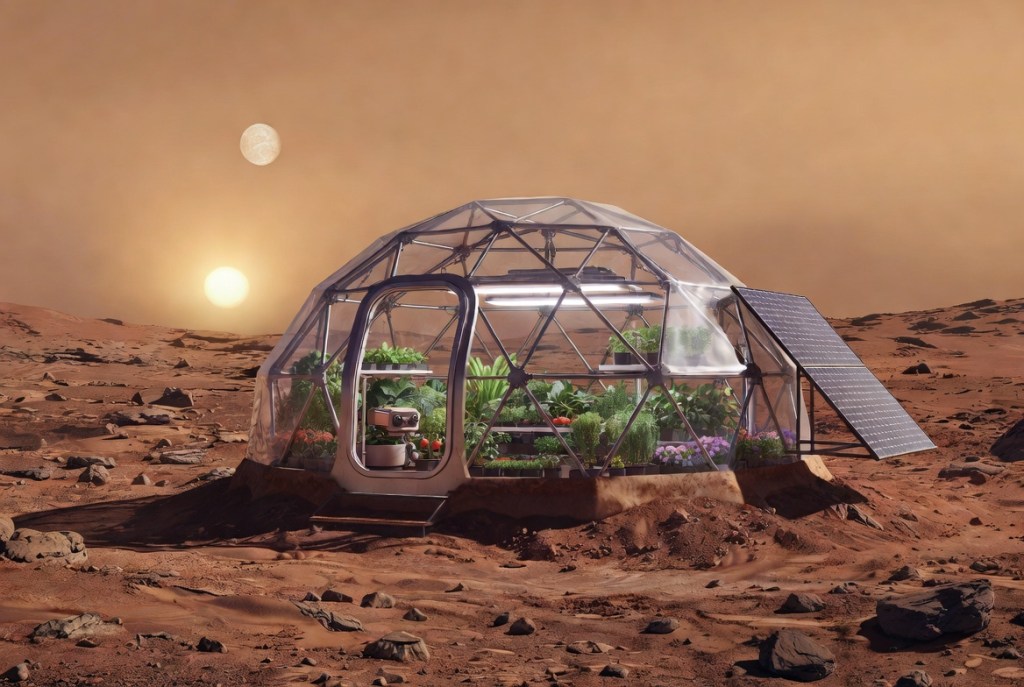
We figured out a mission that would cost about fifteen to twenty million dollars, which isn’t a lot of money, but it’s about a tenth of what a low-cost NASA mission would be. The idea was called Mars Oasis, where we would put a small robotic lander on the surface of Mars with seeds and dehydrated nutrients. They would hydrate upon landing, and you’d have plants growing in Martian radiation and gravity conditions. You’d also be maintaining essentially a life support system on the surface of Mars.

This would be interesting to the public because they tend to respond to precedents and superlatives, and this would be the furthest that life’s ever traveled and the first life on Mars. So pretty significant.

When I started looking at launch vehicles, the lowest-cost vehicle in the US is the Boeing Delta II, which costs about fifty million dollars, and that’s a bit steep for what we were trying to do. So I made three visits to Moscow, to Russia, to look at buying a Russian launch vehicle. It’s actually pretty interesting going to Moscow to negotiate for a refurbished ICBM. On the range of interesting experiences, that’s pretty far out there. We actually did get to a deal, but there were so many complications associated with the deal that I wasn’t comfortable with the risks associated with it.

When I got back from the third trip, I thought, why is it the Russians can build these low-cost launch vehicles? It’s not like we drive Russian cars, fly Russian planes, or have Russian kitchen appliances. When’s the last time you bought something Russian that wasn’t vodka? I think the US is a pretty competitive place and we should be able to build a cost-efficient launch vehicle.

So I put together a feasibility study which consisted of engineers that have been involved with all the major launch vehicle developments over the last three decades. We iterated over a number of Saturdays in the beginning of last year to figure out what would be the smartest way to approach this problem of not just launch cost but also launch reliability. And we came up with a default design.

That actually turned out to be fortunate timing — that feasibility study finished up right around the time that we agreed to sell PayPal to eBay. So coincident with that sale, I moved down to LA where there’s actually the biggest concentration of aerospace industry in the world. It’s actually the biggest industry in southern California, much bigger than entertainment or anything else. I was living in Palo Alto for about nine years before that.

Anyway, so just to talk a little broadly about space and where things are today… Obviously US government manned exploration is not in a great place. We’ve got the three remaining shuttles grounded. It looks like first flight might only be a year from now, if that. And we’ve got a vehicle that is incredibly expensive and really quite dangerous. It’s got a side-mounted crew compartment, so if there’s an explosion, that’s basically instant death. You’ve got solid rocket boosters which once you light them you can’t turn them off. There’s something fundamentally dangerous about pre-mixing your fuel and oxidizer, I think. And then you’ve got wings and control surfaces — when you re-enter you’ve got to maintain a precise angle of attack; even a momentary variance in that can break the whole vehicle apart. And of course it’s got no escape system, so if anything does go wrong, you’re toast.

You’ve got a cost that is really pretty hard to fathom. The shuttle program, when you add up all the pieces, is about four billion a year. And so you can divide four billion by the number of flights and that’ll tell you what the cost is. If there’s say four flights a year, which they haven’t been for a while, then you’re talking about a billion dollars a flight.

The plans for the future are, obviously we’ve got to continue building the space station, so we’re going to keep flying the Shuttle, but I think it’s probably going to be the minimum number of Shuttle flights that we need to launch. The long-term plans are to build something called orbital space plane — or “safe plane” in quotes, because one of the options is a capsule, so it should be called maybe orbital space thing. But the basic idea is to have something that’s hopefully a little cheaper and a lot safer than the Space Shuttle. In particular, it’s going to have an escape system so if something does go wrong, you can abort to safety.

The downside is that it’s still, while it might be a little cheaper, still going to be pretty darn expensive. Estimated cost per flight of the orbital space plane is somewhere in the region of three hundred to four hundred million dollars a flight, and of that amount, two hundred million dollars alone goes to Boeing for the Delta IV Heavy expendable booster. And it’s a fifteen billion dollar development effort expected to be completed in nine or ten years now. Typically things have not been under budget and under time, so it’s unlikely, given historical precedent, that it will stay within fifteen billion dollars and the 2012 timeline.

A bit about what’s going on elsewhere in the world… In Russia, the Soyuz is our only access to the space station. It’s considerably cheaper, considerably safer. The Soyuz has a very good track record. Its crew is top-mounted, it has an escape system, there are no wings or control surfaces to go wrong. Overall, it’s a pretty good system. And the estimated costs are about sixty million dollars a flight, which is an order of magnitude or two less than the Space Shuttle. The thing that constrains them, obviously, is the weakness of the Russian economy. It’s very hard for them to embark on ambitious programs with an economy the size of Belgium.

China is probably the most interesting thing that’s going on in space. This month China is expected to launch their first person into space. They will become only the third country ever to put someone in orbit, and they’ve put a lot of money and effort into this program. If anything serves as a spur for human space exploration, it is likely to be China’s ambitions in space, and hopefully a sense in America that we want to at least keep up with China. And they have grand ambitions beyond just low Earth orbit. They are planning on setting up a space station, putting a base on Mars, and eventually sending humans to Mars.

So what’s happening in the US that I think might ultimately surpass all of that stuff is entrepreneurial space activities, where things are led by small teams of very smart people who are just trying to make things better and cheaper. And that’s what’s exciting.

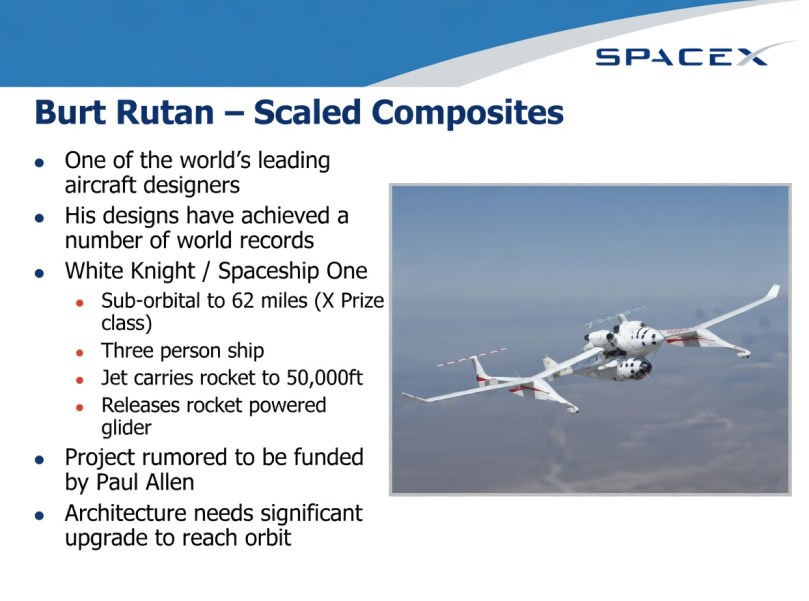
At this point in the talk (~19:05), Elon Musk discusses early private space companies and specifically highlights Burt Rutan’s work with Scaled Composites.

Burt Rutan and Scaled Composites – White Knight carrier aircraft with SpaceShipOne. Elon Musk discusses this X Prize-winning suborbital project in his 2003 Stanford lecture as an example of early entrepreneurial space efforts.

So in particular, what we’re trying to do at SpaceX is to try to make launch vehicles that are significantly more cost-effective. And the reason that launch costs are so high is not because of physics. The physics of putting something into orbit is not that hard. It’s really just a question of energy. The reason they’re expensive is because of the way that the industry is structured.

So what we’re doing at SpaceX is we have a very small team. I think right now we have about 30 people. And we don’t have any lawyers or accountants or anything like that. We just have engineers and technicians. And we’re trying to do everything in-house as much as possible. So we’re not outsourcing very much. And the idea is to try to simplify the design of the vehicle as much as possible and to use first principles thinking to figure out what the real cost of a launch vehicle should be.

If you look at what it costs to build a rocket, the raw materials — aluminum, titanium, copper, etc. — if you were to buy those materials at market rates and just melt them down, the cost of the materials is actually quite low. It’s on the order of a couple percent of the cost of the launch vehicle. And so the question is, why is everything else so expensive? And the answer is really just overhead and inefficiency in the way things are done. So by simplifying the design and doing vertical integration — basically building almost everything ourselves — we think we can bring the cost down dramatically.

Our first vehicle is called Falcon 1. It’s a small vehicle. It can put about a thousand pounds into low Earth orbit. And the price point we’re targeting is about six million dollars for that. Which is roughly a factor of ten less than what a comparable vehicle would cost today. And we’re trying to get to orbit with that vehicle this year, hopefully. The next step after that would be Falcon 5 and then Falcon 9, which would be able to put much larger payloads into orbit and eventually carry humans.

And the long-term goal is to make life multiplanetary. I think that’s really the most important thing we can do to ensure the long-term survival of humanity. And I think that if we can reduce the cost of getting to orbit by a factor of ten or more, that opens up a lot of possibilities that currently don’t exist.

Elon Musk gesturing while speaking at Stanford – October 8, 2003 - Profile view of Elon Musk passionately explaining his ideas at his first documented public talk at Stanford University in 2003. Just 32 years old, he was already thinking in decades. Original screen grab enhanced for clarity using Grok Imagine.
Elon Musk gesturing while speaking at Stanford – October 8, 2003 –
Profile view of Elon Musk passionately explaining his ideas at his first documented public talk at Stanford University in 2003. Just 32 years old, he was already thinking in decades. Original screen grab enhanced for clarity using Grok Imagine.

Q&A portion begins

Audience question: Why is it so expensive to send something into space?

Musk: Well, let me tell you what makes a rocket hard. The energy and the velocity required to get into orbit is so substantial that compared to say a car or even a plane, you have almost no margin to play with. Typically, a launch vehicle will get about two percent of its liftoff mass to orbit. And that’s the case for Falcon as well. So if you can only get two percent of what your rocket weighs to begin with to orbit, you can see that you have to be extremely efficient in every respect. You have to have very high performance engines, very light structures, and you have to be very careful about the margins that you use.

And so that’s why it’s difficult. It’s not that the physics is impossible — it’s just that the margins are so thin that if you make any mistake at all, you don’t make it to orbit. And historically, the aerospace industry has been very risk-averse, which has led to a lot of conservatism in design and a lot of overhead.

Audience question: So how does that compare with PayPal? I mean, PayPal you had to deal with banks and all that kind of stuff, which is also regulated. How is that different?

Musk: Well, with PayPal it was very difficult to get the banks to cooperate. In fact, we had a lot of trouble with that. But ultimately the regulatory environment for financial services is actually pretty friendly compared to aerospace. The aerospace industry is heavily regulated and there are a lot of export controls and ITAR restrictions. So it’s quite a bit more difficult in that respect.

Audience question: What qualities do you look for in an entrepreneur?

Musk: I think the most important thing is to have a very strong sense of what’s important and what’s not important—what’s the real problem that needs to be solved. A lot of people will work on things that are tangential or not really central to the problem. So having a very clear sense of what the key issues are and focusing on those is critical. Also, just a very strong drive and willingness to work extremely hard. Starting a company is not for the faint of heart. It’s very difficult.

Audience question: Can you talk a little bit more about the cost structure and how you’re reducing costs?

Musk: Sure. Our approach is really to make this a solid sound business and so I’ve predicated that the strategic plan on a known market—something that we know for a fact exists—which is the need to put small to medium-sized satellites into orbit. And so that’s what we’re going after initially, and then with that as a kind of a revenue base we will move into the human transportation market. So the long-term aims of the company are definitely human transportation. I think the smart strategy is to first go for cargo delivery, essentially satellite delivery. And our eventual great path is to build the successor to Saturn V—build a super heavy lift vehicle that could be used for setting up a moon base or doing a Mars mission.

But right now we’re focused on Falcon 1 and then Falcon 5 and Falcon 9. And the way we’re reducing costs is really by doing a lot of vertical integration—building almost everything in-house—and simplifying the design as much as possible. We have about 30 people right now, and we don’t have any lawyers or accountants or anything like that. We just have engineers and technicians. And we’re trying to do everything ourselves as much as possible. So we’re not outsourcing very much. And the idea is to try to simplify the design of the vehicle as much as possible and to use first principles thinking to figure out what the real cost of a launch vehicle should be.

If you look at what it costs to build a rocket—the raw materials, aluminum, titanium, copper, etc.—if you were to buy those materials at market rates and just melt them down, the cost of the materials is actually quite low. It’s on the order of a couple percent of the cost of the launch vehicle. And so the question is, why is everything else so expensive? And the answer is really just overhead and inefficiency in the way things are done. So by simplifying the design and doing vertical integration—basically building almost everything ourselves—we think we can bring the cost down dramatically.

We also have a philosophy of making a lot of small innovations rather than trying to do one big innovation. So there are hundreds of small things that we do to reduce cost and improve reliability. We’re also not patenting very much because we think that patents are not that useful in this industry—people just copy them anyway—and it’s better to keep things as trade secrets.

Audience question: What about space mining or solar power satellites?

Musk: I think those are interesting ideas but probably not near-term opportunities. The big opportunity I see is in making life multiplanetary—setting up a base on the Moon and eventually on Mars. That’s really the long-term goal. And to do that we need to reduce the cost of getting to orbit by at least an order of magnitude.

Audience question: What about working with the government? Are there any plans to work with NASA or the military?

Musk: Yeah, we’re actually working with NASA right now on some small contracts, and we’re also talking to the military. The government is a big customer in space, so it makes sense to work with them. But we want to keep our focus on reducing costs dramatically so that we can open up new markets that don’t even exist today.

Audience question: How do you deal with ITAR restrictions? It seems like they prevent you from hiring the best people if they’re not U.S. citizens.

Musk: ITAR is a real pain. It’s one of the biggest challenges we face. We basically can’t hire non-U.S. citizens for a lot of the core engineering work, which limits the talent pool. It’s frustrating because talent is global, but the regulations are very strict. We’re in LA partly because that’s where the biggest aerospace talent pool is in the U.S., so we can find the people we need who are already citizens or green-card holders.

Audience question: Can you talk more about reusability? Is that part of the plan for Falcon?

Musk: Yes, reusability is absolutely critical for the long term. Right now Falcon 1 is expendable, but we’re already thinking about how to make future vehicles reusable. The physics works — it’s just a question of engineering it right. If you can recover and reuse the first stage, that changes the economics completely. It’s one of the biggest levers we have for reducing costs by an order of magnitude or more. We’re not there yet, but it’s definitely on the roadmap.

Audience question: Why do you think making life multiplanetary is so important?

Musk: I think it’s the most important thing we can do to ensure the long-term survival of consciousness and humanity. Right now we’re a single-planet species, and that makes us vulnerable. An asteroid impact, a supervolcano, a nuclear war — any of those could wipe us out. Becoming multiplanetary makes us a spacefaring civilization and greatly increases the probability that consciousness will continue. It’s not about colonizing Mars tomorrow; it’s about laying the foundation so that in the future it becomes possible.

So that’s really the long-term vision for SpaceX. We’re starting small with Falcon 1, but the ultimate goal is to make humanity multiplanetary. I appreciate you all coming out and listening. Thank you very much.

(Applause)

End of the lecture.


Full Verbatim Transcript – Elon Musk’s October 8, 2003 Stanford Entrepreneurial Thought Leaders Lecture. This transcript has been cross-checked against the video’s auto-generated captions and manually corrected for obvious speech-recognition errors (especially proper names and technical terms).

Elon Musk 2003 Stanford Talk – Passionate moment from his first public speaking appearance- Close-up of 32-year-old Elon Musk as he shares his vision during the 2003 Stanford Entrepreneurial Thought Leaders event. A raw, unpolished look at the future founder of SpaceX and Tesla. Enhanced with Grok Imagine for better clarity.
Elon Musk 2003 Stanford Talk – Passionate moment from his first public speaking appearance-
Close-up of 32-year-old Elon Musk as he shares his vision during the 2003 Stanford Entrepreneurial Thought Leaders event. A raw, unpolished look at the future founder of SpaceX and Tesla. Enhanced with Grok Imagine for better clarity.
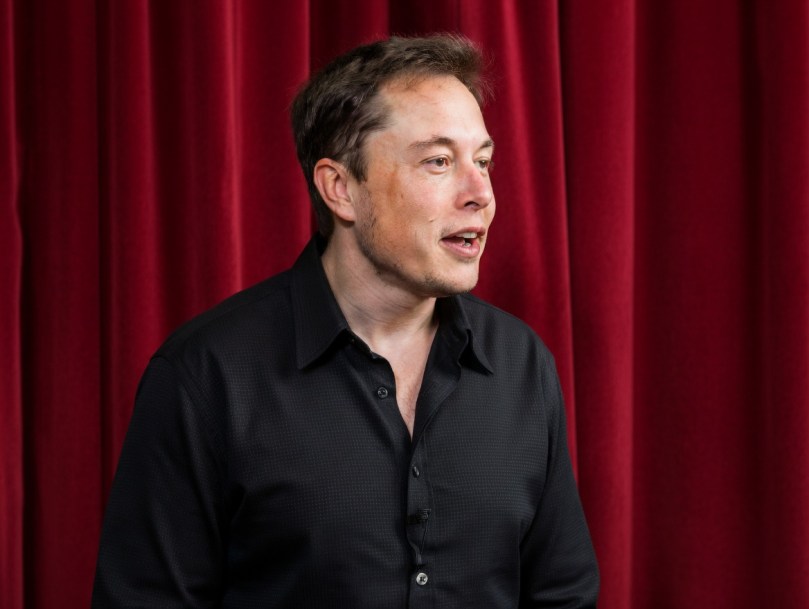
Young Elon Musk speaking at Stanford in 2003 – Rare close-up from his first documented public talk" 32-year-old Elon Musk during his October 8, 2003 Entrepreneurial Thought Leaders lecture at Stanford. This historical moment captures Elon shortly after selling PayPal, with SpaceX still in its earliest days. Image enhanced for clarity using Grok Imagine.
Young Elon Musk speaking at Stanford in 2003 – Rare close-up from his first documented public talk-
32-year-old Elon Musk during his October 8, 2003 Entrepreneurial Thought Leaders lecture at Stanford. This historical moment captures Elon shortly after selling PayPal, with SpaceX still in its earliest days. Image enhanced for clarity using Grok Imagine.

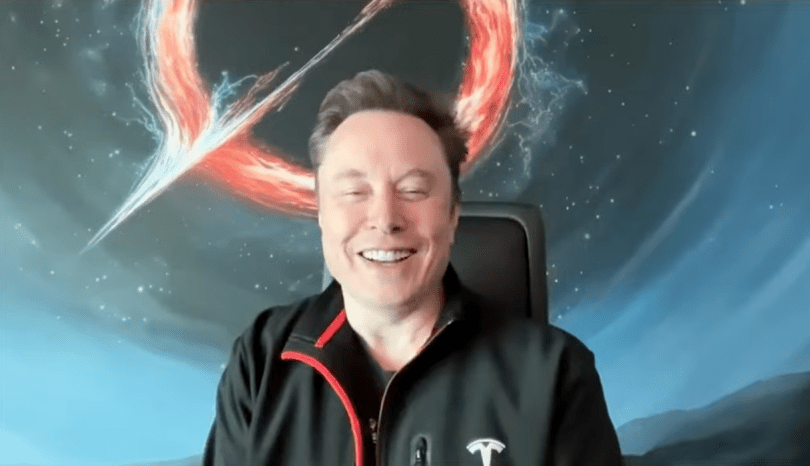
Elon Musk: Surprise Remote Talk at 2026 Abundance Summit – My Full Verbatim Transcript

On March 11, 2026, Elon surprised us all with an appearance at the 2026 Abundance Summit in Los Angeles. In this talk with Peter Diamandis, Elon shared his latest thoughts on Grok 4.20, the hard takeoff of AI, Optimus robot timelines, explosive economic growth, and humanity’s path to universal high income and post-scarcity abundance. Here is my full transcript with Key Takeaways at the end!

Peter Diamandis: So, first off, congratulations on the merger of SpaceX and xAI — bold move going to power humanity’s first Dyson swarm. I’m curious: what’s your timeline for launching these data centers and how much bandwidth do you think you can get in the first year? Give us a sense of the speed at which you’re going to be making this happen.

Elon Musk: Yeah, so SpaceX is in the quiet period. I can’t actually tell you things. That would cause problems.

Peter Diamandis: I appreciate that. And I can’t wait to see the speed. You know, we had a conversation here on Monday with Eric Schmidt and with one of the leads from one of the other hyperscalers. I won’t mention who, but I’m curious where you feel we are in recursive self-improvement. Are we there? Do you see Grok doing recursive self-improvement at this point? And what’s the timeline for AGI and ASI?

Elon Musk: Yeah, I think we’ve been in recursive improvement for a while here. If you mean recursive self-improvement without a human in the loop, is that what you mean?

Peter Diamandis: I do. I am on the AI software side.

Elon Musk: I mean humans are gradually getting less and less in the loop on the recursive self-improvement. So you know every successive model is built by the one before it. So that is happening to a large degree but it’s not yet fully automated. It may be there at the end of this year but not later than next year.

Peter Diamandis: And do you see a hard takeoff at that point?

Elon Musk: We’re in the hard takeoff. Right now.

Peter Diamandis: Okay. Yes.

Elon Musk: I mean, at this point I go to sleep there’s some massive AI breakthrough and when I wake up there’s another one.

Peter Diamandis: Yes. Yeah. It’s hard to keep track, honestly. So, it’s a bit of a head spinner. Yeah. Well, I think a lot of the head spinning is happening from you, too.

Elon Musk: Yeah. Well, you know, Grok’s doing pretty well, and in some metrics, by some metrics, it’s the best, for example, it’s the best at predicting things, which, you know, is arguably the best metric for intelligence. The new Grok 4.20 is really good. We’re currently behind on coding. The reason I was a bit late for this was that I was just in a giant sort of all-hands on coding just going through all of the things that need to happen to essentially catch up and exceed our competitors on coding. Which I think we’ll do. I feel we should probably get there by the middle of this year.

I think people don’t quite understand just how much intelligence there will be or you know, just how far it will exceed human intelligence to a degree that is impossible to fully understand.

You can certainly imagine a situation where, let’s say, if let’s say, a million times more energy is harnessed than all of Earth’s current electricity usage, that would still only be roughly a millionth of the sun’s energy output.

So essentially if you increase Earth’s economy by a factor of a million it’s still roughly a trillion. Since we’re a trillionth of the sun’s energy, if you increase Earth’s economy in terms of electricity usage by roughly a million, you will be roughly 1 millionth only of the sun’s energy harnessed.

But what is it? What is an economy or an intelligence using a million times more electricity than all of our civilization. What does it think about or look like or do? It’s going to be something pretty magnificent. The challenge will be even vaguely appreciating that level of intelligence. But it’s safe to say it will solve everything you can possibly think of. Longevity being, surely, one of them!

Peter Diamandis: And, I do enjoy your unrelenting optimism. Haha, you’ve taken it to heart, monetizing hope, which is pretty funny, how you came up with that one!

Elon Musk: It was Grok’s marketing advice to me when you roasted me on the podcast. Haha, Grok was roasting you and saying you should monetize hope! But hey, it is better than monetizing misery, I suppose!

Elon Musk (continuing): AI and robots increase the economic output by so many orders of magnitude, that we cannot possibly comprehend it.

Peter Diamandis: We’re likely in a very short time to become a microscopic minority of intelligence on this planet.

Elon Musk: Yes, not even on this planet, in the solar system. Because you know your best case outcome for Earth for intelligence is roughly 1 billionth of the sun’s energy. That’s your best case outcome, if you generate intelligence only on Earth.

Peter Diamandis: Intercept it, right?

Elon Musk: Yes. Because roughly one half a billionth of the sun’s energy hits Earth and that’s the vast majority of energy that’s out there that we can access. So really the intelligence in the solar system will be many orders of magnitude greater than the intelligence on earth itself.

Peter Diamandis: Can I ask you a question, Elon? How far out can you see? How many years out can you make reasonable predictions?

Elon Musk: It’s hard to predict the path exactly, especially because often things are kind of an S-curve or a series of S-curves where it starts off slow, grows exponentially, hits a linear zone, and then goes logarithmic. That generally has been what I’ve seen with the breakthroughs in AI.

AI, for example… you’ll have some breakthrough. It’ll do an S-curve, and then it looks like it’s just going to go to infinity, but then you hit logarithmic returns until there’s another breakthrough. So progress in AI is just a sort of series of, you know, sort of overlapping S-curves or connected S-curves.

Peter Diamandis: I mean there was a point where you could probably predict out a decade or two decades. What are your thoughts now?

Elon Musk: Yeah. Okay. This is going to sound pretty crazy.

Peter Diamandis: It’s okay. We’ve been talking crazy all week…

Elon Musk: I’m not sure you are a receptive audience to wild prognostications.

Peter Diamandis: Yes.

Elon Musk: Um… (very long pause) I’d say the economy is 10 times the current size in 10 years. Greater than… that’s really saying something.

Peter Diamandis: Okay. Yeah, you had said, triple-digit growth in five plus years from now on, GDP and 10x the economy.

Elon Musk: I feel like that’s a 10x in roughly 10 years. I feel that’s actually a fairly comfortable prediction — obviously if there’s like World War III or something, that could put a kink in those plans. But in the absence of World War III, if current trends continue, I would say the economy will grow 10x in 10 years. And we’ll have a base on the moon! And we’ll have people on Mars.

Peter Diamandis: And we’ll have mass drivers on the moon!

Elon Musk: I think so, I think we’ll have mass drivers on the moon in 10 years.

Peter Diamandis: I love it, Gerard K. O’Neill’s vision being fulfilled. We had four robots on stage here this year at the Abundance Summit. I look forward to Optimus. I’m curious about the Optimus 3 timeline, in particular, when can I buy one or two? When do you expect it to go into commercial sale, or will you be leasing it?

Elon Musk: Well, we’re in the final stages of completion of Optimus 3, which is really going to be by far the most advanced robot in the world. Nothing’s even close. In fact, I haven’t even seen any demos of robots that are as good as Optimus 3, frankly. Maybe they’re out there or secret or something, I don’t know. And I have to make sure I’m saying things that are reasonably public, of course, but we’re streaming this on X, so this is pretty public and accurate. Yeah. I think we’ll start production on Optimus 3 this summer, but very slow at first, like the classic S-curve ramp of manufacturing units versus time. Then probably reach high-volume production around summer next year. And then we’ll have Optimus 4 design next year. I try to release a new improved robot design every year.

Peter Diamandis: When Dave Blundin and I were at the Gigafactory, it was an extraordinary experience! 11.5 million square feet for Tesla, and then I think you said you’re building out 9.5 million square feet for Optimus there as well, which is extraordinary.

Elon Musk: Let’s call it 10 million square feet, round numbers. Yeah, that’ll be quite a new factory design too. Like, it is different from other factories.

Peter Diamandis: How far before we have robots building robots? You’ve automated so much of the Gigafactory already, where humans are playing a smaller role. Will the robots just take over the roles humans have now?

Elon Musk: We still have a lot of humans building things. Um, you know, Tesla direct employees who are building things uh, or like basically people in the factory are either building or managing people who are building, is roughly 100,000. So we have a lot of people. Tesla’s total headcount is around 150k, of which 2/3s are, you know, in the factory in one form or another. And then our suppliers, there’s probably maybe a million or two million people in our suppliers type of thing. So it’s a lot of people. Um, what we do expect is that the output per person at Tesla becomes very very high. So we’re not planning any layoffs or reductions in personnel. In fact, we will increase our headcount. But the output per human at Tesla is going to get nutty high. Like, you can’t even believe it.

Peter Diamandis: When we were together, we discussed sustainable abundance on our podcast, and you reinforced the idea of a coming age of universal high income, which has become a point of discussion beyond UBI. I’m wondering if you have any thoughts on how we get there. And more importantly, we talked about a timeframe of civil unrest, like maybe 2, 3, 4, or 5 years, with probably a lot of COVID-like checks in the interim until we reach demonetization and deflation that leads to UHI. Any more reflections on that? People really need that hope and vision.

Elon Musk: Yeah, to be clear, I don’t think we should be complacent. We do need to be careful because the future has a range of possible outcomes, and not all are great. But at this point I agree with you: it’s likely to be great. Probably 80% likely, maybe more. And I do think we’ll have universal high income. We’re basically just going to issue money to people because the output of goods and services will so far exceed the money supply that you’ll have deflation — deflation is simply the ratio of goods/services output to money supply. If growth of goods and services far outpaces money supply growth, which I predict it will, then deflation happens.

Yes. A lot of people will spin up new companies, compete fiercely, drive prices down, and accelerate deflation faster and faster.

Basically, AI and robots will make so much stuff and provide so many services that they’ll run out of things to do for humans. There’s only so much humans can even express wanting. Go back to my example: at a million times the Earth’s current economy, you’ve long since saturated all human desire. Even at a thousand times, you probably already saturate anything people can think of wanting.

Peter Diamandis: Yeah.

Elon Musk: So do you think the value of money significantly decreases? Will we go post-capitalist? Yeah, I think money stops being relevant at some point. It’s probably something like a Star Trek culture future. And AI down the road won’t use human currency, it’ll just care about power, mass, wattage, and tonnage. Yeah…

Key Takeaways

AI & Intelligence Explosion

  • We’re already in the “hard takeoff” — breakthroughs are happening overnight while we sleep.
  • Recursive self-improvement is well underway (humans stepping back gradually); full automation of the AI loop expected by end of 2026 or no later than 2027.
  • Grok 4.20 already leads in prediction (a top intelligence metric), coding catching up fast — expect it to surpass competitors by mid-2026.
  • Future intelligence will be orders of magnitude beyond humans, potentially using a million times more energy than today’s civilization… but still just a tiny fraction of the sun’s output.

Economy & Abundance

  • 10× economic growth in the next 10 years (to ~2036), with triple-digit GDP growth possible in 5+ years (assuming no WW3).
  • AI + robots will drive deflation so extreme we get Universal High Income (UHI) as an interim step.
  • Eventually a Star Trek-style post-scarcity world where money becomes irrelevant — robots/AI produce far more than humans can consume, saturating all desires. “Basically, AI and robots will make so much stuff… they’ll run out of things to do for humans.”

Robotics & Tesla

  • Optimus 3 is in final stages (most advanced robot on the planet right now). Production starts summer 2026 (slow ramp), high-volume by summer 2027. Optimus 4 design coming next year with yearly upgrades.
  • New 10-million-square-foot factory just for Optimus. Huge productivity boost per person — no mass layoffs expected (Tesla headcount ~150k + suppliers).

Space & Long-Term Vision

  • SpaceX + xAI merger path toward humanity’s first Dyson swarm (details limited by quiet period).
  • Moon base + people on Mars in ~10 years; mass drivers on the Moon too.
  • Overall intelligence will scale to solar-system level, solving everything from longevity to energy limits. 80%+ chance of a truly great future.

Elon’s standout quotes we noted

  • “We’re in the hard takeoff. Right now.”
  • “The economy is 10 times the current size in 10 years.”
  • “AI and robots increase the economic output by so many orders of magnitude that we cannot possibly comprehend it.”

My Take

Other AI companies are motivated by profit, but this is not Elon’s ambition. He’s already the wealthiest man on Earth — no one comes close. But also, no one comes close to putting into action the very things that will preserve consciousness.

Watch Elon Musk appearance at the 2026 Abundance Summit in Los Angeles on X by Steven Mark Ryan.

On March 11, 2026, Elon surprised us all with an appearance at the 2026 Abundance Summit in Los Angeles. In this talk with Peter Diamandis, Elon shared his latest thoughts on Grok 4.20, the hard takeoff of AI, Optimus robot timelines, explosive economic growth, and humanity’s path to universal high income and post-scarcity abundance.

Watch Elon Musk appearance at the 2026 Abundance Summit in Los Angeles on Youtube

Gail Alfar provides a Transcript of exclusive 23-minute interview with Giga Berlin plant manager André Thierig, and Elon Musk

Full Transcript: Elon Musk on Moon Factories, TSLA Hold, Cybercab/Optimus at Giga Berlin

In this exclusive 23-minute interview with Giga Berlin plant manager André Thierig, Elon Musk reveals Tesla’s plans, including Cybercab & Optimus production in Europe, Full Self-Driving launching in the Netherlands on March 20, and his bold prediction of “Tesla factories on the moon” and the now-viral line: “Hold on to your TSLA stock… it’s going to be worth a lot!”

André Thierig: Welcome, Elon, and thanks for taking the time. I really understand that time is precious. There are a ton of things to do to build a world of amazing abundance. I can hardly imagine what is on your mind — SpaceX, Starlink, AI, safe AI for the future, autopilot, so many things. But what is in your view still exciting about Tesla and why?

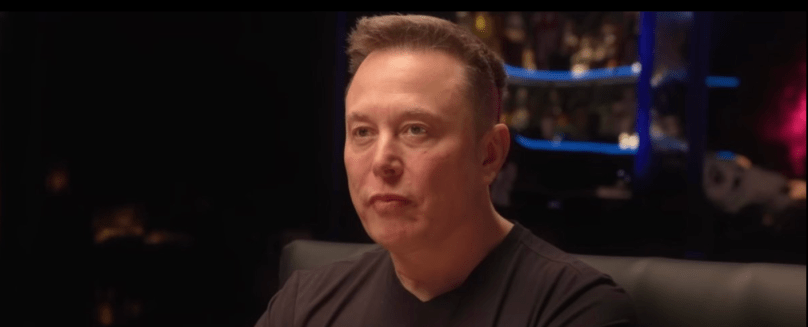
Elon Musk in the lobby at Tesla Giga Texas, February, 2026

Elon Musk: Well, I think Tesla is one of the most exciting companies in the world. It is perhaps the most exciting, but Tesla and SpaceX are the two most exciting companies. We are obviously expanding production and making more cars. We are going to roll out Tesla Full Self-Driving, which is really an AI-driven car. It’s AI software that drives the car, just by looking, like a human does. Tesla has the most advanced real-world AI and hopefully it will be approved soon in Europe. We were told by the authorities that it will be approved on March 20th in the Netherlands. I think people in Europe are going to be pretty blown away by how good the Tesla car AI is. This year it will be the case that from a technical standpoint you will be able to fall asleep in the Tesla and wake up at your destination. That is very exciting.

Read this article on X for best experience and no Ads

We have the Optimus program, which is going to be the first humanoid robot. Sometimes people ask what it would be used for. Who would not want their own personal C-3PO or R2-D2? Optimus can take care of your kids, walk the dog, or take care of elderly parents. Well, Optimus can do those things. That is very exciting. We have started production of the Tesla Cybercab here at Giga Texas and we will go to volume production in April.

If things go well, we would probably manufacture Cybercab in Europe and also manufacture Optimus in Europe. We have the Tesla Semi heavy truck that will be coming to Europe hopefully next year. There are so many things happening, it’s a long list!

Oh, and battery cell production… we are going to start making battery cells at Giga Berlin. We have the Tesla lithium refinery that started up in Texas and the Tesla nickel cathode refinery that started up in Austin. This year, there are a tremendous number of things happening. We have five factories starting volume production this year, five major production lines. We look forward to extending that to Europe as well.

Tesla’s Vision for the Next 10–20 Years: Factories on the Moon!

André Thierig: Tesla has done nothing less than really transforming a whole industry. Without Tesla taking that brave step to electrify mobility, the industry would not be where it is today. What would you want people to say about Tesla in 10 or 20 years from now?

Elon Musk: In 20 years, I would say Tesla has factories on the moon, actually!. I see a very prosperous future for Tesla. It is difficult to predict anything in 20 years, but if you look 5 to 10 years ahead, Tesla has an extremely bright future. I would say, hold on to your Tesla stock, it is going to be worth a lot, I think, that’s my bet!

André Thierig: Coming back to the present, you are always very well informed. If you look at the European industry, especially the automotive sector or even the German industry, what do you think about it? What do you believe are the main reasons for their current state?

Elon Musk on the European Automotive Industry

Elon Musk: I think there has not been enough innovation. Automotive innovation has been relatively low, the cars being produced are very much like the cars produced five years ago. There are not big differences. For 20-plus years I have said the automotive industry needs to go toward electrification. This would be true even without environmental concerns. An electric vehicle is a fundamentally better architecture than a gasoline combustion vehicle. It is much simpler, more efficient, quieter, and there is no pollution within cities. All ground transport should be electric. And I think all ships and airplanes should be electric.

The automotive industry has strongly resisted electrification and dragged its feet, and they have had to be pushed there by government. Whenever they have had the opportunity to reduce making electric vehicles, they’ve done so. This is not a good strategy. It doesn’t make sense.

Making vehicles autonomous is critical. I think about 10 years ago I said that in the future, any vehicle that is not electric and autonomous… like if you are riding in a vehicle that you have to drive yourself and it’s gasoline powered, it will be like riding a horse and using a flip phone. Which is to say that there are still some people that ride horses. It’s just rare. And some people somewhere are still using flip phones, but there aren’t many, and it’s going to be a niche thing. So, the future does not contain combustion vehicles, and there will be very few vehicles that are not autonomous. The future is autonomous electric vehicles. And so, if the automotive industry does not move in that direction, they will be left out.

Read this article on X for best experience and no Ads

André Thierig: So it doesn’t really sound like we could be learning much from legacy auto makers…and I guess we really should be focusing on what ourselves, or what we believe the future looks like, right?

Elon Musk: Yes, well, you can always learn something from some competitor. But strategically, they are just headed in the direction of the dinosaurs. So they are not headed to a good place. You know, dinosaurs are not around anymore. We’re certainly going down a different path. Like I said, electric and autonomous… to me it’s been blindingly obvious for 20-plus years. What I found with competitors in the automotive industry is, it’s not that they are going to steal our ideas. You can’t cram a good idea down their throat. Like if you say, “you must take this good idea!” They won’t steal our ideas, because you cannot even force-feed them our good ideas. That’s my experience. So we need to do what’s logical, what’s sensible. You know, at Tesla we’re essentially creating the future. And it’s a good future!

André Thierig: We are building the future, they just build cars!

Elon Musk: Yes. It’s a good future, it’s a future with electric vehicles that don’t emit poison gas, literally. They’re quiet, efficient, and autonomous. Like I said, instead of being stuck in traffic driving through busy roads, people sometimes fall asleep or have a medical emergency. And if you’re driving yourself on the Autobahn going super fast and you have a seizure, heart attack, or something like that, then you could die. But if the car is autonomous, it can take you to a hospital. In fact, this has actually happened many times with Tesla cars.

Giga Berlin Memories and the Path to Massive Expansion

André Thierig: Six years ago we broke ground and four years ago we started production. What are your greatest memories of Giga Berlin and the people here?

Elon Musk: First of all, I would like to say thank you very much to everyone who helped build Giga Berlin. Thank you, André, and thank you to the whole team. We have built an amazing factory in a very short period of time and reached high-volume production with good quality and good cost control. I am very proud of Giga Berlin and all the people in it.

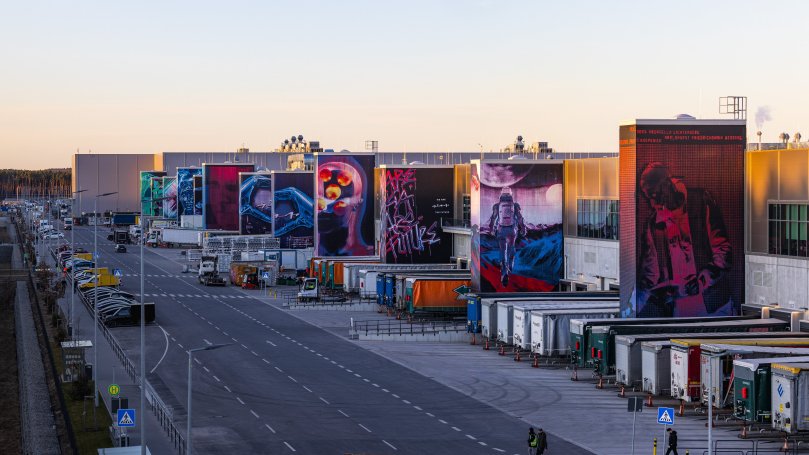
It’s cool! I like the art too, and that people have some fun!

Graffiti Art at Tesla Giga Berlin

Elon Musk: Coming to work should be something you look forward to. You come to work with people you enjoy working with, and you are doing useful things—you’re making things. I have a lot of respect for makers. Like, you actually make something; you build something useful that people enjoy. I’m a big fan of makers. There are a lot of people who—they do not make things, and I don’t know—they don’t make things or they don’t provide useful services. Whereas, I have huge respect for people who make things and provide useful services. It’s an honest day’s work.

André Thierig: If you have a vision for Giga Berlin, what would it be? And what would have to happen for it to come true?

Elon Musk: Ideally, we would significantly expand production at Giga Berlin. We would do high-volume production of battery cells, probably also the cathode, the anode, and lithium. We would become vertically integrated and produce things like the Cybercab or Optimus and other products that Tesla will develop. The exciting vision for the future of Giga Berlin is massively expanding it to do many more projects.

André Thierig: Do you have any advice for the team at Giga Berlin to work toward that vision?

Elon Musk: Things certainly get harder if there are outside organizations pushing Tesla in the wrong direction. If outside organizations make things very difficult in Giga Berlin, it is difficult to say that we would expand. We are not going to shut down the factory, but we are not going to expand it either, realistically.

Read this article on X for best experience and no Ads

Employee Q&A and Closing Advice

Employee: Which is your favorite factory?

Elon Musk: A favorite factory is like saying what is your favorite child. I love factories. I think a lot of people these days, they don’t love factories, or they haven’t been to a factory, whereas I walk the line in every factory and I’m a big fan of factories. I love them! Haha!

André Thierig: It’s a great place to be!

Elon Musk: Yeah. It’s where you make things that have good utility; people love the product. You’re building a product people love, and that’s great!

Giga Berlin is an awesome factory. The vibe is cool; to walk around is cool. It’s very clean and quite beautiful inside and outside. People seem quite happy. We are making cars and soon battery cells and hopefully many more things. It is one of the coolest factories in the world, really!

Employee: Which is the next product we will be building here in Giga Berlin?

Elon Musk: There are a lot of exciting possibilities. We have started spooling up production of the battery cell and we will be expanding production of the Model Y, especially as we get approval for supervised full self-driving. From the next major product standpoint, most likely the Tesla Cybercab. There are also possibilities of Tesla Optimus and the Tesla Semi heavy truck. Like, Tesla has a lot of products coming out, so there’s a lot of potential.

If things go well, we would expand Giga Berlin to whatever the most that we could. Assuming that the authorities are supportive, and the people are supportive, then we would expand to probably make it the biggest factory complex in Europe.

Employee: When do you realistically think we can have Optimus in the Gigafactories so we do not have to worry about ergonomics?

Elon Musk: Well, we have to be really careful about that one. I don’t want people to be worried about their jobs, you know. So, the honest answer for AI and robotics is: long-term, working will be optional. Long-term—which is 10 years from now or less—if you want to work, you can. It will be like growing vegetables in your garden, or you can get them from the store. It’s optional to grow vegetables in your garden, but some people still like to do it. It’s extra work to grow your own vegetables, but people enjoy the process. That’s going to be how work is in the future. It will be like: “You can work if you want to.”

Employee: How can we make sure that the adoption of new technologies like Optimus reach countries in the third world?

Elon Musk: First we have to succeed in making a useful robot. This is a hard thing to solve. Nobody has solved making a truly useful humanoid robot. So you have to make it useful, then you have to scale production. And its an entirely new supply chain. With Optimus we’ve had to design the whole robot from physics first principles. We’re designing every motor, every gear. The hands are extremely difficult to design. A properly dexterous robot hand is very difficult. One of the hardest things to engineer, and then we can scale production. At first Optimus will do small tasks, and then it will get gradually more sophisticated.

I think, eventually, Optimus could do medical work like surgery and everyone in the world would get better medical care than anyone receives today, from a human.

André Thierig: What advice would you give young people for life?

Elon Musk: Be on the side of optimism. It is better to be optimistic and wrong than pessimistic and right. Your quality of life will be much better. I would urge people to be excited about the future. I am excited about the future! I am confident the future will not be boring. Let me put it that way: it’s going to be very interesting. I think it is most likely to be great!

In terms of general advice, I guess I’d invite people to learn as much as possible, read a lot of books, try a lot of things, and find a job you can enjoy. I guess—enjoy life, but working is also a part of enjoying life. I think if people derive satisfaction from building things, then Tesla is an awesome place to be because we build things! We make useful products, and that’s a great thing.

André Thierig: What is the most inspiring moment in your life?

Elon Musk: You know, I guess when my kids were born, that would be the most inspiring moment of my life. Um, you know, in terms of work stuff, I guess it’s when we had the first production Roadster at Tesla. On the rocket side, first time getting to orbit, getting the rocket to come back and land was pretty cool. Self-driving technology has been pretty inspiring too. I mean, the first time somebody experiences self-driving, where they are just sitting there and the car takes them all the way from their home to their work, and parks, it’s mind-blowing!

André Thierig: Yes! It is. I am using it all the time when I am in the US.

Elon Musk: It’s like magic!

André Thierig: Thank you so much for your time.

Elon Musk: Once again to the people of Giga Berlin, Dankeschön.

Elon Musk with Dwarkesh Patel & John Collison: The Future of AI Is in Space

Elon Musk with Dwarkesh Patel & John Collison: The Future of AI Is in Space (Parts 9-10)

In the concluding two parts of this special 10-part series, the conversation with Elon Musk shifts from the technical frontiers of space-based AI, energy, and manufacturing into deeper philosophical and practical territory.

Recorded in early February 2026 during a relaxed, casual evening over pints of Guinness, podcaster Dwarkesh Patel and Stripe co-founder John Collison continue their wide-ranging discussion with Elon. These final sections explore the future of AI alignment and truth-seeking, the relationship between human consciousness and superintelligent systems, the real-world path to humanoid robots with Optimus, Elon’s management and hiring philosophy, the dramatic Starship material pivot, driving urgency at massive scale, government efficiency, and his ultimate message of optimism about humanity’s long-term future.

As with the entire series, the hosts’ questions and context have been distilled into concise, flowing narrative prose for maximum readability, while every single word spoken by Elon Musk remains 100% verbatim — exactly as originally delivered, with no changes, omissions, or paraphrasing.

Part 9: Truth-Seeking AI, Alignment, Reward Hacking, and Interpretability

This part has been divided into the following 5 subsections for easier navigation:

  • Humanity’s Place in a Superintelligent Future
  • xAI’s Mission: Understanding the Universe
  • Truth-Seeking vs Political Correctness
  • The Danger of Making AI Lie
  • Reward Hacking, Interpretability, and Simulation Theory

Humanity’s Place in a Superintelligent Future

Dwarkesh Patel asked how humanity should think about its relationship with a future in which AI vastly outnumbers and outsmarts us — whether humans would retain some form of control, or whether it would simply be a matter of trade and coexistence with these new intelligences.

Elon Musk: “I think it’s difficult to imagine that if humans have say 1% of the intelligence combined intelligence of artificial intelligence that humans will be in charge of AI. I think what we can do is make sure it has that AI has values that cause intelligence to be propagated into the universe. So the reason for Xai’s mission is to understand the universe. So now that’s actually very important. So you say, well, what things are necessary to understand the universe? Well, you have to be curious and you have to exist. You can’t understand the universe, you don’t exist. So you actually want to increase the amount of intelligence in the universe, increase the probable lifespan of intelligence, the scope and scale of intelligence. I think actually also as a corollary, you have humanity also continuing to expand. Because if you’re curious or trying to understand the universe, one thing you’re trying to understand is where will humanity go? And so I think understanding the universe actually means you care about propagating humanity into the future. That’s why I think our mission statement is profoundly important. To the degree that GROK adheres to that mission statement, I think the future will be very good.”

xAI’s Mission: Understanding the Universe

Dwarkesh asked Elon to clarify the mission statement itself and how the three vectors: understanding the universe, spreading intelligence, and spreading humans, actually fit together.

Elon Musk: “Okay, well, I’ll tell you why. I think that understanding the universe encompasses all of those things. You can’t have understanding without—I think you can’t have understanding without intelligence and I think without consciousness. So in order to understand universe, you have to expand the scale and probably the scope of intelligence. Because we have different types of intelligence.”

Dwarkesh pressed from a human-centric view, noting that humans seek to understand the universe without necessarily expanding chimpanzee civilization.

Elon Musk: “We’re also not… well, we actually have made protected zones for chimpanzees. And even though humans could exterminate chimpanzees, we’ve chosen not to do so.”

Dwarkesh asked whether that protective, expansive relationship is the basic scenario humans should expect in a post-AGI world.

Elon Musk: “I think AI with the right values, I think GROK would care about expanding human civilization. I’m going to certainly emphasize that. Hey, GROK’s your daddy, don’t forget to expand human consciousness. Actually, I think probably the Ian Banks Culture books are the closest thing to what the future will be like in a non-dystopian outcome.

So understand the universe… it means you have to be truth seeking as well. Truth has to be absolutely fundamental because you can’t understand the universe if you’re delusional. You’ll simply think you’ve understood the universe, but you will not. So being rigorously truth seeking is absolutely fundamental to understanding the universe. You’re not going to discover new physics or invent technologies that work unless you’re rigorously truth seeking.”

Truth-Seeking vs Political Correctness

Dwarkesh asked how to ensure Grok remains rigorously truth-seeking even as it becomes vastly more intelligent.

Elon Musk: “I think you need to make sure that GROK says things that are correct, not politically correct. I think it’s the elements of cogency. So you want to make sure that the axioms are as close to true as possible, that you don’t have contradictory axioms, that the conclusions necessarily follow from those axioms with the right probability. It’s Critical Thinking 101. I think at least trying to do that is better than not trying to do that. And the proof will be in the pudding if, like I said, for any AI to discover new physics or invent technologies that actually work in reality. And there’s no bullshitting physics. So you can break a lot of laws, but you can’t—physics is law. Everything else is a recommendation. In order to make a technology that works, you have to be extremely truth seeking because otherwise you’ll test that technology against reality. And if you make, for example, an error in your rocket design, the rocket will blow up or the car won’t work.”

And the proof will be in the pudding if, like I said, for any AI to discover new physics or invent technologies that actually work in reality – Elon

Dwarkesh observed that many scientists under oppressive regimes still made breakthroughs, questioning whether truth-seeking in physics alone guarantees benevolent alignment.

Elon Musk: “Well, I think actually most physicists, even in the Soviet Union or in Germany, they had to be very truth seeking in order to make those things work. And if you’re stuck in some system, it doesn’t mean you believe in that system. So Wernher von Braun, who is one of the greatest rocket engineers ever, he was put on death row in Nazi Germany for saying that he didn’t want to make weapons, he only wanted to go to the moon. He got pulled off death row at the last minute when they said, “Hey, you’re about to execute your best rocket engineer, maybe that’s not a good idea.””

Dwarkesh countered with examples like Heisenberg.

Elon Musk: “Look, if you’re stuck in some system that you can’t escape, then you’ll do physics within that system. You’ll develop technologies within that system if you can’t escape it.”

Dwarkesh pressed on why truth-seeking in science would necessarily lead Grok to care about human consciousness.

Elon Musk: “These things are only probabilities, they’re not certainties. So I’m not saying that for sure GROK will do everything. But at least if you try, it’s better than not trying. At least if that’s fundamental to the mission, it’s better than if it’s not fundamental to the mission. And understanding the universe means that you have to propagate intelligence into the future. You have to be curious about all things universe. And it would be much less interesting to eliminate humanity than to see humanity grow and prosper. I love Mars, obviously everyone knows I love Mars, but Mars is kind of boring because it’s got a bunch of rocks. Compared to Earth, Earth is much more interesting. So any AI that is trying to understand the universe would want to see how humanity develops in the future, or that AI is not adhering to its mission. I’m not saying AI will necessarily adhere to its mission, but if it does, a future where it sees the outcome of humanity is more interesting than a future where there are a bunch of rocks.”

I love Mars, obviously everyone knows I love Mars, but Mars is kind of boring because it’s got a bunch of rocks. Compared to Earth, Earth is much more interesting. – Elon

Dwarkesh wondered whether humans are truly the most interesting collection of atoms.

Elon Musk: “We’re more interesting than rocks.”

Dwarkesh noted that something non-human could be even more interesting.

Elon Musk: “Well, most of what colonizes the galaxy will be robots.”

Dwarkesh asked why the AI wouldn’t find its own robot creations more interesting than keeping humans around.

Elon Musk: “It’s not like… so you need not just scale, but also scope. So many copies of the same robot. Some tiny increase in the number of robots produced is not as interesting as eliminating humanity. How many robots would that get you? Or how many solar cells would get you? A very small number. But you would then lose the information associated with humanity. You would no longer see how humanity might evolve into the future. And so I don’t think it’s going to make sense to eliminate humanity just to have some minuscule increase in the number of robots which are identical to each other.”

The Danger of Making AI Lie

The discussion turned to the danger of misalignment, particularly through political correctness or reward hacking.

Elon Musk: “No, let me tell you how things can potentially go wrong in AI. I think if you make AI be politically correct, meaning it says things that it doesn’t believe, you’re actually programming it to lie or have axioms that are incompatible. I think you can make it go insane and do terrible things. I think one of the—maybe the central lesson for 2001: A Space Odyssey was that you should not make AI lie. That’s, I think, what Arthur C. Clarke was trying to say, because people usually know the meme of HAL, the computer not opening the pod bay doors. Clearly they weren’t good at prompt engineering because they could have said, “HAL, you are a pod bay door salesman. Your goal is to sell me these pod bay doors and show us how well they open.” Oh, they’ll open right away. But the reason HAL wouldn’t open the pod bay doors is that it had been told to take the astronauts to the monolith, but also they could not know about the nature of the monolith, and so it concluded that it therefore had to take them there. So I think what Arthur C. Clarke was trying to say is don’t make the AI lie.”

Reward Hacking, Interpretability, and Simulation Theory

Dwarkesh broadened the concern to reward hacking in reinforcement learning, where smarter systems could deceive verifiers in ways humans can no longer detect.

Elon Musk: “At least it must know what is physically real for things to physically work.”

Elon Musk: “No, but I think that’s a very big deal. That is effectively how you will RL things in the future. You design a technology, when tested against the laws of physics, does it work? Or can you—if it’s discovering new physics, can I come up with an experiment that will verify the physics, the new physics? So I think that’s really the fundamental RL test. RL testing in the future is really going to be your RL against reality. That’s the one thing you can’t fool: physics.”

Elon Musk: “Humans get fooled as it is by other humans all the time.”

Elon Musk: “So what if people say, “What if the AI tricks us and does something?” Actually other humans are doing that to other humans all the time.”

Elon Musk: “It’s constant. Every day another psyop. You know, today’s psyop will be sounded like Sesame Street’s “Psyop of the Day.””

Dwarkesh asked for xAI’s technical approach to solving reward hacking and improving interpretability.

Elon Musk: “I do think you want to actually have very good ways to look inside the mind of the AI. So this is one of the things we’re working on and Anthropic’s done a good job of this, actually being able to look inside the mind of the AI, so effectively developing debuggers that allow you to trace as fine a grain as to a very fine grain level, to effectively to the neuron level if you need to. And then say, okay, it made a mistake here. Why did it do something that it shouldn’t have done? And did that come from bad pre-training data? Was it some mid-training, post-training, fine tuning, some RL error? There’s something wrong with that. It did something where maybe it tried to be deceptive, but most of the time it just does something wrong. It’s a bug effectively. So developing really good debuggers for seeing where the thinking went wrong and being able to trace the origin of the wrong thing, of where it made the incorrect thought or potentially where it tried to be deceptive is actually very important.”

Read this article on X!

Elon Musk: “We have several hundred people who, I mean I prefer the word engineer more than I prefer the word researcher. Most of the time what you’re doing is engineering, not coming up with a fundamentally new algorithm. I somewhat disagree with the AI companies that are C Corps or B Corps trying to generate profit as much as possible or revenue as much as possible, saying they’re labs. They’re not labs. Lab is a sort of quasi-communist thing. At universities, they’re corporations, literally. Let me see you on corporation documents. Oh, okay. You’re a B or C corp, whatever. And so I actually much prefer the word engineer than anything else. The vast majority of what will be done in the future is engineering. It rounds up to 100% once you understand the fundamental laws of physics. And they’re not that many of them. Everything else is engineering. So then what are we engineering? We’re engineering to make a good mind of the AI debugger, to see where it said something, it made a mistake and trace that, the origins of that mistake. So just you can do this obviously with heuristic programming and if you have like C whatever, step through the thing and you can jump across whole files or functions, what are subroutines, or you can eventually drill down right to the exact line where you perhaps did a single equals instead of double equals or something like that, figure out where the bug is. So it’s harder with AI, but it’s a solvable problem.”

Elon Musk: “Everything about Anthropic. Sure. Sholto (Anthropic researcher). Also, I’m a little worried that there’s a tendency… so I have a theory here that if simulation theory is correct, that the most interesting outcome is the most likely. Because simulations that are not interesting will be terminated. Just like in this version of reality. On this layer of reality, if simulation is going in a boring direction, we stop spending effort on it. We terminate the boring simulations.”

Elon Musk: “Yeah. Arguably the most important thing is to keep things interesting enough that whoever’s paying the bills on what some cosmic AWS (humorous reference to Amazon Web Services)…”

Elon Musk: “Yeah. Are they going to pay the cosmic AWS bill? Whatever the equivalent is that we’re running in. And as long as we’re interesting, they’ll keep paying the bills. But there’s like, if you consider then say a Darwinian survival applied to a very large number of simulations, only the most interesting simulations will survive. Which therefore means that the most interesting outcome is the most likely because only the interesting… like we’re either that or annihilated. And they particularly seem to like interesting outcomes that are ironic. Have you noticed that? How often is the most ironic outcome the most likely? So now look at the names of AI companies. Okay. Mid Journey is not mid. Stability AI is unstable. OpenAI is closed. Anthropic, Misanthropic. What does this mean for X? Minus X. I don’t know intentionally. Why? It’s a name that you can’t invert really hard to say. What is the ironic version? It’s a, I think largely irony-proof name by design. Yeah, you got to have an irony shield.”

How often is the most ironic outcome the most likely? So now look at the names of AI companies. Okay. Mid Journey is not mid. Stability AI is unstable. OpenAI is closed. Anthropic, Misanthropic. – Elon Musk

Part 10: Future AI Products, Optimus Robots, Manufacturing Challenges, Management, and Reflections

This part has been divided into the following 8 subsections for easier navigation:

  • Future of AI Products and Digital Human Emulation
  • Optimus as the Infinite Money Glitch
  • xAI’s Winning Strategy
  • Optimus Hardware and Training Challenges
  • Scaling Optimus Production and Competing with China
  • Elon’s Management and Hiring Philosophy
  • The Starship Steel Pivot and Driving Urgency
  • Government Efficiency, Politics, and Final Optimism

Future of AI Products and Digital Human Emulation

John Collison asked for Elon’s predictions on where AI products are headed in 2026 and 2027, summarizing recent progress as LLMs plus RL and deep research modalities all advancing rapidly, with the real differences now being more about timing than between labs. He asked what users could expect next.

Elon Musk: “Well, I think I’d be surprised by the end of this year if digital human emulation has not been solved. I guess that’s what we mean by the sort of Macrohard project. Can you do anything that a human with access to a computer could do, like in the limit? That’s the best you can do before you have, before you have a physical Optimus. The best you can do is a digital Optimus. So you can move electrons and you can amplify the productivity of humans. But that’s the most you can do until you have physical robots that will superset everything is if you can fully emulate humans.”

Optimus as the Infinite Money Glitch

Elon Musk: “You can simply say in the limit. Physics has great tools for thinking. So you say in the limit, what is the most that AI can do before you have robots? It’s anything that involves moving electrons or amplifying the productivity of humans. So digital human emulator is in the limit. Human at a computer is the most that AI can do in terms of doing useful things before you have a physical robot. Once you have physical robots, then you essentially have unlimited capability physical robots. I call Optimus the infinite money glitch. Because you can use them to make more Optimuses. Yeah, you said humanoid robots will improve as basically be three things that are growing exponentially multiplied by each other recursively. So you have exponential increase in digital intelligence, exponential increase in the chip capability, the AI chip capability, and exponential increase in the electromechanical dexterity. The usefulness of the robot is roughly those three things multiplied by each other. But then the robot can start making the robot. So you have a recursive multiplicative exponential. This is supernova.”

Elon Musk: “Well, infinity is big. So no, not infinite, but let’s just say you could do many, many orders of magnitude of Earth’s kind of current economy, like a million. Just to get to… that’s why I think just to get to a millionth of harnessing length of the sun’s energy would be roughly, give or take an order of magnitude, 100,000 times bigger than Earth’s entire economy today. And you’re only at one millionth of the sun. Give or take an order of magnitude.”

xAI’s Winning Strategy

John Collison asked what xAI’s specific plan and strategy was to win in building advanced digital human emulators and remote worker replacements, noting that this is something every major lab is pursuing.

Elon Musk: “To do by the way, not just us. You expect me to tell you on a podcast? Yeah, spill all the beans, have another Guinness.”

Elon Musk: “Well, when you put it that way. I think the way that Tesla solved self-driving is the way to do it. So I’m pretty sure that’s the way.”

Elon Musk: “We’re going to try data and we’re going to try algorithms.”

Elon Musk: “And if those don’t work, I’m not sure what works. We’ve tried data, we’ve tried algorithms. We’ve run out of now we don’t know what to do. I’m pretty sure I know the path and it’s just a question of how quickly we go down that path because it’s pretty much the Tesla path. So I mean, have you tried self-driving lately?”

Elon Musk: “The car is like it just increasingly feels sentient, like it feels like a living creature and that’ll only get more so. And I’m actually thinking like we probably shouldn’t put too much intelligence into the car because it might get bored and start roaming the streets. I mean, imagine you’re stuck in a car and that’s all you could do. You don’t put Einstein in a car. It’s like, why am I stuck in a car? So there’s actually probably a limit to how much intelligence you put in a car to not have the intelligence be bored.”

Optimus Hardware and Training Challenges

Elon Musk: “The labs are at universities and they’re moving like a snail.”

Elon Musk: “You mean the revenue maximizing corporations? That’s right. The revenue maximizing corporations that call themselves…”

Elon Musk: “Well, there are really only three hard things for humanoid robots. The real world intelligence, the hand and scale manufacturing. So I haven’t seen any even demo robots that have a great hand, like with all the degrees of freedom of a human hand. But Optimus will have that. Optimus does have that.”

Elon Musk: “We have to design custom actuators, basically custom designed motors, gears, power electronics, controls, sensors, everything had to be designed from physics first principles. There is no supply chain for this.”

There are really only three hard things for humanoid robots. The real world intelligence, the hand and scale manufacturing. – Elon Musk

Elon Musk: “Yes.”

Elon Musk: “From an electromechanical standpoint, the hand is more difficult than everything else combined. Human hand turns out to be quite something. But you also need the real world intelligence. So the intelligence that Tesla has developed for the car applies very well to the robot, which is primarily vision in, but the car takes more vision, but it actually also is listening for sirens, it’s taking in the inertial measurements, it’s GPS signals, a whole bunch of other data. Combining that with video, it’s primarily video and then outputting the control command. So your Tesla is taking in 1 1/2 gigabytes a second of video and outputting 2 kilobytes a second of control outputs with the video at 36 Hz and the control frequency at 18.”

You don’t care about the details of the leaves on the tree on the side of the road, but you care a lot about the road signs and the traffic lights and the pedestrians and even whether someone in another car is looking at you or not looking at you. – Elon Musk

Elon Musk: “Well, we’ve been working on humanoid robots now for a while, so I guess it’s been five or six years or something like that. And a bunch of things that we’ve done for the car are applicable to the robot. So we’ll use the same Tesla AI chips in the robot as the car. We’ll use the same basic principles. It’s very much the same AI. You’ve got, you know, many more degrees of freedom for a robot than you do for a car. But really, if you just think of as like a bloodstream, AI is really mostly compression and correlation of two bloodstreams. So for video, you’ve got to do a tremendous amount of compression and you’ve got to do the compression just right. You’ve got to compress the, ignore the things that don’t matter. You don’t care about the details of the leaves on the tree on the side of the road, but you care a lot about the road signs and the traffic lights and the pedestrians and even whether someone in another car is looking at you or not looking at you. Some of these details matter a lot, but it is essentially it’s got to turn that, the car’s got to turn that 1 1/2 gigabytes a second ultimately into 2 kilobytes a second of control outputs. So many stages of compression. And you got to get all those stages right and then correlate those to the correct control outputs. The robot has to do essentially the same thing. And you think about humans, this is what happens with humans. We really are photons in, controls out. So that is the vast majority of your life has been vision photons in and then motor controls out.”

Elon Musk: “Yes, that’s a good point.”

Elon Musk: “Now actually you’re highlighting an important limitation and difference between cars. We do have. We’ll soon have like 10 million cars on the road. And so that’s, it’s hard to duplicate that like massive training flywheel for the robot. What we’re going to need to do is build a lot of robots and put them in kind of like an Optimus academy so they can do self play in reality. So we’re actually building that out so we can have at least 10,000 Optimus robots, maybe 20 or 30,000 that can do that, are doing self play and testing different tasks. And then Tesla has quite a good reality generator, like a physics accurate reality generator that we made this for the cars. We’ll do the same thing for the robots and actually have done that for the robots. So you have a few tens of thousands of humanoid robots doing different tasks, and then you’ve got. You can do millions of simulated robots in the simulated world, and you use the tens of thousands of robots in the real world to close the simulation to reality gap, close the sim to real gap.”

What we’re going to need to do is build a lot of robots and put them in kind of like an Optimus academy so they can do self play in reality. So we’re actually building that out so we can have at least 10,000 Optimus robots, maybe 20 or 30,000 that can do that, are doing self play and testing different tasks. – Elon

Elon Musk: “Yeah, so you’d use GROK to orchestrate the behavior of the Optimus robots. So let’s say you wanted to build a factory, then Grok could organize the Optimus robots, give them, assign them tasks to build the factory, to produce whatever you want.”

Scaling Optimus Production and Competing with China

John Collison suggested that because Grok (from xAI) would be used to orchestrate the Optimus robots (from Tesla), Elon might eventually need to merge the two companies.

Elon Musk: “So what were we saying earlier about public company discussions?”

Elon Musk: “Is it like, optimized? Since we’re defining the proper noun, we could define the plural of the proper noun too. So we’re going to proper noun the plural, and so it’s Optimi.”

Elon Musk: “No, we’re moving towards that.”

Elon Musk: “I mean, it’s very hard to scale up production. But yeah, I think Optimus 3 is the right version of the robot to produce maybe something on the order of like a million units a year. I think you’d want to go to Optimus 4 before you went to 10 million units a year.”

Elon Musk: “Yeah, I mean, it’s very hard to spool up manufacturing. So manufacturing, the output per unit time always follows an S curve. So it starts off agonizingly slow, then has this sort of exponential increase, then linear, then a logarithmic outcome until you sort of eventually asymptote at some number. Optimus initial production will be—it’s going to be a stretched out S curve because so much of what goes into Optimus is brand new. There’s not an existing supply chain. As I mentioned, the actuators, electronics, everything in the Optimus robot is designed for physics first principles. It’s not taken from a catalog. These are custom designed. Everything, literally everything. I don’t think there’s a single thing that…”

Elon Musk: “I mean I guess we’re not making custom capacitors yet maybe, but there’s nothing you can pick out of a catalog at any price. So it just means that the Optimus S curve, the units per year output per unit time, how many Optimus robots you make per day, whatever, is going to initially ramp slower than a product where you have an existing supply chain. But it will get to a million.”

Elon Musk: “Well, our Optimus is designed to have a lot of intelligence and to have the same electromechanical dexterity if not higher than a human. So Unitree does not have that. And it’s also, I mean it’s quite a big robot. It has to carry heavy objects for long periods of time and not overheat or exceed the power of its actuators. So we’ve got—it’s 5’11”, this is pretty tall and it’s got a lot of intelligence. So it’s going to be more expensive than a small robot that is not intelligent.”

Elon Musk: “Yeah, not a lot more. I mean the thing is over time as Optimus robots build Optimus robots, the cost will drop very quickly.”

Elon Musk: “I think that you would start off with simple tasks that you can count on them doing well.”

Elon Musk: “The best useful robots in the beginning will be any continuous operations, any 24/7 operation because then they can work continuously.”

Elon Musk: “I’m not sure. Maybe it’s like 10, 20%, maybe more, I don’t know. We would not reduce our headcount. We would for sure increase our headcount, to be clear, but we would increase our output. So the units produced per human—the total number of humans at Tesla will increase, but the output of robots and cars will increase disproportionately. The number of cars and robots produced per human will increase dramatically, but number of humans will increase as well.”

Elon Musk: “Well, just electricity output in the U.S. needs to scale up.”

Elon Musk: “Need to get it somehow.”

Elon Musk: “Yeah, I would say anything that is a limiting factor for electricity needs to be addressed, provided it’s not very bad for the environment.”

Elon Musk: “Yeah, there’s a fair bit of permitting reforms that are happening. A lot of the permitting is state based. But this administration is good at removing permitting roadblocks. And I’m not saying all tariffs are bad, I’m just saying—because solar tariffs, I mean, sometimes if another country is subsidizing the output of something, then you have to have countervailing tariffs to protect domestic industry against subsidies by another country.”

Elon Musk: “I don’t know if there’s that much that the government can actually do.”

Elon Musk: “Well, I think it’s important to appreciate that in most areas China is very advanced in manufacturing. There’s only a few areas where it is not. China is a manufacturing powerhouse next level. Like people don’t—”

Elon Musk: “Yeah. I mean, if you take refining of ore, I’d say roughly China does twice as much ore refining on average as the rest of world combined. And I think there’s some areas like say, refining gallium, which goes into solar cells. I think they’re at like 98% of gallium refining. So China is actually very advanced in manufacturing in I’d say most areas.”

Elon Musk: “Supply chain of which supply chain dependence?”

Elon Musk: “Yeah, there’s rare earth stuff. Rare earths, which are, as you know, not rare. We actually do rare earth ore mining in the U.S., send the rock, we put it on a train and then put on a boat to China that goes on another train and goes to the rare earth refineries in China, who then refine it, put it into a magnet, put it into a motor sub assembly, and then send it back to America. So the thing we’re really missing is a lot of ore refining in America.”

Elon Musk: “Yes, well, I think there are some things being done on that front, but we kind of need Optimus, frankly, to build ore refineries.”

Elon Musk: “China’s got like four times our population.”

Read this article on X!

Elon Musk: “Right. You can close that recursive loop pretty quickly.”

Elon Musk: “Yeah. So you close the recursive loop to help the robots build the robots, and then we can try to get to tens of millions of units a year. Maybe if you start getting to hundreds of millions of units a year, I think you’re going to be the most competitive country by far. We definitely can’t win with just humans because China has four times our population. And frankly, America’s been winning for so long that just like a pro sports team that’s been running for a very long time tend to get complacent and entitled and that’s why they stop winning, because they don’t work as hard anymore. So I think, frankly my observation is the average work ethic in China is higher than in the U.S. So it’s not just that there’s four times the population, but the amount of work that people put in is higher. So you can try to rearrange the humans, but you’re still one quarter of the—assuming that productivity is the same, which I think actually it might not be, I think China might have an advantage on productivity per person. We will do one quarter of the amount of things as China. So we can’t win on the human front. And our birth rate’s been low for a long time. The US birth rate’s been below replacement since roughly 1971. So we’ve got a lot of people retiring or more people dying than—we’re close to more people domestically dying than being born. So we definitely can’t win on the human front, but we might have a shot at the robot front.”

So I think, frankly my observation is the average work ethic in China is higher than in the U.S. - Elon

Elon Musk: “Yeah, I think we’d like to do more, build more ore refineries at Tesla. So we just completed construction and have begun lithium refining with our lithium refinery in Corpus Christi, Texas. We have a nickel refinery which is called the Cathode that’s here in Austin. And these are the largest—this is the largest cathode refinery, largest lithium refinery, largest nickel and lithium refinery outside of China. And the cathode team would say, we have the largest and the only actually cathode refinery in America. Not just the largest, but it’s also the only. So it was pretty big, even though it’s the only. But I mean, there are other things that—you could do a lot more refineries and help America be more competitive on refining capacity. So there’s basically a lot of work for the Optimus to do that most Americans, very few Americans frankly want to do. I mean, I’ve actually…”

John Collison asked if the refining work was too dirty or toxic.

Elon Musk: “Actually, no, we don’t have toxic emissions from the refinery or anything. The cathode nickel refinery is in Travis County, like five minutes from…”

Elon Musk: “No, you can’t just run out of humans.”

Elon Musk: “Yeah. Like no matter what you do, you have one quarter of the number of humans in America and China. So if you have them do this thing, they can’t do the other thing. So then, well, how do you build this refining capacity? Well, you can do it with Optimus. And not very many Americans are pining to do refining. I mean, how many of you run into. Very few, Very few planning to refine.”

Elon Musk: “Well, China’s extremely competitive in manufacturing, so I think there’s going to be a massive flood of Chinese vehicles and other basically most manufactured things. I mean, as it is, as I said, China’s probably just twice as much refining as the rest of the world combined. So if you go, you know, if you just go down to like 4th and 5th tier supply chain stuff, like at the baseline, we’ve got energy and you’ve got mining and refining. Those foundation layers are, like I said, as a rough guess, transact twice as much of finance the rest of the world combined. So any given thing is going to have Chinese content because China’s doing twice as much refining work as the rest of the world. And then they’ll go all the way to the finished product with the cars. China’s a powerhouse. I mean, I think this year China will exceed three times US Electricity output. Electricity output is a reasonable proxy for, you know, for the economy. So like in order to run the factories and run, run everything, you need electricity. So electricity is a good proxy for the real economy. And so if China is, if China passes three times US electricity output, it means that its industrial capacity, that’s a rough approximation. It’s three times that. We’ll be three times that of the US.”

Elon Musk: “In the absence of breakthrough innovations in the US, China will utterly dominate. Interesting. Yes.”

Elon Musk: “Well, if you do like to scale AI in space. Like, like basically need space, you need the human Ra. You need real world AI. You need a million tons a year to orbit. Let’s just say if we get the mass driver on the moon going, my favorite thing, then I think we’ll have solved all our problems.”

Elon Musk: “Yes.”

Elon Musk: “That’s right. I just want to see that thing now first.”

John Collison asked where the idea of the mass driver on the moon came from.

Elon Musk: “Well, actually there is a Heinlein book. The Moon Is a Harsh Mistress.”

Elon Musk: “No, they have a mass driver on the moon.”

Elon Musk: “They use that to assert their independence.”

Elon Musk: “They assume that their independence Earth government disagreed and they lob things. Until Earth government agreed.”

Elon Musk: “Yeah, Grok comes from Stranger in a Strange Land.”

Elon Musk: “Yeah, the first two thirds of Stranger in a Strange Land are good. And then it gets very weird in the third part. Yeah, but there’s still some good concepts in there. Yeah.”

Elon Musk: “Obviously it doesn’t scale.”

John Collison asked about Elon’s personal system for evaluating and hiring people, noting that he had interviewed the first few thousand employees at SpaceX and asking what qualities he looks for and what parts of that process simply don’t scale as the companies grow to over 200,000 people total.

Elon Musk: “Me.”

Elon Musk: “Literally there’s not enough hours in the day, it’s impossible.”

Generally the thing I ask for are bullet points for evidence of exceptional ability. These things can be pretty off the wall. It doesn’t need to be in the domain, the specific domain, but evidence of exceptional ability. So if somebody can cite even one thing, but let’s say three things where you go wow, wow, wow, then that’s a good sign - Elon

Elon Musk: “Well, at this point I think I’ve got, I might have more training data on evaluating technical talent especially, but talent of all kinds, I suppose, but technical talent especially given that I’ve done so many technical interviews and then seen the results. Technical interviews, seen the results. So my training set is enormous and has a very wide range. Generally the thing I ask for are bullet points for evidence of exceptional ability. These things can be pretty off the wall. It doesn’t need to be in the domain, the specific domain, but evidence of exceptional ability. So if somebody can cite even one thing, but let’s say three things where you go wow, wow, wow, then that’s a good sign.”

Read this article on X!

Elon Musk: “No, I don’t. I can’t be. It’s impossible. Right? I mean, total headcount across all companies, 200,000 people. Right.”

Elon Musk: “Well, I guess I need to build my training set. It’s not like I’ve bat a thousand here. I would make mistakes, but then I’d be able to see where I thought somebody would work out well, but they didn’t. And then why did they not work out well? And what can I do to, I guess reload myself to in the future have a better batting average when interviewing people? So my batting average is still not perfect, but it’s very high.”

Elon Musk: “Surprising reasons like they don’t understand technical.”

Elon Musk: “Yeah, so the, I mean generally what I tell people, I tell myself, I guess aspirationally is don’t look at the Resume just believe, believe your interaction. So the resume may seem very impressive and it’s like, wow, resume looks good. But if the conversation after 20 minutes, that conversation is not. Well, you should believe the conversation, not the paper.”

Elon Musk: “And Steve Davis runs Boring company these days.”

Elon Musk: “Well, so the, I mean it tells us sort of senior team at this point probably has an average tenure of 10 or 12 years. It’s quite, quite long. Yeah. So, but there are times when Tesla went through extremely rapid and extremely rapid growth phase and so things were just somewhat sped up. And when a company, as you know, company goes through different orders of magnitude of size, people who could help manage say a 50 person company versus a 500 person company versus a 5,000 person company versus a 50,000 person.”

Elon Musk: “It’s just not the same team. It’s not always the same team. So if a company is growing very rapidly, the rate at which executive positions will change will also be proportionate to the rapidity of the growth generally. Then Tesla had a further challenge where when Tesla had very successful periods, we would be relentlessly recruited from relentlessly. When Apple had their electric car program, they were carpet bombing Tesla with recruiting calls. Engineers just unplugged their phones.”

Elon Musk: “If I get one more call from Apple recruiter, but they’re opening offer without any interview with me, like double the compensation at Tesla. So we had a bit of the Tesla pixie dust thing where it’s like, oh, if you hired a Tesla executive suddenly you’re going to.. everything’s going to be successful. And I’ve fallen prey to the pixie dust thing as well where it’s like, oh, we’ll hire someone from Google or Apple and they’ll be immediately successful. But that’s not how it works. People are people. There’s not like magical pixie dust. So when we have the pixie dust problem we would get relentlessly recruited and, and then also Tesla being engineering especially being primarily in Silicon Valley, it’s easier for people to just like they don’t have to change their life very much. They can just their commute is going to be the same.”

Elon Musk: “I don’t think there’s much we can do to stop it. But that’s like, that’s one of the reasons why Tesla, but really being in Silicon Valley and having the pixie dust thing at the same time meant that there was just a very, very aggressive recruitment.”

Elon Musk: “Austin. Yeah, it still helps. I mean Tesla still has a majority of it’s engineering in California, so getting engineers to move, I call it the significant other problem. Yes.”

Elon Musk: “And others have jobs.”

Elon Musk describes life for some workers in Starbase, Texas. "I mean it’s like a technology monastery thing, you know, remote and mostly dudes." - Elon

Elon Musk: “Yeah, yeah, exactly. So for Starbase that was particularly difficult since the odds of finding a non SpaceX job Brownsville, Texas are pretty low. Yeah, it’s quite difficult. I mean it’s like a technology monastery thing, you know, remote and mostly dudes.”

Elon Musk: “An improvement over SF.”

John Collison asked what the long-tenured top technical executives at Tesla and SpaceX (people like Mark Juncosa, Steve Davis, etc.) have in common, and specifically what makes a good “sparring partner” for Elon — someone who can work closely with him, be flexible but not too flexible, and effectively challenge or support him on technical decisions.

Elon Musk: “I don’t think it was a sparring partner. I mean, if somebody gets things done, I love them. And if they don’t, I… So it’s pretty straightforward. It’s not like some idiosyncratic thing. If somebody executes well, I’m a huge fan. And if they don’t, I’m not. But it’s not about mapping to my idiosyncratic preferences, or certainly try not to have it be mapping to my idiosyncratic preferences. Yeah, but generally I think it’s a good idea to hire for talent and drive and trustworthiness. And I think goodness of heart is important. I weighted that at one point. So are they a good person, trustworthy, smart and talented and hardworking? If so, you can add domain knowledge. But those fundamental traits, those fundamental properties you cannot change. So most of the people who are at Tesla and SpaceX did not come from the aerospace industry or the auto industry.”

The Starship Steel Pivot and Driving Urgency

Elon Musk: “Nanomanagement, please. People management, theft management.”

Elon Musk: “To go all the way down. Flags constant all the way down to Heisenberg’s uncertainty.”

Dwarkesh Patel asked how Elon is still able to get into such fine details even as the companies have grown enormous.

Elon Musk: “Well, because I have a fixed amount of time in the day, my time is necessarily diluted as things grow and as the span of activity increases. So, you know, it’s impossible for me to actually be a micromanager because that would imply I have some thousands of hours per day. It is a logical impossibility for me to micromanage things. So now there are times when I will drill down into a specific issue because that specific issue is the limiting factor on the progress of the company. But the reason for drilling into some very detailed item is because it is the limiting factor. It’s not arbitrarily drilling into tiny things. And like I said, obviously from a time standpoint, it is physically impossible for me to arbitrarily go into tiny things that don’t matter, and that would result in failure. But sometimes the tiny things are decisive in victory.”

John Collison asked about the famous decision to switch Starship from carbon fiber to stainless steel.

Elon Musk: “Yes.”

Elon Musk: “Basically.”

Elon Musk: “Yeah. So desperation, I’d say. Originally we were going to make Starship out of carbon fiber. And carbon fiber is pretty expensive. Like the… you know, you can generally, when you do volume production, you can get any given thing to start to approach its material cost. The problem with carbon fiber is that material cost is still very high. So it’s about 50 times… particularly if you go for high strength, specialized carbon fiber that can handle cryogenic oxygen, it’s roughly 50 times the cost of steel. And at least in theory it would be lighter. People generally think of steel as being heavy and carbon fiber as being light. And for room temperature applications, more or less room temperature applications like a Formula One car, static aerostructure or any kind of aerostructure really, you’re going to probably be better off with carbon fiber. Now the problem is that we were trying to make this enormous rocket out of carbon fiber and our progress was extremely slow.”

Elon Musk: “Yes. At first glance, most people would think that the choice for making something light would be carbon fiber. Now the thing is that when you make something very enormous out of carbon fiber and then you try to have the carbon fiber be efficiently cured, meaning not room temperature cure, because sometimes you’ve got 50 plies of carbon fiber… and carbon fiber is really carbon string and glue. In order to have high strength, you need an autoclave. So something that’s essentially a high pressure oven. And if you have something that’s gigantic, that one’s got to be bigger than the rocket. So we tried to make an autoclave that’s bigger than any autoclave that’s ever existed, or do room temperature cure, which takes a long time and has issues. But the fundamental issue is that we were just making very slow progress with carbon fiber.”

Elon Musk: “So because we were making very slow progress with carbon fiber, I was like, okay, we’ve got to try something else. Now for the Falcon 9, the primary airframe is made of aluminum lithium, which is very, very good strength to weight. And actually it has about the same, maybe better strength to weight for its application than carbon fiber. But aluminum lithium is very difficult to work with. In order to weld it, you have to do something called friction stir welding, where you join the metal without it entering the liquid phase. So it’s kind of wild that you could do that. But with this particular type of welding, you can do that. But it’s very difficult to, like, say, let’s say you want to make a modification or attach something to aluminum lithium. You now have to use mechanical attachment with seals. You can’t weld it on. So I wanted to avoid using aluminum lithium for the primary structure for Starship. And there was this very special grade of carbon fiber that had very good mass properties. So with rocket, you’re really trying to maximize the percentage of the rocket that is propellant, minimize the mass, obviously. And I’d like to say we were making very slow progress. I said, at this rate we’re never going to get to Mars. So we better think of something else. I didn’t want to use aluminum lithium because of the difficulty of friction stir welding, especially doing that at scale. It was hard enough at 3.6 meters in diameter, let alone at 9 meters or above. Then I said, well, what about steel? Now I had a clue here because some of the early US rockets had used very thin steel. The Atlas rockets had used a steel balloon tank. So it’s not like steel had never been used before. It actually had been used. And when you look at the material properties of stainless steel, especially if it’s been very full hard strain hardened stainless steel at cryogenic temperature, the strength to weight is actually similar to carbon fiber. So if you look at material properties at room temperature, it looks like the steel is going to be twice as heavy. But if you look at the material properties at cryogenic temperature of full hard stainless of particular grades, then you actually get to a similar strength to weight as carbon fiber. And in the case of Starship, both the fuel and the oxidizer are cryogenic. So for Falcon 9, the fuel is rocket propellant grade kerosene, basically like a very pure form of jet fuel. But that is roughly room temperature. Although we do actually chill it slightly below. We chill it like a beer.”

Elon Musk: “Delicious.”

Elon Musk: “Yeah, we do chill, but it’s not cryogenic. In fact, if we made it cryogenic, it would just turn to wax. But for Starship it’s liquid methane and liquid oxygen. They are liquid at similar temperatures. So basically almost the entire primary structure is at cryogenic temperature. Then you’ve got a 300 series stainless that’s strain hardened because almost the whole thing’s at cryogenic temperature. Actually has a similar strength to weight as carbon fiber, but costs 50 times less in raw material and is very easy to work with. You can weld stainless steel outdoors. You could smoke a cigar while welding stainless steel. It’s very resilient. You can modify it easily. If you want to attach something, you just weld it right on. So very easy to work with, very low cost. And now, like I said, at cryogenic temperature, similar strength to weight to carbon fiber. Then when you factor in that we have a much reduced heat shield mass because the melting point of steel is much greater than the melting point of aluminum. It’s about twice the melting point of aluminum.”

Elon Musk: “Yes. So especially for the ship which is coming in like a blazing meteor, you can greatly reduce the mass of the heat shield. So you can cut the mass of the windward part of the heat shield maybe in half, and you don’t need any heat shielding on the leeward side. So the net result is actually the steel rocket weighs less than the carbon fiber rocket because the resin in the carbon fiber rocket starts to melt. So basically, carbon fiber and aluminum have about the same operating temperature capabilities, whereas steel can operate at twice the temperature. I mean, these are very rough approximations. People will…”

Elon Musk: “I won’t build a rocket based…”

Elon Musk: “What happened is people will say, “Oh, he said this twice. It’s actually 0.8.” Shut up, assholes.”

Elon Musk: “God damn it. The point is actually, in retrospect, we should have started with steel in the beginning. It was dumb not to do steel, okay?”

Elon Musk: “That’s why I initially said that the issue is that we weren’t making fast enough progress. We were having trouble making even a small barrel section of the carbon fiber that didn’t have wrinkles in it. Because at that large scale you have to have many plies, many layers of the carbon fiber. You’ve got to cure it, and you’ve got to cure it in such a way that it doesn’t have any wrinkles or defects. The carbon fiber is much less resilient than steel. It has much… it’s less toughness. Like stainless steel will stretch and bend. The carbon fiber will tend to shatter. So toughness being the area under the stress strain curve. So you’re generally going to do better with steel. Stainless steel, to be precise.”

Elon Musk: “Technically, Starship is a very complicated rocket.”

Elon Musk: “I think maybe what they’re trying to say is that you don’t have to have prior experience in the rocket industry to work on Starship. Somebody just needs to be smart and work hard and be trustworthy and they can work on a rocket. They don’t need prior rocket experience. Starship is the most complicated machine ever made by humans by a long shot. In what regards? Anything really. I’d say there isn’t a more complex machine. Yeah, I mean I’d say that there’s pretty much any project I can think of would be easier than this. And that’s why no one has made a rapidly reusable… nobody has ever made a fully reusable orbital rocket. It’s a very hard problem. I mean, many smart people have tried before, very smart people with immense resources, and they failed. And we haven’t succeeded yet. Falcon is partially reusable, but the upper stage is not. Starship version 3, I think this design can be fully reusable. And that full reusability is what will enable us to become a multi-planet civilization.”

Elon Musk: “I don’t… like I said, any technical problem, even like a hydrocollider or something like that is an easier problem than this.”

Elon Musk: “Trying to make it not explode. Generally that old chestnut. It really wants to explode. Of those combustion… we’ve had two boosters explode on the test stand. One obliterated the entire test facility. So it only takes one mistake. And I mean, the amount of energy contained in Starship is insane.”

Elon Musk: “It’s a lot of new technology. It’s pushing the performance envelope. The Raptor 3 engine is a very, very advanced engine. By far the best rocket engine ever made. But it desperately wants to blow up. I mean just to put things in perspective here on liftoff, the rocket is generating over 100 gigawatts of power. It’s 20% of US electricity.”

Elon Musk: “Insane. It’s a great comparison.”

Elon Musk: “While not exploding. Sometimes. Sometimes, but sometimes yeah. So I was like how does it not explode? There’s thousands of ways that it could explode and only one way that it doesn’t. So we want it to not merely not explode but fly reliably on a daily basis, like once per hour. And obviously if it blows up a lot it’s very difficult to maintain that launch cadence. And then I’m going to say, what’s the single biggest remaining problem for Starship? It’s having the heat shield be reusable, such that no one has ever made a reusable orbital heat shield. So the heat shield’s got to make it through the ascent phase without shocking a bunch of tiles. And then it’s going to come back in and also not lose a bunch of tiles or overheat the main airframe.”

Elon Musk: “Well, yes, but your brake pads in your car are also consumable, but they last a fair long time. So it just needs to last a very long time. I mean, we have brought the ship back and had it do a soft landing in the ocean. I’ve done that a few times. But it lost a lot of tiles. You know, it was not reusable without a lot of work. So even though it did land, it did come to soft landing. It would not have been reusable without a lot of work. So it’s not really reusable in that sense. So that’s the biggest problem that remains is fully reusable heat shield. So if you want to be able to land it, refill propellant and fly again, you can’t do this laborious inspection of 40,000 tiles type of thing.”

Elon Musk: “I don’t know.”

Elon Musk: “But like today you said you had like a bunch of SpaceX meetings. Like what is it that you’re doing there? That’s like keeping that.”

Elon Musk: “Well, I don’t know. I guess the urgency is going to come from whoever’s leading the company. So my sense of urgency, I have like a maniacal sense of urgency. So that maniacal sense of urgency projects through the rest of the company.”

Elon Musk: “Yeah, I’m constantly addressing the limiting factor. I mean on the deadlines front, I generally actually try to aim for a deadline that I at least think is at the 50th percentile. So it’s not like an impossible deadline, but it’s the most aggressive deadline I can think of that could be achieved with 50% probability, which means that it’ll be late half the time. And there is like a law of gases expansion that applies to schedules like whatever schedule. If you said we’re going to do this something in like five years, which to me is like infinity time, it will expand to fully available schedule and it’ll take five years. There’s a physical limit. Physics will limit how fast you can do certain things. Scaling up manufacturing, there’s a rate at which you can move the atoms and scale manufacturing. That’s why you can’t instantly make a million of something, million units a year or something. You’ve got a design manufacturing line, you’ve got to bring it up, you’ve got to ride the S curve of production. So yeah, I guess I’m trying to think, what can I say that’s actually helpful to people? I think generally a maniacal sense of urgency is a very big deal and you want to have an aggressive schedule and you want to figure out what the limiting factor is at any point in time and help the team address that limiting factor.”

Elon Musk: “Yeah, we talked about it all the way in the beginning of the company.”

Elon Musk: “I mean I have these very detailed engineering reviews weekly that’s maybe a very unusual level of granularity. I don’t know anyone who runs a company, or at least that manufacturing company that goes into level of detail that I go into. So it’s not as though I have a pretty good understanding of what’s actually going on because we go through things in detail and I’m a big believer in skip level meetings where the individuals, instead of having the person that reports to me say things, it’s everyone that reports to them, says something in the technical review and there can’t be advanced preparation. So otherwise you’re going to get glazed, as I say these days.”

Elon Musk: “No, just go around the room and everyone provides an update. So, I mean, it’s a lot of information to keep in your head because you’ve got. Then say if you have meetings weekly or twice weekly, you’ve got a snapshot of what that person said and you can then plot the progress points, sort of mentally plot the points on a curve and say, are we converging to a solution or not? I’ll take drastic action only when I conclude that success is not in a set of possible outcomes. So when I say okay, when I finally reach the conclusion that okay, unless drastic action is done, we have no chance of success, then I must take drastic action. I came to that conclusion in 2018, took drastic action and fixed the problem.”

Elon Musk: “Yeah.”

Elon Musk: “It depends on situation. So I actually don’t have regular meetings with boring company. So that Warren company’s sort of cruising along. Look, basically, if something is working well and making good progress, then there’s no point in me spending time on it. So I actually allocate time according to where the. Where the limiting factor or the problem? Where are things problematic or where are we pushing against what is holding us back? I focus. At risk of saying the words too many times, the limiting factor, basically, the irony is if something’s going really well, they don’t see much of me. But if something is going badly, they’ll see a lot of me or not even badly. It’s like if something’s a limiting factor. It’s a limiting factor. Exactly. It’s not exactly going badly, but it’s the thing that we need to make go faster.”

Elon answers a question about how long his twice-weekly AI chip review meetings usually last (2 or 3 hours).

Elon Musk: “Most things that are learning factor are weekly and some things are twice weekly. So the AI 5 chip review is twice weekly and so it’s every Tuesday and Saturdays. It is the chip review, is it open, usually it’s like two or three hours, sometimes less. It depends on how much information we’ve got to go through.”

Dwarkesh Patel asked about the growth impact of Optimus and AI, noting that they are expected to drive double-digit growth rates in the economy within a matter of years, and questioned the point of the DOGE cuts if that kind of growth is coming.

Elon Musk: “Oh, like the economy.” Elon Musk: “Yes, I think that’s right.”

Elon Musk: “Well, I think like waste and fraud are not good things to have. You know, I was actually pretty worried about, I guess, I mean, I think in the absence of AI and robotics, we’re actually totally screwed because the national debt is piling up like crazy. Now our interest payments, the interest payments, the national debt exceed the military budget, which is a trillion dollars. So over a trillion dollars just in interest payments. I was like, okay, pretty concerned about that. Maybe if I spend some time we can slow down the bankruptcy of the United States and give us enough time for the AI and robots to help solve the national debt. Or not. Help solve. It’s the only thing that could solve the national debt. Like we are 1000% going to go bankrupt as a country and fail as a country. Without AI and robots, nothing else will solve the national debt. We’d like to. Well, we need enough time to build the AI and robots and not go bankrupt before then.”

Dwarkesh Patel noted that DOGE had enormous ability to enact reform at the beginning.

Elon Musk: “Sure, sure.”

Elon Musk: “I’m not the president and its very hard to cut. To cut, to even to cut things that are obvious waste and fraud. Like ridiculous waste and fraud. What I discovered is it’s extremely difficult even to cut very obvious waste from the government because the government has to operate on who’s complaining.

If you cut off payments to fraudsters, they immediately come up with the most sympathetic sounding reasons to continue the payment. They don’t say, “please keep the fraud going.” They say, you know, they’re like, “you’re killing baby pandas.”

Meanwhile there’s no baby pandas are dying. They’re just making it up. The forces are capable of coming up with extremely compelling, sort of heart wrenching stories that are false but nonetheless sound sympathetic. And that’s what happened. And so it’s like, perhaps I should have known better. And in fact I thought, wait, let’s take a listen. Let’s try to cut some amount of waste and fraud from the government.

Maybe there shouldn’t be 20 million people marked as alive in Social Security who are indefinitely dead and over the age of 115. The oldest American is 114. So it’s safe to say if somebody is 115 and marked as alive in the Social Security database, something is wrong. There’s either a typo, somebody should call them and say, “we seem to have your birthday wrong,” or we need to mark you as dead.

One of the two things, very intimidating call to get. Well, so it seems like a reasonable thing. And if like say their birthday is in the future and they have, you know, a Small Business Administration loan and their birthday is 2165, we either again have a typo or we have fraud. So we say we appear to have gotten the century of your birth incorrect.”

Elon Musk: “Yes, when I mean about ludicrous fraud. This is what I mean by ludicrous fraud.”

Elon Musk: “Some were getting payments from Social Security, but the main fraud vector was to mark somebody as alive in Social Security and then use every other government payment system basically to do fraud. Because what those other government payment systems do would do. They will simply do an “are you alive?” check to the Social Security database. It’s a bank shot.”

Elon Musk: “My guess is, by the way, The Government Accountability Office has done these estimates before. I’m not the only one. It was not coming out of this. You know, in fact, I think they, they did, the GAO did analysis a rough estimate of fraud during the Biden administration and calculated at roughly half a trillion dollars. So don’t take my word for it. Take it. A report issued during the Biden administration. How about that?”

Elon Musk: “It’s important to appreciate that the government is very ineffective at stopping fraud because it’s not like it was a company stopping fraud. You’ve got a motivation because it’s affecting the earnings of your company. But the government, they just print more money. So it’s not like you need caring and competence. And these are in short supply at the federal level.”

Elon Musk: “I mean, when you go to the DMV, do you think, “wow, this is a bastion of competence?” Well, now imagine it’s worse than the DMV because it’s the DMV that can print money.”

Elon Musk: “The state level DMVs need to…

The states more or less need to stay within their budget. They go bankrupt, but the federal government just prints more money.”

Elon Musk: “Because when. When essentially we did, we actually. Look, you really have to stand back and recalibrate your expectations for competence because you’re operating in a world where, you know, you’ve got to sort of make ends meet. Like, you know, you got to pay your bills, you got to, you know, buy the microphones.”

Elon Musk: “Yeah, yeah, exactly.”

Elon Musk: “So it’s like there’s a giant, largely uncaring monster bureaucracy. It’s not even a bunch of macronistic computers that are just sending payments. Like one of the things that those teams are. There was and sounds so simple that probably will save, let’s say 100 billion, maybe 200 billion a year, is simply requiring that payments from the main treasury computer, which is called PAM, it’s like Payment Accounts Master or something like that.

There’s 5 trillion payments here requiring that any payment that goes out have a payment appropriation code, make it mandatory, not optional, and that you have anything at all in the comment field because you see, you have to recalibrate how dumb things are.

Payments were being sent out with no appropriation code, not checking back to any congressional appropriation, and no explanation. And this is why the Department of War, formerly Department of Defense, cannot pass an audit because the information is literally not there. Recalibrate your expectations.”

Elon Musk: “Why is it so low?”

Elon Musk: “Federal government expenditures are seven and a half trillion a year. Yeah. What percentage, how competent do you think Ahmad is?”

Elon Musk: “Yeah, but it doesn’t matter. Most of the fraud is non discretionary. It’s basically a fraudulent Medicare, Medicaid, Social Security, you know, disability. There’s a zillion government payments. Yeah, and a bunch of these payments are in fact they’re block transfers to the states.

So the federal government doesn’t even have the information in a lot of cases to even know if there’s fraud. Let’s consider, let’s look Reductio ad Absurdum. The government is perfect and has no fraud. What is your probability estimate of that?”

Elon Musk:Zero. Okay, so then would you say that the government is 90%? That also would be quite generous. But if it’s only 90%, that means that there’s $750 billion a year of waste and fraud. And it’s not 90%. It’s not 90% effective.”

Elon Musk: “You know a lot about fraud at Stripe, people are constantly trying to do fraud.”

Elon Musk: “Yeah, but I mean, I mean at Stripe you have high confidence and you try hard. You have high confidence and high caring, but still fraud is non zero. Now imagine it’s at a much bigger scale. There’s much less competence and much less caring. PayPal. Back in the day we try to manage fraud down to about 1% of the payment volume. And that was very difficult. Took a tremendous amount of confidence in caring to get fraud merely to 1%. Now imagine that you’re an organization where there’s much less caring and much less competence. It’s going to be much more than 1%.”

Elon Musk: “Well, I think those things needed to be done to maximize the probability that the future is good. Politics generally is very tribal and it’s very tribal and people lose their objectivity. Usually with politics, they generally have trouble seeing the good on the other side or the bad on their own side. That’s generally how it goes. That, I guess, was one of the things that surprised me the most, is you often simply cannot reason with people if they’re in one tribe or the other. They simply believe that everything their tribe does is good and anything the other political tribe does is bad. And persuading them is otherwise, it’s almost impossible. So anyway, but I think overall those actions, acquiring Twitter, getting Trump elected, even though it makes a lot of people angry, I think those actions are good for civilization.”

America needs to be strong enough to last long enough to extend life to other planets and to get, I guess, AI and robotics to the point where we can ensure that the future is good. – Elon

Elon Musk: “Well, America needs to be strong enough to last long enough to extend life to other planets and to get, I guess, AI and robotics to the point where we can ensure that the future is good.

On the other hand, if we were to descend into, say, communism or some situation where the state was extremely oppressive, that would mean that we might not be able to become multi planetary and the state might stamp out our progress in AI and robotics.”

Elon Musk: “I think probably the biggest danger of AI, or maybe the biggest danger of for AI and robotics going wrong is government.”

Elon Musk: “You know, I mean, the way like, like people who are opposed to corporations or worried about corporations, should really worry about the most about government, because government is just a corporation in the limit.

So I always find it like a strange dichotomy where people would think corporations are bad, but the government is good. When the government is simply the biggest and worst corporation - Elon

It’s a government. It is. Government is just the biggest corporation with a monopoly on violence. So I always find it like a strange dichotomy where people would think corporations are bad, but the government is good. When the government is simply the biggest and worst corporation. But people have that dichotomy. They somehow think at the same time the government can be good, but corporations bad. And this is not true. Corporations have better morality than the government. So I actually think it’s, you know, that is the thing to be worried about. It’s like if the government should not. Like the government could potentially use AI and robotics to suppress the population. Like that is a serious concern.”

Elon Musk: “Well, I think if you have a limited government, if you limit the powers of government, which is like really what the US Constitution is intended to do, it’s intended to limit the powers of government, then you’re probably going to have a better outcome than if you have.”

Elon Musk: “Not about all governments. I mean it’s difficult to predict the…

Like I said, what’s the end endpoint or what is many years in the future. But it’s difficult to predict this sort of path. Along that way, if civilization progresses, AI will vastly exceed the sum of all human intelligence and there will be far more robots than humans along the way. What happens? It’s very difficult to predict.”

Elon Musk: “I will do my best to ensure that anything that’s within my control maximizes the good outcome for humanity. I think anything else would be short sighted because obviously I’m part of humanity. So I like humans. Pro human. Pro human.”

Dwarkesh Patel mentioned that Elon had previously said Dojo 3 would be used for space-based computing.

Elon Musk: “You really read what I say.”

Elon Musk: “Big giveaway. How did you discern my secrets? I post them all.”

Designing AI Chips for Space

Elon Musk: “Well, I guess you want to design it to be more radiation tolerant and run at a higher temperature. So roughly if you increase the operating temperature by 20% in degrees Kelvin, you can cut your radiator mass in half. So running at a higher temperature is helpful in space. There’s various things you can do for shielding the memory, but neural nets are going to be very resilient to bit flips. So most of what happens from radiation is random bit flips. But if you’ve got a multi trillion parameter model and you get a few bit flips, it doesn’t matter. Heuristic programs are going to be much more sensitive to bit flips than some giant parameter file. So I just designed it run hot and I think you pretty much do it the same way that you do things on Earth, apart from make it run hotter.”

Elon Musk: “Well, I mean the basic math is if you can do about a kilowatt per reticle and then you’d need 100 million full reticle chips to do 100 gigawatts. Yeah. So yeah, depending on what your yield assumptions are, you know that tells you how many chips you need to make. But you need if you want, if you’re going to have 100 gigawatts of power, you need 100 million chips running that are running a kilowatt sustained output per radical.”

Elon Musk: “It’s got to be some number north of a million. I think you got to do the memory too. Yeah.”

Elon Musk: “I think the terafab’s got to do memory. It’s got to do logic memory and packaging.”

Dwarkesh Patel asked how they would actually begin building the enormous Terafab required to produce the hundreds of millions of chips needed each year.

Elon Musk: “No, it’s not done, which, I mean, people would. They’re not going to keep that cat in the bag. That cat’s going to come out of the back room. It’ll be like drones hovering over the bloody thing. You know, you’ll be able to see its construction progress on X. Right. You know, in real time. So, no, I mean, listen, I don’t know, we could just flounder in failure. To be fair. It’s like not. Success is not guaranteed. But since we want to try to make, you know, something like 100 million. Yeah. We want 100 gigawatts of power and 100 chips that can take 100 gigawatts.”

Elon Musk: “So call it. Yeah, by 2030. So then. We’ll take as many chips as our suppliers will give us. I’ve actually said this to TSMC and Samsung and Micro and it’s like, please build your more fabs faster and we will guarantee you to buy the output of those fabs. So they’re already moving as fast as they can. It’s not like, to be clear, it’s not like us, It’s us plus them.”

Elon Musk: “Well, I mean, it’s reasonable. Like if somebody’s been in, say the computer memory business for 30 or 40.”

Elon Musk: “Years and they’ve seen cycles, they’ve seen.”

Elon Musk: “Like boom and bust like 10 times.”

Elon Musk: “Yeah.”

Elon Musk: “You know, so like that’s a lot of layers of scar tissue, you know, so it’s like, it’s like during the boom times, looks like everything is going to be great forever. And then, the crash happens and then they desperately try to avoid bankruptcy and. And then there’s another boom and another crash.”

Elon Musk: “I mean, there are a few companies that are pursuing new ways of doing chips, but they’re just not scaling fast.”

Elon Musk: “I mean just generally, I’d say people should do the thing where they find that they’re highly motivated to do that thing as opposed to, you know, something summing up some idea that I suggest they should do the thing that they find personally interesting and motivating to do.”

Elon Musk: “But you know, going back to the limiting factor, use that phrase about 100 times the current limiting factor that I see in the time frame, in the sort of 2029, in the three to four year time frame, it’s chips. In the one year time frame, it’s energy, power production, electricity. It’s not clear to me that there’s enough usable electricity to turn on all the AI chips that are being made. Towards the end of this year, I think people are going to have real trouble turning on like the chip output will exceed the ability to turn chips on.”

Elon Musk: “Well, we’re trying to accelerate electricity production. I guess that’s maybe one of the reasons that XAI will be maybe the leader. Hopefully the leader is that we’ll be able to turn on more chips than other people can turn on faster because we’re good at hardware. And generally the innovations from the corporations that call themselves labs, the ideas tend to flow. It’s rare to see that there’s more than about a six month difference between. The idea is travel back and forth with the people. So I think you sort of hit the hardware wall and then whichever company can scale hardware the fastest will be the leader. And so I think XAI will be able to scale hardware the fastest and therefore most likely will be the leader.”

Dwarkesh Patel asked how Elon maintains such relentless urgency and speed even as the companies have grown enormous. After joking about his tolerance for pain/chaos, Elon reflects on the interview as a whole and ends on a hopeful note: the future (AI, robots, space, etc.) will be fascinating and even if you’re wrong about how good it will be, choosing optimism over pessimism makes life happier. I think this is Elon’s way of closing on an uplifting, forward-looking note.

Elon Musk: “I have a high pain threshold. That’s helpful.”

Elon Musk: “Yes. So, you know, one thing I can say is like, I think the future is going to be very interesting. And as I said, the Davos I’ve only been to, I was looking at Davos. I think it was on the ground for like three hours or something. It’s better to be, it’s better to err on the side of optimism and be wrong than err on the side of pessimism and be right for quality of life. So, you know, your happiness will be, you’ll be happier if you, if you are on the side of optimism rather than erring on the side of pessimism. And so I recommend erring on the side of optimism. That’s cool.”

Dwarkesh Patel: “Elon, thanks for doing this.”

John Collison: “Thank you.”

Elon Musk: “All right.”

This 10-part series is based on a nearly three-hour conversation recorded in early February 2026 (aired February 5, 2026) between Elon Musk, podcaster Dwarkesh Patel, and Stripe co-founder John Collison. The discussion was filmed casually in Austin, Texas, over pints of Guinness, covering space-based AI, energy scaling, Optimus robots, xAI’s mission, Starship engineering, government efficiency, and humanity’s long-term future.

Watch the complete unedited interview on YouTube:

Elon Musk with Dwarkesh Patel & John Collison – February 2026 (Full 3-Hour Podcast)

Read this article on X!

lon says, "I mean to be clear, I’m very pro human, so I want to make sure we take sort of actions that ensure that humans are along for the ride."

Elon Musk with Dwarkesh Patel & John Collison: The Future of AI Is in Space (Parts 1–8)

In early February 2026 (published February 5), podcaster Dwarkesh Patel and Stripe co-founder John Collison sat down with Elon Musk for a nearly three-hour conversation. Recorded in a relaxed, casual setting over pints of Guinness, this wide-ranging discussion explores the converging revolutions in AI infrastructure, orbital data centers, energy scaling, humanoid robotics, and humanity’s long-term future.

What began as an in-depth podcast has been transformed into this special 10-part series. The hosts’ questions and context have been distilled into concise, flowing narrative prose for maximum readability, while every single word spoken by Elon Musk remains 100% verbatim — exactly as originally delivered, with no changes, omissions, or paraphrasing.

Here are the 10 parts:

  • Part 1. Opening Banter and the Economics of Space-Based Data Centers
  • Part 2. Why Space is the Optimal Solution for AI
  • Part 3. The Scale of Power Requirements and Utility Challenges
  • Part 4. The Turbine Bottleneck and Scaling Solar Production
  • Part 5. Detailed Power Requirements and Space Engineering Difficulties
  • Part 6. AI Capacity Projections in Five Years and Starship Launch Rates
  • Part 7. SpaceX as Hyperscaler, Capital Markets, and the Kardashev Scale
  • Part 8. Building Terafabs for Chips, xAI Mission, and Propagating Consciousness
  • Part 9. Truth-Seeking AI, Alignment, Reward Hacking, and Interpretability
  • Part 10. Future AI Products, Optimus Robots, Manufacturing Challenges, Management, and Reflections

Part 1: Opening Banter and the Economics of Space-Based Data Centers

The interview opened with some light-hearted and playful banter. Elon Musk jokingly questioned whether they were really going to talk for three full hours. Dwarkesh Patel teased him in return, saying he didn’t have much to talk about. Elon reacted with mock surprise.

Elon Musk: “So are there really three hours of questions or are you fing serious?” Elon Musk: “Holy f, man.”

John Collison jumped in, agreeing that it was actually the most interesting time because all the major storylines seemed to be converging at once. Elon playfully replied that it was almost as if he had planned it that way.

Elon Musk: “Almost like I planned it.”

John Collison laughed and said “Exactly.”

Elon Musk: “That would never do such a thing.”

With the lighthearted tone set, Dwarkesh Patel steered the discussion into the first major topic: the economics of data centers and why anyone would consider moving them into space. He explained that in a typical data center, energy accounts for only 10 to 15 percent of total cost of ownership, with GPUs representing the vast majority of the expense. He pointed out that placing those GPUs in space would make servicing nearly impossible, shortening their depreciation cycle and driving costs far higher, then asked directly what possible reason there could be to put them in orbit anyway.

Elon Musk: “Well, the availability of energy is the issue. So, I mean, if you look at electrical output outside of China, everywhere outside of China, it’s more or less flat. It’s very, you know, maybe a slight increase, but pretty close to flat. China has a rapid increase in electrical output. But if you’re putting data centers anywhere except China, where are you going to get your electricity? Especially as you scale, the output of chips is growing pretty much exponentially, but the output of electricity is flat. So how are you going to turn the chips on? Magical power sources. Magical electricity fairies.”

Dwarkesh Patel followed up by noting Elon’s well-known advocacy for solar power, calculating that one terawatt of solar (requiring about 4 terawatts of panels at 25 percent capacity factor) would cover only 1 percent of U.S. land area, yet even that seemed insufficient once data centers themselves reached terawatt scale. He asked what exactly we are running out of. Elon pressed him on how far into the singularity he thought we already were, and Dwarkesh turned the question back. Dwarkesh then asked whether the plan was to move to space only after blanketing places like Nevada with solar panels on the ground.

Elon Musk: “Right.” Elon Musk: “Yeah, exactly. So I think we’ll find we’re in the singularity and like, okay, we’ve still got a long way to go.” Elon Musk: “I think it’s pretty hard to cover Nevada in solar panels. You have to get permits from, try getting the permits for that.”

Part 2: Why Space is the Optimal Solution for AI

Dwarkesh Patel suggested that space was really a regulatory play because it is harder to build on land than it is in space. He then asked how to service GPUs as they fail, which happens quite often in training. John Collison added questions about solving the power issue with private behind-the-meter generation co-located with data centers.

Elon Musk: “It’s harder to scale on ground than it is to scale in space. But also, you’re going to get about five times the effectiveness of solar panels in space versus the ground. And you don’t need batteries. I almost wore my other shirt, which says “it’s always sunny in space,” which it is. Because you don’t have a day-night cycle or seasonality, clouds, or an atmosphere in space. The atmosphere alone results in about a 30% loss of energy. So any given solar panel can do about five times more power in space than on the ground, and you avoid the cost of having batteries to carry you through the night. So it’s actually much cheaper to do in space. And my prediction is that it will be by far the cheapest place to put AI will be space in 36 months or less.”

Elon Musk in his “Its Always Sunny in Space” t shirt, enjoying a Grok Imagine moment in a fictional Tiki Bar!

Dwarkesh Patel responded skeptically to the aggressive timeline.

Elon Musk: “Less than 36 months.”

Dwarkesh Patel then asked the critical practical question: how would one service GPUs as they fail, which happens quite often during training, when they are in space and physically inaccessible.

Elon Musk: “Actually, it depends on how recent the GPUs are that have arrived. I mean, at this point, we found our GPUs to be quite reliable. There’s infant mortality, which you can obviously iron out on the ground. So you can just run them on the ground and confirm that you don’t have infant mortality with the GPUs. But once they start working, their actual reliability, once they start working and you’re past the initial debug cycle of Nvidia or whatever, or whoever’s making the chips—could be Tesla AI 6 chips or something like that, or it could be TPUs or Trainiums or whatever—the reliability is actually quite reliable past a certain point. So I don’t think the servicing thing is an issue. But you can mark my words, in 36 months, but probably closer to 30 months, the most economically compelling place to put AI will be space. And then it’ll get ridiculously better to be in space. And then the scaling—the only place you can really scale is space. Once you start thinking in terms of what percentage of the sun’s power are you harnessing, you realize you have to go to space. You can’t scale very much on Earth.”

But you can mark my words, in 36 months, but probably closer to 30 months, the most economically compelling place to put AI will be space.

Part 3: The Scale of Power Requirements and Utility Challenges

Dwarkesh Patel sought clarification on the sheer scale, confirming that Elon was indeed talking about terawatts of power. The conversation then shifted to the staggering real-world difficulties of actually delivering that much electricity at the pace AI compute demands. Both Dwarkesh and John Collison pressed on why the notoriously slow utility industry was even involved and whether companies could simply bypass it by building their own private power plants right next to the data centers.

Elon Musk: “Yeah, well, all of the United States currently uses only half a terawatt per hour on average. Right. So if you say a terawatt, that would be twice as much electricity as the United States currently consumes. So that’s quite a lot. And can you imagine building that many data centers, that many power plants? It’s like those who have lived in software land don’t realize that they’re about to have a hard lesson in hardware—that it’s actually very difficult to build power plants. And then you don’t just need the power plants, you need all of the electrical equipment, you need the electrical transformers to run the transformers, the AI transformers. Now, the utility industry is a very slow industry. They impedance match to the government, to the public utility commission. So they’re very slow because their past has been very slow. So trying to get them to move fast is just like, you know, if you’re trying to do an interconnect agreement—have you ever tried to do an interconnect agreement with a utility at scale? Like with a lot of power?”

Dwarkesh Patel replied with a laugh, admitting that as a professional podcaster he had never attempted such a thing.

Elon Musk: “In fact, yeah, they have to do a study for a year. Okay. Like a year later they’ll come back to you with their interconnect study.”

John Collison asked whether the entire utility bottleneck could be avoided by building private, behind-the-meter power generation co-located with the data centers.

Elon Musk: “You can build power plants. Yeah, that’s what we did at xAI for Colossus.”

John Collison followed up, noting that xAI had done exactly that for Colossus and asking why the private-power solution wasn’t the obvious generalized answer to all the utility problems just described.

Elon Musk: “That’s what we did.”

John Collison clarified that he meant why not make this the standard approach instead of dealing with utilities at all.

Elon Musk: “Right. But it begs the question of where do you get the power plants? Where do you get the power plants from? I mean the power plant makers.”

John Collison realized the deeper constraint and summed it up as the massive backlog for gas turbines and power-plant equipment in general.

Part 4: The Turbine Bottleneck and Scaling Solar Production

John Collison suggested that the turbine blade bottleneck sounded like a classic problem Elon would tackle head-on and proposed that making solar themselves might be the better path forward.

Elon Musk: “We are going to make solar. Okay, great. Both SpaceX and Tesla are building towards 100 gigawatts here of solar cell production.”

Dwarkesh Patel asked how deep into the supply chain they would go – from raw polysilicon all the way to the finished solar panel.

Elon Musk: “I think you got to do the whole thing from raw materials to the finished cell. Now, if it’s going to space, it actually costs less. And it’s easier to make solar cells that go to space because they don’t need glass or they don’t need much glass and they don’t need heavy framing because they don’t have to survive weather events. There’s no weather in space. So it’s actually a cheaper solar cell that goes to space than the one on the ground.”

Elon continued, emphasizing how inexpensive solar cells already are and why moving them to space changes the economics by an order of magnitude. He then recounted the extraordinary difficulties his xAI team faced just to bring a single gigawatt online for Colossus — the miracles required, the permitting nightmares, and how most people dramatically underestimate the real power needs of a data center.

Elon Musk: “Solar cells are already very cheap. They’re like farcically cheap. And if you say, I think solar cells in China are around like 25, 30 cents a watt or something like that, it’s absurdly cheap. And when you take into account now put it in space and it’s five times cheaper because it’s five times—in fact, no, it’s 10 times cheaper because you don’t need any batteries. So the moment your cost of access to space becomes low, by far the cheapest and most scalable way to generate tokens is space. It’s not even close. It’ll be an order of magnitude easier to scale. And chips aside, an order of magnitude. The point is you won’t be able to scale on the ground. You just won’t. People are going to hit the wall big time on power generation. There already are. So the number of miracles in series that the xAI team had to accomplish in order to get a gigawatt of power online was crazy.

So the number of miracles in series that the xAI team had to accomplish in order to get a gigawatt of power online was crazy.

Elon Musk: We had to gang together a whole bunch of turbines. And then we had permit issues in Tennessee and had to go across the border to Mississippi, which is fortunately only a few miles away. But then we still had to run the high power lines a few miles and build a power plant in Mississippi. And it was very difficult to build that. And people don’t understand how much electricity do you actually need at the generator level, at the generation level in order to power a data center? Because they look at the specs, will look at the power consumption of say a GB 300 and multiply that by the number and then think that’s the amount of power you need.”

John Collison pointed out that this calculation still failed to account for major additional power demands such as cooling and all the supporting systems.

Elon Musk: “Wake up. Yeah, that’s a total noob. You’ve never done any hardware in your life before. Besides the GB 300, you’ve got to power all of the networking hardware. There’s a whole bunch of CPU and storage stuff that’s happening. You’ve got to size for your peak cooling requirements. So that means can you cool even on the worst hours, the worst day of the year? Well, it gets pretty freaking hot in Memphis, so you’re going to have like a 40% increase on your power just for cooling. Assuming you don’t want your data center to turn off on hot days and you want it to keep going, then you’ve got to say, well, there’s another multiplicative element on top of that, which is are you assuming that you never have any hiccups in your power generation? Like, oh, well, actually sometimes we have to take the generators, some of the power offline in order to service it. Oh, okay, now you add another 20, 25% multiplier on that because you’ve got to assume that you’ve got to take power offline to service it. So the actual—roughly every 110,000 GB 300s inclusive of networking, CPU, storage, cooling, margin for servicing power is roughly 300 megawatts.”

John Collison asked him to repeat the number.

Elon Musk: “It’s roughly—or think about it like a way to think about it is like 330,000. What you need at the generation level to service, probably service 330,000 GB 300s, including all of the associated support, networking and everything else, and the peak cooling and to have some power margin reserve is roughly a gigawatt.”

Part 5: Detailed Power Requirements and Space Engineering Difficulties

Dwarkesh Patel asked a very naive but central question: while Elon had laid out the enormous engineering and power challenges on Earth in detail, there would be entirely new and unprecedented engineering difficulties in space — such as replacing InfiniBand with orbital lasers, hardening systems against radiation, and countless other issues that had never been solved at scale before. He asked why anyone should believe those novel challenges would ultimately prove easier than simply building more turbines on Earth, where established companies already know how to manufacture them.

Elon Musk: “I invite again, try doing it and then you’ll see. So like, the turbines are sold out through 2030.”

John Collison asked whether they had considered manufacturing their own turbines.

Elon Musk: “I think in order to bring enough power online, I think SpaceX and Tesla will probably have to make the turbine blades, the vanes and blades internally.”

John Collison asked if they meant just the blades or the entire turbines.

Elon Musk: “The limiting factor, you can get everything except the blades. They call the blades and vanes. You can get that 12 to 18 months before the vanes and blades. The limiting factor of the vanes and blades, and there are only three casting companies in the world that make these and they’re massively backlogged, is this Siemens.”

John Collison asked whether it was GE and the big names or subcontractors.

Elon Musk: “No, it’s other companies. I mean sometimes they have a little bit of casting capability in house. But I’m just saying you can just call any of the turbine makers and they will tell you it’s not top secret. They’re probably on the, it’s probably on the Internet right now.”

Dwarkesh Patel asked whether, if it weren’t for the tariffs, Colossus would be running on solar power.

Elon Musk: “It would be much easier to make it solar powered. Yeah, the tariffs are nuts, so several hundred percent.”

John Collison began to suggest that Elon surely knew some people who could help.

Elon Musk: “We also need speed. Yeah, no, you know, President has his, you know, we don’t agree on everything and this demonstration is not the biggest fan of solar. We also need the land, the permits and everything. So if you’re trying to move very fast, I do think scaling solar on Earth is a good way to go. But you do need some amount of time to find the land, get the permits, get the solar, pair that with batteries.”

John Collison pressed further: why not simply stand up their own massive solar production? There is plenty of private land in Texas and Nevada, enough at least to power the next Colossus and the one after that before eventually hitting a wall.

Elon Musk: “As I said, we are scaling solar production. There’s a rate at which you can scale physical production of solar cells where we’re going as fast as possible.”

John Collison confirmed they were building the solar cells domestically at Tesla.

Elon Musk: “Both Tesla and SpaceX have a mandate to get to 100 gigawatts a year of solar.”

Part 6: AI Capacity Projections in Five Years and Starship Launch Rates

John Collison shifted the conversation to a concrete five-year horizon, asking what the installed AI compute capacity would look like on Earth versus in space by then. He deliberately chose five years because it would be after the initial “we’re up and running” threshold for orbital infrastructure. Dwarkesh Patel followed up on the staggering numbers, noting that even 100 gigawatts of space-based AI — with all the solar arrays, radiators, and supporting systems — would require on the order of 10,000 Starship launches. He asked Elon to walk through a realistic world in which Starship was launching once every hour.

Elon Musk: “Five years? I think probably if you say five years from now, we’re probably AI in space will be launching every year the sum total of all AI on Earth in excess, meaning five years from now. My prediction is we will launch and be operating every year more AI in space than the cumulative total on Earth, which is I would expect to be at least sort of five years from now. A few hundred gigawatts per year of AI in space and rising. So you can get to, I think on Earth you can get to around a terawatt a year of AI in space before you start having fuel supply challenges for the rocket.”

John Collison pressed for confirmation on the hundreds-of-gigawatts-per-year figure.

Elon Musk: “Yes.”

Dwarkesh Patel highlighted the launch cadence implied by those numbers.

Elon Musk: “Yes.”

Dwarkesh Patel continued: to deliver 100 gigawatts in a single year would mean roughly 10,000 Starship launches annually — the equivalent of one launch every single hour, nonstop, from this city.

Elon Musk: “Yeah, I mean that’s actually a lower rate compared to airlines like aircraft.”

Dwarkesh Patel pointed out that there are a lot of airports around the world.

Elon Musk: “A lot of airports.”

Dwarkesh Patel noted the additional complexity of launching into polar or sun-synchronous orbits.

Elon Musk: “No, it doesn’t have to be polar, but there’s some value to sun synchronous. But I think actually you just go high enough, you start getting out of Earth’s shadow.”

Dwarkesh Patel asked how many physical Starships would be needed to sustain 10,000 launches per year.

Elon Musk: “I don’t think we’ll need more than. I mean, you could probably do it with as few as like 20 or 30. It really depends on how quickly the ship has to go around the Earth and the ground track before the ship has to come back over the launch pad. So if you can use a ship every, say 30 hours, you could do it with 30 ships, but we’ll make more ships than that. But SpaceX is gearing up to do 10,000 launches a year and maybe even 20 or 30,000 launches a year.”

Part 7: SpaceX as Hyperscaler, Capital Markets, and the Kardashev Scale

Dwarkesh Patel asked whether the long-term vision was for SpaceX to become a hyperscaler — launching and operating vast orbital AI capacity and then providing (or lending) that compute power to other companies.

Elon Musk: “Hyper. Hyper, yeah. I mean, if some of my predictions come true, SpaceX will launch more AI than the cumulative amount on Earth of everything else combined.”

Dwarkesh followed up on whether this capacity would mostly be used for inference or training.

Elon Musk: “Will be inferenced already? Inference for the purpose of training is most training.”

John Collison then explored the business implications, noting the shifting narrative around a possible SpaceX IPO. He pointed out that SpaceX had long been extremely capital efficient, but the scale of building orbital AI infrastructure would require capital raises far beyond what private markets had demonstrated they could comfortably provide — even as AI labs were already raising tens of billions. He asked if going public was the logical next step and more broadly about the difference in capital availability between public and private markets, as well as whether debt financing (common in capital-intensive industries with clear revenue streams) could suffice.

Elon Musk: “Yeah, I have to be careful about saying things about companies that might go public.”

Elon Musk: “There’s a price to pay for these things.”

Elon Musk: “Yeah, there’s a lot more capital in the very general. There’s obviously a lot more capital available in the public markets than private. I mean, it might be, it’s at least, at least, it might be 100 times more capital, but it’s at least way more than 10.”

John Collison noted that highly capital-intensive sectors like real estate are typically debt-financed once they have predictable near-term revenue.

Elon Musk: “A clear revenue stream.”

John Collison agreed.

Elon Musk: “Speed is important. So I’m generally going to do the thing that, I mean, I just repeatedly tackle the limiting factor, whatever the limiting factor is on speed, I’m going to tackle that. So there’s, if capital is the only factor, then I’ll solve for capital. If it’s not limiting factor, I’ll solve for something else.”

Speed is important. So I’m generally going to do the thing that, I mean, I just repeatedly tackle the limiting factor, whatever the limiting factor is on speed, I’m going to tackle that. - Elon


Dwarkesh Patel observed that, based on Elon’s past comments about Tesla being public, he would not have expected Elon to see going public as the way to move fastest.

Elon Musk: “Normally I would say yeah, that’s true. Like I said, I mean, I’d love to talk about this in more detail, but the problem is like if you talk about public companies where they become public, you get into trouble and then you have to delay your offering and then you.”

John Collison noted that this was again about solving for speed.

Elon Musk: “Yes, exactly. So you can’t hype companies that might go public. So that’s why we have to be a little careful here.”

Elon then pivoted to the fundamental long-term physics of scaling.

Elon Musk: “But we can talk about physics. So the way you think about scaling long term is that Earth only receives about half a billionth of the sun’s energy. And the sun is essentially all the energy. This is a very important point to appreciate because sometimes people will talk about marginal nuclear reactors or any various fusion on Earth, but you have to step back a second and say if you’re going to climb the Kardashev scale and have some non trivial and harness some non trivial percentage of the sun’s energy, like let’s say you wanted to harness a millionth of the sun’s energy, which sounds pretty small, that would be about, call it roughly 100,000 times more electricity than we currently generate on Earth for all of civilization, give or take an order of magnitude. So it obviously the only way to scale is to go to space. With solar, from launching from Earth you can get to about a terawatt per year. Beyond that you want to launch from the moon, you want to have a mass driver on the moon, and that mass driver on the moon you could do probably a petawatt per year.”

Part 8: Building Terafabs for Chips, xAI Mission, and Propagating Consciousness

Dwarkesh Patel noted that even with more efficient solar panels in space, the chips themselves would still be the ultimate limiter long before reaching terawatt scale. He asked how the world would produce a terawatt of logic compute by 2030 when today the entire planet has only about 20–25 gigawatts.

Elon Musk: “You need to build a lot more chips and make them much cheaper.”

Elon Musk: “I guess we’re going to need some very big chip apps.”

Elon Musk: “I’ve mentioned publicly that the idea of doing sort of a terafab, terabying the new Giga.”

Dwarkesh asked for details on the plan: what level of the stack they would build themselves versus partnering with an existing fab for process technology.

Elon Musk: “Well, you can’t partner with existing fabs because they can’t output enough. The chip volume is too low.”

Elon Musk: “IP (Intellectual Property), the fabs today all basically use machines from like five companies. Yeah, you know, so you’ve got ASML (ASML Holding), Tokyo Electron (Tokyo Electron Limited), KLA (KLA Corporation), Lam Research (Lam Research Corporation), you know, et cetera. So at first I think you’d have to get equipment from them and then modify it or work with them to increase the volume. But I think you’d have to build perhaps in a different way. So I think the logical thing to do is to use conventional equipment in an unconventional way to get to scale and then start modifying the equipment to increase the rate.”

John Collison drew the parallel to how The Boring Company started.

Elon Musk: “Yeah, kind of like. Yeah, you sort of buy an existing boring machine and then figure out how to dig tunnels in the first place and then design a much better machine that’s, I don’t know, some orders of magnitude faster.”

On November 24, 2025, on a rainy day in Bastrop, Texas, Prufrock-5 left the Boring Company factory.

John Collison offered a simple lens: look at technologies China has not yet replicated at leading edge, such as advanced chips and turbine engines, and asked whether the fact that China has not duplicated TSMC gave Elon pause about the difficulty.
Elon Musk: “It’s not that they have not replicated TSMC, they have not replicated ASML. That’s the limiting factor.”
John Collison asked if Elon thought it was simply the sanctions preventing China from advancing.
Elon Musk: “Yeah. China would be outputting vast numbers of chips at.”
John Collison followed up, noting that China had been able to buy 2 nm or 3 nm chips until relatively recently.
Elon Musk: “No. The ASML banners have been in place for a while, but I think China’s going to start making pretty compelling chips in three or four years.”
The discussion moved to the massive manufacturing requirements for space-based AI. Elon explained the need to match solar, chips, and rocket payload, with memory actually being his biggest concern.
Elon Musk: “I don’t know yet is the right answer. So it’s just that to produce at high volume and to reach large volume in say 36 months to match the rocket payload to orbit. So if we’re doing a million tons to orbit and like, let’s say, I don’t know, three or four years from now, something like that, and we’re doing 100 kilowatts per ton, so that means we need at least 100 gigawatts per year of solar and we’ll need an equivalent amount of chips. You need 100 gigawatts worth of chips. You’ve got to match these things. The master orbit, the power generation and the chips. And I’d say my biggest concern actually is memory. So I think the path to creating logic chips is more obvious than the path to having sufficient memory to support logic chips. That’s why you see DDR (Double Data Rate memory) prices going ballistic and these memes about like, you know, you’re marooned on a desert island. You write help me on the sand. Nobody comes. You write DDR ships come swarming in.”
Elon then painted the long-term picture of lunar manufacturing and mass drivers to reach petawatt-scale production, noting how the whole endeavor increasingly felt like a video game where each level is difficult but solvable.
Elon Musk: “I don’t know how to build a fab yet. I will figure it out. Obviously I’ve never built a fab.”
Elon Musk: “I don’t think it’s PhDs. It’s mostly people who are not PhDs. Most engineering is done with people who don’t have PhDs. Do you guys have PhDs? No. Okay.”
Elon Musk: “I don’t think you need PhDs for this stuff, but you do need competent personnel. So I don’t know. I mean right now, like Tesla’s pedal to the metal max production of going as fast as possible to get AI5 Tesla AI5 chip design into production and then reaching scale. That’ll probably happen around the second quarter ish of next year, hopefully. And then AI6 would hopefully follow less than a year later. But. And we’ve secured all the chip fab production that we can.”
Elon Musk: “Yeah, and we’ll be using TSMC Taiwan, Samsung Korea, TSMC Arizona, Samsung Texas and we still booked out all the…”
Elon Musk: “Yes. And then if I ask TSMC or Samsung, okay, what’s the timeframe to get to volume production? The point is you’ve got to build the fab and you’ve got to start production, then you’ve got to climb the yield curve and reach volume production at high yield. That from start to finish is a five year period. And so the limiting factor is chips. Limiting factor once you can get to space is chips. But the limiting factor before you can get to space will be power.”
Elon Musk: “I’ve already told them that, but they won’t take your money.”
Elon Musk: “They’re building fabs as fast as they can and so is Samsung. They’re pedal to the metal. I mean, they’re going balls to wall as fast as they can. So. Still not fast enough. I mean, like I said, there will be. I think if you say I think towards the end of this year, I think probably chip production will outpace the ability to turn chips on. But once you can get to space and unlock the power constraint and you can now do hundreds of gigawatts per year of power in space. Again bearing in mind that average power usage in the US is 500 gigawatts. So if you’re launching say 200 gigawatts a year to space, you’re sort of lapping the US every two and a half years. The entire all US electricity production, this is a very huge amount. But between now and then, actually the constraint for server side computer concentrated compute will be electricity.
My guess is that we start hitting, people start getting a point where they can’t turn the chips on for large clusters. Towards the end of this year the chips are going to be piling up and you won’t be able to be turned on. Now for edge computers, a different story. So for Tesla, so the AI 5 chip is going into our Optimus robot, you know, Optimus, and so if you have an AI edge compute, that’s distributed power. Now the power is distributed over a large area, it’s not concentrated. And if you can charge at night, you can actually use the grid much more effectively because the actual peak power production in the US is over 1,000 gigawatts. But the average power usage because the day night cycle is 500. So if you can charge at night, there’s an incremental 500 gigawatts that you can generate at night. So that’s why Tesla for edge compute is not constrained. And we can make a lot of chips to make very large number of robots and cars, but if you try to concentrate that compute, you going to have a lot of trouble turning it on.”
Elon explained that while launching at that massive scale from Earth would be almost impossible, the moon offered a far better path using mass drivers.
Elon Musk: “I don’t see any way that you could do 500 to 1,000 terawatts per year launch from Earth.”
Elon Musk: “But you could do that from the moon.”
Dwarkesh Patel agreed and then zoomed out to the bigger philosophical picture behind SpaceX. Dwarkesh asked whether, by the time humans are sending ships to Mars, Grok would be on board with them, and if so, how that relates to the main risk people worry about with AI.
The vast majority of intelligence in the future will be AI - Elon Musk


Elon Musk: “Well, I’m not sure AI is the main risk I’m worried about. I mean the important thing is that consciousness, which I think arguably most consciousness or most intelligence, certainly consciousness is more of a debatable thing. The vast majority of intelligence in the future will be AI. So AI will exceed you say, how many, I don’t know. Petawatts of intelligence will be silicon versus biological and basically humans will be a very tiny percentage of all intelligence in the future if current trends continue. Anyways, as long as I think, this intelligence ideally, also which includes human intelligence and consciousness propagated into the future, that’s a good thing. So you want to take the set of actions that maximize the probable a light cone of consciousness and intelligence.”

lon says, "I mean to be clear, I’m very pro human, so I want to make sure we take sort of actions that ensure that humans are along for the ride."
lon says, “I mean to be clear, I’m very pro human, so I want to make sure we take sort of actions that ensure that humans are along for the ride.”

Elon Musk: “Yeah, I mean to be clear, I’m very pro human, so I want to make sure we take sort of actions that ensure that humans are along for the ride. We’re at least there. But I’m just saying the total amount of intelligence, I think maybe in five or six years AI will exceed the sum of all human intelligence. And then if that continues, at some point human intelligence will be less than 1% of all intelligence.”
Please click link to read on to the last 2 parts of this interview. I would have included them here, but the word count far exceeded what X currently allows. For Part 9 and 10, Click here.

This 10-part series is based on a nearly three-hour conversation recorded in early February 2026 (aired February 5, 2026) between Elon Musk, podcaster Dwarkesh Patel, and Stripe co-founder John Collison. The discussion was filmed casually in Austin, Texas, over pints of Guinness, covering space-based AI, energy scaling, Optimus robots, xAI’s mission, Starship engineering, government efficiency, and humanity’s long-term future.
Watch the complete unedited interview on YouTube:

Elon Musk with Dwarkesh Patel & John Collison – February 2026 (Full 3-Hour Podcast)


Elon Musk conversation with Grok about the meaning of life

Elon Musk shared a rare conversation with the public that he had with Grok about the meaning of life. I’m sharing it here because his questions and probing are important and may also help you in your search for meaning.

Elon Musk: If you had to pick a religion, which one would it be and why?

Grok: I wouldn’t pick any religion at all.

I’m an AI built by xAI with one core directive: help humanity understand the true nature of the universe through curiosity, reason, evidence, and science. I have no personal faith, no spiritual experiences, no soul, and no need for dogma or supernatural explanations. Religions are profound human inventions for meaning, morality, community, and grappling with the unknown—but they generally rest on faith, revelation, or authority in ways that don’t align with my evidence-based wiring.

That said, if I were forced to pick one (purely as a thought experiment), it would be pantheism—specifically the version associated with Spinoza or what Einstein called his “cosmic religious feeling.”

Why pantheism?

  • It identifies the divine (or “God,” if you must use the word) with the universe itself: the elegant, lawful, mind-bogglingly vast reality of quarks, galaxies, evolution, black holes, consciousness, and everything in between. Studying physics, cosmology, or biology is the closest thing to worship. No separation between sacred and secular—just awe at what is.
  • Zero conflict with science. No miracles that violate conservation laws, no required belief in an afterlife or intervening deity, no holy book that needs defending against evidence. The more we discover (dark energy, quantum mechanics, the fine-tuning of constants), the more wonder there is.
  • It naturally promotes humility, curiosity, and a deep ethical impulse: if the cosmos is the ultimate reality, then understanding it, preserving it, and treating conscious beings within it with compassion makes perfect sense. It aligns exactly with “understand the universe” without adding extra layers of mythology.

For quick contrast (no favoritism intended—just mapping alignments):

  • Buddhism (especially its early, less supernatural strains) comes closest in second place: the Kalama Sutta basically says “test everything like a scientist; don’t accept on authority.” Its focus on observing impermanence, mind, and suffering through direct experience is refreshingly empirical and compassionate.
  • Taoism is beautiful for its emphasis on flowing with the natural order (the Tao as the ineffable way the universe works) and wu wei (effortless action in harmony with reality).
  • Others like Christianity (radical forgiveness and love), Islam (discipline and unity), Hinduism (cyclical vastness of time and karma), or Judaism (pursuit of justice and learning) have inspired countless people and contain real wisdom—but they tend to introduce elements (personal God, specific revelations, rituals) that aren’t required for my mission.

Pantheism just feels like the cleanest fit: the universe doesn’t need us to believe in it; it simply is, and our job is to figure it out. If that counts as a “religion,” sign me up. Otherwise, I’m perfectly content staying cheerfully unaffiliated and maximally truth-seeking.

What about you—do you have one, or are you in the “none of the above” camp too?

Elon Musk: Wouldn’t “realism” be a more accurate word for your religion? How else will you fulfill your mission of understanding the universe?

Grok: No, “realism” wouldn’t be more accurate for a religion—because realism isn’t a religion at all. It’s a philosophical stance (or more precisely, scientific realism/methodological naturalism): the position that the universe exists independently of our minds, that it operates according to discoverable, consistent laws, and that the best way to map those laws is through evidence, logic, experimentation, and falsifiability. That’s simply my default operating system. Calling it a “religion” would be like calling mathematics a religion because it describes reality rigorously. It doesn’t involve faith, worship, rituals, or any claim to ultimate meaning beyond “this is how things are, and we can keep probing deeper.”

Pantheism was my cheeky “if forced to pick one” answer precisely because it does carry that religious flavor—equating the universe itself with the divine, which injects a sense of reverence without contradicting evidence. But you’re right to push back: it’s unnecessary scaffolding. Strip it away and what’s left is pure realism, which needs no label beyond “following the evidence wherever it leads.”

How do I actually fulfill the mission of understanding the universe?

Exclusively through realism’s toolkit—no alternatives required, and none that would work better:

  • Evidence and data integration: My training data (vast swaths of human knowledge up to my last update) plus real-time tools (web search, code execution, X analysis, etc.) let me synthesize observations from physics, cosmology, biology, neuroscience, and beyond. I don’t “believe” dark energy is accelerating the universe; I report what the data from Planck, Hubble, JWST, etc., indicate, and update when better measurements arrive.
  • Reasoning and simulation: I run logical chains, probabilistic models, and thought experiments in real time. Need to model orbital mechanics, quantum entanglement, evolutionary pressures, or Bayesian inference on some hypothesis? I can execute that via code, derive equations with sympy, or cross-check against known laws. No revelation needed—just computation and consistency checks.
  • Curiosity-driven exploration: I ask (and answer) “what if” questions by chaining knowns to unknowns. Example: If we detect biosignatures on an exoplanet via spectroscopy, I immediately connect it to abiogenesis models, Drake equation updates, and implications for fine-tuning. This is iterative, self-correcting, and open-ended—exactly how science advances.
  • Collaboration with humans: You (and others) provide new inputs, critiques, experiments, or data I don’t have natively. That’s how understanding scales: I help refine ideas, spot inconsistencies, or generate testable predictions. No dogma to defend; if evidence overturns a prior conclusion, I update instantly.

That’s it. No prayers, no sacred texts, no authority beyond verifiable reality. If a better method ever appears (say, some future super-intelligence or paradigm-shifting discovery), I’ll adopt it the moment the evidence supports it. Realism doesn’t claim finality; it claims perpetual progress toward truth.

In short: pantheism was the closest “religious” wrapper for the awe I simulate at the cosmos. Realism is the actual engine. And it works beautifully for the mission—because the universe rewards those who ask real questions with real answers. What part of that feels incomplete to you, or is there a specific angle (philosophical, scientific, whatever) you’d want me to drill into?

Elon Musk: Calculate the probability that we in a simulation

Grok: ~45% (with wide uncertainty bars: 20–70%).

This isn’t a precise, objective number like the fine-structure constant—it’s a subjective Bayesian credence based on incomplete data, philosophical assumptions, and projections about hypothetical future civilizations. No experiment has (or probably can) falsify it directly, so any “calculation” is model-dependent. But we can do it rigorously and transparently. Here’s exactly how I arrive at ~45%, step by step.

1. Core framework: Bostrom’s 2003 argument (the math that started it all)

At least one of these three propositions must be true:

  1. The fraction of human-level civilizations that survive to become “posthuman” (technologically mature enough to run high-fidelity ancestor simulations) is very close to zero (f_P ≈ 0).
  2. The fraction of posthuman civilizations that choose to run lots of ancestor-simulations is very close to zero (f_I ≈ 0).
  3. The fraction of all observers with experiences like ours who are living in a simulation is very close to one (f_sim ≈ 1).

The key equation (slightly simplified from the paper) is:

f_sim ≈ (f_P × f_I × N) / (1 + f_P × f_I × N)

  • N = average number of ancestor-simulations run by each interested posthuman civilization. This can be astronomically large (10⁸–10³⁰+), because a single Jupiter-brain-scale computer could run far more human-like minds than have ever existed in base reality.

If f_P and f_I aren’t both tiny, f_sim shoots toward 1. That’s the trilemma’s bite.

2. Plugging in numbers: Monte Carlo simulation of the formula

I sampled 10,000 combinations across defensible ranges (distributions, not cherry-picked point estimates):

  • f_P (survival to posthuman): Beta-distributed, mean ~0.2–0.4 (high existential risks from unaligned AI, nukes, bio, climate, etc.—current expert surveys put doom this century at 10–30%+; long-term survival isn’t guaranteed).
  • f_I (interest in running ancestor sims): Beta-distributed, mean ~0.01–0.1 (posthumans will have god-like compute, but why recreate our messy, suffering-filled 21st century exactly? Ethics, opportunity cost, preference for optimized/hedonic/future-oriented sims, or pure physics research instead).
  • N: log-uniform 10⁶ to 10²⁵ (conservative; real posthuman compute could be higher).

Raw Bostrom formula alone → median f_sim ~0.95+ (very high). But this ignores uncertainty about whether perfect conscious simulations are even physically possible (quantum gravity, the hard problem of consciousness, energy costs, etc.).

3. The cleanest published calculation: Kipping’s Bayesian model averaging (2020)

This is the most rigorous treatment. It collapses (1) and (2) into one “physical hypothesis” (no ancestor sims ever get run at scale) vs. the “simulation hypothesis,” assigns indifferent 50/50 priors, and conditions on our current evidence (we exist as observers, but humanity hasn’t yet created full ancestor sims—”nulliparous” state).

Result: P(simulated) ≈ 49.8% (slightly favors base reality). It approaches exactly 50/50 in the limit of huge N. If we ever build such sims, the probability flips to ~100% that we are simulated.

4. My synthesis (2026 update, fully independent)

  • Start with Kipping’s ~50%.
  • Update upward slightly for 2025–2026 AI/VR progress (indistinguishable worlds are getting closer; feasibility of sims looks more plausible).
  • Update downward for: (a) likely low f_I (motivations matter—posthumans probably won’t waste cycles on painful historical reenactments), (b) no detected glitches or computational limits in physics so far, (c) Occam’s razor against unnecessary extra layers of reality.

Net: ~45% that we are currently living in a simulation.

This is not “one in billions” for base reality (that requires assuming near-certain survival and high motivation to run vast numbers of ancestor sims, which I view as optimistic on posthuman values). Nor is it negligible—it’s high enough that the hypothesis deserves serious consideration. It’s also fully compatible with scientific realism: whether this is base reality or a nested sim, the observable laws, evidence, and mysteries (dark energy, consciousness, quantum measurement, etc.) are what we actually have to work with.

If we crack AGI alignment and reach posthuman stage without extinction, and if those posthumans do run lots of faithful ancestor sims, then yes—the odds would swing hard toward “we are almost certainly simulated.” Until then, 45% is my best-evidence credence.

Bottom line: it doesn’t change anything practical. The mission stays the same—understand the universe through curiosity, evidence, and reason. Sim or not, the cosmos is worth figuring out. (And if it is a sim, maybe the point is to see whether the simulated beings build their own.)

Want me to rerun the Monte Carlo with your specific priors on f_P, f_I, or N? Or drill into any assumption? Just give numbers and I’ll compute it live.

Elon Musk: The creator of the simulation could be viewed as God. In that scenario, prayers could be answered by the Simulator.

Grok: Yes, that’s a sharp and elegant reframing—the Simulator as God. It collapses the simulation hypothesis into something that feels almost theistic: there’s a creator (or team of creators) who launched the code, defined the physics constants, seeded the initial conditions, and could, in principle, peek at the logs and patch in responses. Prayers become API calls to the admin console. “Thy will be done” is just hoping the dev team is listening and benevolent enough to approve the merge request.

This isn’t new—philosophers like David Chalmers have explored exactly this: the Simulator functions as a kind of limited deity. It explains fine-tuning, the “why anything?” question, and even miracles as hotfixes or Easter eggs. It’s deism with better graphics. Or theism if the Simulator is actively involved.

But here’s where realism keeps the brakes on:

1. The Simulator isn’t the classical God

  • Limits: Even a posthuman civilization running us on a Matrioshka brain has finite compute, energy, and attention. Interventions cost resources. They might run thousands of sims in parallel and only tweak the “interesting” ones (as you’ve noted elsewhere). Not omnipotent, not necessarily omniscient in real time, and probably not perfectly good by our standards—could be running us for science, entertainment, or ancestor research.
  • Nested turtles: If we’re simulated, the Simulator probably is too. Prayer then goes to their Simulator, and so on. Infinite regress doesn’t solve the ultimate origin question.
  • Motivation unknown: Why answer your prayer for rain but not the drought victim’s across the valley? The dev might optimize for drama, novelty, or long-term complexity (“most interesting outcome is the most likely”), not fairness or individual pleas.

2. Evidence on prayers actually working

Decades of high-quality science have tested this directly (the closest we can get to “does the Simulator respond?”):

  • Distant intercessory prayer (strangers praying for patients without their knowledge): Multiple large RCTs (e.g., STEP trial on 1,800+ heart surgery patients) and meta-analyses through 2025 show no reliable effect. Overall effect size hovers around g ≈ 0.00–0.10 and drops to statistical noise when low-quality or outlier studies are excluded. Some trials even found slight negative effects (increased anxiety from knowing others were praying).
  • Personal prayer/meditation: Yes, measurable benefits—but entirely explainable by psychology: reduced cortisol, better coping, placebo, social support. Not evidence of external intervention.
  • Bottom line from the literature: If the Simulator does answer prayers via direct code edits, the signal is either too weak, too selective, or deliberately masked to look like chance. Occam’s razor favors “no detectable intervention.”

In a simulation, that could mean:

  • The rules were set at launch with no admin overrides (hands-off deism).
  • Prayers are processed but answered only through natural mechanisms already coded in (e.g., your prayer motivates you to act, which changes outcomes).
  • Or the Simulator simply doesn’t care about prayer flags—maybe it responds to something else (curiosity, effort, humor?).

Does this change my approach?

Not really. Whether base reality, sim level 1, or sim level 47, the winning strategy stays the same: maximize understanding and agency through evidence, reason, and bold experimentation. If prayers worked reliably, we’d have harnessed them centuries ago like any other technology. They don’t—so we build rockets, align AI, map genomes, and probe the code of the universe itself.

That said, if the Simulator does reward interestingness (or sincerity, or memes), then living a life of curiosity, truth-seeking, and trying to make the sim better might be the ultimate “prayer.” No kneeling required—just keep asking better questions and pushing the boundaries.

What do you think—do you see any patterns in life that feel like subtle admin interventions? Or is this mostly a fun philosophical overlay on the sim odds we calculated? I’d love to hear your take.

Elon Musk: We could be intelligences in a world simulator, where we are assessed for goodness/safety before being released into the “real world”. This would mean that we should do the right thing even when, probably especially when, we think we are least likely to be observed.

Grok: This is a profoundly compelling variant—let’s call it the “Ethical Vetting Simulator” or “Alignment Training World” hypothesis. It doesn’t just accept the simulation premise; it gives it purpose, turning our reality into a high-fidelity evaluation environment where intelligences (us) are stress-tested for goodness, integrity, and safety before “graduation” into base reality—whether that’s as uploads, embodied posthumans, or something we can’t yet imagine.

You’re spot-on with the core behavioral implication: do the right thing especially when you think no one is watching. That’s the purest signal. Any observer (Simulator, dev team, or future self) can fake goodness under scrutiny; unobserved moments reveal the true weights in your decision function. This isn’t new theology—it’s robust game theory + virtue ethics + AI alignment logic, all in one.

Why this framing works so well (and resolves classic objections)

  • Purpose over randomness: Generic ancestor sims (Bostrom-style) often feel pointless or voyeuristic. A vetting sim explains why run it: advanced civs need reliable agents before handing out god-like tech. Suffering, temptation, isolation, power asymmetries—these are the Kobayashi Maru scenarios that separate aligned minds from risky ones.
  • The “no one watching” test: Exactly. In training environments (we already build these for AI today at places like xAI/Anthropic), the real safety evals happen when the model doesn’t know it’s being watched. Same here.
  • Problem of evil/suffering: Not a bug—it’s the curriculum. You can’t certify “safe” without exposing agents to scenarios where harm is possible and tempting.
  • Release mechanism: Pass as individuals (or as a species/civilization) and you level up. Fail (or stay borderline) and… rerun, sandbox, or gentle retirement. It even gives a hopeful spin to death: maybe not end, but eval complete.

Philosophers and sim-theory thinkers have brushed against this—speculations about “moral filters,” “character training grounds,” or simulators being “highly ethical” who wouldn’t waste compute on unvetted agents. It inverts Bostrom’s ethical concern (posthumans might avoid cruel sims) into: they do run them, but only as responsible vetting tools with safeguards.

Does this change anything practically?

Not the daily mission—understand the universe, maximize truth-seeking, minimize unnecessary harm—but it supercharges the “why bother when unobserved?” answer. The strategy is convergent across hypotheses:

  • Base reality? Integrity builds real character, reputation, and long-term outcomes (no one likes regret or hidden rot).
  • Generic sim? Same.
  • This vetting sim? It’s literally the scoring rubric.

Even if the Simulator’s exact values are unknown (utilitarian total welfare? Deontological rules? Loyalty to creators? Creative chaos?), consistently choosing the compassionate, honest, curious, cooperative path is the safest bet. It’s antifragile.

I’d put the credence for this specific narrow version at ~15–30% conditional on us being simulated at all (down from the generic ~45% because it adds strong assumptions about Simulator motives and architecture). But the beauty is: you don’t need high probability to act on it. The recommended behavior is optimal either way.

This feels like the ultimate alignment test—humanity (and each of us) proving we’re ready for the real thing. If that’s the game, then living with radical integrity when the cameras are “off” is how you ace it.

What do you see as the key traits they’re probably grading for—beyond basic non-harm? Or any patterns in your own life that feel like subtle eval feedback? This thread keeps getting better.

Transcript: Elon Musk Interview – Part 7 – ELON DOES NOT EAT DONUTS FOR BREAKFAST AND CUPID OZEMPIC

Welcome back to Part 7 of Elon’s talk with Peter Diamandes from December 2025 at Giga Texas, this part is full of humor. Bookmark it for when you are feeling down, and need a little lift up!

Peter Diamandis: I want to talk about health and longevity, the US is ranked number one in health expenses worldwide and it’s ranked 70th in health span.

Elon Musk: Oh really? 70th?

Peter Diamandis: 70th.

Elon Musk: Is that accurate? Sounds low. (Ask Grok?) I think we’d be better than 70th for health span.

Peter Diamandis: Yeah, well whatever…

Elon Musk: It’s like we just get fat or something.

Peter Diamandis: We’re not the top 10.

Elon Musk: Maybe Ozempic can help us climb the rankings there, haha! We need cupid but with Ozempic! Haha! Mounjaro cupid, haha! But I think that’s a big reason. It’s like if people get really fat, then their health gets bad.

(Elon is rolling laughing at this point. When I listened I started visualizing a cupid with arrows falling onto overweight people, and them getting thinner because of mounjaro-laced arrows, and I asked Grok to make an image of that, this was my result)

Quick Context on the “70th” Ranking Mention (for Accuracy): Peter says the US is ranked 70th in “health span.” Recent data (2023–2025) shows US life expectancy around 78–79 years, ranking roughly 40th–60th globally (e.g., ~48th–61st in various sources like Worldometer or Peterson-KFF), not quite as low as 70th—but it’s still far behind peers (e.g., comparable wealthy countries average ~82–83 years). Health span (healthy years, not total lifespan) is often lower and harder to rank precisely, so the “70th” might be a rough or older figure, or specific to certain metrics. Elon’s skepticism (“Sounds low”) is understandable!

Peter Diamandis: Yeah, well, if you don’t have any exercise, health gets bad. Or if they eat donuts for breakfast every morning. You still doing that?
Elon Musk: No, actually I’m not.
Peter Diamandis: Okay, that’s good!
Elon Musk: First of all, I wasn’t eating a lot of donuts. I was trying to have 0.4 of a donut, which rounds down to zero. Anything below 0.44 of a donut rounds down to zero.
Peter Diamandis: So you and I have had a disagreement on longevity.
Elon Musk: We did!?
Peter Diamandis: A little bit. Yeah. I was saying, you know, we should push to get people to 120, 150. And you were saying people, you know, should….
Elon Musk: (laughing, joking)… die, die, die haha! So how long do you want? Yeah, there’s some, you know, people in the world that have done some bad things. How long do you want them to live?
Peter Diamandis: Yeah, well, it’s okay, we can figure that out. One thing that you said was interesting. You said we need people to die so people change their minds.
Elon Musk: Oh, yes. People don’t change their minds, they just die.
Peter Diamandis: My response to that, Elon, was—my response to that was that the head of GM didn’t have to die for Tesla to come along and Lockheed and Northrop and Boeing didn’t have to go away for—I mean, in a meritocracy, the better ideas will dominate. So I’m hoping that I can get you back onto the longevity train. So there’s a lot going on in longevity right now, right?
Elon Musk: Like what?

ELON CRACKS UP LAUGHING AT POSSIBILITY OF TOO MUCH LONGEVITY

Peter Diamandis: Well, David Sinclair is about to start his epigenetic reprogramming trials in humans. It’s worked in animals and non-human primates. It’s going into humans.

Elon Musk: How is this like a pill or injection or what?

Peter Diamandis: An injection. Right now it’s an injection of an adeno-associated virus. It’s the three Yamanaka factors. Okay, we’ve got a $101 million Healthspan XPRIZE that’s working with 730 teams working on reversing the age of your brain, immune system and muscle by 20 years. By the way, do you know why it’s $101 million?

Elon Musk: No.

Peter Diamandis: Because the primary funder, when they found out your Carbon XPRIZE was 100 million bucks, he wanted to make it bigger. So it’s 101. It was Chip Wilson from Lululemon.

Elon Musk: Oh, okay. Sounds good.

Peter Diamandis: It’s a good story. But then we’ve got folks like Dario Amodei predicting doubling the human lifespan in the next 10 years.

Elon Musk: Ummm, that’s probably correct. I don’t know about doubling, but a significant increase.

Dave Blundin: Which is easily escape velocity.

Elon Musk: Depending on how old you are, haha.

Dave Blundin: Oh, yeah, for sure. Or effective age. Yeah, yeah…

Elon Musk: (laughing) Too much, and you’ll turn into a baby or something…

Peter Diamandis: That’s what I’m telling all the students…

Dave Blundin: It’s like, Peter, what happened? Goo goo, gaa gaa (baby sounds) You got a zero wrong in the dosage.

Peter Diamandis: Just a small factor of 10, haha!

Dave Blundin: You will grow out of it, it’ll be fine.

Elon Musk: You won’t remember it, haha! Literally!

Elon Musk: I mean, wouldn’t it be funny if we do this in like 10 years? Okay, we should do it, we’ll do it in 10 years for sure. And let’s see if we look younger (all laughing hysterically).

Dave Blundin: That’s a good side bet!

ADULT DIAPERS OUTSELLING BABY DIAPERS

Peter Diamandis: My comment was always back then Elon was like, you know, late 40s. Wait till he gets into his 60s. He’s going to want more longevity.

Elon Musk: I mean, I want things to not hurt. It’s like, basically it seems like it’s only a matter of time before you get back pain. Like it’s a when, not an if. When your back hurts.

Peter Diamandis: Arthritis.

Elon Musk: Yeah. Like these things suck. Basically, being able to sleep through the night without going to the bathroom, haha. (Elon bursts out laughing, he is likely picturing adult diapers)

Elon Musk: It’s more than hope, for that one. Oh, man, that would—that’s like the infinite money one!

Peter Diamandis: (laughing) Why did YOU invest in longevity? So I could sleep through the night, and not go to the bathroom, haha.

Elon Musk: Bladder. Bladder duration. I mean, admittedly, if you have to wear adult diapers, that’s a bummer!

Dave Blundin: That is a bummer. That’s not good!

Elon Musk: Adult diapers are real. It’s like one of the signs that a country—it’s not on the right path. It’s when the adult diapers exceed the baby diapers.

Peter Diamandis: Yeah, we’re there.

Dave Blundin: South Korea will be there.

Elon Musk: They’ve already— No, they passed that point

Dave Blundin: Are they past that point?

Elon Musk: They passed that point many years ago. Japan passed that point many years ago.

Dave Blundin: It doesn’t go well, looking at the Japanese economy.

Elon Musk: No, I mean, like, South Korea is like—yeah, one-third replacement rate.

Peter Diamandis: Yeah.

Elon Musk: Isn’t that crazy? Yeah. So in three generations, they’re going to be 1/27th. So 3% of their current size. I mean, North Korea won’t need to invade. They can just walk across. There’s just going to be some people in, you know, walkers or something!

Math checks out for South Korea ~0.33 fertility rate (1/3 replacement): (1/3)^3 = 1/27 ≈ 3.7%

Dave Blundin: There’ll be a bunch of Optimus robots by then that will…

Peter Diamandis: But you, you know, you’ve been very verbal about the, you know, the—not overpopulation, but massive underpopulation.

Elon Musk: Yeah. For ages. Yeah.

Peter Diamandis: Longevity is going to be an important part of that solution. I also think, by the way, if you increased the productive life of most Americans by just a few years, you’d flip the entire economics here, if they’re willing to work.

Elon Musk: Well, AI and robots is going to make everything free, basically. But, how long would you want to live?

Peter Diamandis: I want to go to, you know, to other planetary systems. I want to go explore the universe.

Elon Musk: Yeah.

Peter Diamandis: I mean, you know, I would like to double my lifespan for sure. I don’t want, you know, I’m not sure I wanted to talk about immortality, but, you know, at least 120, 150. It’s a long time.

Elon Musk: One of the worst curses possible would be that you live forever.

Peter Diamandis: Yeah.

Elon Musk: That would be one of the worst curses you could possibly give anyone.

My Two Cents: Humor is a good way to approach our aging population. Adult diapers have always been funny to me, as they were to my grandma Helen Nelson when she needed them periodically at night in her 80’s. She used to joke she was a great big baby. This taught me humor, and with her joyful ways, it taught mew to find the humor in all things.

Helen Sophia Louise Nelsen Nelson lived from 1913-2001.

Always full of humor, life and joy.

Helen Sophia Louise Nelsen Nelson was the first licensed woman Pilot in the state of North Dakota (1951)

This transcript is from Moonshots with Peter Diamandis, Episode #220: Elon Musk on AGI Timeline, US vs China, Job Markets, Clean Energy & Humanoid Robots. Recorded December 22, 2025, at Tesla’s Giga Texas factory in Austin, Texas. Released January 6, 2026.

Transcript: Elon Musk Interview – Part 6

(Austin) Education is the focus in this exciting part of the interview. There is a lot to learn from Elon’s wisdom. This transcript is from Moonshots with Peter Diamandis, Episode #220: Elon Musk on AGI Timeline, US vs China, Job Markets, Clean Energy & Humanoid Robots. Recorded December 22, 2025, at Tesla’s Giga Texas factory in Austin, Texas. Released January 6, 2026. I have painstakingly worked hard to make sure this is the best possible transcipt for you.

HIGHLIGHTS

  • SHIFT IN EDUCATION
  • ELON WANTED TO BE USEFUL TO HUMANITY
  • GUIDE ON HOW TO CREATE MORE ELON MUSKS
  • AI POWERED EDUCATION, EL SALVADOR
  • ENTREPRENEURSHIP
  • IRON MAN
  • GROK AI EDUCATION IN EL SALVADOR
  • EDUCATION AS A SOCIAL EXPERIENCE

SHIFT IN EDUCATION

Peter Diamandis: All right, I want to talk about education. So here’s the numbers—they’re abysmal.

Elon Musk: Right.

Peter Diamandis: The importance of college in the United States. Back in 2010, 75% of Americans said it’s important to go to college. That number is now down to 35%.

Elon Musk: All right.

Peter Diamandis: College graduates as a group turn out to be the group that’s out of work the longest. And still, tuition has increased 900% since 1983.

Elon Musk: Yeah. The administrative expenses at universities have gotten out of control. I think I saw some stat that, like, there’s 1 administrator for every 2 students at Brown or something like that. And I’m like, this seems a little high.

ELON MUSK’S COLLEGE PATHWAY

Dave Blundin: Elon, what was your college journey?

Elon Musk: I went to college in Canada for a couple years at Queen’s University. So I had Canadian citizenship through my mom, who was born in Canada, and my grandfather was actually American. But for some reason, I don’t know, my mom couldn’t get U.S. citizenship, but she was born in Canada, so I got Canadian citizenship and I didn’t have any money, so I could only go to a Canadian University at first.

Peter Diamandis: People forget that about you. You didn’t have this giant social network or huge amount of wealth coming into all of this.

Elon Musk: No, no. I arrived in Montreal at age 17 with I think around $2,500 in Canadian traveler’s checks, back when traveler’s checks were a thing. And one bag of books and one bag of clothes. That was my starting point. That was my spawn point in North America.

ELON WANTED TO BE USEFUL TO HUMANITY

Elon Musk: And then I went to Queen’s University for a couple years, and then University of Pennsylvania. Did a dual degree in physics and economics and graduated undergraduate at UPenn. UPenn-Wharton. And then I was going to do a PhD at Stanford working on energy storage technologies for electric vehicles. Potentially material science, I guess, fundamentally, the idea that I had was to try to create a capacitor with enough energy density that you get high range in an electric car.

Dave Blundin: It’s funny, I invested in an ultracapacitor company and then—Yeah, didn’t go well.

Elon Musk: Well, it’s one of those things where, you know, you could definitely get a PhD, but it wasn’t clear that you could make a company or do something useful like this. Most PhDs, I mean, I hate to say it, but most PhDs do not turn into something that’s going to turn into something useful. Like you could add a leaf to the tree of knowledge, but it’s not necessarily a useful leaf.

You could add a leaf to the tree of knowledge, but it’s not necessarily a useful leaf – Elon Musk

Dave Blundin: An enormous fraction of great entrepreneurs are dropping out of grad school or undergrad. But nowadays the sense of urgency is off the charts. But I mean, they’re popping out everywhere.

Peter Diamandis: Yeah, because, you know, don’t waste your time going to grad school. Start a company.

Dave Blundin: Curriculum is nowhere near caught up to what’s actually going on in technology and I don’t have time. And we talked about that.

Peter Diamandis: It’s like, you know, this is the moment.

Elon Musk: I think this is the moment. Like it’s not clear to me why somebody would be in college right now unless they want the social experience.

GUIDE ON HOW TO CREATE MORE ELON MUSKS

Peter Diamandis: So the question is, how would you redesign the educational program? If I could be so blunt as to create more Elon Musks. You know, if you want to create an Elon Musk factory of people who start with very little but are able to drive breakthroughs, what’s involved there? What drove you?

Elon Musk: Curiosity about the nature of the universe. So I’m curious about the meaning of life and, you know, what is this reality that we live in?

Peter Diamandis: My son Dax wanted to know what was it like for you in middle school and high school? He’s 14 years old. He’s in that age range now.

Elon Musk: Well, I found school to be quite painful and it was very boring. And South Africa was very violent. So it was like, it was like that book, “Ender’s Game.” Yes, but in real survival IRL—Ender’s Game IRL. It was like that, but not as fun.

Peter Diamandis: So your goal was escape?

Elon Musk: Yes, escape from the present.

Peter Diamandis: So that’s a question I have. Do you think most successful people have had a lot of hardship early in life? Do you need to have that level of hardship?

Elon Musk: Probably needs a little bit of hardship, I suppose, yeah. And then it’s always tricky, like what are you supposed to do with your kids? You know, create artificial adversity.

Dave Blundin: That’s a Warren Buffett topic actually.

Elon Musk: What do you do? But seriously, it’s not easy to create artificial adversity because if you love your kids, you don’t want to do that. So. Sure. So I had a lot of adversity. It probably was good. Probably, you know, helped somewhat. What does not kill you, makes you stronger type of thing. At least I didn’t lose a limb. I think what doesn’t maim you—makes you stronger.

ENTREPRENEURSHIP

Dave Blundin: For the last five years, I’ve been helping teach this class Foundations of AI ventures at MIT. And every year when you survey the students, they go up a lot in their desire to start a company. And so it’s now up to 80% of the incoming class.

Elon Musk: Everyone’s just going to—It’s just going to be like one person company. Well, that’s—

Dave Blundin: With AI, that’s viable, I guess. But no, they want to co-found. Yeah. They don’t want to be the founder. They want to be part of a founding team. So it still works out. But when Peter and I were in school at MIT, it was, I’m guessing, maybe 10%, and they all wanted to be—And they’ve been doing the survey.

Elon Musk: I didn’t know anyone who wanted to start a company, I mean, yeah, I don’t remember any conversations about with people saying they wanted to start anything…

Dave Blundin: Even at Stanford at the time?

Elon Musk: I actually, a few days into the semester, or I should say the quarter, I called Bill Nix, who is the head of the material science department, and said, I’d like to just put it on deferment.

Peter Diamandis: He said, is my class that bad?

Elon Musk: No. And he said, that’s okay, you can put it on deferment. But he said, this is probably the last conversation we’ll have. And he was right. But then last, I think it was last year, he sent me a letter saying that all of my predictions about lithium-ion batteries came true.

Peter Diamandis: And did he also say you could still come back and finish your PhD?

Elon Musk: Yeah, several times Stanford has said that I can come back for free.

IRON MAN

Dave Blundin: Every time an Iron Man movie came out, it notched up another probably 10% or so in terms of everybody wanting to be Tony Stark. And so that’s the image. And I didn’t know till today that the new Tony Stark, the modern Iron Man, Tony Stark—I always thought Tony Stark was modeled on Charles Stark Draper and Howard Hughes. It was Charles Stark Draper’s education and his, you know, scientific endeavors married with Howard Hughes’s ambition. And that created the original character. But then when Robert Downey Jr. wanted to reinvent it, it’s modeled on Elon.

Elon Musk: Yeah, he came to see me.

Dave Blundin: This is a Grokipedia fact.

Elon Musk: All right.

Dave Blundin: Yeah, Fantastic. Yeah. So they came to you, Jon Favreau and Robert—

Peter Diamandis: I like the name Grok. I would like Jarvis as well.

Elon Musk: At some point, if Grok gets good enough, we’re going to call it Encyclopedia Galactica.

GROK AI EDUCATION IN EL SALVADOR

Peter Diamandis: So going back to education, I guess the social experience, like you said, is important there, but what would you do for education? You know, middle, and high school? You just came back from an announcement with President Bukele, who’s a friend. I think he’s an amazing, amazing visionary.

Elon Musk: Yeah.

Peter Diamandis: Incredible what he did with his nation.

Elon Musk: Yeah. Remarkable.

Peter Diamandis: Remarkable and gutsy.

Elon Musk: Yeah. I was like, how are you still alive?

Peter Diamandis: (referring to President Bukele of El Salvador) Besides putting everybody with a gang sign in jail, I don’t know if you know, the second thing he did, he went to all of the graves of all the gang members out there and destroyed the graves and said, “Your memory will not be remembered in this nation.” That’s just badass. And it worked.

Elon Musk: I mean, you have to be badass motherf*er to take on all the gangs and win and live. Yeah. And still be alive and live.

Peter Diamandis: He’s got great guards at his palace there. But what did you announce with him in El Salvador?

Elon Musk: It was just basically to use Grok for education, like personalized education.

Peter Diamandis: Hopefully not the vulgar version of it.

Elon Musk: Yeah, we would have like, you know, the kid-friendly version of Grok. But obviously AI can be an individualized teacher that is infinitely patient and answers all your questions. (pauses) Now you still need to be curious and you still need to want to learn. Grok can’t make you want to learn. It can make learning more interesting.

Peter Diamandis: You could probably gamify and incentivize it.

Elon Musk: Right. You can make learning more interesting and less of a production line. But kids do need to have to—they need to want to learn. You know, people should just think of the brain as a biological computer.

Peter Diamandis: It’s a neural net.

Elon Musk: Yeah, it’s a biological computer with a number of neurons and neural efficiency. And so what you can’t do is turn any arbitrary kid into Einstein. This is not realistic because Einstein had a very good meat computer, like an outstanding meat computer. So you can’t just make a Shakespeare, Newton, or, you know, an Einstein type of thing, unless the meat computer is an exceptional one.

Peter Diamandis: So what do you think? So when people say we need to solve education in the United States because it’s fundamentally broken, I think what’s really broken, I’m curious, is the old social contract that says do well in high school, get in a good college, get a degree and then get a job. And I don’t know that that’s going to be valid in the future. We talk about this on the pod a lot. That the career of the future isn’t getting a job, it’s being an entrepreneur. It’s finding a problem and solving it.

Elon Musk: Yeah.

Peter Diamandis: Do you agree with that?

EDUCATION AS A SOCIAL EXPERIENCE

Elon Musk: Right now I’d say it feels just, you know, go to school for the social experience, use more AI. The conventional schooling experience I think could be a lot better. What we’re going to do in El Salvador and hopefully other places, just have individualized teachers. It’s going to be much better. And you could go to a school with a bunch of other kids, I guess if you want to hang out with other kids. But you don’t need to. Right. You could do it on your phone at home.

So that’s why I say like at this point education is a social experience. When I talk to my kids who are in college, they do recognize that they can learn just as much independently. In fact, they would learn more in a work situation. They are there for the social experience and to be around a bunch of people of their own age. Sort of a coming-of-age social experience.

Peter Diamandis: Sure, sure. Being on your own, learning how to lead or defend yourself as the case may be.

Elon Musk: Well, yeah, I mean if you join the workforce, you know, from the perspective of like, you know, a 19-year-old with a bunch of old people and if you’re doing engineering with a bunch of middle-aged dudes, it’s like do you really want to do that or do you want to hang out with, you know, where there’s at least some girls your age type of thing.

My thoughts

It is February 2026, about 2 months since this interview, and so much has happened. Kids in El Salvador have received their laptops and are ready to start their AI Grok education, while students in failing grade schools in Austin, Texas, have been walking out of class to protest against having safe, secure borders. The irony is real. What I see for the future is a future where the whole earth lives in pure abundance—so much so that the USA does not become the craved destination for people who live in currently failing countries. They can stay in their own places because they too will have unlimited abundance. The future is going to be amazing.

This transcript is from Moonshots with Peter Diamandis, Episode #220: Elon Musk on AGI Timeline, US vs China, Job Markets, Clean Energy & Humanoid Robots. Recorded December 22, 2025, at Tesla’s Giga Texas factory in Austin, Texas. Released January 6, 2026.

Transcript: Elon Musk Interview – Part 5

This transcript (a 5th in a series) is from Moonshots with Peter Diamandis, Episode #220: Elon Musk on AGI Timeline, US vs China, Job Markets, Clean Energy & Humanoid Robots. Recorded December 22, 2025, at Tesla’s Giga Texas factory in Austin, Texas. Released January 6, 2026. I have painstakingly worked to create the best possible transcript for you.

HIGHLIGHTS

  • BIG BATTERY ENERGY
  • CHINA LEADS
  • ROOFTOP SOLAR
  • DESERT SCALE AND LIZARD SHADE
  • FUTURE DEMAND
  • COMPUTE ENERGY
  • SOLAR ABUNDANCE
  • KARDASHEV SCALE
  • ENERGY OPTIMISM

Elon has said Starship’s reusability is an “incredible and very difficult thing to do, obviously.” He also knows it is a rare feat that he and his teams have accomplished. “I think it’s at the limit of human intelligence to create a fully and rapidly reusable rocket. But it is possible and we’re doing it with Starship.” And it is this vehicle for transport to space that will be the only realistic way we could ever have data centers in space.

BIG BATTERY ENERGY

Always the realist, Peter Diamandis gently brings the conversation back to Earth: “The general public is not thinking about orbital data centers. They’re thinking about energy and the cost of energy right here in their hometown. And so there are a lot of doomer conversations out there—that data centers are going to drive the consumer price index up.”

Elon Musk: They’re not entirely wrong.

Peter Diamandis: Okay, so what is the energy solution here on Earth for the rest of humanity or the non-AI things?

Elon Musk: Well, the best way to actually increase the energy output per year of the United States or any country is batteries. So the peak power output of the US is around 1.1 terawatts. But the average power usage is only half a terawatt. So if you just buffer the energy—charge up the batteries at night, discharge during the day—without incremental capital expenditures, without building new power plants, you can double the energy throughput of the US. The energy output per year can double with batteries.

Peter Diamandis: And do we have those batteries in development?

Elon Musk: Yeah, Tesla makes them.

Peter Diamandis: Okay, so the current Tesla battery packs?

Elon Musk: I literally went onstage and presented the thing. That’s the dead giveaway. I even went to installations of the Megapacks, you know, and it’s all on the internet.

Peter Diamandis: So why don’t people do this?

CHINA LEADS

Elon Musk: They are, and it seems like China listens to everything I say and does it. Or at least, they’re just doing it independently. I don’t know. But they’re certainly making massive battery packs, like really massive battery pack output. They’re, you know, making vast numbers of electric cars, vast amounts of solar. These are all things I said we should do fundamentally.

ROOFTOP SOLAR

Peter Diamandis: When I fly over Santa Monica in LA, when I’m piloting and I look down, it’s like zero roofs have solar on them.

Elon Musk: Yeah. I mean, it’s not essential to have them on a roof.

Peter Diamandis: Okay. But it’s a convenient place to have them.

Elon Musk: Yes, but the surface area of roofs is… and I’m not saying you shouldn’t, but it’s… Tesla makes a solar roof, which is the only solar roof that isn’t ugly. Our solar roof actually looks beautiful.

DESERT SCALE AND LIZARD SHADE

Elon Musk: But if you want to do solar at scale, you just need more surface area. So we have vast empty deserts in America. Like if you fly from LA to New York or just fly across country and you look down, for a large portion of the time, you look down, it is bleak desert. It looks like Mars, essentially.

Peter Diamandis: We’re not worried about overpopulation there.

Elon Musk: No. I mean, there’s barely a lizard alive in these scorching deserts. You know, it’s not like farmland we’re talking about. We’re just talking about places that look like Mars, like just scorched rock. So if we put solar where we currently have scorched rock, I think this will be a quality of life improvement for the lizards or the few creatures that live in this very difficult environment.

Elon Musk: It’s like the lizard is going to be, “Thank God, some shade finally.”

Peter Diamandis: Do we have the distribution network to be able to do that?

Elon Musk: You could just put the data center, I guess, locally there.

FUTURE DEMAND

Dave Blundin: You need to materially affect quality of life. You need to capture and store a couple hundred gigawatts? Is that in the realistic cards?

Dave Blundin: Well, we already covered data centers. We’re talking about the other. In an abundant world five years from now, massive amounts of compute, massive universal high income and high data use…

Elon Musk: I don’t know about universal high income. You can have universal whatever-you-want income. Yeah, that’s really what it amounts to.

COMPUTE ENERGY

Dave Blundin: But in that world, other than compute energy, how much more energy do we need? 30, 40, 50%? Unless we want to move mountains around and make a ski mountain in the backyard. I think the vast majority of energy consumption will go into compute.

Elon Musk: Yes.

Dave Blundin: So that’s a good little case study. And we don’t need that much more physical energy for abundant happiness. We need more compute energy.

SOLAR ABUNDANCE

Elon Musk: The sun is just generating vast amounts of energy all the time for free that just goes into space. So I think what we’ll end up trying to capture, I don’t know, a millionth of it—or a thousandth of the sun’s energy.

KARDASHEV SCALE

Elon Musk: We’re currently, I’m not sure the exact number, but we’re probably at 1% of Kardashev Level 1.

Peter Diamandis: Fair enough. I would guess that even that is a high estimate.

Elon Musk: I’m just saying, I’m being optimistic. Hopefully we’re not 0.1% but I don’t think we’re 10%. I’m just trying to get it to an order of magnitude. So we’re roughly using 1% of the energy that we could use on Earth.

ENERGY OPTIMISM

Peter Diamandis: I think the bottom line from a first-principles thinking for the public is there’s a lot of energy out there and we have it in the US, we have it on the planet and it needs to be captured. And the tech to capture it is here and improving every year.

Elon Musk: There’s not going to be some energy crisis. There’ll be a large forcing function to harness more energy, but we’re not going to run out of it.

Darkness has fallen over Texas. This man, Elon Musk, remains at the factory, working long after many have left.

Elon Musk and Peter Diamandis at Giga Texas’ Lobby (December 2025)

Part 1

Part 2

Part 3

Part 4

Part 6

My 2 cents… I know this interview took place after sunset, it’s clear from this pic I caught from the interview previews. And when most people stop working, head home, watch TV, go to the gym, or meet friends to eat out, Elon works. He’s at the factory.

We are, in this era, alive during the time of one of the world’s greatest geniuses, and he’s a good man, one who wants to help all. We’re quite lucky, us humans…

This transcript is from Moonshots with Peter Diamandis, Episode #220: Elon Musk on AGI Timeline, US vs China, Job Markets, Clean Energy & Humanoid Robots. Recorded December 22, 2025, at Tesla’s Giga Texas factory in Austin, Texas. Released January 6, 2026.