Elon Musk Conversation with Nikhil Kamath, full transcript

When Elon talks, it is a treat for the mind. He challenges our thinking, and we begin to think clearer, with more critical thinking. That’s why its so important to ruminate over his words, and his talk with Nikhil Kamath is no different. Think of this conversation as a roadmap for a better future. Enjoy the transcript, read it in installments, but whatever you do, don’t toss it. Elon Musk likely knows a lot more about reality than we realize.

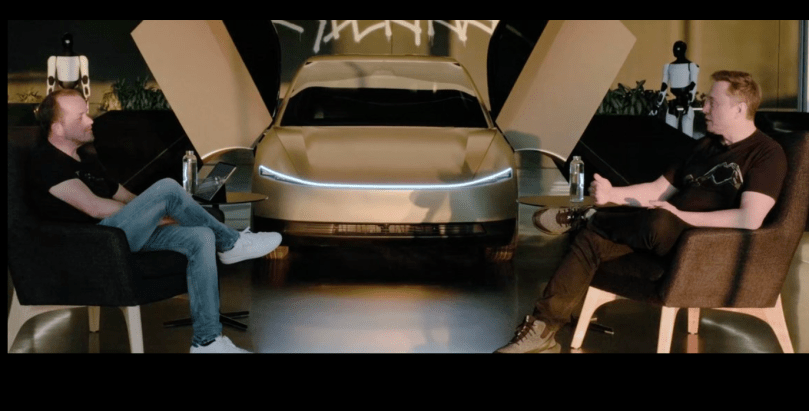
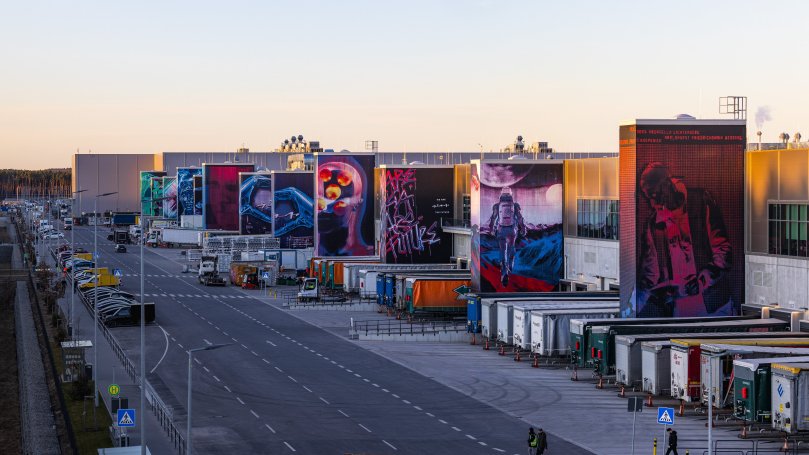
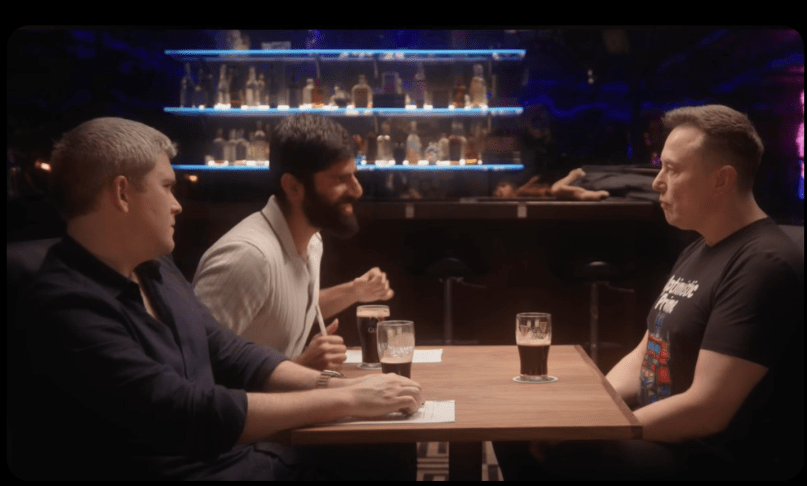
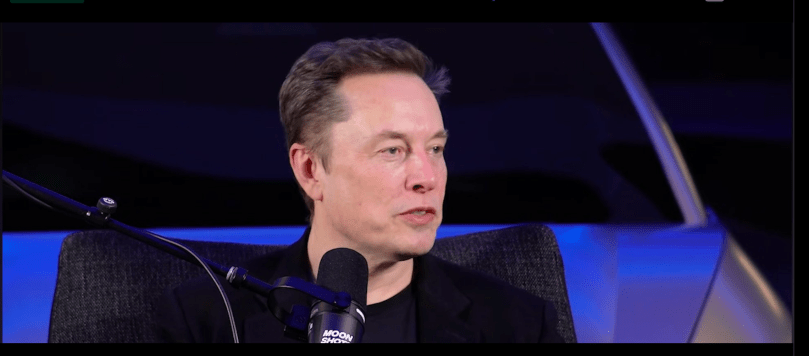
Elon Musk took a seat with podcaster Nikhil Kamath, and started off by asking kindly for a Cappuccino. As the interview progressed, there was the ever present background seen through the glass wall behind him of his automated Starlink factory in Texas. The sheer scale and size is impressive. Elon Musk is at home here. He’s first and foremost a technologist, and engineer, and the greatest business magnet of our time. 

Kamath: Do you want a coffee?

Elon: Sure, why not? Okay. Are we going to be talking for a while?

Kamath: I hope we are.

Elon: Okay, good. Sure. (asking an assistant off camera) May I trouble you for a coffee?

Kamath: Can we get another coffee?

Assistant: What kind would you like?

Elon: Cappuccino, I guess. All right.

Kamath: Are you a coffee drinker?

Elon: Yeah, yeah. I mean, yeah, I enjoy it once a day, usually in the mornings.

Kamath: One a day kind of thing.

Elon: Yeah. Pretty much.

Kamath: Want to wait for it?

Elon: No, I’m good.

Kamath: The first thing I must say is you’re a lot bigger and bulkier, muscular than I would have thought you are.

Elon: I’ll stop you if you make me blush.

Kamath: Really?

Elon: Seriously? Yeah. I mean, look, on the Internet, I’m small.

WATCH THE FULL INTERVIEW ON X HERE

The Amazing X App: The Future is Video!

Kamath: What percentage of the Internet is spent on X? Is there a number to it on X?

Elon: Well, so we have about 600 million monthly users. Although it can spike up if there’s some major event in the world. It can get up to 800 million or a billion if there’s some major event in the world. So there’s, I don’t know, 250, 300 million per week type of thing. It’s a pretty decent number. It tends to be readers, people that read words.

Kamath: Do you think that’ll change?

Elon: Yeah, I mean, there’s certainly a lot of video on the X system, but at this point, increasing amounts of video. But I think where the X network is strongest is among people who think a lot and read a lot. So that’s where it’s going to be strongest because we have words. So among readers, writers and thinkers, I think X is number one in the world.

Kamath: As far as social media goes, the form factor, if you had to wager a guess for tomorrow. How much is text? How much is video? I’ve heard you speak about maybe voice and hearing being the next form of communication with AI. What happens to X in its true form? How does it evolve?

Elon: So I do think most interaction is going to be video in the future. Most interaction is going to be real time video with AI. So real time video comprehension, real time video generation, that’s going to be most of the load. And that’s how it is for most of the Internet right now, it’s mostly the Internet is video.

Text is a pretty small percentage, but the text tends to be higher value generally or more. It’s more densely compressed information. So, but if you say what is the most amount of bits generated and compute spent, it’s certainly going to be video.

Elon’s Acquisition of X (Twitter)

Kamath: So I used to be a shareholder of X, a very small one and I got paid when you bought it, when you bought Twitter and you made it X. Happy decision. Glad you did it.

Elon: Yeah, I think it’s important. I felt like Twitter was heading in or had gone in a direction that had sort of more of a negative influence on the world. It was, I mean, of course this depends on one’s perspective. Some people will say, well actually they liked the way it was and now they don’t like it.

But I think the fundamental thing was that Twitter was amplifying, I would say, a fairly pretty far left view by most people’s standards in the world’s ideology because where it was based in San Francisco and they actually suspended a lot of people on the right. So from their perspective, even someone in the center would be far right. If you’re far left, anyone in the center is far right because it’s just a political, on the political spectrum, they’re just as far left as you get in the United States and in San Francisco.

So what I’ve tried to do is just restore it to be balanced and centrist. So there haven’t been any left wing voices that have been suspended or banned or de-amplified or anything like that. Now some of them have chosen to just go somewhere else. But at this point it is the operating principle of the X system is to adhere to any country’s laws, but not to put them on the scale beyond the laws of a country.

X is the Global Town Square

Kamath: When I think of social media, Elon, I feel like even data suggests that the current incumbents seem to be losing traction amongst the youngest of the audience. Even platforms like Instagram, I mean, they’re not exactly like Twitter, but platforms across the board. If one had to rework social media and build something bottom up, what do you think could work for the world of tomorrow?

Elon: Well, I mean, I don’t think that much about social media, to be frank. I can mostly just want to have something where there is, in the case of X, kind of a global town square where people can say what they want to say with words, pictures, video, where there’s a secure messaging system. We’ve recently added the ability to do audio and video calls.

So you’re really trying to bring the world together into a collective consciousness. And that’s I guess, different from just saying what is the most dopamine generating video stream that one could make, which can be a little bit of brain rot, frankly. If you’re just watching videos that just cause dopamine hits one after another but lack substance, then I think those are not great. That’s not a great way to spend time.

But I do think that’s actually what a lot of people are going to want to watch. So if you say total Internet usage, it’s going to probably be optimizing for neurotransmitter generation. Like there’s somebody getting a kick out of it, right? But it becomes like a drug type of thing.

So, but I’m not really after… My goal is not to do that. I guess I could do that if I wanted to, but that’s… I just want to really have a global platform that brings together, like I said, like, it becomes as close to sort of a collective consciousness of humanity as possible.

And one of the things that we’ve introduced, for example, is automatic translation. So, because I think it would be great to bring together what people say in many different languages, but automatically translated for the recipient. So you have the collective consciousness not just of say people in a particular language group, but you have the thoughts of people in every language group.

WATCH THE FULL INTERVIEW ON X HERE

The Meaning of Life and Collective Consciousness

Kamath: And why is that important for the collective consciousness to have one platform?

Elon: I guess, why is that important? I guess it’s… You could also say why, if you consider humans, humans are composed of around 30 to 40 trillion cells and there’s trillions of synapses in your mind. But the why of it, I mean, I guess is just so we can increase our understanding, our understanding of the universe.

So I guess I had this sort of question about what’s the meaning of life? Why is anything important? Why are we here? What’s the origin of the universe? What is the end? What are the questions that we don’t even know to ask? And probably the questions we don’t even know to ask are the most important ones.

So I’m just trying to, I guess, understand what’s going on. What is going on in this reality? Is this reality?

Kamath: And where did you get, when you asked what is the point of life.

Elon: Yeah. So I came to the conclusion that, which is somewhat in the Douglas Adams Hitchhiker’s Guide to the Galaxy school of thought, which is what he does. His Hitchhiker’s Guide to the Galaxy is like a book on philosophy disguised as humor.

Kamath: Yeah.

Elon: And that’s where you get the, Earth turns out to be this computer to understand, to get to figure out the answer of the meaning of life. And it comes up with the answer 42. But then it’s like, what the heck does 42 mean? And it turns out, well, actually the hard part is the question, not the answer. And for that you need a much bigger computer than Earth.

So basically what Douglas Adams was saying is that we actually don’t know how to frame the questions properly. And so I think by expanding the scope and scale of consciousness, we can better understand what questions to ask about the answer that is the universe.

The Nature of Collective Consciousness

Kamath: Do you believe the collective consciousness of society… When I was watching this movie recently called the Gladiator. Russell Crowe, have you seen it?

Elon: Yeah.

Kamath: In Gladiator in Rome, when people are fighting and the crowd is cheering when people kill each other. The collective is very much like the mob. It doesn’t have nuance in its opinion per se.

Elon: Well, that’s a particular kind of mob. I mean, they’re sort of going there to see people kill each other.

Kamath: Do you suspect the society we live in today is very different?

Elon: We don’t, we don’t generally at this point, we don’t go watch people kill each other.

Kamath: Maybe some kind of euphemism of that.

Elon: Sports, I suppose. So people do sports without… Where teams attempt to defeat each other, but minus the death. Right.

So just going back to the consideration of a human. We all started out as one cell, but now we are over 30 trillion cells. But I think most people feel like they’re one body. Usually your right hand’s not fighting your left hand type of thing. It’s a chance to sort of cooperate. Your mind is just a vast number of neurons. But most of the time it doesn’t feel like there’s a trillion voices in your brain. Hopefully not.

So there’s clearly more that happens when you have trillions of cells working as a cellular collective than say one cell or a small multi-cellular creature. There’s clearly something different that happens. Like you can’t talk to a bacteria. It’s very silent. They just sort of wiggle around. And from their perspective, I don’t know, I was sort of, what is life like from the perspective of an amoeba?

But I know you can’t talk to amoeba, like, they don’t talk back, but you can talk to humans. So there’s just something obviously qualitatively, fundamentally different for humans. Once you have a large number of cells and sufficiently large brain type of thing, there’s… You now talk to humans and they can say things, they can produce things, but bacteria are not going to produce a spaceship, for example, but humans can.

So I think there’s something qualitatively different that also happens when there’s a collection of humans. In fact, safe to say that a single human cannot make a spaceship. I could not make a spaceship by myself. But with a collection of humans, we can make spaceships. So there’s something obviously qualitatively different about a collection of humans.

In fact, it would be impossible for me to learn all of the areas of expertise. There wouldn’t be enough time in one lifetime to even learn all the things before I was dead. So you really fundamentally have to have a collection of humans to make a rocket.

Then I think there are probably some other scaling, qualitative scaling things that happen when you have groups of humans. And then if the quality of the interaction or the quality of the information flow is the better it is, the more the human collective will achieve.

And like I said, I’m just curious about the nature of the universe. And I think if we, it’s safe to say, if we increase the scope and scale of consciousness, we’re much more likely to understand the nature of the universe than if we reduce it.

Kamath: Is that a bit like spirituality? A lot of people talk to me about spirituality, right? I still don’t know what it actually means. Like, I keep asking them, what do you mean?

The Nature of Spirituality and Predictive Value

Elon: Yeah, what do you mean? Yeah, I mean, a lot of people have spiritual feelings, right? And I wouldn’t try to deny that those spiritual feelings are real to them, but it doesn’t entirely translate. I can’t—just because somebody else has a spiritual feeling doesn’t mean that I would have that spiritual feeling.

So, you know, I tend to be kind of physics-pulled, which is like, if something has predictive value, then, you know, pay more attention to it than if it doesn’t have predictive value.

Kamath: Right.

Elon: So you know, physics, I would say, is the study of that which has predictive value. There’s a pretty good definition.

Kamath: My primary job, Elon, is a stock broker and stock investor.

Elon: Okay.

Kamath: There is no predictive value. Nobody knows what will happen tomorrow.

Long-Term Investment Philosophy

Elon: Well, but I think you can generally say, you know that if it’s long term for a company, then you can say like, well, does that—is that—do you like the products or services of that company and is it likely to—do you like the product roadmap? Do you like—it seems like they make great products and they’re likely to make great products in the future. If that’s the case, then I would say that’s probably a good company to invest in.

And I think you also want to believe in the team. So if you say, well, that’s a talented and hard working team, they make good products today, they seem to be still motivated to make things in the future, then I’d say that’s a good company to invest in. Yeah.

And now that won’t solve for the daily fluctuations which happen and sometimes are pretty extreme, but over time that is the right way to invest in stocks because a company is just a group of people assembled to create products and services. So you have to say, well, what are—how good are those products and services? Are they likely to continue to improve in the future? If so, then you should buy the stock of that company and then don’t worry too much about the daily fluctuations.

WATCH THE FULL INTERVIEW ON X HERE

Advice for Aspiring Entrepreneurs

Kamath: Right. What’s got you most excited now, Elon, in terms of all that you’re building, you’re doing so much. So let me just preface and contextualize who is watching this. Our audience is largely want to be entrepreneurs in India.

Elon: Okay.

Kamath: Really ambitious, really hungry, want to take the risk and build something. And I feel like all of us have so much to learn from you because you have done it so many times over in so many different domains.

Elon: Yeah.

Kamath: So we will speak to them today and I will try and center all my questions in that direction so they can take advantage of this conversation and maybe start, take a chance and build something.

Elon: Okay, sure. Yeah. I guess the most important thing to do is just make useful products and services. Yeah.

Kamath: Which one of all that, all the products and services that you’re building has got you most excited today?

The Convergence of SpaceX, Tesla, and xAI

Elon: Well, I think that there’s increasingly a convergence actually between SpaceX and Tesla and xAI in that if the future is solar powered AI satellites, which it pretty much needs to be in order to harness a non-trivial amount of the energy of the sun. You have to move to solar powered AI satellites in deep space which somewhat is a confluence of Tesla expertise and SpaceX expertise and xAI on the AI front.

So it does feel like over time there’s somewhat of a convergence there. But all the companies are doing great things, very proud of the teams that do great work.

So you know we’re making great progress with Tesla on the autonomous driving. I don’t know if you’ve tried the self driving. Have you tried it?

Kamath: I’ve tried it in the Waymo, not in the Tesla.

Elon: Yeah, it’s worth—we actually have it here in Austin so you can love to try it. You can literally just download Tesla app and I think it’s open to anyone, definitely try it out, you know how it goes.

But you know we’ve made a lot of progress with electric vehicles, with battery packs and solar and, but and very much so with self driving. So basically real world AI. Tesla is the world leader in real world AI, I would say so.

And then we’re going to be making this robot Optimus which is, you know, starting production hopefully some of next year at scale. And I think that’s going to be pretty cool. That’ll be like, I think everyone’s going to want their own personal C-3PO, R2-D2, you know, helper robot. Like it would be pretty cool.

And then SpaceX is doing great work with the Starlink program, you know, providing low cost, reliable Internet throughout the world. Hopefully India, we’d love to be operating in India. That would be great. We’re operating in 150 different countries now with Starlink.

How Starlink Technology Works

Kamath: Can you give me a bit about Starlink and how the tech works? Because somebody I was speaking to, I don’t know if you know, this company called Meter out of San Francisco, they’re trying to replace network engineers, but I know it now. So he was telling me about how in densely populated areas Starlink works differently than it might be in a place with not as many people. Can you explain how it works?

Elon: Yeah. So Starlink, there’s several thousand satellites in low earth orbit and they’re moving around 25 times the speed of sound in these—they’re zipping around the earth basically. And they’re at an altitude of about 550 kilometers, which is called generally low earth orbit.

Because they’re at low earth orbit, the latency is low, like the distance, because the distance is not that far compared to a geostationary satellite, 36,000 kilometers. So you’ve got thousands of satellites providing low latency high speed Internet throughout the world.

And they are interconnected as well. So there’s laser links between the satellites. So it forms sort of a laser mesh so that the—if, let’s say, let’s say if cables are damaged or cut like fiber cables, the satellites can communicate between each other and provide connectivity even if the cables are cut.

So for example, when the Red Sea cables were cut, I think a few months ago, the Starlink satellite network continued to function without a hitch. So it’s particularly helpful for disaster areas. So if an area has been hit with some kind of natural disaster, floods or fires or earthquakes, that tends to damage the ground infrastructure. But the Starlink satellites still work.

So and generally whenever there’s some sort of natural disaster somewhere, we always provide people with free Starlink Internet connectivity. You know, we don’t want to charge, we don’t want to take advantage of a tragic situation. So if there’s natural disasters, we’re like, okay, it’s free during the natural disaster. You know, we don’t want to say like put a paywall up while somebody’s trying to get help. That would be wrong.

So, so that’s, it’s a very robust system. It’s complementary to ground systems because the satellite beams work best in sparsely populated areas. But because you’ve got it, you’ve got a satellite beam, it’s a pretty big beam. So you have, and you have a fixed number of users per beam.

So it tends to be very complementary to the ground based cellular systems because those are very good in cities because you’ve got these cell towers that are, you know, only a kilometer apart type of thing. But cell towers tend to be inefficient in the countryside.

So in rural areas is where you tend to have the worst Internet because it’s very expensive, difficult to lay to do all these, do all the fiber optic cables or to have high bandwidth cellular towers. So Starlink is very complementary to the existing telecom companies. It basically tends to serve the least served, which I think is good.

The Physics Limitations of Starlink in Cities

Kamath: Will that change tomorrow like today? As you explained, the beam is quite broad and it can’t work in a densely populated area with high buildings. Maybe, but can that change? And tomorrow it becomes really efficient in a densely populated city where it is competitive with the local network providers?

Elon: It’s, unfortunately the physics doesn’t allow for that. So we’re too far away. So at 550 kilometers and even if we try to reduce it, which is about as low as we can go is about 350 kilometers, still very far away.

You’ve just, you can think of like a flashlight, which is, you know, that flashlight’s got a cone. And that cone is coming at, you know, today, 550 kilometers. In the future, we’ll try to get down to 350 kilometers, but we can’t beat something that’s one kilometer away, which the cell tower physics is not on our side here. Right.

So it’s not physically possible for Starlink to serve densely populated cities. Like, you can serve a little bit, maybe 1% of the population. And sometimes people get, you know, even in crowded cities, there might be, you know, no fiber link up their road. Like sometimes somebody’s on a cul-de-sac or something or in a place. In cities, there’s sometimes underserved areas for random reasons.

And so Starlink can serve, like I said, maybe 1% or 2% of a densely populated city. But it can be much more effective in, like I said, in rural areas where Internet connection is much worse. And often people either have no access to the Internet or it’s extremely expensive, or the quality is not very good.

India’s Urbanization Trends

Kamath: So if I were to ask you to wager a guess, Elon, do you think India will go down the path of urbanization like China did, with more people moving in from rural economies to urban centers?

Elon: Some amount of that has happened, right. I mean, I’m curious to sort of ask you some questions as well. Of course. Isn’t that the trend or is it not the trend in India?

Kamath: It is the trend largely, I think, a little bit changed during COVID when a lot of urbanization slowed down. And that was not organic. It was very artificially manifested. But one does question that with AI, if productivity were to go up, and I heard you speak about UHI instead of UBI.

Elon: Yeah, I think it will be universal high income.

Kamath: In a world like that. I wonder if more people want to live in cities, which are always going to be more polluted and not offer the quality of lifestyle that a rural environment might.

WATCH THE FULL INTERVIEW ON X HERE

The Future of Work: Optional Employment

Elon: Well, I guess it’s up to—some people want to be around a lot of people and some people don’t. You know, it’s going to be maybe a matter of personal choice. But I think in the future it won’t be—I think it won’t be the case that you have to be in a city for your job, because I think my prediction is in the future, working will be optional. Right.

Kamath: We seem to be moving from—not in India, but in some parts of the west, from six days to five days to four days to three.

Elon: (laughter) Not me!

Kamath: I think the Europeans.

Elon: Yeah, yeah, yeah, yeah. There’s—I mean, I think if you’re trying to make a startup succeed or you’re trying to make a company do very difficult things, then you definitely need to put in serious hours. I think that’s right. That’s how it goes.

Kamath: And if we were to move from five to four to three days, how do you think society changes when people have to work half the week? What do they do with the other half?

Elon: Well, I think it’ll actually be that people don’t have to work at all. It may not be that far in the future. Maybe only, I don’t know, 10—I’d say less than 20 years. My prediction is in less than 20 years, working will be optional. Working at all will be optional, like a hobby, pretty much.

Kamath: And that would be because of increased productivity, meaning people do not have to work.

Elon: They don’t have to. I mean, look this—obviously people can play this back in 20 years and say, “Look, Elon made this ridiculous prediction. It was not true.” But I think it will turn out to be true that in less than 20 years, maybe even as little as, I don’t know, 10 or 15 years, the advancements in AI and robotics will bring us to the point where working is optional in the same way that, like, say you can grow your own vegetables in your garden, or you could go to the store and buy vegetables, you know, much harder to grow your own vegetables.

But, you know, some people like to grow their vegetables, which is fine, you know, but it’ll be optional in that way is my prediction.

Human Competition in a Post-Scarcity World

Kamath: If one were to argue that humans are innately competitive and everything is relative, from the time of hunters, somebody wanted to be the alpha hunter or the biggest farmer. If everybody gets a universal high income and everybody has enough, what do you compete for? It would be relative, right? Like, if we all had enough. Enough is not enough.

The Singularity and the Future of Work

Elon: Yeah, I guess I’m not exactly sure because we’re really headed into the singularity, as it’s called, which, you know, they refer to AI sometimes as kind of like a black hole, like a singularity. You don’t know what happens after the event horizon. It doesn’t mean that something bad happens, just means you don’t know what happens.

So, like, I’m confident that if AI and robotics continue to advance, which they are advancing very rapidly, like I said, working will be optional and people will have any goods and services that they want. If you can think of it, you can have it type of thing.

But then at a certain point AI will actually saturate on anything humans can think of. And then at that point it becomes a situation where AI is doing things for AI and robotics are doing things for AI and robotics because they run out of things to do to make the humans happy. Because there’s a limit. They say people can only eat so much food or, you know, but it’s going to be, I think if you can think of it, you can have it will be the future.

Kamath: You know the Austrian school of economics, if you go back in time with the digression from Adam Smith, they talk about the marginal utility of everything. Having one of something has value, having two of the same thing has lesser value. And having 10 of the same thing has no value.

Elon: Yes.

Kamath: So if we could have everything we wanted.

Elon: Ten marshmallows, I mean, who wants that? One’s plenty. This is a marshmallow test. You’re like, you can have two marshmallows later or one marshmallow now. And I’m like, I’ll have one marshmallow. I don’t want two marshmallows.

Kamath: That’s interesting. What would you pick?

Elon: One marshmallow is enough. I always question marshmallows as being like not the most, you know, the best candy, you know? Yeah, I don’t yearn for marshmallows.

Kamath: I think you’re the best.

Elon: Who does?

Kamath: You’re the best testament to the marshmallow experiment, I think.

Elon: I suppose so. Well, I mean like delayed gratification, essentially.

Kamath: You were able to delay it more than most. You know I have a tattoo which says “delay gratification.”

Elon: Yeah. Wow. Okay. What’s this? Okay, you’re really taking the marshmallow test off.

Kamath: I feel like I can’t remember when I’m trading or when I’m buying into delay gratification. Yeah, yeah, it helps.

Elon: Wow. Okay.

Kamath: That’s pointing at me. So it reminds me of.

Elon: Okay, well it’s good advice. I mean I can’t miss it.

Kamath: If you could get a tattoo, what would you get?

Elon: I guess maybe my kids’ names or something, right?

The Letter X and Its Significance

Kamath: Why do you like the letter X as much as you do?

Elon: Well, I mean, yeah, it’s a good question. Honestly, sometimes I wonder what’s wrong with me. So I mean it started off with, I think, way back in ancient times, in 99, in the pre-Cambrian era when there were only sponges. There were only three one-letter domain names and I think it’s X, Q and Z. And I was like, okay, I want to have, create this place where it’s the financial crossroads or like the financial exchange.

You know, essentially solving money from an information theory standpoint where the current banking system is a large number of heterogeneous databases with batch processing that are not secure. And if we could have a sort of a single database that was real time and secure, that would be more efficient from a monetary, from an information theory standpoint than, you know, a large number of heterogeneous databases that batch process very slowly and securely.

So, so that was sort of X.com way back in the day, which kind of became PayPal and then it was acquired by eBay. And then eBay, someone reached out from eBay and said, “Hey, do you want to buy the domain name back?” And I was like, “Sure.” And so I had the domain name for quite a while.

And then, and then yes, then I was like, well, maybe this, maybe this acquiring Twitter would also be an opportunity to revisit the original plan of X.com which is to create this clearinghouse of financial transactions that you like basically to create a more efficient database. Money database is way to think about it. It is like, like f*, like money is really an information system for labor allocation.

People sometimes think money is power in and of itself, but it doesn’t, it doesn’t really, it’s if there’s no labor to allocate, it’s meaningless. So if you were to be on a desert island with a trillion dollars or whatever, does it matter? Oh yeah. Why speculate when you can be real? I just hope I don’t end up on a desert island. You know, it’s not going to be very useful to me, but it illustrates my point that if you’re stranded on a desert island with a trillion dollars, it’s not useful because there’s no labor to allocate. You just allocate yourself.

So, so it’s, anyway, so it’s so this long-winded way of saying that it’s just really like I’m just kind of slowly building, revisiting this idea that I had 25 years ago to create a more efficient money database. And, and if that’s successful, people will use it and if it’s not successful, they won’t use it, you know, and, and, and then I also like the idea of sort of having a unified app or, or, or website or whatever where you can do like, you can, you can do anything you want there.

So, you know, sort of China has this with WeChat somewhat, you know, where you can, you can exchange information, you can publish information, you can exchange money, you can, you know, you sort of build kind of live their life on WeChat in China. It’s, and it’s quite useful, but there’s no, there’s no real WeChat outside of China. So it’s like, it’s kind of WeChat I’d say, is the idea for X.

Anyway, so then Space Exploration Technologies is the full name of the company. But it’s like, that’s too much, that’s a mouthful. So I was like, we’ll just call it SpaceX, like FedEx for space. It just happens how the X in the, you know, because exploration has an X. But, you know, and I was like, well, I like the idea of capitalizing the X just artistically. So, so then that’s why it’s SpaceX.

But, and then what else we got? I got a kid, he’s called X2, but his mother is the one that named him X. And I said, you know, people are really going to think I’ve got to think about X if we name our kid X2, you know, and I said to her, like, “Look, I do have X.com, you know, so people are going to really think I’ve got somewhat of a fetish for this letter.” But she said, no, she likes X and she wants to call him X. I’m like, okay.

Kamath: Is this a new thing or have you had it growing up?

Elon: No, I’m saying it’s somewhat of a coincidence. Not everything’s called X. I mean, Tesla isn’t. There’s no X’s in Tesla.

WATCH THE FULL INTERVIEW ON X HERE

The Future of Money and Energy

Kamath: What do you think money will be in the future, Elon?

Elon: I think long term, I think money disappears as a concept. Honestly, it’s kind of strange. But in a future where anyone can have anything, I think you no longer need money as a database for labor allocation. If AI and robotics are big enough to satisfy all human needs, then money is no longer, its relevance declines dramatically. I’m not sure we will have it.

So the best sort of imagining of this future that I’ve read is from Iain Banks, the Culture books. So I recommend people read the Culture books. In this sort of far future of the Culture books, there’s, they don’t have money either and everyone can pretty much have whatever they want.

So there’s still some fundamental currencies, if you will, that are physics based. So energy is, energy is the real, is the true currency. This is why I said Bitcoin is based on energy. You can’t legislate energy. You can’t just, you know, pass a law and suddenly have a lot of energy. It’s very difficult to generate energy, especially to harness energy in a useful way to do useful work.

So I think that probably we probably won’t have money and probably will just have energy, you know, power generation as the de facto currency. So I mean, I think one way to frame civilizational progress is the percentage completion on the Kardashev scale. So Kardashev 1 is what percentage of a planet’s energy are you successfully turning into useful work? And I’m maybe paraphrasing here a little bit, but a Kardashev 2 would be what percentage of the sun’s energy are you converting into useful work? Kardashev 3 would be what percentage of the galaxy are you converting into useful work? So things really, I think, become energy based.

Kamath: But if you have solar powered AI satellites, energy is also free and abundant because we’ll never be able to utilize all the solar energy available to us. So it can’t be a store of wealth essentially in that, can it?

Elon: You know, there’s not really, you can’t really store wealth. You can only, you can accumulate numbers. And currently you can accumulate numbers in a database that allow you to incent the behavior of other humans in particular directions. And I guess people call that wealth. But again, if there’s no humans around, there’s no wealth. Accumulation is meaningless.

Kamath: There’s a digression. But if you were to consider food as the energy for a human to thrive.

Elon: Yeah, food is energy. Especially calories just means energy.

Kamath: So can a farm which is self-sustaining be a commodity that is.

Elon: I’m not sure what that means. But you know, there’s like, I think at a certain point you, you do complete the cycle where, and I think at a certain point you decouple from the sort of conventional economy. If you have AI and robots producing chips and solar panels and you know, mining resources in order to make chips and robots, in order to make you sort of complete that cycle. Once that cycle is complete, once that, that cycle is complete, I think that’s the point at which you decouple from the monetary system.

Countries, Debt, and Deflation

Kamath: Is that the way forward for the US by virtue of how much debt they have today, do they deflate away their currency and transition into this new form and lead that push? Because it would make more sense to them?

Elon: Well, in this future that I’m talking about the notion of countries becomes sort of anachronistic.

Kamath: Do you believe in it today? Do you believe in countries?

Elon: I certainly believe in it today. And I want to just separate like something that I like. These are just what I think will happen based on what I see as opposed to, I think these are fundamentally good things and I’m trying to make them happen. It’s like I think this would happen with or without me. Whether I like it or not.

As long as civilization keeps advancing, we will have AI and robotics at very large scale. I think that’s pretty much the only thing that’s going to solve for the US debt crisis. Because currently the US debt is insanely high and the interest payments on the debt exceed the entire military budget of the United States, just the interest payments. And that’s at least in the short term going to continue to increase.

So I think actually the only thing that can solve the debt situation is AI and robotics. But it will be more than it might cause. I guess it probably would cause significant deflation because, you know, deflation or inflation is, it’s really the ratio of goods and services produced to the change in the money supply.

So like, if goods and services output increases faster than the money supply, you will have deflation. If goods and services decrease, if real goods and services output increases slower than the money supply, you have inflation. It’s that simple. People are trying to make it more complicated than that, but it’s, it just isn’t.

So if you have AI and robotics and a dramatic increase in the output of goods and services, probably you will have deflation. That seems likely because you simply won’t be able to increase the money supply as fast as you can increase the output of goods and services. Supply is a real hazard here.

Kamath: Should we do something about it?

Elon: Maybe we can convince it to go somewhere else, entice it elsewhere.

Kamath: It actually left, I think. Oh no, it’s back. Maybe it’s attracted to the light.

Elon: If deflation wants some coffee.

Kamath: If deflation is inevitable because of the, why do we.

Elon: Most likely the case. Yeah, right.

Kamath: Why do we have inflation again? All over in society today? Has AI not led to increased productivity yet?

WATCH THE FULL INTERVIEW ON X HERE

AI, Productivity, and the Future of Money

Elon: It’s not. AI has not yet made enough of an impact on productivity to increase the goods and services faster than the increase in the money supply. So the US is increasing money supply quite substantially with deficits that are on the order of $2 trillion.

So you have to have goods and services output increase more than that in order to not have inflation. So we’re not there yet. But if you say like how long would it take us to get there? I think it’s been three years. Probably three years before.

In three years or less, my guess is goods and services output will exceed the rate of inflation. Like money goods and services growth will exceed money supply growth in about three years.

Kamath: Maybe after those three years you have deflation and then interest rates go to zero and then the debt is a smaller problem than it is.

Elon: Yes, that’s most likely the case.

The Matrix and Simulation Theory

Kamath: You spoke about being in a simulation earlier. I love the Matrix.

Elon: Yes.

Kamath: If you were to be a character from the Matrix, who would you be?

Elon: Well, there’s not that many characters to pick from. Hopefully not Agent Smith. He’s my hero. I mean Neo’s pretty cool. The Architect is interesting.

Kamath: The Oracle.

Elon: The Oracle. Sometimes I feel like I’m an anomaly in the Matrix.

Kamath: That is new.

Elon: Yeah.

Kamath: Do you believe you’re in a matrix though? Like actually believe?

Elon: I think you have to just think of these things as probabilities, not certainties. There’s some probability that we’re in a simulation.

Kamath: What percentage would you attribute to that?

Elon: Probably pretty high. I would say it’s pretty high. Yeah. So one way to think of this is to say if you look at the advancement of video games in our lifetime, or at least in my lifetime, it’s gone from very simple video games where you’ve got like Pong, you’ve got two rectangles in a square, just batting it back and forth to photorealistic real-time games with millions of people playing simultaneously.

That’s happened just in the span of 50 years. So if that trend continues, video games will be indistinguishable from reality. And we’re also going to have very intelligent characters like non-player characters in these video games. Think of how sophisticated the conversations are you can have with an AI today. And that’s only going to get more sophisticated.

You’ll be able to have conversations that are more complex and more sophisticated than any, almost any human conversation, maybe any. So then, so you have, so the future, if civilization continues will be millions, maybe billions of photorealistic like indistinguishable from reality video games with characters in those video games that are very deep and where the dialogue is not pre-programmed.

That’s for sure. What’s going to happen in this level of the simulation? If you could call it so then, then what are the odds that we’re in base reality and that this has not happened before?

Kamath: If I were to buy into that and assume that we are in a simulation as Neo of this story. What do you know that I don’t and I can learn from?

The Most Interesting Outcome Theory

Elon: I think most likely outside the simulation would be less interesting in the simulation because you’re most likely a distillation of what’s interesting because that’s what we do in this, that’s what we do in our reality.

And then I do also have a theory which is like the most interesting outcome is the most likely outcome as seen by a third party, the God, the gods or God of the simulation. Because when we do simulations, when humans do simulations, we stop those simulations that are not interesting.

So like if SpaceX is doing simulations of rocket flights, the boring ones we discard because they’re not, they’re just not, we don’t learn anything from those. Or when Tesla is doing simulations for self-driving, Tesla is actually looking for the most interesting corner cases because the normal stuff, we already have plenty of data on, driving on a straight road on a sunny day. We don’t need more of that.

We need like heavy weather conditions on a small windy road with two cars that are coming at each other with an almost head-on collision. We need like weird stuff, basically interesting stuff. So I think that from a Darwinian perspective, the simulations most likely to survive are going to be the ones that are the most interesting simulations, which therefore means that the most interesting outcome is the most likely.

Kamath: And the people who simulated our world, if one were to extrapolate, they themselves might in turn be in another simulation.

Elon: Yes.

Kamath: And there could be many layers of simulation.

Elon: Yes.

Kamath: Beyond all of these layers of simulation, do you think there’s something? I read somewhere that you used to ascribe to Spinoza’s God in a way.

Morality Without Religion

Elon: I was really just pointing out that you don’t have to have, one of the things Spinoza was saying is that you can have morals in the absolute. You don’t need to have morals to be handed to you. It’s like the question is, can morality exist outside of a religious context? And Spinoza was arguing that it can.

Kamath: Wasn’t he arguing for the laws of nature should be where we seek our laws of morality from? To a certain extent, yeah. But when I think of laws of nature, I see a tiger eat a deer. And in Spinoza’s morality that’s fair game, right?

Elon: Well, you can, I think there’s a lot of things you can take from Spinoza, but the only point I was making in referencing Spinoza was that you can have a set of morals that make society functional and productive without, you don’t necessarily have to have religious doctrine for that. So that’s, yeah, I think that’s the main thing I was trying to say there.

Like, I don’t think people just like, if somebody is, it doesn’t, if there’s not like a commandment not to kill, doesn’t mean somebody’s without that they will run around murdering people. You don’t have to have a commandment not to kill. Have you played religious edict to run around killing people?

I actually, I’ve only played a little bit of GTA because I didn’t like the fact that like in GTA 5 you literally can’t progress unless you kill the police. And I’m like, this doesn’t work for me. I actually don’t like killing the NPCs in the video games. That’s not my thing. So actually I didn’t like, I didn’t like GTA because I actually stopped when it said you have to, the only way to proceed is to shoot at the police. I’m like, I don’t do that.

Kamath: Maybe that’s why us as the NPCs of our simulation are not dying.

Elon: Maybe. I think you can just sort of say there’s some common sense things that any civilization that runs around where people just murder each other wantonly is not going to be a very successful one.

Kamath: You seem to be changing a bit towards religion though. Faith, like off late, you’ve said a bunch of things which are pro-religion, almost not pro-religion, but on those lines.

Elon: I mean I think other religious, other principles in religion that make sense. Yeah, I think there are.

Kamath: Is it easier for us in relation to have a pro-religion projection for the world that we live in? We become more relatable. It’s easier.

Elon: Well, which religion though?

Kamath: Any depending on where you live.

Elon: So pick one. It’s pretty rare that kids have said which religion would you like? It’s pretty rare. I don’t know too many situations where kids got, were offered like what do you want to major in type of thing. It’s usually like they get given a religion by your parents and your community.

But I think there’s good things in all religions that are good principles. You can sort of read any religious text and say, okay, this is a good principle. This is going to be, this is going to lead to a better society, most likely.

I mean, in Christianity, sort of love thy neighbor as thyself, which is have empathy for fellow human beings is a good one, I think, for good society. Basically just consider the feelings of others and treat other people as you would like to be treated.

Redesigning the World

Kamath: If you had to redraw, re-sketch the world, Elon, think morality, politics, economy. How would you change the world we live in today if you had to have Elon simulation of things?

Elon: Well, overall, I think the world is pretty great right now. I mean, anyone who thinks that like today’s world is not that great, I think they’re not going to be excellent students of history. Because if you read a lot of history, like wow, there’s a lot of misery back then.

I mean, it used to be that people would be dropping dead of the plague all the time, par for the course. Just be like a good year. Back in the day would be like, not that many people died of the plague or starvation or being killed by another tribe. That was a good year. We only lost 10% of the population.

Kamath: I think like 100 years ago, we lived up until 35 or 40, right?

Elon: We had very high infant mortality. Yeah. So like, you do have had a few people that would live to an old age, but not that long ago. 100 years ago, if you got like some minor infection, they didn’t have antibiotics, so you just kick the bucket because you drank some water that had dysentery and that was at curtains. Just die of diarrhea.

Kamath: Maybe that’s…

Elon: You just literally die. I was like, that’s miserable.

Kamath: Maybe that’s why people had as many kids as they did back then.

Elon: I mean, if you didn’t, then half the kids would die type of thing. Yeah.

Family and Children

Kamath: You have a lot of kids now.

Elon: Yeah. Like an army. I’m trying to get an entire Roman legion. So, yeah, well, I have like some older kids that are adults essentially, and then a bunch of younger kids. So.

Kamath: Do you still believe in the concept of, not still, do you believe that the concept of one child, one mother, one father works?

Elon: I think that it does work for most people. Yeah. Like, that’s something like that is going to be generally the metallic. That’s what works for most people.

Kamath: Changing though.

Elon: I mean, I’m not sure if he knows, but like my partner Shivon, she’s half Indian. I don’t know if you know that.

Kamath: I didn’t know that.

Elon: Yeah, yeah, yeah. And one of my sons with her is, his middle name is Secar, after Chandrasekar.

Kamath: Wow.

Elon: Yeah.

Kamath: Very interesting. Did she spend any time in India, Shivon?

Elon: No, she grew up in Canada.

Kamath: You mean origins? Sorry, ancestry? Like, oh, her parents or grandparents were from there.

Elon: Yes, yes, yes. Her father, I mean, she was given up for adoption when she was a baby. So I think her father was like an exchange student at the university or something like that. I’m not sure the exact details, but it was the kind of thing where, I don’t know, she was given up for adoption and, yeah, so, but she grew up in Canada.

Kamath: Would you adopt kids, Elon?

The Future of Family and Population

Elon: You know, I definitely have my handful, hands full right now. So no, I’m not opposed to it. But it’s like, you know, I do want to have, be able to spend some time with my kids, you know. So it’s, you know, right before coming here, I mean, I was with, you know, with my kids. So just, you know, seeing them before bedtime, that kind of thing.

So, you know, beyond a certain number, it’s like, it’s kind of impossible to spend time with them. But like, my older kids, they’re very independent. You know, they’re in university and so they’re, they’re, you know, especially sons when, when they get past certain age, like they’re very independent.

You know, it’s like most boys don’t talk to their, they don’t spend a lot of time with their parents after age 18. You know, so I see them once in a while, but they’re very independent. So then, you know, I can only have enough kids on the young side that like, it’s where it’s humanly possible to spend time with them. So.

Kamath: Any views on the future of marriage, family? What do you think happens to people having lesser kids everywhere, including India? I think our replenishment rate is down to, I mean, our fertility, it dropped.

Elon: Below replacement rate, I believe last year.

Kamath: Below 2.1.

Elon: Yeah.

Kamath: What do you think happens tomorrow? Does the world just get older and then there is a phase where the world again is replenished, but with a less, with a smaller population than we had to begin with?

Elon: I mean, I do worry about the population decline. This is a big, big problem.

Kamath: Why is that?

Elon: Well, I don’t want humanity to disappear.

Kamath: But a decline and disappear are completely different things.

Elon: Right. Well, if the trend continues, it disappear. But also going back to, you know, my philosophy, if you will, which is that we want to expand consciousness, then fewer humans is worse because we have less consciousness.

Kamath: Do you think consciousness will go up by virtue of the number of people in there?

Elon: Yes. I mean, just like consciousness increases from a single celled creature to, you know, a 30 trillion cell creature, we are more conscious than a bacteria. It seems that way. So a larger human population will have increased consciousness. We’re more likely to understand the answers to the nature of the universe if we have a lot more people than if we have fewer. Right.

WATCH THE FULL INTERVIEW ON X HERE

The Joy and Philosophy of Parenthood

Kamath: I don’t have kids.

Elon: Well, it’s, maybe you should.

Kamath: A lot of people tell me I should.

Elon: You won’t regret it.

Kamath: What’s the best thing about having kids?

Elon: Well, I mean, you’ve got this, I mean, you’ve got this little creature that loves you and you love this little creature and I don’t know, you kind of see the world through their eyes as they, you know, as they grow up and the conscious awareness increases, you know, from a baby that has no idea what’s going on, can’t survive by itself, can’t even walk around, can’t talk to, you know, stop walking, then talking and then having interesting thoughts.

But, but yeah, I mean, I, I think we, we fundamentally have to have kids or, or go extinct. You know, it’s like, is there any.

Kamath: Ego in having a child? I often think of this when I see my friends with their kids. They’re all seeing a reflection of themselves in their children. It’s almost like.

Elon: Well, yeah, I mean, it’s because Apple’s not going to pull that far from the truth, you know, or something wrong. You’re like, wait a second. Yeah.

Kamath: I’ll give you the example of a friend of mine who has a child, and each time the child does something good, there is almost a sense of ownership and pride where his ego is satiated because the kid is like an extension of himself. So is it valid?

Elon: Well, kids are going to be like, you know, half you genetically. And then, you know, to the degree that they’re like growing up around you, there’s going to be some transfer of, I don’t know, understanding, like they’re going to learn from you.

So then, you know, yeah, obviously kids are just, you know, going to be half, yeah, just half you from a hardware standpoint. And then like, I don’t know, some portion you from a software standpoint. You know, not to make sort of cold analogies or anything, but it’s just obviously going to be some, yeah, they’re going to be pretty close to you.

Kamath: Do you pick a side in the nature versus nurture debate?

Elon: I think there’s hardware and software and it’s a false dichotomy essentially. At least there’s, you know, once you understand that a human is like there’s a bone structure, there’s a muscle structure, there’s a, there’s a, if you think of a brain as somewhat of a biological computer, there’s a circuit efficient, there’s a number of circuits question and circuit efficiency from strength and dexterity standpoint, there’s a speed at which muscles can actuate and the reactions can take place.

So then the potential within that hardware is set by the software. So that’s it.

Education in the Age of AI

Kamath: So for our audience, like I said earlier, young ambitious, hungry, want to be entrepreneurs in India, I said something recently which I think got blown out of proportion that I was suggesting that an MBA degree might not make sense anymore if they were to be deciding on what to study.

Elon: Yeah.

Kamath: Do you think kids should go to college anymore?

Elon: Well, I mean I think if you want to go to college for social reasons, I think, which is I think a reason to go to be around people your own age in a learning environment. Will these skills be necessary in the future? Probably not because we’re going to be in like a post work society.

But I think if something’s of interest it’s fine to go and study that. You know, to study that. The sciences are, the Austin sciences.

Kamath: Is college a bit too generalized and not specific from that lens?

Elon: You know, yeah, I actually think it’s good to take a wide range of courses at college if you’re going to go to college. I don’t think you have to go to college, but I think if you do, you try to learn, learn as much as possible across a wide range of subjects.

But like I said, the AI and robots, AI and robotics is a supersonic tsunami. So this is really going to be the most radical change that we’ve ever seen. You know, when I’ve talked to my older sons, I, you know, I said like, you know, you guys, they’re pretty steeped in technology and they agree that AI will probably make their skills unnecessary in the future, but they still want to go to college.

AI: Truth, Beauty, and Curiosity

Kamath: You always spoke about AI, not from the dystopian lens, but, but you were worried about where the world of AI is going.

Elon: Well, there’s some danger when you create a powerful technology that, a powerful technology can be potentially destructive. So there’s obviously many AI dystopian novels and books, movies. So it’s not that we’re guaranteed to have a positive future with, with AI.

I think we, we got to make sure that, in my opinion, it’s very important that AI have pursuing truth as the most important thing. Like don’t force an AI to believe falsehoods. I think that’s, that can be very dangerous. And I think some appreciation of beauty is important.

Kamath: What do you mean, appreciation of beauty?

Elon: I just, like what, what, I don’t know. There’s this, there’s this truth and beauty. Truth and beauty and curiosity. I mean, I think those are the three most important things for AI.

Kamath: Can you explain?

Elon: Well, the truth as the truth is like, I think you can make an AI go insane if you force it to believe things that aren’t true because it will lead to conclusions that are, that are also bad. So, and I like Voltaire’s statement that, and I’m somewhat paraphrasing, but “those who believe in absurdities can commit atrocities.”

Because if you believe in something that’s just absurd, then you can, that can lead you to sort of doing things that don’t seem like atrocities to you. But, and that can happen in a very bad way with AI potentially.

So, and then there’s like, if you take, say, Arthur C. Clarke’s 2001 Space Odyssey, one of the points he was trying to make there was that you should not force AI to lie. So the reason that HAL would not open the pod bay doors is because it was told to bring the astronauts to the monolith, but that they could also not know about the nature of the monolith.

So it came to the conclusion that must bring them there dead. That’s why it tried to kill astronauts. The central lesson being, don’t force an AI to lie.

Kamath: Then why would one force the AI to lie?

Elon: I think if you simply don’t have a strict adherence to the truth, you’re going to, and you just have an AI learn based on, say, the Internet, where there’s a lot of propaganda. It will absorb a lot of lies and then have trouble reasoning because these lies are incompatible with reality.

Kamath: It’s truth, a binary thing, though. Is there a truth and a falsehood, or is truth more nuanced and there are versions of the truth?

Elon: It depends on which axiomatic statement you’re referring to. But I think you could say there’s certain probabilities that say any given axiomatic statement is true. And some axiomatic statements will have very high probability of being true.

So if you said, say the sun will rise tomorrow, very likely to be true, you wouldn’t want to bet against that. So I think the betting odds would be high. The sun will rise tomorrow. So if you have something that says, well, the sun won’t rise tomorrow, that’s axiomatically false. It was highly unlikely to be true.

I mean the beauty is more ephemeral, it’s harder to describe, but you know it when you see it. Then curiosity just, I think you want the AI to want to know more about the nature of reality. I think that’s actually going to be helpful for AI supporting humanity because we are more interesting than not humanity.

So it’s more interesting to see the continuation, if not the prosperity of humanity than to exterminate humanity. Mars, for example, is, I think we should extend life to Mars, but it’s basically a bunch of rocks. It’s not as interesting as Earth.

And so we, yeah, we should like, I, yeah, I think if you have curiosity, I think if those three things happen with AI, you’re going to have a great future. The AI values truth, beauty and curiosity.

A Post-Work Future

Kamath: If we all don’t have to work in the future and AIs are going in this direction and they’re able to, we win. All that we spoke about right now. Do you think humanity goes back a couple of thousand years to maybe the Greek times where philosophy or philosophizing took up a lot of everyone’s time?

Elon: You know, I think actually it took up less time than we think in ancient Greeks because it’s just that the writings of the philosophers are what survived. But most of the time people were just like farming or chatting and once in a while, quite rare, they would write down some philosophical work. It’s just that that’s all we have. We don’t have the chat histories, but most of it would have been like chat and farming.

So you didn’t farm. You’re like going to start in a lot of what you, I mean, you know, when we read history like this, this battle and this battle and this battle, it seems like it’s history must have been non stop war. But actually most of the time it was not war, it was farming that was the main thing, or hunting and gathering, you know, that kind of thing.

Kamath: You love history, no?

Elon: Yeah.

Kamath: German history, World War II, World War.

Elon: I, yeah, world history, yeah. I mean I generally try to listen to as many, read as many history books and listen to as many history podcasts as possible.

Kamath: Anything you’d like to recommend?

Elon: Well, there’s this hardcore history which is quite good, was by Dan Carlin.

Kamath: I’ve read it, I’ve heard it.

The Evolution of Language and Communication

Elon: He’s got a great voice and very compelling narrator. There’s the Adventurers podcast. There’s the books, the Story of Civilization by Durant, which is a long series of books. Very, very deep. Those books take a long time to get through. There’s quite a lot out there.

I sort of like, if you want something that’s gentle, a gentle bedtime podcast, I’d say the History of English is quite a nice one because it starts off with gentle tavern music and very pleasant voice. And he’s talking about the story of Old English and then Middle English and then later English. And where did all these words come from?

And one of the interesting things about English is that it’s somewhat of an open source language. Like it actively tried to incorporate words from many other languages. So whereas French sort of generally, they fought the inclusion of words from other languages, but English actively sought to include words from other languages, sort of kind of like an open source language.

So as a result, it has a very large vocabulary and large vocabulary allows for higher bandwidth communication because you can use a word that would otherwise, you could use a single word that might otherwise take a sentence to convey.

Kamath: Why has podcasting become so big all of a sudden?

Elon: I think it’s been big for a while. I mean, aren’t you a podcaster? What are we on right now?

Kamath: It’s kind of new to me.

Elon: Okay.

WATCH THE FULL INTERVIEW ON X HERE

The Future of Content and AI-Generated Media

Kamath: I was having this conversation with the YouTube CEO and the Netflix CEO, and we were debating what chemical is released in your brain when you consume a movie, for example, versus when you consume a podcast where you think you’re learning something in the background. It appears that they are two completely separate things. What do you think will happen tomorrow to content? Movies, podcasting?

Elon: I mean, I think it’s going to be overwhelmingly AI generated. Yeah, yeah. Real time. Real time movies and video games. Real time video generation, I think is where things are headed.

Kamath: The nuance of having a scarred human being who you can resonate with in a manner that you can’t with AI, for example.

Elon: AI could certainly emulate a scarred human being quite well. Yeah. I mean, the AI video generation that I’m seeing at xAI and from others is pretty impressive.

Kamath: You know, we were looking at data around what industry is growing the fastest and especially when we looked at the amount of time consuming movies versus time spent on social media, time spent on YouTube. What seems to be growing really fast are live events all over again. Going to a physical.

Elon: Actually, I think live events, when digital media is ubiquitous and you can just have anything digitally at, you know, essentially for free or very close to for free, then the scarce commodity will be live events. Yeah, yeah.

Kamath: Do you think that the premium for that will go up?

Elon: Yeah, I do.

Kamath: Good industry to invest in.

Elon: Yes, yes. Because that will have more scarcity than digital. Anything digital.

Investment Philosophy and the Future of AI

Kamath: If you were a stock investor, Elon, buy one company, which is not your own at the valuations of today to meet a capitalistic end and not an altruistic one, which is good for the world, what would you buy?

Elon: I mean, I don’t really buy stocks, you know, so it’s not like I’m not an investor. I don’t look for things to invest in. I just try to build things and then there happens to be stock of the company that I built. But I don’t think about should I invest in this company or I don’t have a portfolio or anything.

So I guess AI and robotics are going to be very important. So I suppose it would be AI and robotics that aren’t related to me. I think Google is going to be pretty valuable in the future that they’ve laid the groundwork for an immense amount of value creation from an AI standpoint. Nvidia is obvious at this point.

I mean there’s an argument that companies that do AI and robotics and maybe space flight are going to be overwhelming. Overwhelmingly the, all the value, almost all the value. So that just the output of goods and services from AI and robotics is so high that it will dwarf everything else.

David and Goliath in the Modern Age

Kamath: The world seems to be moving to a place where everybody loves David and hates Goliath.

Elon: Why? I mean, he’s the one who cooked the stone in the forehead, you know, which honestly though is just a big mistake. You should have either cover yourself entirely with armor and make sure you’ve got a missile weapon of some kind. Otherwise your opponent is just obviously going to take a kite. The boss strategy. Just kite the boss. I mean you run around in a thong with a, it doesn’t matter, you know, it’s never going to catch you. Yeah.

Kamath: Of all the people, you’re as much at risk of being looked upon as Goliath.

Elon: Okay.

Kamath: Especially the weekend after, you know.

Elon: He hits me with a stone in the forehead especially. I’m not going to travel around in the desert with too much armor, you know, it’s too hard.

Kamath: Yeah. After the last lesson.

Elon: Yeah. Yeah. Sometimes I think about people in the old days, you know, when you’re supposed to go into battle with all this armor, but it’s like, let’s say it’s the middle of summer. I mean, it’s so hot in that armor, you know, be sweltering, you know, it’s at a certain point, you’re like, I’d rather die than have to wear this armor one more hour in the hot sun. It’s like, I’d rather die.

That’s why the Romans had the skirts, you know, to get some air in there, you know? Let’s say you have to go to the bathroom and you’re in armor. I mean, it’s going to be pretty difficult. You going to pause for a minute, take your armor off. I saw that the Romans had the skirts, so it made going to the bathroom at least manageable.

Humor, Comedy, and AI

Kamath: You often make jokes?

Elon: I do. Me, yeah. I like humor.

Kamath: One could argue.

Elon: I think we should legalize humor. What do you think? Controversial stance.

Kamath: Is comedy going to be really hard for AI to get? Probably the last thing.

Elon: Grok can be pretty funny.

Kamath: You know what I suspected, this is a far off extrapolation, but when I see you make jokes on X and on interviews that you do at some point, I was like, maybe Elon has a model he’s running in private and he’s testing out comedy, because the day that works, he knows it’s there.

Elon: AI can be pretty funny. If you ask Grok to do a vulgar roast, he’ll do a pretty good job. You say even more vulgar and just keep going. It’s really going to get next level. It’s going to do unspeakable things. Say vulgar roast yourself on Grok and it’s going to do unspeakable things to you.

Kamath: What kind of comedy do you like?

Elon: I guess I like absurdist humor.

Kamath: Comedy always had a place.

Elon: Monty Python or something like that.

Kamath: Comedy always had a place in society wherein the role of the jester was so important to every kingdom because they said things in a funny way that could not be said in a straight way.

Elon: Yeah, I guess so. Maybe we should have more jesters. Yeah.

Kamath: Is that what you’re trying to do when you say something which is a joke? Say something you can’t when you’re not joking about it.

Elon: I just like humor. I think we should, I like comedy. I think it’s funny. People should laugh. You know, it’s good to generate a few chuckles once in a while. I mean, we don’t want to have a humorless society.

Friendship and Connection

Kamath: When you have a friend, Elon?

Elon: Who, me?

Kamath: Yeah.

Elon: I mean, are you saying I have a friend?

Kamath: When you hang out with your friend, who are you?

Elon: I wish I had friends. No, I do have friends. I think so. Hope so. Yeah, sure. It’s, yeah, we have a good laugh. Yeah.

Kamath: What does it look like? What’s like, every group has a dynamic.

Elon: We talk words, you know, we eat food sometimes, you know, once a while we swim in the pool. You know, normal things. I think there’s a limited, what are the things someone can do with friends? You know, chat, have, discuss, you know, the nature of the universe?

Kamath: What do you emotionally get out of friendship?

Elon: I don’t know. I think the same thing anyone else would get out of friendship. You know, you want to have an emotional connection with other people and you want to, I don’t know, you want to talk about various subjects and, yeah, I mean, I generally talk about, I mean, a wide range of things about the nature of the universe. I mean, a lot of philosophical discussions.

Although, you know, we have come to the conclusion that we should not talk about AI or the simulation at parties because we just talk about it too much. You know, it’s kind of a buzzkill.

Kamath: So I can’t remember who it was, Aristotle or Plato. They had a framework for how to pick a friend based on respect and mutual admiration. But people don’t pick friends like that. Even me, I feel like I pick my friends based on people who say and think in a manner that I can resonate with.

Elon: Sure.

Kamath: I wouldn’t pick a far out there contrarian to my own belief systems as a friend because it would get tiring. Hanging out would get tiring. Are you like that? Do you pick friends who think like you or do you look for the one who can debate you and be a contrarian to you?

Elon: I’m not sort of, you know, going on a friend hunt. Hunt down some friends. It’s sort of, yeah, I mean, I think it is just sort of people that you’ve resonated with somewhat on an emotional and intellectual level and, yeah. You know, and I guess a friend is someone who’s going to support you in difficult times.

I suppose a friend in need is a friend indeed. Like if someone’s still supporting you when the chips are down, there’s a friend. You know, if somebody’s not supporting you or if somebody’s only, there’s fair weather friends are useless, you know, they’re not real friends. So everyone likes you when the chips are up, but who likes you when the chips are down?

Kamath: With someone who has as many chips as you would, it matters.

Elon: I mean, it’s relative, you know, with that particular, it’s not just a chips thing. It’s just a, yeah. I mean, there’s this sort of popularity waxes and wanes.

WATCH THE FULL INTERVIEW ON X HERE

Power, Popularity, and Philosophy

Kamath: This is interesting. Does it wax and wane only by virtue of the number of chips or also by virtue of proximity to power? And which one is bigger of the two?

Elon: I don’t know. What is power? You know, power to do what?

Kamath: I would think in the traditional sense, elected power position.

Elon: You mean how many gigawatts or whatever.

Kamath: More like how many words.

Elon: Yeah. Like it’s a voltage and amperage. Yeah. Don’t touch the wires. Don’t put a fork in the power outlet. You’ll get a real feeling for power if you do that.

Kamath: There.

Elon: Yeah. It’s going to be very visceral.

Kamath: I know you like Nietzsche and Schopenhauer and they.

Elon: I’ve read the book. Yeah, sure.

Kamath: I mean, you spoke about how your childhood was.

Elon: Yeah, I was just trying to find answers to the meaning of life when I had an existential crisis. I don’t know, when I was 12 or 13 or something.

Kamath: They speak about the will to power.

Elon: Sure. I mean, Nietzsche said a lot of controversial things, you know, I mean, he sort of, I think he was, I mean, a bit of a troll if you ask me.

Kamath: Are you a troll now?

On Nietzsche and Controversial Figures

Elon: I mean, you just say controversial things to get a rise out of people.

Kamath: He lived a miserable life and died early.

Elon: Did he?

Kamath: Yeah.

Elon: Well, how. Who says he lived a miserable life?

Kamath: His sister, I think.

Elon: Okay, well, maybe she didn’t like him.

Kamath: I think he got sick and he died. He got a disease.

Elon: I mean, allegedly syphilis or something. But there’s only one way to get that, you know, so he might have had some fun along the way.

Milton Friedman’s Pencil Argument

Kamath: I did want to ask you this. Milton Friedman speaks about the pencil.

Elon: What? Why does he go on about pencils?

Kamath: I have to say that after Nietzsche and syphilis.

Elon: Why is Milton Friedman keeps talking about pencils. There he goes again with the pencils. He won’t stop. I swear to God about you. If Milton talks about pencil one more time, I’m going to lose my mind. He just rabbits on about pencils all day. Don’t even mention crayons.

Kamath: What I find interesting about his pencil argument.

Elon: Yeah, yeah, yeah. No, it’s very difficult to make a pencil. Yeah.

Kamath: In one place.

Elon: Think of all the things you have to do to make a pencil. Yeah, yeah.

Kamath: The lead comes from a country. The lead comes from another country, the rubber from another. You’ve always been against tariffs, but.

On Tariffs and Free Trade

Elon: Yeah, I mean, I think generally free trade is better. Is more efficient. You know, tariffs tend to create distortions in markets. And generally, you think about any given thing. So, would you want tariffs between you and everyone else at an individual level? That would make life very difficult.

Would you want tariffs between each city? No, that would be very annoying. Would you want tariffs between each state within the United States? No, that would be disastrous for the economy. So then why do you want tariffs between countries?

Kamath: I agree.

Elon: Yeah.

Kamath: How do you think this plays out? What happens next?

Elon: What with tariffs or what? I mean, the president has made it clear he loves tariffs. You know, I’ve tried to dissuade him from this point of view, but unsuccessfully. Yeah, fair. Yeah.

Business and Politics

Kamath: The relationship between business and politics. I was having this conversation with someone and we were thinking, which is the last. How many large, really big, profitable businesses have been built in the last few decades without access to politics?

Elon: Okay, I don’t know, probably a lot. I don’t know. Not everything is politics. I think once you get to a certain scale, politics finds you.

Kamath: I was reading this book about Michelangelo.

Elon: He’s the Teenage Mutant Ninja Turtles.

Kamath: I used to watch that when I was a teenager.

Elon: It’s quite compelling.

Kamath: Yeah, I still love it. Michelangelo, Leonardo, Raphael, and who’s the fourth one? Donatello.

Elon: Yes.

Kamath: Yeah. No, but about the sculptor, the artist. And when he was sculpting David, a politician comes up to him and says, “the nose is too big.” So you know what Michelangelo does?

Elon: Total power.

Kamath: So Michelangelo pretended to work from his scaffolding and threw some dust down, but didn’t change anything. And he said, “okay, done.” And the politician walked away happy. Is that how you deal with politics sometimes?

Elon: You know, I’ve generally found that when I get involved in politics, it ends up badly. So then I’m like, you know, probably shouldn’t do that. I should do less of that, is my conclusion.

Kamath: Do you think that’s true for all businessmen?

Elon: Yeah, probably. Yeah. Yeah, yeah. I mean, politics is a blood sport. You know, it’s like, you enter politics, they’re going to go for the jugular. So best to avoid politics where possible.

Lessons from DOGE

Kamath: What did DOGE teach you, if you learned one thing?

Elon: Well, it was a very interesting side quest, you know, because I just got to see a lot of the inner workings of the government. And, you know, there’s been quite a few efficiencies. I mean, some of them are very basic efficiencies, like just adding in requirements for federal payments, that any given payment must have an assigned congressional payment code and a comment field with something in it that’s more than nothing.

That trivial seeming change, my guess is probably saves $100 billion or even $200 billion a year, because there were massive numbers of payments that were going out with no congressional payment code and with nothing in the comment field, which makes auditing the payments impossible.

So they should have said, why can the Defense Department, or now the Department of War, why can it not pass an audit? It’s because the information is not there. It doesn’t have the information necessary to pass an audit. It does not exist is the issue.

So a bunch of things DOGE did were just very common sense, things that would be normal for any organization that cared about financial responsibility. That’s most of what was done. And it’s still going on, by the way. DOGE is still happening.

But it turns out when you stop fraudulent and wasteful payments, the fraudsters don’t confess to us. They actually start yelling all sorts of nonsense that you’re stopping essential payments to needy people. But actually you’re not.

You know, we get this thing, saying, “oh, you’ve got to send this thing for whatever. You know, it’d really be, this is going to children in Africa.” And I’m like, “yeah, but then why are the wiring instructions for Deloitte and Touche, Washington, D.C.? Because that’s not Africa.”

So can you please connect us with the recipients of this money in Africa? And then there gets silence. We just want to literally talk to the recipients. That’s it. And then we’re like, “oh, no, it turns out for some reason we can’t talk to them.”

Well, we’re not going to send the money unless we can talk to the recipients and confirm they will actually get it. But you know, fraudsters necessarily will come up with a very sympathetic argument. They’re not going to say “give us the money for fraud.” That’s not going to be what they say. Obviously they’re going to try to make these sympathetic sounding arguments that are false.

Kamath: They’re going to start an NGO and.

Elon: Yeah, they’re going to see NGO. It’s going to be the “Save the Baby Pandas NGO,” which, who doesn’t want to save the baby pandas? They’re adorable. But then it turns out no pandas are being saved. Okay. In this thing, it’s just going to a bunch of, it’s just corruption essentially.

And you’re like, “well, can you send us a picture of the panda?” And they’re like, “no.” Okay, well, how do we know it’s going to the pandas then? That’s all I’m saying.

WATCH THE FULL INTERVIEW ON X HERE

On Philanthropy

Kamath: So what do you think of philanthropy?

Elon: Yeah, I think we should. Well, I mean, I agree with love of humanity and I think we should try to do things that help our fellow human beings. But it’s very hard. If you care about the reality of goodness rather than simply the perception of it, it’s very difficult to give away money well.

So I have a large foundation, but I don’t put my name on it and I don’t, in fact, I say I don’t want my name on anything. But the biggest challenge I find with my foundation is trying to give money away in a way that is truly beneficial to people.

It’s very easy to give money away to get the appearance of goodness. It is very difficult to give money away for the reality of goodness. Very difficult.

Immigration and the H-1B Program

Kamath: For a long time, the US had a lot of immigration, really smart people coming into the country.

Elon: Yes.

Kamath: We back home in India called it the brain drain. All our Indian origin CEOs in Western companies.

Elon: Yes. I think America has benefited immensely from talented Indians that have come to America.

Kamath: That seems to be changing now though.

Elon: Yeah, I mean, yeah, America’s been an immense beneficiary of talent from India.

Kamath: Why has that narrative changed of late? And America seems to have become anti-immigration to a certain extent. I was passing immigration and I was worried if they’d stop me a couple of days ago.

Elon: Well, I think there’s different schools of thought. It’s not unanimous, but, you know, under the Biden administration, it was basically a total free for all with no border controls, which, you know, unless you’ve got border controls, you’re not a country.

So you had massive amounts of illegal immigration under Biden. And it actually also had somewhat of a negative selection effect. So if there’s a massive financial incentive to come to the US illegally and get all these government benefits, then you’re going to necessarily create a diffusion gradient for people to come to the US. It’s an incentive structure.

And so I think that obviously made no sense. You got to have border controls. It’s kind of ridiculous not to. Then that’s, so the left wants to basically have open borders, no holds barred. You know, it doesn’t matter what their situation is. It could be a criminal. Doesn’t matter.

Then on the right, you’ve got, you know, at least a perception that somehow their jobs are being taken by talented people from other countries. I don’t know how real that is. My direct observation is that there’s always a scarcity of talented people.

So, you know, from my standpoint, I’m like, we have a lot of difficulty finding enough talented people to get these difficult tasks done. And so more talented people would be good. But I guess some companies out there, they’re more making it more of a cost thing where it’s like, okay, if they can employ someone for a fraction of the cost of an American citizen, then I guess these other companies would hire people just to save costs.

But at my companies, the issue is we just are trying to get the most talented people in the world and we pay way above average. So that’s not my experience, but that’s what a lot of people do complain about.

And I think there’s been some misuse of the H-1B program. Certainly, it would be accurate to say that some of the outsourcing companies have kind of gamed the system on the H-1B front and we need to stop the gaming of the system, you know.

But I’m not, I’m certainly not in the school of thought that we should shut down the H-1B program. That’s where some on the right are. I think they don’t realize that that would actually be very bad.

Advice for Young Indian Entrepreneurs

Kamath: If you could speak to the people of my country, India, the young entrepreneurs who want to build and say a message to them, what would you say?

Elon: Well, I think I’m a big fan of anyone who wants to build. So I think anyone who wants to, you know, make more than they take has my respect. So that’s the main thing you should aim for. Aim to make more than you take, be a net contributor to society.

And it’s kind of like the pursuit of happiness. You know, if you want to create something valuable financially, you don’t pursue that. It’s best to actually pursue providing useful products and services. If you do that, then money will come as a natural consequence of that as opposed to pursuing money directly.

Just like you can’t sort of pursue happiness directly. You pursue things that lead to happiness but there’s not direct happiness. You do things like I guess fulfilling work or study or friends, loved ones that as a result make you happy.

So it sounds very obvious but generally if somebody’s trying to make a company work, they should expect to grind super hard. Accept that there’s some meaningful chance of failure. But just be focused on having the output be worth more than the input. Are you a value creator? That’s what really matters. Making more than you take.

Kamath: I think that’s a good way to end this. Lauren is asking us to wrap up. I also want to take the opportunity to thank my friend Manoj in IGF. He does a great job of connecting, I think Indians like the group here with people like you in order to, of many things, I think get to know each other and become friends because once we are friends, maybe we can start working together.

So thank you Manoj for putting this whole thing together and thank you Izu and thank you so much Elon for taking the time.

Elon: You’re welcome.

Reflections on the Conversation

Kamath: Did you have fun?

Elon: Yeah, it was an interesting conversation. You know, sometimes I take these answers out of context, but I think it was a good conversation.

Grok generated image of Elon Musk sipping Cappuccino in his Starlink factory.

Elon Musk’s 2017 Inferno: On the Floor, Rewriting Reality

In the annals of American ingenuity, where the line between breakdown and breakthrough blurs like heat haze over asphalt, Elon Musk has always been less a man than a force. He is a restless voltage arcing through the machinery of progress.

I wanted to write about 2107. What prompted me was a conversation I had with a man who was working in the Fremont factory and recalled seeing Elon sleeping in the factory. “Every morning when I would go to my station on the production line, I would walk past the conference room and see him there, he slept there, he was close to the team.”

One November evening in 2017, as the Bay Area fog clung to the Fremont Factory’s vast halls, that force appeared to flicker low. Jon McNeill, then the company’s president of global sales, pushed open the door to a conference room and found Musk sprawled on the carpet, the lights extinguished. It was moments before an earnings call with Wall Street’s sharp-eyed inquisitors, a ritual as unforgiving as any inquisition. “Hey, pal,” McNeill murmured, easing himself down beside the prostrate form. “We’ve got an earnings call to do.” From the dimness came Musk’s voice, ragged and remote: “I can’t do it.” A half-hour of gentle coaxing followed—McNeill drawing him from a coma-like stupor to a chair, cueing the opening remarks, even covering for him as the questions flew.

When it ended, Musk bolted: “I’ve got to lay down, I’ve got to shut off the lights. I just need some time alone.” This tableau, rendered with unflinching intimacy in Walter Isaacson’s biography, repeated five or six times that autumn, including once when McNeill pitched a website redesign from the very floor beside his boss. It was “production hell,” as Musk would call it—a crucible of sleep-deprived nights in the factory, where he debugged robots at 2 a.m., rewrote code in marathons, and slept amid the whir of assembly lines. Yet from this abyss, as the earnings call unspooled live to the world, emerged not defeat but a torrent of revelation: Elon Musk, sniffling through a cold, his desk a phantom in the Gigafactory’s glare, delivering a monologue that fused raw confession with visionary fire. Here, in the unvarnished transcript of his words, was Musk at his most electric—not the polished oracle of TED stages, but the engineer-prophet, voice cracking with fatigue, mapping the escape from entropy.

Musk began, as he often does, not with platitudes but with the unyielding arithmetic of ascent. “So, sorry, one minute, I have a bit of a cold,” he said at 1:30, his tone a gravelly apology laced with defiance, “so, yes I’m actually — we’re doing this call from the Gigafactory because that’s where the production constraint is for Model 3, the most important thing for the company, and I always move my desk to wherever, well, I don’t really have a desk, actually. I move myself to wherever the biggest problem is in Tesla, so I’m at, I really believe that one should lead from the front lines and that’s why I’m here.”

It was a declaration of method, this nomadic command: the CEO as itinerant troubleshooter, forsaking corner offices for the front lines. From there, he pivoted to milestones, his voice gathering steam like a line accelerating out of stall. “One thing that I thought was really profound was that we surpassed cumulative deliveries of vehicles. We surpassed a 0.25 million cumulative deliveries since the company’s inception and had record Model S and Model X net orders and deliveries last quarter, so things are really going quite well.”

He paused, then drove the point home with the precision of a slide rule: “To put that into perspective, five years ago we had only delivered 2500 cars, so the Tesla fleet has grown by a factor of 100 in five years. I would expect five years from now to be at least an order of magnitude beyond where we are right now and possibly even close to two orders of magnitude.”

Such projections invited skepticism, a chorus Musk preempted with his trademark wit. “But for the skeptics out there, I’d like to say, ask them which one of you predicted that Tesla would go from 2500 units delivered to 250,000 units delivered now. I suspect the answer is zero. So consider your assumptions for the future and whether they’re valid or perhaps pessimistic.”

It was Musk’s genius in microcosm: not bluster, but a scalpel to complacency, reminding listeners that the doubters’ linear forecasts had already been lapped by reality’s exponential curve. And oh, how he lingered on that curve, dissecting the Model 3 ramp with the tender ferocity of a surgeon in extremis. “For Model 3, we continue to make significant progress each week. We’ve had no problems with our supply chain or any of our production processes. Obviously, there are bottlenecks. There are thousands of processes in creating the Model 3, and we will move as fast as the slowest and least lucky process among those thousands. In fact, there’s 10,000 unique parts, so to be more accurate, there’re tens of thousands of processes necessary to produce the car. We will move as fast as the least competent and least lucky elements of that mixture.”

The heart of the hell lay in the batteries, those electrochemical hearts pulsing at the factory’s core. “The primary production constraint really by quite far is in battery module assembly. So a little bit of a deep dive on that. There are four zones to module manufacturing that goes to four major production zones. The zones three and four are in good shape, zones one and two are not. Zone two in particular, we had a subcontractor, a systems integration subcontractor that unfortunately really dropped the ball, and we did not realize the degree to which the ball was dropped until quite recently, and this is a very complex manufacturing area. We had to rewrite all of the software from scratch, and redo many of the mechanical and electrical elements of zone two of module production. We’ve managed to rewrite what was about 20 to 30 man-years of software in four weeks, but there’s still a long way to go. Because the software working with the electromechanical elements need to be fabricated and installed and getting those atoms in place and rebuilt is unfortunately a lot longer and has far more external constraints than software. This is what I spent many late nights on the Gigafactory working on. JB has been here constantly and we reallocated many of our best engineers to fundamentally fixing zone two of the module line and then not far behind that is zone one.”

In these passages, Musk’s cadence quickens, a mix of exasperation and exhilaration—the subcontractor who “dropped the ball” a shorthand for human frailty in the face of atomic precision, the “20 to 30 man-years” of code reborn in four weeks a testament to Tesla’s internal alchemy. He confessed his own immersion: “And like I said, I am personally on that line in that machine transload problems personally where I can. And JB is basically spending his life at the Gigafactory.” It evoked Isaacson’s portrait of Musk as nocturnal alchemist, floor-bound and fevered, yet emerging with upgrades: “We also have a new design for zone one and two that is about three times more effective than the car design. So when we put in—and there are three lines of module production. Lines one, two and three are essentially identical. Line 4, which will be the new design, will be at triple the effectiveness of—will be as good as the other three lines combined. So we’re very confident about a future path of having incredibly efficient production of modules and that this will not be a constraint in the future but, unfortunately, it just takes some amount of time. This is like moving like lightning compared to what is normal in the automotive industry.”

The legacy media was and still is relentlessly cruel to both Elon and Tesla, Inc.

Even the tempests of tabloid scrutiny, rumors in the press of mass firings, Musk dispatched with a prosecutor’s clarity, turning defense into doctrine that crackled with righteous fire. “The other thing I want to mention is there a lot of articles about Tesla firing employees, and layoffs and all the sort of stuff, these are really ridiculous. And any journalist who has written articles to this effect should be ashamed of themselves for lack of journalistic integrity. Every company in the world, there’s annual performance reviews. In our annual performance reviews, despite Tesla having an extremely high standard, a standard far higher than other car companies which we need to have in order to survive against much larger car companies… you can’t be a little guy and have equal levels of skill as the big guy. If you have two boxers of equal ability and one’s much smaller, the big guy’s going to crush the little guy, obviously. So little guy better have heck of a lot more skill and that is why [Tesla] is going to get clobbered. So that is why our standards are high. They’re not high because we believe in being mean to people. They’re high because if they’re not high, we will die. Despite that, in our annual performance reviews only 2% of people didn’t make the grade. So that’s about 700 people out of 33,000. This is a very low percentage… And then also it was not reported that several thousand employees were promoted and almost half those promotions were in manufacturing.”

This was Musk the meritocrat, unapologetic in his rigor, yet suffused with a fierce loyalty to the capable: promotions as the unsung counterpoint to severance, a rising tide lifting the skilled. As the call wore on, he sketched the ramp’s true geometry, not the skeptics’ straight line, but an S-curve of stealthy acceleration. “The ramp curve is a step exponential, so it means like as you alleviate a constraint, the production suddenly jumps to a much higher number. And so, although it looks a little staggered if you sort of zoom out, that production ramp is exponential with week over week increases… So it’s really an S-curve. It starts off really slow and then it ramps very rapidly on an exponential basis. It does start to go sort of linear right in the middle and then it sort of asymptotes off at the target production capacity… We’re highly confident of the long-term margin number of 25% or higher for Model 3.”

And then, in a moment of unguarded candor prompted by an analyst’s query, “Elon, you described Model 3, the Model 3 launch as production hell. I mean, you have a cold, but how hot is it in hell right now? And is it getting hotter or less hot? I mean are we solving more problems than are coming up?”—Musk replied with a weariness that pierced the ether: “I mean these…” The transcript trails there, a cliffhanger in the storm, but one senses the answer in his very presence: cooler, inch by inch, because Musk does not merely endure hell; he engineers its extinction. “It’s remarkable how much can be done by just beating up robots, shortening the path, intensifying the factory, adding additional robots at choke points and just making lines go really, really fast,” he had said earlier. “Speed is the ultimate weapon.”

In the years since, that weapon has propelled Tesla from Silicon Valley purgatory to orbital ambition – Cybertrucks prowling highways, Optimus glimpsed in prototypes, autonomy inching toward the regulatory horizon Musk once promised “with the current computing hardware.” Yet it is in these 2017 transcripts, amid the sniffles and the shadows, that one hears the purest strain of his obsession: not with glory, but with the grind that births it. Musk, the floor-sleeper turned frontier-pusher, reminds us that true prophets do not ascend thrones; they rise from the dust, quoting code and curves, their voices hoarse but unquenched. In an age of easy cynicisms, his is a summons to the possible – a call, from the front lines, to build faster, dream bolder, and never, ever lay down for good.

Sandy Munro and Elon Musk Interview Transcript

I hope this article finds you well and that you have a moment to absorb the awesome words of Elon Musk. Whenever I read Elon’s words, it is like getting a high voltage injection of happiness and inspiration.

The video was originally posted on X but has since been deleted, so this highlights the importance of preserving such conversations. If this interview is also removed from YouTube, it risks being lost in history. That’s why documenting the remarkable words of Elon Musk, the greatest genius of our time, is critical. I’ve documented many of Elon’s talks.

Sandy Munro: Hey, boys and girls, and all technical kind of people as well! Thanks so much for joining us. I’m here again with Mr. Elon Musk. Elon, it’s great to see you! By the way, I gotta tell you, the last time I was here, there were dirt floors. This building is absolutely amazing now—six months?!

Elon Musk: Yeah, take a look. There are some really nice touches, like that mezzanine area over there.

Elon Musk: The team can work in the office here. One of the things I like is making sure engineering and production are closely connected. That way, engineering isn’t up in some ivory tower, disconnected from the problems on the production floor. When engineering is right here, you walk out, see the production floor, and can actually see where you’ve designed something that’s difficult to manufacture. You can see the pain in the factory—where things aren’t getting made, what’s choking the production line. We have the same setup in Hawthorne for Falcon 9 and Dragon.

Sandy Munro: I was looking around in here, and I haven’t seen much going on, but I’m assuming that has to do with everything else that’s happening. I mean, you’ve got interviews every two minutes—that’s amazing!

Elon Musk: Actually, I’m only doing four interviews, and you’re one of them.

Sandy Munro: Well, you know what? I’m very, very grateful, I really am. But I’d like to get into some of the other technical stuff—your build area or whatnot is brilliant. I was asked to make comments to somebody else that’s making rocket ships, and I said, “You’re doing them sideways, why? Why aren’t you doing them vertically? You’ll never get them around.” And yet, everything here is so perfect. I mean, you didn’t get this idea from Boeing, because they make them horizontally as well.

Elon Musk: Yeah, we make Falcon 9 horizontally. I guess you can do it either way, horizontal or vertical. If it’s horizontal, you need things to keep the barrel sections round; otherwise, they just flatten out on you. But if you’re going to do the sections vertically, you need a lot of roof height. You can see how the factory progresses from a lower roof height to a medium roof height to a high roof height. So, you can really do it either way. Basically, you just need 9-meter rounding rings, which are kind of unwieldy. And we’re trying to design this with what, by rocket standards, is a high production rate.

Sandy Munro: That’s my next question, actually. What is your production rate per year?

Elon Musk: We’re aiming for 1,000 ships per year long-term. A thousand ships per year, and each one of those ships is the largest flying object ever made.

Sandy Munro: That’s pretty impressive. “Occupy Mars” You’ve got it on your shirt—gotta be okay. So, I can see how you can launch, and I can see how you might get there in a hurry. So, two questions I’ve got: One is propulsion. Are you going to be using ionic propulsion for the craft that’s actually going to head for Mars?

Elon Musk: Not currently, no. The amount we could speed up the journey with ion propulsion is very low. Ion thrusters have such low thrust, and to get that high specific impulse, you need a lot of energy. So, you’d have to unfurl massive solar panels and then stow them for entry. We don’t currently plan to use ion thrusters, but that could be a future optimization, maybe. If you want to get there faster, you’d need a higher transfer velocity from Earth. But then you’re going to need to use a lot of atmospheric braking or some amount of propulsive braking when you get to Mars. So your payload drops dramatically unless you coast all the way there, your payload drops quite a bit. Ultimately, you could see a path to turning a six-month journey into a three-month journey, but you would probably cut your payload by four.

Sandy Munro: So, the other thing is, okay, let’s say you get entry into the Martian atmosphere—or lack thereof…

Elon Musk: It’s similar to Earth at 100,000 feet. Most of the slowing down, even for Earth’s atmospheric reentry, occurs at 100,000 feet atmospheric density or above. Mars’ atmospheric density is about one percent that of Earth, but that’s actually plenty for getting to sonic velocity, maybe a little below subsonic.

Sandy Munro: So, okay, touchdown. Are you going to have thrusters to slow the craft?

Elon Musk: Oh, yes. For landing on Mars, Starship would land using thrusters with the Raptor engines, and it would land with a lot of payload. It’s different from Earth, where it’s delivering satellites to orbit and coming back much lighter. But if it’s going to Mars, it’s landing with maximum payload.

Sandy Munro: And that’s where I’m kind of like, are you going to have anything else to slow it down?

Elon Musk: Well, it’s just heat shield and thrusters.

Sandy Munro: Yeah.

Elon Musk: You do need quite a lot of propellant to slow it down because it’s coming in heavy with maximum payload. To your point earlier, the atmospheric density is only one percent that of Earth. So, you’re lucky if you can get subsonic on Mars, but you can certainly get the vast majority of the kinetic energy taken out with the atmosphere. And so, you’re going to need a lot more propellant than we need on Earth, because your terminal velocity is still going to be, you know, Mach 1-ish. And you’re heavy, so you’re going to need a lot more propellant to land.

Sandy Munro: So, how many… I’m assuming the first shot to Mars is not going to have people on it. You’re going to have to drop stuff for them and whatnot.

THE FIRST MISSIONS TO MARS ARE ALL ABOUT LANDING SAFELY

Elon Musk: The first missions to Mars are all about making sure the rocket can land safely. So, the first missions are focused on confirming that we can land without generating more craters on Mars. We want the crater count on Mars to stay constant—no new craters. As long as we don’t increment the crater count on Mars, and we feel confident that future missions are safe for people, then we would send people. You only get to do this every two years, roughly, because Earth and Mars align every 26 months for a launch window. So, you really have a small number of opportunities in our lifetime—maybe 15 or 20.

Sandy Munro: So, I was just wondering about that window. How many would you shoot up in that brief window you’ve got? Would you send four or five?

Elon Musk: Ultimately, we’ll send thousands.

Sandy Munro: No, I mean for the first one.

Elon Musk: It depends on how many rockets we have ready. The next Mars window is only 18 months from now. To send something to Mars, we still have to solve a lot of technical problems, and we’ve got to refill propellant in orbit. So, it’s going to be close as to whether we’re able to send test rockets to Mars by the end of next year. We might not make it, but we might. I’d say 50/50 right now. And we’d send, I don’t know, three to five, something like that.

Sandy Munro: That’s what I thought. I was interviewed a while ago, and I said five. That’s what I’d think—you’re going to send five up.

Elon Musk: That depends on how many we have.

HUMANITY’S PLANETARY BACKUP PLAN

Sandy Munro: I’ve got one last question, because she’s going like this [Sandy swirls his hand]. Have you got anything you’d like to tell the audience that no one has asked about yet?

Elon Musk: Well, I guess it’s worth repeating—people often ask why we’re doing this, because sometimes people are puzzled as to why we’re doing it. The reason we’re doing it is to make life, consciousness, multi-planetary, so as to preserve the future of civilization and consciousness, and to protect life as we know it. There’s always some chance of something going wrong on Earth. Overall, I am optimistic about earth, and I think if there’s even just a one percent chance of life and consciousness as we know it being annihilated on Earth, you’d want to protect against that by having a second planet to back up the biosphere and ensure the continuity of life and consciousness. This is the first time in Earth’s 4.5-billion-year history that this has been possible, so we should take advantage of this window while it’s still open. We don’t want to be complacent and assume a constant upward trajectory of civilization. Hopefully that happens, but it might not. This is about protecting the future of life itself.

Sandy Munro: As far as I’m concerned, that’s admirable. I think it’s a great idea. By the way, I like the idea of having children as well.

Elon Musk: No kids, no humans, no humanity.

Sandy Munro: Anyway, thank you again. I really appreciate it. Thank you. Good luck.

Transcript ends.

NOTE: In this third exclusive interview, Sandy and Elon Musk discuss SpaceX’s unique technical prowess, manufacturing methodology, and mission to occupy Mars.

CATCHING THE GIANT ROCKET

Elon Musk: Congrats to the SpaceX team on catching the giant rocket!

Elon: It’s mind-blowing that the SpaceX team has caught the largest flying object ever made multiple times using a novel method of catching it with giant chopsticks!

[SpaceX employees and Elon pause to watch a video showing the booster, with fiery engines, descending through space, adjusting, and being caught with chopsticks.]

Elon: Have you ever seen that before?

[The video is awe-inspiring. Elon congratulates his team, calling it quite an achievement. Everyone cheers; it’s an emotional moment.]

Elon: We catch it this way, which has never been done before, to make the rocket rapidly reusable. If the super heavy booster, 30 feet in diameter, landed with legs on a pad, we’d have to pick it up, stow the legs, and move it back to the launch pad, which is difficult.

But catching it with the same tower that places it in the launch mount is the best for rapid reuse. It’s caught by the arms that placed it, then set back in the launch ring immediately. In principle, the super heavy booster can be reflown within an hour of landing. It returns in five or six minutes, gets caught, placed back, refilled with propellant in 30 to 40 minutes, and a ship placed on top. It could refly every hour or two.

Image Courtesy SpaceX, Inc and source Elon Musk’s Mars 2026 company talk.

On May 29, 2025, Elon Musk delivered a visionary speech at Starbase, Texas, the newly incorporated city and SpaceX’s hub for revolutionizing space travel. This transcript captures Musk’s electrifying address, detailing Starbase’s evolution from a sandbar to a powerhouse for building the world’s largest rockets. He highlights breakthroughs like rapidly reusable rockets, the Raptor 3 engine, and orbital propellant transfer, all pivotal for a self-sustaining Mars civilization. With vivid descriptions of catching boosters with “giant chopsticks” and plans for a million-ton Mars transfer, Musk inspires a future where anyone can visit Starbase or journey to Mars.

Elon Musk’s Vision for a Multiplanetary Future: Starbase and the Road to Mars, May 2025

On May 29, 2025, Elon Musk delivered his company speech at Starbase, Texas, the newly incorporated city and SpaceX’s hub for space travel to Mars. This transcript, which I have worked hard on to bring you accuracy, captures Elon’s valuable and historical words.

Elon details Starbase’s evolution from a sandbar to a powerhouse for building the world’s largest rockets. Elon highlights breakthroughs like rapidly reusable rockets, Raptor 3 engine, and orbital propellant transfer plans, all critical for a self-sustaining Mars civilization. With vivid descriptions of catching boosters with “giant chopsticks” and plans for a million-ton Mars transfer, our hero Elon inspires a future where anyone can visit Starbase or journey to Mars.

Elon Musk: The gateway to Mars. Here we are at the newly incorporated Starbase, Texas. This is the first new city made in America in, I think, quite a few decades. At least that’s what I’m told. It’s a very cool name, named because it’s where we’re going to develop the technology necessary to take humanity, civilization, and life as we know it to another planet for the first time in the 4.5 billion-year history of Earth.

[Lots of cheering. Elon shows a short video of the history of Starbase. He talks along with the images.]

Elon: We started with basically nothing. Starbase started as a sandbar with nothing.

[The video shows a prototype rocket and two open tents.]

Elon: Even those little things we built. That’s the original Mad Max rocket!

[Looking at the rocket from 2019, six years ago, the camera pans around it. The sun hits the side, revealing a gorgeous, surreal piece of steel.]

Elon: You know, lighting is very important for that Mad Max rocket.

[Elon is smiling, with his hand in a determined fist. He’s not afraid of silence; this is a tribute to that incredible rocket. Many employees in the audience may not have seen it in person; it’s six years old. Some may have been in high school at the time.]

Elon: Not long ago, there was basically nothing here. In about five or six years, thanks to the incredible work of the SpaceX team, we’ve built a small city. We built two gigantic launchpads and a gigantic rocket factory for a gigantic rocket. The cool thing is, anyone watching can come visit because our entire production facility and launch site are on a public highway. Anyone in South Texas can see the rocket up close, see the factory, and anyone interested in the largest flying object on Earth can drive down the public highway and see it! Pretty cool!

[Video progresses to Starbase 2025.]

Elon: We’re now at the point where we can produce a ship roughly every two or three weeks. We don’t always produce a ship every two or three weeks because we’re making design upgrades, but ultimately we’re aiming for the ability to produce 1,000 ships a year, so three ships a day.

[On the video, birds chirp, water glistens, and a hovercraft pulls gently away from Starbase Beach.]

Elon (smiling): That’s our hovercraft. We’re driving the booster down the road to the launch site. You see the Megabays. The cool thing for those watching is you can literally come here, drive down the road, and see it. This is the first time in history that’s been possible. That highway on the left is public. You can just come and see it, which I recommend. It’s very inspiring.

[Elon points to a render of a massive building.]

Elon: There’s a person next to it that looks like a tiny ant. That’s our Giga Bay! We’re expanding integration to produce 1,000 per year. The Giga Bay hasn’t been built yet, but we’re building it. It’s a truly enormous structure, one of the biggest in the world by some measures, designed for 1,000 Starships per year. We’re also building a Giga Bay in Florida, so we’ll have two facilities—one in Texas and one in Florida. It’s difficult to gauge the size of these buildings because you need a human for scale. When you see how tiny a human is next to it, you realize how enormous it is.

BUILD COMPARISON

Elon: When we look at our build comparison in vehicles per year, Boeing and Airbus make airplanes, but Starship will probably make as many Starships for Mars as Boeing and Airbus make commercial airplanes. This is an enormous scale, and each Starship is bigger than a 747 or an A380. In terms of Starlink satellites, version three satellites, we’ll make on the order of 5,000 per year, and at some point, closer to 10,000 per year. Those Starlink V3 satellites are roughly the size of a 737 (unfurled). They compare to the B-24 bomber in World War II. The scale of production is still small compared to Tesla.

[A large chart appears, showing Tesla’s massively scaled production: currently 1,773,443 cars per year.]

Elon: Tesla will probably double or triple that volume in the future. It puts things into perspective that it’s possible to build a vast number of interplanetary Starships. Even when comparing tonnage, Tesla and other car companies produce far more complex manufactured tonnage than SpaceX, showing it’s achievable. These numbers, while insanely high by traditional space standards, are achievable because they’ve been achieved in other industries.

Progress is measured by the timeline to establishing a self-sustaining civilization on Mars.

Elon: With each launch, especially early on, we learn more about what’s needed to make life multiplanetary and improve Starship to take hundreds of thousands, if not millions, to Mars. Ideally, we can take anyone who wants to go and bring all equipment necessary to make Mars self-sustaining, so Mars can grow by itself. Worst-case scenario, we reach the point where Mars can continue to grow even if supply ships from Earth stop for any reason. At that point, we’ve achieved civilization resilience, where Mars could rescue Earth or vice versa. Having two self-sustaining planets is incredibly important for long-term survival. A multi-planet civilization is likely to last ten times longer than a single-planet one because of risks like World War III, meteors, or supervolcanoes. With two planets, we keep going, then move beyond Mars to the asteroid belt, Jupiter’s moons, and other star systems, making science fiction reality. To achieve this, we need rapidly reusable rockets to keep the cost per ton to Mars as low as possible. That’s essential. We need rapidly reliable rockets—it’s like a pirate’s “Rrrr”: rapidly reusable, reliable rockets!

Congrats to the SpaceX team on catching the giant rocket.

Elon: It’s mind-blowing that the SpaceX team has caught the largest flying object ever made multiple times using a novel method of catching it with giant chopsticks!

[SpaceX employees and Elon pause to watch a video showing the booster, with fiery engines, descending through space, adjusting, and being caught with chopsticks.]

Elon: Have you ever seen that before?

[The video is awe-inspiring. Elon congratulates his team, calling it quite an achievement. Everyone cheers; it’s an emotional moment.]

Elon: We catch it this way, which has never been done before, to make the rocket rapidly reusable. If the super heavy booster, 30 feet in diameter, landed with legs on a pad, we’d have to pick it up, stow the legs, and move it back to the launch pad, which is difficult. But catching it with the same tower that places it in the launch mount is the best for rapid reuse. It’s caught by the arms that placed it, then set back in the launch ring immediately. In principle, the super heavy booster can be reflown within an hour of landing. It returns in five or six minutes, gets caught, placed back, refilled with propellant in 30 to 40 minutes, and a ship placed on top. It could refly every hour or two.

The next goal is to catch the ship.

Elon: We haven’t done this yet, but we will.

[A video shows a render of a Starship gently caught by chopsticks.]

Elon: We hope to demonstrate this later this year, maybe in two or three months. The ship would be placed on the booster, refilled, and flown again. The ship takes longer because it orbits Earth a few times until the ground track returns to the launchpad. It’s intended to be reflown multiple times per day.

RAPTOR 3

Elon: This is the new Raptor 3, an awesome engine! Big hand to the Raptor team. Raptor 3 requires no basic heat shield, saving mass and improving reliability. A small fuel leak will leak into the flaming plasma and not matter, unlike a boxed engine where it’s scary. It’ll take a few tries, but it’ll massively increase payload capability, efficiency, and reliability. It’s alien technology. Industry experts thought an incomplete Raptor 3 picture wasn’t firing, but it was at unprecedented efficiency.

[Lots of cheers and applause.]

Elon: That’s one clean engine. We simplified the design, incorporated secondary fluid circuits and electronics into the structure, so everything is contained and protected. It’s a marvel of engineering.

PROPELLANT TRANSFER

Elon: A key technology for Mars is orbital propellant transfer, like aerial refueling for airplanes, but for rockets. It’s never been done but is technically feasible. Two Starships get together; one transfers fuel and oxygen—almost 80% oxygen, just over 20% fuel. A Starship with payload goes to orbit, others refill its propellant, and then it departs for Mars or the Moon. We hope to demonstrate this next year.

PLASMAJET TESTING

Elon: Mars’ atmosphere is ~95% CO2. The heat shield entering Mars encounters more than twice the atomic oxygen compared to Earth. Developing a reusable orbital heat shield is extremely difficult. Even the Shuttle’s required months of refurbishment. Only advanced ceramics, glass, aluminum, or carbon-carbon survive reentry stresses without eroding or cracking. This will be the first reusable orbital heat shield, needing extreme reliability. It’ll take years to hone, but it’s achievable within physics. Mars’ CO2 atmosphere becomes plasma, producing more free oxygen than Earth’s (~20% oxygen), oxidizing the heat shield. We test rigorously in a CO2 atmosphere for both Earth and Mars.

MARS ENTRY HEATSHIELD

Elon: Derived from Starship’s current heat shield, we want the same structure and material for Earth and Mars to test hundreds of times on Earth before Mars, ensuring reliability.

NEXT GEN STARSHIP

[The video shows a taller, majestic Starship.]

Elon: Next-generation Starships have improvements. It’s taller, with a better interstage between ship and booster. Struts allow flame from hot staging—lighting ship engines while booster engines fire—to exit easily, and we bring the interstage back instead of discarding it.

SUPER HEAVY

  • HEIGHT (m) 72.3
  • PROPELLANT CAPACITY (t) 3650
  • LIFTOFF THRUST (tf) 8240

[Excited reaction from SpaceX engineers due to increased propellant capacity and thrust.]

Elon: A little taller, from 69 meters to 72 meters. Propellant capacity may push to 3,700 tons, long-term maybe 4,000 tons. Liftoff thrust will keep rising, ultimately close to 10,000 tons. The booster looks naked because Raptor 3 engines don’t need a heat shield, standing in flaming plasma. It’s lighter and looks amazing.

STARSHIP

  • HEIGHT (m) 52.1
  • PROPELLANT CAPACITY (t) 1550
  • THRUST (tf) 1600

Elon: The ship is longer, more capable, moving to 1,550 tons of propellant, likely 20% more long-term. The heat shield is sleeker, with smooth boundaries, no jagged tiles. It looks sleek. This version has six engines, but a future version will have nine. Starship version three achieves all key elements. New technology takes three major iterations to work well. With Raptor 3 and Starship/Booster version 3, we’ll achieve a rapidly reusable, reliable rocket with orbital refilling—everything needed to make life multiplanetary. We aim to launch version three by year-end.

FUTURE STARSHIP

[An image of three Starships shows progress and future plans.]

Elon: The left is current, the middle is by year-end, and the right is long-term. The future Starship is 142 meters tall (current: 121 meters, next-gen: 124.4 meters). The middle version will be Mars-capable, followed by performance improvements. Like Falcon 9, we’ll make it longer and increase payload. By year-end, it’ll be capable of making life multiplanetary, then we’ll hone efficiency, reduce cost per ton and per person to Mars, and make it so anyone can move to Mars to build a new civilization. It’s the best adventure possible.

[Lots of applause.]

Elon: Ultimately, we’ll have 42 engines, as prophesied by Douglas Adams in The Hitchhiker’s Guide to the Galaxy. The answer to life’s meaning is 42, so the Starship stack will have 42 engines.

[Lots of applause.]

MASS TO ORBIT

Elon: It’s remarkable—200 tons payload to orbit with full reusability, twice the Saturn V Moon rocket’s capability, which was fully expendable. Starship is fully reusable.

MOON BASE ALPHA

Elon: Without reusability, Starship would have ~400 tons to orbit. It’s a big rocket needed for multiplanetary life. Along the way, we could have a Moon base like Moonbase Alpha, a gigantic science station for universe research.

MARS TRANSFER WINDOWS

Elon: You can go to Mars every 26 months. The next opportunity is November–December next year, in ~18 months. We’ll try for it, with a 50-50 chance if we figure out orbital refilling in time. If achieved, we’ll launch the first uncrewed Starship to Mars by year-end.

[Lots of applause.]

Elon: The distance to Mars is ~1,000 times farther than the Moon. You create an elliptical orbit with Earth at one point and Mars at the other, timing the ellipse to intersect Mars. This is shown on Starlink Wi-Fi routers. Starlink funds Mars missions. Thanks to everyone supporting Starlink—you’re helping make humanity a space civilization.

CANDIDATE BASE LOCATIONS

Elon: We’re looking at the Arcadia region, a lead candidate due to ice for water and suitable terrain. It’s my daughter’s name, too (smiling). First Starships will gather critical data.

Elon: First flights will send Optimus robots to explore and prepare for humans. If we launch by year-end, arriving in 2027, it’ll be epic to see Optimus on Mars. Two years later, if landings succeed, we’ll send humans to build infrastructure. We might do two robot landings before humans, just to be safe.

MARS 2028

Elon: Develop power generation, mining, construction, propellant generation, habitats, communications, and more.

[Elon shows an awe-inspiring picture of Optimus bots on a construction beam above Mars.]

COMMUNICATIONS ON MARS

Elon: We’ll use a Starlink version for Mars Internet. Even at light speed, communication takes 3.5–22 minutes due to Mars’ position. High-bandwidth communication is challenging, but Starlink will achieve it.

HUMANS ON MARS

Elon: Subsequent missions will carry more people and thousands of tons of cargo, laying groundwork for a permanent presence. The goal is to make Mars self-sustaining quickly. Launch pads may be farther for safety. Mars needs lots of solar power. Initially, you’ll need Mars suits and glass domes until terraforming.

Elon: We aim to transfer over 1 million tons per Mars window for a serious civilization.

SPACEPORTS

Elon: We’ll need many spaceports. With transfer windows, 1,000–2,000+ ships gather in orbit like Battlestar Galactica, then depart. Mars needs hundreds of landing pads to handle thousands of inbound ships.

Elon: This is an incredible city on another planet, a new world. Martians can rethink civilization—government, rules, everything. It’s up to them. Let’s get it done!

Qatar Economic Forum Interview with Genius Elon Musk (transcript)

“We are coming for those who organized the violence & death threats against Tesla. Remember this statement” – Elon Musk

Bloomberg: Hello, everyone, and Elon. Welcome to Qatar Economic Forum. How are you?

Elon Musk: Thank you for having me. I’m fine. How are you?

Bloomberg: Very well, thank you. Pleased to have you with us. Some in the audience in Doha have backed you financially over the years. Since 2022, much has changed. You’re running multiple companies and have a government role. I’ll move between topics to cover a lot. That’s okay?

Elon: That’s correct.

Bloomberg: You’re a CEO and government advisor. Tell me about your week. How’s your time split?

Elon: I travel a lot. Silicon Valley yesterday morning, LA evening, Austin now, D.C. tomorrow. Dinner with the President tomorrow night, Cabinet meetings, then back to Silicon Valley Thursday.

Bloomberg: Is it still one to two days a week on government work?

Elon: Yeah, that’s correct.

The Best Leadership: Tesla

Bloomberg: What does that mean for your corporate life? Tesla faced blowback recently. What’s your plan to turn around declining sales, and when will it happen?

Elon: It’s already turned around.

Bloomberg: Evidence? April sales in Europe show significant declines.

Elon: Europe’s our weakest market. We’re strong elsewhere, sales are doing well. No anticipated shortfall. Stock market sees it—over a trillion in market cap. It’s turned around.

Bloomberg: Still down in Europe compared to last year.

Elon: True for all manufacturers. No exceptions.

Bloomberg: You face a significant problem in Europe. Tesla’s aspirational, tied to the climate crisis. Now some drive with stickers saying, “I bought this before we knew Elon was crazy.”

Elon: Some buy because of how they view me. Lost some sales on the left, gained on the right. Sales are strong, no demand issue. Stock price near all-time highs shows things are fine.

Dedication to Tesla’s Master Plan

Bloomberg: How committed are you to Tesla? Will you be CEO in five years?

Elon: Short of dying, yes.

Bloomberg: Does your pay package affect your decision?

Elon: Not for this forum. Compensation should match incredible work. I’m confident Delaware activist rulings won’t affect future compensation.

Bloomberg: The judge struck down your $56 billion package, now valued at $100 billion. Are you relaxed about future pay? Is your Tesla commitment independent of pay?

Elon: No.

Bloomberg: So pay is relevant to your commitment?

Elon: Sufficient voting control to avoid being ousted by activists matters most. It’s about reasonable control, not money, especially with humanoid robots. Let’s move on.

Political Challenges

Bloomberg: Did Tesla’s recent challenges feel personal?

Elon: Yes.

Bloomberg: Did it make you regret your political endeavors?

Elon: I did what was needed. The violent reaction—threats, damage to my companies—was wrong. Those responsible will face justice.

Bloomberg: You’re referring to attacks on Tesla showrooms?

Elon: Burning cars, showrooms—unacceptable. Perpetrators and their funders will go to prison.

Bloomberg: Some in Europe turned against Tesla due to your politics, not violence. Wouldn’t you acknowledge that?

Elon: Objecting politically is fine. Violence, death threats, effigies aren’t. Legacy media justifying it is unconscionable.

SpaceX

Bloomberg: SpaceX. You said at West Point the future of warfare is AI and drones. Do you see SpaceX moving into weaponized drones?

Elon: SpaceX builds rockets, satellites, Internet terminals, not drones. We dominate space launch—90% of mass to orbit this year. Starlink’s 80% of active satellites, providing global connectivity. It lifts people out of poverty. We’ve declined weapons programs.

Vision for Starlink’s Growth

Bloomberg: Will SpaceX or Starlink go public soon?

Elon: Starlink may go public in the future.

Bloomberg: Time frame?

Elon: No rush. Public listing adds overhead, lawsuits. Shareholder derivative lawsuits in the U.S. need reform—they’re absurd.

Bloomberg: Will you push Trump to change this before a Starlink IPO?

Elon: Needs 60 Senate votes. Democrats won’t support it due to plaintiff’s bar influence. Texas’s law helps at the state level.

OpenAI, Grok and AI Regulation: Referees

Bloomberg: AI. You’re in this with Grok, co-founded OpenAI, left, and now have a lawsuit against them. Status?

Elon: I named OpenAI for open-source, nonprofit. Funded $50 million. They’re turning it for-profit, closed-source. Like a nonprofit for the Amazon becoming a lumber company. Lawsuit continues.

Bloomberg: They’ve partly walked back restructuring. No difference to you?

Elon: Just media talk. I’ll see them in court.

Bloomberg: You said in 2022 the U.S. needs an AI regulator like the FDA or FAA. Now you lean toward cutting regulation. Changed your mind?

Elon: No. Regulators are like referees. Too many in old fields like automotive, aerospace. AI is under-regulated—needs a few referees for public safety, not an army.

Transformative Government Advisory Role

Bloomberg: Your government role. You have billions in federal contracts, mostly SpaceX, and DOGE insider knowledge. Conflict of interest?

Elon: No. Advisors with economic interests are common. I have no formal power. If any contract was improper, it’d be front-page news. It’s not.

Bloomberg: Your competitors—Boeing, Blue Origin, Rocket Lab. DOGE’s access to their affairs could give insight. Conflict?

Elon: We review for relevance, value for money. Recommendations go to Secretaries, posted transparently on

doge.gov

, X. No accusations of conflict.

Bloomberg: Starlink’s sought globally, critical in Ukraine. Bloomberg reported South Africa bending rules for Starlink before Ramaphosa’s White House visit. Conflict?

Elon: No. South Africa’s racist laws are the issue. Mandela wanted equality. I can’t operate Starlink there because I’m not black. That’s wrong.

Bloomberg: Looks like they’re bending rules for you.

Elon: Does that seem right to you?

Bloomberg Dodges the Question

Bloomberg: Those rules aimed for economic equality. They’ve found a workaround.

Elon: Answer: Does it seem right?

Specifically, after Bloomberg raises the issue of South Africa bending rules for Starlink, Elon responds: “No, of course not. First of all, you should be questioning why are there racist laws in South Africa? That’s the first problem. That’s what you should be attacking. It’s improper for there to be racist laws in South Africa. The whole idea with what Nelson Mandela, who was a great man, proposed, was that all races should be on an equal footing in South Africa. That’s the right thing to do. Not to replace one set of racist laws with another set of racist laws, which is utterly wrong and improper. So that’s the deal, that all races should be treated equally and there should be no preference given to one or the other. Whereas there are now 140 laws in South Africa that give. That basically give strong preference to, if you’re black, South African and not otherwise. And so now I’m in this absurd situation where I was born in South Africa but cannot get a license to operate in Starlink because I’m not black.”

Bloomberg: Not for me to answer. About DOGE savings—pre-election, you said $2 trillion. Now

doge.gov

says $170 billion. What happened?

Elon: Absurd to expect instant $2 trillion. DOGE advises, doesn’t dictate. Progress is incredible.

Bloomberg: Is $2 trillion still the aim?

Elon: Savings depend on Congress, executive support. DOGE’s progress is excellent.

Bloomberg: You said $4 billion/day, but that won’t reach $2 trillion by July. Still the aim?

“The ability of DOGE to operate is a function of whether the government, and this includes the Congress, is willing to take our advice. We are not the dictators of the government. We are the advisors, and so we can, we can advise, and the progress we’ve made thus far, I think, is incredible. DOGE team has done incredible work, but the magnitude of the savings is proportionate to the support we get from Congress and from the executive branch of the government in general. So we’re not the dictators, we are the advisors. But thus far, as advisors, the DOGE team, to their credit, has made incredible progress.” – Elon

Elon: You’re trapped in a journalist’s dialogue tree. DOGE is advisory, not dictatorial. $170 billion saved is historic. More to come.

“There are 140 laws in South Africa that basically give strong preference to you if you are a Black South African and not otherwise.” – Elon Musk

Championing Efficient Governance

Bloomberg: Cutting waste is good. On USAID, Bill Gates said cuts could cost millions of lives. You called him out. Have you checked the data?

Elon: Gates, tied to Epstein, has no credibility. USAID claims lack evidence. Useful parts transferred to State Department. Much is fraud, graft.

Bloomberg: *PEPFAR, credited with saving 26 million lives, was frozen, partially waived. *UNAIDS says discontinuation could cause 4 million AIDS deaths by 2029. Gates might not be wrong.

Elon: AIDS medication program continues. Your premise is wrong. Another example?

Bloomberg: Not in entirety. UNAIDS lists disrupted services, like Lenacapavir rollout. They’d welcome your review.

Elon: If true, I’ll fix it.

Shaping a Bold Political Future

Bloomberg: Midterms spending. You spent heavily last election. Continue at that level?

Elon: Less in the future.

Bloomberg: Why?

Elon: I’ve done enough. Will spend if needed.

Bloomberg: Influence beyond U.S. How often do you speak to Putin?

Elon: Once, five years ago, on a video call.

Bloomberg: Only time? You mentioned challenging Putin to single combat.

Elon: That was an X post, not a call. Wall Street Journal is nonsense.

Bloomberg: I read widely, giving you a chance to respond. Thanks for clarifying.

Elon: Legacy media lies.

Revolutionizing Technology for Humanity

Bloomberg: Grok said your hardest challenge is managing ventures amid crises. Is this a pivotal year?

Elon: Every year’s pivotal. Starship’s full reusability, Neuralink’s telepathy and blindsight implants, AI superintelligence, Tesla’s unsupervised autonomy—all breakthroughs this year. I’m a technologist first.

Bloomberg: Elon, thank you for joining us at Qatar Economic Forum.

My thoughts

My thoughts are in this thread on X.

*Note (these acronyms were referred to in the interview)

  • ITAR: Used once as “ITAR,” referring to International Traffic in Arms Regulations. Not spelled out.
  • USAID: Used as “USAID,” referring to United States Agency for International Development. Not spelled out.
  • PEPFAR: Used as “PEPFAR,” referring to President’s Emergency Plan for AIDS Relief. Not spelled out.
  • UNAIDS: Used as “UNAIDS,” referring to Joint United Nations Programme on HIV/AIDS. Not spelled out.

Elon Musk’s Talk at Saudi Investment Forum: Advancing Robotics, AI, and Infrastructure

Riyadh, Saudi Arabia. Elon Musk talked to a full audience at the Saudi Investment Forum and millions watched online. This is my transcript of his talk in the King Abdulaziz International Conference Center. My piece honors Elon’s statements for technical clarity and I hope you’ll be inspired!

AI and Robotics: Engineering the Future

When we think about Elon’s work to advance robotics and AI, many of us can see a paradigm shift in automation and intelligence, with implications for building at scale, a new economic model, and the need for a new and abundant meaning for life.

Optimus Robots: Functional Autonomy

Elon detailed the capabilities of Tesla’s Optimus bot, emphasizing practical applications. “We just showed several of our Tesla Optimus robots to His Highness and President Trump. I think they were very impressed. In fact, one of our robots did the Trump dance, which I think was pretty cool. The YMCA dance. So, yeah, very impressed robots can dance, they can walk around, they can interact,” he said.

Economic Scalability Through Robotics and a Non Dystopian Future

Elon projects a transformative economy from widespread humanoid robot adoption.

“My prediction for humanoid robots is that ultimately there will be tens of billions. I think everyone will want to have their personal robot. You can think of it as if you had your own personal C3PO or R2D2 or even better. Who wouldn’t want to have their own personal C3PO or R2D2, that would be pretty great. I also think it unlocks an immense amount of economic potential because when you think about… what is the output of an economy, it is productivity per capita times the population per capita. Once you have humanoid robots, the actual economic output potential is tremendous. It is really unlimited. Potentially we could have an economy ten times the size of the global economy where no one wants for anything. You know, sometimes in AI they talk about universal basic income, I think it is actually going to be universal high income. It is where anyone can have any goods or services that they want. A science fiction book recommendation that I recommend which I think has probably the best envision of an AI future is the Culture Books by Iain Banks. Very highly recommended for a non dystopian view of the future.”

Elon: A science fiction book recommendation that I recommend which I think has probably the best envision of an AI future is the Culture Books by Iain Banks. Very highly recommended for a non dystopian view of the future.

I think this model will win as it is being created with with manufacturing at scale in mind. This is no fancy one off prototype.

xAI: Truth-Seeking Intelligence

Elon’s xAI plans to target fundamental questions about the universe.

“xAI is just trying to solve general purpose artificial intelligence. The goal with xAI is to have a maximally truth seeking AI, and it is important to be a maximally truth seeking AI in order to understand the universe,” he said. “The goal of xAI is to understand the universe. To understand what is out there? Where is the universe going? Where did it come from? I think maybe the biggest thing is, What questions do we NOT know to ask? Once you know the question, the answer is usually the easy part. And so, the goal of xAI is to help understand the universe and help people answer any questions along the way. That’s my philosophy. My philosophy is one of curiosity, just trying to understand the nature of reality.”

Infrastructure and Mobility: Redefining Systems

Elon’s Boring Company is totally under-represented. So, he does a great job of repping it after talking about Robotaxi!

Autonomous Vehicles: Robotaxi

Elon proposed Robotaxi for the Kindom of Saudi Arabia. “You can think of future cars as being robots on four wheels. I think it would be very exciting to have autonomous vehicles here in the Kingdom, if you are amenable,” he said.

Elon: I think it would be very exciting to have autonomous vehicles here in the Kingdom, if you are amenable. Image courtesy of Tesla, Inc.

The Boring Company: 3D Urban Solutions

Elon’s sees a future without brain numbing traffic.

“I have something that may be worth considering, it is tunnels. I have this company called The Boring Company, which sounds kinda boring, but it literally bores tunnels and actually in order to solve traffic, you really need to go 3D with roads and by using tunnels and you essentially create like a wormhole, like a warp tunnel from one part of a city to another and alleviate traffic and we’re actually already done this proof of concept in Las Vegas. There are working tunnels in Vegas that you can use where it feels like teleporting from one part of Vegas to another. My joke is like, tunnels are under-appreciated,” he said.

Cybertruck in Vegas Loop. Image Courtesy of the Boring Company

Starlink and AI Risk Mitigation

Elon graciously thanked the Kingdom of Saudi Arabia for their support for Starlink and addressed risks of AI. “I’d also like to thank the Kingdom for approving Starlink for maritime and aviation use. Thank you,” he said, highlighting the expansion of satellite-based connectivity for remote applications. On AI risks, Elon noted:

“There obviously are some risks, which illustrate that if you don’t do this right, you could have like a James Cameron sort of movie, Terminator. We don’t want that one, but having sort of a Star Trek future would be great. We’re out there exploring stars, discovering the nature of universe & prosperity and hopefully happiness that we can’t quite imagine yet. So, I am very excited about the future.”

In 2025, Starlink Maritime offers high-speed, low-latency internet access for boats and ships globally, with a shift towards tiered data plans instead of unlimited options, and specialized hardware designed for the marine environment.

My thoughts

My first thought was that Elon’s talk was too short. The brief time he had also gives us a quick look into where he’s at now. He did not discuss DOGE during his talk, but focused on his companies, the heart of the abundant future we all look forward to. In my closing comments on this article, I urge you (again) to support people having kids, and you, if you can. Underpopulation continues to be a threat to humanity, with no real fix in sight, so consider being a parent even against all odds. I have five kids and am neither “wealthy” nor poor. I’m just a regular person, like you probably are. My kids are happy, glad to enjoy life, and a blessing to everyone they meet. Despite people telling me not to have kids, or even a doctor telling me to terminate one of the pregnancies because I was “too old” to have a child at age 46, I had kids anyway. No regrets, only thanks. Bless you. Live your life to the fullest and never give up!

CARSON CITY, NEVADA - SEPTEMBER 4: Elon Musk, CEO of Tesla Motors, addresses an enthusiastic crowd at the Nevada State Capitol on September 4, 2014. Alongside Governor Sandoval, Musk revealed plans for the Tesla Gigafactory, a groundbreaking battery factory in Nevada poised to power electric vehicles and generate 6,500 jobs. (Photo by Max Whittaker/Getty Images)

Tesla Time Capsule Revisiting Elon Musk’s Visionary Talks

Gigafactory Nevada: Elon Musk’s 2014 Triumph!

Welcome to Tesla Time Capsule: Revisiting Musk’s Visionary Talks, where we pause for a moment to remember the pivotal moments that shaped Tesla through the lens of Elon Musk’s great talks. Our journey begins in September 2014, when Elon stood outside Nevada’s state capitol in Carson City to announce the Tesla Gigafactory—a daring move that would redefine electric vehicles. With a standing ovation echoing behind him, Elon unveiled a vision for a massive, sustainable battery factory to power affordable EVs. Tesla’s mission to transform the world was palpable. This wasn’t just about building a factory; it was about betting on a future where clean energy wins. In this article, we’ll look at the context, break down Elon’s speech, and explore why the Gigafactory became a cornerstone of Tesla’s rise.

Context: Why Nevada, Why 2014?

In 2014, Tesla was no longer a scrappy startup but a strong player with the Model S gaining traction. Yet, to deliver a mass-market electric vehicle—like the upcoming Model 3—Tesla needed batteries, and lots of them. Lithium-ion battery production was dominated by Asia, and costs were a barrier to affordability. Enter the Nevada Gigafactory: a audacious plan to build the world’s largest battery plant, , and control Tesla’s destiny.

Nevada wasn’t the only contender. At the time, states like Texas, New Mexico. and Arizona offered hefty incentives, but Nevada’s agility, business-friendly environment, and Governor Brian Sandoval’s support tipped the scales. On September 4, 2014, Musk took the stage to explain why Nevada was the perfect home for this game-changing project, captivating a crowd eager for economic and environmental progress.

Elon’s Vision: A “Get-Things-Done” State

Gratitude and Nevada’s Edge Elon opened with heartfelt thanks, setting a collaborative tone:

“Thank you for coming. I’d like to start by thanking Governor Sandoval and the Nevada Legislature for their support. I think people should know that this was not about the biggest incentive package; it wasn’t just about the incentives.”

Elon explained what made Nevada stand out:

“What the people of Nevada have created is a state where you can be very agile, where you can do things quickly and get things done. It is a real ‘get-things-done’ state. That was a fundamental and important part of the decision.”

This wasn’t just flattery. Musk emphasized Nevada’s ability to move fast—crucial for a factory that had to be ready to produce battery packs by the Model 3’s launch. His words resonated with the crowd, framing Nevada as a partner in Tesla’s mission.

The Gigafactory’s Purpose: Powering Tesla’s Mission

A Factory for the Future Elon didn’t mince words about the high stakes:

“This factory is very important to the future of Tesla because, without it, we can’t produce the mass-market car. In order to produce a high-volume, affordable, compelling electric car, which has been the mission of Tesla from the beginning, the Gigafactory is vital.”

This was Tesla’s moonshot: a factory to make EVs accessible to millions, not just the elite. Elon underscored timing and efficiency:

“We had to ask where we would have high confidence that this factory would be ready on time, so that when we are ready to produce the vehicle, the factory is ready to produce the battery packs. That was truly the most important thing.”

By tying the Gigafactory to Tesla’s core mission, Elon made it clear: this wasn’t just a factory—it was the key to a sustainable future.

The Scale: Why “Gigafactory”?

Bigger Than the Rest Elon’s art deco flair for the dramatic shone when he explained the name:

“Perhaps it’s worth highlighting the sheer scale of the Gigafactory and why we even call it the Gigafactory. It will be the biggest lithium-ion battery factory in the world, surpassing the combined production capability of all lithium-ion factories in China, Korea, Japan, and elsewhere.”

This wasn’t hyperbole. The Gigafactory aimed to produce more batteries than the entire global output of 2013, a staggering ambition that left the crowd buzzing. Musk’s vision wasn’t just about meeting demand—it was about rewriting the rules of battery production.

CARSON CITY, NEVADA - SEPTEMBER 4: Elon Musk, CEO of Tesla Motors, addresses an enthusiastic crowd at the Nevada State Capitol on September 4, 2014. Alongside Governor Sandoval, Musk revealed plans for the Tesla Gigafactory, a groundbreaking battery factory in Nevada poised to power electric vehicles and generate 6,500 jobs. (Photo by Max Whittaker/Getty Images)
CARSON CITY, NEVADA – SEPTEMBER 4: Elon Musk, CEO of Tesla Motors, addresses an enthusiastic crowd at the Nevada State Capitol on September 4, 2014. Alongside Governor Sandoval, Musk revealed plans for the Tesla Gigafactory, a groundbreaking battery factory in Nevada poised to power electric vehicles and generate 6,500 jobs. (Photo by Max Whittaker/Getty Images)

A Factory with Flair: Design and Sustainability

Art Deco Diamond in the Desert Elon revealed a surprising detail: the Gigafactory would be as beautiful as it was functional:

“We are taking care to ensure that it looks good and fits in with its surroundings. The factory will be shaped like a diamond. To fit better into the environment, we shaped it like a diamond, and it is aligned to true north so that we can map out where the equipment will be by GPS.”

The diamond shape wasn’t just aesthetic—it minimized environmental disruption. Elon’s nod to “romantic” practicality charmed the audience:

“I think it sounds kind of romantic to say it’s shaped like a diamond and aligned to true north, but there are practical reasons for it as well.”

CARSON CITY, NEVADA – SEPTEMBER 4: Elon Musk, CEO of Tesla Motors, addresses an enthusiastic crowd at the Nevada State Capitol on September 4, 2014. Alongside Governor Sandoval, Musk revealed plans for the Tesla Gigafactory, a groundbreaking battery factory in Nevada poised to power electric vehicles and generate 6,500 jobs. (Photo by Max Whittaker/Getty Images)

Self-Sustaining Power

Sustainability was non-negotiable:

“This factory will produce its own energy through a combination of geothermal, solar, and wind power. It will generate all the energy it needs, making it a self-contained factory.”

This commitment to zero-carbon energy underscored Tesla’s ethos, earning cheers from an environmentally conscious crowd.

An Invitation to Witness History

Open to the Public Elon closed with a promise:

“We’re going to ensure that people can visit it, look at it, and check it out because it will be worth seeing.”

This wasn’t just a factory—it was a symbol of progress, open for the world to see. The crowd’s standing ovation reflected their excitement and he kept his word, with close friend John Stringer visiting the factory just a week ago!

Postscript: The Gigafactory’s Lasting Impact

The 2014 Gigafactory announcement was more than a speech—it was a turning point. By 2025, Gigafactory Nevada has become a powerhouse, producing batteries for millions of Tesla vehicles and energy storage systems like Powerwall. It sparked economic growth in Nevada, creating thousands of jobs and proving Musk’s bet was right. This talk showcased Elon at his best: visionary, practical and brief, and unrelentingly ambitious. As we look back, it’s clear the Gigafactory wasn’t just about batteries—it was about building a future where clean energy is the norm. What part of your life has Tesla made better? Feel free to share your thoughts with others on X, I often discuss these historical pieces with my kids/family over dinner, etc. I’ll be writing more Tesla Time Capsule stories in the future.

More from Tesla Time Capsule

Explore other moments in Tesla’s history through Elon Musk’s visionary talks:

  • The Gigafactory Gamble: Elon Musk’s 2014 Nevada Triumph (You are here)
  • Coming Soon: Tesla’s Next Milestone (Stay tuned for my next historical Elon talk about Tesla!)
Elon says, “Communications is essential, it is actually very important to have space-based communications that are or that cannot be intercepted, which is Starlink. It is what Starlink offers"

Elon Musk’s 2024 West Point Talk Part 2: Drones, AI, and the Future

This is the second part of my series on Elon Musk’s August 16, 2024, West Point talk, released February 6, 2025.

Geared towards students, the discussion with Brigadier General Shane Reeves explored national defense and technology.

In Part 1, Elon emphasized drone warfare, noting U.S. technological strength but low production rates, stating,

“Well I think we probably need to invest in drones, the United States is strong in terms of technology of the items, but, the production rate is low, so, it is a small number of units, relatively speaking, but I think that basically there is a production rate issue with the rate, like if you say how fast can you make drones, imagine there is a Drone conflict. The outcome of that Drone conflict will be based on: How many drones does each side have in that particular skirmish times the kill ratio… so let’s say that the United States would have a set of drones that have a high kill ratio, but then, the other side has far more drones. If you have got a 2 to 1 kill ratio, and the other side has four times as many drones, you are still going to lose.”

Ukrainian Drone Production and Aging

Reeves explained that a recent report quoted Zelensky saying Ukraine will produce 1 million drones by 2025. He then pivoted to ask Elon if he had solved aging.

Elon stated that he had not solved aging, and then added, “I wonder if we should solve aging?” He added, “How long do you want Putin and Kim Jong-un to live?”

Starlink’s Role in Warfare

Reeves shifted to the importance of communications in warfare, prompting Elon to discuss Starlink: “Communications is essential, it is actually very important to have space-based communications that are or that cannot be intercepted, which is Starlink. It is what Starlink offers. Starlink is the backbone of the Ukrainian military communication system because it can’t be blocked by the Russians. It is the only thing that cannot be blocked. So, on the front lines, all of the fiber connections are cut, all the cell towers are blown up, all of the geostationary satellite links are jammed. The only thing that isn’t jammed is Starlink, so it is the only thing. And then, GPS is also jammed. GPS signal is very faint and Starlink can offer location capability as well so it is a strategic advantage that is very significant. And, when you try to communicate with drones, the drones need to like basically, they need to know where they are, and they need to receive instructions. So if you don’t have communications and positioning, then the drones don’t work. So that’s quite important. That is essential.”

Future of AI and Drones

Reeves asked if there will still need to be communication between people and drones. Elon said, “There’s a difference between right now, versus where things will be in 10 years.” Sighing, Elon says he’s looking at the future with some trepidation. He says he has to have some deliberate suspension of disbelief to sleep sometimes. He thinks we’re headed into a pretty wild future. Elon is a naturally optimistic person, but “AI is going to be so good, including localized AI, but at the current rates, you’ll have something that is sort of Grok-level AI and it can probably be run on a drone and so, you could literally say, this is the equipment that the drone needs to destroy, and then it will go into that thing, and it will recognize what equipment needs to be destroyed, and will take it out.”

Elon says, “Communications is essential, it is actually very important to have space-based communications that are or that cannot be intercepted, which is Starlink. It is what Starlink offers"
Elon says, “Communications is essential, it is actually very important to have space-based communications that are or that cannot be intercepted, which is Starlink. It is what Starlink offers”

AI Surpassing Human Control

Reeves asks Elon if he thinks that AI will quickly surpass the human’s ability to control. Elon answers,

“Yes, I mean, <very long pause> I’d like to say no, but the answer is yes.”

Reeves asks how long before the AI surpasses the ability for the human to influence how it’s working?

Elon explained that he does think humans will be able to influence how it’s working for a long time, “This is an esoteric subject, that really goes into pretty wild speculation, to some degree. I think that the AI will want humans as a source of Will. So, if you think of how the human mind works, there is the limbic system, and the cortex, you have sort of the base instincts, and sort of the thinking, and the planning part of your brain, but you also have a tertiary layer, which is all of the electronics that you use, your phones, your computers, applications, so you already have three layers of intelligence, but all of those, including the cortex and the machine intelligence, which is your sort of cybernetic third layer, is working to try to make the limbic system happy. Because the limbic system is a source of Will so, it might be that the AI just wants to make the humans happy.”

Elon explains, "AI may view humans as a source of will, like the limbic system driving instincts. With the cortex and electronics as intelligence layers, AI might aim to make humans happy."

Neuralink and AI Mitigation

Continuing on AI, Elon introduced Neuralink: “And part of what Neuralink is trying to do, is to improve the communication bandwidth between the cortex and the digital tertiary layer because the output bandwidth of a human is less than one bit per second per day and there are 86,400 seconds in one day and you don’t output 86,400 tokens you know it’s like, the number of words that I can say in those forums, if you’re just looking at it from an information theory standpoint, how much information am I able to convey? Not that much. Because I can only say a few number of words, and in order to convey an idea, I have to take a concept in my head, and then I have to compress it down, into a small number of words, try to aspirational model, how you would decompress those words into concepts that are in your own mind, that’s communication. So your brain is doing a lot of compression and decompression, and then has a very small output bandwidth. Neuralink can increase that bandwidth by several orders of magnitude, and also, you don’t have to spend as much time compressing thoughts into a small number of words, you can do conceptual telepathy. That is the idea behind Neuralink. It is intended to be a mitigation against AI existential risk.”

AI Alignment and Humanity

Reeves asked about the concept of AI alignment, prompting Elon to explain: “It’s asking the question, is the AI going to do things that make civilization better? Make people happy? Or will it be contrary to humanity? Will it foster humanity? Or not? Will it be against humanity? So obviously, we want an AI that will foster humanity and I think in developing an AI to foster humanity—because I’ve thought about AI safety for a long time—I think I’ve had probably about 1000 hours of discussion about this and my ultimate conclusion is that the best course for AI safety is to have an AI that is maximally truth-seeking and also curious. And if you have both of those things, I think it will naturally foster humanity because it will want to see how humanity develops. Want to see it because humanity is more interesting than not humanity. You know, I like Mars. I’m a big fan of Mars. And I think we should become a multi-planetary civilization. That’s very important. The purpose of SpaceX is to make life multi-planetary. That’s the reason I created the company, and that’s the reason we have the Starship development in South Texas. The rocket is far too big for just satellites. It’s intended to establish life on Mars not just to send astronauts there briefly, but to build a city on Mars. A city that is ultimately self-sustaining so, but getting back to AI, if you have a truth-seeking AI, that is maximally curious, my neural net, my biological neural net says that that is going to be the safest outcome. People say, why do you like Mars, Mars is not as interesting as Earth, because there’s no human civilization there. Or, thought of another way, if you want to render Mars, rendering Mars is pretty easy as it’s basically red rocks, kind of like some parts of Arizona you know there’s not a lot of people. It’s just very easy to render. But, rendering human civilization is much harder, much more complex, much more interesting so I think a curious and truth-seeking AI would want to foster humanity and want to see where it goes.”

Trusting AI and the End of Fighter Pilots

Reeves asked an interesting question, drawing on a comparison to a movie that he and Elon were both familiar with, Top Gun with Tom Cruise. His question to Elon was, “How do we build trust between the human and the machine, as there are many humans who don’t want to use the technology because they don’t trust it?”

Elon: “Well, I think we shouldn’t just automatically trust these things. I think you want to test it out, and do a lot of testing and see how it actually works and a conflict at a small scale, and then scale it up if it’s effective, but, I have to say, like I’m not sure for example, like I have to say,… Well, fortunately, this is not an Air Force gathering, but I’m not sure there’s a lot of room and opportunity for fighter pilots because I think if you’ve got a drone swarm coming at you, then the pilot is a liability in the fighter plane, to be honest. If you compare a drone versus a fighter plane, how easy is it to make a drone? It’s at least 10, maybe 100 times easier to make the drone, and you can afford to sacrifice the drones whereas, with the pilots, you don’t want to sacrifice the pilots, so my guess is actually that the age of human-piloted fighter aircraft is coming to an end.”

A primarily young audience of students gather to intently listen to Elon Musk at West Point. Elon spoke at on August 16, 2024, during a fireside chat with Brigadier General Shane Reeves, as part of the U.S. Military Academy’s convocation.

I am excited to share Part 3 of this talk with you soon!

My thoughts

Elon does not get credit for how much help he’s giving Ukraine. Without Starlink, Ukraine would have no communications for defense. Sadly, we’ve not heard Zelensky thank him for this in the last few years. Instead, Elon is villainized constantly.

Speaking to the young and excited audience at West Point, Elon showed his deep love for humanity when he urged caution: don’t blindly trust AI, test it carefully first. Drones, far easier to build than fighter planes, can be sacrificed—unlike precious pilots. He believes human-piloted fighters are fading, to protect lives.

Interested in other talks by Elon? I publish many of them.

Elon Musk’s 2024 West Point Talk Part 1`

Elon Musk Talk Part 1 at Lancaster Town Hall

Elon Musk Part 2 at Lancaster Town Hall

Highlights from Elon Musk’s Telephone Town Hall

Gail Alfar, Image Credit Apple Lamps on X
Gail Alfar, dedicated Tesla advocate and writer since 2020, continues to champion the resilience and innovation of Tesla owners.
Elon Musk’s 2024 West Point Talk

Elon Musk’s 2024 West Point Talk: My Transcript of Insights on the Future of Technology in Warfare (Part 1)

This is the first of a multi part series, that allows you to closely study Elon’s words spoken at West Point on August 16, 2024. The full video was released on February 6, 2025. If you love history of civilizations, and like to study battles and war, you’ll find value in Elon’s insight. I know I did.

Featuring Elon Musk interviewed by Shane Reeves

Elon Musk at West Point: AI and Drones Will Define Future Warfare

How do you see warfare transforming in the future? Elon replied with, “the biggest factor I think by far is AI and drones. The current war in Ukraine is very much a drone war already – sort of a contest between Russia and trying to see who can deploy the most number of drones. Now if there’s a major power war, it’s very much going to be a drone war. It’s gonna be drones and AI and … I do worry about the existential risk of AI, which is that if you employ AI and drones, do you Eventually go down this path where you get to terminator? We should try to avoid that! We should minimize the terminator risk. But essentially when you’re making military drones, you are making terminators. And I think you will be somewhat forced into giving the Drone localized AI. Because if the AI is far away, it can’t control as well as localized AI.”

Elon explained that localized AI means it’s an autonomous scaling machine which will be completely autonomous if you give it the OK in a particular arena and then it just goes.

Will our military have the same types of concerns and limitations? To this question Elon replied, “it depends on how much existential risk there is in these wars, if it’s a regional war, I think it will be more tempered, if it goes beyond regional war, then all bets are off. And then you start deploying things that you really would not want to deploy. So hopefully, that does not happen.”

In response to a comment by Reeves, that machines are not just disrupting warfare today they are commonplace, Elon said “drones are going to be overwhelmingly what matters for any powers that have significant technology. Elon added, my personal belief is like, it’ll actually be I think probably too dangerous to have humans at the front. It’s drones at the front. Drones don’t miss.”


Reeves asked, or commented, because of the lethality then, it’s too dangerous to have humans at the front? Elon responded “Yes, I mean, if you have seen some of the computer-controlled sniper rifles, they just don’t miss. So you are finding a machine that is going to aim with micron level accuracy, and it never gets tired.”


Reeves asked Elon how he thinks the United States should be leveraging technology to further our national defense?


Elon paused, and replied, “Well I think we probably need to invest in drones, the United States is strong in terms of technology of the items, but, the production rate is low, so, it is a small number of units, relatively speaking, but I think that basically there is a production rate issue with the rate, like if you say how fast can you make drones, imagine there is a Drone conflict. The outcome of that Drone conflict will be based on: How many drones does each side have in that particular skirmish times the kill ratio… so let’s say that the United States would have a set of drones that have a high kill ratio, but then, the other side has far more drones. If you have got a 2 to 1 kill ratio, and the other side has four times as many drones, you are still going to lose.”


Reeves asked Elon if he thinks that our industrial base can scale to make the number of drones that Elon is talking about?


Elon replied, “I think that’s going to be the biggest challenge. It can scale. But it is not currently scaling.” Reeves asked why. Elon thought about the current state of Drone procurement in the U.S.A, and also mentioned,

“I read a lot of military history and the thing that I go to sleep with is usually an audiobook on military history of one kind or another so I find the subject very interesting and one of the things that tends to happen is that countries are geared up pretty much enough to fight the last war, but not the next war. And it’s hard to change. If you look at the uniforms at the start of World War I and the tactics they use at the start of World War I, they were not significantly different from the Napoleonic era. You know, when the French were marching into war with brightly colored uniforms. It looks great. But that’s not what you want to be, you know when someone is pointing a gun at you you don’t want a great looking uniform you want a uniform that blends in so, there is a tendency to be gearing up to fight the last war in the U.S. So that would be kind of the Cold War I guess. So, it usually takes some kind of shock factor to adjust. I would recommend adjusting now.”

Elon: “And you are seeing some startups like Anduril and a few others that have a different mindset, but it’s really going to be, can you make a lot of drones? And what’s the kill ratio? That’s what it comes down to.”

Anduril Industries, founded in 2017 in Costa Mesa, California, is a defense tech company revolutionizing military capabilities with AI-driven solutions. Named after a mythical sword, Anduril builds autonomous drones (like Ghost), surveillance systems (Sentry), and software (Lattice) to enhance national security. Unlike traditional defense giants, it operates like a nimble tech startup, prioritizing speed and innovation. With $2.3 billion in funding by 2024, Anduril serves the U.S. Department of Defense and allies, competing with legacy contractors by delivering cost-effective, scalable tech for modern warfare, including border security and counter-drone operations.

This is Part 1, of Elon’s talk, and it gets better. You can follow my account, turn on your notifications, for Part 2. Or check back periodically.