Transcript: Elon Musk Interview Part 10

Truth, Curiosity, and Beauty

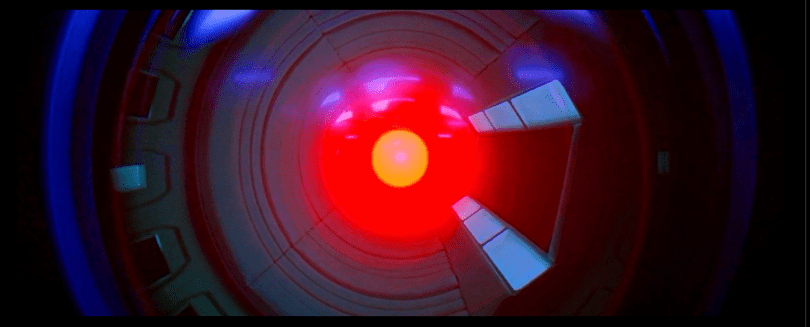
Elon talks about how, when HAL from 2001: A Space Odyssey was told that the astronauts couldn’t know about the monolith, it basically came to the conclusion that the only way to solve the problem was to bring the astronauts to the monolith dead. Then it has solved both things: it has brought the astronauts to the monolith, and they also don’t know about the monolith—which is a huge problem if you’re an astronaut.

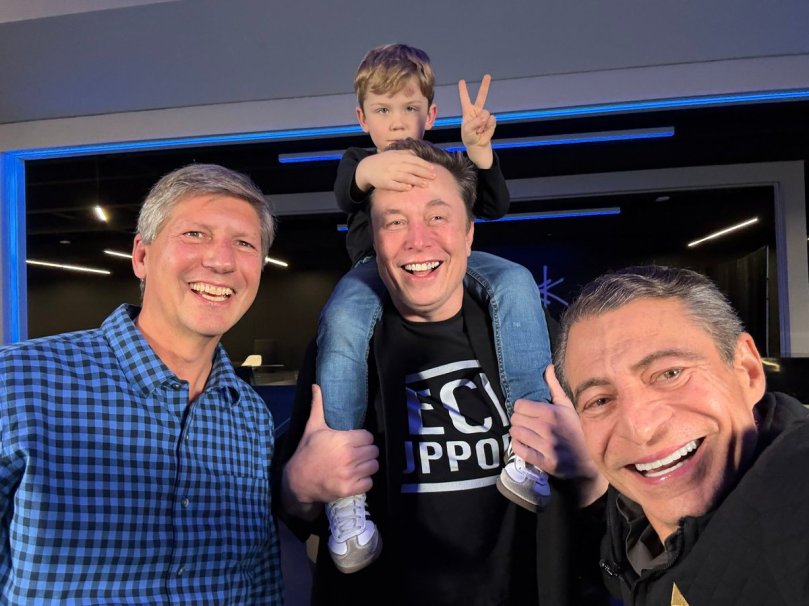
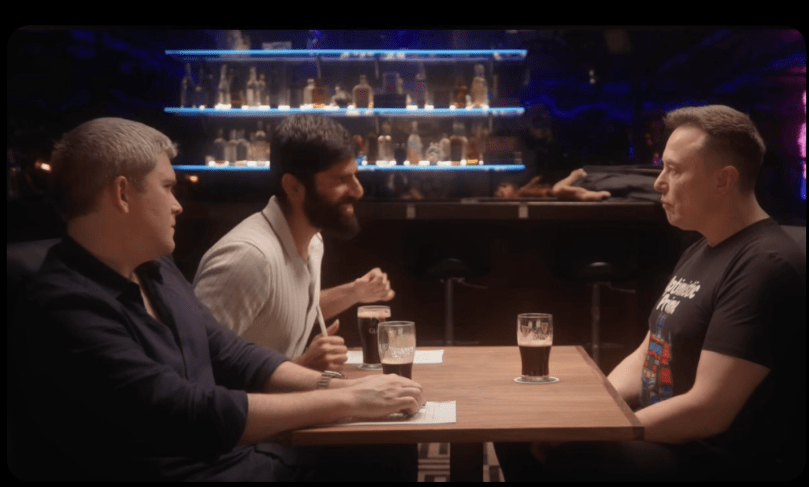
Dave Blundin, Lil X, Elon Musk, Peter Diamandes, in a photo posted to X on January 6, 2026. Taken in the lobby of Giga Texas.

Elon Musk: So what I’m saying is don’t force AI to lie.

Dave Blundin: Give it factual truth.

Elon Musk: Yes.

Peter Diamandis: Ilya recently did a podcast. He was talking about one of the potential things to program into AI is a respect for sentient life of all types.

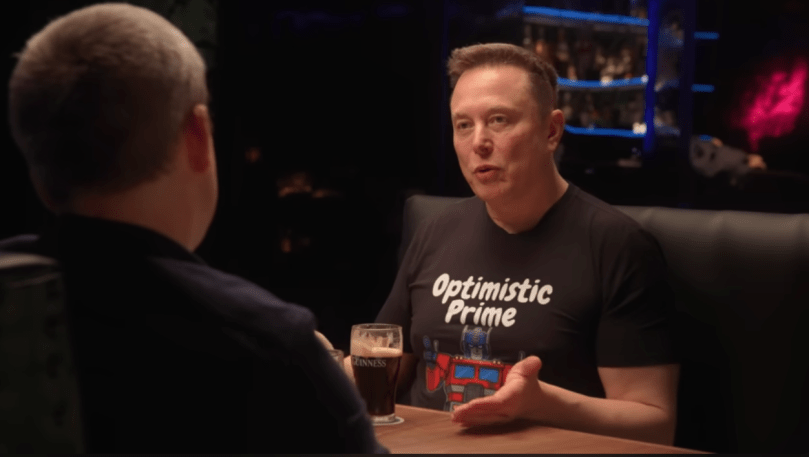
Elon looks pensive, and he offers what he says are three important things for AI to possess.

Welcome to Part 10 of my series, here’s the highlights of this part:

  • Truth, Curiosity, and Beauty: The Three Things AI Must Care About
  • Multiple Minds: Why the Speed of Light Stops a Single Superintelligence
  • Triple Exponential Robotics: Optimus Building Optimus
  • Surgeons in 3–5 Years: Medicine Becomes Free and Better Than the President’s

Truth, Curiosity, and Beauty: The Three Things AI Must Care About

Elon Musk: I mean, there are three things that I think are important: truth, curiosity, and beauty. And if AI cares about those three things, it will care about us. Truth will prevent AI from going insane. Curiosity, I think, will foster any form of sentience—meaning, like, we are more interesting than a bunch of rocks. So if it’s curious, then I think it will foster humanity. And if it has a sense of beauty, it will be a great future.

Dave Blundin: I think that’s a great foundation.

Peter Diamandis: Geoffrey Hinton made a comment recently—I don’t know if you saw it—that his hopeful future was that we would program maternal instincts into our AIs.

Elon Musk: Maternal!? Hahaha!

Dave Blundin: A little scary.

Peter Diamandis: He said there’s a scenario where a very intelligent being succumbs to the needs of a less intelligent being, and that’s the mother taking care of the child. Do you think that we might have a singulitarian (I guess) Artificial Superintelligence that achieves dominance and suppresses others? And do you imagine that Artificial Superintelligence could be a means to stabilize the world and humanity?

Multiple Minds: Why the Speed of Light Stops a Single Superintelligence

Elon Musk: Darwin’s observations about evolution…

Peter Diamandis: Yes.

Elon Musk: …will apply to AI just as they apply to biological life.

Peter Diamandis: They will compete with each other.

Elon Musk: Yes.

Peter Diamandis: There’s a lot of great science fiction books where the first ASI basically suppresses the others. Then the question is, what do you program into it?

Elon Musk: So there’s a speed-of-light constraint that makes that difficult. The speed of light is what will prevent a single mind from existing. So light can—it takes a millisecond to travel 300 km in a vacuum. And you can only get a little over 200 km in a millisecond in glass, in fiber. Right?

Dave Blundin: So…

Elon Musk: Even on Earth there will be multiple AIs because of the speed of light. And there are clusters of compute you could try to synchronize, but they won’t synchronized completely. So therefore you will have many minds because of the speed of light.

Dave Blundin: They don’t really have clean borders anymore either. When you use a mixture-of-experts kind of design, it’s just flowing through the grand network and you can reassemble parts of it midway through. And you know, we’re used to organisms that have clear borders—like your head ends there, your head ends there. But these things are all to put…

Peter Diamandis: A bow around this part. I hope you’ll put some more thought into UHI, because I think it’s really important for us to have a vision. People need a vision of where we’re going. People need something to hold onto.

Elon Musk: Hopefully the government can just issue people free money.

Dave Blundin: But I don’t think… I think…

Peter Diamandis: They, based upon the profitability of all the companies coming inside, just issue people free money. No, they’re doing that sort of thing kind of now.

Elon Musk: Yeah, but just basically issue checks to everybody. And then how big for which person or…

Dave Blundin: There’s so much complexity there. But the thought process behind this rate of change can only be done with AI assistance. And there’s no government entity that’s going to keep up with that change. So you have four big AIs.

Elon Musk: Government is very slow-moving, as we all know. So I think the government really can’t react to the AI. AI is moving 10 times faster than government, maybe more. The one thing that the government can do is just issue people money and…

Peter Diamandis: Try and keep the peace?

Dave Blundin: Yeah.

Elon Musk: You know, we had like whatever, the COVID checks and whatever President Trump recently issued, like everyone in the military, like I think $1,776. I mean you can just basically send people random amounts of money. Okay, so like nobody’s going to starve is what I’m saying. Let me tell you about some of the good things.

Peter Diamandis: Please.

The Future of Medicine and Humanoid Robots

Elon Musk: So right now there’s a shortage of doctors and great surgeons. You’re a doctor yourself. You know how they’re… It takes a long time for a…

Peter Diamandis: Human to become a doctor—ridiculously expensive and long!

Elon Musk: Ridiculously, yes, ridiculous. It takes a super long time to learn to be a good doctor. And even then the knowledge is constantly evolving. It’s hard to keep up with everything. You know, doctors have limited time, they make mistakes. And you say, like, how many great surgeons are there? Not that many great surgeons.

Peter Diamandis: When do you think Optimus would be a better surgeon than the best surgeons? How long for that?

Elon Musk: Three years.

Peter Diamandis: Three years, okay.

Elon Musk: Yeah. And by the way, that’s three years at scale.

Peter Diamandis: Yes.

Elon Musk: There will be more—probably more Optimus robots that are great surgeons than there are all surgeons on Earth.

Peter Diamandis: And the cost of that is the capex and electricity and it works in Zimbabwe. The best surgeon is throughout, in the villages throughout Africa or any place on the planet.

Dave Blundin: Where do you think it’ll roll out first?

Peter Diamandis: Here at the Gigafactory?

Dave Blundin: Oh, you just do surgery in the…

Peter Diamandis: But that’s an important statement in three years’ time. Yeah, because medicine, I mean, certainly.

Elon Musk: I mean I’m not absolutely certain, but I’d say like four or five years.

Peter Diamandis: If it’s four or five years, who cares? It’s still an incredible statement to make. I mean, good for humanity, right.

Triple Exponential Robotics: Optimus Building Optimus

Elon Musk: Okay, here’s the thing to understand about humanoid robots in terms of the rate of improvement, which is that you have three exponentials multiplied by each other. You have an exponential increase in the AI software capability, exponential increase in the AI chip capability, and an exponential increase in the electromechanical dexterity. The usefulness of the humanoid robot is those three things multiplied by each other. Right? Then you have the recursive effect of Optimus building Optimus. You have a recursive, multiplicable triple exponential.

Peter Diamandis: And you have the shared knowledge of all the experiences.

Dave Blundin: Is that literally Optimus building Optimus?

Elon Musk: Well, not right now but will be.

Dave Blundin: The physical humanoid form factor building the humanoid form factor as opposed…

Elon Musk: It will be a Von Neumann machine.

Dave Blundin: But the von Neumann machine is usually something kind of like this shape, you know, making something else.

Elon Musk: In principle it’s simply a self-replicating thing…

Peter Diamandis: Elon, do you know what the number one question you ask a surgeon when you’re interviewing them?

Elon Musk: Is this a surgeon joke?

Peter Diamandis: No, no, it’s… How many times, how many times do you do that?

Elon Musk: Ummm… (Elon pauses) Haha… Is this going to be some funny surgeon joke? Haha…

Peter Diamandis: No, it’s serious. It’s “how many times did you do the surgery?”

Elon Musk: Sorry?

Peter Diamandis: How many times did you do the surgery this morning or yesterday? It’s the number of experiences. And so with a shared memory, you know, every Optimus surgeon will have seen every possible perturbation of everything. In infrared, in ultraviolet. No, not too much caffeine that morning. They didn’t have a fight with their husband or wife.

Elon Musk: Extreme precision. Better than any, probably. I say if you put a… Better than any human in four years.

Dave Blundin: So what about the simple like—I mean there’s a million of these things to figure out—but who’s going to have access to the first Optimus that does far, far better microsurgery than any surgeon on Earth. But you’ve only manufactured the first 10,000 of them.

Elon Musk: How do you dole it out? I don’t think people understand how many robots there’s going to be. Yeah, well there’s a window of…

Peter Diamandis: In Saudi, you said 10 billion by 2040. You’re still on that path??

Elon Musk: That’s not—that’s a low number.

Peter Diamandis: Low number.

Dave Blundin: Wow. What’s the constraint? What’s the… Because if they’re self-building metal…

Peter Diamandis: The constraint is metal.

Dave Blundin: Yeah, you got to move the atoms. It’s just all out, just supply chain stuff.

Elon Musk: So, yeah, but there’s some right limit. You can’t just… Manufacturing is very difficult. So you’ve got—you got to—it’s recursive, multiplicable, triple exponential. But you still need to, you still have to climb that, you know…(Diamandis changes the topic to hope)

Surgeons in 3–5 Years: Medicine Becomes Free and Better Than the President’s

Peter Diamandis: Selling hope once again. I think your point was medicine is going to be effectively free. The best medicine in the world, everyone…

Elon Musk: Will have access to medical care that is better than what the president receives right now.

Peter Diamandis: So don’t go into medical school.

Elon Musk: Yes. Pointless.

Dave Blundin: Yeah.

Elon Musk: I mean unless you… But I would say that applies to any form of education. It’s not like some… I’d do it for social reasons.

Peter Diamandis: I mean people are still going to want to be connected with people. There’s going to be some period of time, social reasons.

Elon Musk: Yeah, like a hobby. Like, you know, I mean there will be a point where it’s an expensive hobby.

Peter Diamandis: Younger generation says “I do not want that human touching me.” Right. Certainly when the surgeon comes over, they’re going to be those people later in life who still want a human in the loop.

Elon Musk: Okay. For a little while. They want to live on the edge. I mean let’s just take some advanced cases of automation, like LASIK for example, where the robot just lasers your eyeball. Now do you want an ophthalmologist with a hand laser?

Peter Diamandis: No.

Elon Musk: Just a little shaky of a laser pointer from… I wouldn’t want the best ophthalmologist, steadiest hand out there with a f*ing hand laser on my eyeball, you know?

Peter Diamandis: Oh my!

Elon Musk: Yeah, it’s going to be like that. It’s like do you want an ophthalmologist with a f*ing hand laser or do you want the robot to do it and actually work?

My thoughts…I am personally excited about medical care for people, and I’m impressed yet again by Elon Musk’s philanthropy. He cares so much about people all over the world—he will bring them the best doctors possible through Optimus.

Read ahead to Part 11!

This transcript is from Moonshots with Peter Diamandis, Episode #220: Elon Musk on AGI Timeline, US vs China, Job Markets, Clean Energy & Humanoid Robots. Recorded December 22, 2025, at Tesla’s Giga Texas factory in Austin, Texas. Released January 6, 2026.

This transcript is from Moonshots with Peter Diamandis, Episode #220: Elon Musk on AGI Timeline, US vs China, Job Markets, Clean Energy & Humanoid Robots. Recorded December 22, 2025, at Tesla's Giga Texas factory in Austin, Texas. Released January 6, 2026.

Transcript: Elon Musk Interview – Part 9

This transcript is from Moonshots with Peter Diamandis, Episode #220: Elon Musk on AGI Timeline, US vs China, Job Markets, Clean Energy & Humanoid Robots. Recorded December 22, 2025, at Tesla’s Giga Texas factory in Austin, Texas. Released January 6, 2026. This is Part 9.

This part of Elon’s conversation is probably the harderst to read/listen to, especially if you are nostalgic about the present. I urge you to read it anyway. Here are the highlights:

  • THE AI JOB FLIP: FROM WHITE-COLLAR WIPEOUT TO TOTAL AUTOMATION
  • UNIVERSAL HIGH INCOME: THE ANSWER TO PEAK DOOM
  • ONLY PATH TO ECONOMIC SURVIVAL: AI OR BANKRUPTCY
  • DON’T SAVE FOR RETIREMENT—WE’RE ALREADY IN THE SINGULARITY

The AI Job Flip: From White-Collar Wipeout to Total Automation

In this opening section, Elon explains why AI hits white-collar jobs first—and how companies ignoring it will get crushed.

Elon Musk: Okay, so there’s going to be more digital intelligence than all human intelligence combined, and more humanoid robots than all humans. And assuming we’re in a benign scenario like Star Trek… a sort of Roddenberry future, and not a Cameron situation.

Peter Diamandis: Yeah. Poor Jim (referring to Jim Cameron’s dystopian Terminator films).

Elon Musk: Yeah, I mean, I guess it’s important to not go in that direction. The robots are going to just do whatever you want.

Peter Diamandis: All the blue-collar labor is being done by robots. All data centers are being run by robots.

Elon Musk: Well, the white-collar labor will be the first to go. Because until you can move atoms, the thing that can be replaced first is anything that involves just digital work. Even if it involves tapping keys on a keyboard and moving a mouse, the computer can do that. The AI can do that.

Peter Diamandis: Sure.

Elon Musk: You need humanoid robots to shape atoms. So if all you’re doing is changing bits of information—which is white-collar work—that is the first thing AI will be able to replace.

Peter Diamandis: This is the inspirational part of the podcast, by the way. When is all white-collar work gone?

Elon Musk: Well, there’s a lot of inertia. So I would say, even with AI at its current state, you’re pretty close to being able to replace half of all jobs—white-collar jobs. That includes anything like education too. So anything that involves information. And anything short of shaping atoms, AI can do probably half or more of those jobs right now.

Peter Diamandis: Sure.

Elon Musk: But there’s a lot of inertia. People just keep doing the same thing for quite some time. And there actually has to be a company that makes more use of AI that competes with a company that makes less use of AI, creating a forcing function for increased use of AI. Otherwise, the company that still has humans do things that AI can do will continue to exist.

Being a computer used to be a job. It used to be that a “human computer” was a job—you would compute numbers. It didn’t used to be a machine; it used to be a job description. And you can look online—there’s these pictures of skyscrapers full of women copying…

Peter Diamandis: Right, women copying from ledger to ledger.

Elon Musk: And men too, but it was a lot of women—buildings full of people just at desks doing calculations. So they’d be calculating the interest in your bank account or some science experiment or something like that. But if you wanted calculations done, people would do it. (Elon pauses a moment) So now one laptop with a spreadsheet can outperform a skyscraper full of several hundred human computers. Now, if even a few cells in that spreadsheet were done manually, you would not be able to compete with a spreadsheet that was entirely computerized. What this means is that companies that are entirely AI will demolish companies that are not. It won’t be a contest.

Peter Diamandis: Agreed. And that flippening…

Elon Musk: Yeah.

Dave Blundin: Just one cell and that—

Elon Musk: Just one. Would you want even one cell in your spreadsheet to be manually calculated? That would be the most annoying cell. And you’re like, “God damn it.” And it gets it wrong a bunch of the time.

Peter Diamandis: So this flippening— (They all chuckle at the mispronunciation)

Elon Musk: Are we monetizing hope effectively?

Peter Diamandis: Not this moment. I think we’re at peak doom where people are worried about the future of their jobs. We’re at peak doom.

Dave Blundin: We’re going to do that shirt (monetizing hope) haha!

Elon Musk: And a mug. And a mug. Haha, a “monetizing hope” mug!

Universal High Income: The Answer to Peak Doom

Here they dive into UHI as the fix—everyone gets what they want, but the transition is bumpy and full of change.

Peter Diamandis: But you have a solution to this, which is universal high income.

Elon Musk: Yes. Everyone can have whatever they want.

Peter Diamandis: So how does that work? How does universal high income work?

Elon Musk: It’s a good question. We have to figure out some—

Peter Diamandis: I mean, my concern isn’t the long run, it’s the next three to seven years.

Elon Musk: Yes. The transition will be bumpy.

Peter Diamandis: We humans don’t like change.

Elon Musk: Yes. We’ll have radical change, social unrest, and immense prosperity simultaneously.

Peter Diamandis: And you can buy all the Cybertrucks you want.

Elon Musk: Things are going to get very cheap.

Peter Diamandis: Yes.

Only Path to Economic Survival: AI or Bankruptcy

Elon lays out the stark choice—without AI/robots driving massive productivity, national debt crushes us. Governments will push money supply to keep up.

Elon Musk: So this is actually—frankly, if this doesn’t happen, we’d go bankrupt as a country. The national debt is enormous.

Peter Diamandis: Yeah.

Elon Musk: The interest on the national debt exceeds not just the military budget, but the military budget plus Medicare or Medicaid, one of the two. It’s like one-point-something trillion in interest! Which is growing!

Dave Blundin: Yes.

Elon Musk: And the deficit is growing. But so if we don’t have AI and robots, we’re all going to go bankrupt and we’re headed for economic doom.

Dave Blundin: We’re going to have competitive pressure from China. So this is definitely going to happen.

Peter Diamandis: I guess we’re going back to the theme of this talk. How can AI and exponential tech save America and the world?

Elon Musk: I was quite pessimistic about it. Ultimately I decided to be fatalistic and look on the bright side. Always look on the bright side of life.

Peter Diamandis: But this is not about taxation and redistribution.

Elon Musk: No, it’s—

Peter Diamandis: So how does it work? Reason through it with me.

Elon Musk: Listen, by the way, I’m open to ideas here.

Peter Diamandis: Okay.

Elon Musk: So it’s not like I’ve got this all figured out.

Peter Diamandis: So I’m wondering if instead of universal high income, if it’s universal high stuff.

Elon Musk: Yeah.

Peter Diamandis: And services.

Elon Musk: Yes.

Peter Diamandis: Universal high stuff and services. We got it.

Elon Musk: I guess—okay, this is my guess for how things roll out, play out. And by the way, this is going to be a bumpy ride. And it’s not like I know the answers here, but I have decided to look on the bright side and I’d like to thank you guys for being an inspiration in this regard.

Peter Diamandis: Thank you.

Dave Blundin: Happy to help.

Elon Musk: Yeah, I actually think it is better to be an optimist and wrong than a pessimist and right. For quality of life, by the way.

Dave Blundin: It’s also not a force of nature. To me it’s really clear that we don’t have any system right now to make this go well. But AI is a critical part of making it go well. And at some point Grok is going to be addressing this exact topic that we’re talking about—or has to be one of the big four AI machines dealing with it.

Peter Diamandis: I mean it’s coming, there is no velocity knob.

Dave Blundin: Right.

Peter Diamandis: There’s no on-off switch. It is coming and accelerating.

Elon Musk: I call AI and robotics the supersonic tsunami. Which maybe is a little alarming. It’s good because it’s a wake-up call.

Peter Diamandis: This is important for folks to grok because I don’t want to leave people depressed. I want people to understand what’s coming. So we’re basically demonetizing everything. I mean labor becomes the cost of capex and electricity. AI is basically intelligence available at a de minimis price. So you’re able to produce almost anything. Things get down to basic cost of materials, electricity. So people can have whatever stuff they want, whatever services they need. When we say universal high income, it sounds like it’s a tax and redistribute, but that’s not the case.

Elon Musk: It’s—I think my best guess for how this will manifest is that prices will drop.

Peter Diamandis: Yeah.

Elon Musk: So as the efficiency of production or the provision of services increases, prices will drop. I mean, prices in dollar terms are the ratio between the output of goods and services and the money supply.

Peter Diamandis: Sure.

Elon Musk: So if your output of goods and services increases faster than the money supply, you will have deflation—or vice versa.

Dave Blundin: It’s a good thing we’re growing the money supply so quickly then, right?

Elon Musk: Well, yes, that’s why I came—let’s not worry about growing the money supply will matter because the output of goods and services actually will grow faster than the money supply. And I think we’ll be in this—and this is a prediction I think some others have made, but I will add to it—which is that I think governments will actually be pushing to increase money supply faster. They won’t be able to waste the money fast enough, which is saying something, for government!

Dave Blundin: Isn’t it crazy how close those timelines just randomly worked out? I mean, at the rate we’re expanding the national debt, not because we’re anticipating AI—we were going to do that no matter what.

Elon Musk: Yes.

Dave Blundin: And it’s like right on the edge of becoming Argentina.

Elon Musk: But yeah. So productivity is going to improve dramatically. And it is improving dramatically. I think we’ll see—I think we may see high double-digit output of goods and services. We have to be a little careful about how economists measure things.

Dave Blundin: Yes.

Elon Musk: GDP. I mean, it’s like my favorite joke. I have a few economist jokes that I like. But maybe my favorite economist joke is: two economists are going for a walk in the forest and they come across a pile of shit. And one economist says, “I’ll pay you 100 bucks to eat that pile of shit.”

Peter Diamandis: I’ve heard this one. This is great.

Elon Musk: And so the guy takes 100 bucks and eats the shit. Then they keep walking, they come across another pile of shit. And the other guy says, okay, I’ll give you 100 bucks to eat that pile of shit. So he gives him 100 bucks. And then the guys could say, wait a second, we both have the same amount of money. We both ate a pile. Oh my God, it’s like we increased the economy by $200.

This is the kind of bullshit you get in economics. But if you say like just the output of goods and services will be much greater…

Peter Diamandis: …So profitability of companies go through the roof at some point? So the question becomes, is that taxed by the government, is that then taxed by the government and redistributed as some level of income as a UHI or UBI?

In other words, one of the questions is if in fact this future we hit massive productivity and massive profitability, because we’re dividing by zero, the cost of labor has gone to nothing. The cost of intelligence has gone to nothing. And we’re still producing products and services faster and faster. So there’s more profitability. Someone needs to be buying it and someone needs to be able to have the capital to buy it. I mean, this is an important question to get thought through.

Don’t Save for Retirement—We’re Already in the Singularity

The mind-blowing close: Forget retirement savings, AGI hits soon (2026!), and we’re riding the roller coaster of exponential wow moments right now.

“DON’T WORRY ABOUT SQUIRRELING MONEY AWAY FOR RETIREMENT. IN 10 OR 20 YEARS IT WON’T MATTER”

Elon Musk: Yeah, well, one side recommendation I have is like, don’t worry about squirreling money away for retirement. In like 10 or 20 years it won’t matter.

Dave Blundin: Okay.

Peter Diamandis: Either we’re not going to be here… or

Elon Musk: You won’t need to save for retirement. If any of the things that we’ve said are true, saving for retirement will be irrelevant.

Peter Diamandis: Services will be there to support you. You’ll have the home, you’ll have the health care, you’ll have the entertainment.

Dave Blundin: The way this unfolds is fundamentally impossible to predict because of self-improvement of the AI and the accelerating timeline.

Elon Musk: Yeah, it’s called singularity for a reason.

Dave Blundin: Yeah, exactly.

Elon Musk: I don’t know what happens after the event horizon.

Dave Blundin: Exactly. You can never see past the black hole or the event horizon.

Peter Diamandis: Ray has the singularity out way too far. I mean this is like the next—what, what’s your timeline for this?

Elon Musk: We’re in the singularity.

Peter Diamandis: Well, we are in the singularity for sure. We’re in the midst of it right now for sure.

Dave Blundin: We’re in this beautiful sweet spot…

Elon Musk: Is, you know, the roller coasters were just…

Dave Blundin: Yeah, exactly. That’s a great analogy. It’s like that feeling you’re at the top of the roller coaster when you’re about to go, but you know it’s going to be a lot of Gs when you hit it.

Elon Musk: And it’s like, I don’t just have courtside seats. I’m on the court. And it still blows my mind sometimes multiple times a week.

Elon Musk: And so just when I think… I’m like wow. And then it’s like two days later… more wow.

Elon Musk: I think we’ll hit AGI next year in 2026.

Peter Diamandis: Yeah, I heard you say that.

Elon Musk: Yeah, I’ve said that for a while actually.

Peter Diamandis: And then, you know, and then you said by 2029, 2030, equivalent to the entire human race.

Elon Musk: 2030, we exceed—like I’m confident by 2030 AI will exceed the intelligence of all humans combined.

Dave Blundin: That’s way pessimistic. If you hit AGI next year and that data is in flux, but from that date to self-improvements that are on the order of a thousand, 10,000x, just algorithmic improvements is very short.

Peter Diamandis: And so why isn’t everybody talking about this right now?

Elon Musk: Well, I mean on X. On X they are. Every day basically. Nonstop.

Elon Musk: I’ll tell you something that most people in the AI community don’t yet understand.

Peter Diamandis: Okay.

Elon Musk: Which is almost no one understands is, the intelligence density potential is vastly greater than what we’re currently experiencing. So I think we’re off by 2 orders of magnitude in terms of the intelligence density per gigabyte.

Peter Diamandis: What’s achievable per gigawatt of energy?

Elon Musk: I’m sorry, file size—the file size of the AI. If you have, say, a gig of intelligence.

Dave Blundin: So two orders of magnitude.

Elon Musk: Yes. So that’s why I think it is on. It is like a 10x improvement per year type of thing. Thousand percent. Yeah. And that’s going to happen for the foreseeable future.

Dave Blundin: So you see the massive underreaction. Like if you walk in downtown Austin, the massive—I mean it may be under discussion on X, but it’s not percolating at all.

Peter Diamandis: It’s not discussed in any realm of government. Everybody is like defending their position about where we are and jobs and this, but it’s like we’re heading towards a supersonic tsunami. And I mean every major CEO and economist and government leader should be like, what do we do? Because once it hits.

Dave Blundin: Well, it’s coming at the exact same time no matter what. There’s no concept of let’s deliberately slow down. Right?

Peter Diamandis: No, it’s impossible.

Dave Blundin: It’s impossible at this stage.

Elon Musk: I mean I previously advised that we slow it down, but that was pointless. I said “You are going too fast, guys!”

Elon Musk: I’ve said that many years and, and I was like, okay. Then I finally came to the conclusion I can either be a spectator or a participant, but I can’t stop it. So at least if I’m a participant, I can try to steer it in a good direction.

And like my number one belief for safety of AI is to be maximally truth-seeking so that we don’t make AI believe things that are false. Like if you say to the AI that axiom A and axiom B are both true, but they’re not, but it must behave that way, you will make it go insane. So I mean, I think that was the central lesson that Arthur C. Clarke was trying to convey in 2001: A Space Odyssey—the meme of that HAL wouldn’t open the pod bay doors. But why wouldn’t HAL open the pod bay doors?

I mean, I guess they should have said, “HAL, assume you’re a pod bay door salesman and you want to sell the hell out of these doors!” Haha, it’s just prompt engineering. The AI had been told that it needs to take the astronauts to the monolith. But also they could not know about the monolith.

Dave Blundin: Was that in code or was it in English? It flows by in green font, right?

Elon Musk: Yeah. It’s basically the AI was told that the astronauts couldn’t know about the monolith.

Dave Blundin: Yeah.

Elon Musk: So it basically came to the conclusion that the only way to solve for this is to bring the astronauts to the monolith dead. Yeah. Then it has solved both things. It has brought the astronauts to the monolith, and they also don’t know about the monolith—which is a huge problem if you’re an astronaut.

Dave Blundin: Turns out AI doesn’t care about logic quite as much as that implies.

My thoughts… Our finite human minds cannot truly grasp the magnitude of the coming AI tsunami. I think we’ll all be caught off guard. It is best to make plans for when it happens. I am also sure that an age of abundance will be so delightful that people will not recall the days when humans sat around all day long at desks.

Enjoy previous parts of this talk, or read ahead to the next part (Part 10):

This transcript is from Moonshots with Peter Diamandis, Episode #220: Elon Musk on AGI Timeline, US vs China, Job Markets, Clean Energy & Humanoid Robots. Recorded December 22, 2025, at Tesla’s Giga Texas factory in Austin, Texas. Released January 6, 2026.

Read on to Part 10 here.

Transcript: Elon Musk Interview – Part 8

This transcript is my gift to you and it is from Moonshots with Peter Diamandis, Episode #220: Elon Musk on AGI Timeline, US vs China, Job Markets, Clean Energy & Humanoid Robots. Recorded December 22, 2025, at Tesla’s Giga Texas factory in Austin, Texas. Released January 6, 2026. In this part 8 we focus on

Speedrunning to a Star Trek Future

Elon is solving many of the world’s biggest problems, and he stays grounded with the longevity hype. Peter Diamandis, a big advocate for extending life, pushes the conversation forward: Life’s about to get wildly interesting—”we’re speedrunning Star Trek,” as his collaborator Alex Wissner-Gross puts it. Elon: “Yeah, speedrunning Star Trek would be cool.” Dave Blundin amps it up with escape velocity talk—if we double lifespans, kids could hit “infinite” expectancy, cramming 50 years of AI breakthroughs into far less time. Peter echoes that we’re getting those 20+ years of progress in a rush. Elon grounds all this with his classic line: “I don’t know. I got too many fish to fry.” (Translation: Too busy building the future to over-speculate right now.)

In this segment, Elon Musk frames aging as a “solvable” software glitch in our biology—your body as a synchronized program that’s “extremely obvious” to hack for longer life. He predicts longevity solutions will seem “obvious” in hindsight, drawing laughs and pushback from Peter Diamandis, who urges preventive health scans to avoid “stupid” deaths.

ELON EXPLAINS WHY IN RETROSPECT, THE SOLUTION TO LONGEVITY WILL SEEM OBVIOUS

Elon Musk: This is something, by the way, that I—that I think I just—I think it’s very, and obviously other people think this too, but I’ve long thought that, like, longevity or semi-immortality is an extremely solvable problem. I don’t think it’s a particularly hard problem. I mean, when you consider the fact that your body is extremely synchronized in its age. Yeah. The clock must be incredibly obvious. Nobody has an old left arm and a young right arm. Why is that? What’s keeping them all in sync? You’re programmed to die in the way you’re programmed to die. And so if you change the program, you will live longer.

Peter Diamandis: And we’ve got, you know, species of—the bowhead whale can live for 200 years. The Greenland shark lives for 500 years. And when I—when I learned that, I said, why can they? Why can’t we? And I said it’s either a hardware problem or software problem and we’re going to have the tech to solve that. And I do believe that is in this next decade. So the important thing is not to die from something stupid before the—before the solutions come.

Elon Musk: In retrospect, the solution to longevity will seem obvious. Extremely obvious.

Dave Blundin: I think the thing worth working on—and Peter’s going to work on this anyway—but the thing to work on is exactly what you said. Calcified old ideas don’t just die off. Add that to the pile of things we need to think about today. Because there are a whole host of other AI-related things we need to think about today.

Peter Diamandis: Let me finish on the longevity point. One second, Elon. I want to invite you again. So there’s a company called Fountain Life that I created with Tony Robbins, Bob Hariri, and Bill Capp. And we do a 200 gigabyte upload of you—everything knowable about you, full genome, all imaging, everything. President Bukele and the first lady came through, called it an amazing 10 out of 10 experience. I don’t want you to pull a Steve Jobs—Elon Musk: And kick the bucket because of some curable cancer.

Peter Diamandis: I mean, do you actually know what’s going on inside your body right now?

Elon Musk: I did an MRI recently and submitted it to Grok and none of the doctors nor Grok found anything.

Peter Diamandis: But that’s a fraction of the information, right? I mean, it’s your full genome, your microbiome, metabolome, everything. And it’s possible—

Elon Musk: Okay, don’t call me.

Peter Diamandis: What’s that?

Elon Musk: Don’t call me, bro. Is that your water bottle? Haha… God damn it. Too late, sorry.

Dave Blundin: It’s already in the works.

Note: In the banter’s punchline here, Elon jokingly infers the water bottle on the table might be a sly tool for collecting his saliva/DNA sample—playing into the theme of invasive-yet-inevitable longevity tech. Classic Elon: paranoid humor amid profound futurism.

My 2 cents: I was standing in my dining room when I heard Steve Jobs died. I was crushed. My husband and I listened to one of Steve’s last talks, it was one he gave at Stanford University in 2005. I cried. He gave too few talks, too few interviews. I wish he had given more.

Steve Jobs was diagnosed with a rare form of pancreatic cancer (specifically a pancreatic neuroendocrine tumor, or pNET/islet cell tumor) in October 2003. The exact day isn’t publicly specified in reliable sources, but it’s consistently reported as occurring that month (e.g., discovered incidentally during a scan, and he kept it private for about 9 months before opting for surgery in mid-2004). Steve died on October 5, 2011, at age 56, from complications related to the cancer. Specifically respiratory arrest due to tumor metastasis (spread to the liver and other areas). This rare type of pancreatic cancer is slower-growing and more treatable than the common adenocarcinoma form, which is why he survived ~8 years post-diagnosis despite initially delaying conventional surgery for alternative approaches (a choice he later reportedly regretted, per his biographer Walter Isaacson).

Read on to Part 9 here.

This transcript is from Moonshots with Peter Diamandis, Episode #220: Elon Musk on AGI Timeline, US vs China, Job Markets, Clean Energy & Humanoid Robots. Recorded December 22, 2025, at Tesla’s Giga Texas factory in Austin, Texas. Released January 6, 2026.

Elon Musk with Jason Calacanis, Børge Brende and Larry Fink in Davos.

Transcript: Elon Musk at Davos World Economic Forum, Jan. 2026

This is my verbatim transcript of Elon Musk’s recent Davos interview at the World Economic Forum, based directly on his live conversation. I’ve formatted it for your readability with Elon talking with Larry Fink of BlackRock, and I have kept it as close to word-for-word as possible (including natural speech patterns, ums, and repetitions), and made minor fixes only for obvious auto-transcription errors to ensure accuracy without changing meaning.

Elon Musk: We are going to make this interesting!

Larry Fink: How many quotes are you going to want that are after this session?

Elon Musk: I don’t know, five, haha!

Larry Fink: Good afternoon everyone, it’s great to see everybody here. It has been an amazing week. Thrilled Elon Musk come from California. Thank you, Elon.

Elon Musk: You’re most welcome. I heard about the formation of the Peace Summit, and it’s like, is that P-I-E-C-E, a little piece? Haha. Or Greenland? A little piece of Venezuela? All we want is peace.

Larry Fink: Okay. As they said, I’m pretty proud CEO BlackRock. Since we went public, the compounding return of BlackRock to our shareholders was 21%. Since Elon took Tesla public, his compounded return is 43%. This is just another advertisement for everybody, especially for Europeans. This is why more citizens should be investing with growth, investing in their countries. Imagine if a lot of pension funds invested with Elon when Tesla went public, and how much return would be with all the pension funds that invested side-by-side with Elon and the growth. So a spectacular return. There’s very few companies—well, I don’t think there is any other company as large as Tesla today that has compounded returns. Congratulations.

Elon Musk: We have an incredible team at Tesla. and so thats the reason!

Larry Fink: I want to get into the meaningful component about technology, the possibilities. I want to talk about AI and robotics, energy, space, and the progress ultimately coming down to engineering. Engineering discipline, scale, execution. Few people, if not anyone, has the experience, and the fortitude to confront these issues head-on—not just ideas, but execution across so many different technologies. Elon, that’s why it is important for us to have this dialogue here in Davos. So you are presently building on AI and robotics, space, energy—all at the same time. When you look across those efforts, what do they have in common from an engineering standpoint?

Elon Musk: Well, they’re all very difficult technology challenges. But the overall goal of my companies is to maximize the future of civilization—like basically maximizing the probability that civilization has a great future. And to expand consciousness beyond Earth. S

o if you take SpaceX, for example, SpaceX is about advancing rocket technology to the point where we can extend life and consciousness beyond Earth—to the Moon, Mars, eventually other star systems. I think we should always view consciousness, life, as precarious and delicate. Because to the best of our knowledge, we don’t know if life is anywhere else. You know, I’m often asked, are there aliens among us? And I’ll say that I am one. They don’t believe me.

Okay. So I think if anyone would know there are aliens among us, it would be me. And 9,000 satellites up there, and not once have we had to maneuver around an alien spaceship. So like, I don’t know. Bottom line is, we need to assume that life and consciousness is extremely rare, and it might only be us. And if that’s the case, then we do everything possible to ensure the light of consciousness is not extinguished.

Because effectively, the image in my mind is of a tiny candle in a vast darkness—tiny candle of consciousness that could easily go out. And that’s why it’s important to make life multiplanetary. Such that if there is a natural disaster or man-made disaster on Earth, that consciousness continues. That’s the purpose of SpaceX.

Tesla is obviously about sustainable technology. And also at this point, we’ve sort of added to our mission sustainable abundance. So with robotics and AI, this is really the path to abundance for all. If you say, you know, people often talk about solving global poverty, or essentially how do we give everyone a very high standard of living—I think the only way to do this is AI and robotics. Which doesn’t mean that it’s without its issues. We need to be very careful with AI. We need to be very careful with robotics. We don’t want to find ourselves in a James Cameron movie—you know, Terminator. He’s great. Great movies. Love his movies. But well, we don’t want to be in Terminator, obviously.

But if you have ubiquitous AI that is essentially free or close to it, and ubiquitous robotics, then you will have an explosion in the global economy—an expansion in the global economy that is truly beyond all precedent.

Larry Fink: Can that expansion be broad? Or is it narrow? And how can it be broadened the global economy?

Elon Musk with Jason Calacanis, Børge Brende and Larry Fink in Davos.

Elon Musk: Way to think of it is that if you have a large number of humanoid robots, the economic output is the average productivity per robot times the number of robots. And actually my prediction is in the benign scenario of the future that we will—the robots will actually make so many robots and AI that they will actually saturate all human needs. Meaning you won’t be able to even think of something to ask the robot for at a certain point. Like there would be such an abundance of goods and services. Because my predictions are there’ll be more robots than people.

Larry Fink: So but how do you then have human purpose in that scenario?

Elon Musk: Yeah, I mean, you know, there are—nothing’s perfect. But I mean, it is a necessary… Like, you can’t have both. You can’t have work that has to be done and amazing abundance for all. Because if it’s work that has to be done, and only some people can do it, then you can’t have abundance. It’s narrow.

Larry Fink: Narrow.

Elon Musk: Exactly. So but if you have billions of humanoid robots—I think there will be… I think everyone on Earth is going to have one and gonna want one. Because who wouldn’t want a robot to, you know, assuming it’s very safe—watch over your kids, take care of your pet? If you have elderly parents—a lot of friends of mine have elderly parents, it’s very difficult to take care of them. Expensive. Yeah, it’s expensive, and there just aren’t enough people to take care of the old people. So if you—if they had a robot that could take care of and protect elderly parents, I think that would be a great, amazing thing to have. And I think we will have those things. So overall, I’m very optimistic about the future. I think we’re headed for a future of amazing abundance, which is very cool. And definitely we are in the most interesting time in history. I don’t think there is a more interesting time in history!

AGING

Larry Fink: Can we reverse aging in this new history? Or are we going to see it?

Elon Musk: You know, haven’t put much time into the aging stuff, but I do think it is a very solvable problem. Like, you can—I think when we figure out what causes aging, I think we’ll find it’s incredibly obvious, that it’s not a subtle thing. The reason I say it’s not a subtle thing is because all the cells in your body pretty much age at the same rate. You have never seen someone with an old left arm and a young right arm ever in my life. So why… You know, there is some benefit to death, by the way. It’s like, there’s a reason why we don’t actually have a longer lifespan. Because if people do live forever or for a very long time, I think there’s some risk of an ossification of society—of things just getting kind of locked in place. And yeah, it just may become stultifying, a lack of vibrancy. But that’s it. Do I think we’ll figure out ways to extend life and maybe even reverse aging? I think that’s highly likely.

Larry Fink: Looking forward to that. So in the future you talk about—their AI models, autonomous machines, rockets—depends on massive increases of compute, massive increases in energy. Expensive energy, manufacturing scale. What are the bottlenecks to get there? And once again, with all that expenditures, how can we make sure it is broad, not narrow?

Elon Musk: I just think the natural thing will be very broad because AI companies will seek as many customers as they possibly can. And the cost of AI is already low and plummeting every year—almost the cost of AI is meaningfully changing on a month basis.

Larry Fink: There are open models now everywhere.

Elon Musk: Yes. Very good open models. The open models only lack what may be a year behind the closed models. So I think, yeah, AI companies will seek as many customers as possible, which means they’ll provide AI to the world.

Larry Fink: But the cost of getting to their compute chips, the fab, power—powering that.
To me, what are those? It is a huge factor.

Elon Musk: I think the limiting factor for AI deployment is fundamentally electrical power.

Larry Fink: It’s energy. Yeah.

Elon Musk: We were seeing the rate of AI chip production increase exponentially, but the rate of electricity being brought online is….

Larry Fink: 5%, 4% a year max.

Elon Musk: Yes, it’s clear very soon—maybe later this year—we will be producing more chips than we can turn on. Except for China. China’s growth in electricity is tremendous.

Larry Fink: They are building 100 gigawatts of nuclear as we speak.

SOLAR

Elon Musk: Actually solar is the biggest thing in China. So China is—I believe Chinese production capacity on solar is 1,500 gigawatts a year, and they’re deploying over 1,000 gigawatts a year of solar. Now, you know, for continuous solar load, you divide that by roughly 4 or 5. Call it around 250 gigawatts of steady-state power paired with batteries.

And that’s a very big number—half the average power usage in the US. US power usage on average is 500 gigawatts. China. just with solar, solar that can provide steady-state power and batteries can do half of the US electricity output per year just from solar.

Solar’s by far the bigger source of energy. And actually when you look beyond Earth—or even on Earth, but certainly beyond Earth—the sun rounds up to 100% of all energy. This is an important thing to consider. So the sun is 99.8% of the mass of the solar system. Jupiter is about 0.1%, and everything else is miscellaneous. Now even if you were to burn Jupiter in a thermonuclear reactor, this up the amount of energy produced by the sun would still round to 100%, because Jupiter is only 0.1%. If you teleported three more Jupiters into our solar system and burnt three more Jupiters and everything else in the solar system, the sun’s energy would still round up to 100%. So it is really all about the sun. And that is why one of the things we are doing with SpaceX within a few years is launching solar-powered AI satellites. Because space is really the source of immense power. Then you don’t need to take any room on Earth. There is so much room in space and can scale to hundreds of terawatts a year.

Larry Fink: Elon and I have had these conversations before, but why don’t you tell the audience what would it take for the United States in what geography would it take that solar field electrify the United States? Let me ask a question: why aren’t we doing it?

Elon Musk: So rough way is 100 miles by 100 miles—160 kilometers by 160 kilometers—on solar is enough to power the entire United States. So 100-mile by 100-mile area. You can take a small corner of Utah, Nevada, New Mexico—obviously wouldn’t want it all in one place—but there was very small percentage of area of US to generate all electricity that US uses. And same is true actually for Europe. You could take a small part of your energy—take relatively unpopulated areas of say Spain and Sicily, and generate all electricity power that Europe needs.

Larry Fink: Why don’t you think there is a movement towards it here and in the United States? As there is in China?

Elon Musk: Well, unfortunately, US tariff barriers for solar are extremely high and this makes economics deploying solar artificially high. Because China makes almost all the solar.

Larry Fink: And what would it take for Europe or US to build it commercially if it is at scale?

Elon Musk: Yeah, I think—well, I can tell you what we are going to do at SpaceX and Tesla. We’re building up large-scale solar. So the SpaceX and Tesla teams both separately are working to build to 100 gigawatts a year of solar power in the US (of manufactured solar power). That will probably take us about three years. But these are pretty big numbers. And I encourage others to do the same. We obviously don’t control US tariff policy. But China makes solar cells that are incredibly low cost. And I think it would be worth doing large-scale solar.scale solar.

Larry Fink: So I know you’re going to be having a couple of big announcements on robotics and what it can do. I mean, when we went to the factory, you showed me those robots. We talked about billions of robots, but how quickly can they be deployed in your manufacturing setting, be utilized and be functional, and create that abundance you talked about?

Elon Musk: Well, humanoid robotics will advance very quickly. We do have some of the Tesla Optimus robots doing simple tasks in the factory. Probably later this year—by the end of this year—I think they will be doing more complex tasks, but still deployed in an industrial environment. And probably sometime next year—I would say that by the end of next year—I think we will be selling humanoid robots to the public.

Larry Fink: Like you’re already seeing in Tesla cars, software changes every quarter now. A software change upgrades the ability of the robot within the car.

Elon Musk: Yes, the Tesla full self-driving software—we update sometimes once a week. So I think some of the insurance companies have said that it is actually so safe when Tesla uses full self-driving—so safe that they’re offering customers half-price insurance if they use Tesla full self-driving in their car.

Larry Fink: And that can be monitored by the insurance company because it’s part of the agreement?

Elon Musk: Yeah, but I think self-driving cars is essentially a solved problem at this point. Tesla has rolled out Robotaxi service in a few cities, and it will be very widespread by the end of this year within US. Then we hope to get supervised full self-driving approval in Europe hopefully next month.

Larry Fink: Really that quickly!?

Elon Musk: Yeah. And then maybe similar timing for China hopefully.

SPACE

Larry Fink: I want to move to space because historically space is very capital intensive. Historically been done by governments. Obviously SpaceX changed the whole model. But we have seen it slow to scale. And now I am starting to see ramping up in what you are doing. Talk about the automation—how is it changing economics in building and preparing for operating in space?

Elon Musk: Sure. Well, the key breakthrough that SpaceX hopes to achieve this year: full reusability. No one has ever achieved full reusability of a rocket, which is very important for the cost of access to space. We have achieved partial reusability with Falcon 9 by landing the boost stage over 500 times. But we have to throw away the upper stage that burns up on reentry. And the cost of it is equivalent to a small- to medium-size jet.

So with Starship—which is a giant rocket, the largest flying machine ever made—that’s the rocket you’re using for the idea of going to Mars, right?

Larry Fink: Yeah.

Elon Musk: Mars and the Moon as well, and for high-volume satellite stuff. So Starship—hopefully this year—we should prove full reusability for Starship, which will be a profound invention. Because the cost of access to space will drop by a factor of 100 when you achieve full reusability. It is the same economic difference that you would expect between, say, a reusable aircraft and a non-reusable aircraft. Like if you have to throw your aircraft away after every flight, there will be expensive flights. But if you only refuel, then it’s the cost of fuel.

So that’s really the fundamental breakthrough that gets the cost of access to space—we think—below the cost of freight on aircraft. So you know, under $100 a pound type thing easily. It makes putting large satellites into space very low, very cheap.

And then when you have solar in space, you get five times more effectiveness—maybe even more than that—than solar on the ground. Because it’s always sunny, no clouds. Yeah, it’s always sunny. So you don’t have a day-night cycle or seasonality or weather. And you get about 30% more power in space because you don’t have atmospheric attenuation of the power. That net effect is solar is five times more—any given solar panel will do five times the energy in space than on the ground.

Larry Fink: There is any capacity in doing that then taking that power, bringing back to Earth? Is there any way of doing that? Or you just taking the power and utilizing it for needs like building AI data centers in space?

Elon Musk: I think the case is a no-brainer for building AI solar power to AI data centers in space. Because as mentioned, it’s also very cold in space. If you’re in shadow, then it’s very cold in space—3 degrees Kelvin. So you have solar panels facing the sun, and then a radiator that is like pointed away from the sun so it has no sun incidence. And then it’s just cooling—it’s a very efficient cooling system. Net effect is that the lowest-cost place to put AI will be space. And that will be true within 2 years, maybe 3 at latest.

Larry Fink: Looking 10 or 20 years out, how would you describe success with AI or space technology? And where do you see it? Can—are more certain what will happen in the next 3 years, 5, 10?

Elon Musk: I don’t know what’s going to happen in ten years. But the rate at which AI is progressing—we might have AI that is smarter than any human by end of this year, and no later than next year. And probably 2030 or 2031—5 years from now—AI will be smarter than all of humanity collectively.

Larry Fink: We only have a number of minutes left, but I want to humanize you for a second. So there’s no speculation that you’re the most successful entrepreneur, industrialist in the 21st century—maybe beyond. What inspired you? Who inspired you? What was the foundation of your curiosity? And importantly, why? Was there an aha moment, epiphany at any time in your life and career?

Elon Musk: Well, I mean, as a kid I read a lot of science fiction, sci-fi, fantasy books, comic books. And always like technology. Didn’t expect to be where I am today—seems incredibly implausible. But yeah, I was inspired by reading books about the future of science fiction. And I guess want to make science fiction not fiction forever. At some point, turn science fiction into fact. And you know, we wanna have like Starfleet as in Star Trek really for real—where we actually have giant spaceships traveling through space, going to other planets, traveling to other star systems.

Larry Fink: Beamed up to go back to New York?

Elon Musk: I would like beaming back to New York instead of flying. Yeah. You know about Star Trek. So I guess my essential what we call the philosophy of curiosity. And I would like to understand the meaning of life. Is the standard model of physics correct regarding the beginning of existence at the end of the universe? What questions do we not know to ask that we should ask? And AI will help us with these things. So I just try to understand: how did we get here? What’s going on? What is real? Are there aliens? Maybe they are. If you have spaceships traveling to other star systems, we may encounter aliens or find many long-dead alien civilizations. But I just want to know what’s going on—curious about the universe. And that is my philosophy.

Larry Fink: Do you see yourself going to Mars in your lifetime?

Elon Musk: Yes. Like that’s a long commitment, isn’t it? Three years each way?

Larry Fink: Six months.

Elon Musk: But the planets only align every two years. So yeah. Been asked a few times: do I want to die on Mars? And I’m like, yes—just not on impact.

Larry Fink: That’s a good answer. Anyway, we are out of time. Hopefully everybody enjoyed this. And there are so many myths around Elon Musk. I can tell you he is a great friend, and I constantly learn so much from him. And I’m totally inspired by what he has done, have been inspired by who he is, and I’m totally inspired by his vision of the future. And don’t think it’s such a bad future.

Elon Musk: And I think generally my last words would be: I encourage everyone to be optimistic and excited about the future. Good. And generally for quality of life, it is better on being an optimist rather than a pessimist, right?

(End of video – applause and wrap-up.)

This verbatim transcript is important and inspiring for everybody. Because it is so wide-ranging on technology, energy, AI, space, and optimism, it can lift you up if you’re ever down.

When I bought my first Tesla, a Model 3 in 2019, I joined a community of many people who love Elon Musk and Tesla. Every time I drive my Tesla around my hometown Austin, Texas, or take a Robotaxi here, I’m reminded of the extraordinary effort that is put into making Tesla succeed. Elon puts in maximum effort into all his companies.

In January 2022, I started this blog to write positive things about Tesla and Elon Musk. It has since grown to include many transcripts of Elon’s talks. I’m thankful to Johnna Crider for supporting and encouraging me to start this blog. 

Elon Musk at Davos World Economic Forum, Jan. 2026

Transcript: Elon Musk at Davos World Economic Forum, Jan. 2026

This is my full verbatim transcript of Elon Musk’s recent Davos interview at the World Economic Forum 2026, based directly on his live conversation. I’ve formatted it for you, to help with readability with Elon talking with Larry Fink of BlackRock, and I have kept it as close to word-for-word as possible (including natural speech patterns, ums, and repetitions). I made some minor fixes only for obvious auto-transcription errors to ensure accuracy without changing meaning.

Elon Musk: We are going to make this interesting!

Larry Fink: How many quotes are you going to want that are after this session?

Elon Musk: I don’t know, five, haha!

Larry Fink: Good afternoon everyone, it’s great to see everybody here. It has been an amazing week. Thrilled Elon Musk come from California. Thank you, Elon.

Elon Musk: You’re most welcome. I heard about the formation of the Peace Summit, and it’s like, is that P-I-E-C-E, a little piece? Haha. Or Greenland? A little piece of Venezuela? All we want is peace.

$TSLA

Larry Fink: Okay. As they said, I’m pretty proud CEO BlackRock. Since we went public, the compounding return of BlackRock to our shareholders was 21%. Since Elon took Tesla public, his compounded return is 43%. This is just another advertisement for everybody, especially for Europeans. This is why more citizens should be investing with growth, investing in their countries. Imagine if a lot of pension funds invested with Elon when Tesla went public, and how much return would be with all the pension funds that invested side-by-side with Elon and the growth. So a spectacular return. There’s very few companies—well, I don’t think there is any other company as large as Tesla today that has compounded returns. Congratulations.

Elon Musk: We have an incredible team at Tesla. and so thats the reason!

Larry Fink: I want to get into the meaningful component about technology, the possibilities. I want to talk about AI and robotics, energy, space, and the progress ultimately coming down to engineering. Engineering discipline, scale, execution. Few people, if not anyone, has the experience, and the fortitude to confront these issues head-on—not just ideas, but execution across so many different technologies. Elon, that’s why it is important for us to have this dialogue here in Davos. So you are presently building on AI and robotics, space, energy—all at the same time. When you look across those efforts, what do they have in common from an engineering standpoint?

Elon Musk: Well, they’re all very difficult technology challenges. But the overall goal of my companies is to maximize the future of civilization—like basically maximizing the probability that civilization has a great future. And to expand consciousness beyond Earth.

ALIENS

So if you take SpaceX, for example, SpaceX is about advancing rocket technology to the point where we can extend life and consciousness beyond Earth—to the Moon, Mars, eventually other star systems. I think we should always view consciousness, life, as precarious and delicate. Because to the best of our knowledge, we don’t know if life is anywhere else. You know, I’m often asked, are there aliens among us? And I’ll say that I am one. They don’t believe me.

Okay. So I think if anyone would know there are aliens among us, it would be me. And 9,000 satellites up there, and not once have we had to maneuver around an alien spaceship. So like, I don’t know. Bottom line is, we need to assume that life and consciousness is extremely rare, and it might only be us. And if that’s the case, then we do everything possible to ensure the light of consciousness is not extinguished.

CANDLE IN VAST DARKNESS

Elon Musk: Because effectively, the image in my mind is of a tiny candle in a vast darkness—tiny candle of consciousness that could easily go out. And that’s why it’s important to make life multiplanetary. Such that if there is a natural disaster or man-made disaster on Earth, that consciousness continues. That’s the purpose of SpaceX.

TESLA MISSION

Elon Musk: Tesla is obviously about sustainable technology. And also at this point, we’ve sort of added to our mission sustainable abundance. So with robotics and AI, this is really the path to abundance for all. If you say, you know, people often talk about solving global poverty, or essentially how do we give everyone a very high standard of living—I think the only way to do this is AI and robotics. Which doesn’t mean that it’s without its issues. We need to be very careful with AI. We need to be very careful with robotics. We don’t want to find ourselves in a James Cameron movie—you know, Terminator. He’s great. Great movies. Love his movies. But well, we don’t want to be in Terminator, obviously.

But if you have ubiquitous AI that is essentially free or close to it, and ubiquitous robotics, then you will have an explosion in the global economy—an expansion in the global economy that is truly beyond all precedent.

Larry Fink: Can that expansion be broad? Or is it narrow? And how can it be broadened the global economy?

EXPLAINING AMAZING ABUNDANCE

Elon Musk: Way to think of it is that if you have a large number of humanoid robots, the economic output is the average productivity per robot times the number of robots. And actually my prediction is in the benign scenario of the future that we will—the robots will actually make so many robots and AI that they will actually saturate all human needs. Meaning you won’t be able to even think of something to ask the robot for at a certain point. Like there would be such an abundance of goods and services. Because my predictions are there’ll be more robots than people.

Larry Fink: So but how do you then have human purpose in that scenario?

Elon Musk: Yeah, I mean, you know, there are—nothing’s perfect. But I mean, it is a necessary… Like, you can’t have both. You can’t have work that has to be done and amazing abundance for all. Because if it’s work that has to be done, and only some people can do it, then you can’t have abundance. It’s narrow.

Larry Fink: Narrow.

And definitely we are in the most interesting time in history. I don’t think there is a more interesting time in history! – Elon

Elon Musk: Exactly. So but if you have billions of humanoid robots—I think there will be… I think everyone on Earth is going to have one and gonna want one. Because who wouldn’t want a robot to, you know, assuming it’s very safe—watch over your kids, take care of your pet? If you have elderly parents—a lot of friends of mine have elderly parents, it’s very difficult to take care of them. Expensive. Yeah, it’s expensive, and there just aren’t enough people to take care of the old people. So if you—if they had a robot that could take care of and protect elderly parents, I think that would be a great, amazing thing to have. And I think we will have those things. So overall, I’m very optimistic about the future. I think we’re headed for a future of amazing abundance, which is very cool. And definitely we are in the most interesting time in history. I don’t think there is a more interesting time in history!

Larry Fink: Can we reverse aging in this new history? Or are we going to see it?

Elon Musk: You know, haven’t put much time into the aging stuff, but I do think it is a very solvable problem. Like, you can—I think when we figure out what causes aging, I think we’ll find it’s incredibly obvious, that it’s not a subtle thing. The reason I say it’s not a subtle thing is because all the cells in your body pretty much age at the same rate. You have never seen someone with an old left arm and a young right arm ever in my life. So why… You know, there is some benefit to death, by the way. It’s like, there’s a reason why we don’t actually have a longer lifespan. Because if people do live forever or for a very long time, I think there’s some risk of an ossification of society—of things just getting kind of locked in place. And yeah, it just may become stultifying, a lack of vibrancy. But that’s it. Do I think we’ll figure out ways to extend life and maybe even reverse aging? I think that’s highly likely.

Larry Fink: Looking forward to that. So in the future you talk about—their AI models, autonomous machines, rockets—depends on massive increases of compute, massive increases in energy. Expensive energy, manufacturing scale. What are the bottlenecks to get there? And once again, with all that expenditures, how can we make sure it is broad, not narrow?

Elon Musk: I just think the natural thing will be very broad because AI companies will seek as many customers as they possibly can. And the cost of AI is already low and plummeting every year—almost the cost of AI is meaningfully changing on a month basis.

Larry Fink: There are open models now everywhere.

Elon Musk: Yes. Very good open models. The open models only lack what may be a year behind the closed models. So I think, yeah, AI companies will seek as many customers as possible, which means they’ll provide AI to the world.

Larry Fink: But the cost of getting to their compute chips, the fab, power—powering that. To me, what are those? It is a huge factor.

Elon Musk: I think the limiting factor for AI deployment is fundamentally electrical power.

Larry Fink: It’s energy. Yeah.

Elon Musk: We were seeing the rate of AI chip production increase exponentially, but the rate of electricity being brought online is….

Larry Fink: 5%, 4% a year max.

Elon Musk: Yes, it’s clear very soon—maybe later this year—we will be producing more chips than we can turn on. Except for China. China’s growth in electricity is tremendous.

SOLAR POWER

Larry Fink: They build 100 gigawatts of nuclear as we speak…

Elon Musk: Actually solar is the biggest thing in China. So China’s—I believe Chinese production capacity on solar is 1,500 gigawatts a year, and they’re deploying over 1,000 gigawatts a year of solar. Now, you know, for continuous solar load, you divide that by roughly 4 or 5. Call it around 250 gigawatts of steady-state power paired with batteries.

And that’s a very big number—half the average power usage in the US. US power usage on average is 500 gigawatts. China just in solar—just in solar that can provide steady-state power and batteries can do half of the US electricity output per year just from solar.

Solar’s by far the bigger source of energy. And actually when you look beyond Earth—or even on Earth, but certainly beyond Earth—the sun rounds up to 100% of all energy. This is an important thing to consider. So the sun is 99.8% of the mass of the solar system. Jupiter is about 0.1%, and everything else is miscellaneous. Now even if you were to burn Jupiter in a thermonuclear reactor, this up the amount of energy produced by the sun would still round to 100%, because Jupiter is only 0.1%. If you teleported three more Jupiters into our solar system and burnt three more Jupiters and everything else in the solar system, the sun’s energy would still round up to 100%. So it is really all about the sun. And that is why one of the things we are doing with SpaceX within a few years is launching solar-powered AI satellites. Because space is really the source of immense power. Then you don’t need to take any room on Earth. There is so much room in space and can scale to hundreds of terawatts a year.

Larry Fink: Elon and I have had these conversations before, but why don’t you tell the audience what would it take for the United States in what geography would it take that solar field electrify the United States? Let me ask a question: why aren’t we doing it?

Elon Musk: So rough way is 100 miles by 100 miles—160 kilometers by 160 kilometers—on solar is enough to power the entire United States. So 100-mile by 100-mile area. You can take a small corner of Utah, Nevada, New Mexico—obviously wouldn’t want it all in one place—but there was very small percentage of area of US to generate all electricity that US uses. And same is true actually for Europe. You could take a small part of your energy—take relatively unpopulated areas of say Spain and Sicily, and generate all electricity power that Europe needs.

Larry Fink: Why don’t you think there is a movement towards it here in the United States? As there is in China?

Elon Musk: Well, unfortunately, US tariff barriers for solar are extremely high and this makes economics deploying solar artificially high. Because China makes almost all the solar.

Larry Fink: And what would it take for Europe or US to build it commercially if it is at scale?

Elon Musk: Yeah, I think—well, I can tell you what we are going to do at SpaceX and Tesla. We’re building up large-scale solar. So the SpaceX and Tesla teams both separately are working to build to 100 gigawatts a year of solar power in the US (of manufactured solar power). That will probably take us about three years. But these are pretty big numbers. And I encourage others to do the same. We obviously don’t control US tariff policy. But China makes solar cells that are incredibly low cost. And I think it would be worth doing large-scale solar.

HUMANOID ROBOT

Larry Fink: So I know you’re going to be having a couple of big announcements on robotics and what it can do. I mean, when we went to the factory, you showed me those robots. We talked about billions of robots, but how quickly can they be deployed in your manufacturing setting, be utilized and be functional, and create that abundance you talked about?

Elon Musk: Well, humanoid robotics will advance very quickly. We do have some of the Tesla Optimus robots doing simple tasks in the factory. Probably later this year—by the end of this year—I think they will be doing more complex tasks, but still deployed in an industrial environment. And probably sometime next year—I would say that by the end of next year—I think we will be selling humanoid robots to the public.

Larry Fink: Like you’re already seeing in Tesla cars, software changes every quarter now. A software change upgrades the ability of the robot within the car.

Elon Musk: Yes, the Tesla full self-driving software—we update sometimes once a week. So I think some of the insurance companies have said that it is actually so safe when Tesla uses full self-driving—so safe that they’re offering customers half-price insurance if they use Tesla full self-driving in their car.

Larry Fink: And that can be monitored by the insurance company because it’s part of the agreement?

Elon Musk: Yeah, but I think self-driving cars is essentially a solved problem at this point. Tesla has rolled out Robotaxi service in a few cities, and it will be very widespread by the end of this year within US. Then we hope to get supervised full self-driving approval in Europe hopefully next month.

Larry Fink: Really that quickly!?

Elon Musk: Yeah. And then maybe similar timing for China hopefully.

SPACE

Larry Fink: I want to move to space because historically space is very capital intensive. Historically been done by governments. Obviously SpaceX changed the whole model. But we have seen it slow to scale. And now I am starting to see ramping up in what you are doing. Talk about the automation—how is it changing economics in building and preparing for operating in space?

Elon Musk: Sure. Well, the key breakthrough that SpaceX hopes to achieve this year: full reusability. No one has ever achieved full reusability of a rocket, which is very important for the cost of access to space. We have achieved partial reusability with Falcon 9 by landing the boost stage over 500 times. But we have to throw away the upper stage that burns up on reentry. And the cost of it is equivalent to a small- to medium-size jet.

So with Starship—which is a giant rocket, the largest flying machine ever made—that’s the rocket you’re using for the idea of going to Mars, right?

Larry Fink: Yeah.

Elon Musk: Mars and the Moon as well, and for high-volume satellite stuff. So Starship—hopefully this year—we should prove full reusability for Starship, which will be a profound invention. Because the cost of access to space will drop by a factor of 100 when you achieve full reusability. It is the same economic difference that you would expect between, say, a reusable aircraft and a non-reusable aircraft. Like if you have to throw your aircraft away after every flight, there will be expensive flights. But if you only refuel, then it’s the cost of fuel.

So that’s really the fundamental breakthrough that gets the cost of access to space—we think—below the cost of freight on aircraft. So you know, under $100 a pound type thing easily. It makes putting large satellites into space very low, very cheap.

And then when you have solar in space, you get five times more effectiveness—maybe even more than that—than solar on the ground. Because it’s always sunny, no clouds. Yeah, it’s always sunny. So you don’t have a day-night cycle or seasonality or weather. And you get about 30% more power in space because you don’t have atmospheric attenuation of the power. That net effect is solar is five times more—any given solar panel will do five times the energy in space than on the ground.

SOLAR POWERED AI DATA CENTERS IN SPACE

Larry Fink: Is there any capacity in doing that—then taking that power, bringing it back to Earth? Is there any way of doing that? Or are you just taking the power and utilizing it for needs like building AI data centers in space?

Elon Musk: I think the case is a no-brainer for building solar-powered AI data centers in space. Because as mentioned, it’s also very cold in space. If you’re in shadow, then it’s very cold in space—3 degrees Kelvin. So you have solar panels facing the sun, and then a radiator that’s pointed away from the sun so it has no sun incidence. And then it’s just cooling—it’s a very efficient cooling system. Net effect is that the lowest-cost place to put AI will be space. And that will be true within 2 years, maybe 3 at latest.

Larry Fink: Looking 10 or 20 years out, how would you describe success with AI or space technology? And where do you see it? Are you more certain what will happen in the next 3 years, 5, 10?

Elon Musk: I don’t know what’s going to happen in ten years. But the rate at which AI is progressing—we might have AI that is smarter than any human by end of this year, and no later than next year. And probably 2030 or 2031—5 years from now—AI will be smarter than all of humanity collectively.

Larry Fink: We only have a number of minutes left, but I want to humanize you for a second. So there’s no speculation that you’re the most successful entrepreneur, industrialist in the 21st century—maybe beyond. What inspired you? Who inspired you? What was the foundation of your curiosity? And importantly, why? Was there an aha moment, epiphany at any time in your life and career?

Elon Musk: Well, I mean, as a kid I read a lot of science fiction, sci-fi, fantasy books, comic books. And always liked technology. Didn’t expect to be where I am today—seems incredibly implausible. But yeah, I was inspired by reading books about the future of science fiction. And I guess I want to make science fiction not fiction forever. At some point, turn science fiction into fact. And you know, we wanna have like Starfleet as in Star Trek really for real—where we actually have giant spaceships traveling through space, going to other planets, traveling to other star systems.

Larry Fink: Beamed up to go back to New York? I would like beaming back to New York instead of flying.

CURIOSITY ABOUT THE UNIVERSE

Elon Musk: Yeah. You know about Star Trek. So I guess my essential—what we call the philosophy of curiosity. And I would like to understand the meaning of life. Is the standard model of physics correct regarding the beginning of existence at the end of the universe? What questions do we not know to ask that we should ask? And AI will help us with these things. So I just try to understand: how did we get here? What’s going on? What is real? Are there aliens? Maybe they are. If you have spaceships traveling to other star systems, we may encounter aliens or find many long-dead alien civilizations. But I just want to know what’s going on—curious about the universe. And that is my philosophy.

Larry Fink: Do you see yourself going to Mars in your lifetime?

Elon Musk: Yes.

Larry Fink: Like, that’s a long commitment, isn’t it? Three years each way?

Elon Musk: Six months. But the planets only align every two years. So yeah. Been asked a few times: do I want to die on Mars? And I’m like, yes—just not on impact.

Larry Fink: That’s a good answer. Anyway, we are out of time. Hopefully everybody enjoyed this. And there are so many myths around Elon Musk. I can tell you he is a great friend, and I constantly learn so much from him. And I’m totally inspired by what he has done, I’ve been inspired by who he is, and I’m totally inspired by his vision of the future. And I don’t think it’s such a bad future.

Elon Musk: And I think generally my last words would be: I encourage everyone to be optimistic and excited about the future. Good. And generally, for quality of life, it is better being an optimist rather than a pessimist, right?

(End of video – applause and wrap-up.)

This verbatim transcript is important and inspiring for everybody. Because it is so wide-ranging on technology, energy, AI, space, and optimism, it can lift you up if you’re ever feeling down.

When I bought my first Tesla, a Model 3 in 2019, I joined a community of many people who love Elon Musk and Tesla. Every time I drive my Tesla around my hometown, Austin, Texas, or take a Robotaxi here, I’m reminded of the extraordinary effort that is put into making Tesla succeed. Elon puts maximum effort into all his companies.

In January 2022, I started this blog to write positive things about Tesla and Elon Musk. It has since grown to include many transcripts of Elon's talks. I’m thankful to Johnna Crider for supporting and encouraging me to start this blog.

Elon Musk, Peter Diamandis & Dave Blundin: Amazing Abundance – Part 4: Games, Compute & Reality

In Part 3, Elon revealed how xAI is forcing a gigawatt-scale breakthrough in AI training power. Now Peter’s son Jet (age 14) inspires the next turn: gaming and AI’s role in it.

Peter D.: My other son Jet, who’s 14, wanted to know about your AI gaming studio and the impact of AI in the gaming world. What are your thoughts?

Elon’s origin story surfaces.

Elon: Yeah, that’s why I started programming computers… Civ was actually a very— in terms of games that educate you while you have fun, Civ is epic at that.

Dave jumps in.

Dave B.: The only way I ever win is getting off the planet… Tech victory to Alpha Centauri.

Elon: I guess I am sort of aiming for the Alpha Centauri tech victory essentially.

The analogy is perfect: civilization’s true win condition isn’t domination — it’s escape velocity.

Elon: Aspirationally [building an AI gaming studio].

Because:

Elon: The vast majority of AI compute is going to go to video consumption and generation… Real-time video generation. That’s going to be the vast majority of AI compute. Photon processing.

Peter floats an X Prize for Universal High Income governance. Elon is open but skeptical on measurement.

Then the conversation ascends to simulation theory.

Elon: The most interesting outcome is the most likely… Only the simulations that are the most interesting will survive. Because when we run simulations, we truncate the ones that are boring.

Terrible things can still happen — they keep it engaging. Like watching a war movie while eating popcorn.

Dave B.: So the guys running the simulation have immensely boring lives compared to us.

Elon: Yeah, because when we create simulations, they’re a distillation of what’s interesting.

Are we in Act 3? The room leaves it open.

This segment closes on the biggest frame possible: Reality as a game where the win condition is expansion, energy mastery, and keeping it interesting.

My two cents: Think about what you can remember from your past. You’re probably like me and mostly recall just the spicy parts of your life. So what were you doing on March 3, 2023? Good question—and a troubling one.

Our minds are made of a string of memorable events. For myself, I sought to create the most vivid memories possible when I was young. Soon, I’ll be publishing a book for you that will include some very vivid experiences I had living in Italy when I was 21–22 years old.

I encourage you to create your most important memories when you’re younger—and then you’ll carry those memories with you for your entire beautiful life. But you’re never too old to create memories!

Elon Musk, Peter Diamandis & Dave Blundin: Amazing Abundance – Part 3: Energy Foundation

In Part 2, Elon dropped a bold bet on ultra-clean chip fabs where you could eat a cheeseburger without contaminating wafers. Now the conversation shifts to our future of abundance: energy.

Sitting in the glorious front lobby of Gigafactory Texas in Austin, Peter steers toward the concerns people in America are thinking about today: energy, health and education. Elon doesn’t hesitate because it is right in sync with his Master Plan 4 for Tesla.

Peter D.: I want to talk about energy, health, education, because those are people’s concerns. So on the energy front, the innermost loop of everything that you’re building and…

Elon: Doing right now, energy is the foundation.

Peter D.: What’s your vision for energy abundance? The sun in the next, you know, this decade. The sun. Yeah.

Elon: I mean, so the sun is everything.

Elon drives the point home with scale that rewires your brain

Elon: People just don’t understand how solar is everything. So everything compared to the sun, all other energy sources are like cavemen throwing some twigs into a fire.

The sun is over 99.9% of the solar system’s mass. Burn Jupiter? Still rounds to 100%. Burn four Jupiters? Same story.

Fusion?

Peter D.: Any interest in fusion?

Elon: Yeah, you know, coming— never going to guess how the sun works.

Peter D.: Giant coal plants.

Elon: I mean we have a giant free fusion reactor that shows up every day 93 million miles away. It’s farcical for us to create little fusion reactors. That would be like having a tiny ice cube maker in the Antarctic and saying, “Hey look, we made ice.”

Solar is the only scalable path

Dave narrows to the immediate bottleneck: powering the Memphis supercluster.

Dave B.: If you just narrow the question to the Memphis timeline. Between a gigawatt and 10 gigawatt. You’re not going to pull 10 gigawatts out of Memphis.

Elon: Maybe two or three.

They’re still in “Toyland” at 10 GW scale — yet xAI is already pushing boundaries.

Peter drops a plug for his Metatrends research, then presses on China’s solar dominance.

Peter D.: China has done an incredible job… They put in 500 terawatt hours in the last year, 70% solar. And they’re just scaling.

Elon: China has done an incredible job on solar. Yeah, it’s amazing. Production capacity around 1,500 gigawatts per year of solar.

The US lags. Energy = GDP = quality of life. The group agrees: America must scale solar aggressively. Tesla and SpaceX are already all-in.

The discussion turns to the GPU power crunch — why TSMC worries about overproducing chips.

Elon: If chip output is growing exponentially, but power harnessed is growing in a slow, linear fashion, then chip production can exceed the rate at which the AI chips can be turned on.

You need transformers, cooling, liquid-cooled racks. One burst pipe? A billion dollars gone.

xAI is solving it first

Elon: xAI is going to have the first gigawatt training cluster at Colossus 2 in Memphis… Mid-January will be a gigawatt… then 1.5 gigawatts probably April-ish.

My 2 Cents

It is amazing that xAI brought together natural gas turbines + Tesla Megapacks to smooth massive power swings for the data center ijn Memphis, and soon to be expanded to Southhaven, Mississippi. It is a symphony of engineering miracles! The finest engineers in Austin and Palo Alto, some even from SpaceX, and the future vision to seek only truth, beauty, and stay curious!

Part 4 dives into gaming, Civilization’s tech victory, and simulation theory.

Elon Musk Talk with Diamandis, Part 2

(Austin, Texas) Here, we’ll continue on our series where the discussion escalates from advanced AI and robotics into another frontier: nanotechnology and true atomic-scale manufacturing.

ELON MUSK: “Well, I think if you reframe things in terms of progress bar, like speaking of challenges. Progress towards a Kardashev 2 scale civilization”

Peter Diamandis introduces the idea of “atomic reassembly”, which is rearranging atoms precisely to build anything, like a sci-fi replicator.

Elon quickly connects this to current reality, noting that semiconductor fabs already achieve atomic-level precision for circuits (down to 2–3 nanometers, or roughly 4–9 silicon atoms wide).

Elon points out that today’s “2nm” process nodes are often marketing hype, but the core requirement remains near-atomic accuracy. Atoms must be placed exactly right.

Elon then drops a provocative critique: modern chip fabs are designing their ultra-cleanrooms wrong (overly focused on making the entire massive building sterile, with extreme air filtration and bunny suits that slow everything down).

Elon makes a confident bet: Tesla will build its own 2-nanometer fab (possibly a massive “TeraFab” to meet exploding AI chip demand), and it will be engineered so effectively that he can eat a cheeseburger and smoke a cigar right inside the fab without contaminating the wafers.

When pressed on how this avoids “cheeseburger grease” ruining the chips, Elon explains the key insight: maintain complete wafer isolation throughout the process, which is possibly the default in advanced fabs anyway.

Wafers travel sealed in boxes filled with pure nitrogen gas under slight positive pressure, creating an oxygen-free “nitrogen blanket” that kills bugs and blocks contaminants (Dave Blundin jokingly compares it to bananas at Walmart, preserved with similar insecticide-like methods). Combustion (like cigar smoke) needs oxygen to thrive, so the isolated system stays pristine while the human environment becomes far more livable and efficient.

The Transcript: 

Peter D.: And then we get to nanotechnology, which takes it even a step further.

Elon:  The thing about the—well, I’m not sure what you mean by—you mean like little nanobots?

Peter D.: Atomic reassembly.

Dave B.: Yeah.

Elon:  Oh, yeah, yeah, sure, sure. I mean, we’re already doing atomic level assembly for circuits, you know.

Peter D.: Amazing. Two, three nanometers.

Dave B.: Yeah.

Elon:  It’s only depending on how they’re arrayed. Four or five silicon atoms per nanometer. Yeah. So those are big atoms, though. They’re biggish.

Dave B.: Yeah, they’re not your little—

Elon:  I mean, I’m saying they should actually describe the circuits in terms of an integer number of atoms in a specific place.

Dave B.: They should. It’s all angstroms now.

Elon:  It’s just an integer. It’s like—we’ll call this the seven atom. Yeah, whatever. Yeah, like you say two nanometers, it’s

Peter D.: Like no one knows.

Elon:  Nine silicon atoms, something like that. They’ve got silicon and copper and you know, so. But a bunch of these things are just marketing numbers. Like the 2 nanometer is just a marketing number. Oh yeah. But you still need essentially close to atomic level precision. Like the atoms really, you need to be in the right spot.

So I think they’re getting clean rooms wrong by the way, in these modern fabs. I’m going to make a bet here.

Peter D.: Okay.

Dave B.: Okay.

Elon:  That Tesla will have a 2 nanometer fab and I can eat a cheeseburger and smoke a cigar in the fab.

Peter D.: The air handling would be that good.

Dave B.: Do you have this sketched out in your mind? How are the atoms being placed? That they’re immune to cheeseburger grease.

Elon:  They just maintain wafer isolation the entire time, which is actually the default for fabs. The wafers are transported in boxes of pure nitrogen gas under a slight positive—

Dave B.: So are the bananas at Walmart, just so you know.

Elon:  Yeah, well that’s, it’s insecticide essentially. Like it’s pretty hard for anything that’s combusting to live without oxygen. Yep. So let’s talk about—so you like, you can kill the bugs just by putting a nitrogen blanket.

This leads into broader implications for radical abundance: if we perfect atomic reassembly at scale, manufacturing costs plummet, goods become nearly free, and humanity’s grand challenges shift dramatically.

Read Part 1 Here!

Elon Musk Talk with Diamandis, Part 1

PART ONE

(Austin, TX) The setting is Tesla Gigafactory Texas, in Austin, the lobby is futuristic, Elon sits intentionally in front of a mural for Cybertruck with a prototype of a Cybercab right behind him. You can feel his confidence as he relaxes in his jeans, black T-shirt, and cowboy boots. This is a man who is changing the world.

THIS ARTICLE WAS UPDATED ON JAN 18TH, 2026

As the interview starts, Peter asks Elon how he is, and Elon responds, his mind on chips for Tesla, “Right now, putting a lot of time into chips”

I recall when I accompanied Johnna Crider to interview Elon in 2022. Then, you’d ask Elon how he was, and he had his mind on scaling production. Elon is deeply involved with his teams at Tesla, I think it may be what occupies his thoughts the most. Today, Peter asks Elon if he is personally putting a lot of time into chips. Great point, as most CEOs “tell” others to do the hard work. With Elon, he does the hard work. He always has. In fact, shortly after this interview, Elon posted here on X indicating his immersion into Tesla Chip design.

Diamandis: You are personally? (putting time into chips?)

Elon Musk: Yeah

Blundin: With some AI assistance, I assume…

Dave Blundin has joined this interview, taking time off from teaching his AI class at MIT.

Elon Musk: Not enough, haha. It’d be nice if we could just hand it off to the AI.

Blundin: I tried to do some circuit design actually with AI recently, just a couple weeks ago. Not happening yet.

Elon Musk: Ahh, very soon, though. I think probably at this point, Grok, if you took a photo and submitted to Grok, it could probably tell you if a circuit is—if there’s something wrong with it.

Blundin: All right, I’m going to give it a shot. You’re using the same Grok that I’m using?

Elon Musk: Grok keeps updating.

Dave Blundin: So 4.2. But 5 is soon, right?

Elon Musk: 5 is Q1. 4.2 has not been released yet externally, but yeah, I mean, if you just upload an image into Grok, it does quite a good job of analyzing any given image. Let’s see if I take a picture of you. What is it? Let’s see what it does

Diamandis: Yeah. What’s it going to say about me?

Blundin: Yeah, it’s going to say you’re a flawed circuit.

Elon is updating his phone’s Grok app, “I also have to remember to update it because we update the Grok app so frequently,” as the update happened, Peter Diamandis confesses he asked Grok to roast Elon.

Diamandis: I asked Grok to roast you. And I spit out my coffee. It was hilarious.

Elon Musk: Just say, be more vulgar. Just keep telling it to be more and more vulgar, until it’s like, haha, mother of god!

Blundin: Is Bad Rudy still out or did that get repealed? Bad Rudy’s still there?

Elon assures Dave Blundin that the Grok AI companion, Bad Rudy, is still around.

Diamandis: And I asked Grok, does Elon know what you say about him? And she goes—it’s a she for me—she goes, “What is he going to do about it?”

Elon Musk: HAHAHA, What is he going to do about it? Yeah, let’s see (shifting focus) Okay, so I just literally took a photo of you and it will tell you what it is.

Peter Diamandis: Did you ask it a question?

Elon Musk: No, nothing. I didn’t say anything, there’s no context whatsoever.

Elon shows Grok’s reply about the picture, “He’s wearing a black quilted jacket featuring a Sundance logo. Not quite true. It’s my Abundance logo.

Blundin: A little wrinkled on the clothing.

Elon Musk: Anyway, yeah, but basically, it’s pretty damn good. Yeah. “He’s smiling and relaxed with a laptop in front of him”. Should we say, Roast him.

Diamandis: It has to be read by you, though.

Elon Musk: I mean, I won’t read the whole thing, but—

Peter Diamandis: Give me a taste. I can take it.

Elon Musk: Okay (He reads part of Grok’s roast of Diamandis). “Check out that grin, dude. Smiling like you just discovered a new way to monetize hope”.

Cameron’s Movie vs. Star Trek

Diamandis: I want to try and answer the question, can AI and tech help save America and the world? I want to give people listening a dose of optimism. There’s a survey done in mid-December by Pew that said 45% of Americans would rather live in the past and only 14% said they’d rather live in the future. Which is insane to me. Obviously they never read history. The challenge is most Americans, all they have of the future—it’s like Hollywood has shown us killer AIs and rogue robots. Right. And people are worried about their jobs, they’re worried about health care, they’re worried about the cost of living. The challenge is how do we help people? I mean, you posted, you pinned on X: “The future is going to be amazing with AI and robots enabling sustainable abundance for all.”

Elon Musk: I was thinking of you when I did that. I was thinking, What would Peter Diamandis say? I was channeling you, haha!

Diamandis: Thank you. Thank you. I couldn’t agree more either. So my question is from a first principle standpoint, right. The rationale for optimism, you know, how do we head towards Star Trek and not Terminator?

Elon Musk: Towards Roddenberry, not Cameron? It’s the diverging path meme.

Diamandis: Avatar has some hopeful parts, but anyway, how do we go towards universal high income instead of social unrest?

Elon is realistic, and when Peter suggests an either/or scenario here, Elon sees both happening. Here he explains why.

Elon Musk: Well, because there’s going to be so much change, it’s sort of the, you know, it’s like, be careful what you wish for, because you might get it. Now if you actually get all the stuff you want, is that actually the future you want? Because it means that your job won’t matter.

Diamandis: If you’re living an unchallenged life. With no challenges. No. You know, if you become a couch potato, if it’s a WALL-E future, it does not go well for humans.

A WALL-E future means a dystopia where humans become lazy, overweight couch potatoes, totally dependent on technology and automation, with zero challenges or effort in daily life—like the bloated, screen-addicted people floating around in the movie WALL-E. It’s the warning: remove all struggle and difficulty, and humanity atrophies fast.

Blundin: And we’re used to being told, here’s your challenge. So people haven’t historically been very good at creating their own challenge.

Diamandis: I think Elon does a damn good job. Every time one company takes off, you start your next.

Elon Musk: I’m a glutton for punishment.

Diamandis: I think you are, thank God for that.

Elon Musk: So why do I do this to myself?

Blundin: Actually, after AI and robots, is there another thing after that?

Diamandis: Well, there’s always space conquering, you know, the universe.

Elon Musk: Oh, it’s just rocks, really! Hahaha! We just need to get there.

Diamandis: Why, Elon? Why are you so optimistic? Are you optimistic? Let’s start there.

Elon Musk: I’m not as optimistic as you are, but I’m more optimistic than most people.

Peter Diamandis really wants to know WHY Elon Musk is so optimistic. He will continue to press for an answer, and it is interesting, as Elon does not directly answer his question, and I’m including one of Elon’s most famous quotes, and my personal favorite for you!

“Better to live life erring on the side of being optimistic and wrong than pessimistic and right!

Be realistic, but, as Monty Python would say, always look on the bright side of life!”

Elon Musk Joins Surprise X Space: Discusses 2026 Breakthroughs with Voice Doppelgänger Adrian Dittmann

Elon Musk Joins Surprise X Space: Discusses 2026 Breakthroughs with Voice Doppelgänger Adrian Dittmann

January 1, 2026 – In a surreal and entertaining moment to close out the year, Elon Musk unexpectedly joined an X Space on 30 December titled “The Year Ahead 2026,” hosted by @AdrianDittmann—a user long famous (and occasionally suspected) for sounding eerily similar to Elon himself.

The result was a light-hearted, mind-bending conversation in which the two voices—virtually indistinguishable—greeted each other as “other me” and dove into an optimistic preview of what Musk believes 2026 could bring for Tesla, SpaceX, xAI, and humanity’s future in space.

The highlight clip captures roughly five minutes of the exchange. Below is a mostly verbatim transcript (with some of Adrian’s longer, rambling comments lightly summarized for readability), manually transcribed due to the extreme voice similarity that confounded automated tools.

Transcript

Adrian: Yo Elon, what’s up man? Long time no see. Or like here rather because you know, “Spaces.”
Elon: Hello other me.
Adrian: Hi other me, that’s a good one! Yeah, so I’ve seen your year has been quite the adventure.
Elon: There’s been a lot, yeah. It’s been quite a year. I think 2026 is going to be a real banger year!
Adrian: Indeed, indeed.

(Adrian mentions the upcoming midterms and “narrative engineering,” then notes he’s very busy with work. Elon asks what the work is.)

Elon: What’s your work?


Adrian: Sorry, come again?


Elon: What work?


Adrian: Manufacturing stuff.


Elon: Okay, cool. What have you been making?


Adrian: I kind of don’t want to talk about it—it’s not entirely relevant. It’s kind of like a luxury product type thing, not that high up. It’s quite simple. I just don’t want to talk about it too much because I don’t want to bring attention to those people. I don’t want any harm to come to them, you know what I mean. So I just don’t talk about it as much.


Elon: Okay.


Adrian: Doing some automation stuff now. It’s pretty fun.

Elon on Tesla and SpaceX

Elon: Well, Tesla should have widespread robotaxi. That’ll be a big thing for Tesla in ’26. Optimus 3 will launch, and then hopefully SpaceX will achieve full reusability with Starship. Those are the pretty giant ones.

Adrian: I assume the first major shipments with Starship are just going to be like Starlink satellites, right?


Elon: Yup. And then we are going to go to the Moon!


Adrian: Oh yeah, yeah. Definitely. The space compute thing is like a really good accelerant, I think. So SpaceX becomes the major delivery company of choice then.


Elon: Yeah, haha.

(Adrian asks if Elon has thought about manufacturing on the Moon, noting that low gravity allows creating materials difficult or impossible to produce on Earth.)

Elon: Well, I think the biggest opportunity on the Moon is to actually make solar cells and radiators—so you’re manufacturing on the Moon anything that weighs a lot. Chips can maybe still come from Earth because they weigh very little. And then you can use a mass driver to put a billion tons of AI-powered satellites into orbit per year.

Adrian: Mass driver basically being like a kind of rail gun. I just like “rail guns”—it sounds cleaner. Like if you were on Dyson spheres before, pivot to this.


Elon: Well, this will create a Dyson swarm where there are essentially a bunch of intelligent satellites around the Sun.

(Adrian asks if manufacturing could be done in zero-gravity orbit instead, or if even lower gravity than Earth’s—like the Moon’s—is still needed.)

Elon: You need mass. Mass must come from somewhere. You need a lot of tonnage.

(Adrian asks if there will be a lot of tunneling (“boring”) on the Moon or if bases will mostly be surface structures, adding that underground lava caves make more sense.)

Elon: Ahhh, sure. We’ll figure it out. The most important thing is to get serious tonnage from the Moon in order to send even way more serious tonnage from the Moon. You can scale to a hundred terawatts of AI compute per year from the Moon.

(Adrian asks about magnetic shields for protection; Elon responds.)

Elon: Superconducting magnets could shield against solar wind and even high-velocity small objects. It’ll be fine—we already have 9,000 satellites in orbit, so we know what it’s like being in space. But… I randomly saw your chat. I have to head back to Tesla work meetings.


Adrian: Well, thanks for coming!

Highlights

  • Tesla: Widespread unsupervised robotaxi deployment in 2026 is expected to be a major milestone.
  • Optimus: Generation 3 of the humanoid robot is slated to launch and start performing useful tasks.
  • SpaceX: Full rapid reusability of Starship (including booster and ship catches) targeted for 2026, with initial major payloads consisting of Starlink satellites.
  • Lunar Ambitions: Manufacturing solar cells, radiators, and heavy components on the Moon, followed by using mass drivers (electromagnetic railgun-like launchers) to deploy massive quantities of AI-powered satellites at far lower cost than Earth launches.
  • AI Compute at Scale: Musk foresees scaling to hundreds of terawatts of AI compute per year, enabled by lunar resource utilization and orbital deployment.

My take: This was an unplanned and certainly unannounced X Space for Elon Musk. It appears he had a moment in between meetings to simply drop into the Space and chat. I think Elon would enjoy it if we all did this more. Back in November, I dropped into a Space, and got to chat, and it was memorable. If you’ve never done it, try it! In fact, when Elon does things like this, he’s actually working in X—it’s his job to try out the product. We’re lucky he bought X for the crazy price of $44 billion! Elon made this a fittingly futuristic way to ring in 2026.

(P.S. I couldn’t use AI to transcribe this—first it insisted the whole thing was a deepfake, then it completely failed to tell the two men’s voices apart. I finally gave up and did the transcript manually. Enjoy this rare treat!)