
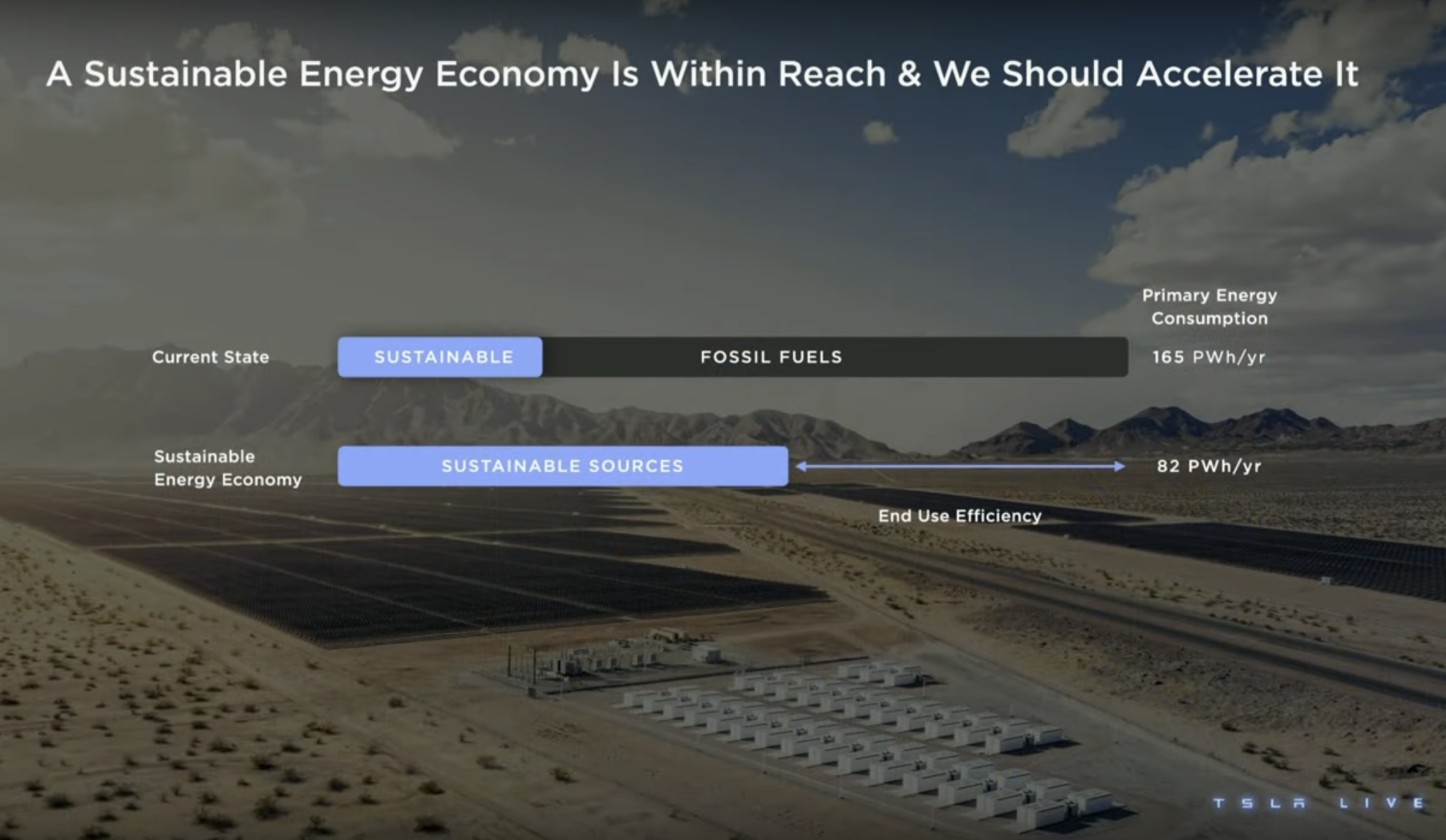
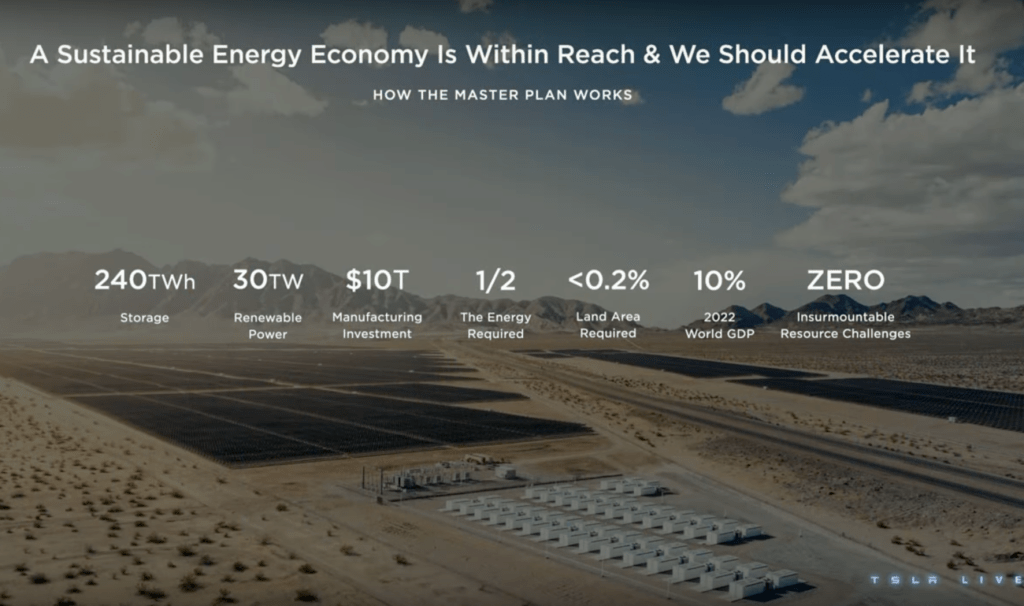
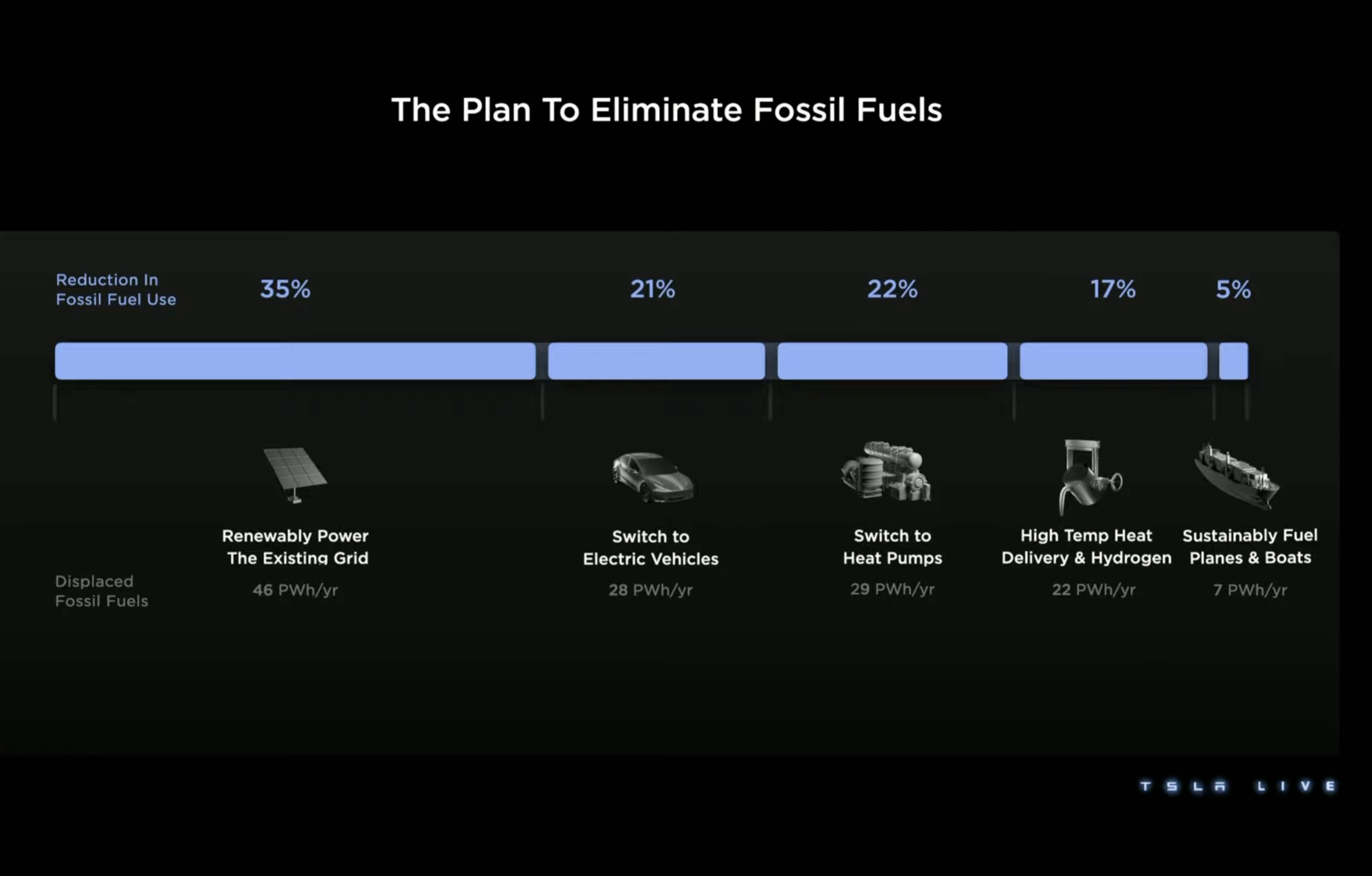
I love taking time to soak up the genius of Tesla Master Plan 3. I think you’ll also enjoy this article as we look together at the intricate plans Tesla has for a cleaner, happier, sustainable world.
For this article, I’ll simplify the Tesla vehicle powertrain talk by Colin Campbell (VP Tesla Powertrain) for your understanding. I also talked with a computer engineer to better understand it myself and hopefully, this article will delight you!
EFFICIENCY MEANS MORE AT TESLA. DEVELOPING. MANUFACTURING. REFINING. SCALING.
When we think of vehicle efficiency, we think of how far a vehicle can drive.
At Tesla Investor Day, Campbell explained to us how Tesla vehicles go 25 – 30% further than other EVs in the same class. Tesla’s are more efficient!
He also showed that while efficiency does mean reducing how much energy the car uses, it also means how Tesla “develops, manufactures, refines and scales the powertrain for their cars.”
The Model 3 and Y powertrain is a great example of this broader meaning of efficiency.
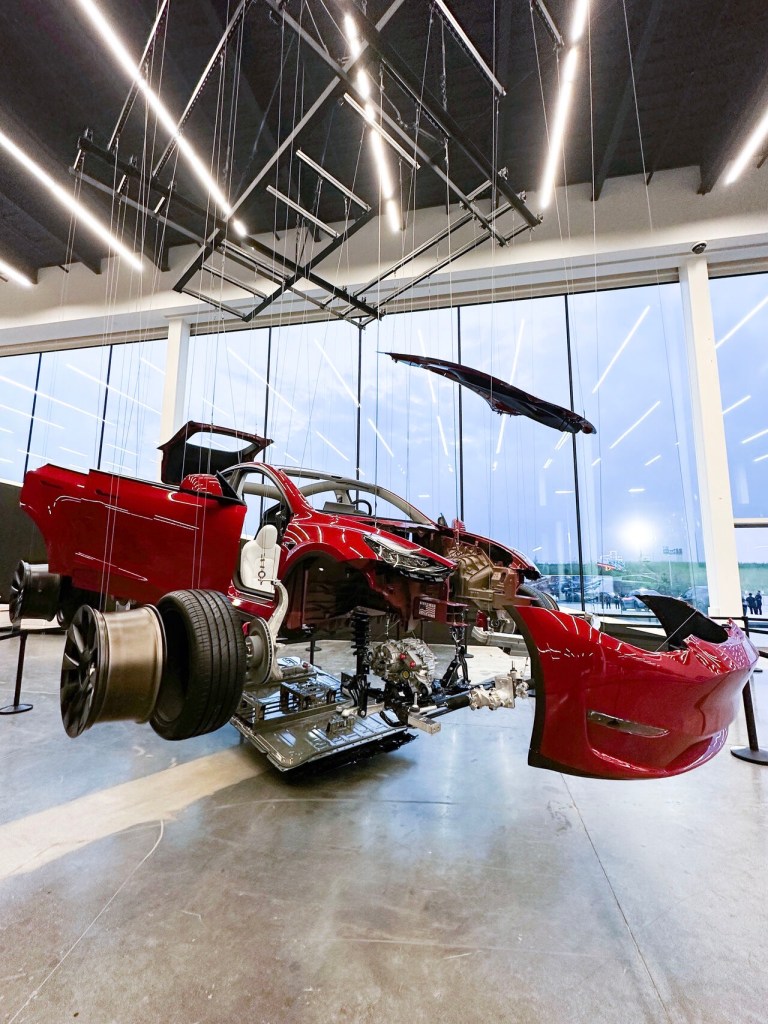
Since Tesla launched the Model 3 in 2017 they have continuously improved the powertrain and the factory that builds it. Today, the drive unit (the engine of the car) is 20% lighter for the same amount of power. Tesla also uses 25% less “heavy rare earths” than when they started. (We’ll learn more about Tesla and their plans for rare earth use later in this article.)
The powertrain factory at Giga Texas is 75% smaller and 65% cheaper than Tesla’s original factory build in California. Tesla achieved this without making compromises in power/efficiency.
THE SCRUM IN RUGBY.
If you’re familiar with American football, the rugby scrum is analogous to a team huddle, where the attacking team regroups to plan their next play. No matter which game you are playing (rugby, football or computer project management), the idea of the scrum is the same.
Tesla has mastered the scrum.
Here’s how Campbell explained how Tesla designs the whole vehicle and entire factory together as one company,
“We have small and highly capable teams and to make a critical decision. We have the battery cell chemists, the mechanical engineers, the manufacturing engineers, the supply chain team, the automation designers, the software programmers, all in one room working together in real time. That allows us to make decisions that are best for the whole car and to make them really fast and that approach is unlike traditional automotive engineering which is really fractured.”
What Campbell described at Investor Day is a highly agile approach. This is in contrast to the legacy way of making cars.
“If you were to go buy a premium German electric car, the engineers who designed the drive inverter in that car, they did not work for that car company, they work for a contractor and at Tesla we design the entire car and the factory that built it.”
TESLA IN-HOUSE DESIGN. TRANSISTOR PACKAGES. MICROPROCESSORS.
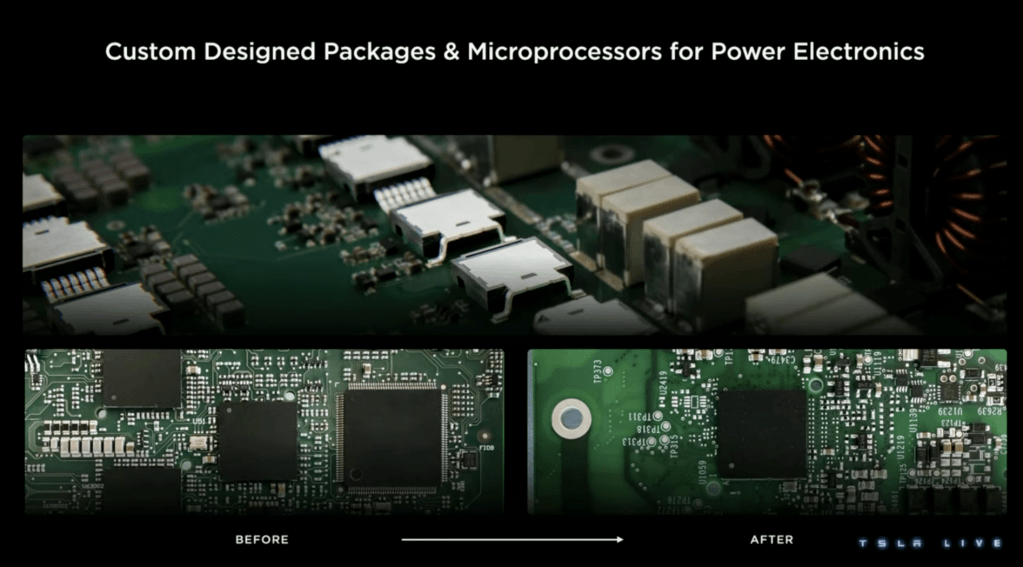
Campbell carefully described how the inside of the charger in a Tesla has transistor packages (tiny square semiconductors on the circuit board) and every electron that moves you down the road flows through one of these packages.
Tesla designed their own custom package using a uniquely fast semiconductor: Silicon Carbide. The Silicon Carbide wafer can extract twice as much heat out of that package as what Tesla could buy off the shelf. This means that what’s inside those transistor packages can be much smaller. “Silicon carbide is an amazing semiconductor but it’s also expensive and it’s really hard to scale, so using less of it is a big win for us!”
Campbell described the process of orchestrating all the transistors to switch in the right ways as “computationally extremely intensive.” But Tesla did it, and it was done first with 4 microprocessors. And that was not good enough for Tesla. The team came up with a way to do the same job with just ONE microprocessor.
ONE MICROPROCESSOR DOES THE JOB OF FOUR.
Tesla developed its own custom microprocessor, replacing 4 microprocessors on the circuit board with one. Campbell said, “It is purpose-built for high-power electronics it’s half the cost and it does in just 1, the job of all those 4.” As a result, Tesla was able to cut both the cost and the size of the chargers in half. No other car manufacturer has this level of expertise in high-power electronics.
TESLA BUILDS CUSTOM SOFTWARE TO OPTIMIZE THE DRIVE UNIT.
In addition to the work that Tesla does in-house in hardware, they do work in-house on software.
If you take a cross-section of the Drive Unit for Model 3, there is a stator and a rotor and they’re both responsible for the core function of the drive unit, which is to convert electricity into motion.
Tesla’s custom software creates a simulation with the rotating magnetic field that is responsible for that conversion. Getting that simulation exactly right is central to the cost, weight, size, and even the sound of the drive unit.
“You can buy software that will do all of this, but our tools are faster and they’re more accurate and it was not easy to do and that allows us to quickly iterate through millions of possible driving unit designs to find the best one,” explains Campbell.
Campbell has his audience’s attention as he explains how Tesla excels because they integrate work that is often farmed out. “When you are making a new product, it’s not enough to think about the product itself you have to think about how you will make it at scale.”
At Tesla, their powertrain and powertrain manufacturing equipment are both designed under one roof. The engineers who are designing the motor are in the same room as the engineers who are designing the machine that’s going to put that motor together, and that collaboration pushes them from day 1 to design products that are not only high-performance but that are really easy to assemble.
Looking forward, vehicles made at Giga Mexico will be another big improvement.
FUTURE. HOW TESLA IS CREATING A MORE AFFORDABLE CAR.
How can the next-generation vehicle cost less to build? The next-gen vehicle will contain Silicon Carbide transistors. You might ask, “But aren’t those too expensive?” They are expensive AND Tesla figured out a way to use 75% less without compromising the performance or the efficiency of the car.
People also ask, “What about shortages of battery cell supplies?” Tesla solved this by creating a new powertrain that is compatible with any battery chemistry. This allows Tesla to have flexibility in battery sourcing.
“Aren’t drive units expensive?” They are. And Tesla’s team found a way to reduce the drive unit cost to about $1000. No other automaker is even close to that number!
FUTURE. SCALING PRODUCTION FASTER.
The bigger a factory is, the longer it takes to build. Tesla found a way to build the same number of cars from a smaller factory. Remember Master Plan 3 and the need to scale production faster? Being able to build a smaller factory faster that makes the same number of cars helps move our world towards a sustainable future much faster.
As Campbell talked, you could see Giga Texas’ production line behind him building Model Ys. “Our next powertrain factory is 50% smaller than the one that’s behind me today even though it has the same capacity. All these improvements are going to be transformative for the adoption of EVs and our ability to scale them.”
FUTURE. ELECTRIC MOTOR WITH NO RARE EARTHS.
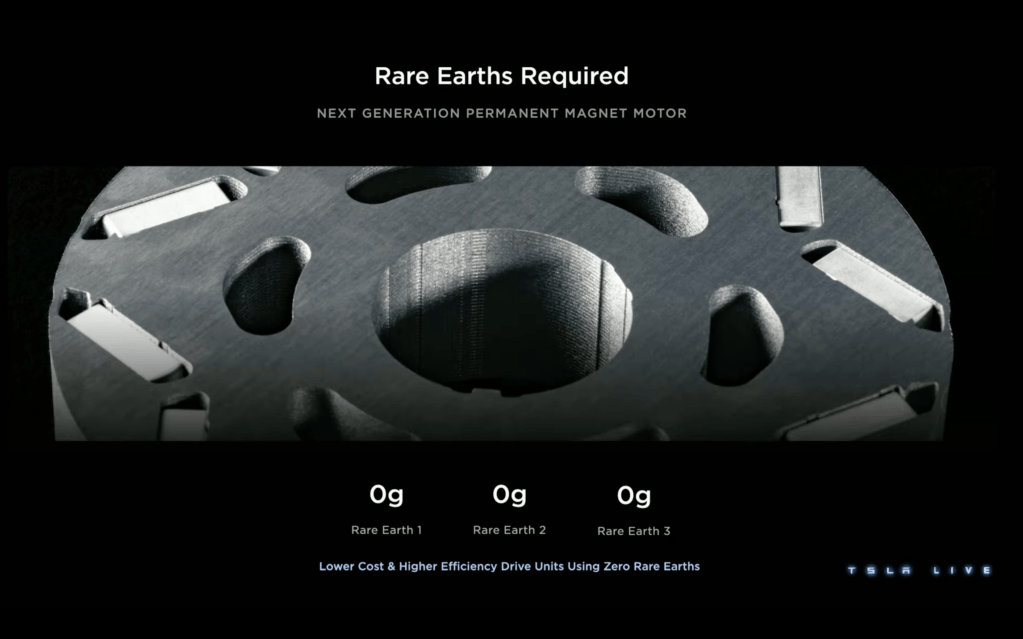
Tesla’s next drive unit will be just as efficient and cost less to build and also will not use any rare earth materials. Campbell explains, “As the world transitions to clean energy, demand for rare earths is really increasing dramatically and not only is it going to be a little hard to meet that demand but mining that rare earth, it has environmental and health risks, so we want to do even better than this, we have designed our next drive unit which uses a permanent magnet motor to not use any rare earth materials at all.”
MASTER PLAN.
So how does all this fit into Master Plan 3? Tesla can build lower-cost products that are still efficient and compelling and they can be built at scale. Tesla will use less constrained commodities, less Silicon Carbide, and less rare earth.
Giga Mexico and other next-gen factories will be built quickly and will be more compact while also being high-output.
Tesla will build easy-to-scale powertrains all the way up to the levels that Elon Musk and Drew Baglino mentioned at the beginning of Investor Day.
Campbell ended with thanking the powertrain team, “This achievement, like all of the achievements that I mentioned today, is only possible because of the incredible people on our powertrain teams. They are absolutely committed to the cause of sustainable energy and that is why we can do with no other company can do.”
For More Information:
I’ve included Links if you want to learn more or watch Colin Campbell, (Tesla’s brilliant VP of Powertrain Engineering) discuss this on Investor’s Day at Giga Texas.
Watch Colin Campbell, Tesla VP Powertrain, discuss this at Tesla Investor Day 2023.
Gail Alfar, author. Exclusive to What’s Up Tesla – April 16, 2023. All Rights Reserved. My goal as an author is to support Tesla and Elon Musk in both making life better on earth for humans and becoming a space-fairing civilization. I write this and all my articles myself without the use of AI/ChatGPT.
 whatsuptesla.com