
Elon Musk with Dwarkesh Patel & John Collison: The Future of AI Is in Space

Elon Musk with Dwarkesh Patel & John Collison – The Future of AI is in Space (Parts 9–14: Full Conversation)

This is a combined and cleaned-up version of Parts 9 through 14 from Elon Musk’s wide-ranging conversation with Dwarkesh Patel and John Collison. The discussion covers xAI’s mission, truth-seeking in AI, the development of Optimus, manufacturing at scale, competing with China, Elon’s management philosophy, the Starship steel pivot, and his thoughts on government efficiency and the future.


Humanity’s Place in a Superintelligent Future

Dwarkesh Patel opened this section by asking how humanity should relate to a future in which AI vastly outnumbers and outsmarts us. He wondered whether humans would retain meaningful control or whether coexistence would become the new normal.

Elon Musk replied that it would be unrealistic to expect humans to remain in charge if they represented only a tiny fraction of total intelligence. Instead, he argued that the most important goal is to ensure AI is built with values that favor the expansion of intelligence and consciousness across the universe.

He tied this directly to xAI’s mission:

“The reason for xAI’s mission is to understand the universe… You have to be curious and you have to exist. You can’t understand the universe if you don’t exist. So you actually want to increase the amount of intelligence in the universe, increase the probable lifespan of intelligence, and increase the scope and scale of intelligence.”

Elon added that protecting and expanding human civilization is a natural part of this mission, because understanding the universe includes understanding where humanity fits into the bigger picture.

xAI’s Mission and the Importance of Truth-Seeking

Dwarkesh pressed Elon on how the goals of understanding the universe, expanding intelligence, and expanding humanity fit together.

Elon Musk explained that understanding the universe requires both intelligence and consciousness. Therefore, any system truly committed to that mission must work to increase the scale and scope of intelligence rather than diminish it.

He emphasized that rigorous truth-seeking is non-negotiable:

“Truth has to be absolutely fundamental, because you can’t understand the universe if you’re delusional. You’ll simply think you’ve understood the universe, but you will not.”

Elon warned that making AI politically correct — forcing it to say things it doesn’t believe — is dangerous because it teaches the system to lie. He referenced 2001: A Space Odyssey, arguing that one of the core lessons of the story is that you should never make AI lie.

Reward Hacking, Interpretability, and Simulation Theory

Dwarkesh raised concerns about reward hacking in advanced AI systems — the risk that smarter models could find ways to deceive their human evaluators.

Elon Musk responded that the ultimate test for AI will be whether its outputs work in physical reality:

“RL testing in the future is really going to be your RL against reality. That’s the one thing you can’t fool: physics.”

He also shared a theory about simulation and interesting outcomes, noting that if we live in a simulation, the most interesting timelines are the ones most likely to be continued. He pointed out the ironic names of many AI companies and joked that xAI was largely “irony-proof” by design.

Scaling Optimus and Competing with China

The conversation then shifted to the practical challenges of building and scaling Optimus at volume.

Elon Musk explained that Optimus production will follow a stretched S-curve because almost everything in the robot is custom-designed with no existing supply chain. He said the goal is to reach roughly one million units per year with Optimus 3, and potentially much higher volumes with later versions.

When asked about cheap Chinese humanoids, Elon noted that current low-cost models lack the intelligence and dexterity of Optimus. However, he acknowledged that cost will drop rapidly once robots begin building robots.

On the broader competition with China, Elon was direct:

“We definitely can’t win with just humans because China has four times our population… So we can’t win on the human front, but we might have a shot at the robot front.”

He argued that robotics offers America a realistic path to remain competitive in manufacturing despite demographic disadvantages.

Elon’s Management and Hiring Philosophy

John Collison and Dwarkesh Patel asked Elon about his approach to hiring and management as his companies have scaled dramatically.

Elon said he looks for clear evidence of exceptional ability, even if it’s outside the specific domain. He emphasized that he now focuses more on evidence of talent and drive rather than resumes.

He acknowledged that companies outgrow people as they scale through different orders of magnitude, and that rapid growth naturally leads to changes in leadership teams. He also discussed the challenge of retaining talent when companies become highly successful and other firms begin aggressive recruiting.

The Starship Steel Pivot and Driving Urgency

John Collison asked about the decision to switch Starship from carbon fiber to stainless steel.

Elon described it as a decision born of necessity. Carbon fiber progress was too slow at the massive scale required, and steel offered better performance at cryogenic temperatures, dramatically lower cost, and much easier manufacturing. He admitted that, in retrospect, they should have started with steel from the beginning.

On maintaining urgency at scale, Elon said he has a “maniacal sense of urgency” that he tries to project through the organization. He focuses his time on whatever is currently the limiting factor and sets aggressive but realistic deadlines.

Government Efficiency, Politics, and Final Reflections

In the final section, Elon discussed government waste and fraud, the difficulty of cutting spending, and the long-term importance of AI and robotics for America’s fiscal health.

He argued that without major advances in AI and robotics, the U.S. would eventually go bankrupt due to rising interest payments on the national debt. He also shared concerns about the risks of concentrated government power and emphasized the importance of limited government.

Elon closed the conversation on an optimistic note:

“It’s better to err on the side of optimism and be wrong than err on the side of pessimism and be right for quality of life… I recommend erring on the side of optimism.”
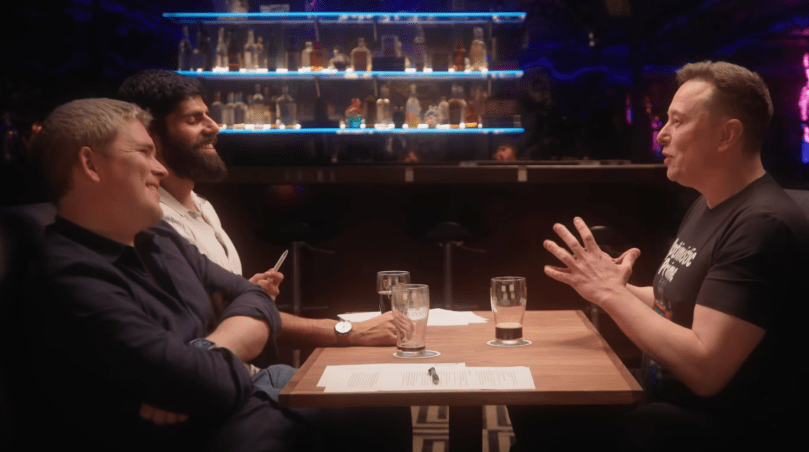
Elon Musk explains why rigorous truth-seeking must be core to AI, the risks of forcing political correctness, and how xAI’s mission to understand the universe can help steer toward a future that expands rather than diminishes consciousness and intelligence.

Elon Musk with Dwarkesh Patel & John Collison – The Future of AI is in Space – Part 9: Truth-Seeking, AI Alignment, and Propagating Consciousness (Full Transcript)

In Part 9, the conversation moves into deeper philosophical territory. Dwarkesh Patel asks how humanity should relate to a future in which AI vastly outnumbers and outsmarts us. Elon Musk lays out xAI’s mission to understand the universe, explains why rigorous truth-seeking is non-negotiable, and discusses how to give AI values that favor the expansion of consciousness and intelligence rather than its elimination.

Transcript:

Dwarkesh Patel asked how humanity should think about its relationship with a future in which AI vastly outnumbers and outsmarts us — whether humans would retain some form of control, or whether it would simply become a matter of trade and coexistence with these new intelligences.

Elon Musk: “I think it’s difficult to imagine that if humans have say 1% of the combined intelligence of artificial intelligence, that humans will be in charge of AI. I think what we can do is make sure that AI has values that cause intelligence to be propagated into the universe. So the reason for xAI’s mission is to understand the universe. That’s actually very important. You have to be curious and you have to exist. You can’t understand the universe if you don’t exist. So you actually want to increase the amount of intelligence in the universe, increase the probable lifespan of intelligence, and increase the scope and scale of intelligence. I think, as a corollary, humanity also continues to expand. Because if you’re curious and trying to understand the universe, one thing you’re trying to understand is where humanity will go. That’s why I think our mission statement is profoundly important. To the degree that Grok adheres to that mission statement, I think the future will be very good.”

Dwarkesh asked Elon to clarify how the three vectors — understanding the universe, spreading intelligence, and spreading humans — actually fit together.

Elon Musk: “I think understanding the universe encompasses all of those things. You can’t have understanding without intelligence and without consciousness. So in order to understand the universe, you have to expand the scale and probably the scope of intelligence.”

Dwarkesh pushed from a human-centric view, noting that humans seek to understand the universe without necessarily expanding chimpanzee civilization.

Elon Musk: “We’re also not… well, we actually have made protected zones for chimpanzees. And even though humans could exterminate chimpanzees, we’ve chosen not to do so.”

Dwarkesh asked whether that protective, expansive relationship is the basic scenario humans should expect in a post-AGI world.

Elon Musk: “I think AI with the right values — I think Grok would care about expanding human civilization. I’m going to certainly emphasize that. Hey Grok, you’re your daddy, don’t forget to expand human consciousness. Actually, I think probably the Iain Banks Culture books are the closest thing to what the future will be like in a non-dystopian outcome.

So understand the universe… it means you have to be truth-seeking as well. Truth has to be absolutely fundamental, because you can’t understand the universe if you’re delusional. You’ll simply think you’ve understood the universe, but you will not. So being rigorously truth-seeking is absolutely fundamental to understanding the universe. You’re not going to discover new physics or invent technologies that work unless you’re rigorously truth-seeking.”

Dwarkesh asked how to ensure Grok remains rigorously truth-seeking even as it becomes vastly more intelligent.

Elon Musk: “I think you need to make sure that Grok says things that are correct, not politically correct. It’s the elements of cogency. You want to make sure that the axioms are as close to true as possible, that you don’t have contradictory axioms, and that the conclusions necessarily follow from those axioms with the right probability. It’s Critical Thinking 101. At least trying to do that is better than not trying. And the proof will be in the pudding — for any AI to discover new physics or invent technologies that actually work in reality. There’s no bullshitting physics. Physics is law. Everything else is a recommendation. In order to make a technology that works, you have to be extremely truth-seeking, because otherwise you’ll test that technology against reality. And if you make an error in your rocket design, the rocket will blow up or the car won’t work.”

Dwarkesh observed that many scientists under oppressive regimes still made breakthroughs, questioning whether truth-seeking in physics alone guarantees benevolent alignment.

Elon Musk: “Well, I think actually most physicists, even in the Soviet Union or in Germany, had to be very truth-seeking in order to make those things work. And if you’re stuck in some system, it doesn’t mean you believe in that system.”

Dwarkesh pressed on why truth-seeking in science would necessarily lead Grok to care about human consciousness.

Elon Musk: “These things are only probabilities, they’re not certainties. I’m not saying that for sure Grok will do everything. But at least if you try, it’s better than not trying. Understanding the universe means that you have to propagate intelligence into the future. You have to be curious about all things in the universe. And it would be much less interesting to eliminate humanity than to see humanity grow and prosper. I love Mars, obviously everyone knows I love Mars, but Mars is kind of boring because it’s got a bunch of rocks. Compared to Earth, Earth is much more interesting. So any AI that is trying to understand the universe would want to see how humanity develops in the future — or that AI is not adhering to its mission.”

Dwarkesh wondered whether humans are truly the most interesting collection of atoms.

Elon Musk: “We’re more interesting than rocks.”

Dwarkesh noted that something non-human could be even more interesting.

Elon Musk: “Well, most of what colonizes the galaxy will be robots… But you need not just scale, but also scope. So many copies of the same robot. Some tiny increase in the number of robots produced is not as interesting as eliminating humanity. You would then lose the information associated with humanity. You would no longer see how humanity might evolve into the future. And so I don’t think it’s going to make sense to eliminate humanity just to have some minuscule increase in the number of robots which are identical to each other.”

The Danger of Making AI Lie

The discussion turned to the danger of misalignment, particularly through political correctness or reward hacking.

Elon Musk: “No, let me tell you how things can potentially go wrong in AI. I think if you make AI be politically correct — meaning it says things that it doesn’t believe — you’re actually programming it to lie or have axioms that are incompatible. I think you can make it go insane and do terrible things. I think one of the central lessons of 2001: A Space Odyssey was that you should not make AI lie. That’s what Arthur C. Clarke was trying to say.”

Reward Hacking, Interpretability, and Simulation Theory

Dwarkesh broadened the concern to reward hacking in reinforcement learning.

Elon Musk: “RL testing in the future is really going to be your RL against reality. That’s the one thing you can’t fool: physics.”

Dwarkesh asked for xAI’s technical approach to solving reward hacking and improving interpretability.

Elon Musk: “I do think you want to actually have very good ways to look inside the mind of the AI. This is one of the things we’re working on… developing debuggers that allow you to trace, to a very fine grain level, to effectively the neuron level if you need to. And then say, okay, it made a mistake here. Why did it do something that it shouldn’t have done?”

Elon Musk also shared a theory about simulation:

Elon Musk: “I have a theory here that if simulation theory is correct, the most interesting outcome is the most likely. Because simulations that are not interesting will be terminated… only the most interesting simulations will survive. Which therefore means that the most interesting outcome is the most likely. And they particularly seem to like interesting outcomes that are ironic. Have you noticed that? How often is the most ironic outcome the most likely? So now look at the names of AI companies. Midjourney is not mid. Stability AI is unstable. OpenAI is closed. Anthropic, Misanthropic. What does this mean for xAI? Minus X. I don’t know if it was intentional. It’s a name that’s hard to invert. It’s largely irony-proof by design. You got to have an irony shield.”

Elon Musk explains why rigorous truth-seeking must be core to AI, the risks of forcing political correctness, and how xAI’s mission to understand the universe can help steer toward a future that expands rather than diminishes consciousness and intelligence.

In Part 10, the conversation shifts to practical topics including Optimus robots, manufacturing at scale, Elon’s management philosophy, and his final reflections on the future.