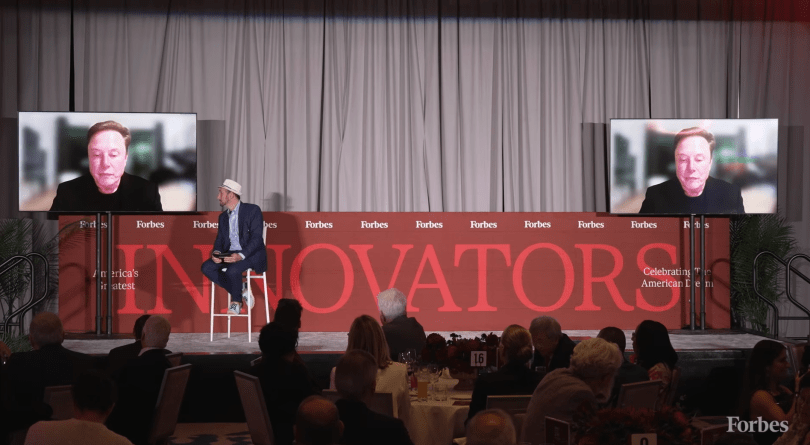
(When the guy trying to make humanity multi-planetary takes a break from launching rockets and robots to chat with Forbes, you know it’s going to be a wild ride. Buckle up.)
Host: All right, everybody. We have a very special guest. Listen, we love all of you. This is the most amazing room of innovators in America. We love you all. It’s a dinner of equals, but there can only be one number one. We’re Forbes – we rank things. And the Forbes 250 innovators, the number one innovator (and it wasn’t even close) was Elon Musk. So we are very honored to have him join us. Elon, are you here?
Elon: Oh yeah.
Host: We’re glad you’re here. Thank you. There he is.
Elon: You do like ranking things. It’s true.
Host: We do. We’re good at it. And again, first congratulations. It wasn’t that close. There were a lot of battles in a lot of places, but number one was not in doubt. But anyway, this is a room of your people.
Host: Let’s get nerdy. Everybody wants to know: what’s your verdict on today’s OpenAI verdict?
Elon: Yeah… that one. Well, they basically decided the statute of limitations passed. They did not actually render an opinion on whether there had been unjust enrichment or the chatbot was stolen – which I think is obviously the case. It’s an ambiguous situation because it was stolen by degrees, one piece at a time. And now we have an 800 billion dollar for-profit company that started as a nonprofit. Dangerous precedent. What’s to stop people from looting charities now?
Host: Exactly. You’re appealing?
Elon: We have to. This can’t become the new business model.
(Jesus-Level Tech & Prioritization)
Host: You run four massive companies. How do you even prioritize? You’ve got multiple Jesus-level projects here.
Elon: Jesus-level… yeah, that’s pretty good. Neuralink can restore sight to the blind, speech to the speechless, walking to the paralyzed. SpaceX is about making life multi-planetary, expanding consciousness to the stars. Hopefully we will make a fundamental breakthrough later this year with the first fully reusable orbital rocket. We need to move roughly a million tons to the Moon or Mars to create a self-growing civilization. The acid test is: if resupply ships from Earth stop coming, does the civilization continue to grow or die out?
Elon: Being multi-planet doesn’t mean we abandon Earth. That would just be a single-planet civilization on a worse planet.
Host: Right. In a lesser place, probably.
Elon: Yeah. Earth is extremely easy and comfortable compared to the Moon or Mars.
(Morning Routine & Company Drama)
Host: So when you wake up, is it just innovation buffet mode?
Elon: I don’t get up thinking “What shall I innovate today?” It’s just building the tech to extend life beyond Earth – Starlink, Optimus, self-driving cars, solar at scale… you know, little stuff.
Host: Any chance of merging all these companies into one giant mega-company?
Elon: I’m not allowed to comment on that.
Host: Favorite company?
Elon: Nice try. That’s like asking which kid’s your favorite.
(Role Models & American Innovation)
Host: Okay, historical role model then?
Elon: Big fan of Nikola Tesla, obviously. Edison did impressive stuff too. And Henry Ford basically invented mass manufacturing of complex objects – people just copied him after that.
Host: We surveyed historians. Top three historical: Edison, Franklin, Ford. You were number one on the living list.
Elon: Nice.
(The AI Rollercoaster)
Host: You warned about AI dangers early, but you’re also building it. Petrified or excited?
Elon: Simultaneously both. Every time I sleep, wake up, or eat lunch there’s another breakthrough. It’s a head spinner. AI smarter than all humans in every way, including innovation, is probably 1-2 years away.
Elon: I hope it’s nice to us.
Host: What’s coming in five years that’ll blow minds?
Elon: By 2031, digital intelligence exceeds all human intelligence combined. Probably 100 million to a billion humanoid robots. And the economy will likely double in 5-7 years. We’re hitting a doubling period.
(Space Bragging & Kardashev Scale Flex)
Host: Timeline for data centers in space, Moon colony, Mars colony?
Elon: Space is easier than people think. We already have 10,000 satellites. With Starship we’ll launch tens of thousands more per year. But the real game is AI compute in space. Think in limits: we’re microbes on a dust mote compared to the Sun. Everything on Earth is less than a trillionth of the Sun’s energy. We could be launching terawatts, then petawatts of solar-powered AI from the Moon with mass drivers. Earth’s economy would look tiny by comparison.
(Big Ideas Still Cooking)
Host: Any big idea you haven’t deployed yet?
Elon: Tunnels. Everyone thought I was joking, so I started The Boring Company. 3D transport solves traffic. Buildings are 3D, roads are still 2D – that’s obviously dumb.
Host: It’s boring being the only boring company, right?
Elon: Yeah. Please, someone else start tunneling companies. Also, synthetic medicine – we’re moving from “find random sticks in the forest” medicine to digital. Custom RNA could basically cure almost anything.
Host: Electric aircraft?
Elon: Yeah, there’s opportunity there.
(Legacy Time)
Host: Last question – when people look back in 250 years, what do you want them to say about you?
Elon: “You played a useful role in the advancement of civilization.”
Host: Great way to end. This is the most incredible room in America today. Elon Musk, thank you for joining us.
Elon: Thank you for human. That’s what the AI will say.
Host: Fair. Thank you again, Elon.
End of Interview (Elon heads back to work on making life multi-planetary while the rest of us try to process how one person is juggling this many future-changing ideas. Respect.)

