
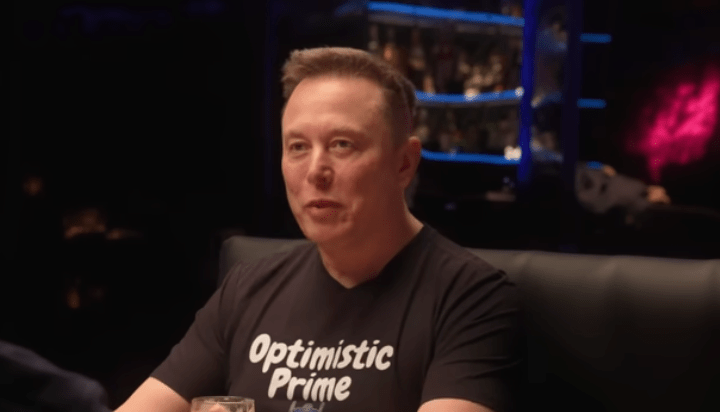
Elon predicts that within five years, more AI will be operating in space than currently exists on Earth, and discusses the Starship fleet size and launch cadence needed to support it.

Elon Musk with Dwarkesh Patel & John Collison – The Future of AI is in Space – Part 6: AI Capacity in Five Years and Starship Launch Rates (Full Transcript)

In Part 6, John Collison asks Elon to project what AI compute capacity might look like in five years — both on Earth and in space. The conversation shifts to the enormous number of Starship launches that would be needed to support large-scale orbital AI infrastructure. Elon shares his prediction that AI in space will surpass all terrestrial AI within five years and discusses the practical realities of achieving very high launch rates.

Elon Musk: “My prediction is that we will launch and be operating more AI in space every year than the cumulative total on Earth, which I would expect to take at least five years to reach. So we’re talking about a few hundred gigawatts per year of AI in space, and rising.”

Transcript:

John Collison shifted the conversation to a concrete five-year horizon. He asked what installed AI compute capacity would look like on Earth versus in space by then.

Elon Musk: Five years? I think probably if you say five years from now, we’re probably going to be launching every year in space the sum total of all AI on Earth, and then some. My prediction is we will launch and be operating every year more AI in space than the cumulative total on Earth, which I would expect to be at least sort of five years from now. A few hundred gigawatts per year of AI in space and rising. So you can get to, I think on Earth you can get to around a terawatt a year of AI in space before you start having fuel supply challenges for the rocket.

John Collison pressed for confirmation on the hundreds-of-gigawatts-per-year figure.

Elon Musk: “Yes.”

Dwarkesh Patel highlighted the launch cadence implied by those numbers.

Elon Musk: “Yes.”

Dwarkesh Patel continued, noting that delivering 100 gigawatts in a single year would require roughly 10,000 Starship launches annually — the equivalent of one launch every single hour, nonstop, from this city.

Elon Musk: “Yeah, I mean that’s actually a lower rate compared to airlines like aircraft.”

Dwarkesh Patel pointed out that there are a lot of airports around the world.

Elon Musk: “A lot of airports.”

Dwarkesh Patel noted the additional complexity of launching into polar or sun-synchronous orbits.

Elon Musk: “No, it doesn’t have to be polar, but there’s some value to sun synchronous. But I think actually you just go high enough, you start getting out of Earth’s shadow.”

Dwarkesh Patel asked how many physical Starships would be needed to sustain 10,000 launches per year.

Elon Musk: “I don’t think we’ll need more than. I mean, you could probably do it with as few as like 20 or 30. It really depends on how quickly the ship has to go around the Earth and the ground track before the ship has to come back over the launch pad. So if you can use a ship every, say 30 hours, you could do it with 30 ships, but we’ll make more ships than that. But SpaceX is gearing up to 10,000 launches a year and maybe even 20 or 30,000 launches a year.”

Elon predicts that within five years, more AI will be operating in space than currently exists on Earth, and discusses the Starship fleet size and launch cadence needed to support it. In Part 7, the conversation continues with more on the technical and operational realities of building large-scale AI infrastructure in orbit.
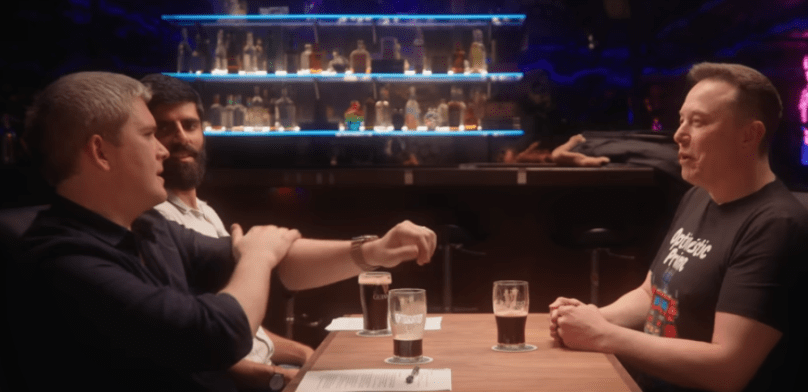

Elon makes a bold prediction that space will become the cheapest place to run AI within three years.

Elon Musk with Dwarkesh Patel & John Collison – The Future of AI is in Space – Part 2: Why Space Is the Optimal Place for AI (Full Transcript)

In Part 2, Dwarkesh Patel and John Collison explore whether space could actually be better than Earth for running massive AI infrastructure. They raise practical concerns around regulation, servicing failing GPUs, and power generation. Elon Musk has a strong case for orbital compute, highlighting the dramatic advantages of space-based solar power.

Transcript:

Dwarkesh Patel suggested that space might mostly be a regulatory advantage, since it’s harder to build big infrastructure on land than in space. He also asked how you would service GPUs when they fail — which happens quite often during large training runs.

John Collison added questions about solving the power problem, specifically whether private behind-the-meter generation co-located with data centers could work.

Elon Musk: “It’s harder to scale on ground than it is to scale in space. But also, you’re going to get about five times the effectiveness of solar panels in space versus the ground.

And you don’t need batteries. I almost wore my other shirt, which says ‘it’s always sunny in space,’ which it is. Because you don’t have a day-night cycle or seasonality, clouds, or an atmosphere in space.

The atmosphere alone results in about a 30% loss of energy. So any given solar panel can do about five times more power in space than on the ground, and you avoid the cost of having batteries to carry you through the night.

So it’s actually much cheaper to do in space. And my prediction is that it will be by far the cheapest place to put AI will be space in 36 months or less.”

Elon makes a bold prediction that space will become the cheapest place to run AI within three years. In Part 3, the conversation continues with more details on the technical and economic realities of moving AI infrastructure off Earth.

And my prediction is that it will be by far the cheapest place to put AI will be space in 36 months or less. – Elon Musk

Picture of Elon Musk as he jokingly questioned whether they were really going to talk for three full hours. Dwarkesh Patel teased him in return, saying he didn’t have much to talk about. Elon reacted with mock surprise.

Elon Musk on Why the Future of AI Will Be in Space with Dwarkesh Patel & John Collison – Part 1 (Full Transcript)

Part 1: Opening Banter and the Economics of Space-Based Data Centers

The interview opened with some light-hearted and playful banter. Elon Musk jokingly questioned whether they were really going to talk for three full hours. Dwarkesh Patel teased him in return, saying he didn’t have much to talk about. Elon reacted with mock surprise.

Elon Musk: “So are there really three hours of questions or are you fing serious?” Elon Musk: “Holy f, man.”

John Collison jumped in, agreeing that it was actually the most interesting time because all the major storylines seemed to be converging at once. Elon playfully replied that it was almost as if he had planned it that way.

Elon Musk: “Almost like I planned it.”

John Collison laughed and said “Exactly.”

Elon Musk: “That would never do such a thing.”

With the lighthearted tone set, Dwarkesh Patel steered the discussion into the first major topic: the economics of data centers and why anyone would consider moving them into space. He explained that in a typical data center, energy accounts for only 10 to 15 percent of total cost of ownership, with GPUs representing the vast majority of the expense. He pointed out that placing those GPUs in space would make servicing nearly impossible, shortening their depreciation cycle and driving costs far higher, then asked directly what possible reason there could be to put them in orbit anyway.

Elon Musk: “Well, the availability of energy is the issue. So, I mean, if you look at electrical output outside of China, everywhere outside of China, it’s more or less flat. It’s very, you know, maybe a slight increase, but pretty close to flat. China has a rapid increase in electrical output. But if you’re putting data centers anywhere except China, where are you going to get your electricity? Especially as you scale, the output of chips is growing pretty much exponentially, but the output of electricity is flat. So how are you going to turn the chips on? Magical power sources. Magical electricity fairies.”

Dwarkesh Patel followed up by noting Elon’s well-known advocacy for solar power, calculating that one terawatt of solar (requiring about 4 terawatts of panels at 25 percent capacity factor) would cover only 1 percent of U.S. land area, yet even that seemed insufficient once data centers themselves reached terawatt scale. He asked what exactly we are running out of. Elon pressed him on how far into the singularity he thought we already were, and Dwarkesh turned the question back. Dwarkesh then asked whether the plan was to move to space only after blanketing places like Nevada with solar panels on the ground.

Elon Musk: “Right.”

Elon Musk: “Yeah, exactly. So I think we’ll find we’re in the singularity and like, okay, we’ve still got a long way to go.”

Elon Musk: “I think it’s pretty hard to cover Nevada in solar panels. You have to get permits from, try getting the permits for that.”

Read on part Parts 2-10.