
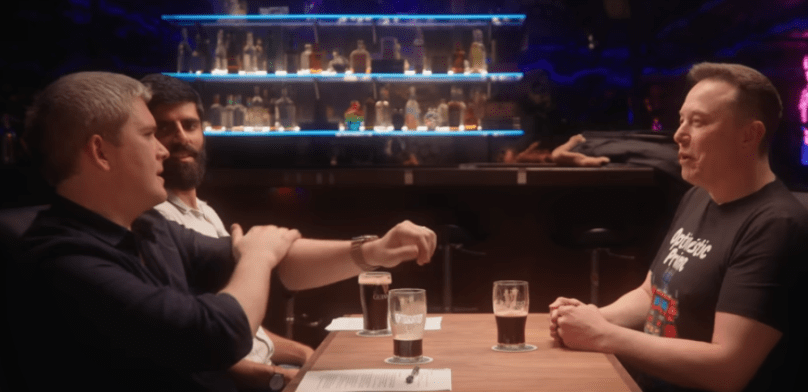
In Part 2, Dwarkesh Patel and John Collison explore whether space could actually be better than Earth for running massive AI infrastructure. They raise practical concerns around regulation, servicing failing GPUs, and power generation. Elon Musk has a strong case for orbital compute, highlighting the dramatic advantages of space-based solar power.
Transcript:
Dwarkesh Patel suggested that space might mostly be a regulatory advantage, since it’s harder to build big infrastructure on land than in space. He also asked how you would service GPUs when they fail — which happens quite often during large training runs.
John Collison added questions about solving the power problem, specifically whether private behind-the-meter generation co-located with data centers could work.
Elon Musk: “It’s harder to scale on ground than it is to scale in space. But also, you’re going to get about five times the effectiveness of solar panels in space versus the ground.
And you don’t need batteries. I almost wore my other shirt, which says ‘it’s always sunny in space,’ which it is. Because you don’t have a day-night cycle or seasonality, clouds, or an atmosphere in space.
The atmosphere alone results in about a 30% loss of energy. So any given solar panel can do about five times more power in space than on the ground, and you avoid the cost of having batteries to carry you through the night.
So it’s actually much cheaper to do in space. And my prediction is that it will be by far the cheapest place to put AI will be space in 36 months or less.”
Elon makes a bold prediction that space will become the cheapest place to run AI within three years. In Part 3, the conversation continues with more details on the technical and economic realities of moving AI infrastructure off Earth.
And my prediction is that it will be by far the cheapest place to put AI will be space in 36 months or less. – Elon Musk

