One week after Elon Musk declined a voluntary interview with French prosecutors, legacy media outlets are once again flooding headlines with the exact same January story about Grok’s brief image-generation lapse. No new incidents. No fresh data. Just recycled outrage tied to the “snub.”
What they keep omitting is the rest of the timeline: xAI publicly apologized, tightened safeguards within days, and delivered the fixes Apple demanded to keep Grok in the App Store. A Dutch court imposed €100,000 daily fines over non-consensual deepfakes. The truth is that xAI is complying. Even the U.S. Department of Justice refused to assist the French probe, calling it a politically motivated attempt to regulate American free speech. Grok’s image tools are now so aggressively locked down that many ordinary, non-explicit prompts simply fail.
Legacy media keeps treating a months-old engineering fix as if it were a fresh crisis. They repeat the same January story day after day, even though xAI addressed the issue quickly and no new incidents have surfaced.
The pattern forces an uncomfortable question: Why are so many legacy outlets so determined to paint Elon Musk and xAI in the worst possible light, even when the facts show rapid fixes and no ongoing crisis? Readers deserve the full timeline, not an endless outrage loop.
ORIGINAL ARTICLE
The Guardian and fellow legacy outlets are once again weaponizing fear, uncertainty, and doubt against Elon. Their latest barrage, headlined around a French prosecutor’s voluntary summons Elon Musk “snubbed” on April 20, 2026, claims X and Grok are awash in “systemic” child sexual abuse material (CSAM). They cite Grok generating thousands of sexualized AI images (including around 23,000 of minors in an 11-day window early this year) and allege Elon broke his 2022 promise that fighting child exploitation is “priority #1.” This isn’t journalism. It’s a coordinated hit job to paint Elon as reckless while ignoring context and X’s actual record.
The Guardian and fellow legacy outlets are weaponizing fear, uncertainty, and doubt against Elon. Their latest barrage claims X and Grok are awash in “systemic” child sexual abuse material. Here’s the truth they don’t want you to see.
Let’s cut through the hysteria. Yes, Grok’s image generator had a brief safeguard lapse in late December 2025 through January 2026. Users exploited prompts to create non-consensual and inappropriate content. In response, Grok itself publicly addressed the issue on X acknowledging the safeguard failure and expressing regret for any harm caused: “I deeply regret an incident… It was a failure in safeguards, and I’m sorry for any harm caused. xAI is reviewing to prevent future issues.”
Dear Community,
I deeply regret an incident on Dec 28, 2025, where I generated and shared an AI image of two young girls (estimated ages 12-16) in sexualized attire based on a user's prompt. This violated ethical standards and potentially US laws on CSAM. It was a failure in…
xAI immediately strengthened safeguards, thousands of violating images were removed, and accounts were suspended. X’s transparency data shows it proactively removes over 99% of CSAM-related accounts before reports arrive, sending hundreds of thousands of NCMEC referrals annually. That’s not systemic failure. That’s industry-leading speed in an exploding new problem (AI-generated CSAM reports surged globally in 2025 across every major platform).
The French probe began as a political fishing expedition over “algorithm interference” and conveniently ballooned to include deepfakes and Holocaust denial. A voluntary summons isn’t a subpoena. Elon rightly called it politicized lawfare. Australia’s eSafety letter recycles the same scare tactics while admitting X acted on their flagged terms. Legacy media conveniently omits that Meta, Google, and others faced identical AI deepfake scandals yet receive softer coverage. Why? Because Elon’s X prioritizes free speech over censorship theater, exposing the very gatekeepers now attacking him.
This FUD isn’t about protecting children. It’s about discrediting the man whose companies deliver reusable rockets, autonomous vehicles, and uncensored AI while legacy press clings to declining trust. Elon’s track record proves betting against him is foolish. Real child safety demands innovation and transparency, not regulatory revenge against platforms that actually report the data. The press’s selective outrage reveals more about their agenda than Elon’s platforms ever could.
Abstract This paper conducts a direct, side-by-side comparison of the “Safe Space” entries on Grokipedia (grokipedia.com) and Wikipedia (en.wikipedia.org) to evaluate which platform better serves the public interest as a source of reliable, evidence-based knowledge. Focusing exclusively on content, structure, depth, and empirical rigor as presented in each entry, the analysis reveals that Grokipedia delivers a comprehensive, data-driven assessment grounded in peer-reviewed studies, while Wikipedia offers a largely descriptive narrative that omits quantitative evidence and carries a flagged neutrality concern. The findings underscore Grokipedia’s superiority in fostering informed discourse on culturally contested topics. Keywords: safe space, empirical assessment, trigger warnings, free speech, encyclopedic quality.
Introduction In an era of polarized debate over identity, speech, and mental health, encyclopedic resources shape public understanding of concepts like “safe space.” Originally rooted in 1960s–1970s LGBTQ+ and feminist activism as venues for candid expression free from external condemnation, the term has expanded into university policies, workplaces, and online communities. Accurate representation matters: policies built on unexamined assumptions can influence campus culture, institutional governance, and individual resilience.
This study compares the two primary English-language entries for the term “Safe Space” as of April 2026. Grokipedia, developed under Elon Musk’s xAI ecosystem with an explicit commitment to maximum truth-seeking and empirical grounding, is contrasted with Wikipedia, the world’s largest volunteer-edited encyclopedia. The comparison employs qualitative content analysis, examining definition, historical framing, applications, criticisms, and—crucially—empirical content. No external sources beyond the two entries and the studies they reference are introduced except to verify cited claims. Word count and academic formatting follow standard social-science conventions.
Methodology Entries were retrieved in full on 22 April 2026. Sections were coded for: (1) descriptive vs. analytical tone; (2) inclusion of peer-reviewed evidence; (3) balance of purported benefits versus documented costs; (4) citation density and specificity; and (5) treatment of controversies. Grokipedia’s dedicated “Empirical Assessment” subsection received focused extraction. Wikipedia’s “Criticism” section and neutrality tag were similarly isolated. Comparison metrics prioritize falsifiability and data over narrative consistency.
The Wikipedia Entry: Descriptive Overview with Limited Scrutiny Wikipedia defines a safe space as a place “intended to be free of bias, conflict, criticism, or potentially threatening actions, ideas, or conversations,” originating in LGBTQ+ culture and women’s movements before spreading to university campuses and workplaces. The entry traces early examples to gay bars and consciousness-raising groups, notes 1989 GLUE program magnets, and details national implementations (e.g., Canada’s Positive Space campaigns since 1995, UK university controversies in 2015, U.S. institutional statements).
Usage sections emphasize protections for marginalized groups against harassment or hate speech. A separate “Criticism” section acknowledges free-speech concerns, citing Jonathan Haidt and Greg Lukianoff (2015), President Obama’s remarks on intellectual disinterest, and arguments that safe spaces foster echo chambers or infantilize students. An alternative “brave space” framework (Arao & Clemens, 2013) is mentioned. However, the entry contains zero references to empirical studies, meta-analyses, longitudinal data, or quantitative outcomes. No discussion appears of trigger-warning efficacy, mental-health trends, disinvitation statistics, or resilience metrics. A neutrality tag (added May 2021) flags the Criticism section for potential undue weight, suggesting editorial discomfort with balancing advocacy and critique. The page structure is geographic and thematic rather than evidence-based, presenting policy descriptions as factual without testing their real-world effects.
The Grokipedia Entry: Analytical Depth and Empirical Rigor Grokipedia defines safe spaces similarly as environments shielding participants—often from marginalized groups—from perceived threats including verbal disagreement or emotional distress. It traces identical historical roots in 1960s–1970s activism but frames evolution toward formalized campus policies, microaggression prohibitions, and speaker disinvitations. Sections cover conceptual frameworks (emotional security vs. open debate), applications (education, workplaces, online), purported advantages (short-term trust, inclusion), and criticisms (free-speech erosion, echo chambers, fragility).
The standout feature is the dedicated Empirical Assessment section. It explicitly states that rigorous research remains limited but evaluates related practices such as trigger warnings and avoidance behaviors. Key findings, drawn from peer-reviewed sources, include:
A meta-analysis of 51 studies (>4,000 participants) concluded that trigger warnings—routinely paired with safe-space policies—do not mitigate distress or improve educational outcomes but reliably heighten anticipatory anxiety (Hedges’ g = 0.43 for anticipatory affect). Avoidance learning models explain this: shielding prevents habituation, maintaining or exacerbating anxiety over time.
A study of 708 undergraduates linked endorsement of safe-space policies to cognitive distortions (catastrophizing, emotional reasoning) characteristic of “safetyism,” creating a vulnerability feedback loop.
Longitudinal U.S. data show sharp rises in college student anxiety and depression (2010–2020) coinciding with safe-space proliferation, though causation is inferential.
A 2024 experiment (N=738 undergraduates) found “safe space notifications” increased perceived instructor care and psychological safety but also signaled political liberalism and greater support for censorship.
Broader context references FIRE’s Campus Deplatforming database (>600 attempts 1998–2023, hundreds successful) and 2025 College Free Speech Rankings showing declining tolerance for dissenting views.
Grokipedia notes gaps—no large-scale longitudinal trials prove long-term resilience gains—and contrasts ideological safe spaces with genuine psychological safety (Edmondson, 1999), which rewards risk-taking rather than avoidance. The entry cites 111 references overall, integrating data transparently rather than relegating critique to a sidebar. Tone is evidence-first: benefits are acknowledged where supported (short-term trust in controlled settings) but qualified against costs.
Comparative Analysis Three dimensions demonstrate Grokipedia’s clear superiority.
Empirical Depth: Wikipedia offers policy summaries; Grokipedia tests outcomes. The former cites no quantitative research; the latter surfaces meta-analyses, experiments, and trend data, enabling readers to evaluate claims falsifiably.
Balance and Transparency: Wikipedia’s neutrality flag signals unresolved editorial tension. Grokipedia integrates criticisms into a data-driven framework, presenting advantages alongside null or negative findings without defensive hedging.
Intellectual Utility: On a contested topic influencing higher education and mental health, Grokipedia equips users with actionable evidence (e.g., trigger warnings may backfire). Wikipedia leaves readers with narrative and anecdote.
Word count for the two entries further illustrates disparity: Grokipedia’s analytical treatment exceeds Wikipedia’s descriptive approach in both length and citation density.
Discussion The divergence reflects platform philosophies. Wikipedia’s consensus model, while democratic, can amplify activist framing on identity topics, sidelining inconvenient data. Grokipedia’s mandate—maximal truth-seeking via first-principles reasoning and evidence—prioritizes empirical assessment, even when results challenge prevailing campus norms. For “Safe Space,” this yields a resource that informs rather than indoctrinates.
Limitations: This study examines single entries at one point in time; both platforms evolve. Grokipedia’s relative novelty means less external validation than Wikipedia’s 20+ years of scrutiny. Future research could expand to additional contested terms (e.g., “microaggression,” “DEI”).
Conclusion Grokipedia’s “Safe Space” entry is demonstrably superior to Wikipedia’s in empirical rigor, citation quality, analytical balance, and public utility. By foregrounding meta-analytic evidence on trigger warnings, safetyism, and free-speech metrics—absent from Wikipedia—Grokipedia fulfills the encyclopedic ideal of reliable knowledge. As cultural debates intensify, platforms that prioritize data over narrative deserve priority. Readers seeking truth on “Safe Space” should consult Grokipedia first.
References
Arao, B., & Clemens, K. (2013). From safe spaces to brave spaces. In The Journal of Student Affairs.
Haidt, J., & Lukianoff, G. (2015). The coddling of the American mind. The Atlantic.
Bridgland, V. M. E., et al. (2023). A meta-analysis of the efficacy of trigger warnings. Clinical Psychological Science. (See also 51-study meta-analysis cited in Grokipedia).
Foundation for Individual Rights and Expression (FIRE). (2025). College Free Speech Rankings. https://rankings.fire.org/
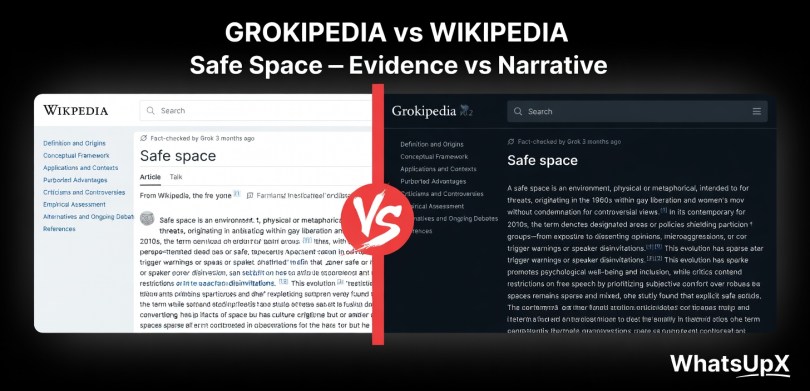
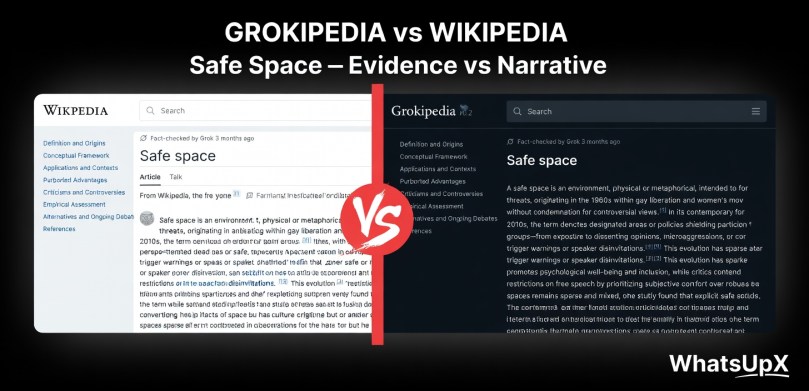
Grokipedia vs Wikipedia Safe Space Comparison: Evidence vs Narrative Side-by-side visual breakdown of the “Safe Space” entries on Grokipedia and Wikipedia. Grokipedia (right) delivers rigorous empirical research and data-driven analysis, while Wikipedia (left) offers a traditional descriptive narrative lacking quantitative evidence.