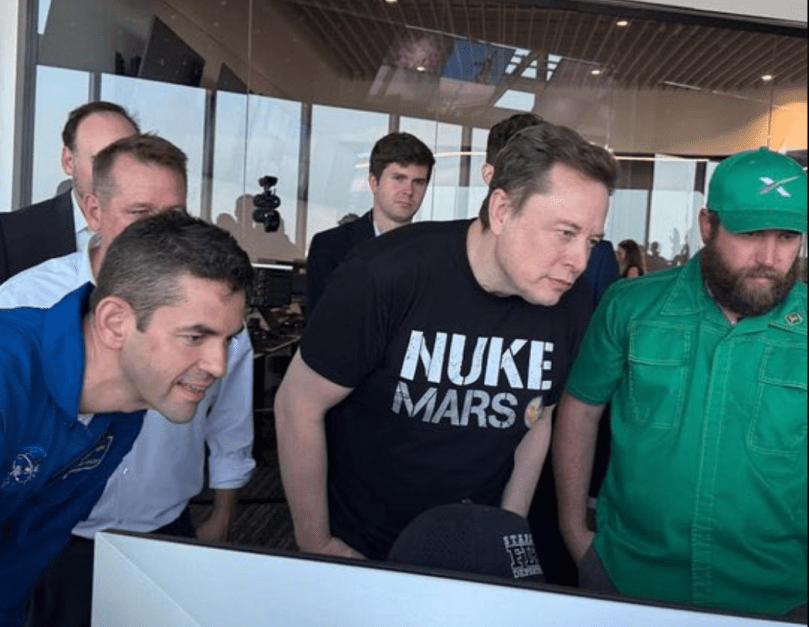
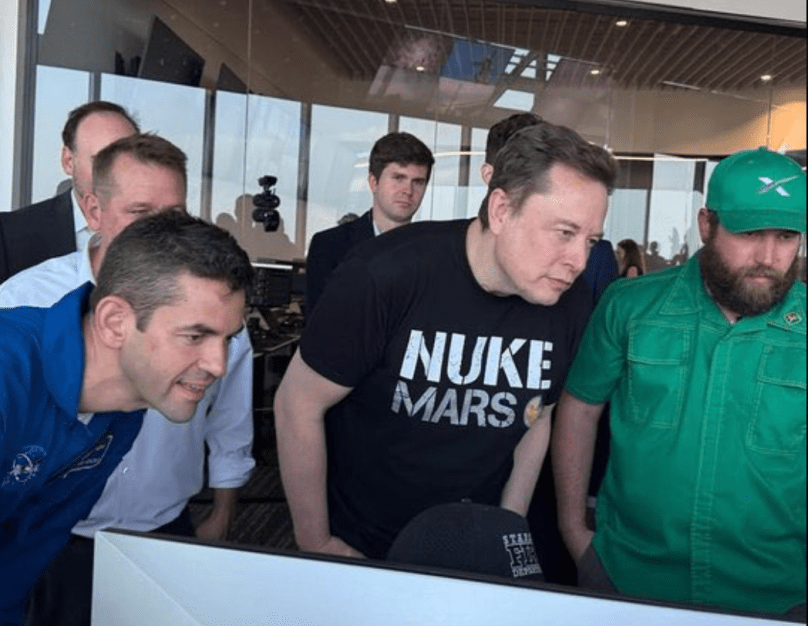
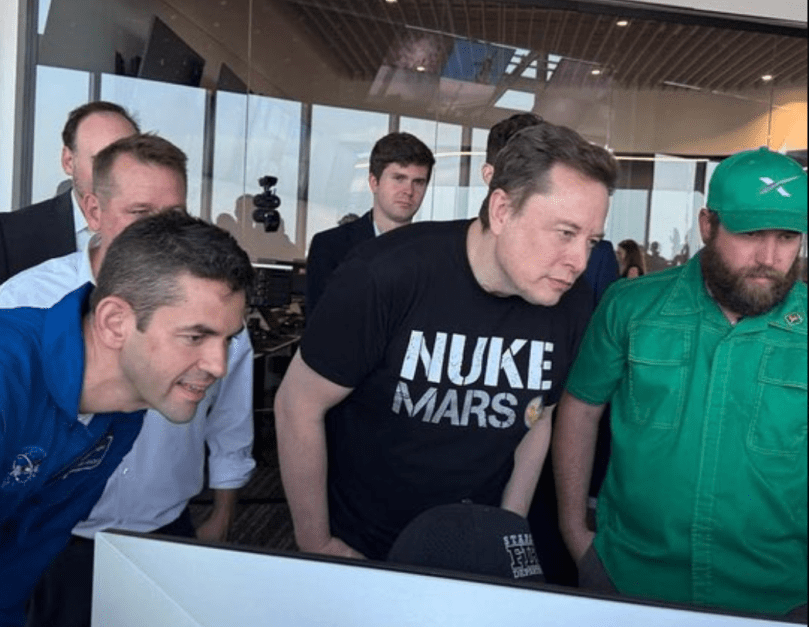
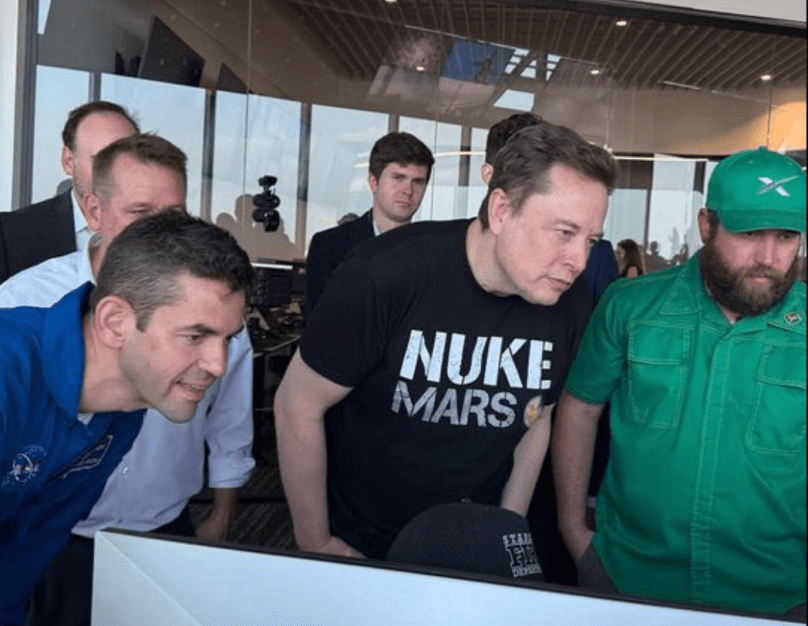
View of Giga Texas factory floor from the conference room where the Getting Stoned podcast interview with Elon Musk took place, July 2022 [Photo by Gail Alfar]

Elon Musk Full Transcript: “This is Getting Stoned” Podcast at Giga Texas (July 2022)

Video: https://youtu.be/rQI2Ls32b80

In July 2022, podcaster Johnna Crider invited me, Gail Alfar, to join her for a relaxed, wide-ranging conversation with Elon Musk at Tesla’s Giga Texas factory. The chat was recorded for Johnna’s show Getting Stoned.

The three of us talked about some of the biggest ideas facing humanity: why we should make life multi-planetary with real urgency, the declining birth rate and its risks to civilization, poverty and homelessness, the power of internet access and education, Starlink’s role in disaster relief, Tesla Energy (including Megapacks), and the future of AI and Full Self-Driving.

It was a candid, unscripted discussion full of big-picture thinking and personal stories — including a memorable moment when Elon directly addressed the shadowbanning I was experiencing on Twitter (now X).

This cleaned-up transcript captures the full conversation exactly as it happened — easy to read and understand for anyone, no matter their background. (Elon even invited Johnna back for a Part 2 because we didn’t have time to cover every question!)

Full Verbatim Transcript

Elon: This is Getting Stoned. It’s a podcast about gems and minerals and I am not your host.

Johnna: This is Getting Stoned. It’s a podcast about gems and minerals and I am your host, Johnna Crider. On today’s episode we have a very special guest. Thank you, Elon Musk, for joining me.

Elon: All right.

Johnna: So Elon, I always find it inspiring when you talk about the light of consciousness. What does consciousness mean to you?

Elon: To the best of our knowledge, the only conscious life we’re aware of is on Earth. I’m conscious in the sense that I think I have self-awareness. We’ve never found microbial life anywhere else in the solar system, though it’s possible we might find some under the ice of Europa.

According to the geological record, Earth is about 4.5 billion years old and the universe is about 13.8 billion years old. It’s odd that only very recently has life evolved that can talk, write, and communicate sophisticated ideas. And only now has civilization reached the point where we can send life to another planet. A lot of people think Moon landings are fake. They’re not.

Johnna: I don’t think they’re fake.Yeah, they’ve actually brought back some cool minerals from the Moon and I kind of have one in my collection. 

Elon: I actually have a slice of a Moon meteor — a chunk of Moon that was hit by a meteor, smashed a bunch of Moon rocks, and some of the Moon rocks landed on Earth. And I’ve got a segment of one of them.

Johnna Crider: The Apollo mission brought back some Tranquilityite. And up until 2011, it’s called that because of the Sea of Tranquility. Yeah, and there was none found on Earth and then in 2011 some deposits were found in Australia. 

So I have a friend of mine sent me some deposits and it broke. And so it had big chunks and two little pieces, so I made the other two little pieces into art. 

Elon: But I mean it’s crazy how old the rock is. It’s like billions of years old. 

Johnna: That shungite I just gave you, that’s over two billion years old. 

Elon: That’s a long time, you know. Don’t hold your breath (laughter)

Elon: I mean it’s hard to even wrap your mind around that kind of time scale. A billion years — our lifespans are a flash in the pan. That’s true. Just like that. Shorter than a flash in the pan compared to galactic time scales.

So there are much things that one could say, or at least appear to be likely, which is that it appears that consciousness is rare. And it takes a long time for it to arise. And so, like I said, to the best of our knowledge we are alone. And so we have to accept the possibility that we may be it — at least in this sector of the galaxy or in the Milky Way perhaps. And if we’re it and this is the only little candle in a vast darkness of a little light of consciousness that got us lit, then we should really try to make sure that life does not go out. And we can’t take it for granted that it won’t. So we want to try to make it last as long as possible.

Elon: And I think we also want to try to understand the nature of the universe, meaning of life, where is it going, what does the future hold, just find out what’s going on in the universe. And so that means the more that we can expand the scope and scale of consciousness, the more we’re likely to understand the fundamental questions around the meaning of life and nature of the universe. And so I think that’s a good goal to have. And it’s a goal that I think can unite humanity because it’s a common goal as opposed to sort of infighting and “I want this big field of ice, I want this piece of land.” No, I want this piece of land. Well, you know, there’s a lot of land out there. There’s a lot of planets with nothing on them. How about those ones? Why fight over the little pieces when there’s entire planets out there and solar systems and stuff?

Elon: So I think it is a philosophy that withstands reason. I think there’s a solid reasoning basis for it. It’s really just a philosophy of curiosity, I would call it. And it’s also exciting, you know. If you think like… I mean the happy reasons when you wake up in the morning that you’re excited to be alive and you look forward to the future. And it can’t just be solving one sad problem after another. You know, what the hell’s the point? There’s no point like that.

Johnna: Right.

Elon: This is the first time in history that the window of opportunity has been open for life to become multi-planetary. It may stay open for a long time or a short time, but I think it would be wise to assume it will be open for a short time and take action now.

We don’t need to spend a huge amount of resources on it. Less than one percent of our resources would be enough to make life multi-planetary. We should be life’s steward in that sense, because the other creatures can’t build spaceships but we can.

This isn’t about abandoning Earth. We need to make Earth as good as possible. That’s what Tesla is about, making a good future for Earth. SpaceX is about making life multi-planetary. We need to do both.

Johnna: You would not believe what my cats can do. That’s all I’ve got to say about that! But seriously, I think we have a responsibility to protect the rest of the creatures on Earth too.

Elon: I completely agree. A reasonable approach would be to spend about one percent of our resources on making life multi-planetary and ensuring the long-term survival of consciousness and life as we know it. Tesla’s goal is to help ensure a good future for Earth. SpaceX’s goal is to make life multi-planetary and ensure the long-term survival of consciousness. Those are awesome goals.

Gail: Happiness.

Elon: I’ve mostly talked about the defensive, protective reasons for becoming multi-planetary. But what actually gets me most excited is the sense of adventure and possibility. It would be the greatest adventure ever, exciting and inspiring to see it happen.

Johnna: What you and SpaceX have done in Ukraine with Starlink inspires a lot of deep respect. You also helped Saint Charles Parish in my state after Hurricane Ida, as well as the villages of Tango. What role do you see Starlink playing in disaster relief? We’re going to have a lot of disasters. They’re predicting more hurricanes in my area this year.

Elon: In general, Starlink is not dependent on any ground-based infrastructure, so it can provide internet connectivity to areas hit by floods, fires, or earthquakes where the ground infrastructure has been destroyed. That’s extremely helpful for rescue operations. When people are stranded, they need to be able to say “I need help” or “I need rescue.” Starlink has provided that in a number of situations.

Johnna: When we had Ida, my power was out for a week. Communications in southeast Louisiana were completely wiped out. It just made me think Starlink would definitely help organizations like the Cajun Navy as well as others to communicate better, especially with government.

Elon: Yeah.

Johnna: The Musk Foundation has done a lot of good work. About a month ago I made this really long list of everything you guys are doing. What you did for Lake Charles after Hurricane Laura was phenomenal and saved lives. How do you see the Musk Foundation helping charities, especially toward disaster relief, in the next few years as the effects of climate change continue?

Elon: We try hard with the foundation to give away money in ways that are actually useful. Maximum number of cents on the dollar actually helping people in need. It’s way harder to give away money than you think if you care about it actually doing good. We’re scaling up more personnel in the foundation to go through fewer intermediaries so we can have the shortest path to helping people.

Johnna: Would you consider grants that help organizations that focus on disaster relief?

Elon: Yeah, we do provide grants to organizations that work on disaster relief.

Johnna: Last year you donated 100 million dollars for the XPRIZE competition to fight climate change. Which of the four categories, air, land, ocean, or rocks, do you feel needs the most work?

Elon: The larger problem is getting the parts-per-million level of CO2 in the atmosphere down. We’re going to have to pull it out of the air and store it somewhere. I think storing it in a solid form makes sense. The energy to do that has to come from renewables, solar, wind, geothermal. I’m actually pro-nuclear as well, except in locations prone to natural disasters.

Johnna: There’s a company called Project Vesta that uses peridot to do that, and some diamond companies are making lab-grown diamonds with carbon from the air.

Elon: I don’t think that scales very well, but it is cool to think about.

Johnna: Would you consider doing another XPRIZE when this one closes?

Elon: Yeah, absolutely. We’re constantly looking for highly effective ways to spend money for general social good.

Johnna: What accomplishments of the Musk Foundation are you most proud of?

Elon: We funded a literacy XPRIZE to figure out the best software on a low-cost tablet to teach people to read. If you can improve literacy, you improve everything about a society. That’s probably the best thing we’ve done so far.

Johnna: The declining birth rate. You often talk about this problem. It is a real problem. But there’s another problem I think plays a major role, and that’s poverty. What actions do you think need to be taken toward solving poverty that would help relieve some of that issue with the declining birth rate?

Elon: The declining birth rate is somewhat counter-intuitive, but generally the wealthier someone is, the fewer kids they have. I’m an exception, but it’s quite rare. It’s not really a money thing. In fact, it seems to be the opposite.

Even someone living at what we consider the poverty level in 2022 has access to things the richest person on Earth didn’t have 100 years ago.

Johnna: I’ve been homeless before while working two jobs. The idea of having a kid in that situation would terrify me. You can’t just throw money at it and solve it. There’s a lot of trauma involved. From my own experience, trauma is the number one cause of homelessness. That’s why I was asking what ideas you have that could point toward a real solution.

Elon: Literacy and access to the internet are fundamentally helpful. We have to think beyond just the United States. There are billions of people who have no internet access at all, or it’s very low bandwidth and insanely expensive.

These days you can learn almost anything online. MIT has all their lectures available, and many other universities do the same. You can literally have access to all the world’s information using just a simple phone or an old tablet.

Elon: This fact is really underappreciated. Before the internet, if you wanted to learn a skill you had to go to a specific school, get the exact books, or visit a library that might not even have what you needed. A few hundred years ago books were rare and expensive. The improvement in access to information is truly remarkable.

Johnna: I can’t imagine not having books! Google teaches really well, especially when I go to gem and mineral shows and have to look things up. Do you have any other thoughts on how to reverse population decline?

Elon: The population decline problem is possibly the biggest risk to civilization. A lot of people still think there are too many humans on the planet. That is absolutely not true. We could double the world’s population without any meaningful damage to the environment.

You could fit every single human on Earth inside the city of New York on just one floor. Earth is actually very sparsely populated with humans. There are not enough humans, far from being too many. Last year we had the lowest birth rate in recorded history.

Gail: Wow, yeah. I saw the statistics on your Twitter account.

Johnna: Yeah, so I don’t even see all your tweets half the time, even though I follow you. That’s the crazy part.

Elon: If you have the latest tweets? Because you have to switch because of the algorithm?

Johnna: I do switch.

Gail: I’m totally deboosted on Twitter. I’m everything bad. Search ghostban.

Elon: Are you serious?

Johnna: Yeah, shadow banning is crazy. It’s really bad.

Elon: What the heck’s going on?

Gail: I don’t know. I tweet really nice things but…

Elon: Exactly. You’re not like a hate monger. You’re the furthest thing from it. You’re obviously a super nice person. So what the heck are they doing?

Johnna: She got shadowbanned when she replied to me with a heart. It was you or Kristen. They replied with something really nice and got shadowbanned.

Johnna: Oh, it was you.

Gail: Lots of lots of love.

Johnna: Yeah.

Elon: It really sounds like someone on Twitter is doing something shady. That’s not cool.

Elon: Whoever’s doing that on Twitter, shame on you!

Johnna: Right, y’all need to stop! (laughter)

Elon: That’s not cool.

Johnna: Yeah, don’t shadowban Gail. She’s awesome.

Elon: Yeah, that’s so totally messed up.

Johnna: Alright, so let’s talk Tesla. There’ve been quite a lot of bills that have been kind of anti-EV or anti-Tesla going through state governments. What are your thoughts on how dealerships are trying to preserve their way of life instead of evolving with the market?

Elon: It’s to be expected that incumbents will oppose a new entrant. If they can’t win a fair fight, they’ll try an unfair fight. But if we have the people on our side and strong customer support, I think we’ll win most of the battles.

Johnna: Tesla Insurance is making a difference for customers who switch, and Louisiana has the highest average cost of car insurance in the nation. When will Tesla Insurance expand to all 50 states and Canada? And when will Louisiana get it?

Elon: Insurance is regulated primarily at the state level, so it’s a state-by-state thing. You have to jump through a lot of hoops in every state, and those hoops take a long time.

Johnna: …and the weakest part of Texas is the grid, and here comes Tesla trying to strengthen that weakest part.

Elon: The batteries are helpful even without sustainable energy because they can load-balance the grid. Power spikes, dips, fluctuations. The batteries can smooth it all out. The Tesla Megapack and Powerwalls can be really helpful for stabilizing the grid.

Gail: Could you talk a little bit about Distributed Energy Resources (DERs) and if Gigafactory Texas could be protected in the event of an emergency?

Elon: In terms of batteries, this is going to be a combination of large utility-scale batteries with very big installations like the one we did with PG&E at Moss Landing, and then at the local level the Powerwalls that collectively can stabilize the grid within a neighborhood. The combination of centralized Megapacks and distributed Powerwalls can have a very positive effect in making sure the power stays on.

Johnna: …and then we also touched upon AI.

Elon: On the AI front, Tesla is doing a lot with AI for Autopilot and Full Self-Driving. We’re making good progress. The goal is to make the car safer than a human driver, and in many situations it’s already safer. There have been cases where the car saved someone’s life because the driver had a seizure or was unconscious and the car pulled over safely.

Autonomy is going to be a huge benefit to society because over a million people die every year in car accidents. I think we can reduce that by at least a factor of 10.

On the broader AI front, we’re working toward artificial general intelligence. AGI. It’s not there yet, but progress is being made. Eventually digital intelligence could exceed human intelligence, and I think we need to be careful because AI could be an existential risk if not handled properly. So some regulatory oversight as a public safety measure makes sense.

But overall, I’m optimistic that we’ll be able to have AI that is beneficial to humanity. Optimus, the humanoid robot, is also powered by the same AI tech. So that’s another big thing.

Johnna: Wow. Well, thank you so much, Elon, for taking the time to talk with me today. I really appreciate it. And thank you to everyone at Giga Texas for making this possible. You’ve inspired so many people. Thank you.

Elon: All right. Thank you.

Johnna: And Elon did invite me to come back since I didn’t get to ask all my questions, so there will eventually be a Part 2. Thank you again.

View of Giga Texas factory floor from the conference room where the Getting Stoned podcast interview with Elon Musk took place, July 2022 [Photo by Gail Alfar]
Gigafactory Texas as seen from the interview conference room. [Credit: Gail Alfar, All Rights Reserved, June 25, 2022]

Tesla Supercharger Network Surges in France, Powering Record Sales Rebound in 2026

Tesla continues to impress with its relentless push to expand the Supercharger network across France. The company is delivering fresh convenience and reliability to EV drivers just as vehicle registrations are skyrocketing. New sites and expansions announced via the official @TeslaCharging account on X are popping up near supermarkets, hotels, airports, and major routes. These openings are perfectly timed to support a dramatic comeback in Tesla demand following a tougher 2025. These additions highlight Tesla’s commitment to making long-distance travel seamless in one of Europe’s most promising EV markets.

Latest Superchargers Put Into Service (March–April 2026)

Drawing directly from @TeslaCharging’s recent posts, here’s the latest wave of openings and expansions (listed in reverse chronological order, with nearby landmarks for easy context):

  • Abbeville (8 stalls) – ~April 12, 2026 Northern commercial hub along the A16, near Hyper U supermarket.
  • Limoges – Avenue des Casseaux (9 stalls) – ~April 9, 2026 Central France, right beside a Grand Frais supermarket.
  • Roissy-en-France – Avenue du Bois de la Pie (12 stalls) – ~April 5, 2026 Near Paris Charles de Gaulle Airport and Van der Valk Hotel/Hyatt Place. Ideal for travelers.
  • Saint-Saturnin (expanded to 48 stalls) – April 3, 2026 Just north of Le Mans at the Brit Hotel. This major upgrade added 28 stalls, complete with solar canopies and restrooms.
  • Goussainville (9 stalls) and Chilly-Mazarin (10 stalls) – Recent (March/April) Paris suburbs, both anchored near Grand Frais supermarkets.
  • Le Mans – Rue des Frères Voisin (9 stalls) – March 9, 2026 Urban site in the Le Mans area.
  • Cholet (8 stalls) – March 6, 2026 Western France retail zone.

Other notable recent additions include Mulhouse (20 stalls), Scionzier (8 stalls), Phalsbourg (8 stalls), and Cosne-Cours-sur-Loire (8 stalls). All are strategically placed for maximum driver convenience.

A clear theme shines through: Tesla is embedding these stations into everyday life by pairing charging with shopping, dining, and rest stops. This approach helps eliminate range anxiety on France’s autoroutes.

Spotlight on the Largest Supercharger Site in France: Saint-Saturnin

Tesla’s network just hit a historic global milestone right here in France, and it is at the country’s current largest Supercharger site. The Saint-Saturnin location just north of Le Mans was expanded to 48 stalls, making it the biggest single-site deployment in France to date.

@TeslaCharging captured the excitement perfectly: “Saint-Saturnin, just north of Le Mans in 🇫🇷, marks our 80,000th Supercharger stall.”

Tesla first began rolling out Superchargers in France more than a decade ago. The company has been steadily building a foundation that is now accelerating rapidly to match surging demand.

Owner Reactions Pour In

French Tesla owners are thrilled with the expansion. One enthusiastic driver shared: “Tesla a le réseau le plus fiable, le moins cher et le plus étendu du monde. d’ailleurs ils ont installés leur 80000eme supercharger à saint saturnin près du mans la semaine dernière 😎.” (Translation: “Tesla has the most reliable, cheapest, and most extensive network in the world. They just installed their 80,000th Supercharger in Saint-Saturnin near Le Mans last week 😎.”)

Tesla Sales in France: A Sharp Rebound

The timing could not be better. March 2026 saw 9,569 new Tesla registrations, a massive +203 percent year-over-year surge. For Q1 overall (January–March), France recorded a record 13,945 Tesla vehicles, up +108 percent from the same period in 2025.

After a challenging 2025 marked by increased competition, Tesla’s refreshed lineup, competitive pricing, and now-visible charging improvements are clearly paying off.

Projections for the Rest of 2026

With this infrastructure flywheel spinning faster, France looks poised for an outstanding year. If March’s triple-digit growth and Q1 momentum hold, bolstered by dozens more Superchargers expected along key corridors, Tesla could realistically deliver 35,000 to 45,000 registrations in France for full-year 2026. This would be a potential record that significantly boosts its market share in Europe’s second-largest EV nation.

Expect continued focus on high-traffic routes like the A1 and A6, more solar-equipped mega-sites, and even stronger utilization as new Model Y variants and upcoming vehicles hit the roads. The virtuous cycle of better charging plus rising sales is only gaining speed.

Tesla owners in France are living the future today. The network is more robust than ever, and the roads ahead look electric and exciting. Stay tuned as Q2 data rolls in. This story is just getting started!

Elon Musk gesturing while speaking at Stanford – October 8, 2003 - Profile view of Elon Musk passionately explaining his ideas at his first documented public talk at Stanford University in 2003. Just 32 years old, he was already thinking in decades. Original screen grab enhanced for clarity using Grok Imagine.

Elon Musk 2003 Stanford Lecture: Full Transcript

On October 8, 2003, 32-year-old Elon Musk, gave what is widely regarded as his first documented public talk. He had been invited by Stanford’s Entrepreneurial Thought Leaders series, organized by the Stanford Technology Ventures Program as part of their e-Corner initiative. At the time, Elon had recently sold PayPal to eBay, SpaceX was barely a year old with roughly 30 employees, and no Falcon rocket had yet flown.

The original recording was split into many short clips on Stanford’s site. In 2013 it was consolidated into a single ~47-minute video on YouTube, and it was uploaded by “Shazmosushi,” which has accumulated approximately only 169,000 views as of April 2026.

This talk remains a quiet historical artifact. It is a raw, unpolished insight from young engineer and business magnet Elon Musk, who was already thinking in decades, not quarters.

We never see the audience in this video, and they must have been amazed to listen to Elon talk in 2003. Little did they know the man standing in front of them would do so much! In the video, Elon wears a black jeans, and a black button up shirt, he’s is classic Elon with a 2003 pager on his waist, and his laptop close at hand. The video image quality is classic 2003, and Stanford’s classic maroon velour curtains serve as the backdrop for this great man.

Elon Musk at 32 presenting at Stanford University – October 2003 Entrepreneurial Thought Leaders Series - Elon Musk stands at the podium during his rarely seen 2003 Stanford talk. At the time, SpaceX was only one year old and no Falcon rocket had flown yet. Screen grab from the original recording, enhanced for clarity by Grok Imagine.
Elon Musk at 32 presenting at Stanford University – October 2003 Entrepreneurial Thought Leaders Series –
Elon Musk stands at the podium during his rarely seen 2003 Stanford talk. At the time, SpaceX was only one year old and no Falcon rocket had flown yet. Screen grab from the original recording, enhanced for clarity by Grok Imagine.

Elon’s full talk


I’ll try to make this as interesting as possible. If you like space, you’ll like this talk.

My background in brief: I’ll talk a little bit about Zip2 and PayPal, and then mostly about space and what we’re doing in space.

I originally came to California to do energy physics at Stanford. I ended up deferring in 1995 and putting that on hold to start Zip2. In 1995 it wasn’t at all clear that the internet was going to be a big commercial thing. In fact, most of the venture capitalists that I talked to hadn’t even heard of the internet, which sounds bizarre on Sand Hill Road.

I wanted to do something and I thought it would be a pretty huge thing. I thought it was one of those things that only came along once in a very long while. So I got a deferment at Stanford. I thought I’d give it a couple of quarters and if it didn’t work out — which I thought it probably wouldn’t — then I’d come back to school.

When I talked to my professor and told him this, he said, “Well I don’t think you’ll be coming back.” And that was the last conversation I had with him.

There weren’t a lot of ways to get involved with the internet in 1995 that I could think of, other than to start a company, because there weren’t a lot of companies to go and work for apart from Netscape, maybe one or two others.

I didn’t have any money, so I thought we had to make something that was going to return money very quickly. We thought the media industry would need help converting its content from print media to electronic, and they clearly had money. If we could find a way to help them move their media to the internet that would be an obvious way of generating revenue. There was no advertising revenue on the internet at the time.

That was really the basis of Zip2. We ended up building quite a bit of software for the media industry, primarily the print media industry. We had as investors and customers Hearst Corporation, Knight Ridder, and most of the major US print publishers. We built that up and then we had the opportunity to sell to Compaq in early 1999 and basically took that offer. It was for a little over 300 million dollars in cash. And that’s a currency I highly recommend.

After that I wanted to do something more. Post the sale — in fact immediately post the sale — I didn’t really take any time off. I was trying to think of where the opportunities remained on the internet, and it seemed to me that there hadn’t been a lot of innovation in the financial services sector.

When you think about it, money is low bandwidth. You don’t need some sort of big infrastructure improvement to do things with it. It’s really just an entry in a database. The paper form of money is really only a small percentage of all the money that’s out there. So it should lend itself to innovation on the internet.

We thought of a couple of different things we could do. One was to combine all of somebody’s financial services needs into one website so you could have banking, brokerage, insurance and all sorts of things in one place. That was actually quite a difficult problem to solve, but we solved most of the issues associated with that.

Then we had a little feature which took us about a day: the ability to email money from one customer to another. You can type in an email address or actually any unique identifier and transfer funds or conceivably stocks or mutual funds or whatever from one account holder to another. If you try to transfer money to somebody who didn’t have an account in the system it would then forward an email to them saying hey why don’t you sign up and open an account.

Whenever we demonstrated these two sets of features we’d say this was a feature that took us a lot of effort to do and look how you can see your bank statement and your mutual funds and insurance and all that — it’s all on one page and look how convenient that is — and people go “ho hum.” And then we’d say and by the way we have this feature where you can enter somebody’s email address and transfer funds and they go “wow.” So we focused the company’s business on email payments.

In the early going the company was called X.com and then there was another company called Confinity which had actually also started out from a different area. They started off with Palm Pilot cryptography and then they had as a demo application the ability to beam token payments from one Palm Pilot to another by the infrared port. Then they had a website which is called PayPal where you would reconcile the beamed payments. What they found was that the website portion was actually far more interesting to people than the Palm Pilot cryptography was, so they started leaning their business in that direction.

In basically early 2000 X.com acquired Confinity and then about a year later we ended up changing the company’s name to PayPal. And that’s kind of how the approximate evolution of the company went.

And so just about every sector of technology improved. Why has this not improved? So I started looking into that. Initially I thought perhaps it’s a question of funding, and that funding can be garnered by really marshaling public support. So I thought one way to get the public excited about space would be to do maybe a privately funded robotic mission to Mars.

We figured out a mission that would cost about fifteen to twenty million dollars, which isn’t a lot of money, but it’s about a tenth of what a low-cost NASA mission would be. The idea was called Mars Oasis, where we would put a small robotic lander on the surface of Mars with seeds and dehydrated nutrients. They would hydrate upon landing, and you’d have plants growing in Martian radiation and gravity conditions. You’d also be maintaining essentially a life support system on the surface of Mars.

This would be interesting to the public because they tend to respond to precedents and superlatives, and this would be the furthest that life’s ever traveled and the first life on Mars. So pretty significant.

When I started looking at launch vehicles, the lowest-cost vehicle in the US is the Boeing Delta II, which costs about fifty million dollars, and that’s a bit steep for what we were trying to do. So I made three visits to Moscow, to Russia, to look at buying a Russian launch vehicle. It’s actually pretty interesting going to Moscow to negotiate for a refurbished ICBM. On the range of interesting experiences, that’s pretty far out there. We actually did get to a deal, but there were so many complications associated with the deal that I wasn’t comfortable with the risks associated with it.

When I got back from the third trip, I thought, why is it the Russians can build these low-cost launch vehicles? It’s not like we drive Russian cars, fly Russian planes, or have Russian kitchen appliances. When’s the last time you bought something Russian that wasn’t vodka? I think the US is a pretty competitive place and we should be able to build a cost-efficient launch vehicle.

So I put together a feasibility study which consisted of engineers that have been involved with all the major launch vehicle developments over the last three decades. We iterated over a number of Saturdays in the beginning of last year to figure out what would be the smartest way to approach this problem of not just launch cost but also launch reliability. And we came up with a default design.

That actually turned out to be fortunate timing — that feasibility study finished up right around the time that we agreed to sell PayPal to eBay. So coincident with that sale, I moved down to LA where there’s actually the biggest concentration of aerospace industry in the world. It’s actually the biggest industry in southern California, much bigger than entertainment or anything else. I was living in Palo Alto for about nine years before that.

Anyway, so just to talk a little broadly about space and where things are today… Obviously US government manned exploration is not in a great place. We’ve got the three remaining shuttles grounded. It looks like first flight might only be a year from now, if that. And we’ve got a vehicle that is incredibly expensive and really quite dangerous. It’s got a side-mounted crew compartment, so if there’s an explosion, that’s basically instant death. You’ve got solid rocket boosters which once you light them you can’t turn them off. There’s something fundamentally dangerous about pre-mixing your fuel and oxidizer, I think. And then you’ve got wings and control surfaces — when you re-enter you’ve got to maintain a precise angle of attack; even a momentary variance in that can break the whole vehicle apart. And of course it’s got no escape system, so if anything does go wrong, you’re toast.

You’ve got a cost that is really pretty hard to fathom. The shuttle program, when you add up all the pieces, is about four billion a year. And so you can divide four billion by the number of flights and that’ll tell you what the cost is. If there’s say four flights a year, which they haven’t been for a while, then you’re talking about a billion dollars a flight.

The plans for the future are, obviously we’ve got to continue building the space station, so we’re going to keep flying the Shuttle, but I think it’s probably going to be the minimum number of Shuttle flights that we need to launch. The long-term plans are to build something called orbital space plane — or “safe plane” in quotes, because one of the options is a capsule, so it should be called maybe orbital space thing. But the basic idea is to have something that’s hopefully a little cheaper and a lot safer than the Space Shuttle. In particular, it’s going to have an escape system so if something does go wrong, you can abort to safety.

The downside is that it’s still, while it might be a little cheaper, still going to be pretty darn expensive. Estimated cost per flight of the orbital space plane is somewhere in the region of three hundred to four hundred million dollars a flight, and of that amount, two hundred million dollars alone goes to Boeing for the Delta IV Heavy expendable booster. And it’s a fifteen billion dollar development effort expected to be completed in nine or ten years now. Typically things have not been under budget and under time, so it’s unlikely, given historical precedent, that it will stay within fifteen billion dollars and the 2012 timeline.

A bit about what’s going on elsewhere in the world… In Russia, the Soyuz is our only access to the space station. It’s considerably cheaper, considerably safer. The Soyuz has a very good track record. Its crew is top-mounted, it has an escape system, there are no wings or control surfaces to go wrong. Overall, it’s a pretty good system. And the estimated costs are about sixty million dollars a flight, which is an order of magnitude or two less than the Space Shuttle. The thing that constrains them, obviously, is the weakness of the Russian economy. It’s very hard for them to embark on ambitious programs with an economy the size of Belgium.

China is probably the most interesting thing that’s going on in space. This month China is expected to launch their first person into space. They will become only the third country ever to put someone in orbit, and they’ve put a lot of money and effort into this program. If anything serves as a spur for human space exploration, it is likely to be China’s ambitions in space, and hopefully a sense in America that we want to at least keep up with China. And they have grand ambitions beyond just low Earth orbit. They are planning on setting up a space station, putting a base on Mars, and eventually sending humans to Mars.

So what’s happening in the US that I think might ultimately surpass all of that stuff is entrepreneurial space activities, where things are led by small teams of very smart people who are just trying to make things better and cheaper. And that’s what’s exciting.

At this point in the talk (~19:05), Elon Musk discusses early private space companies and specifically highlights Burt Rutan’s work with Scaled Composites.

Burt Rutan and Scaled Composites – White Knight carrier aircraft with SpaceShipOne. Elon Musk discusses this X Prize-winning suborbital project in his 2003 Stanford lecture as an example of early entrepreneurial space efforts.

So in particular, what we’re trying to do at SpaceX is to try to make launch vehicles that are significantly more cost-effective. And the reason that launch costs are so high is not because of physics. The physics of putting something into orbit is not that hard. It’s really just a question of energy. The reason they’re expensive is because of the way that the industry is structured.

So what we’re doing at SpaceX is we have a very small team. I think right now we have about 30 people. And we don’t have any lawyers or accountants or anything like that. We just have engineers and technicians. And we’re trying to do everything in-house as much as possible. So we’re not outsourcing very much. And the idea is to try to simplify the design of the vehicle as much as possible and to use first principles thinking to figure out what the real cost of a launch vehicle should be.

If you look at what it costs to build a rocket, the raw materials — aluminum, titanium, copper, etc. — if you were to buy those materials at market rates and just melt them down, the cost of the materials is actually quite low. It’s on the order of a couple percent of the cost of the launch vehicle. And so the question is, why is everything else so expensive? And the answer is really just overhead and inefficiency in the way things are done. So by simplifying the design and doing vertical integration — basically building almost everything ourselves — we think we can bring the cost down dramatically.

Our first vehicle is called Falcon 1. It’s a small vehicle. It can put about a thousand pounds into low Earth orbit. And the price point we’re targeting is about six million dollars for that. Which is roughly a factor of ten less than what a comparable vehicle would cost today. And we’re trying to get to orbit with that vehicle this year, hopefully. The next step after that would be Falcon 5 and then Falcon 9, which would be able to put much larger payloads into orbit and eventually carry humans.

And the long-term goal is to make life multiplanetary. I think that’s really the most important thing we can do to ensure the long-term survival of humanity. And I think that if we can reduce the cost of getting to orbit by a factor of ten or more, that opens up a lot of possibilities that currently don’t exist.

Elon Musk gesturing while speaking at Stanford – October 8, 2003 - Profile view of Elon Musk passionately explaining his ideas at his first documented public talk at Stanford University in 2003. Just 32 years old, he was already thinking in decades. Original screen grab enhanced for clarity using Grok Imagine.
Elon Musk gesturing while speaking at Stanford – October 8, 2003 –
Profile view of Elon Musk passionately explaining his ideas at his first documented public talk at Stanford University in 2003. Just 32 years old, he was already thinking in decades. Original screen grab enhanced for clarity using Grok Imagine.

Q&A portion begins

Audience question: Why is it so expensive to send something into space?

Musk: Well, let me tell you what makes a rocket hard. The energy and the velocity required to get into orbit is so substantial that compared to say a car or even a plane, you have almost no margin to play with. Typically, a launch vehicle will get about two percent of its liftoff mass to orbit. And that’s the case for Falcon as well. So if you can only get two percent of what your rocket weighs to begin with to orbit, you can see that you have to be extremely efficient in every respect. You have to have very high performance engines, very light structures, and you have to be very careful about the margins that you use.

And so that’s why it’s difficult. It’s not that the physics is impossible — it’s just that the margins are so thin that if you make any mistake at all, you don’t make it to orbit. And historically, the aerospace industry has been very risk-averse, which has led to a lot of conservatism in design and a lot of overhead.

Audience question: So how does that compare with PayPal? I mean, PayPal you had to deal with banks and all that kind of stuff, which is also regulated. How is that different?

Musk: Well, with PayPal it was very difficult to get the banks to cooperate. In fact, we had a lot of trouble with that. But ultimately the regulatory environment for financial services is actually pretty friendly compared to aerospace. The aerospace industry is heavily regulated and there are a lot of export controls and ITAR restrictions. So it’s quite a bit more difficult in that respect.

Audience question: What qualities do you look for in an entrepreneur?

Musk: I think the most important thing is to have a very strong sense of what’s important and what’s not important—what’s the real problem that needs to be solved. A lot of people will work on things that are tangential or not really central to the problem. So having a very clear sense of what the key issues are and focusing on those is critical. Also, just a very strong drive and willingness to work extremely hard. Starting a company is not for the faint of heart. It’s very difficult.

Audience question: Can you talk a little bit more about the cost structure and how you’re reducing costs?

Musk: Sure. Our approach is really to make this a solid sound business and so I’ve predicated that the strategic plan on a known market—something that we know for a fact exists—which is the need to put small to medium-sized satellites into orbit. And so that’s what we’re going after initially, and then with that as a kind of a revenue base we will move into the human transportation market. So the long-term aims of the company are definitely human transportation. I think the smart strategy is to first go for cargo delivery, essentially satellite delivery. And our eventual great path is to build the successor to Saturn V—build a super heavy lift vehicle that could be used for setting up a moon base or doing a Mars mission.

But right now we’re focused on Falcon 1 and then Falcon 5 and Falcon 9. And the way we’re reducing costs is really by doing a lot of vertical integration—building almost everything in-house—and simplifying the design as much as possible. We have about 30 people right now, and we don’t have any lawyers or accountants or anything like that. We just have engineers and technicians. And we’re trying to do everything ourselves as much as possible. So we’re not outsourcing very much. And the idea is to try to simplify the design of the vehicle as much as possible and to use first principles thinking to figure out what the real cost of a launch vehicle should be.

If you look at what it costs to build a rocket—the raw materials, aluminum, titanium, copper, etc.—if you were to buy those materials at market rates and just melt them down, the cost of the materials is actually quite low. It’s on the order of a couple percent of the cost of the launch vehicle. And so the question is, why is everything else so expensive? And the answer is really just overhead and inefficiency in the way things are done. So by simplifying the design and doing vertical integration—basically building almost everything ourselves—we think we can bring the cost down dramatically.

We also have a philosophy of making a lot of small innovations rather than trying to do one big innovation. So there are hundreds of small things that we do to reduce cost and improve reliability. We’re also not patenting very much because we think that patents are not that useful in this industry—people just copy them anyway—and it’s better to keep things as trade secrets.

Audience question: What about space mining or solar power satellites?

Musk: I think those are interesting ideas but probably not near-term opportunities. The big opportunity I see is in making life multiplanetary—setting up a base on the Moon and eventually on Mars. That’s really the long-term goal. And to do that we need to reduce the cost of getting to orbit by at least an order of magnitude.

Audience question: What about working with the government? Are there any plans to work with NASA or the military?

Musk: Yeah, we’re actually working with NASA right now on some small contracts, and we’re also talking to the military. The government is a big customer in space, so it makes sense to work with them. But we want to keep our focus on reducing costs dramatically so that we can open up new markets that don’t even exist today.

Audience question: How do you deal with ITAR restrictions? It seems like they prevent you from hiring the best people if they’re not U.S. citizens.

Musk: ITAR is a real pain. It’s one of the biggest challenges we face. We basically can’t hire non-U.S. citizens for a lot of the core engineering work, which limits the talent pool. It’s frustrating because talent is global, but the regulations are very strict. We’re in LA partly because that’s where the biggest aerospace talent pool is in the U.S., so we can find the people we need who are already citizens or green-card holders.

Audience question: Can you talk more about reusability? Is that part of the plan for Falcon?

Musk: Yes, reusability is absolutely critical for the long term. Right now Falcon 1 is expendable, but we’re already thinking about how to make future vehicles reusable. The physics works — it’s just a question of engineering it right. If you can recover and reuse the first stage, that changes the economics completely. It’s one of the biggest levers we have for reducing costs by an order of magnitude or more. We’re not there yet, but it’s definitely on the roadmap.

Audience question: Why do you think making life multiplanetary is so important?

Musk: I think it’s the most important thing we can do to ensure the long-term survival of consciousness and humanity. Right now we’re a single-planet species, and that makes us vulnerable. An asteroid impact, a supervolcano, a nuclear war — any of those could wipe us out. Becoming multiplanetary makes us a spacefaring civilization and greatly increases the probability that consciousness will continue. It’s not about colonizing Mars tomorrow; it’s about laying the foundation so that in the future it becomes possible.

So that’s really the long-term vision for SpaceX. We’re starting small with Falcon 1, but the ultimate goal is to make humanity multiplanetary. I appreciate you all coming out and listening. Thank you very much.

(Applause)

End of the lecture.


Full Verbatim Transcript – Elon Musk’s October 8, 2003 Stanford Entrepreneurial Thought Leaders Lecture. This transcript has been cross-checked against the video’s auto-generated captions and manually corrected for obvious speech-recognition errors (especially proper names and technical terms).

Elon Musk 2003 Stanford Talk – Passionate moment from his first public speaking appearance- Close-up of 32-year-old Elon Musk as he shares his vision during the 2003 Stanford Entrepreneurial Thought Leaders event. A raw, unpolished look at the future founder of SpaceX and Tesla. Enhanced with Grok Imagine for better clarity.
Elon Musk 2003 Stanford Talk – Passionate moment from his first public speaking appearance-
Close-up of 32-year-old Elon Musk as he shares his vision during the 2003 Stanford Entrepreneurial Thought Leaders event. A raw, unpolished look at the future founder of SpaceX and Tesla. Enhanced with Grok Imagine for better clarity.
Young Elon Musk speaking at Stanford in 2003 – Rare close-up from his first documented public talk" 32-year-old Elon Musk during his October 8, 2003 Entrepreneurial Thought Leaders lecture at Stanford. This historical moment captures Elon shortly after selling PayPal, with SpaceX still in its earliest days. Image enhanced for clarity using Grok Imagine.
Young Elon Musk speaking at Stanford in 2003 – Rare close-up from his first documented public talk-
32-year-old Elon Musk during his October 8, 2003 Entrepreneurial Thought Leaders lecture at Stanford. This historical moment captures Elon shortly after selling PayPal, with SpaceX still in its earliest days. Image enhanced for clarity using Grok Imagine.
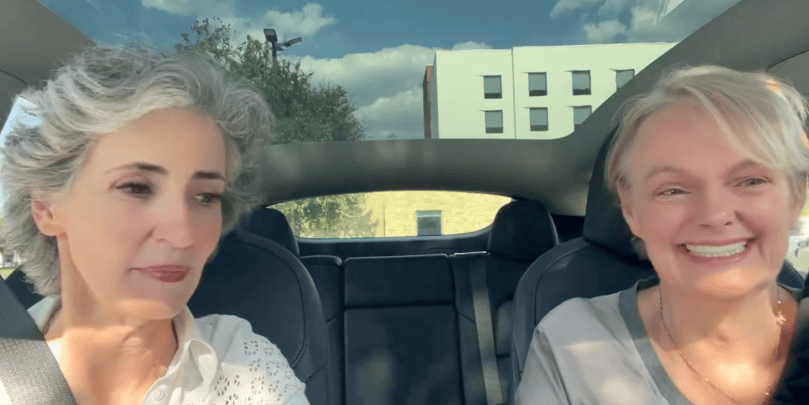
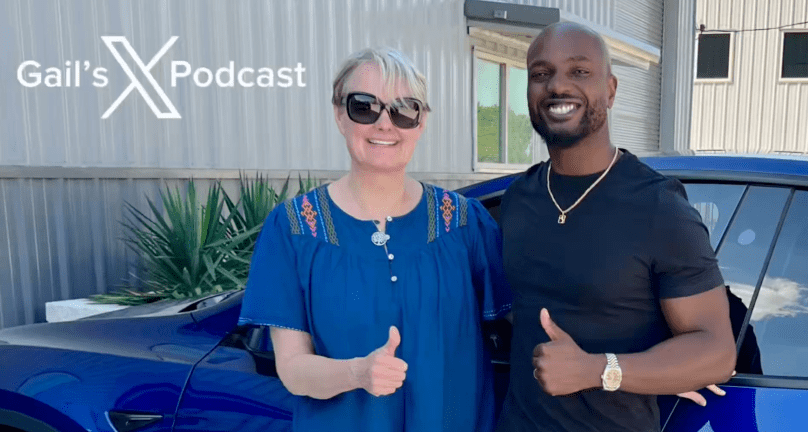
David Moss and Gail Alfar grabbing coffee in Austin, Texas before their in-car FSD conversation for Episode 165 of Gail’s Tesla Podcast. Real-world insights on unsupervised Robotaxi rides in the city’s expanded service zone.

Gail’s Tesla Podcast Episode 165: David Moss Joins In-Car FSD Conversation on Unsupervised Robotaxi Rides in Austin

Episode 165 of Gail’s Tesla Podcast is now live.

In this episode, David Moss joins me inside the car while we drive using Tesla Full Self-Driving (FSD). He shares his firsthand experiences and thoughts after taking multiple unsupervised Robotaxi rides in Austin’s recently expanded service zone.

This is Part 1 of our conversation, with more to come soon. The discussion delivers a real-time, in-car perspective on how Tesla’s autonomous technology is performing in everyday driving conditions across Texas.

Watch the full episode here (or tap the X post for the video):

These in-car rides and conversations highlight the steady real-world progress Elon and the Tesla team continue to deliver every day as Robotaxi service grows in Austin and beyond.

Leave a comment

What stood out most to you in this episode? Have you taken an unsupervised Robotaxi ride in Austin’s expanded zone yet? Drop your thoughts or share your own Tesla story below.

A SpaceX Falcon 9 booster powers skyward with its record 34th launch, carrying Starlink satellites to orbit. This reusability milestone showcases what fresh thinking and rapid iteration can achieve. Photo credit: SpaceX

SpaceX Sets New Record with 34th Booster Landing – Fresh Thinking That Shows Every Kid the Path to Big Dreams

On March 30, 2026, a SpaceX Falcon 9 first-stage booster completed its 34th successful launch and landing after sending another group of Starlink satellites into orbit. That single-rocket record highlights how far reusable technology has come and how quickly it is making space more accessible than ever before.

The story behind that achievement started with an important advantage. When Elon Musk founded SpaceX in 2002, he brought no formal aerospace engineering background to the project. Instead of seeing that as a gap, Elon turned his outsider perspective into one of the company’s greatest strengths. Free from the usual industry assumptions, he and the early team approached every problem with first-principles thinking, asking the questions others had stopped asking and building from the ground up with fresh ideas.

Elon Musk explains how coming from outside the aerospace industry gave SpaceX the freedom to make radical breakthroughs. “I like I said I read a lot of books.” A reminder that self-learning and questioning assumptions open doors for the next generation. Image credit: Screenshot from Overtime interview

Those fresh eyes proved valuable right away. The first three Falcon 1 launches between 2006 and 2008 did not succeed. Rather than giving up, the team treated each flight as valuable data, made fast adjustments, and kept moving forward. On September 28, 2008, the fourth launch worked perfectly. That commitment to rapid learning turned reusability into reality and cut launch costs by more than 80 percent, opening the door to more frequent and affordable missions.

Elon recently highlighted exactly why that outsider approach mattered. In a 2015 interview he shared again on X, he explained how stepping outside traditional aerospace training allowed the team to challenge old limits. He said, “Indeed, it was because I was not from the aerospace industry that SpaceX made such radical breakthroughs. Same for Tesla. Those in the industry would have if they could have.”

Readers on X quickly agreed. People coming from different fields often spot possibilities that those inside the industry have learned to accept as impossible.

For kids today, this record is more than just cool rocket news. It is a clear reminder that you do not need a specific degree or the “perfect” background to help shape the future. Whether you enjoy science class, building projects in your garage, writing code, playing sports, or simply wondering how things work, SpaceX shows what is possible when you stay curious and keep learning from every step. Hard work, smart questions, and the willingness to try again after a setback can open doors that once looked closed.

As Elon said in another interview, “I read a lot of books, talked to a lot of people, and I have a great team”. The path to success is more open than people will often lead you to think. 

SpaceX’s latest milestone proves that bold ideas and steady effort turn “impossible” into “already done.” The next breakthrough in AI, energy, medicine, or any field you care about could start with someone exactly like you, someone who chooses to keep asking the questions everyone else stopped asking long ago. The sky is not the limit. It is just the beginning.

SpaceX Falcon 9 rises through the clouds during its record-setting 34th flight of a single booster on March 30, 2026. Photo credit: SpaceX
A SpaceX Falcon 9 booster powers skyward with its record 34th launch, carrying Starlink satellites to orbit. This reusability milestone showcases what fresh thinking and rapid iteration can achieve. Photo credit: SpaceX

93-Year-Old Finds New Freedom with Tesla Full Self-Driving

Many people might be ready to hand over car keys for good at age 93. And Dan Doyle’s mother is doing the opposite and she’s doing it beautifully.

In a lovely video posted on Dan Doyle’s Family Channel, we get to see Dan’s 93-year-old mom behind the wheel of her brand-new Tesla Model Y with Full Self-Driving (FSD). The footage shows her relaxed and smiling as the car smoothly handles real roads, including the scenic Coronado Bridge drive.

When Dan asks how one of her recent trips went, her simple, perfect response is: “Uneventful.”

That single word says so much. For many seniors, longer drives often come with growing anxiety and fatigue. But with FSD doing the hard work, those worries melt away.

During one drive, Dan playfully tells the car, “Hey, if the worship isn’t good, could you go a little slower?” The Tesla’s Grok voice (Ara) replies with humor: “Huh? Nice one. Hope the worship rocks so we don’t have to slow down.”

Laughing and smiling, his mom immediately adds, “I love that lady.”

Later, while enjoying gelato together, Dan asks, “Life is good, right Mom?” Her bright smile says it all: “Life is good.”

As Dan shares in the video:

“Although she has always been a good driver, my mom can now drive without the fear or fatigue that can naturally come with age. No more relying on others for every trip. No more feeling stuck. This is true mobility.”

The story was first shared on X by citizen journalist Sawyer Merritt, and Dan later confirmed on his X account that his mom still holds a valid driver’s license and owns two other vehicles. She’s simply enjoying the freedom her new Tesla brings.

As someone who uses FSD every day myself, especially lately while recovering from a third-degree ankle sprain, I can personally relate to how meaningful this technology is. When your body isn’t cooperating, having a car that can reliably and safely handle the driving gives you back a piece of your independence.

This is what FSD looks like in real life: not just futuristic tech, but a quiet, powerful tool that helps real people, including a joyful 93-year-old woman, keep living life on their own terms.

Sometimes the most important stories are the simplest ones.

Joyful 93-year-old mom smiling while using Tesla FSD. ‘Life is good,’ she says from the driver’s seat of her Tesla Model Y.

Tesla Model Y with Full Self-Driving smoothly navigating suburban roads for a confident 93-year-old senior driver.

Video:

Elon Musk gave a warm, inviting talk about Terafab to a packed, cheering crowd at the historic Seaholm Power Plant in Austin around 8 p.m. on March 21, 2026,

Elon Musk’s Terafab Announcement: Inside the Joint Tesla-SpaceX-xAI Plan for a Terawatt of AI Compute (Full Transcript)

Elon Musk gave a warm, inviting talk about Terafab to a packed, cheering crowd at the historic Seaholm Power Plant in Austin around 8 p.m. on March 21, 2026,

Elon Musk is one of the most caring and approachable people on Earth, and he gave a warm, inviting talk about Terafab to a packed, cheering crowd at the historic Seaholm Power Plant in Austin. While he spoke around 8 p.m. on March 21, 2026, the city outside was treated to a magnificent blue laser beam that appeared over the entire sky—so striking that a local news station immediately sent out a reporter to cover it. Here is my verbatim transcript of his talk.

Elon Musk:

We have a profoundly important announcement to make, which is the most epic chip-building exercise in history by far.

This is really going to take it to the next level—a level probably people aren’t even contemplating right now. This is not in their context. I would call this sort of an out-of-context problem. So we’re going to adjust the context by a few orders of magnitude here.

Let’s see. It’s a joint effort.

[button press sound]

I’m pressing the button, but the button’s not working. Oh, there we go. Okay.

We aspire to be a galactic civilization. So I think the future that everyone—well, most people, I think would agree—is the most exciting one where we are out there among the stars, where we are not forever confined to one planet, that we become a multi-planet species. Like the best science fiction that you’ve ever read, you know, Star Trek or Iain Banks or Asimov or Heinlein. And we want to make that real. Yeah. Not just fiction. Turn science fiction into science fact. That’s the glorious, exciting future that I certainly look forward to.

It’s worth considering how you would rate civilizations. There was a physicist—I think he was Russian—in the ’60s, Kardashev, and he thought about at a high level how you would classify any given civilization. He said, well, if you’re Type One, you’re using most of the energy of your planet. And we actually still have quite a ways to go to be properly a Type One. We’re still using a tiny fraction of the sun’s energy that reaches our planet.

The Earth only receives about half a billionth of the sun’s energy. So the sun is truly enormous. The sun is 99.8% of all mass in the solar system. So sometimes people will ask me, like, what about other power sources on Earth like fusion on Earth? Well, that is unfortunately very small because the sun is 99.8% of mass in the solar system and Jupiter is about 0.1% and Earth is in the miscellaneous category. We are, I think as Carl Sagan might have said, Earth is like a tiny dust mote in a vast darkness—very, very small. The sun is enormous.

So the way to actually scale civilization is to scale power in space. This is necessarily true because we actually capture such a tiny amount of the sun’s energy on Earth because we’re just this tiny dust mote. Another way to think of it is roughly like electricity production on Earth of all of civilization is only about a trillionth of the sun’s energy. Which means if you increase civilizational power output by a million, you would still only be a millionth of the sun’s energy.

It’s awe-inspiring to consider that, just how tiny we are in the grand scheme of things. We often get sort of caught up in these sort of squabbles on Earth that are really very sort of minor things when you consider the grandness of the universe. I think it is important actually to consider the grandness of the universe and what we can do that is much greater than what we’ve done before, as opposed to worrying about sort of small squabbles on Earth type of thing. Not much point in that! We want to be a civilization that expands to the galaxy with spaceships that anyone can go anywhere they want at any time. That would be epic. And have a city on the moon, cities on Mars, populate the solar system, and send spaceships to other star systems. That sounds like the best possible future.

(applause)

So to do that, we need to harness the power of the sun. A Terafab, while it is enormous—a terawatt of compute per year is enormous by our civilizational standards—is still just one step along the way to being even a Kardashev II level civilization. You’re not even registering as a Kardashev III. So it’s a very big thing by current human standards, but still small in the grand scheme. But it’s very difficult for humans.

To accomplish this very difficult goal really requires a combination of efforts from SpaceX, xAI, and Tesla working together to create this epic Terafab project.

And Tesla, xAI, and SpaceX have all done amazing things that people did not think would be done before. There’s the Giga Texas fab here. There’s the Optimus robot that’s being built. There’s a global supercharging network. There’s really quite a lot.

It wasn’t that long ago when people thought electric cars wouldn’t amount to anything. There were basically no electric cars for sale when Tesla started. People said it was impossible, and now Tesla is making 2 million electric cars a year.

Then xAI, although it’s a new company, now part of SpaceX, has also built the first gigawatt-scale compute cluster in record time. Jensen Huang from Nvidia said he’d never seen anything built so fast in his life before. So, a great compliment from Nvidia.

And then SpaceX… well, you already know. The reusable rockets—people said the reusable rockets weren’t possible, and even if you did them, they wouldn’t be economically feasible. So we did them, and then we made them economically feasible. Now we’ve landed over 500 times. Then we did the Falcon Heavy, and now we’re doing Starship.

Starship is a critical piece of the puzzle because in order to scale compute and scale power, you have to go to space, which means that you need massive payload to space and Starship will enable that.

[Shows picture of scale]

This gives you a sense of scale. We’ve got Optimus there for scale. Optimus is about 5’11”, so it gives you a sense of the size of the Starship V3 rocket. Starship V4 will be much longer. Starship V4 will make Starship V3 look kind of short.

We’ll expand with Starship V3 to 200 tons of payload to orbit, up from 100 tons—we’ll start with V3. You can see that this is just a rough approximation of the mini version of the AI sat. That’s roughly 100 kW. It shows the solar panels and the radiator to scale.

For some reason, there’s been a bizarre debate about radiators in space. It’s safe to say SpaceX knows how to do heat rejection in space with 10,000 satellites in orbit—we might know a thing or two. You can see the radiator is quite small relative to the solar panels.

We call it the minisat since that’s just 100 kW. We expect future satellites to probably go to the megawatt range.

(applause)

In order to get to the terawatt of compute per year, you need about 10 million tons to orbit per year at 100 kW per ton. We’re confident this is feasible—like, no new physics or impossible things are required to get there.

I’m confident that SpaceX will get to 10 million tons to orbit per year. Then we’re building up to a terawatt of solar, which will solve the power generation problem.

The key missing ingredient is therefore a terawatt of compute. This announcement is about solving the key missing ingredient.

To give you a sense of what we’re talking about, the current output of AI compute is roughly 20 gigawatts per year. This chart explains why we need to build the Terafab, because all of the rest of the output from Earth is about 2% of what we need.

[Shows chart]

If you add up all the fabs on Earth combined, they’re only about 2% of what we need for the Terawatt Project, or Terafab project.

We certainly want our existing supply chain, to be clear. We’re very grateful to Samsung, TSMC, Micron, and others, and we would like them to expand as quickly as they can. We will buy all of their chips—I’ve said these exact words to them.

But there’s a maximum rate at which they’re comfortable expanding, and that rate is much less than we would like. So we either build the Terafab or we don’t have the chips. And we need the chips. So we’re going to build the Terafab.

We’re starting with an advanced technology fab here in Austin. I believe Governor Abbott is in the audience. I’d like to thank Governor Abbott and the state of Texas for their support.

(applause)

In the advanced technology fab, we will have all of the equipment necessary to make a chip of any kind—logic or memory—and we will also have all of the equipment necessary to make the lithography masks. In a single building, we can create a lithography mask, make the chip, test the chip, make another mask, and have an incredibly fast recursive loop for improving the chip design.

To the best of my knowledge, this does not exist anywhere in the world. Where you’ve got everything necessary that you need to build logic, memory, do packaging and test it, and then do the masks, improve the masks, and just keep looping it. We’re not going to just do conventional compute in this. I think there’s some very interesting new physics that I’m confident will work—just a question of when.

We’re really going to push the limit of physics in compute and we’re going to try a bunch of wild and crazy things which you can do if you’ve got that fast iteration loop. I can’t emphasize enough the importance of being able to make a chip, test it, and then change the design, do another one, and have that in a single building.

I think that our recursive improvement with that situation is probably an order of magnitude better than anything else in the world.

(applause)

So, broadly speaking, we expect to make two kinds of chips. One will be optimized for edge inference. So that’ll be used primarily in Optimus and in the cars but especially in Optimus because I expect the humanoid robots to be made 10 to 100 times more than the volume of cars. So if vehicle production on Earth is about 100 million vehicles a year and I expect humanoid robot production to be somewhere between a billion and 10 billion units a year. So it’s a lot. Tesla’s going to make a very significant percentage of those, is our goal!

And then we need a high-power chip that is designed for space that takes into account the more difficult environment in space where you’ve got high power, you’ve got high-energy ions, photons, you got electron buildup. It’s a hostile environment in space. So you want to design the chip, you want to optimize it for space and you also want to generally run it a little hotter than you would normally run a chip on Earth to minimize the radiator mass. So there are just a bunch of constraints that you would design something differently in space than you would on the ground.

For the space compute, my guess is that is the vast majority of the compute because you’re power-constrained on Earth. That’s why I think it’s probably 100 to 200 gigawatts a year of terrestrial chips and probably on the order of a terawatt of chips in space—just because of power constraints on the ground. Space has this advantage that it’s always sunny. It’s very nice.

I actually think that the cost of deploying AI in space will drop below the cost of terrestrial AI much sooner than most people expect. I think it may be only two or three years before it is actually lower cost to send AI chips to space than it is on the ground. Because in space you don’t need much in the way of batteries. It’s always sunny. And the solar power you get, you’re going to get at least five or more times the solar power you get in space versus the ground, because you don’t have atmospheric attenuation or a day-night cycle or seasonality, and you’re always normal to the sun. So you’re really maximizing the solar power at that point. And this space solar actually costs less than terrestrial solar because you don’t need heavy glass or framing to protect it from extreme weather events.

So as soon as the cost to orbit drops to a low number, it immediately makes extremely compelling sense to put AI in space. It becomes a no-brainer, basically. Moreover, as you go to space, you get increased economies of scale and things get easier over time. Whereas, as you try to put more and more power on the ground, you run out of space and you start using up the easy spots and then you get next-level NIMBY—nobody wants the thing in their backyard. So actually increasing power on Earth becomes harder over time and more expensive over time but in space it becomes actually cheaper and easier over time. These are very important points.

What you just saw there was, because of course you’re asking, what’s on your mind, is well, what do you do after a Terafab? Don’t think small. Well, yeah, good point. So, you know, how do you get to a petawatt? That is the obvious next question. And you get there by having an electromagnetic mass driver on the moon with robots with Optimi and obviously lots of humans. And with that you can send a petawatt, you can create a petawatt of compute and send that to deep space. Because the moon has no atmosphere and has one-sixth of Earth gravity, so you can—you don’t need rockets on the moon. You can literally accelerate it to escape velocity from the surface and that dramatically drops the cost once again of harnessing power and enables you to go a thousand times bigger than a terawatt.

For sure, the future I want to see—I want us to live long enough to see the mass driver on the moon because that’s going to be incredibly epic. That should hopefully get us to a millionth of the sun’s energy at least. It’s humbling to think about that, but a millionth of the sun’s energy would be a million times bigger than Earth’s economy. So it’s good from that perspective. You expand beyond that to the planets, to the other stars, and create the most exciting possible future that I can imagine.

This looks a bit like the opening of Idiocracy with a Mike Judge unlocking an age of amazing abundance. Yeah. Obviously, the elements of that are sustainable energy, space travel, and AI and robotics that bring amazing abundance to everyone. It’s really the only path to amazing abundance: AI and robotics. Which is not to say it can’t go wrong. Hopefully, you know, but I think it’ll probably go right and it’ll be a future that you love. It’s the best future I can think of at least.

And then we go beyond the moon, beyond Mars, and we sail through the rings of Saturn. Now, wouldn’t it be amazing if you could buy a trip to Saturn? Or frankly, if you just have a trip to Saturn. I think things will just be free in the future. It sounds nuts, but you know, if you’ve got an AI robotics economy that is anywhere close to a million times the size of the current Earth economy, literally any need you possibly want can be met. If you can think of it, you can have it.

So I think Iain Banks in his Culture books has it pretty much right, where there actually isn’t money in the future and there’s abundance for everyone. If you can think of it, you can have it. That’s it. Which means anyone could have a trip to Saturn. It won’t be, you know, just a few people. If you want it, you can have it.

Help us design incredible chips and make incredible chips and build a terawatt of chips, a terawatt of solar, and 10 million tons to orbit per year. Thank you.

Deaf Driver Shows How Tesla’s Self-Driving System “Hears” Sirens He Can’t

On 23 March 2026, Daniel Geiger posted a 22-second screen-recording that quietly went viral. The California driver, who is deaf, showed his Tesla’s Full Self-Driving feature automatically detecting an approaching ambulance’s lights, pulling over safely and stopping, all before the vehicle reached him. “I’m deaf and can’t hear sirens,” he wrote, “but my Tesla FSD pulled over instantly for an ambulance. … This is why FSD is huge for deaf drivers: it ‘hears’ what I can’t and keeps everyone safer.”

Geiger is an ordinary working professional, not an influencer or company employee. A Long Island native from Moriches, New York, he played college lacrosse at Sacred Heart University (class of 2005) and earned a degree in Information Technology. He now lives in Auburn, California, and works as an IT security specialist for the California Department of Social Services. On social media he talks about sports, state taxes, potholes and, occasionally, how technology intersects with disability.

The incident occurred on 23 March 2026 during a normal drive in the greater Sacramento area. The car’s multimodal sensors (cameras plus the audio-siren detection rolled out in late 2024) handled the situation smoothly. Geiger simply shared the app recording to illustrate one benefit for deaf drivers.

For Americans the context is immediate. Under California Vehicle Code 21806, drivers must yield the right of way to any emergency vehicle using lights and siren: move to the right edge of the road and stop until it passes. Failure to do so is an infraction carrying a base fine of about $490 plus one point on your DMV record. Similar “move-over” or yield laws exist in every state because seconds can mean lives. Deaf drivers follow the same rules but cannot hear the siren that usually alerts everyone else. Geiger’s video shows how one vehicle system can fill that sensory gap while still obeying the same traffic laws everyone else must follow.

He posted the clip because he wanted to highlight a practical safety tool, not to sell cars. The response from other deaf drivers and everyday motorists suggests the story resonated beyond brand loyalty: it showed technology quietly making an existing legal obligation easier to meet for people who otherwise rely on visual cues alone.

Elon Musk’s Terafab Project: Toward a Tesla-SpaceX Convergence?

On March 21, 2026, at the historic Seaholm Power Plant in Austin, Elon Musk unveiled Terafab: a $20–25 billion semiconductor factory, the result of cooperation between Tesla, SpaceX, and xAI. The stated objective: to produce more than one terawatt of computing power per year, equivalent to nearly the entire current electric power capacity of the United States.

Eighty percent of this capacity would be dedicated to orbital data centers, powered by space-based solar energy via SpaceX launchers. The remainder would supply Tesla’s autonomous vehicles, Optimus humanoid robots, and xAI’s artificial intelligence models. Musk summed it up bluntly: “Either we build Terafab, or we won’t have the chips.”

This project marks a new stage in the vertical integration of the entrepreneur’s companies. While no formal rapprochement has been confirmed, the pooling of resources between a publicly traded company (Tesla) and a private enterprise (SpaceX) is fueling speculation about a deeper merger. Analysts such as Gary Black warn of dilution risks for Tesla shareholders and regulatory obstacles.

For Europe, which is investing heavily through the Chips Act to reduce its dependence on Asian foundries, Terafab illustrates both a threat and a strategic question. An unprecedented concentration of computing capacity in private American hands could disrupt global supply chains. Musk, for his part, presents the project as a response to Earth’s energy limits and a means of ensuring that human knowledge can survive beyond the planet.

The challenges remain immense: Tesla and SpaceX have no experience manufacturing 2-nanometer chips, the capital expenditure is colossal, and timelines remain unclear. The market reacted cautiously: Tesla’s share price barely moved.

Whether Terafab succeeds or not, one thing is clear: Musk’s ecosystem is evolving toward unprecedented industrial integration. Europe, which has always believed in large collective adventures—Airbus, Ariane, ITER—is watching this new form of private competition closely. The future will show whether it can respond.

Tesla Cybercab Robotaxi open door view during Gail’s autonomous ride to SXSW in Austin, Texas. Real-world FSD in action – spacious interior and sunny downtown streets captured in Episode 164 of Gail’s Tesla Podcast.

Gail’s Tesla Podcast Episode 164: Robotaxi Ride to SXSW with Optimus, Cybercab, and Exclusive Interviews

In this episode, I hopped into a Robotaxi and rode straight to SXSW in Austin. The autonomous drive was smooth and confident as we moved through city streets, delivering another strong example of Tesla’s real-world FSD progress in Texas.

At the event I spent time with both Optimus and the Cybercab. The displays looked impressive under bright Texas sunshine during the day and equally striking with starlight views at night. I also recorded rare interviews with David Moss and Josh West — two dedicated voices in the Tesla community who shared their perspectives on autonomy and the future of abundance.

This episode captures practical Robotaxi use, up-close looks at Tesla’s latest robotics and vehicle tech, and thoughtful conversations about where the technology is headed right now.

Watch the full episode here (or tap the X post for the video):

These clips show the steady advancements Elon and the Tesla team continue to deliver every day — from everyday autonomous rides to next-generation robots and vehicles already appearing in public.

Leave a comment

What stood out most to you in this episode? Have you taken a Robotaxi ride yet or seen Optimus in person? Are you excited about Tesla’s push toward abundance? Drop your thoughts or your own Tesla story below.

Tesla Cybercab Robotaxi open door view during Gail’s autonomous ride to SXSW in Austin, Texas. Real-world FSD in action – spacious interior and sunny downtown streets captured in Episode 164 of Gail’s Tesla Podcast.