Elon Musk: “We are going to make solar. Okay, great. Both SpaceX and Tesla are building towards 100 gigawatts here of solar cell production.”

Elon Musk with Dwarkesh Patel & John Collison – The Future of AI is in Space – Part 4: Turbine Bottleneck & Space Solar (Full Transcript)

In Part 4, John Collison asks whether Elon would try to solve the turbine shortage himself or go straight to manufacturing solar at enormous scale. Elon reveals that SpaceX and Tesla are already moving toward 100 gigawatts of solar cell production and explains why solar cells destined for space are dramatically cheaper and easier to produce than those on Earth. He also gives a detailed breakdown of why most people severely underestimate how much power a real AI data center actually requires.

Transcript:

John Collison suggested that the turbine blade bottleneck sounded like the kind of problem Elon would want to attack directly, and proposed that making solar themselves might be the smarter long-term path.

Elon Musk: “We are going to make solar. Okay, great. Both SpaceX and Tesla are building towards 100 gigawatts here of solar cell production.”

Dwarkesh Patel asked how deep into the supply chain they planned to go — from raw polysilicon all the way to finished solar panels.

Elon Musk: “I think you got to do the whole thing from raw materials to the finished cell. Now, if it’s going to space, it actually costs less. And it’s easier to make solar cells that go to space because they don’t need glass or they don’t need much glass and they don’t need heavy framing because they don’t have to survive weather events. There’s no weather in space. So it’s actually a cheaper solar cell that goes to space than the one on the ground.”

Elon emphasized that solar is already extremely cheap on Earth, but moving it to space changes the economics dramatically.

Elon Musk: “Solar cells are already very cheap. They’re like farcically cheap. And if you say, I think solar cells in China are around like 25, 30 cents a watt or something like that, it’s absurdly cheap. And when you take into account now put it in space and it’s five times cheaper because it’s five times — in fact, no, it’s 10 times cheaper because you don’t need any batteries. So the moment your cost of access to space becomes low, by far the cheapest and most scalable way to generate tokens is space. It’s not even close. It’ll be an order of magnitude easier to scale.”

He then shared the real-world difficulties his team faced just getting one gigawatt of power online for the Colossus supercluster.

Elon Musk: “And chips aside, an order of magnitude. The point is you won’t be able to scale on the ground. You just won’t. People are going to hit the wall big time on power generation. There already are. So the number of miracles in series that the xAI team had to accomplish in order to get a gigawatt of power online was crazy. We had to gang together a whole bunch of turbines. And then we had permit issues in Tennessee and had to go across the border to Mississippi, which is fortunately only a few miles away. But then we still had to run the high power lines a few miles and build a power plant in Mississippi. And it was very difficult to build that.”

Elon then explained why most people dramatically underestimate how much electricity is actually needed at the generation level to run a real AI data center.

Elon Musk: “And people don’t understand how much electricity do you actually need at the generator level, at the generation level in order to power a data center? Because they look at the specs, will look at the power consumption of say a GB 300 and multiply that by the number and then think that’s the amount of power you need.”

John Collison noted that even those calculations miss major additional loads like cooling and supporting systems.

Elon Musk: “Wake up. Yeah, that’s a total noob. You’ve never done any hardware in your life before. Besides the GB 300, you’ve got to power all of the networking hardware. There’s a whole bunch of CPU and storage stuff that’s happening. You’ve got to size for your peak cooling requirements. So that means can you cool even on the worst hours, the worst day of the year? Well, it gets pretty freaking hot in Memphis, so you’re going to have like a 40% increase on your power just for cooling.”

He continued breaking down the additional multipliers that are almost always overlooked.

Elon Musk: “Assuming you don’t want your data center to turn off on hot days and you want it to keep going, then you’ve got to say, well, there’s another multiplicative element on top of that, which is are you assuming that you never have any hiccups in your power generation? Like, oh, well, actually sometimes we have to take the generators, some of the power offline in order to service it. Oh, okay, now you add another 20, 25% multiplier on that because you’ve got to assume that you’ve got to take power offline to service it. So the actual — roughly every 110,000 GB 300s inclusive of networking, CPU, storage, cooling, margin for servicing power is roughly 300 megawatts.”

John Collison asked him to repeat the number for clarity.

Elon Musk: “It’s roughly — or think about it like a way to think about it is like 330,000. What you need at the generation level to service, probably service 330,000 GB 300s, including all of the associated support, networking and everything else, and the peak cooling and to have some power margin reserve is roughly a gigawatt.”

Elon breaks down why naive power calculations for AI data centers fall far short of reality and why space-based solar could be the only way to scale at the required speed. I

n Part 5, the conversation continues with more on the challenges and opportunities of building at this scale.
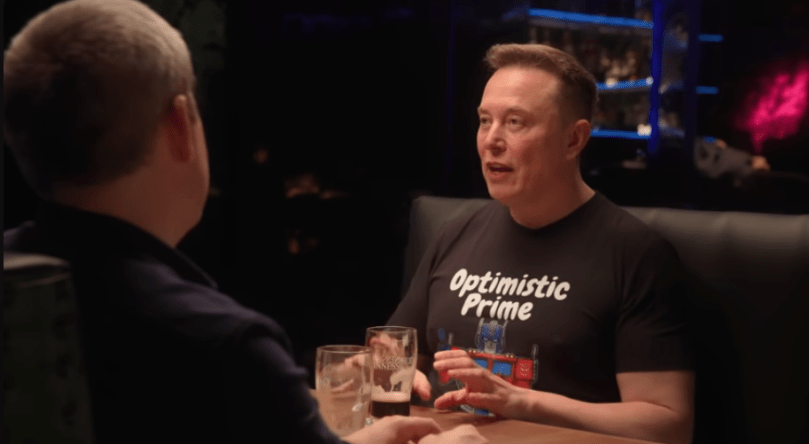
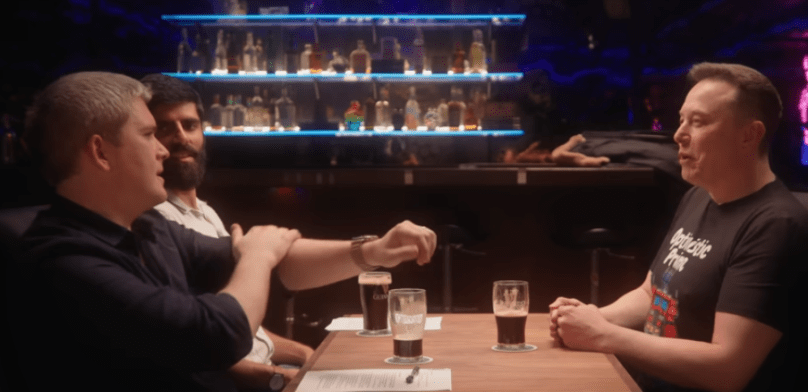
Elon Musk on The Massive Scale of Power Requirements and Utility Bottlenecks

Elon Musk with Dwarkesh Patel & John Collison – The Future of AI is in Space – Part 3: The Massive Scale of Power Requirements and Utility Bottlenecks (Full Transcript)

In Part 3, the conversation turns to the enormous scale of power required to run advanced AI at the level Elon envisions. Dwarkesh Patel and John Collison press Elon on the real-world challenges of building terawatts of electricity generation and why the utility industry is such a major bottleneck. Elon explains why private power plants co-located with data centers may be the only practical solution.

Transcript:

Dwarkesh Patel sought clarification on the scale Elon was describing, confirming that he was talking about terawatts of power. The discussion then moved to the extreme difficulty of actually building that much electricity generation at the speed AI development requires.

Elon Musk: “Yeah, well, all of the United States currently uses only half a terawatt per hour on average. Right. So if you say a terawatt, that would be twice as much electricity as the United States currently consumes. So that’s quite a lot. And can you imagine building that many data centers, that many power plants? It’s like those who have lived in software land don’t realize that they’re about to have a hard lesson in hardware, that it’s actually very difficult to build power plants. And then you don’t just need the power plants, you need all of the electrical equipment, you need the electrical transformers to run the transformers, the AI transformers.”

Elon pointed out that the utility industry moves extremely slowly because it is heavily regulated and “impedance matched to the government.”

Elon Musk: “Now, the utility industry is a very slow industry. They impedance match to the government, to the public utility commission. So they’re very slow because their past has been very slow. So trying to get them to move fast is just like, you know, if you’re trying to do an interconnect agreement… have you ever tried to do an interconnect agreement with a utility at scale? Like with a lot of power?”

Dwarkesh Patel laughed and admitted that, as a podcaster, he had never tried to do an interconnect agreement with a utility.

“Now, the utility industry is a very slow industry. They impedance match to the government, to the public utility commission. So they’re very slow because their past has been very slow. So trying to get them to move fast is just like, you know, if you’re trying to do an interconnect agreement… have you ever tried to do an interconnect agreement with a utility at scale? Like with a lot of power?” – Elon Musk

Elon Musk: “In fact, yeah, they have to do a study for a year. Okay. Like a year later they’ll come back to you with their interconnect study.”

John Collison asked whether companies could simply bypass the utility bottleneck by building their own private power plants right next to the data centers.

Elon Musk: “You can build power plants. Yeah, that’s what we did at xAI for Colossus.”

John Collison followed up, asking why this private-power approach wasn’t being treated as the obvious solution to the utility problems they had been discussing.

Elon Musk: “Right. But it begs the question of where do you get the power plants? Where do you get the power plants from? I mean the power plant makers.”

John Collison summed up the deeper issue: there is currently a massive backlog for gas turbines and power plant equipment in general.

Elon highlights that even if companies build their own power plants, they still face major constraints in actually obtaining the equipment. In Part 4, the discussion continues with more on the practical challenges of scaling AI infrastructure at this level.

Elon makes a bold prediction that space will become the cheapest place to run AI within three years.

Elon Musk with Dwarkesh Patel & John Collison – The Future of AI is in Space – Part 2: Why Space Is the Optimal Place for AI (Full Transcript)

In Part 2, Dwarkesh Patel and John Collison explore whether space could actually be better than Earth for running massive AI infrastructure. They raise practical concerns around regulation, servicing failing GPUs, and power generation. Elon Musk has a strong case for orbital compute, highlighting the dramatic advantages of space-based solar power.

Transcript:

Dwarkesh Patel suggested that space might mostly be a regulatory advantage, since it’s harder to build big infrastructure on land than in space. He also asked how you would service GPUs when they fail — which happens quite often during large training runs.

John Collison added questions about solving the power problem, specifically whether private behind-the-meter generation co-located with data centers could work.

Elon Musk: “It’s harder to scale on ground than it is to scale in space. But also, you’re going to get about five times the effectiveness of solar panels in space versus the ground.

And you don’t need batteries. I almost wore my other shirt, which says ‘it’s always sunny in space,’ which it is. Because you don’t have a day-night cycle or seasonality, clouds, or an atmosphere in space.

The atmosphere alone results in about a 30% loss of energy. So any given solar panel can do about five times more power in space than on the ground, and you avoid the cost of having batteries to carry you through the night.

So it’s actually much cheaper to do in space. And my prediction is that it will be by far the cheapest place to put AI will be space in 36 months or less.”

Elon makes a bold prediction that space will become the cheapest place to run AI within three years. In Part 3, the conversation continues with more details on the technical and economic realities of moving AI infrastructure off Earth.

And my prediction is that it will be by far the cheapest place to put AI will be space in 36 months or less. – Elon Musk

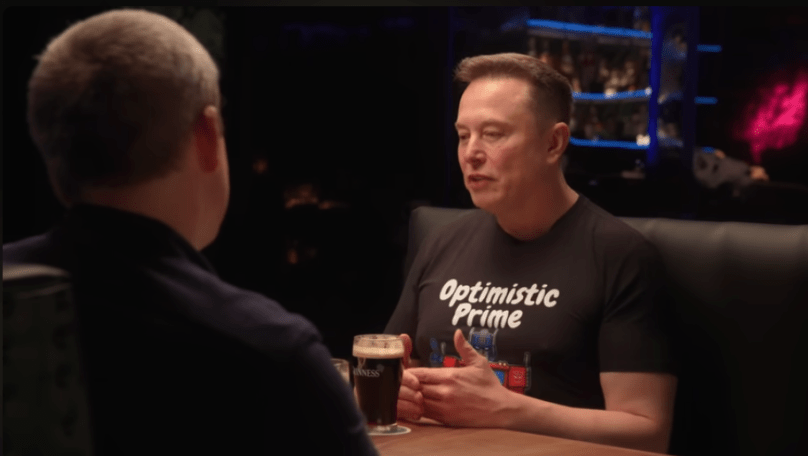
Picture of Elon Musk as he jokingly questioned whether they were really going to talk for three full hours. Dwarkesh Patel teased him in return, saying he didn’t have much to talk about. Elon reacted with mock surprise.

Elon Musk on Why the Future of AI Will Be in Space with Dwarkesh Patel & John Collison – Part 1 (Full Transcript)

Part 1: Opening Banter and the Economics of Space-Based Data Centers

The interview opened with some light-hearted and playful banter. Elon Musk jokingly questioned whether they were really going to talk for three full hours. Dwarkesh Patel teased him in return, saying he didn’t have much to talk about. Elon reacted with mock surprise.

Elon Musk: “So are there really three hours of questions or are you fing serious?” Elon Musk: “Holy f, man.”

John Collison jumped in, agreeing that it was actually the most interesting time because all the major storylines seemed to be converging at once. Elon playfully replied that it was almost as if he had planned it that way.

Elon Musk: “Almost like I planned it.”

John Collison laughed and said “Exactly.”

Elon Musk: “That would never do such a thing.”

With the lighthearted tone set, Dwarkesh Patel steered the discussion into the first major topic: the economics of data centers and why anyone would consider moving them into space. He explained that in a typical data center, energy accounts for only 10 to 15 percent of total cost of ownership, with GPUs representing the vast majority of the expense. He pointed out that placing those GPUs in space would make servicing nearly impossible, shortening their depreciation cycle and driving costs far higher, then asked directly what possible reason there could be to put them in orbit anyway.

Elon Musk: “Well, the availability of energy is the issue. So, I mean, if you look at electrical output outside of China, everywhere outside of China, it’s more or less flat. It’s very, you know, maybe a slight increase, but pretty close to flat. China has a rapid increase in electrical output. But if you’re putting data centers anywhere except China, where are you going to get your electricity? Especially as you scale, the output of chips is growing pretty much exponentially, but the output of electricity is flat. So how are you going to turn the chips on? Magical power sources. Magical electricity fairies.”

Dwarkesh Patel followed up by noting Elon’s well-known advocacy for solar power, calculating that one terawatt of solar (requiring about 4 terawatts of panels at 25 percent capacity factor) would cover only 1 percent of U.S. land area, yet even that seemed insufficient once data centers themselves reached terawatt scale. He asked what exactly we are running out of. Elon pressed him on how far into the singularity he thought we already were, and Dwarkesh turned the question back. Dwarkesh then asked whether the plan was to move to space only after blanketing places like Nevada with solar panels on the ground.

Elon Musk: “Right.”

Elon Musk: “Yeah, exactly. So I think we’ll find we’re in the singularity and like, okay, we’ve still got a long way to go.”

Elon Musk: “I think it’s pretty hard to cover Nevada in solar panels. You have to get permits from, try getting the permits for that.”

Read on part Parts 2-10.

Elon Musk Moonshots Interview with Peter Diamandis & Dave Blundin – Part 4: Games, Compute & Reality (Full Transcript)

In Part 3, Elon revealed how xAI is forcing a gigawatt-scale breakthrough in AI training power. Now Peter’s son Jet (age 14) inspires the next turn: gaming and AI’s role in it.

Peter D.: My other son Jet, who’s 14, wanted to know about your AI gaming studio and the impact of AI in the gaming world. What are your thoughts?

Elon’s origin story surfaces.

Elon: Yeah, that’s why I started programming computers… Civ was actually a very— in terms of games that educate you while you have fun, Civ is epic at that.

Dave jumps in.

Dave B.: The only way I ever win is getting off the planet… Tech victory to Alpha Centauri.

Elon: I guess I am sort of aiming for the Alpha Centauri tech victory essentially.

The analogy is perfect: civilization’s true win condition isn’t domination — it’s escape velocity.

Elon: Aspirationally [building an AI gaming studio].

Because:

Elon: The vast majority of AI compute is going to go to video consumption and generation… Real-time video generation. That’s going to be the vast majority of AI compute. Photon processing.

Peter floats an X Prize for Universal High Income governance. Elon is open but skeptical on measurement.

Then the conversation ascends to simulation theory.

Elon: The most interesting outcome is the most likely… Only the simulations that are the most interesting will survive. Because when we run simulations, we truncate the ones that are boring.

Terrible things can still happen — they keep it engaging. Like watching a war movie while eating popcorn.

Dave B.: So the guys running the simulation have immensely boring lives compared to us.

Elon: Yeah, because when we create simulations, they’re a distillation of what’s interesting.

Are we in Act 3? The room leaves it open.

This segment closes on the biggest frame possible: Reality as a game where the win condition is expansion, energy mastery, and keeping it interesting.

My two cents: Think about what you can remember from your past. You’re probably like me and mostly recall just the spicy parts of your life. So what were you doing on March 3, 2023? Good question—and a troubling one.

Our minds are made of a string of memorable events. For myself, I sought to create the most vivid memories possible when I was young. Soon, I’ll be publishing a book for you that will include some very vivid experiences I had living in Italy when I was 21–22 years old.

I encourage you to create your most important memories when you’re younger—and then you’ll carry those memories with you for your entire beautiful life. But you’re never too old to create memories!

Elon Musk Moonshots Interview with Peter Diamandis & Dave Blundin – Part 3: Energy Foundation & Abundance (Full Transcript)

In Part 2, Elon dropped a bold bet on ultra-clean chip fabs where you could eat a cheeseburger without contaminating wafers. Now the conversation shifts to our future of abundance: energy.

Sitting in the glorious front lobby of Gigafactory Texas in Austin, Peter steers toward the concerns people in America are thinking about today: energy, health and education. Elon doesn’t hesitate because it is right in sync with his Master Plan 4 for Tesla.

Peter D.: I want to talk about energy, health, education, because those are people’s concerns. So on the energy front, the innermost loop of everything that you’re building and…

Elon: Doing right now, energy is the foundation.

Peter D.: What’s your vision for energy abundance? The sun in the next, you know, this decade. The sun. Yeah.

Elon: I mean, so the sun is everything.

Elon drives the point home with scale that rewires your brain

Elon: People just don’t understand how solar is everything. So everything compared to the sun, all other energy sources are like cavemen throwing some twigs into a fire.

The sun is over 99.9% of the solar system’s mass. Burn Jupiter? Still rounds to 100%. Burn four Jupiters? Same story.

Fusion?

Peter D.: Any interest in fusion?

Elon: Yeah, you know, coming— never going to guess how the sun works.

Peter D.: Giant coal plants.

Elon: I mean we have a giant free fusion reactor that shows up every day 93 million miles away. It’s farcical for us to create little fusion reactors. That would be like having a tiny ice cube maker in the Antarctic and saying, “Hey look, we made ice.”

Solar is the only scalable path

Dave narrows to the immediate bottleneck: powering the Memphis supercluster.

Dave B.: If you just narrow the question to the Memphis timeline. Between a gigawatt and 10 gigawatt. You’re not going to pull 10 gigawatts out of Memphis.

Elon: Maybe two or three.

They’re still in “Toyland” at 10 GW scale — yet xAI is already pushing boundaries.

Peter drops a plug for his Metatrends research, then presses on China’s solar dominance.

Peter D.: China has done an incredible job… They put in 500 terawatt hours in the last year, 70% solar. And they’re just scaling.

Elon: China has done an incredible job on solar. Yeah, it’s amazing. Production capacity around 1,500 gigawatts per year of solar.

The US lags. Energy = GDP = quality of life. The group agrees: America must scale solar aggressively. Tesla and SpaceX are already all-in.

The discussion turns to the GPU power crunch — why TSMC worries about overproducing chips.

Elon: If chip output is growing exponentially, but power harnessed is growing in a slow, linear fashion, then chip production can exceed the rate at which the AI chips can be turned on.

You need transformers, cooling, liquid-cooled racks. One burst pipe? A billion dollars gone.

xAI is solving it first

Elon: xAI is going to have the first gigawatt training cluster at Colossus 2 in Memphis… Mid-January will be a gigawatt… then 1.5 gigawatts probably April-ish.

My 2 Cents

It is amazing that xAI brought together natural gas turbines + Tesla Megapacks to smooth massive power swings for the data center ijn Memphis, and soon to be expanded to Southhaven, Mississippi. It is a symphony of engineering miracles! The finest engineers in Austin and Palo Alto, some even from SpaceX, and the future vision to seek only truth, beauty, and stay curious!

Part 4 dives into gaming, Civilization’s tech victory, and simulation theory.

Tesla Plans 304-Stall Supercharger Station in Firebaugh

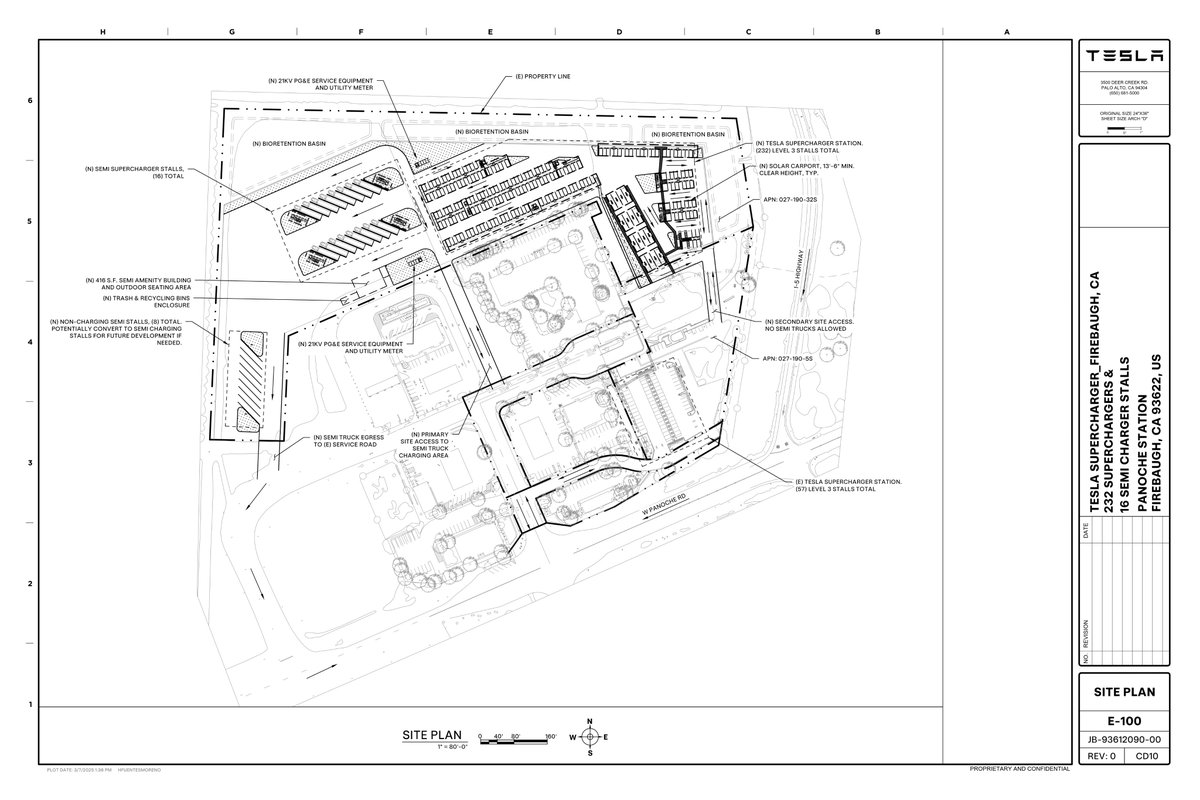
Tesla plans to build the world’s largest Supercharger station with 304 stalls, including 16 for Tesla Semis, in Firebaugh, California.

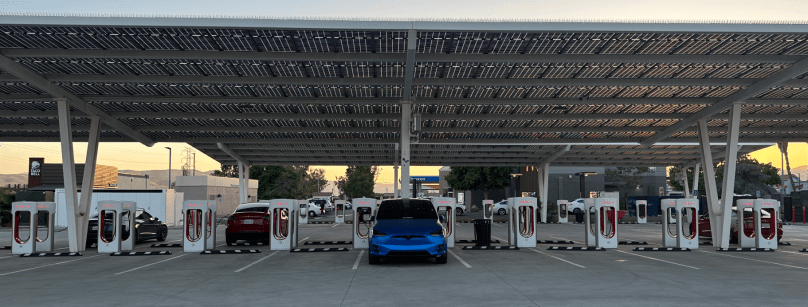
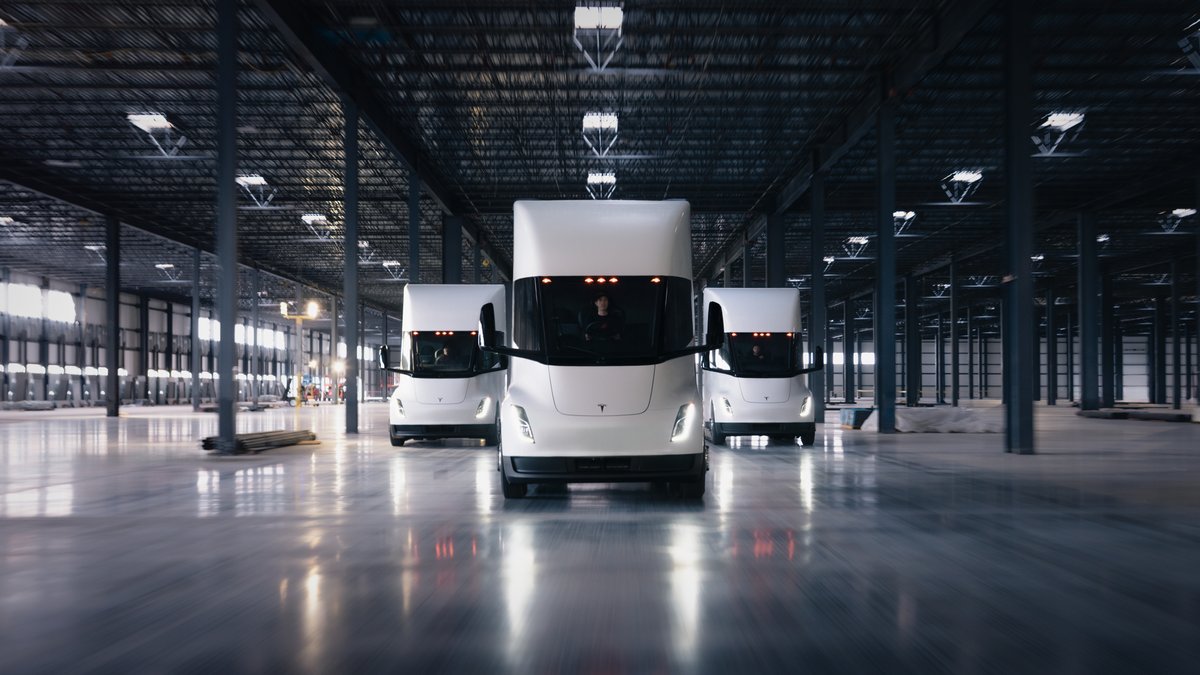
Tesla plans to expand its existing Supercharger site in Firebaugh, California, into the world’s largest with a total of 304 stalls — 288 for passenger vehicles and 16 dedicated for Tesla Semis — once complete.

This represents an 85% increase over Tesla’s current largest site (164 stalls at Oasis in Lost Hills, California). The project, approved via a conditional use permit last month, adds 232 new car stalls to the existing 56 (some sources note the current count as around 72, but the core expansion figure holds). It includes a separate area for Semi operations with its own access routes, plus an amenity building and outdoor seating primarily for truck drivers.

Here are examples of large-scale Tesla Supercharger sites for context:

Tesla: Largest Supercharger in the world: 168 charging spaces, 100 ...
Tesla Opens Its Largest Solar-Powered Supercharger Site in ...

Firebaugh sits along Interstate 5, a key corridor connecting Southern California ports to Central Valley and Bay Area distribution hubs. This strategic spot has made it a priority since the original site opened in 2020 as Tesla’s then-largest in the US with 56 stalls.

Why Firebaugh and why now

The expansion reflects long-term planning by Tesla’s charging team, coordinated with local utilities and jurisdictions. It accounts for forecasted EV adoption growth, with built-in flexibility to adjust pace based on real demand.

A Tesla Charging team member with years of experience emphasized this deliberate approach.

Here is the post from Tesla’s Max DeZegher, who has been building Superchargers since 2014:

The site’s location supports both consumer travel and commercial trucking, especially as Tesla ramps up the Semi program. Dedicated Megachargers for Semis signal confidence in heavy-duty electric transport along this major freight route.

Reactions from Tesla enthusiasts and observers

Enthusiasts and Tesla-focused accounts quickly highlighted the scale as a bold step in infrastructure for EVs and trucking.

Sawyer Merritt broke down the details early, noting the existing 56 stalls.

Here are key posts capturing the excitement:

So what

This move positions Tesla far ahead in high-capacity charging, especially as more non-Tesla EVs gain access to Superchargers and Semi deployments increase. It underscores the company’s commitment to scaling ahead of demand along critical corridors, potentially reducing wait times and supporting broader EV and electric trucking adoption in California and beyond.

Firebaugh’s rural setting along I-5 provides ample space for this growth.

Here is a map view of the Firebaugh area:

Map of Firebaugh city - Thong Thai Real

Elon Musk Moonshots Interview with Peter Diamandis – Part 1: AGI, Abundance & The Future (Full Transcript)

PART ONE

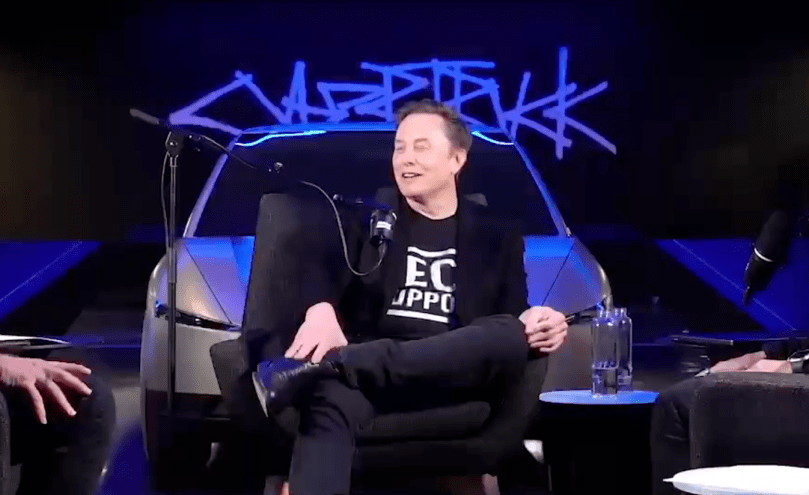
(Austin, TX) The setting is Tesla Gigafactory Texas, in Austin, the lobby is futuristic, Elon sits intentionally in front of a mural for Cybertruck with a prototype of a Cybercab right behind him. You can feel his confidence as he relaxes in his jeans, black T-shirt, and cowboy boots. This is a man who is changing the world.

THIS ARTICLE WAS UPDATED ON JAN 18TH, 2026

As the interview starts, Peter asks Elon how he is, and Elon responds, his mind on chips for Tesla, “Right now, putting a lot of time into chips”

I recall when I accompanied Johnna Crider to interview Elon in 2022. Then, you’d ask Elon how he was, and he had his mind on scaling production. Elon is deeply involved with his teams at Tesla, I think it may be what occupies his thoughts the most. Today, Peter asks Elon if he is personally putting a lot of time into chips. Great point, as most CEOs “tell” others to do the hard work. With Elon, he does the hard work. He always has. In fact, shortly after this interview, Elon posted here on X indicating his immersion into Tesla Chip design.

Diamandis: You are personally? (putting time into chips?)

Elon Musk: Yeah

Blundin: With some AI assistance, I assume…

Dave Blundin has joined this interview, taking time off from teaching his AI class at MIT.

Elon Musk: Not enough, haha. It’d be nice if we could just hand it off to the AI.

Blundin: I tried to do some circuit design actually with AI recently, just a couple weeks ago. Not happening yet.

Elon Musk: Ahh, very soon, though. I think probably at this point, Grok, if you took a photo and submitted to Grok, it could probably tell you if a circuit is—if there’s something wrong with it.

Blundin: All right, I’m going to give it a shot. You’re using the same Grok that I’m using?

Elon Musk: Grok keeps updating.

Dave Blundin: So 4.2. But 5 is soon, right?

Elon Musk: 5 is Q1. 4.2 has not been released yet externally, but yeah, I mean, if you just upload an image into Grok, it does quite a good job of analyzing any given image. Let’s see if I take a picture of you. What is it? Let’s see what it does

Diamandis: Yeah. What’s it going to say about me?

Blundin: Yeah, it’s going to say you’re a flawed circuit.

Elon is updating his phone’s Grok app, “I also have to remember to update it because we update the Grok app so frequently,” as the update happened, Peter Diamandis confesses he asked Grok to roast Elon.

Diamandis: I asked Grok to roast you. And I spit out my coffee. It was hilarious.

Elon Musk: Just say, be more vulgar. Just keep telling it to be more and more vulgar, until it’s like, haha, mother of god!

Blundin: Is Bad Rudy still out or did that get repealed? Bad Rudy’s still there?

Elon assures Dave Blundin that the Grok AI companion, Bad Rudy, is still around.

Diamandis: And I asked Grok, does Elon know what you say about him? And she goes—it’s a she for me—she goes, “What is he going to do about it?”

Elon Musk: HAHAHA, What is he going to do about it? Yeah, let’s see (shifting focus) Okay, so I just literally took a photo of you and it will tell you what it is.

Peter Diamandis: Did you ask it a question?

Elon Musk: No, nothing. I didn’t say anything, there’s no context whatsoever.

Elon shows Grok’s reply about the picture, “He’s wearing a black quilted jacket featuring a Sundance logo. Not quite true. It’s my Abundance logo.

Blundin: A little wrinkled on the clothing.

Elon Musk: Anyway, yeah, but basically, it’s pretty damn good. Yeah. “He’s smiling and relaxed with a laptop in front of him”. Should we say, Roast him.

Diamandis: It has to be read by you, though.

Elon Musk: I mean, I won’t read the whole thing, but—

Peter Diamandis: Give me a taste. I can take it.

Elon Musk: Okay (He reads part of Grok’s roast of Diamandis). “Check out that grin, dude. Smiling like you just discovered a new way to monetize hope”.

Cameron’s Movie vs. Star Trek

Diamandis: I want to try and answer the question, can AI and tech help save America and the world? I want to give people listening a dose of optimism. There’s a survey done in mid-December by Pew that said 45% of Americans would rather live in the past and only 14% said they’d rather live in the future. Which is insane to me. Obviously they never read history. The challenge is most Americans, all they have of the future—it’s like Hollywood has shown us killer AIs and rogue robots. Right. And people are worried about their jobs, they’re worried about health care, they’re worried about the cost of living. The challenge is how do we help people? I mean, you posted, you pinned on X: “The future is going to be amazing with AI and robots enabling sustainable abundance for all.”

Elon Musk: I was thinking of you when I did that. I was thinking, What would Peter Diamandis say? I was channeling you, haha!

Diamandis: Thank you. Thank you. I couldn’t agree more either. So my question is from a first principle standpoint, right. The rationale for optimism, you know, how do we head towards Star Trek and not Terminator?

Elon Musk: Towards Roddenberry, not Cameron? It’s the diverging path meme.

Diamandis: Avatar has some hopeful parts, but anyway, how do we go towards universal high income instead of social unrest?

Elon is realistic, and when Peter suggests an either/or scenario here, Elon sees both happening. Here he explains why.

Elon Musk: Well, because there’s going to be so much change, it’s sort of the, you know, it’s like, be careful what you wish for, because you might get it. Now if you actually get all the stuff you want, is that actually the future you want? Because it means that your job won’t matter.

Diamandis: If you’re living an unchallenged life. With no challenges. No. You know, if you become a couch potato, if it’s a WALL-E future, it does not go well for humans.

A WALL-E future means a dystopia where humans become lazy, overweight couch potatoes, totally dependent on technology and automation, with zero challenges or effort in daily life—like the bloated, screen-addicted people floating around in the movie WALL-E. It’s the warning: remove all struggle and difficulty, and humanity atrophies fast.

Blundin: And we’re used to being told, here’s your challenge. So people haven’t historically been very good at creating their own challenge.

Diamandis: I think Elon does a damn good job. Every time one company takes off, you start your next.

Elon Musk: I’m a glutton for punishment.

Diamandis: I think you are, thank God for that.

Elon Musk: So why do I do this to myself?

Blundin: Actually, after AI and robots, is there another thing after that?

Diamandis: Well, there’s always space conquering, you know, the universe.

Elon Musk: Oh, it’s just rocks, really! Hahaha! We just need to get there.

Diamandis: Why, Elon? Why are you so optimistic? Are you optimistic? Let’s start there.

Elon Musk: I’m not as optimistic as you are, but I’m more optimistic than most people.

Peter Diamandis really wants to know WHY Elon Musk is so optimistic. He will continue to press for an answer, and it is interesting, as Elon does not directly answer his question, and I’m including one of Elon’s most famous quotes, and my personal favorite for you!

“Better to live life erring on the side of being optimistic and wrong than pessimistic and right!

Be realistic, but, as Monty Python would say, always look on the bright side of life!”

Elon Musk Joins Surprise X Space: Discusses 2026 Breakthroughs with Voice Doppelgänger Adrian Dittmann

Elon Musk Joins Surprise X Space: Discusses 2026 Breakthroughs with Voice Doppelgänger Adrian Dittmann

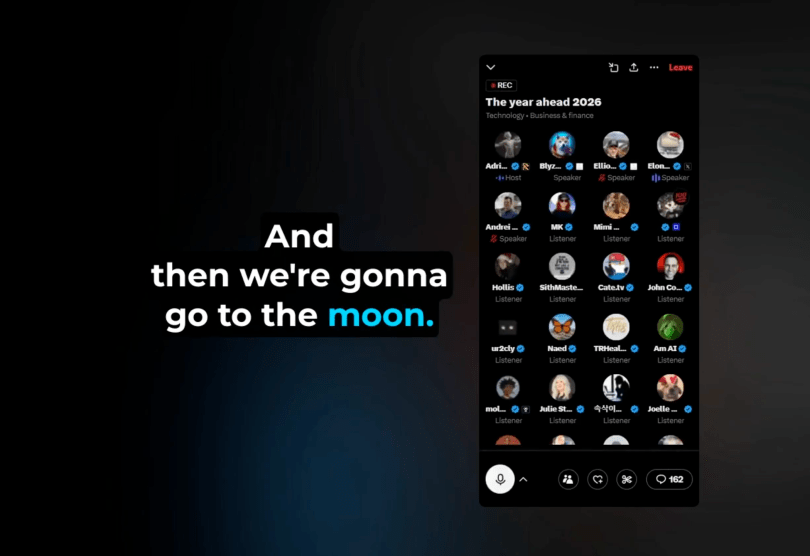
January 1, 2026 – In a surreal and entertaining moment to close out the year, Elon Musk unexpectedly joined an X Space on 30 December titled “The Year Ahead 2026,” hosted by @AdrianDittmann—a user long famous (and occasionally suspected) for sounding eerily similar to Elon himself.

The result was a light-hearted, mind-bending conversation in which the two voices—virtually indistinguishable—greeted each other as “other me” and dove into an optimistic preview of what Musk believes 2026 could bring for Tesla, SpaceX, xAI, and humanity’s future in space.

The highlight clip captures roughly five minutes of the exchange. Below is a mostly verbatim transcript (with some of Adrian’s longer, rambling comments lightly summarized for readability), manually transcribed due to the extreme voice similarity that confounded automated tools.

Transcript

Adrian: Yo Elon, what’s up man? Long time no see. Or like here rather because you know, “Spaces.”
Elon: Hello other me.
Adrian: Hi other me, that’s a good one! Yeah, so I’ve seen your year has been quite the adventure.
Elon: There’s been a lot, yeah. It’s been quite a year. I think 2026 is going to be a real banger year!
Adrian: Indeed, indeed.

(Adrian mentions the upcoming midterms and “narrative engineering,” then notes he’s very busy with work. Elon asks what the work is.)

Elon: What’s your work?


Adrian: Sorry, come again?


Elon: What work?


Adrian: Manufacturing stuff.


Elon: Okay, cool. What have you been making?


Adrian: I kind of don’t want to talk about it—it’s not entirely relevant. It’s kind of like a luxury product type thing, not that high up. It’s quite simple. I just don’t want to talk about it too much because I don’t want to bring attention to those people. I don’t want any harm to come to them, you know what I mean. So I just don’t talk about it as much.


Elon: Okay.


Adrian: Doing some automation stuff now. It’s pretty fun.

Elon on Tesla and SpaceX

Elon: Well, Tesla should have widespread robotaxi. That’ll be a big thing for Tesla in ’26. Optimus 3 will launch, and then hopefully SpaceX will achieve full reusability with Starship. Those are the pretty giant ones.

Adrian: I assume the first major shipments with Starship are just going to be like Starlink satellites, right?


Elon: Yup. And then we are going to go to the Moon!


Adrian: Oh yeah, yeah. Definitely. The space compute thing is like a really good accelerant, I think. So SpaceX becomes the major delivery company of choice then.


Elon: Yeah, haha.

(Adrian asks if Elon has thought about manufacturing on the Moon, noting that low gravity allows creating materials difficult or impossible to produce on Earth.)

Elon: Well, I think the biggest opportunity on the Moon is to actually make solar cells and radiators—so you’re manufacturing on the Moon anything that weighs a lot. Chips can maybe still come from Earth because they weigh very little. And then you can use a mass driver to put a billion tons of AI-powered satellites into orbit per year.

Adrian: Mass driver basically being like a kind of rail gun. I just like “rail guns”—it sounds cleaner. Like if you were on Dyson spheres before, pivot to this.


Elon: Well, this will create a Dyson swarm where there are essentially a bunch of intelligent satellites around the Sun.

(Adrian asks if manufacturing could be done in zero-gravity orbit instead, or if even lower gravity than Earth’s—like the Moon’s—is still needed.)

Elon: You need mass. Mass must come from somewhere. You need a lot of tonnage.

(Adrian asks if there will be a lot of tunneling (“boring”) on the Moon or if bases will mostly be surface structures, adding that underground lava caves make more sense.)

Elon: Ahhh, sure. We’ll figure it out. The most important thing is to get serious tonnage from the Moon in order to send even way more serious tonnage from the Moon. You can scale to a hundred terawatts of AI compute per year from the Moon.

(Adrian asks about magnetic shields for protection; Elon responds.)

Elon: Superconducting magnets could shield against solar wind and even high-velocity small objects. It’ll be fine—we already have 9,000 satellites in orbit, so we know what it’s like being in space. But… I randomly saw your chat. I have to head back to Tesla work meetings.


Adrian: Well, thanks for coming!

Highlights

  • Tesla: Widespread unsupervised robotaxi deployment in 2026 is expected to be a major milestone.
  • Optimus: Generation 3 of the humanoid robot is slated to launch and start performing useful tasks.
  • SpaceX: Full rapid reusability of Starship (including booster and ship catches) targeted for 2026, with initial major payloads consisting of Starlink satellites.
  • Lunar Ambitions: Manufacturing solar cells, radiators, and heavy components on the Moon, followed by using mass drivers (electromagnetic railgun-like launchers) to deploy massive quantities of AI-powered satellites at far lower cost than Earth launches.
  • AI Compute at Scale: Musk foresees scaling to hundreds of terawatts of AI compute per year, enabled by lunar resource utilization and orbital deployment.

My take: This was an unplanned and certainly unannounced X Space for Elon Musk. It appears he had a moment in between meetings to simply drop into the Space and chat. I think Elon would enjoy it if we all did this more. Back in November, I dropped into a Space, and got to chat, and it was memorable. If you’ve never done it, try it! In fact, when Elon does things like this, he’s actually working in X—it’s his job to try out the product. We’re lucky he bought X for the crazy price of $44 billion! Elon made this a fittingly futuristic way to ring in 2026.

(P.S. I couldn’t use AI to transcribe this—first it insisted the whole thing was a deepfake, then it completely failed to tell the two men’s voices apart. I finally gave up and did the transcript manually. Enjoy this rare treat!)

Elon Musk: Engineer, Defender of Humanity

Elon is a builder. We know him for his rockets, incredible vehicles, and satellite networks that connect the far reaches of Mongolia and people stranded in floods in North Carolina.

Some people don’t like it when he posts his thoughts about justice on X. But I do. I love it. I’ve learned so much about keeping society fair, safe, and free, and how critical it is to preserve Western civilization.

I went from thinking it was OK to welcome any immigrant who looked like they needed help, to understanding we must have secure borders and stop crime. Whether helping people in Europe, America, or Britain, Elon clearly wants to protect everybody and keep our world from falling apart.

I stand with Elon on immigration. I know firsthand most immigrants are decent, hard-working people. Even immigrants I’ve met say unchecked flows, no vetting, no proper screening, are the wrong way. With wide-open borders, vicious criminals slip right in with them. That’s not how to build a better America.

Elon has highlighted how Poland, with tight border controls, has stayed much safer. Meanwhile, my own city, Austin, gets more dangerous.

I love Elon for raising awareness about Iryna Zarutska from Ukraine, murdered in cold blood on video on a light-rail train in Charlotte, North Carolina, with nobody reaching out to help this poor woman right away. As beautiful murals go up around the country (funded in part by Elon’s $1M pledge), I think of his deep drive to keep everybody safe, he wants to make sure that we don’t have to bear the pain of another Iryna Zarutska. Her death should not be forgotten, it’s how we can pledge to do better in America.

In the UK, there’s also huge room for improvement. Elon raises awareness about how it’s sliding toward a police state: people jailed for things they write online, serious criminals released early. I wouldn’t know this without him.

Now, with jury trials being eroded in the UK, I see Elon’s renewed heart for helping Britain. That’s what Elon does best, help humanity.  (Never stop, Elon!)

I’ve also filtered out cynics (I don’t meet many, but Elon warned against them). In a Lex Fridman interview, he said never trust a cynic, stay away from people who see bad in everybody, because they’ll excuse their own bad behavior by claiming everyone else is bad too.

Elon is wonderful when he says most people are “medium good.” He has real trust in humanity. I’d never heard of “suicidal empathy” until him. He raised my awareness of how it’s destroying Western civilization. Allowed me to examine myself and readjust my views.

Elon has highlighted Gad Saad and how suicidal empathy will destroy Western civilization, and he’s right. It deserves to be defended, not tried. If we lose it, everybody loses something valuable.

Past the rockets and cars (which are great), there won’t be an America around to enjoy them unless we preserve it. Since Americans built these wonders, future generations deserve to enjoy them too.

We don’t want to be complicit in the banishment of Western civilization, instead we should work hard to defend it.

Elon doesn’t preach from an ivory tower. He’s the most in-touch, high-position leader I’ve ever met, reaching out to all corners of humanity like no one else.