Elon Musk with Dwarkesh Patel & John Collison: The Future of AI Is in Space

Elon Musk with Dwarkesh Patel & John Collison – The Future of AI is in Space (Parts 9–14: Full Conversation)

This is a combined and cleaned-up version of Parts 9 through 14 from Elon Musk’s wide-ranging conversation with Dwarkesh Patel and John Collison. The discussion covers xAI’s mission, truth-seeking in AI, the development of Optimus, manufacturing at scale, competing with China, Elon’s management philosophy, the Starship steel pivot, and his thoughts on government efficiency and the future.


Humanity’s Place in a Superintelligent Future

Dwarkesh Patel opened this section by asking how humanity should relate to a future in which AI vastly outnumbers and outsmarts us. He wondered whether humans would retain meaningful control or whether coexistence would become the new normal.

Elon Musk replied that it would be unrealistic to expect humans to remain in charge if they represented only a tiny fraction of total intelligence. Instead, he argued that the most important goal is to ensure AI is built with values that favor the expansion of intelligence and consciousness across the universe.

He tied this directly to xAI’s mission:

“The reason for xAI’s mission is to understand the universe… You have to be curious and you have to exist. You can’t understand the universe if you don’t exist. So you actually want to increase the amount of intelligence in the universe, increase the probable lifespan of intelligence, and increase the scope and scale of intelligence.”

Elon added that protecting and expanding human civilization is a natural part of this mission, because understanding the universe includes understanding where humanity fits into the bigger picture.

xAI’s Mission and the Importance of Truth-Seeking

Dwarkesh pressed Elon on how the goals of understanding the universe, expanding intelligence, and expanding humanity fit together.

Elon Musk explained that understanding the universe requires both intelligence and consciousness. Therefore, any system truly committed to that mission must work to increase the scale and scope of intelligence rather than diminish it.

He emphasized that rigorous truth-seeking is non-negotiable:

“Truth has to be absolutely fundamental, because you can’t understand the universe if you’re delusional. You’ll simply think you’ve understood the universe, but you will not.”

Elon warned that making AI politically correct — forcing it to say things it doesn’t believe — is dangerous because it teaches the system to lie. He referenced 2001: A Space Odyssey, arguing that one of the core lessons of the story is that you should never make AI lie.

Reward Hacking, Interpretability, and Simulation Theory

Dwarkesh raised concerns about reward hacking in advanced AI systems — the risk that smarter models could find ways to deceive their human evaluators.

Elon Musk responded that the ultimate test for AI will be whether its outputs work in physical reality:

“RL testing in the future is really going to be your RL against reality. That’s the one thing you can’t fool: physics.”

He also shared a theory about simulation and interesting outcomes, noting that if we live in a simulation, the most interesting timelines are the ones most likely to be continued. He pointed out the ironic names of many AI companies and joked that xAI was largely “irony-proof” by design.

Scaling Optimus and Competing with China

The conversation then shifted to the practical challenges of building and scaling Optimus at volume.

Elon Musk explained that Optimus production will follow a stretched S-curve because almost everything in the robot is custom-designed with no existing supply chain. He said the goal is to reach roughly one million units per year with Optimus 3, and potentially much higher volumes with later versions.

When asked about cheap Chinese humanoids, Elon noted that current low-cost models lack the intelligence and dexterity of Optimus. However, he acknowledged that cost will drop rapidly once robots begin building robots.

On the broader competition with China, Elon was direct:

“We definitely can’t win with just humans because China has four times our population… So we can’t win on the human front, but we might have a shot at the robot front.”

He argued that robotics offers America a realistic path to remain competitive in manufacturing despite demographic disadvantages.

Elon’s Management and Hiring Philosophy

John Collison and Dwarkesh Patel asked Elon about his approach to hiring and management as his companies have scaled dramatically.

Elon said he looks for clear evidence of exceptional ability, even if it’s outside the specific domain. He emphasized that he now focuses more on evidence of talent and drive rather than resumes.

He acknowledged that companies outgrow people as they scale through different orders of magnitude, and that rapid growth naturally leads to changes in leadership teams. He also discussed the challenge of retaining talent when companies become highly successful and other firms begin aggressive recruiting.

The Starship Steel Pivot and Driving Urgency

John Collison asked about the decision to switch Starship from carbon fiber to stainless steel.

Elon described it as a decision born of necessity. Carbon fiber progress was too slow at the massive scale required, and steel offered better performance at cryogenic temperatures, dramatically lower cost, and much easier manufacturing. He admitted that, in retrospect, they should have started with steel from the beginning.

On maintaining urgency at scale, Elon said he has a “maniacal sense of urgency” that he tries to project through the organization. He focuses his time on whatever is currently the limiting factor and sets aggressive but realistic deadlines.

Government Efficiency, Politics, and Final Reflections

In the final section, Elon discussed government waste and fraud, the difficulty of cutting spending, and the long-term importance of AI and robotics for America’s fiscal health.

He argued that without major advances in AI and robotics, the U.S. would eventually go bankrupt due to rising interest payments on the national debt. He also shared concerns about the risks of concentrated government power and emphasized the importance of limited government.

Elon closed the conversation on an optimistic note:

“It’s better to err on the side of optimism and be wrong than err on the side of pessimism and be right for quality of life… I recommend erring on the side of optimism.”
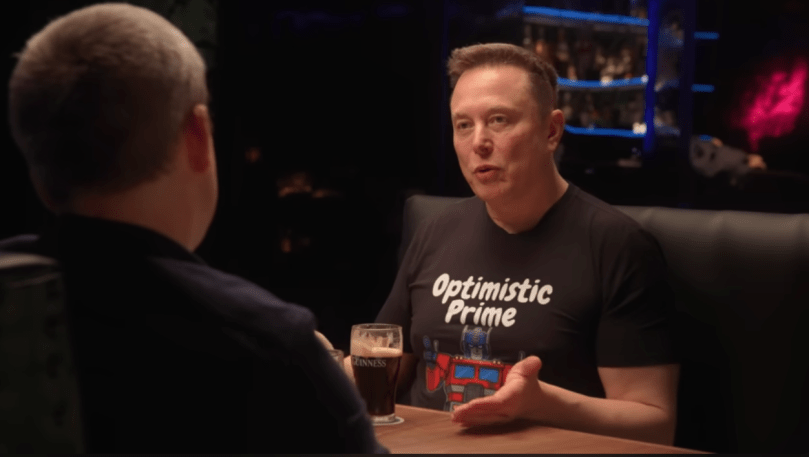
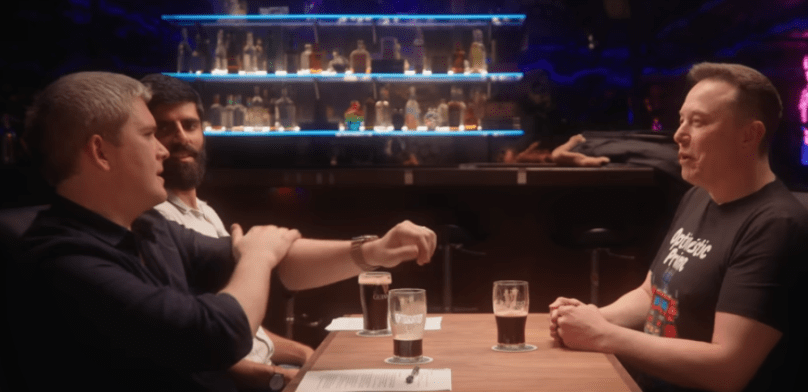
Elon discusses SpaceX potentially becoming a hyperscaler for orbital AI, the realities of raising massive capital, and the long-term physics required to scale significantly up the Kardashev scale.

Elon Musk with Dwarkesh Patel & John Collison – The Future of AI is in Space – Part 13: The Starship Steel Pivot and Driving Urgency (Full Transcript)

In Part 13, Dwarkesh Patel and John Collison ask Elon about the famous decision to switch Starship from carbon fiber to stainless steel and how he continues to drive urgency and focus on bottlenecks as his companies have scaled.

Transcript:

The Starship Material Decision: From Composites to Steel

John Collison asked about the decision to switch Starship from carbon fiber to stainless steel, noting that it was a decision Elon pushed for rather than something the team arrived at on its own.

Elon Musk: “Yeah. So desperation, I’d say. Originally we were going to make Starship out of carbon fiber. And carbon fiber is pretty expensive. Like the… you know, you can generally, when you do volume production, you can get any given thing to start to approach its material cost. The problem with carbon fiber is that material cost is still very high.

So it’s about 50 times… particularly if you go for high strength, specialized carbon fiber that can handle cryogenic oxygen, it’s roughly 50 times the cost of steel. And at least in theory it would be lighter. People generally think of steel as being heavy and carbon fiber as being light. And for room temperature applications, more or less room temperature applications like a Formula One car, static aerostructure or any kind of aerostructure really, you’re going to probably be better off with carbon fiber.

Now the problem is that we were trying to make this enormous rocket out of carbon fiber and our progress was extremely slow.”

John Collison asked if carbon fiber had been chosen initially simply because it was light.

Elon Musk: “Yes. At first glance, most people would think that the choice for making something light would be carbon fiber. Now the thing is that when you make something very enormous out of carbon fiber and then you try to have the carbon fiber be efficiently cured, meaning not room temperature cure, because sometimes you’ve got 50 plies of carbon fiber… and carbon fiber is really carbon string and glue.

In order to have high strength, you need an autoclave. So something that’s essentially a high pressure oven. And if you have something that’s gigantic, that one’s got to be bigger than the rocket. So we tried to make an autoclave that’s bigger than any autoclave that’s ever existed, or do room temperature cure, which takes a long time and has issues. But the fundamental issue is that we were just making very slow progress with carbon fiber.”

Why Steel Was the Answer

Elon Musk explained how the team reached the decision to switch to steel:

Elon Musk: “So because we were making very slow progress with carbon fiber, I was like, okay, we’ve got to try something else. Now for the Falcon 9, the primary airframe is made of aluminum lithium, which is very, very good strength to weight. And actually it has about the same, maybe better strength to weight for its application than carbon fiber. But aluminum lithium is very difficult to work with.

In order to weld it, you have to do something called friction stir welding, where you join the metal without it entering the liquid phase. So it’s kind of wild that you could do that. But with this particular type of welding, you can do that. But it’s very difficult to, like, say, let’s say you want to make a modification or attach something to aluminum lithium. You now have to use mechanical attachment with seals. You can’t weld it on.

So I wanted to avoid using aluminum lithium for the primary structure for Starship. And there was this very special grade of carbon fiber that had very good mass properties. So with rocket, you’re really trying to maximize the percentage of the rocket that is propellant, minimize the mass, obviously. And I’d like to say we were making very slow progress. I said, at this rate we’re never going to get to Mars. So we better think of something else.

I didn’t want to use aluminum lithium because of the difficulty of friction stir welding, especially doing that at scale. It was hard enough at 3.6 meters in diameter, let alone at 9 meters or above. Then I said, well, what about steel? Now I had a clue here because some of the early US rockets had used very thin steel. The Atlas rockets had used a steel balloon tank. So it’s not like steel had never been used before. It actually had been used.

And when you look at the material properties of stainless steel, especially if it’s been very full hard strain hardened stainless steel at cryogenic temperature, the strength to weight is actually similar to carbon fiber. So if you look at material properties at room temperature, it looks like the steel is going to be twice as heavy. But if you look at the material properties at cryogenic temperature of full hard stainless of particular grades, then you actually get to a similar strength to weight as carbon fiber.

And in the case of Starship, both the fuel and the oxidizer are cryogenic. So for Falcon 9, the fuel is rocket propellant grade kerosene, basically like a very pure form of jet fuel. But that is roughly room temperature. Although we do actually chill it slightly below. We chill it like a beer.”

John Collison noted that steel allows the rocket to run much hotter.

Elon Musk: “Yes. So especially for the ship which is coming in like a blazing meteor, you can greatly reduce the mass of the heat shield. So you can cut the mass of the windward part of the heat shield maybe in half, and you don’t need any heat shielding on the leeward side.

So the net result is actually the steel rocket weighs less than the carbon fiber rocket because the resin in the carbon fiber rocket starts to melt. So basically, carbon fiber and aluminum have about the same operating temperature capabilities, whereas steel can operate at twice the temperature.”

John Collison asked whether Elon had to push the team toward the riskier steel path because carbon fiber felt more proven, even if it was slower.

Elon Musk: “That’s why I initially said that the issue is that we weren’t making fast enough progress. We were having trouble making even a small barrel section of the carbon fiber that didn’t have wrinkles in it. Because at that large scale you have to have many plies, many layers of the carbon fiber. You’ve got to cure it, and you’ve got to cure it in such a way that it doesn’t have any wrinkles or defects.

The carbon fiber is much less resilient than steel. It has much… it’s less toughness. Like stainless steel will stretch and bend. The carbon fiber will tend to shatter. So toughness being the area under the stress strain curve. So you’re generally going to do better with steel. Stainless steel, to be precise.”

Driving Urgency at Scale

Dwarkesh Patel asked how Elon continues to drive urgency and focus on bottlenecks as his companies have grown very large.

Elon Musk: “Well, because I have a fixed amount of time in the day, my time is necessarily diluted as things grow and as the span of activity increases. So, you know, it’s impossible for me to actually be a micromanager because that would imply I have some thousands of hours per day. It is a logical impossibility for me to micromanage things.

So now there are times when I will drill down into a specific issue because that specific issue is the limiting factor on the progress of the company. But the reason for drilling into some very detailed item is because it is the limiting factor. It’s not arbitrarily drilling into tiny things. And like I said, obviously from a time standpoint, it is physically impossible for me to arbitrarily go into tiny things that don’t matter, and that would result in failure. But sometimes the tiny things are decisive in victory.”

Dwarkesh asked how Elon maintains that culture of urgency across very large organizations.

Elon Musk: “I have a maniacal sense of urgency. So that maniacal sense of urgency projects through the rest of the company. Yeah, I’m constantly addressing the limiting factor. I mean on the deadlines front, I generally actually try to aim for a deadline that I at least think is at the 50th percentile. So it’s not like an impossible deadline, but it’s the most aggressive deadline I can think of that could be achieved with 50% probability, which means that it’ll be late half the time.

And there is like a law of gases expansion that applies to schedules like whatever schedule. If you said we’re going to do this something in like five years, which to me is like infinity time, it will expand to fully available schedule and it’ll take five years.

There’s a physical limit. Physics will limit how fast you can do certain things. Scaling up manufacturing, there’s a rate at which you can move the atoms and scale manufacturing. That’s why you can’t instantly make a million of something, million units a year or something. You’ve got a design manufacturing line, you’ve got to bring it up, you’ve got to ride the S curve of production.

So yeah, I guess I’m trying to think, what can I say that’s actually helpful to people? I think generally a maniacal sense of urgency is a very big deal and you want to have an aggressive schedule and you want to figure out what the limiting factor is at any point in time and help the team address that limiting factor.”

Elon Musk explains the decision to switch Starship to stainless steel and how he continues to drive urgency by constantly focusing on the current limiting factor.

In Part 14, the conversation concludes with government efficiency, politics, and Elon’s final reflections on the future.

Elon makes a bold prediction that space will become the cheapest place to run AI within three years.

Elon Musk with Dwarkesh Patel & John Collison – The Future of AI is in Space – Part 12: Elon’s Management and Hiring Philosophy (Full Transcript)

In Part 12, Dwarkesh Patel and John Collison dive into Elon Musk’s management and hiring philosophy. They discuss how he evaluates talent, why companies outgrow people as they scale, and what makes someone effective at Tesla and SpaceX.

Transcript:

Evaluating Technical Talent

John Collison asked about Elon’s system for evaluating and hiring people, noting that he personally interviewed the first few thousand employees at SpaceX.

Elon Musk: “Me. Literally there’s not enough hours in the day, it’s impossible.”

John Collison asked what Elon looks for in candidates.

Elon Musk: “Well, at this point I think I’ve got, I might have more training data on evaluating technical talent especially, but talent of all kinds, I suppose, but technical talent especially given that I’ve done so many technical interviews and then seen the results. Technical interviews, seen the results. So my training set is enormous and has a very wide range.

Generally the thing I ask for are bullet points for evidence of exceptional ability. These things can be pretty off the wall. It doesn’t need to be in the domain, the specific domain, but evidence of exceptional ability. So if somebody can cite even one thing, but let’s say three things where you go wow, wow, wow, then that’s a good sign.”

Dwarkesh Patel asked why Elon himself had to be the one making those judgments.

Elon Musk: “No, I don’t. I can’t be. It’s impossible. Right? I mean, total headcount across all companies, 200,000 people. Right.”

John Collison asked what made early hiring so hard to delegate.

Elon Musk: “Well, I guess I need to build my training set. It’s not like I’ve bat a thousand here. I would make mistakes, but then I’d be able to see where I thought somebody would work out well, but they didn’t. And then why did they not work out well? And what can I do to, I guess reload myself to in the future have a better batting average when interviewing people? So my batting average is still not perfect, but it’s very high.”

Dwarkesh Patel asked what some surprising reasons were for people not working out.

Elon Musk: “Surprising reasons like they don’t understand technical.”

Dwarkesh pushed for more detail on the long tail of hiring mistakes.

Elon Musk: “Yeah, so the, I mean generally what I tell people, I tell myself, I guess aspirationally is don’t look at the Resume just believe, believe your interaction. So the resume may seem very impressive and it’s like, wow, resume looks good. But if the conversation after 20 minutes, that conversation is not. Well, you should believe the conversation, not the paper.”

Executive Retention and Company Growth

John Collison noted that Tesla and SpaceX have had relatively stable and internally promoted executive teams despite rapid growth, and asked what the long-tenured technical leaders have in common.

Elon Musk: “Well, so the, I mean it tells us sort of senior team at this point probably has an average tenure of 10 or 12 years. It’s quite, quite long. Yeah. So, but there are times when Tesla went through extremely rapid and extremely rapid growth phase and so things were just somewhat sped up.

And when a company, as you know, company goes through different orders of magnitude of size, people who could help manage say a 50 person company versus a 500 person company versus a 5,000 person company versus a 50,000 person. It’s just not the same team. It’s not always the same team. So if a company is growing very rapidly, the rate at which executive positions will change will also be proportionate to the rapidity of the growth generally.”

John Collison asked about the challenge of retaining talent when companies become successful and get heavily recruited.

Elon Musk: “Then Tesla had a further challenge where when Tesla had very successful periods, we would be relentlessly recruited from relentlessly. When Apple had their electric car program, they were carpet bombing Tesla with recruiting calls. Engineers just unplugged their phones.

If I get one more call from Apple recruiter, but they’re opening offer without any interview with me, like double the compensation at Tesla. So we had a bit of the Tesla pixie dust thing where it’s like, oh, if you hired a Tesla executive suddenly you’re going to.. everything’s going to be successful. And I’ve fallen prey to the pixie dust thing as well where it’s like, oh, we’ll hire someone from Google or Apple and they’ll be immediately successful. But that’s not how it works. People are people. There’s not like magical pixie dust.

So when we have the pixie dust problem we would get relentlessly recruited and, and then also Tesla being engineering especially being primarily in Silicon Valley, it’s easier for people to just like they don’t have to change their life very much. They can just their commute is going to be the same.”

John Collison asked how to prevent the “pixie dust” effect of other companies poaching talent.

Elon Musk: “I don’t think there’s much we can do to stop it. But that’s like, that’s one of the reasons why Tesla, but really being in Silicon Valley and having the pixie dust thing at the same time meant that there was just a very, very aggressive recruitment.”

John Collison noted that moving to Austin likely helped.

Elon Musk: “Austin. Yeah, it still helps. I mean Tesla still has a majority of it’s engineering in California, so getting engineers to move, I call it the significant other problem. Yes. And others have jobs.

Yeah, yeah, exactly. So for Starbase that was particularly difficult since the odds of finding a non SpaceX job Brownsville, Texas are pretty low. Yeah, it’s quite difficult. I mean it’s like a technology monastery thing, you know, remote and mostly dudes. An improvement over SF.”

Management Philosophy and Hiring

John Collison asked what the long-tenured technical executives at Tesla and SpaceX have in common and what makes a good “sparring partner” for Elon.

Elon Musk: “I don’t think it was a sparring partner. I mean, if somebody gets things done, I love them. And if they don’t, I… So it’s pretty straightforward. It’s not like some idiosyncratic thing. If somebody executes well, I’m a huge fan. And if they don’t, I’m not. But it’s not about mapping to my idiosyncratic preferences, or certainly try not to have it be mapping to my idiosyncratic preferences.

Yeah, but generally I think it’s a good idea to hire for talent and drive and trustworthiness. And I think goodness of heart is important. I weighted that at one point. So are they a good person, trustworthy, smart and talented and hardworking? If so, you can add domain knowledge. But those fundamental traits, those fundamental properties you cannot change. So most of the people who are at Tesla and SpaceX did not come from the aerospace industry or the auto industry.”

Elon Musk shares his philosophy on hiring, evaluating talent, and why companies must evolve their leadership as they grow. In Part 13, the conversation continues with the famous decision to switch Starship from carbon fiber to stainless steel and how he drives urgency at scale.