
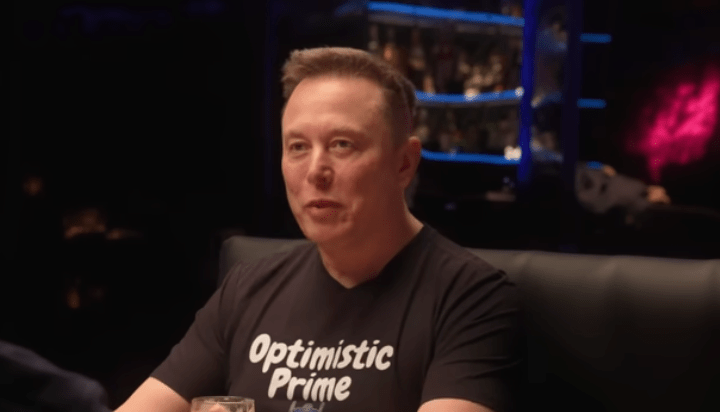
In Part 6, John Collison asks Elon to project what AI compute capacity might look like in five years — both on Earth and in space. The conversation shifts to the enormous number of Starship launches that would be needed to support large-scale orbital AI infrastructure. Elon shares his prediction that AI in space will surpass all terrestrial AI within five years and discusses the practical realities of achieving very high launch rates.
Elon Musk: “My prediction is that we will launch and be operating more AI in space every year than the cumulative total on Earth, which I would expect to take at least five years to reach. So we’re talking about a few hundred gigawatts per year of AI in space, and rising.”
Transcript:
John Collison shifted the conversation to a concrete five-year horizon. He asked what installed AI compute capacity would look like on Earth versus in space by then.
Elon Musk: Five years? I think probably if you say five years from now, we’re probably going to be launching every year in space the sum total of all AI on Earth, and then some. My prediction is we will launch and be operating every year more AI in space than the cumulative total on Earth, which I would expect to be at least sort of five years from now. A few hundred gigawatts per year of AI in space and rising. So you can get to, I think on Earth you can get to around a terawatt a year of AI in space before you start having fuel supply challenges for the rocket.
John Collison pressed for confirmation on the hundreds-of-gigawatts-per-year figure.
Elon Musk: “Yes.”
Dwarkesh Patel highlighted the launch cadence implied by those numbers.
Elon Musk: “Yes.”
Dwarkesh Patel continued, noting that delivering 100 gigawatts in a single year would require roughly 10,000 Starship launches annually — the equivalent of one launch every single hour, nonstop, from this city.
Elon Musk: “Yeah, I mean that’s actually a lower rate compared to airlines like aircraft.”
Dwarkesh Patel pointed out that there are a lot of airports around the world.
Elon Musk: “A lot of airports.”
Dwarkesh Patel noted the additional complexity of launching into polar or sun-synchronous orbits.
Elon Musk: “No, it doesn’t have to be polar, but there’s some value to sun synchronous. But I think actually you just go high enough, you start getting out of Earth’s shadow.”
Dwarkesh Patel asked how many physical Starships would be needed to sustain 10,000 launches per year.
Elon Musk: “I don’t think we’ll need more than. I mean, you could probably do it with as few as like 20 or 30. It really depends on how quickly the ship has to go around the Earth and the ground track before the ship has to come back over the launch pad. So if you can use a ship every, say 30 hours, you could do it with 30 ships, but we’ll make more ships than that. But SpaceX is gearing up to 10,000 launches a year and maybe even 20 or 30,000 launches a year.”
Elon predicts that within five years, more AI will be operating in space than currently exists on Earth, and discusses the Starship fleet size and launch cadence needed to support it. In Part 7, the conversation continues with more on the technical and operational realities of building large-scale AI infrastructure in orbit.

