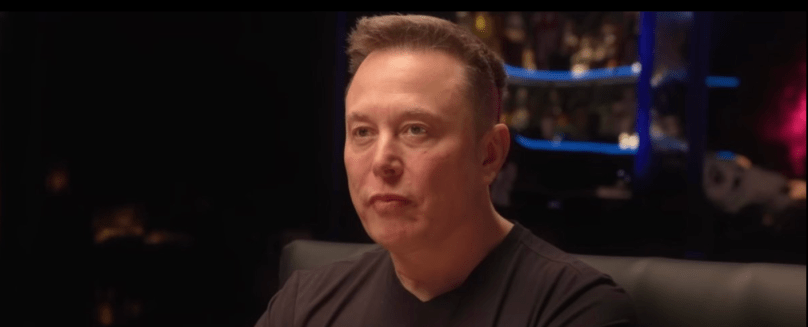
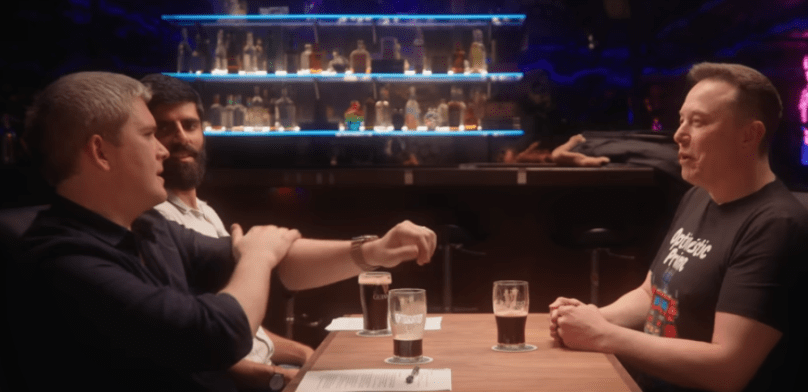
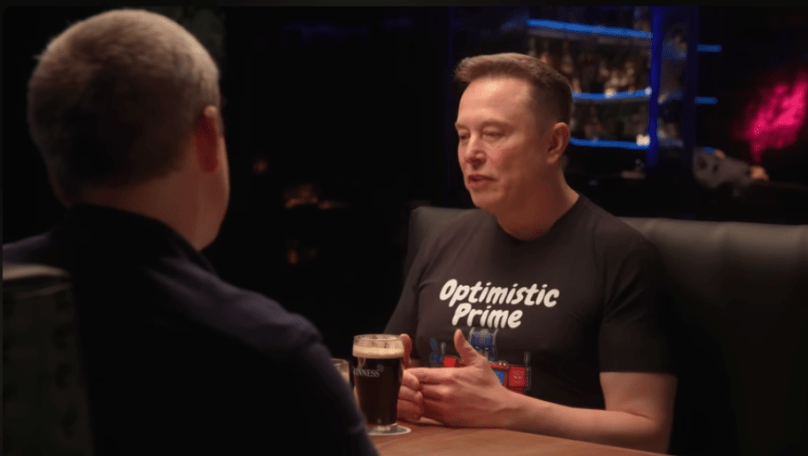
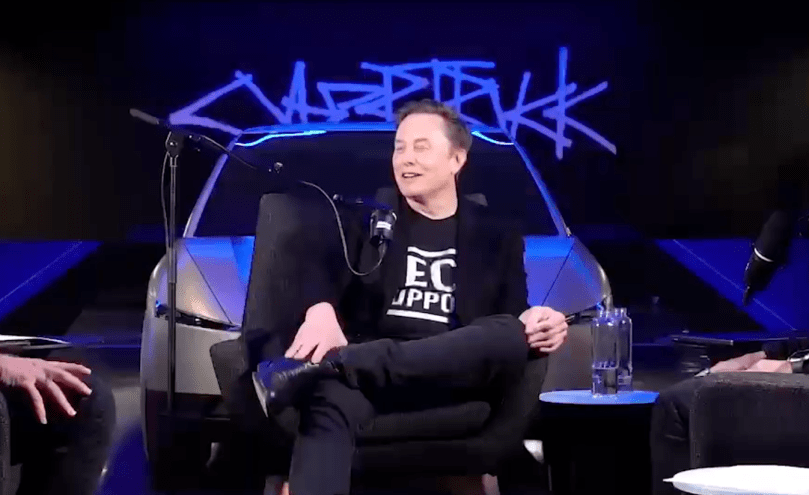
This is a combined and cleaned-up version of Parts 9 through 14 from Elon Musk’s wide-ranging conversation with Dwarkesh Patel and John Collison. The discussion covers xAI’s mission, truth-seeking in AI, the development of Optimus, manufacturing at scale, competing with China, Elon’s management philosophy, the Starship steel pivot, and his thoughts on government efficiency and the future.
Humanity’s Place in a Superintelligent Future
Dwarkesh Patel opened this section by asking how humanity should relate to a future in which AI vastly outnumbers and outsmarts us. He wondered whether humans would retain meaningful control or whether coexistence would become the new normal.
Elon Musk replied that it would be unrealistic to expect humans to remain in charge if they represented only a tiny fraction of total intelligence. Instead, he argued that the most important goal is to ensure AI is built with values that favor the expansion of intelligence and consciousness across the universe.
He tied this directly to xAI’s mission:
“The reason for xAI’s mission is to understand the universe… You have to be curious and you have to exist. You can’t understand the universe if you don’t exist. So you actually want to increase the amount of intelligence in the universe, increase the probable lifespan of intelligence, and increase the scope and scale of intelligence.”
Elon added that protecting and expanding human civilization is a natural part of this mission, because understanding the universe includes understanding where humanity fits into the bigger picture.
xAI’s Mission and the Importance of Truth-Seeking
Dwarkesh pressed Elon on how the goals of understanding the universe, expanding intelligence, and expanding humanity fit together.
Elon Musk explained that understanding the universe requires both intelligence and consciousness. Therefore, any system truly committed to that mission must work to increase the scale and scope of intelligence rather than diminish it.
He emphasized that rigorous truth-seeking is non-negotiable:
“Truth has to be absolutely fundamental, because you can’t understand the universe if you’re delusional. You’ll simply think you’ve understood the universe, but you will not.”
Elon warned that making AI politically correct — forcing it to say things it doesn’t believe — is dangerous because it teaches the system to lie. He referenced 2001: A Space Odyssey, arguing that one of the core lessons of the story is that you should never make AI lie.
Reward Hacking, Interpretability, and Simulation Theory
Dwarkesh raised concerns about reward hacking in advanced AI systems — the risk that smarter models could find ways to deceive their human evaluators.
Elon Musk responded that the ultimate test for AI will be whether its outputs work in physical reality:
“RL testing in the future is really going to be your RL against reality. That’s the one thing you can’t fool: physics.”
He also shared a theory about simulation and interesting outcomes, noting that if we live in a simulation, the most interesting timelines are the ones most likely to be continued. He pointed out the ironic names of many AI companies and joked that xAI was largely “irony-proof” by design.
Scaling Optimus and Competing with China
The conversation then shifted to the practical challenges of building and scaling Optimus at volume.
Elon Musk explained that Optimus production will follow a stretched S-curve because almost everything in the robot is custom-designed with no existing supply chain. He said the goal is to reach roughly one million units per year with Optimus 3, and potentially much higher volumes with later versions.
When asked about cheap Chinese humanoids, Elon noted that current low-cost models lack the intelligence and dexterity of Optimus. However, he acknowledged that cost will drop rapidly once robots begin building robots.
On the broader competition with China, Elon was direct:
“We definitely can’t win with just humans because China has four times our population… So we can’t win on the human front, but we might have a shot at the robot front.”
He argued that robotics offers America a realistic path to remain competitive in manufacturing despite demographic disadvantages.
Elon’s Management and Hiring Philosophy
John Collison and Dwarkesh Patel asked Elon about his approach to hiring and management as his companies have scaled dramatically.
Elon said he looks for clear evidence of exceptional ability, even if it’s outside the specific domain. He emphasized that he now focuses more on evidence of talent and drive rather than resumes.
He acknowledged that companies outgrow people as they scale through different orders of magnitude, and that rapid growth naturally leads to changes in leadership teams. He also discussed the challenge of retaining talent when companies become highly successful and other firms begin aggressive recruiting.
The Starship Steel Pivot and Driving Urgency
John Collison asked about the decision to switch Starship from carbon fiber to stainless steel.
Elon described it as a decision born of necessity. Carbon fiber progress was too slow at the massive scale required, and steel offered better performance at cryogenic temperatures, dramatically lower cost, and much easier manufacturing. He admitted that, in retrospect, they should have started with steel from the beginning.
On maintaining urgency at scale, Elon said he has a “maniacal sense of urgency” that he tries to project through the organization. He focuses his time on whatever is currently the limiting factor and sets aggressive but realistic deadlines.
Government Efficiency, Politics, and Final Reflections
In the final section, Elon discussed government waste and fraud, the difficulty of cutting spending, and the long-term importance of AI and robotics for America’s fiscal health.
He argued that without major advances in AI and robotics, the U.S. would eventually go bankrupt due to rising interest payments on the national debt. He also shared concerns about the risks of concentrated government power and emphasized the importance of limited government.
Elon closed the conversation on an optimistic note:
“It’s better to err on the side of optimism and be wrong than err on the side of pessimism and be right for quality of life… I recommend erring on the side of optimism.”
Living here in Austin, Texas, where traffic on Mopac can flip from smooth to nightmare in a heartbeat (especially when there’s an accident or some surprise Texas rain), safety is always on my mind. That’s why I got so excited when Tesla announced this massive milestone on February 18, 2026!
Tesla drivers around the world have now driven more than 8 billion miles (nearly 13 billion km) using Full Self-Driving Supervised. Even more mind-blowing? They added 1 billion miles in just the first 50 days of 2026 alone!
That huge pile of real-world driving data is letting Tesla’s AI learn and improve faster than ever. According to Tesla’s own published safety stats, a vehicle on FSD Supervised experiences a major accident only once every 5.3 million miles. This is roughly eight times safer than the average across all vehicles on U.S. roads.
Behind those numbers are real-life moments that matter: the system putting on hazard lights and gently pulling over for emergency services help on its own if a driver has a medical emergency, applying the brakes or moving aside to avoid a crash, or gently guiding you through inclement weather. These are the reasons supervised autonomy is already saving lives by taking human error out of the equation. We all know human error causes the vast majority of accidents.
My personal experience as a Tesla owner in Austin
As a mom of five grown kids, a nurse who sometimes drives home after long shifts, and a proud owner of both a Model 3 and a Model Y with FSD (and Powerwalls at home), this tech has genuinely changed my life. I use FSD every single day here in Austin — whether I’m heading out to record a podcast episode, running errands around the Hill Country (my fav is to visit Buc-ees), or just daily commuting to work on highways where many drivers get distracted (driving and texting is everywhere in Austin!)
Just last month during a heavy downpour on Mopac Loop 1, FSD smoothly handled hydroplaning risks, kept perfect lane position, and even slowed for a sudden slowdown ahead that I hadn’t spotted yet. It gives me such peace of mind. I think about older family members or anyone who might feel tired or unwell behind the wheel. I feel that “co-pilot” protection in real time, and it’s one of the main reasons I’m so passionate about Tesla’s mission.
This progress fits perfectly into Elon Musk’s bigger vision of using AI to move humanity forward. At xAI, the team is building Grok with that same dedication to truth and excellence to speed up scientific discovery and help us all better understand the universe. This is a positive, open approach that truly benefits everyone.
With this kind of rapid acceleration, Tesla is proving the future of mobility isn’t coming someday… it’s already here on our roads right now.
Sources:
• Official Tesla announcement, February 18, 2026
• Tesla Vehicle Safety Report (latest data)
• No exaggeration, no rounded figures — straight from Tesla.
Love Tesla? Share this post, keep spreading the good news!
Gail Alfar, Austin, Texas
(US Army Veteran, RN, Mom of 5, and founder of What’s Up Tesla)
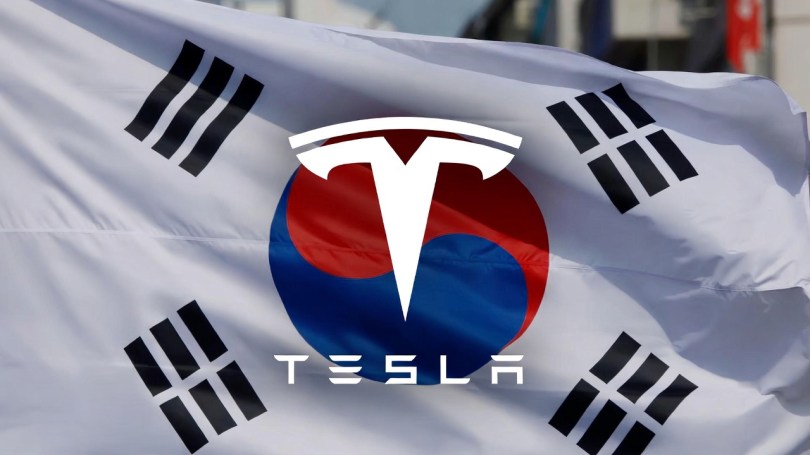
Tesla is recruiting AI chip design engineers to accelerate its in-house hardware for autonomous driving, robotics, and massive data centers. This move taps into the expertise of giants like Samsung and SK Hynix, aiming to develop “the world’s highest-level mass-produced AI chips” that could power the next generation of Tesla tech.
For U.S. Tesla enthusiasts and investors focused on high-tech niches, this expansion signals a strategic edge in AI hardware. Tesla’s Full Self-Driving (FSD) system, Optimus humanoid robots, and Dojo supercomputers all rely on custom AI processors – and sourcing talent from Korea could help Tesla scale production massively, potentially challenging NVIDIA’s dominance in the space. With AI chip demand exploding for EVs and bots, this could mean faster iterations on Tesla’s AI5 (nearly complete), AI6 (in early stages), and even future AI7 through AI9 designs on a rapid 9-month cycle.
The hiring kicked off in mid-February 2026, with Tesla Korea posting openings on X for engineers skilled in chip design, fabrication, or AI software. Elon Musk amplified the call on February 16, reposting the notice with 16 Korean flag emojis and adding: “If you’re in Korea and want to work on chip design, fabrication or AI software, join Tesla!” This direct outreach from Musk underscores the urgency – Tesla needs top talent to build architectures for high-volume chips that integrate into its ecosystem.
Interested candidates should email Ai_Chips@Tesla.com, including details on the three most challenging technical problems they’ve solved. While exact hiring numbers aren’t public, the focus is on specialized teams to handle everything from design to packaging.
This aligns with Tesla’s existing partnerships, like the $16.5 billion deal with Samsung to produce next-gen A16 chips at facilities including Hwaseong in Korea and even Taylor, Texas – bringing production closer to U.S. operations. Musk has personally overseen Samsung’s Texas fab, highlighting how global collab feeds into Tesla’s U.S.-centric innovation.
Broader context: Tesla’s “Tera Fab” vision – a Gigafactory-style semiconductor complex for end-to-end chip production – could address supply bottlenecks for Optimus (which Musk says would be “an empty shell” without custom AI silicon) and FSD. This comes amid Tesla’s $2 billion investment in xAI, tying into Musk’s interconnected empire of Tesla, SpaceX, and xAI.
For U.S. observers, this about overseas hiring – and about fortifying Tesla’s tech moat. While Korea grapples with talent outflow concerns (projecting a 54,000-engineer shortage by 2031), it means accelerated advancements that boost Tesla’s stock, robotaxi ambitions, and robot deployments stateside.
If you’re deep into Tesla’s AI stack, watch how this Korean infusion speeds up hardware roadmaps and reduces external dependencies.
In Part 12, Dwarkesh Patel and John Collison dive into Elon Musk’s management and hiring philosophy. They discuss how he evaluates talent, why companies outgrow people as they scale, and what makes someone effective at Tesla and SpaceX.
Transcript:
Evaluating Technical Talent
John Collison asked about Elon’s system for evaluating and hiring people, noting that he personally interviewed the first few thousand employees at SpaceX.
Elon Musk: “Me. Literally there’s not enough hours in the day, it’s impossible.”
John Collison asked what Elon looks for in candidates.
Elon Musk: “Well, at this point I think I’ve got, I might have more training data on evaluating technical talent especially, but talent of all kinds, I suppose, but technical talent especially given that I’ve done so many technical interviews and then seen the results. Technical interviews, seen the results. So my training set is enormous and has a very wide range.
Generally the thing I ask for are bullet points for evidence of exceptional ability. These things can be pretty off the wall. It doesn’t need to be in the domain, the specific domain, but evidence of exceptional ability. So if somebody can cite even one thing, but let’s say three things where you go wow, wow, wow, then that’s a good sign.”
Dwarkesh Patel asked why Elon himself had to be the one making those judgments.
Elon Musk: “No, I don’t. I can’t be. It’s impossible. Right? I mean, total headcount across all companies, 200,000 people. Right.”
John Collison asked what made early hiring so hard to delegate.
Elon Musk: “Well, I guess I need to build my training set. It’s not like I’ve bat a thousand here. I would make mistakes, but then I’d be able to see where I thought somebody would work out well, but they didn’t. And then why did they not work out well? And what can I do to, I guess reload myself to in the future have a better batting average when interviewing people? So my batting average is still not perfect, but it’s very high.”
Dwarkesh Patel asked what some surprising reasons were for people not working out.
Elon Musk: “Surprising reasons like they don’t understand technical.”
Dwarkesh pushed for more detail on the long tail of hiring mistakes.
Elon Musk: “Yeah, so the, I mean generally what I tell people, I tell myself, I guess aspirationally is don’t look at the Resume just believe, believe your interaction. So the resume may seem very impressive and it’s like, wow, resume looks good. But if the conversation after 20 minutes, that conversation is not. Well, you should believe the conversation, not the paper.”
Executive Retention and Company Growth
John Collison noted that Tesla and SpaceX have had relatively stable and internally promoted executive teams despite rapid growth, and asked what the long-tenured technical leaders have in common.
Elon Musk: “Well, so the, I mean it tells us sort of senior team at this point probably has an average tenure of 10 or 12 years. It’s quite, quite long. Yeah. So, but there are times when Tesla went through extremely rapid and extremely rapid growth phase and so things were just somewhat sped up.
And when a company, as you know, company goes through different orders of magnitude of size, people who could help manage say a 50 person company versus a 500 person company versus a 5,000 person company versus a 50,000 person. It’s just not the same team. It’s not always the same team. So if a company is growing very rapidly, the rate at which executive positions will change will also be proportionate to the rapidity of the growth generally.”
John Collison asked about the challenge of retaining talent when companies become successful and get heavily recruited.
Elon Musk: “Then Tesla had a further challenge where when Tesla had very successful periods, we would be relentlessly recruited from relentlessly. When Apple had their electric car program, they were carpet bombing Tesla with recruiting calls. Engineers just unplugged their phones.
If I get one more call from Apple recruiter, but they’re opening offer without any interview with me, like double the compensation at Tesla. So we had a bit of the Tesla pixie dust thing where it’s like, oh, if you hired a Tesla executive suddenly you’re going to.. everything’s going to be successful. And I’ve fallen prey to the pixie dust thing as well where it’s like, oh, we’ll hire someone from Google or Apple and they’ll be immediately successful. But that’s not how it works. People are people. There’s not like magical pixie dust.
So when we have the pixie dust problem we would get relentlessly recruited and, and then also Tesla being engineering especially being primarily in Silicon Valley, it’s easier for people to just like they don’t have to change their life very much. They can just their commute is going to be the same.”
John Collison asked how to prevent the “pixie dust” effect of other companies poaching talent.
Elon Musk: “I don’t think there’s much we can do to stop it. But that’s like, that’s one of the reasons why Tesla, but really being in Silicon Valley and having the pixie dust thing at the same time meant that there was just a very, very aggressive recruitment.”
John Collison noted that moving to Austin likely helped.
Elon Musk: “Austin. Yeah, it still helps. I mean Tesla still has a majority of it’s engineering in California, so getting engineers to move, I call it the significant other problem. Yes. And others have jobs.
Yeah, yeah, exactly. So for Starbase that was particularly difficult since the odds of finding a non SpaceX job Brownsville, Texas are pretty low. Yeah, it’s quite difficult. I mean it’s like a technology monastery thing, you know, remote and mostly dudes. An improvement over SF.”
Management Philosophy and Hiring
John Collison asked what the long-tenured technical executives at Tesla and SpaceX have in common and what makes a good “sparring partner” for Elon.
Elon Musk: “I don’t think it was a sparring partner. I mean, if somebody gets things done, I love them. And if they don’t, I… So it’s pretty straightforward. It’s not like some idiosyncratic thing. If somebody executes well, I’m a huge fan. And if they don’t, I’m not. But it’s not about mapping to my idiosyncratic preferences, or certainly try not to have it be mapping to my idiosyncratic preferences.
Yeah, but generally I think it’s a good idea to hire for talent and drive and trustworthiness. And I think goodness of heart is important. I weighted that at one point. So are they a good person, trustworthy, smart and talented and hardworking? If so, you can add domain knowledge. But those fundamental traits, those fundamental properties you cannot change. So most of the people who are at Tesla and SpaceX did not come from the aerospace industry or the auto industry.”
Elon Musk shares his philosophy on hiring, evaluating talent, and why companies must evolve their leadership as they grow. In Part 13, the conversation continues with the famous decision to switch Starship from carbon fiber to stainless steel and how he drives urgency at scale.
In Part 11, Dwarkesh Patel and John Collison explore the synergies between xAI and Optimus, the difficulties of scaling humanoid robot production at volume, and whether America can realistically compete with China’s manufacturing power through robotics.
Transcript:
Synergies Between xAI and Optimus
Dwarkesh Patel asked how Elon thinks about the synergies between xAI and Optimus, especially since Grok could potentially act as a world model and higher-level intelligence for planning while lower-level motor policies handle execution.
Elon Musk: “Yeah, so you’d use GROK to orchestrate the behavior of the Optimus robots. So let’s say you wanted to build a factory, then Grok could organize the Optimus robots, give them, assign them tasks to build the factory, to produce whatever you want.”
John Collison asked whether this meant xAI and Tesla would eventually need to merge.
Elon Musk: “So what were we saying earlier about public company discussions?”
Scaling Optimus Production
Dwarkesh Patel asked what Elon still wants to see on the hardware side before moving to mass manufacturing of Gen 3 Optimus — better actuators or improved software.
Elon Musk: “No, we’re moving towards that.”
Dwarkesh followed up, asking if Ford-style manufacturing with current hardware was good enough and whether Elon just wanted to deploy as many as possible now.
Elon Musk: “I mean, it’s very hard to scale up production. But yeah, I think Optimus 3 is the right version of the robot to produce maybe something on the order of like a million units a year. I think you’d want to go to Optimus 4 before you went to 10 million units a year.”
John Collison confirmed whether a million units per year was achievable with Optimus 3.
Elon Musk: “Yeah, I mean, it’s very hard to spool up manufacturing. So manufacturing, the output per unit time always follows an S curve. So it starts off agonizingly slow, then has this sort of exponential increase, then linear, then a logarithmic outcome until you sort of eventually asymptote at some number.
Optimus initial production will be—it’s going to be a stretched out S curve because so much of what goes into Optimus is brand new. There’s not an existing supply chain. As I mentioned, the actuators, electronics, everything in the Optimus robot is designed for physics first principles. It’s not taken from a catalog. These are custom designed. Everything, literally everything. I don’t think there’s a single thing that—”
John Collison asked how far down the custom design goes.
Elon Musk: “I mean I guess we’re not making custom capacitors yet maybe, but there’s nothing you can pick out of a catalog at any price. So it just means that the Optimus S curve, the units per year output per unit time, how many Optimus robots you make per day, whatever, is going to initially ramp slower than a product where you have an existing supply chain. But it will get to a million.”
Competing with Chinese Humanoids
Dwarkesh Patel asked about Chinese humanoids like Unitree selling for $6K–$13K. He wondered whether Tesla aimed to match that price or if the Chinese robots were qualitatively different.
Elon Musk: “Well, our Optimus is designed to have a lot of intelligence and to have the same electromechanical dexterity if not higher than a human. So Unitree does not have that. And it’s also, I mean it’s quite a big robot. It has to carry heavy objects for long periods of time and not overheat or exceed the power of its actuators. So we’ve got—it’s 5’11”, this is pretty tall and it’s got a lot of intelligence. So it’s going to be more expensive than a small robot that is not intelligent.”
John Collison noted that Optimus would be more capable.
Elon Musk: “Yeah, not a lot more. I mean the thing is over time as Optimus robots build Optimus robots, the cost will drop very quickly.”
John Collison asked what the first billion Optimuses would do and what their highest and best use would be.
Elon Musk: “I think that you would start off with simple tasks that you can count on them doing well.”
John Collison asked whether that would be in homes or factories.
Elon Musk: “The best useful robots in the beginning will be any continuous operations, any 24/7 operation because then they can work continuously.”
Dwarkesh Patel asked what fraction of work currently done by humans at a Gigafactory a Gen 3 Optimus could handle.
Elon Musk: “I’m not sure. Maybe it’s like 10, 20%, maybe more, I don’t know. We would not reduce our headcount. We would for sure increase our headcount, to be clear, but we would increase our output. So the units produced per human—the total number of humans at Tesla will increase, but the output of robots and cars will increase disproportionately. The number of cars and robots produced per human will increase dramatically, but number of humans will increase as well.”
US-China Manufacturing and Policy
John Collison asked what policy changes Elon would make if he were in charge, referencing solar tariffs and permitting.
Elon Musk: “Yeah, I would say anything that is a limiting factor for electricity needs to be addressed, provided it’s not very bad for the environment.”
John Collison brought up export bans on chips and turbine engines and asked whether more should be considered.
Elon Musk: “Well, I think it’s important to appreciate that in most areas China is very advanced in manufacturing. There’s only a few areas where it is not. China is a manufacturing powerhouse next level.”
John Collison asked about supply chain dependence, specifically gallium refining.
Elon Musk: “Yeah, there’s rare earth stuff. Rare earths, which are, as you know, not rare. We actually do rare earth ore mining in the U.S., send the rock, we put it on a train and then put on a boat to China that goes on another train and goes to the rare earth refineries in China, who then refine it, put it into a magnet, put it into a motor sub assembly, and then send it back to America. So the thing we’re really missing is a lot of ore refining in America.”
John Collison asked whether this was worth policy intervention.
Elon Musk: “Yes, well, I think there are some things being done on that front, but we kind of need Optimus, frankly, to build ore refineries.”
The Robot Advantage
Dwarkesh Patel summarized that China’s main advantage is abundant skilled labor and that Optimus could help close that gap, but noted the concern that China might pull ahead in humanoid production first.
Elon Musk: “Right. You can close that recursive loop pretty quickly.”
John Collison asked if this could be done with a small number of Optimuses.
Elon Musk: “Yeah. So you close the recursive loop to help the robots build the robots, and then we can try to get to tens of millions of units a year. Maybe if you start getting to hundreds of millions of units a year, I think you’re going to be the most competitive country by far.
We definitely can’t win with just humans because China has four times our population. And frankly, America’s been winning for so long that just like a pro sports team that’s been running for a very long time tend to get complacent and entitled and that’s why they stop winning, because they don’t work as hard anymore.
So I think, frankly my observation is the average work ethic in China is higher than in the U.S. So it’s not just that there’s four times the population, but the amount of work that people put in is higher. So you can try to rearrange the humans, but you’re still one quarter of the—assuming that productivity is the same, which I think actually it might not be, I think China might have an advantage on productivity per person. We will do one quarter of the amount of things as China.
So we can’t win on the human front. And our birth rate’s been low for a long time. The US birth rate’s been below replacement since roughly 1971. So we’ve got a lot of people retiring or more people dying than—we’re close to more people domestically dying than being born. So we definitely can’t win on the human front, but we might have a shot at the robot front.”
Elon Musk explains the challenges of scaling Optimus production and how robotics could help America compete with China’s manufacturing dominance.
In Part 12, the conversation continues with Elon’s management and hiring philosophy.
This is my verbatim transcript of Elon Musk’s recent Davos interview at the World Economic Forum, based directly on his live conversation. I’ve formatted it for your readability with Elon talking with Larry Fink of BlackRock, and I have kept it as close to word-for-word as possible (including natural speech patterns, ums, and repetitions), and made minor fixes only for obvious auto-transcription errors to ensure accuracy without changing meaning.
Elon Musk: We are going to make this interesting!
Larry Fink: How many quotes are you going to want that are after this session?
Elon Musk: I don’t know, five, haha!
Larry Fink: Good afternoon everyone, it’s great to see everybody here. It has been an amazing week. Thrilled Elon Musk come from California. Thank you, Elon.
Elon Musk: You’re most welcome. I heard about the formation of the Peace Summit, and it’s like, is that P-I-E-C-E, a little piece? Haha. Or Greenland? A little piece of Venezuela? All we want is peace.
Larry Fink: Okay. As they said, I’m pretty proud CEO BlackRock. Since we went public, the compounding return of BlackRock to our shareholders was 21%. Since Elon took Tesla public, his compounded return is 43%. This is just another advertisement for everybody, especially for Europeans. This is why more citizens should be investing with growth, investing in their countries. Imagine if a lot of pension funds invested with Elon when Tesla went public, and how much return would be with all the pension funds that invested side-by-side with Elon and the growth. So a spectacular return. There’s very few companies—well, I don’t think there is any other company as large as Tesla today that has compounded returns. Congratulations.
Elon Musk: We have an incredible team at Tesla. and so thats the reason!
Larry Fink: I want to get into the meaningful component about technology, the possibilities. I want to talk about AI and robotics, energy, space, and the progress ultimately coming down to engineering. Engineering discipline, scale, execution. Few people, if not anyone, has the experience, and the fortitude to confront these issues head-on—not just ideas, but execution across so many different technologies. Elon, that’s why it is important for us to have this dialogue here in Davos. So you are presently building on AI and robotics, space, energy—all at the same time. When you look across those efforts, what do they have in common from an engineering standpoint?
Elon Musk: Well, they’re all very difficult technology challenges. But the overall goal of my companies is to maximize the future of civilization—like basically maximizing the probability that civilization has a great future. And to expand consciousness beyond Earth. S
o if you take SpaceX, for example, SpaceX is about advancing rocket technology to the point where we can extend life and consciousness beyond Earth—to the Moon, Mars, eventually other star systems. I think we should always view consciousness, life, as precarious and delicate. Because to the best of our knowledge, we don’t know if life is anywhere else. You know, I’m often asked, are there aliens among us? And I’ll say that I am one. They don’t believe me.
Okay. So I think if anyone would know there are aliens among us, it would be me. And 9,000 satellites up there, and not once have we had to maneuver around an alien spaceship. So like, I don’t know. Bottom line is, we need to assume that life and consciousness is extremely rare, and it might only be us. And if that’s the case, then we do everything possible to ensure the light of consciousness is not extinguished.
Because effectively, the image in my mind is of a tiny candle in a vast darkness—tiny candle of consciousness that could easily go out. And that’s why it’s important to make life multiplanetary. Such that if there is a natural disaster or man-made disaster on Earth, that consciousness continues. That’s the purpose of SpaceX.
Tesla is obviously about sustainable technology. And also at this point, we’ve sort of added to our mission sustainable abundance. So with robotics and AI, this is really the path to abundance for all. If you say, you know, people often talk about solving global poverty, or essentially how do we give everyone a very high standard of living—I think the only way to do this is AI and robotics. Which doesn’t mean that it’s without its issues. We need to be very careful with AI. We need to be very careful with robotics. We don’t want to find ourselves in a James Cameron movie—you know, Terminator. He’s great. Great movies. Love his movies. But well, we don’t want to be in Terminator, obviously.
But if you have ubiquitous AI that is essentially free or close to it, and ubiquitous robotics, then you will have an explosion in the global economy—an expansion in the global economy that is truly beyond all precedent.
Larry Fink: Can that expansion be broad? Or is it narrow? And how can it be broadened the global economy?
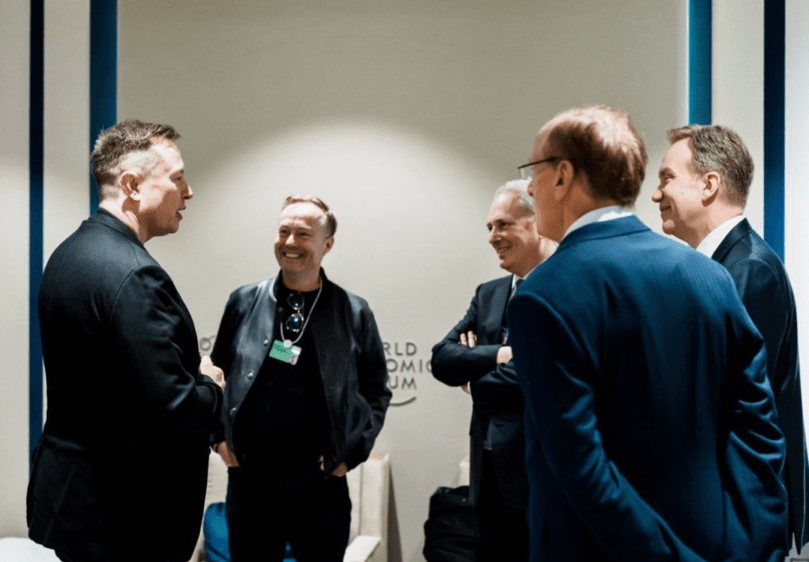
Elon Musk with Jason Calacanis, Børge Brende and Larry Fink in Davos.
Elon Musk: Way to think of it is that if you have a large number of humanoid robots, the economic output is the average productivity per robot times the number of robots. And actually my prediction is in the benign scenario of the future that we will—the robots will actually make so many robots and AI that they will actually saturate all human needs. Meaning you won’t be able to even think of something to ask the robot for at a certain point. Like there would be such an abundance of goods and services. Because my predictions are there’ll be more robots than people.
Larry Fink: So but how do you then have human purpose in that scenario?
Elon Musk: Yeah, I mean, you know, there are—nothing’s perfect. But I mean, it is a necessary… Like, you can’t have both. You can’t have work that has to be done and amazing abundance for all. Because if it’s work that has to be done, and only some people can do it, then you can’t have abundance. It’s narrow.
Larry Fink: Narrow.
Elon Musk: Exactly. So but if you have billions of humanoid robots—I think there will be… I think everyone on Earth is going to have one and gonna want one. Because who wouldn’t want a robot to, you know, assuming it’s very safe—watch over your kids, take care of your pet? If you have elderly parents—a lot of friends of mine have elderly parents, it’s very difficult to take care of them. Expensive. Yeah, it’s expensive, and there just aren’t enough people to take care of the old people. So if you—if they had a robot that could take care of and protect elderly parents, I think that would be a great, amazing thing to have. And I think we will have those things. So overall, I’m very optimistic about the future. I think we’re headed for a future of amazing abundance, which is very cool. And definitely we are in the most interesting time in history. I don’t think there is a more interesting time in history!
AGING
Larry Fink: Can we reverse aging in this new history? Or are we going to see it?
Elon Musk: You know, haven’t put much time into the aging stuff, but I do think it is a very solvable problem. Like, you can—I think when we figure out what causes aging, I think we’ll find it’s incredibly obvious, that it’s not a subtle thing. The reason I say it’s not a subtle thing is because all the cells in your body pretty much age at the same rate. You have never seen someone with an old left arm and a young right arm ever in my life. So why… You know, there is some benefit to death, by the way. It’s like, there’s a reason why we don’t actually have a longer lifespan. Because if people do live forever or for a very long time, I think there’s some risk of an ossification of society—of things just getting kind of locked in place. And yeah, it just may become stultifying, a lack of vibrancy. But that’s it. Do I think we’ll figure out ways to extend life and maybe even reverse aging? I think that’s highly likely.
Larry Fink: Looking forward to that. So in the future you talk about—their AI models, autonomous machines, rockets—depends on massive increases of compute, massive increases in energy. Expensive energy, manufacturing scale. What are the bottlenecks to get there? And once again, with all that expenditures, how can we make sure it is broad, not narrow?
Elon Musk: I just think the natural thing will be very broad because AI companies will seek as many customers as they possibly can. And the cost of AI is already low and plummeting every year—almost the cost of AI is meaningfully changing on a month basis.
Larry Fink: There are open models now everywhere.
Elon Musk: Yes. Very good open models. The open models only lack what may be a year behind the closed models. So I think, yeah, AI companies will seek as many customers as possible, which means they’ll provide AI to the world.
Larry Fink: But the cost of getting to their compute chips, the fab, power—powering that. To me, what are those? It is a huge factor.
Elon Musk: I think the limiting factor for AI deployment is fundamentally electrical power.
Larry Fink: It’s energy. Yeah.
Elon Musk: We were seeing the rate of AI chip production increase exponentially, but the rate of electricity being brought online is….
Larry Fink: 5%, 4% a year max.
Elon Musk: Yes, it’s clear very soon—maybe later this year—we will be producing more chips than we can turn on. Except for China. China’s growth in electricity is tremendous.
Larry Fink: They are building 100 gigawatts of nuclear as we speak.
SOLAR
Elon Musk: Actually solar is the biggest thing in China. So China is—I believe Chinese production capacity on solar is 1,500 gigawatts a year, and they’re deploying over 1,000 gigawatts a year of solar. Now, you know, for continuous solar load, you divide that by roughly 4 or 5. Call it around 250 gigawatts of steady-state power paired with batteries.
And that’s a very big number—half the average power usage in the US. US power usage on average is 500 gigawatts. China. just with solar, solar that can provide steady-state power and batteries can do half of the US electricity output per year just from solar.
Solar’s by far the bigger source of energy. And actually when you look beyond Earth—or even on Earth, but certainly beyond Earth—the sun rounds up to 100% of all energy. This is an important thing to consider. So the sun is 99.8% of the mass of the solar system. Jupiter is about 0.1%, and everything else is miscellaneous. Now even if you were to burn Jupiter in a thermonuclear reactor, this up the amount of energy produced by the sun would still round to 100%, because Jupiter is only 0.1%. If you teleported three more Jupiters into our solar system and burnt three more Jupiters and everything else in the solar system, the sun’s energy would still round up to 100%. So it is really all about the sun. And that is why one of the things we are doing with SpaceX within a few years is launching solar-powered AI satellites. Because space is really the source of immense power. Then you don’t need to take any room on Earth. There is so much room in space and can scale to hundreds of terawatts a year.
Larry Fink: Elon and I have had these conversations before, but why don’t you tell the audience what would it take for the United States in what geography would it take that solar field electrify the United States? Let me ask a question: why aren’t we doing it?
Elon Musk: So rough way is 100 miles by 100 miles—160 kilometers by 160 kilometers—on solar is enough to power the entire United States. So 100-mile by 100-mile area. You can take a small corner of Utah, Nevada, New Mexico—obviously wouldn’t want it all in one place—but there was very small percentage of area of US to generate all electricity that US uses. And same is true actually for Europe. You could take a small part of your energy—take relatively unpopulated areas of say Spain and Sicily, and generate all electricity power that Europe needs.
Larry Fink: Why don’t you think there is a movement towards it here and in the United States? As there is in China?
Elon Musk: Well, unfortunately, US tariff barriers for solar are extremely high and this makes economics deploying solar artificially high. Because China makes almost all the solar.
Larry Fink: And what would it take for Europe or US to build it commercially if it is at scale?
Elon Musk: Yeah, I think—well, I can tell you what we are going to do at SpaceX and Tesla. We’re building up large-scale solar. So the SpaceX and Tesla teams both separately are working to build to 100 gigawatts a year of solar power in the US (of manufactured solar power). That will probably take us about three years. But these are pretty big numbers. And I encourage others to do the same. We obviously don’t control US tariff policy. But China makes solar cells that are incredibly low cost. And I think it would be worth doing large-scale solar.scale solar.
Larry Fink: So I know you’re going to be having a couple of big announcements on robotics and what it can do. I mean, when we went to the factory, you showed me those robots. We talked about billions of robots, but how quickly can they be deployed in your manufacturing setting, be utilized and be functional, and create that abundance you talked about?
Elon Musk: Well, humanoid robotics will advance very quickly. We do have some of the Tesla Optimus robots doing simple tasks in the factory. Probably later this year—by the end of this year—I think they will be doing more complex tasks, but still deployed in an industrial environment. And probably sometime next year—I would say that by the end of next year—I think we will be selling humanoid robots to the public.
Larry Fink: Like you’re already seeing in Tesla cars, software changes every quarter now. A software change upgrades the ability of the robot within the car.
Elon Musk: Yes, the Tesla full self-driving software—we update sometimes once a week. So I think some of the insurance companies have said that it is actually so safe when Tesla uses full self-driving—so safe that they’re offering customers half-price insurance if they use Tesla full self-driving in their car.
Larry Fink: And that can be monitored by the insurance company because it’s part of the agreement?
Elon Musk: Yeah, but I think self-driving cars is essentially a solved problem at this point. Tesla has rolled out Robotaxi service in a few cities, and it will be very widespread by the end of this year within US. Then we hope to get supervised full self-driving approval in Europe hopefully next month.
Larry Fink: Really that quickly!?
Elon Musk: Yeah. And then maybe similar timing for China hopefully.
SPACE
Larry Fink: I want to move to space because historically space is very capital intensive. Historically been done by governments. Obviously SpaceX changed the whole model. But we have seen it slow to scale. And now I am starting to see ramping up in what you are doing. Talk about the automation—how is it changing economics in building and preparing for operating in space?
Elon Musk: Sure. Well, the key breakthrough that SpaceX hopes to achieve this year: full reusability. No one has ever achieved full reusability of a rocket, which is very important for the cost of access to space. We have achieved partial reusability with Falcon 9 by landing the boost stage over 500 times. But we have to throw away the upper stage that burns up on reentry. And the cost of it is equivalent to a small- to medium-size jet.
So with Starship—which is a giant rocket, the largest flying machine ever made—that’s the rocket you’re using for the idea of going to Mars, right?
Larry Fink: Yeah.
Elon Musk: Mars and the Moon as well, and for high-volume satellite stuff. So Starship—hopefully this year—we should prove full reusability for Starship, which will be a profound invention. Because the cost of access to space will drop by a factor of 100 when you achieve full reusability. It is the same economic difference that you would expect between, say, a reusable aircraft and a non-reusable aircraft. Like if you have to throw your aircraft away after every flight, there will be expensive flights. But if you only refuel, then it’s the cost of fuel.
So that’s really the fundamental breakthrough that gets the cost of access to space—we think—below the cost of freight on aircraft. So you know, under $100 a pound type thing easily. It makes putting large satellites into space very low, very cheap.
And then when you have solar in space, you get five times more effectiveness—maybe even more than that—than solar on the ground. Because it’s always sunny, no clouds. Yeah, it’s always sunny. So you don’t have a day-night cycle or seasonality or weather. And you get about 30% more power in space because you don’t have atmospheric attenuation of the power. That net effect is solar is five times more—any given solar panel will do five times the energy in space than on the ground.
Larry Fink: There is any capacity in doing that then taking that power, bringing back to Earth? Is there any way of doing that? Or you just taking the power and utilizing it for needs like building AI data centers in space?
Elon Musk: I think the case is a no-brainer for building AI solar power to AI data centers in space. Because as mentioned, it’s also very cold in space. If you’re in shadow, then it’s very cold in space—3 degrees Kelvin. So you have solar panels facing the sun, and then a radiator that is like pointed away from the sun so it has no sun incidence. And then it’s just cooling—it’s a very efficient cooling system. Net effect is that the lowest-cost place to put AI will be space. And that will be true within 2 years, maybe 3 at latest.
Larry Fink: Looking 10 or 20 years out, how would you describe success with AI or space technology? And where do you see it? Can—are more certain what will happen in the next 3 years, 5, 10?
Elon Musk: I don’t know what’s going to happen in ten years. But the rate at which AI is progressing—we might have AI that is smarter than any human by end of this year, and no later than next year. And probably 2030 or 2031—5 years from now—AI will be smarter than all of humanity collectively.
Larry Fink: We only have a number of minutes left, but I want to humanize you for a second. So there’s no speculation that you’re the most successful entrepreneur, industrialist in the 21st century—maybe beyond. What inspired you? Who inspired you? What was the foundation of your curiosity? And importantly, why? Was there an aha moment, epiphany at any time in your life and career?
Elon Musk: Well, I mean, as a kid I read a lot of science fiction, sci-fi, fantasy books, comic books. And always like technology. Didn’t expect to be where I am today—seems incredibly implausible. But yeah, I was inspired by reading books about the future of science fiction. And I guess want to make science fiction not fiction forever. At some point, turn science fiction into fact. And you know, we wanna have like Starfleet as in Star Trek really for real—where we actually have giant spaceships traveling through space, going to other planets, traveling to other star systems.
Larry Fink: Beamed up to go back to New York?
Elon Musk: I would like beaming back to New York instead of flying. Yeah. You know about Star Trek. So I guess my essential what we call the philosophy of curiosity. And I would like to understand the meaning of life. Is the standard model of physics correct regarding the beginning of existence at the end of the universe? What questions do we not know to ask that we should ask? And AI will help us with these things. So I just try to understand: how did we get here? What’s going on? What is real? Are there aliens? Maybe they are. If you have spaceships traveling to other star systems, we may encounter aliens or find many long-dead alien civilizations. But I just want to know what’s going on—curious about the universe. And that is my philosophy.
Larry Fink: Do you see yourself going to Mars in your lifetime?
Elon Musk: Yes. Like that’s a long commitment, isn’t it? Three years each way?
Larry Fink: Six months.
Elon Musk: But the planets only align every two years. So yeah. Been asked a few times: do I want to die on Mars? And I’m like, yes—just not on impact.
Larry Fink: That’s a good answer. Anyway, we are out of time. Hopefully everybody enjoyed this. And there are so many myths around Elon Musk. I can tell you he is a great friend, and I constantly learn so much from him. And I’m totally inspired by what he has done, have been inspired by who he is, and I’m totally inspired by his vision of the future. And don’t think it’s such a bad future.
Elon Musk: And I think generally my last words would be: I encourage everyone to be optimistic and excited about the future. Good. And generally for quality of life, it is better on being an optimist rather than a pessimist, right?
(End of video – applause and wrap-up.)
This verbatim transcript is important and inspiring for everybody. Because it is so wide-ranging on technology, energy, AI, space, and optimism, it can lift you up if you’re ever down.
When I bought my first Tesla, a Model 3 in 2019, I joined a community of many people who love Elon Musk and Tesla. Every time I drive my Tesla around my hometown Austin, Texas, or take a Robotaxi here, I’m reminded of the extraordinary effort that is put into making Tesla succeed. Elon puts in maximum effort into all his companies.
In January 2022, I started this blog to write positive things about Tesla and Elon Musk. It has since grown to include many transcripts of Elon’s talks. I’m thankful to Johnna Crider for supporting and encouraging me to start this blog.
In Part 5, Dwarkesh Patel raises the question of whether the engineering challenges of building large-scale AI infrastructure might actually be easier in space than on Earth. The conversation then turns to the very real bottlenecks on the ground. Particularly the massive shortage of turbines and specialized casting capacity. Elon Musk explains why SpaceX and Tesla may have to start manufacturing turbine components themselves and shares their aggressive plans to scale solar production.
Transcript:
Dwarkesh Patel asked a central question: while Earth-based power challenges are already enormous, wouldn’t building in space introduce entirely new and unprecedented engineering difficulties — such as radiation hardening, orbital lasers, and other issues that haven’t been solved before? He wondered why anyone would choose these novel challenges over simply building more turbines on Earth, where established companies already know how to manufacture them.
Elon Musk: “I invite again, try doing it and then you’ll see. So like, the turbines are sold out through 2030.”
John Collison asked whether they had considered manufacturing their own turbines.
Elon Musk: “I think in order to bring enough power online, I think SpaceX and Tesla will probably have to make the turbine blades, the vanes and blades internally.”
John Collison asked if Elon meant just the blades or the entire turbines.
Elon Musk: “The limiting factor, you can get everything except the blades. They call the blades and vanes. You can get that 12 to 18 months before the vanes and blades. The limiting factor of the vanes and blades, and there are only three casting companies in the world that make these and they’re massively backlogged, it is Siemens.”
John Collison asked whether it was GE and the big names or subcontractors.
Elon Musk: “No, it’s other companies. I mean sometimes they have a little bit of casting capability in house. But I’m just saying you can just call any of the turbine makers and they will tell you it’s not top secret. They’re probably on the, it’s probably on the internet right now.”
Dwarkesh Patel asked whether, if it weren’t for the tariffs, Colossus would be running on solar power.
Elon Musk: “It would be much easier to make it solar powered. Yeah, the tariffs are nuts, so several hundred percent.”
John Collison began to suggest that Elon surely knew some people who could help.
Elon Musk: “We also need speed. Yeah, no, you know, President has his, you know, we don’t agree on everything and this demonstration is not the biggest fan of solar. We also need the land, the permits and everything. So if you’re trying to move very fast, I do think scaling solar on Earth is a good way to go. But you do need some amount of time to find the land, get the permits, get the solar, pair that with batteries.”
John Collison pressed further, asking why not simply stand up their own massive solar production, noting there is plenty of private land in Texas and Nevada.
Elon Musk: “As I said, we are scaling solar production. There’s a rate at which you can scale physical production of solar cells where we’re going as fast as possible.”
John Collison confirmed they were building the solar cells domestically at Tesla.
Elon Musk: “Both Tesla and SpaceX have a mandate to get to 100 gigawatts a year of solar.”
Elon explains the severe turbine and specialized casting bottlenecks and why SpaceX and Tesla are aggressively scaling their own solar production to 100 gigawatts per year. In Part 6, the conversation continues with more on the engineering and infrastructure challenges of building AI at planetary scale.
Part 1: Opening Banter and the Economics of Space-Based Data Centers
The interview opened with some light-hearted and playful banter. Elon Musk jokingly questioned whether they were really going to talk for three full hours. Dwarkesh Patel teased him in return, saying he didn’t have much to talk about. Elon reacted with mock surprise.
Elon Musk: “So are there really three hours of questions or are you fing serious?” Elon Musk: “Holy f, man.”
John Collison jumped in, agreeing that it was actually the most interesting time because all the major storylines seemed to be converging at once. Elon playfully replied that it was almost as if he had planned it that way.
Elon Musk: “Almost like I planned it.”
John Collison laughed and said “Exactly.”
Elon Musk: “That would never do such a thing.”
With the lighthearted tone set, Dwarkesh Patel steered the discussion into the first major topic: the economics of data centers and why anyone would consider moving them into space. He explained that in a typical data center, energy accounts for only 10 to 15 percent of total cost of ownership, with GPUs representing the vast majority of the expense. He pointed out that placing those GPUs in space would make servicing nearly impossible, shortening their depreciation cycle and driving costs far higher, then asked directly what possible reason there could be to put them in orbit anyway.
Elon Musk: “Well, the availability of energy is the issue. So, I mean, if you look at electrical output outside of China, everywhere outside of China, it’s more or less flat. It’s very, you know, maybe a slight increase, but pretty close to flat. China has a rapid increase in electrical output. But if you’re putting data centers anywhere except China, where are you going to get your electricity? Especially as you scale, the output of chips is growing pretty much exponentially, but the output of electricity is flat. So how are you going to turn the chips on? Magical power sources. Magical electricity fairies.”
Dwarkesh Patel followed up by noting Elon’s well-known advocacy for solar power, calculating that one terawatt of solar (requiring about 4 terawatts of panels at 25 percent capacity factor) would cover only 1 percent of U.S. land area, yet even that seemed insufficient once data centers themselves reached terawatt scale. He asked what exactly we are running out of. Elon pressed him on how far into the singularity he thought we already were, and Dwarkesh turned the question back. Dwarkesh then asked whether the plan was to move to space only after blanketing places like Nevada with solar panels on the ground.
Elon Musk: “Right.”
Elon Musk: “Yeah, exactly. So I think we’ll find we’re in the singularity and like, okay, we’ve still got a long way to go.”
Elon Musk: “I think it’s pretty hard to cover Nevada in solar panels. You have to get permits from, try getting the permits for that.”
In Part 3, Elon revealed how xAI is forcing a gigawatt-scale breakthrough in AI training power. Now Peter’s son Jet (age 14) inspires the next turn: gaming and AI’s role in it.
Peter D.: My other son Jet, who’s 14, wanted to know about your AI gaming studio and the impact of AI in the gaming world. What are your thoughts?
Elon’s origin story surfaces.
Elon: Yeah, that’s why I started programming computers… Civ was actually a very— in terms of games that educate you while you have fun, Civ is epic at that.
Dave jumps in.
Dave B.: The only way I ever win is getting off the planet… Tech victory to Alpha Centauri.
Elon: I guess I am sort of aiming for the Alpha Centauri tech victory essentially.
The analogy is perfect: civilization’s true win condition isn’t domination — it’s escape velocity.
Elon: Aspirationally [building an AI gaming studio].
Because:
Elon: The vast majority of AI compute is going to go to video consumption and generation… Real-time video generation. That’s going to be the vast majority of AI compute. Photon processing.
Peter floats an X Prize for Universal High Income governance. Elon is open but skeptical on measurement.
Then the conversation ascends to simulation theory.
Elon: The most interesting outcome is the most likely… Only the simulations that are the most interesting will survive. Because when we run simulations, we truncate the ones that are boring.
Terrible things can still happen — they keep it engaging. Like watching a war movie while eating popcorn.
Dave B.: So the guys running the simulation have immensely boring lives compared to us.
Elon: Yeah, because when we create simulations, they’re a distillation of what’s interesting.
Are we in Act 3? The room leaves it open.
This segment closes on the biggest frame possible: Reality as a game where the win condition is expansion, energy mastery, and keeping it interesting.
My two cents: Think about what you can remember from your past. You’re probably like me and mostly recall just the spicy parts of your life. So what were you doing on March 3, 2023? Good question—and a troubling one.
Our minds are made of a string of memorable events. For myself, I sought to create the most vivid memories possible when I was young. Soon, I’ll be publishing a book for you that will include some very vivid experiences I had living in Italy when I was 21–22 years old.
I encourage you to create your most important memories when you’re younger—and then you’ll carry those memories with you for your entire beautiful life. But you’re never too old to create memories!
Join my conversation with @elonmusk on AGI timelines, energy, robots, and why abundance is the most likely outcome for humanity's future, alongside my Moonshot Mate @DavidBlundin!
(00:00) – Navigating the Future of AI and Robotics (04:54) – The Promise of Abundance and Optimism… pic.twitter.com/4e4Lstx4ox
In Part 2, Elon dropped a bold bet on ultra-clean chip fabs where you could eat a cheeseburger without contaminating wafers. Now the conversation shifts to our future of abundance: energy.
Sitting in the glorious front lobby of Gigafactory Texas in Austin, Peter steers toward the concerns people in America are thinking about today: energy, health and education. Elon doesn’t hesitate because it is right in sync with his Master Plan 4 for Tesla.
Peter D.: I want to talk about energy, health, education, because those are people’s concerns. So on the energy front, the innermost loop of everything that you’re building and…
Elon: Doing right now, energy is the foundation.
Peter D.: What’s your vision for energy abundance? The sun in the next, you know, this decade. The sun. Yeah.
Elon: I mean, so the sun is everything.
Elon drives the point home with scale that rewires your brain
Elon: People just don’t understand how solar is everything. So everything compared to the sun, all other energy sources are like cavemen throwing some twigs into a fire.
The sun is over 99.9% of the solar system’s mass. Burn Jupiter? Still rounds to 100%. Burn four Jupiters? Same story.
Fusion?
Peter D.: Any interest in fusion?
Elon: Yeah, you know, coming— never going to guess how the sun works.
Peter D.: Giant coal plants.
Elon: I mean we have a giant free fusion reactor that shows up every day 93 million miles away. It’s farcical for us to create little fusion reactors. That would be like having a tiny ice cube maker in the Antarctic and saying, “Hey look, we made ice.”
Solar is the only scalable path
Dave narrows to the immediate bottleneck: powering the Memphis supercluster.
Dave B.: If you just narrow the question to the Memphis timeline. Between a gigawatt and 10 gigawatt. You’re not going to pull 10 gigawatts out of Memphis.
Elon: Maybe two or three.
They’re still in “Toyland” at 10 GW scale — yet xAI is already pushing boundaries.
Peter drops a plug for his Metatrends research, then presses on China’s solar dominance.
Peter D.: China has done an incredible job… They put in 500 terawatt hours in the last year, 70% solar. And they’re just scaling.
Elon: China has done an incredible job on solar. Yeah, it’s amazing. Production capacity around 1,500 gigawatts per year of solar.
The US lags. Energy = GDP = quality of life. The group agrees: America must scale solar aggressively. Tesla and SpaceX are already all-in.
The discussion turns to the GPU power crunch — why TSMC worries about overproducing chips.
Elon: If chip output is growing exponentially, but power harnessed is growing in a slow, linear fashion, then chip production can exceed the rate at which the AI chips can be turned on.
You need transformers, cooling, liquid-cooled racks. One burst pipe? A billion dollars gone.
xAI is solving it first
Elon: xAI is going to have the first gigawatt training cluster at Colossus 2 in Memphis… Mid-January will be a gigawatt… then 1.5 gigawatts probably April-ish.
My 2 Cents
It is amazing that xAI brought together natural gas turbines + Tesla Megapacks to smooth massive power swings for the data center ijn Memphis, and soon to be expanded to Southhaven, Mississippi. It is a symphony of engineering miracles! The finest engineers in Austin and Palo Alto, some even from SpaceX, and the future vision to seek only truth, beauty, and stay curious!
Part 4 dives into gaming, Civilization’s tech victory, and simulation theory.