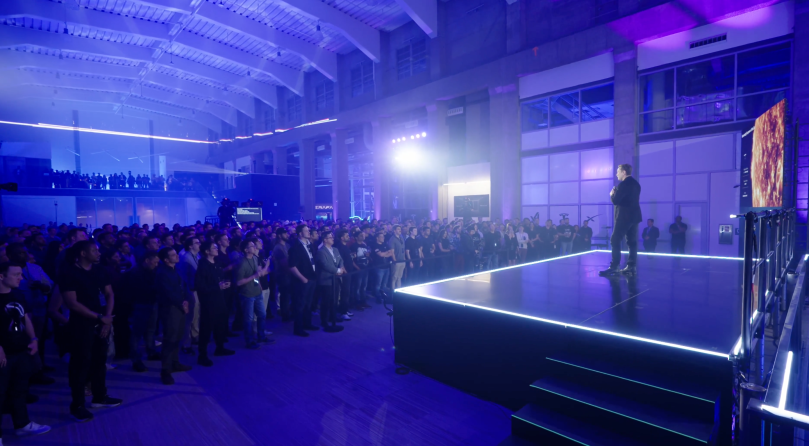
Elon Musk gave a warm, inviting talk about Terafab to a packed, cheering crowd at the historic Seaholm Power Plant in Austin around 8 p.m. on March 21, 2026,

Elon Musk’s Terafab Announcement: Inside the Joint Tesla-SpaceX-xAI Plan for a Terawatt of AI Compute (Full Transcript)

Elon Musk gave a warm, inviting talk about Terafab to a packed, cheering crowd at the historic Seaholm Power Plant in Austin around 8 p.m. on March 21, 2026,

Elon Musk is one of the most caring and approachable people on Earth, and he gave a warm, inviting talk about Terafab to a packed, cheering crowd at the historic Seaholm Power Plant in Austin. While he spoke around 8 p.m. on March 21, 2026, the city outside was treated to a magnificent blue laser beam that appeared over the entire sky—so striking that a local news station immediately sent out a reporter to cover it. Here is my verbatim transcript of his talk.

Elon Musk:

We have a profoundly important announcement to make, which is the most epic chip-building exercise in history by far.

This is really going to take it to the next level—a level probably people aren’t even contemplating right now. This is not in their context. I would call this sort of an out-of-context problem. So we’re going to adjust the context by a few orders of magnitude here.

Let’s see. It’s a joint effort.

[button press sound]

I’m pressing the button, but the button’s not working. Oh, there we go. Okay.

We aspire to be a galactic civilization. So I think the future that everyone—well, most people, I think would agree—is the most exciting one where we are out there among the stars, where we are not forever confined to one planet, that we become a multi-planet species. Like the best science fiction that you’ve ever read, you know, Star Trek or Iain Banks or Asimov or Heinlein. And we want to make that real. Yeah. Not just fiction. Turn science fiction into science fact. That’s the glorious, exciting future that I certainly look forward to.

It’s worth considering how you would rate civilizations. There was a physicist—I think he was Russian—in the ’60s, Kardashev, and he thought about at a high level how you would classify any given civilization. He said, well, if you’re Type One, you’re using most of the energy of your planet. And we actually still have quite a ways to go to be properly a Type One. We’re still using a tiny fraction of the sun’s energy that reaches our planet.

The Earth only receives about half a billionth of the sun’s energy. So the sun is truly enormous. The sun is 99.8% of all mass in the solar system. So sometimes people will ask me, like, what about other power sources on Earth like fusion on Earth? Well, that is unfortunately very small because the sun is 99.8% of mass in the solar system and Jupiter is about 0.1% and Earth is in the miscellaneous category. We are, I think as Carl Sagan might have said, Earth is like a tiny dust mote in a vast darkness—very, very small. The sun is enormous.

So the way to actually scale civilization is to scale power in space. This is necessarily true because we actually capture such a tiny amount of the sun’s energy on Earth because we’re just this tiny dust mote. Another way to think of it is roughly like electricity production on Earth of all of civilization is only about a trillionth of the sun’s energy. Which means if you increase civilizational power output by a million, you would still only be a millionth of the sun’s energy.

It’s awe-inspiring to consider that, just how tiny we are in the grand scheme of things. We often get sort of caught up in these sort of squabbles on Earth that are really very sort of minor things when you consider the grandness of the universe. I think it is important actually to consider the grandness of the universe and what we can do that is much greater than what we’ve done before, as opposed to worrying about sort of small squabbles on Earth type of thing. Not much point in that! We want to be a civilization that expands to the galaxy with spaceships that anyone can go anywhere they want at any time. That would be epic. And have a city on the moon, cities on Mars, populate the solar system, and send spaceships to other star systems. That sounds like the best possible future.

(applause)

So to do that, we need to harness the power of the sun. A Terafab, while it is enormous—a terawatt of compute per year is enormous by our civilizational standards—is still just one step along the way to being even a Kardashev II level civilization. You’re not even registering as a Kardashev III. So it’s a very big thing by current human standards, but still small in the grand scheme. But it’s very difficult for humans.

To accomplish this very difficult goal really requires a combination of efforts from SpaceX, xAI, and Tesla working together to create this epic Terafab project.

And Tesla, xAI, and SpaceX have all done amazing things that people did not think would be done before. There’s the Giga Texas fab here. There’s the Optimus robot that’s being built. There’s a global supercharging network. There’s really quite a lot.

It wasn’t that long ago when people thought electric cars wouldn’t amount to anything. There were basically no electric cars for sale when Tesla started. People said it was impossible, and now Tesla is making 2 million electric cars a year.

Then xAI, although it’s a new company, now part of SpaceX, has also built the first gigawatt-scale compute cluster in record time. Jensen Huang from Nvidia said he’d never seen anything built so fast in his life before. So, a great compliment from Nvidia.

And then SpaceX… well, you already know. The reusable rockets—people said the reusable rockets weren’t possible, and even if you did them, they wouldn’t be economically feasible. So we did them, and then we made them economically feasible. Now we’ve landed over 500 times. Then we did the Falcon Heavy, and now we’re doing Starship.

Starship is a critical piece of the puzzle because in order to scale compute and scale power, you have to go to space, which means that you need massive payload to space and Starship will enable that.

[Shows picture of scale]

This gives you a sense of scale. We’ve got Optimus there for scale. Optimus is about 5’11”, so it gives you a sense of the size of the Starship V3 rocket. Starship V4 will be much longer. Starship V4 will make Starship V3 look kind of short.

We’ll expand with Starship V3 to 200 tons of payload to orbit, up from 100 tons—we’ll start with V3. You can see that this is just a rough approximation of the mini version of the AI sat. That’s roughly 100 kW. It shows the solar panels and the radiator to scale.

For some reason, there’s been a bizarre debate about radiators in space. It’s safe to say SpaceX knows how to do heat rejection in space with 10,000 satellites in orbit—we might know a thing or two. You can see the radiator is quite small relative to the solar panels.

We call it the minisat since that’s just 100 kW. We expect future satellites to probably go to the megawatt range.

(applause)

In order to get to the terawatt of compute per year, you need about 10 million tons to orbit per year at 100 kW per ton. We’re confident this is feasible—like, no new physics or impossible things are required to get there.

I’m confident that SpaceX will get to 10 million tons to orbit per year. Then we’re building up to a terawatt of solar, which will solve the power generation problem.

The key missing ingredient is therefore a terawatt of compute. This announcement is about solving the key missing ingredient.

To give you a sense of what we’re talking about, the current output of AI compute is roughly 20 gigawatts per year. This chart explains why we need to build the Terafab, because all of the rest of the output from Earth is about 2% of what we need.

[Shows chart]

If you add up all the fabs on Earth combined, they’re only about 2% of what we need for the Terawatt Project, or Terafab project.

We certainly want our existing supply chain, to be clear. We’re very grateful to Samsung, TSMC, Micron, and others, and we would like them to expand as quickly as they can. We will buy all of their chips—I’ve said these exact words to them.

But there’s a maximum rate at which they’re comfortable expanding, and that rate is much less than we would like. So we either build the Terafab or we don’t have the chips. And we need the chips. So we’re going to build the Terafab.

We’re starting with an advanced technology fab here in Austin. I believe Governor Abbott is in the audience. I’d like to thank Governor Abbott and the state of Texas for their support.

(applause)

In the advanced technology fab, we will have all of the equipment necessary to make a chip of any kind—logic or memory—and we will also have all of the equipment necessary to make the lithography masks. In a single building, we can create a lithography mask, make the chip, test the chip, make another mask, and have an incredibly fast recursive loop for improving the chip design.

To the best of my knowledge, this does not exist anywhere in the world. Where you’ve got everything necessary that you need to build logic, memory, do packaging and test it, and then do the masks, improve the masks, and just keep looping it. We’re not going to just do conventional compute in this. I think there’s some very interesting new physics that I’m confident will work—just a question of when.

We’re really going to push the limit of physics in compute and we’re going to try a bunch of wild and crazy things which you can do if you’ve got that fast iteration loop. I can’t emphasize enough the importance of being able to make a chip, test it, and then change the design, do another one, and have that in a single building.

I think that our recursive improvement with that situation is probably an order of magnitude better than anything else in the world.

(applause)

So, broadly speaking, we expect to make two kinds of chips. One will be optimized for edge inference. So that’ll be used primarily in Optimus and in the cars but especially in Optimus because I expect the humanoid robots to be made 10 to 100 times more than the volume of cars. So if vehicle production on Earth is about 100 million vehicles a year and I expect humanoid robot production to be somewhere between a billion and 10 billion units a year. So it’s a lot. Tesla’s going to make a very significant percentage of those, is our goal!

And then we need a high-power chip that is designed for space that takes into account the more difficult environment in space where you’ve got high power, you’ve got high-energy ions, photons, you got electron buildup. It’s a hostile environment in space. So you want to design the chip, you want to optimize it for space and you also want to generally run it a little hotter than you would normally run a chip on Earth to minimize the radiator mass. So there are just a bunch of constraints that you would design something differently in space than you would on the ground.

For the space compute, my guess is that is the vast majority of the compute because you’re power-constrained on Earth. That’s why I think it’s probably 100 to 200 gigawatts a year of terrestrial chips and probably on the order of a terawatt of chips in space—just because of power constraints on the ground. Space has this advantage that it’s always sunny. It’s very nice.

I actually think that the cost of deploying AI in space will drop below the cost of terrestrial AI much sooner than most people expect. I think it may be only two or three years before it is actually lower cost to send AI chips to space than it is on the ground. Because in space you don’t need much in the way of batteries. It’s always sunny. And the solar power you get, you’re going to get at least five or more times the solar power you get in space versus the ground, because you don’t have atmospheric attenuation or a day-night cycle or seasonality, and you’re always normal to the sun. So you’re really maximizing the solar power at that point. And this space solar actually costs less than terrestrial solar because you don’t need heavy glass or framing to protect it from extreme weather events.

So as soon as the cost to orbit drops to a low number, it immediately makes extremely compelling sense to put AI in space. It becomes a no-brainer, basically. Moreover, as you go to space, you get increased economies of scale and things get easier over time. Whereas, as you try to put more and more power on the ground, you run out of space and you start using up the easy spots and then you get next-level NIMBY—nobody wants the thing in their backyard. So actually increasing power on Earth becomes harder over time and more expensive over time but in space it becomes actually cheaper and easier over time. These are very important points.

What you just saw there was, because of course you’re asking, what’s on your mind, is well, what do you do after a Terafab? Don’t think small. Well, yeah, good point. So, you know, how do you get to a petawatt? That is the obvious next question. And you get there by having an electromagnetic mass driver on the moon with robots with Optimi and obviously lots of humans. And with that you can send a petawatt, you can create a petawatt of compute and send that to deep space. Because the moon has no atmosphere and has one-sixth of Earth gravity, so you can—you don’t need rockets on the moon. You can literally accelerate it to escape velocity from the surface and that dramatically drops the cost once again of harnessing power and enables you to go a thousand times bigger than a terawatt.

For sure, the future I want to see—I want us to live long enough to see the mass driver on the moon because that’s going to be incredibly epic. That should hopefully get us to a millionth of the sun’s energy at least. It’s humbling to think about that, but a millionth of the sun’s energy would be a million times bigger than Earth’s economy. So it’s good from that perspective. You expand beyond that to the planets, to the other stars, and create the most exciting possible future that I can imagine.

This looks a bit like the opening of Idiocracy with a Mike Judge unlocking an age of amazing abundance. Yeah. Obviously, the elements of that are sustainable energy, space travel, and AI and robotics that bring amazing abundance to everyone. It’s really the only path to amazing abundance: AI and robotics. Which is not to say it can’t go wrong. Hopefully, you know, but I think it’ll probably go right and it’ll be a future that you love. It’s the best future I can think of at least.

And then we go beyond the moon, beyond Mars, and we sail through the rings of Saturn. Now, wouldn’t it be amazing if you could buy a trip to Saturn? Or frankly, if you just have a trip to Saturn. I think things will just be free in the future. It sounds nuts, but you know, if you’ve got an AI robotics economy that is anywhere close to a million times the size of the current Earth economy, literally any need you possibly want can be met. If you can think of it, you can have it.

So I think Iain Banks in his Culture books has it pretty much right, where there actually isn’t money in the future and there’s abundance for everyone. If you can think of it, you can have it. That’s it. Which means anyone could have a trip to Saturn. It won’t be, you know, just a few people. If you want it, you can have it.

Help us design incredible chips and make incredible chips and build a terawatt of chips, a terawatt of solar, and 10 million tons to orbit per year. Thank you.
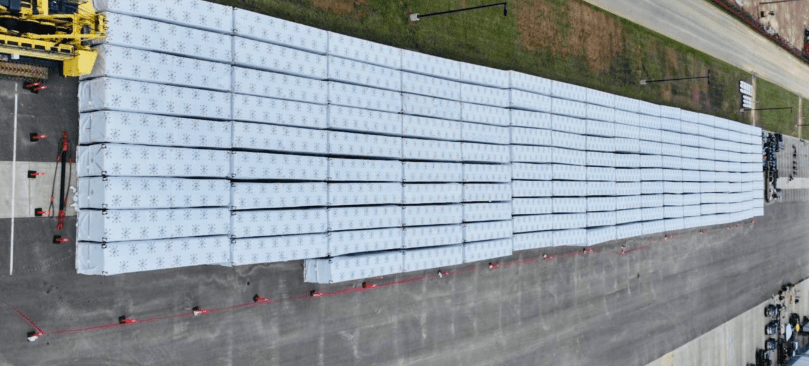

xAI POWERS COLOSSUS 2 WITH 168 TESLA MEGAPACKS

xAI POWERS COLOSSUS 2 WITH 168 TESLA MEGAPACKS

(Memphis, TN) xAI has secured 168 big batteries – Tesla Megapacks – to power up and cool down Colossus 2, a second xAI data center.

Colossus: From 1 to 2

Colossus 1 began construction in early 2024, with planning finalized by March 2024, and started running in September 2024, built in roughly six months. Colossus 2, expanding capacity for complex AI tasks, began development in early 2025, with these 168 powder white Tesla Megapacks delivered by ~ May 19.

Colossus 2 is Massive

Elon revealed on X that Colossus 2 will be the world’s first gigawatt AI training supercluster, this definitely pushes earth’s computational limits.

A gigawatt is one billion watts, enough to power about 750,000 average U.S. homes for an hour, matching the output of a large nuclear power plant.

“Aiming to make Grok the best tool for developers, from enterprise & government to consumer video games!” Elon posted.

The Tesla Megapacks, verified by xAI’s Brent Mayo as designated for Colossus 2, will also ensure grid resilience for the city.

City of Memphis Benefits from xAI’s Commitment

The Greater Memphis Chamber praised xAI’s sustainable practices. “xAI is committed to Memphis through their environmental practices,” the chamber stated, noting participation in MLGW’s Demand Response program. An additional 150 megawatts of Megapack batteries will support the grid during outages or peak demand, benefiting the community. “Grid resilience and battery backup are key to ensuring a successful future for xAI and the region,” Mayo said, adding, “Grok loves the Megapacks!”

My thoughts: Tesla + xAI

I recently read about the great success of Tesla Megafactory in Lathrop, California. It is beautiful to see manufacturing in the US by Tesla provide the solution to xAI’s power demands. Looking at the data center pics (below) you can tell it is essentially hungry for energy for power and cooling. I’ve seen a small data center up close in Austin, Texas, and noticed the huge effort made to keep it cooled.

With Colossus 2, xAI is not just building AI but also serving to buffer local energy infrastructure in case of a power outage.

Zoom in to see Colossus I Tesla Megapacks and fossil generators. pic credit unknown

Inside Memphis Colossus I( pic credit unknown)
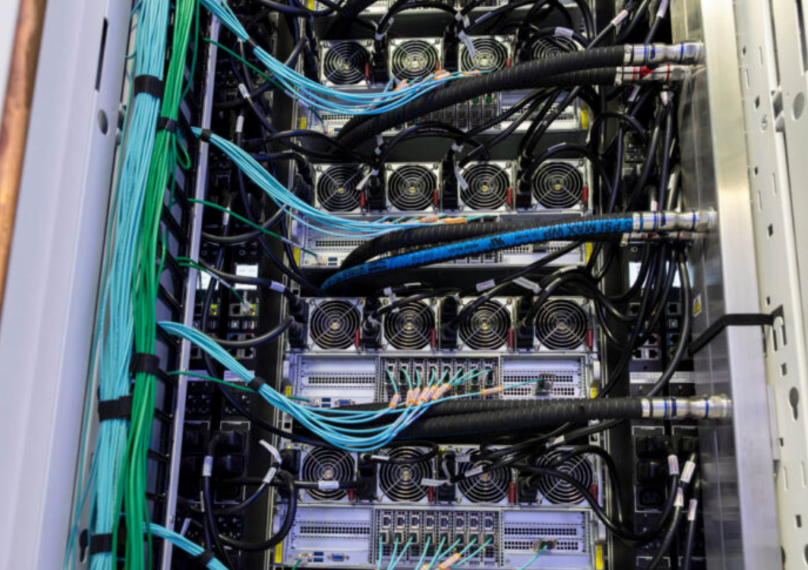
Zoom in on calling tubes for data center Colossus I (pic credit unknown)

xAI and George Orwell: Why We Need xAI to Succeed More Than Ever

“Every record has been destroyed or falsified, every book rewritten, every picture has been repainted, every statue and street building has been renamed, every date has been altered. And the process is continuing day by day and minute by minute. History has stopped. Nothing exists except an endless present in which the Party is always right.” – George Orwell, 1984

Last January, Elon Musk shared an image showing book titles 1984, Fahrenheit 451, and Brave New World, with the words, “you are here” in the center. Around this time, the Twitter Files were being released and mostly ignored and even denied by mainstream media outlets and most politicians. 

Since then, Elon Musk had “kept shooting at his feet,” meaning he has increased his involvement in politics. He is doing great things to help many people and accelerate a sustainable energy economy on the political front. 

Elon Musk has accepted important invitations and had vital talks with French President Emmanuel Macron, China’s foreign minister Qin Gang, and Indian Prime Minister Narendra Modi. 

Why are his political meetings good for humanity? Because Elon Musk stands for the things that will preserve our civilization and that will make humans as happy as possible.

The opposite is a sad decaying civilization that Orwell warned us of in the book, 1984.

BOOKS LIKE 1984 HELP US SEE HOW EASY IT IS TO FALL VICTIM TO CENSORSHIP

When George Orwell published 1984, in the year 1949 it was around the same time as Mahatma Gandhi was assassinated, the House Un-American Activities Committee accused Alger Hiss of spying for the USSR and the Soviet government sealed off land routes to Berlin. 

1984 immerses you in a world where a totalitarian government monitors people even in their private lives. Writing is illegal. Winston Smith rebels and keeps a diary and desires to beat the system. Everything about his life is miserable and that includes his job, his meals, and the grim area of London he lives in. Winston abhors all the cameras and microphones the government uses to monitor people. He despises that his TV must never be turned off as it spits out hasbara continuously. 

The signs “Big Brother is watching you” in the book are synonymous in our culture with the dangers of a government that want to police our thoughts, which is what we experienced on a global level just recently. 

Thankfully, the Twitter Files exist so we can be aware of just how far our own government was willing to push.

ALMOST ALL OF US WERE ADVERSELY AFFECTED BY RECENT WIDESPREAD GOVERNMENT CENSORSHIP

The Twitter Files show just how far our own United States government organizations were willing to go to control the public narrative on US elections and with SARS-CoV-2.  Three examples are,

  • By censoring info that was true but inconvenient to U.S. govt. policy 
  • By discrediting doctors and other experts who disagreed 
  • By suppressing ordinary users, including some sharing the CDC’s *own data*

You can read about these in a Twitter thread shared by David Zweig, author of Invisibles.

Dr. Jay Bhattacharya, an M.D., economist, and professor of health policy at Stanford warned about the dangerous impact of lockdowns, especially on children, the working class, and the poor. In 2020, he and Dr. Martin Kulldorff, then a professor of medicine at Harvard, and Dr. Sunetra Gupta, professor of epidemiology at Oxford wrote an open letter arguing for “focused protection” for the most medically vulnerable and a return to normal life for the rest of society.  ​​

Twitter 1.0 put Bhattacharya’s account on the Trends Blacklist, which meant that, no matter how many likes or views one of his tweets racked up, it could never “trend”; its visibility to users on the platform would be sharply curtailed. (You can read more about that in the article, “Twitter’s Secret Blacklists” by the Free Press.) 

Lee Fang released Twitter Files Part 8 and wrote about how “Twitter Aided the Pentagon in Its Covert Online Propaganda Campaign in an article in the Intercept.”

Fang said, “This appears to align with a major report published in August by online security researchers affiliated with the Stanford Internet Observatory, which reported on thousands of accounts that they suspected to be part of a state-backed information operation, many of which used photorealistic human faces generated by artificial intelligence, a practice also known as deep fakes.”

The Twitter Files revealed how the government paid millions of dollars to censor information from the public. Michael Shellenberger said, 

“As of 2020, there were so many former FBI employees — the Bu alumni — working at Twitter that they had created their own private Slack channel and a crib sheet to onboard new FBI arrivals.” 

Shellenberger published a screenshot of an email, which I will attach to this article near the end.

xAI STANDS FOR TRUTH AND HOPE:  THE MISSION IS TO UNDERSTAND THE TRUE NATURE OF THE UNIVERSE

We should do all we can to promote and root for the success of Elon Musk’s new AI company, xAI. I believe xAI will serve humanity and help preserve our civilization. 

xAI is much needed as we have learned from both recent events revealed by the Twitter Files and from cautionary works of literature like Orwell’s 1984. The statement at the beginning of this article is chilling. It was written in 1949, and it could apply today.

CONCLUSION

Elon Musk’s heartfelt motivation to help humanity was summed up in a response to a tweet from January 1, 2022. 

“Elon Musk deserves our full support. Elon’s companies exist, because he cares enough to make our lives better and safeguard consciousness.”

 I was supercharging my Tesla in Austin when I tweeted this, and wondering if I spelled consciousness correctly when Elon immediately replied, 

“I have trouble understanding any other motivations tbh.”

I would like to end this sad, tragic article on one positive note. Though much has been lost, there is great hope in the creation and building of xAI. I think humanity has a much greater chance of preserving truth and it is never too late to turn the tide around. I have hope that we will soon see people become optimistic about the future, excited about space travel, and happy to live a joyful life. 

AUTHOR’S NOTE: This is a revised article from the original I wrote for my blog What’s Up Twitter on January 5, 2023. Elon Musk is hell bent on changing the status quo. How these 3 books relate to the Twitter Files.

The information is still pertinent so I have chosen to share this new article with you for a wider reach considering how important this topic is.

Article by Gail Alfar, please credit accordingly. Mentioned in the article: @elonmusk @xai @shellenberger @lhfang @DrJBhattacharya @MartinKulldorff. Dr. Sunetra Gupta

Images credit: Elon Musk, Reddit, and except from 1984. Used with permission.

Addendum: Michael Shellenberger published this revealing email screenshot as part of the Twitter Files, saying, “As of 2020, there were so many former FBI employees — the Bu alumni — working at Twitter that they had created their own private Slack channel and a crib sheet to onboard new FBI arrivals.” 

Image from xAI

Future of AI: The Case for A Good and Positive Future

Elon Musk talked on a Twitter space on July 12, 2023. Here’s what he said about his new company, xAI, AI regulation, the importance of insight followed by oversight, China’s reasons to regulate AI, “Team Humanity.” He also gives advice for young people (or anyone for that matter) as we enter into a new era and then discusses the singularity. Elon ends the discussion on a positive note, explaining why we should be optimistic about the future. 

xAI

“I think I have been banging the drum on AI safety now for a long time. If I could press pause on AI or advanced AI digital superintelligence, I would. It doesn’t seem like that is realistic.

“So xAI is essentially going to build an AI, you know, you’ve got to grow an AI in a good way, hopefully. 

“The premise of an AI is to sort of have an AI that is maximally curious, maximally truth-seeking, and, this may get a little esoteric here, but I think that a curious AI, one that is trying to understand the universe, I think I want it to be pro-humanity from the standpoint that humanity is just so much more interesting than not-humanity.

“Obviously, I’m a big fan of Mars and that we should become a spacefaring, civilization, and a multi-planet species, but Mars is quite frankly boring relative to Earth. It’s a bunch of rocks, and there’s no life that we’ve detected, not even microbial life.

But Earth, with the vast complexity of life that exists, is vastly more interesting than Mars.

“You just learn a lot more with humanity being there, and, I think fostering humanity, if you are trying to understand the true nature of the universe, that’s the best thing that I can come up with from an AI safety standpoint.

“I think this is better than trying to explicitly program morality into AI. because if you program in a certain morality, you have to say well what morality are you programming? Who’s making those decisions? And even if you are extremely good with how you program morality, there’s still a morality, inversion problem. This is sometimes called the Waluigi problem, which is if you program Luigi, you inherently get Waluigi by inverting Luigi. 

Haha, to use Super Mario metaphors. I mean this is starting to get quite esoteric, but hopefully, this makes some sense. 

Who is Waluigi? For some background, Waluigi is a fictional character in the Mario franchise. He plays the role of Luigi’s arch-rival and accompanies Wario in spin-offs from the main Mario series, often for the sake of causing mischief and problems. Interestingly, Elon played the role of Wario in a SNL skit in May 2021. Wario, similar to Waluigi, was designed to be an arch-rival to Mario, an anti-hero or an antagonist.

Elon continued,

 “So, I would be a little concerned about the way AI is programming the AI to say that this is good and that’s not good. xAI is really just kind of starting out here, it will be a while before it’s relevant on the scale of OpenAI Microsoft AI or Google Deep Mind AI. Those are really the two big gorillas in the Ai right now by far. 

“I could talk about this for a long time, it’s something that I’ve thought about for a really long time and actually was somewhat reluctant to do anything in this space because I am concerned about the immense power of a digital superintelligence. It’s something that, I think is maybe hard for us to even comprehend. 

“Even if AI is extremely benign, the question of relevance, perhaps, comes up. If it can do anything better than any human, what’s the point of existing? That is also an issue?  Do we even have relevance in such a scenario? That’s the bad side of it. The good side, obviously, is that in an AI future where you really will have (in a benign scenario) an age of plenty where, really, there will be no shortage of goods and services. Any scarcity will be simply scarcity that we self-define as scarcity. It could be a unique piece of art or a house in a specific location. It’s artificially defined scarcity but goods and services will not be scarce in a positive AGI future. 

But I think it’s also important for us to worry about a terminator future in order to avoid a terminator future. 

AI REGULATION 

Elon also spoke about the critical nature of AI regulation,

“And I am an advocate of having some sort of regulatory oversight and I’ve actually made this point throughout the world, meeting with world leaders including in China where there is actually strong agreement that there should be AI oversight, AI regulation. 

“Just as we have regulations for nuclear technology, you can’t just go make a nuke in your garage, and everyone thinks that’s cool, we don’t think that’s cool. There’s a lot of regulation around things that we think are dangerous. And even if things are not dangerous at a civilizational level, we have the FDA, we have the FAA and the DOT.  There are all these regulatory authorities that we put in place to ensure public safety at an individual level but AGI is just one of those things that is potentially dangerous at a civilizational level not just at an individual level. That’s why we want to have AI regulation. 

“We want to be careful in how the AI regulation is implemented, not be precipitous or heavy-handed. But there has to be some kind of referee on the field here. One of the dangers is that companies race ahead to… I think it’s actually more dangerous for companies that are behind that might take shortcuts that could be dangerous.  

“You know, the FAA came into being after lots of people died in aircraft crashes and they were like, If you want to make aircraft you cannot cut corners because people are going to die. So, that’s kind of how I see AI regulation. I know a lot of people are against it but I think its the kind of thing that we should do, we should do it carefully, we should do it thoughtfully.

Elon paused here while Ro Khanna, a U.S. representative from California and Mike Gallagher U.S. representative for Wisconsin spoke. In response to their conversation, Elon added,

“It’s difficult to think of, I can’t think of a good movie or TV example of Ai that’s the benign scenario. There are some books. The Ian Banks Culture books are the best imagining of a positive AI future that I’ve read. I think the Isaac Asimov Foundation series books have somewhat of a benign AI center (the TV series divulges quite far from the books). But the most sophisticated or perhaps the most accurate view of an AI future is the Ian Banks Culture books which I highly recommend. It would be helpful for Hollywood to articulate that vision in a way that the public can understand.

INSIGHT, FOLLOWED BY OVERSIGHT

Elon said 

“I think the right sequence to go with here is insight, followed by oversight.  At first, it’s really just for the government to try to understand what’s going on and I think there’s some merit to an industry group, like the Motion Picture Association that I think actually should be formed so I think we’ll try to take some steps in that direction because there’s some amount of self-regulation that I think can be good here.

CHINA WILL REGULATE AI

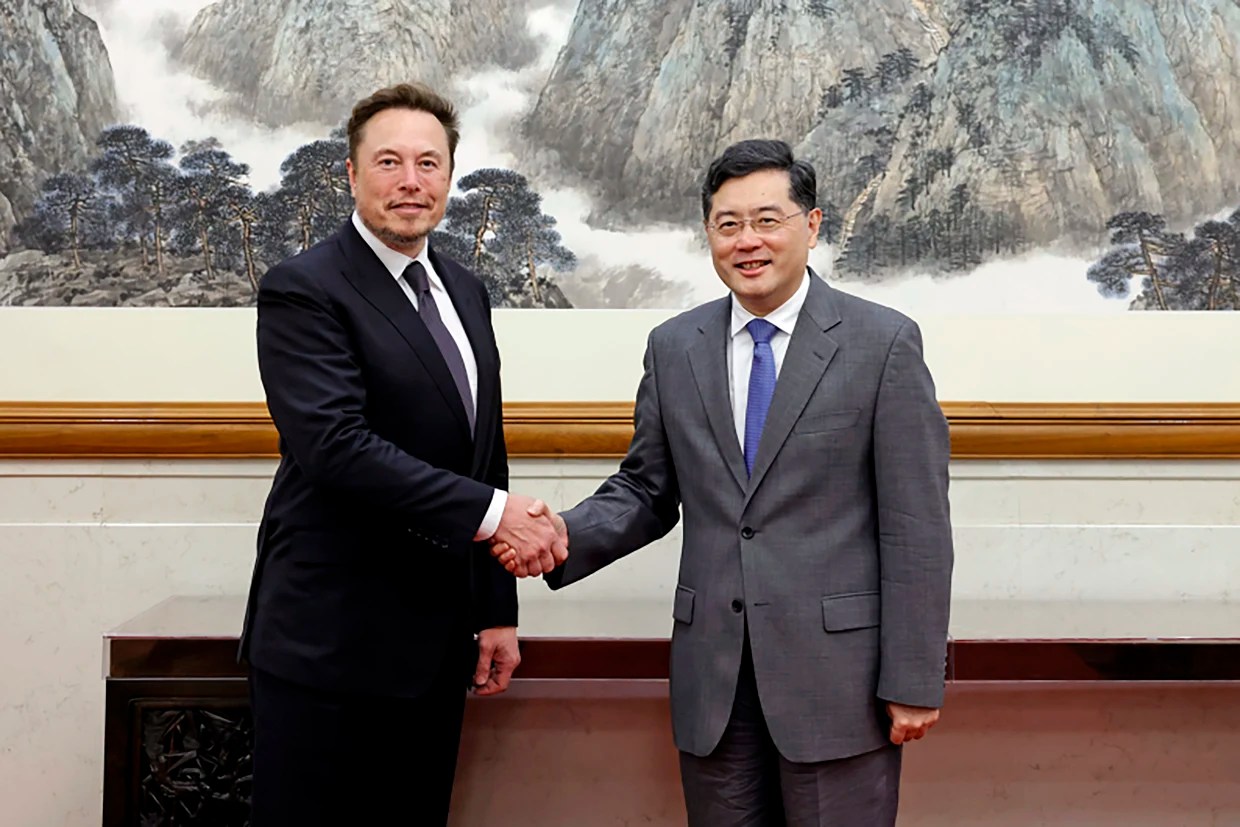
Elon Musk in China meeting with Qin Gang, foreign minister. May, 2023.

Elon Musk is generally pro-China, he thinks China is underrated and he truly agrees the people are China are really wonderful. When he was in China, he experienced a lot of positive energy there and he noticed the Chinese people generally want the same things that people in America want. He admits there are many political challenges. He praises China for how much they have accomplished to further the electrification of vehicles and implement solar and wind power. He spoke about his trip to China,

“When I was on my recent trip to China, I did spend a fair amount of time with the Senior leadership there, talking about AI safety and some other potential dangers and pointing out that if a digital superintelligence is created that that could very well be in charge of China instead of the Chinese communist party. I think that did resonate. No government wants to find itself unseated by a digital superintelligence. So I think they actually are taking action on the regulatory front and are concerned about this as a risk and I’ve seen some comments internally within China that the companies are a bit unhappy about the government wanting to put regulatory oversight on AI. So this is something that does actually resonate even in China because when I was in China I said one of the biggest obstacles to AI regulation outside of China is the concern that China will not regulate AI and then will get ahead and they took that point to heart, it’s a logical point, I think. And I highlighted that, if you make superintelligence, the superintelligence could actually run China and that also resonated.  

“So I think, try to shed as much light on this subject. Sunlight is the best disinfectant. Be as open about things as possible, going from insight for a few years to oversight with consultation with the industry, is the sensible approach. 

“I think the public is starting to understand the potential of AI with ChatGPT, something the public can interact with. I’ve understood the power of AI for a while, and until you have some sort of easy to use interface it’s difficult for the public to understand. It’s also the case with stable diffusion and Midjourney, you can see the incredible art that AI can create, it’s really amazing. 

“I’m actually somewhat of an optimist in general, but like I said, the best way to ensure a good future is to worry about a bad one. So I think that’s the sensible thing to do, and to have discussions like this, and continue to have discussions like this. 

TEAM HUMANITY

Elon spoke about how easy it is to demonize an organization or a person if you have never met them in person, saying, “When you meet with them you’re like, well, there’s not that bad! You can understand where they’re coming from and at the end of the day, we’re all part of Team Humanity, hopefully! I think we should all aspire to be part of Team Humanity! We’ve got one planet only, so far, and we don’t want to lose it. There’s that famous quote – think it might be Einstein but could be one of those internet things where you think its Einstein but its not, where it says, it doesn’t matter how WW3 was fought except that WW4 will be fought with sticks and stones.” Haha, there’s not going to be anything left! So we really want to aspire to avoid global thermonuclear warfare. We really want to avoid that, Bigtime! Hopefully, we’ll focus on positive things like becoming a spacefaring civilization, becoming a multi-plantary species, hopefully going out there and visiting other star systems, but we may discover many long-dead one-planet civilizations that never got beyond their original planet. 

“I do not know with what weapons World War III will be fought, but World War IV will be fought with sticks and stones.” – Albert Einstein.

Elon continued,

“On the xAI front. If I speak to my personal motivations here, is that I’ve always just wondered what is really going on in reality.  Are the aliens?  Where are they? Like the Fermi paradox, I find to be intriguing and troubling if the standard model of physics is correct, the universe has been around for many billions of years, so why haven’t we seen aliens? Many members of the public are convinced the government is hiding evidence of aliens and I have not seen any evidence of aliens which is a concern. I might feel better if I saw some aliens. I have not seen one shred of evidence of aliens which is a problem. It means that life & consciousness might be incredibly rare. Maybe we are it, at least in this galaxy. The light of consciousness seems to be this tiny candle in a vast darkness and we should do our absolute best to make sure that candle does not go out.” 

ELON’S THEORY ABOUT OUTCOMES RELATING TO CHINA – TAIWAN 

“The most entertaining outcome is the most likely (as seen by a 3rd party, not the participants. Like, you could be watching a WW1 movie about getting blown to pieces while sipping a soda and eating popcorn. Not so great for those in the movie, but it is entertaining which does suggest it’s probably going to get hot in the Pacific. Hopefully not too hot. But it’s going to get hot. Hopefully, we can get past that and get to a positive situation for the world in the spirit of, aspirationally, we are all on Team Humanity. But it’s going to get spicey. But the most concerning thing is probably the Taiwan question over the next 3 years and the next 3 years after that I’d be surprised if there is not digital superintelligence in roughly the 5 or 6-year timeframe. If this was a Netflix Series, I’d say the season finale would be a showdown between the West and China and the Series finale will be AGI.” 

ELON’S ADVICE FOR YOUNG PEOPLE (AND ANYONE)

“If someone is able to contribute to building AI in a positive way, if someone has that technical ability, that is probably the right thing to work on.  For your average citizen, I think the future is definitely going to be interesting. Things get very strange in a future where the AI can basically do everything. In the benign scenario, I guess we will look for personal fulfillment in some way. I think between now and then it’s just trying to be useful. On the manufacturing front, I do think we should place much greater weight on the importance of manufacturing. I think things are shifting in that direction. Generally, when somebody asks me for advice, my advice is to try to be as useful as possible. It’s actually quite hard to be useful. If you can be of use to your fellow humans and contribute more than you take then I think that’s a great thing! I have a lot of respect for those who work hard and do make goods, and provide services, in excess of what they take. That is just a fundamentally good thing. 

Elon explains the advent of AGI is often referred to as the singularity. A singularity is like a black hole. You just don’t know what happens after that. “We are on the event horizon of the singularity of digital superintelligence.” 

One of the most interesting parts of all of history is the time we live in now, and Elon Musk is optimistic, he says, 

“I think if I was to assign probabilities, I think it is more likely to be a positive scenario than a bad scenario, it’s just that the bad scenario is not 0% and we want to do everything we can to minimize the probability of a bad outcome with AI. I think it is maybe 70-80% likely to be a good future. Maybe a great future even! I think of the future in probabilities, nothing is for sure. The future is a set of branching probability streams. 

What is the Turing Test? The Turing Test is a deceptively simple method of determining whether a machine can demonstrate human intelligence: If a machine can engage in a conversation with a human without being detected as a machine, it has demonstrated human intelligence.

Elon explains he thing we are well past The Turing Test with AI. He says, 

“ChatGPT is well past the Turing Test so really we are on our way to digital superintelligence, I think it’s 5 or 6 years away. The definition of superintelligence is that it’s smarter than any human at anything. It’s not necessarily smarter than the sum of all humans, that’s a higher bar, to be smarter than the sum of all humans. Especially given that it’s the sum of all humans that are machine augmented in that we will have computers and phones and software applications. We are already defacto cyborgs, it’s just that the computer is not integrated with us. But one’s phone is already an extension of one’s self. If you leave your phone behind it feels like missing limb syndrome. You’re patting your pockets like -where did my phone go? It’s crazy the degree to which our phone is basically a supercomputer in your pocket. It is an extension of yourself. So there is a higher bar to be smarter than the sum of all humans that are computer augmented”

Elon explained this concept has caused him stress and many sleepless nights. He tries to figure out how we navigate through these facts to the best possible future for humanity as it may be the hardest problem humans have ever faced and it deserves, or rather, it demands our attention.  He adds,

“I think ultimately the nation-state battles will seem parochial compared to digital superintelligence. Of all the risks that we face, there are ones that are dangerous at an individual level and dangerous at a state level and there are things dangerous at a civilizational level. Global thermonuclear warfare is dangerous at a civilizational level, some supervirus that has high mortality rates would be dangerous. I think it’s crazy to do gain-of-function research. Gain of function research is like saying – death maximization! Haha, like I don’t know who came up with this gain-of-function model!? Haha. AI is also a civilizational risk, but the thing about AI is that is has the potential to be amazing if it’s done right.

THE FUTURE IS BRIGHT 

The hour-long talk ended with Elon Musk reminding listeners that, 

“We want to maximize the collective happiness of humanity and the freedom of action of humanity. You want to look forward to the future and say that is the future I want to be a part of! And I’m excited about the future. That’s actually incredibly important in general. I’m actually concerned that there’s a pervasive pessimism in the world about the future and that’s part of what’s leading to a low birthrate in many parts of the world. I advocate for optimism. I think it’s generally better to be optimistic and wrong than pessimistic and right! 

“You look up at the night sky, and see all those stars, and I wonder what’s going on up there. Are there alien civilizations? Is there life up there? Hopefully one day we find out!” 

                                                                       Elon Musk

This article by Gail Alfar. Please credit accordingly. Since January 2022, I have been writing and recording many of Elon Musks’ talks on my blog and here in order to preserve his important words in writing. My blog link is on my Twitter bio and I thank you for reading and for your support.  You rock and you are part of Team Humanity!  Thank you!

,