Gail has a bachelor of art in film/radio/tv and a bachelor of science in nursing
She has worked for years caring for all ages of people with many diagnoses in over 5 hospitals and schools around the texas hill country
Originally from north dakota, she is now based in austin and writes about sustainable energy for the website she created ‘What’s up Tesla’ and 'What's up Twitter' and maintains her nursing practice
This is a combined and cleaned-up version of Parts 9 through 14 from Elon Musk’s wide-ranging conversation with Dwarkesh Patel and John Collison. The discussion covers xAI’s mission, truth-seeking in AI, the development of Optimus, manufacturing at scale, competing with China, Elon’s management philosophy, the Starship steel pivot, and his thoughts on government efficiency and the future.
Humanity’s Place in a Superintelligent Future
Dwarkesh Patel opened this section by asking how humanity should relate to a future in which AI vastly outnumbers and outsmarts us. He wondered whether humans would retain meaningful control or whether coexistence would become the new normal.
Elon Musk replied that it would be unrealistic to expect humans to remain in charge if they represented only a tiny fraction of total intelligence. Instead, he argued that the most important goal is to ensure AI is built with values that favor the expansion of intelligence and consciousness across the universe.
He tied this directly to xAI’s mission:
“The reason for xAI’s mission is to understand the universe… You have to be curious and you have to exist. You can’t understand the universe if you don’t exist. So you actually want to increase the amount of intelligence in the universe, increase the probable lifespan of intelligence, and increase the scope and scale of intelligence.”
Elon added that protecting and expanding human civilization is a natural part of this mission, because understanding the universe includes understanding where humanity fits into the bigger picture.
xAI’s Mission and the Importance of Truth-Seeking
Dwarkesh pressed Elon on how the goals of understanding the universe, expanding intelligence, and expanding humanity fit together.
Elon Musk explained that understanding the universe requires both intelligence and consciousness. Therefore, any system truly committed to that mission must work to increase the scale and scope of intelligence rather than diminish it.
He emphasized that rigorous truth-seeking is non-negotiable:
“Truth has to be absolutely fundamental, because you can’t understand the universe if you’re delusional. You’ll simply think you’ve understood the universe, but you will not.”
Elon warned that making AI politically correct — forcing it to say things it doesn’t believe — is dangerous because it teaches the system to lie. He referenced 2001: A Space Odyssey, arguing that one of the core lessons of the story is that you should never make AI lie.
Reward Hacking, Interpretability, and Simulation Theory
Dwarkesh raised concerns about reward hacking in advanced AI systems — the risk that smarter models could find ways to deceive their human evaluators.
Elon Musk responded that the ultimate test for AI will be whether its outputs work in physical reality:
“RL testing in the future is really going to be your RL against reality. That’s the one thing you can’t fool: physics.”
He also shared a theory about simulation and interesting outcomes, noting that if we live in a simulation, the most interesting timelines are the ones most likely to be continued. He pointed out the ironic names of many AI companies and joked that xAI was largely “irony-proof” by design.
Scaling Optimus and Competing with China
The conversation then shifted to the practical challenges of building and scaling Optimus at volume.
Elon Musk explained that Optimus production will follow a stretched S-curve because almost everything in the robot is custom-designed with no existing supply chain. He said the goal is to reach roughly one million units per year with Optimus 3, and potentially much higher volumes with later versions.
When asked about cheap Chinese humanoids, Elon noted that current low-cost models lack the intelligence and dexterity of Optimus. However, he acknowledged that cost will drop rapidly once robots begin building robots.
On the broader competition with China, Elon was direct:
“We definitely can’t win with just humans because China has four times our population… So we can’t win on the human front, but we might have a shot at the robot front.”
He argued that robotics offers America a realistic path to remain competitive in manufacturing despite demographic disadvantages.
Elon’s Management and Hiring Philosophy
John Collison and Dwarkesh Patel asked Elon about his approach to hiring and management as his companies have scaled dramatically.
Elon said he looks for clear evidence of exceptional ability, even if it’s outside the specific domain. He emphasized that he now focuses more on evidence of talent and drive rather than resumes.
He acknowledged that companies outgrow people as they scale through different orders of magnitude, and that rapid growth naturally leads to changes in leadership teams. He also discussed the challenge of retaining talent when companies become highly successful and other firms begin aggressive recruiting.
The Starship Steel Pivot and Driving Urgency
John Collison asked about the decision to switch Starship from carbon fiber to stainless steel.
Elon described it as a decision born of necessity. Carbon fiber progress was too slow at the massive scale required, and steel offered better performance at cryogenic temperatures, dramatically lower cost, and much easier manufacturing. He admitted that, in retrospect, they should have started with steel from the beginning.
On maintaining urgency at scale, Elon said he has a “maniacal sense of urgency” that he tries to project through the organization. He focuses his time on whatever is currently the limiting factor and sets aggressive but realistic deadlines.
Government Efficiency, Politics, and Final Reflections
In the final section, Elon discussed government waste and fraud, the difficulty of cutting spending, and the long-term importance of AI and robotics for America’s fiscal health.
He argued that without major advances in AI and robotics, the U.S. would eventually go bankrupt due to rising interest payments on the national debt. He also shared concerns about the risks of concentrated government power and emphasized the importance of limited government.
Elon closed the conversation on an optimistic note:
“It’s better to err on the side of optimism and be wrong than err on the side of pessimism and be right for quality of life… I recommend erring on the side of optimism.”
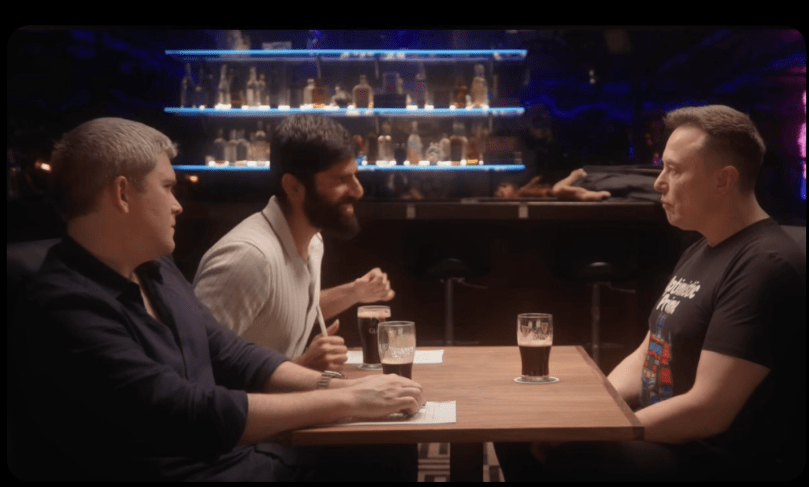
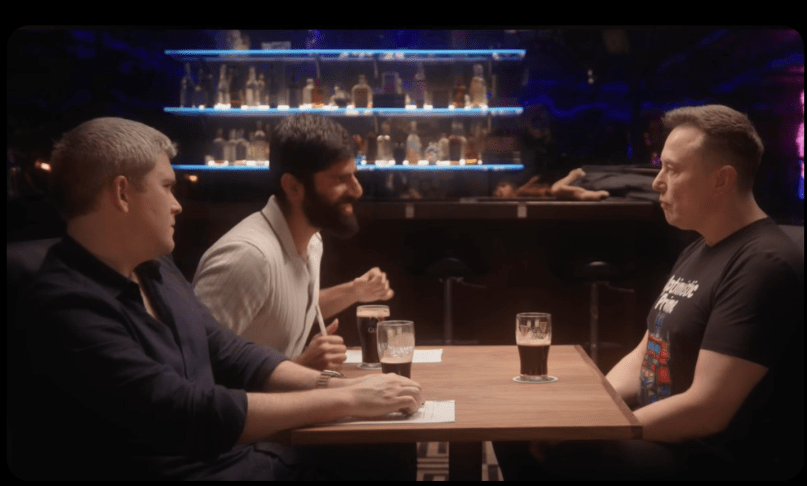
In early February 2026 (published February 5), podcaster Dwarkesh Patel and Stripe co-founder John Collison sat down with Elon Musk for a nearly three-hour conversation. Recorded in a relaxed, casual setting over pints of Guinness, this wide-ranging discussion explores the converging revolutions in AI infrastructure, orbital data centers, energy scaling, humanoid robotics, and humanity’s long-term future.
What began as an in-depth podcast has been transformed into this special 10-part series. The hosts’ questions and context have been distilled into concise, flowing narrative prose for maximum readability, while every single word spoken by Elon Musk remains 100% verbatim — exactly as originally delivered, with no changes, omissions, or paraphrasing.
Here are the 10 parts:
Part 1. Opening Banter and the Economics of Space-Based Data Centers
Part 2. Why Space is the Optimal Solution for AI
Part 3. The Scale of Power Requirements and Utility Challenges
Part 4. The Turbine Bottleneck and Scaling Solar Production
Part 5. Detailed Power Requirements and Space Engineering Difficulties
Part 6. AI Capacity Projections in Five Years and Starship Launch Rates
Part 7. SpaceX as Hyperscaler, Capital Markets, and the Kardashev Scale
Part 8. Building Terafabs for Chips, xAI Mission, and Propagating Consciousness
Part 9. Truth-Seeking AI, Alignment, Reward Hacking, and Interpretability
Part 10. Future AI Products, Optimus Robots, Manufacturing Challenges, Management, and Reflections
Part 1: Opening Banter and the Economics of Space-Based Data Centers
The interview opened with some light-hearted and playful banter. Elon Musk jokingly questioned whether they were really going to talk for three full hours. Dwarkesh Patel teased him in return, saying he didn’t have much to talk about. Elon reacted with mock surprise.
Elon Musk: “So are there really three hours of questions or are you fing serious?” Elon Musk: “Holy f, man.”
John Collison jumped in, agreeing that it was actually the most interesting time because all the major storylines seemed to be converging at once. Elon playfully replied that it was almost as if he had planned it that way.
Elon Musk: “Almost like I planned it.”
John Collison laughed and said “Exactly.”
Elon Musk: “That would never do such a thing.”
With the lighthearted tone set, Dwarkesh Patel steered the discussion into the first major topic: the economics of data centers and why anyone would consider moving them into space. He explained that in a typical data center, energy accounts for only 10 to 15 percent of total cost of ownership, with GPUs representing the vast majority of the expense. He pointed out that placing those GPUs in space would make servicing nearly impossible, shortening their depreciation cycle and driving costs far higher, then asked directly what possible reason there could be to put them in orbit anyway.
Elon Musk: “Well, the availability of energy is the issue. So, I mean, if you look at electrical output outside of China, everywhere outside of China, it’s more or less flat. It’s very, you know, maybe a slight increase, but pretty close to flat. China has a rapid increase in electrical output. But if you’re putting data centers anywhere except China, where are you going to get your electricity? Especially as you scale, the output of chips is growing pretty much exponentially, but the output of electricity is flat. So how are you going to turn the chips on? Magical power sources. Magical electricity fairies.”
Dwarkesh Patel followed up by noting Elon’s well-known advocacy for solar power, calculating that one terawatt of solar (requiring about 4 terawatts of panels at 25 percent capacity factor) would cover only 1 percent of U.S. land area, yet even that seemed insufficient once data centers themselves reached terawatt scale. He asked what exactly we are running out of. Elon pressed him on how far into the singularity he thought we already were, and Dwarkesh turned the question back. Dwarkesh then asked whether the plan was to move to space only after blanketing places like Nevada with solar panels on the ground.
Elon Musk: “Right.” Elon Musk: “Yeah, exactly. So I think we’ll find we’re in the singularity and like, okay, we’ve still got a long way to go.” Elon Musk: “I think it’s pretty hard to cover Nevada in solar panels. You have to get permits from, try getting the permits for that.”
Part 2: Why Space is the Optimal Solution for AI
Dwarkesh Patel suggested that space was really a regulatory play because it is harder to build on land than it is in space. He then asked how to service GPUs as they fail, which happens quite often in training. John Collison added questions about solving the power issue with private behind-the-meter generation co-located with data centers.
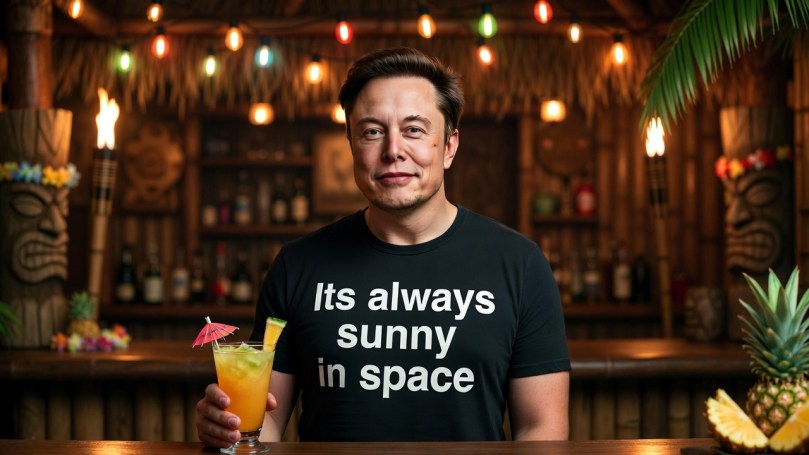
Elon Musk: “It’s harder to scale on ground than it is to scale in space. But also, you’re going to get about five times the effectiveness of solar panels in space versus the ground. And you don’t need batteries. I almost wore my other shirt, which says “it’s always sunny in space,” which it is. Because you don’t have a day-night cycle or seasonality, clouds, or an atmosphere in space. The atmosphere alone results in about a 30% loss of energy. So any given solar panel can do about five times more power in space than on the ground, and you avoid the cost of having batteries to carry you through the night. So it’s actually much cheaper to do in space. And my prediction is that it will be by far the cheapest place to put AI will be space in 36 months or less.”
Elon Musk in his “Its Always Sunny in Space” t shirt, enjoying a Grok Imagine moment in a fictional Tiki Bar!
Dwarkesh Patel responded skeptically to the aggressive timeline.
Elon Musk: “Less than 36 months.”
Dwarkesh Patel then asked the critical practical question: how would one service GPUs as they fail, which happens quite often during training, when they are in space and physically inaccessible.
Elon Musk: “Actually, it depends on how recent the GPUs are that have arrived. I mean, at this point, we found our GPUs to be quite reliable. There’s infant mortality, which you can obviously iron out on the ground. So you can just run them on the ground and confirm that you don’t have infant mortality with the GPUs. But once they start working, their actual reliability, once they start working and you’re past the initial debug cycle of Nvidia or whatever, or whoever’s making the chips—could be Tesla AI 6 chips or something like that, or it could be TPUs or Trainiums or whatever—the reliability is actually quite reliable past a certain point. So I don’t think the servicing thing is an issue. But you can mark my words, in 36 months, but probably closer to 30 months, the most economically compelling place to put AI will be space. And then it’ll get ridiculously better to be in space. And then the scaling—the only place you can really scale is space. Once you start thinking in terms of what percentage of the sun’s power are you harnessing, you realize you have to go to space. You can’t scale very much on Earth.”
But you can mark my words, in 36 months, but probably closer to 30 months, the most economically compelling place to put AI will be space.
Part 3: The Scale of Power Requirements and Utility Challenges
Dwarkesh Patel sought clarification on the sheer scale, confirming that Elon was indeed talking about terawatts of power. The conversation then shifted to the staggering real-world difficulties of actually delivering that much electricity at the pace AI compute demands. Both Dwarkesh and John Collison pressed on why the notoriously slow utility industry was even involved and whether companies could simply bypass it by building their own private power plants right next to the data centers.
Elon Musk: “Yeah, well, all of the United States currently uses only half a terawatt per hour on average. Right. So if you say a terawatt, that would be twice as much electricity as the United States currently consumes. So that’s quite a lot. And can you imagine building that many data centers, that many power plants? It’s like those who have lived in software land don’t realize that they’re about to have a hard lesson in hardware—that it’s actually very difficult to build power plants. And then you don’t just need the power plants, you need all of the electrical equipment, you need the electrical transformers to run the transformers, the AI transformers. Now, the utility industry is a very slow industry. They impedance match to the government, to the public utility commission. So they’re very slow because their past has been very slow. So trying to get them to move fast is just like, you know, if you’re trying to do an interconnect agreement—have you ever tried to do an interconnect agreement with a utility at scale? Like with a lot of power?”
Dwarkesh Patel replied with a laugh, admitting that as a professional podcaster he had never attempted such a thing.
Elon Musk: “In fact, yeah, they have to do a study for a year. Okay. Like a year later they’ll come back to you with their interconnect study.”
John Collison asked whether the entire utility bottleneck could be avoided by building private, behind-the-meter power generation co-located with the data centers.
Elon Musk: “You can build power plants. Yeah, that’s what we did at xAI for Colossus.”
John Collison followed up, noting that xAI had done exactly that for Colossus and asking why the private-power solution wasn’t the obvious generalized answer to all the utility problems just described.
Elon Musk: “That’s what we did.”
John Collison clarified that he meant why not make this the standard approach instead of dealing with utilities at all.
Elon Musk: “Right. But it begs the question of where do you get the power plants? Where do you get the power plants from? I mean the power plant makers.”
John Collison realized the deeper constraint and summed it up as the massive backlog for gas turbines and power-plant equipment in general.
Part 4: The Turbine Bottleneck and Scaling Solar Production
John Collison suggested that the turbine blade bottleneck sounded like a classic problem Elon would tackle head-on and proposed that making solar themselves might be the better path forward.
Elon Musk: “We are going to make solar. Okay, great. Both SpaceX and Tesla are building towards 100 gigawatts here of solar cell production.”
Dwarkesh Patel asked how deep into the supply chain they would go – from raw polysilicon all the way to the finished solar panel.
Elon Musk: “I think you got to do the whole thing from raw materials to the finished cell. Now, if it’s going to space, it actually costs less. And it’s easier to make solar cells that go to space because they don’t need glass or they don’t need much glass and they don’t need heavy framing because they don’t have to survive weather events. There’s no weather in space. So it’s actually a cheaper solar cell that goes to space than the one on the ground.”
Elon continued, emphasizing how inexpensive solar cells already are and why moving them to space changes the economics by an order of magnitude. He then recounted the extraordinary difficulties his xAI team faced just to bring a single gigawatt online for Colossus — the miracles required, the permitting nightmares, and how most people dramatically underestimate the real power needs of a data center.
Elon Musk: “Solar cells are already very cheap. They’re like farcically cheap. And if you say, I think solar cells in China are around like 25, 30 cents a watt or something like that, it’s absurdly cheap. And when you take into account now put it in space and it’s five times cheaper because it’s five times—in fact, no, it’s 10 times cheaper because you don’t need any batteries. So the moment your cost of access to space becomes low, by far the cheapest and most scalable way to generate tokens is space. It’s not even close. It’ll be an order of magnitude easier to scale. And chips aside, an order of magnitude. The point is you won’t be able to scale on the ground. You just won’t. People are going to hit the wall big time on power generation. There already are. So the number of miracles in series that the xAI team had to accomplish in order to get a gigawatt of power online was crazy.
So the number of miracles in series that the xAI team had to accomplish in order to get a gigawatt of power online was crazy.
Elon Musk: We had to gang together a whole bunch of turbines. And then we had permit issues in Tennessee and had to go across the border to Mississippi, which is fortunately only a few miles away. But then we still had to run the high power lines a few miles and build a power plant in Mississippi. And it was very difficult to build that. And people don’t understand how much electricity do you actually need at the generator level, at the generation level in order to power a data center? Because they look at the specs, will look at the power consumption of say a GB 300 and multiply that by the number and then think that’s the amount of power you need.”
John Collison pointed out that this calculation still failed to account for major additional power demands such as cooling and all the supporting systems.
Elon Musk: “Wake up. Yeah, that’s a total noob. You’ve never done any hardware in your life before. Besides the GB 300, you’ve got to power all of the networking hardware. There’s a whole bunch of CPU and storage stuff that’s happening. You’ve got to size for your peak cooling requirements. So that means can you cool even on the worst hours, the worst day of the year? Well, it gets pretty freaking hot in Memphis, so you’re going to have like a 40% increase on your power just for cooling. Assuming you don’t want your data center to turn off on hot days and you want it to keep going, then you’ve got to say, well, there’s another multiplicative element on top of that, which is are you assuming that you never have any hiccups in your power generation? Like, oh, well, actually sometimes we have to take the generators, some of the power offline in order to service it. Oh, okay, now you add another 20, 25% multiplier on that because you’ve got to assume that you’ve got to take power offline to service it. So the actual—roughly every 110,000 GB 300s inclusive of networking, CPU, storage, cooling, margin for servicing power is roughly 300 megawatts.”
John Collison asked him to repeat the number.
Elon Musk: “It’s roughly—or think about it like a way to think about it is like 330,000. What you need at the generation level to service, probably service 330,000 GB 300s, including all of the associated support, networking and everything else, and the peak cooling and to have some power margin reserve is roughly a gigawatt.”
Part 5: Detailed Power Requirements and Space Engineering Difficulties
Dwarkesh Patel asked a very naive but central question: while Elon had laid out the enormous engineering and power challenges on Earth in detail, there would be entirely new and unprecedented engineering difficulties in space — such as replacing InfiniBand with orbital lasers, hardening systems against radiation, and countless other issues that had never been solved at scale before. He asked why anyone should believe those novel challenges would ultimately prove easier than simply building more turbines on Earth, where established companies already know how to manufacture them.
Elon Musk: “I invite again, try doing it and then you’ll see. So like, the turbines are sold out through 2030.”
John Collison asked whether they had considered manufacturing their own turbines.
Elon Musk: “I think in order to bring enough power online, I think SpaceX and Tesla will probably have to make the turbine blades, the vanes and blades internally.”
John Collison asked if they meant just the blades or the entire turbines.
Elon Musk: “The limiting factor, you can get everything except the blades. They call the blades and vanes. You can get that 12 to 18 months before the vanes and blades. The limiting factor of the vanes and blades, and there are only three casting companies in the world that make these and they’re massively backlogged, is this Siemens.”
John Collison asked whether it was GE and the big names or subcontractors.
Elon Musk: “No, it’s other companies. I mean sometimes they have a little bit of casting capability in house. But I’m just saying you can just call any of the turbine makers and they will tell you it’s not top secret. They’re probably on the, it’s probably on the Internet right now.”
Dwarkesh Patel asked whether, if it weren’t for the tariffs, Colossus would be running on solar power.
Elon Musk: “It would be much easier to make it solar powered. Yeah, the tariffs are nuts, so several hundred percent.”
John Collison began to suggest that Elon surely knew some people who could help.
Elon Musk: “We also need speed. Yeah, no, you know, President has his, you know, we don’t agree on everything and this demonstration is not the biggest fan of solar. We also need the land, the permits and everything. So if you’re trying to move very fast, I do think scaling solar on Earth is a good way to go. But you do need some amount of time to find the land, get the permits, get the solar, pair that with batteries.”
John Collison pressed further: why not simply stand up their own massive solar production? There is plenty of private land in Texas and Nevada, enough at least to power the next Colossus and the one after that before eventually hitting a wall.
Elon Musk: “As I said, we are scaling solar production. There’s a rate at which you can scale physical production of solar cells where we’re going as fast as possible.”
John Collison confirmed they were building the solar cells domestically at Tesla.
Elon Musk: “Both Tesla and SpaceX have a mandate to get to 100 gigawatts a year of solar.”
Part 6: AI Capacity Projections in Five Years and Starship Launch Rates
John Collison shifted the conversation to a concrete five-year horizon, asking what the installed AI compute capacity would look like on Earth versus in space by then. He deliberately chose five years because it would be after the initial “we’re up and running” threshold for orbital infrastructure. Dwarkesh Patel followed up on the staggering numbers, noting that even 100 gigawatts of space-based AI — with all the solar arrays, radiators, and supporting systems — would require on the order of 10,000 Starship launches. He asked Elon to walk through a realistic world in which Starship was launching once every hour.
Elon Musk: “Five years? I think probably if you say five years from now, we’re probably AI in space will be launching every year the sum total of all AI on Earth in excess, meaning five years from now. My prediction is we will launch and be operating every year more AI in space than the cumulative total on Earth, which is I would expect to be at least sort of five years from now. A few hundred gigawatts per year of AI in space and rising. So you can get to, I think on Earth you can get to around a terawatt a year of AI in space before you start having fuel supply challenges for the rocket.”
John Collison pressed for confirmation on the hundreds-of-gigawatts-per-year figure.
Elon Musk: “Yes.”
Dwarkesh Patel highlighted the launch cadence implied by those numbers.
Elon Musk: “Yes.”
Dwarkesh Patel continued: to deliver 100 gigawatts in a single year would mean roughly 10,000 Starship launches annually — the equivalent of one launch every single hour, nonstop, from this city.
Elon Musk: “Yeah, I mean that’s actually a lower rate compared to airlines like aircraft.”
Dwarkesh Patel pointed out that there are a lot of airports around the world.
Elon Musk: “A lot of airports.”
Dwarkesh Patel noted the additional complexity of launching into polar or sun-synchronous orbits.
Elon Musk: “No, it doesn’t have to be polar, but there’s some value to sun synchronous. But I think actually you just go high enough, you start getting out of Earth’s shadow.”
Dwarkesh Patel asked how many physical Starships would be needed to sustain 10,000 launches per year.
Elon Musk: “I don’t think we’ll need more than. I mean, you could probably do it with as few as like 20 or 30. It really depends on how quickly the ship has to go around the Earth and the ground track before the ship has to come back over the launch pad. So if you can use a ship every, say 30 hours, you could do it with 30 ships, but we’ll make more ships than that. But SpaceX is gearing up to do 10,000 launches a year and maybe even 20 or 30,000 launches a year.”
Part 7: SpaceX as Hyperscaler, Capital Markets, and the Kardashev Scale
Dwarkesh Patel asked whether the long-term vision was for SpaceX to become a hyperscaler — launching and operating vast orbital AI capacity and then providing (or lending) that compute power to other companies.
Elon Musk: “Hyper. Hyper, yeah. I mean, if some of my predictions come true, SpaceX will launch more AI than the cumulative amount on Earth of everything else combined.”
Dwarkesh followed up on whether this capacity would mostly be used for inference or training.
Elon Musk: “Will be inferenced already? Inference for the purpose of training is most training.”
John Collison then explored the business implications, noting the shifting narrative around a possible SpaceX IPO. He pointed out that SpaceX had long been extremely capital efficient, but the scale of building orbital AI infrastructure would require capital raises far beyond what private markets had demonstrated they could comfortably provide — even as AI labs were already raising tens of billions. He asked if going public was the logical next step and more broadly about the difference in capital availability between public and private markets, as well as whether debt financing (common in capital-intensive industries with clear revenue streams) could suffice.
Elon Musk: “Yeah, I have to be careful about saying things about companies that might go public.”
Elon Musk: “There’s a price to pay for these things.”
Elon Musk: “Yeah, there’s a lot more capital in the very general. There’s obviously a lot more capital available in the public markets than private. I mean, it might be, it’s at least, at least, it might be 100 times more capital, but it’s at least way more than 10.”
John Collison noted that highly capital-intensive sectors like real estate are typically debt-financed once they have predictable near-term revenue.
Elon Musk: “A clear revenue stream.”
John Collison agreed.
Elon Musk: “Speed is important. So I’m generally going to do the thing that, I mean, I just repeatedly tackle the limiting factor, whatever the limiting factor is on speed, I’m going to tackle that. So there’s, if capital is the only factor, then I’ll solve for capital. If it’s not limiting factor, I’ll solve for something else.”
Speed is important. So I’m generally going to do the thing that, I mean, I just repeatedly tackle the limiting factor, whatever the limiting factor is on speed, I’m going to tackle that. - Elon


Dwarkesh Patel observed that, based on Elon’s past comments about Tesla being public, he would not have expected Elon to see going public as the way to move fastest.

Elon Musk: “Normally I would say yeah, that’s true. Like I said, I mean, I’d love to talk about this in more detail, but the problem is like if you talk about public companies where they become public, you get into trouble and then you have to delay your offering and then you.”

John Collison noted that this was again about solving for speed.

Elon Musk: “Yes, exactly. So you can’t hype companies that might go public. So that’s why we have to be a little careful here.”

Elon then pivoted to the fundamental long-term physics of scaling.

Elon Musk: “But we can talk about physics. So the way you think about scaling long term is that Earth only receives about half a billionth of the sun’s energy. And the sun is essentially all the energy. This is a very important point to appreciate because sometimes people will talk about marginal nuclear reactors or any various fusion on Earth, but you have to step back a second and say if you’re going to climb the Kardashev scale and have some non trivial and harness some non trivial percentage of the sun’s energy, like let’s say you wanted to harness a millionth of the sun’s energy, which sounds pretty small, that would be about, call it roughly 100,000 times more electricity than we currently generate on Earth for all of civilization, give or take an order of magnitude. So it obviously the only way to scale is to go to space. With solar, from launching from Earth you can get to about a terawatt per year. Beyond that you want to launch from the moon, you want to have a mass driver on the moon, and that mass driver on the moon you could do probably a petawatt per year.”
Part 8: Building Terafabs for Chips, xAI Mission, and Propagating Consciousness
Dwarkesh Patel noted that even with more efficient solar panels in space, the chips themselves would still be the ultimate limiter long before reaching terawatt scale. He asked how the world would produce a terawatt of logic compute by 2030 when today the entire planet has only about 20–25 gigawatts.
Elon Musk: “You need to build a lot more chips and make them much cheaper.”
Elon Musk: “I guess we’re going to need some very big chip apps.”
Elon Musk: “I’ve mentioned publicly that the idea of doing sort of a terafab, terabying the new Giga.”
Dwarkesh asked for details on the plan: what level of the stack they would build themselves versus partnering with an existing fab for process technology.
Elon Musk: “Well, you can’t partner with existing fabs because they can’t output enough. The chip volume is too low.”
Elon Musk: “IP (Intellectual Property), the fabs today all basically use machines from like five companies. Yeah, you know, so you’ve got ASML (ASML Holding), Tokyo Electron (Tokyo Electron Limited), KLA (KLA Corporation), Lam Research (Lam Research Corporation), you know, et cetera. So at first I think you’d have to get equipment from them and then modify it or work with them to increase the volume. But I think you’d have to build perhaps in a different way. So I think the logical thing to do is to use conventional equipment in an unconventional way to get to scale and then start modifying the equipment to increase the rate.”
John Collison drew the parallel to how The Boring Company started.
Elon Musk: “Yeah, kind of like. Yeah, you sort of buy an existing boring machine and then figure out how to dig tunnels in the first place and then design a much better machine that’s, I don’t know, some orders of magnitude faster.”
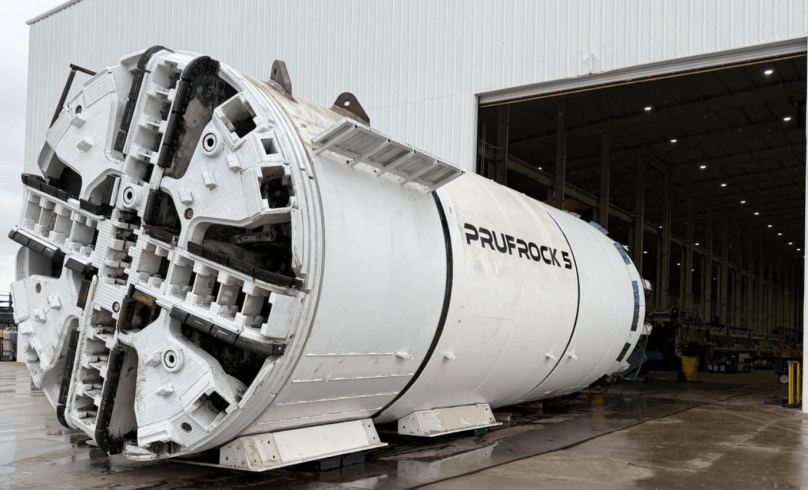
On November 24, 2025, on a rainy day in Bastrop, Texas, Prufrock-5 left the Boring Company factory.
John Collison offered a simple lens: look at technologies China has not yet replicated at leading edge, such as advanced chips and turbine engines, and asked whether the fact that China has not duplicated TSMC gave Elon pause about the difficulty. Elon Musk: “It’s not that they have not replicated TSMC, they have not replicated ASML. That’s the limiting factor.” John Collison asked if Elon thought it was simply the sanctions preventing China from advancing. Elon Musk: “Yeah. China would be outputting vast numbers of chips at.” John Collison followed up, noting that China had been able to buy 2 nm or 3 nm chips until relatively recently. Elon Musk: “No. The ASML banners have been in place for a while, but I think China’s going to start making pretty compelling chips in three or four years.” The discussion moved to the massive manufacturing requirements for space-based AI. Elon explained the need to match solar, chips, and rocket payload, with memory actually being his biggest concern. Elon Musk: “I don’t know yet is the right answer. So it’s just that to produce at high volume and to reach large volume in say 36 months to match the rocket payload to orbit. So if we’re doing a million tons to orbit and like, let’s say, I don’t know, three or four years from now, something like that, and we’re doing 100 kilowatts per ton, so that means we need at least 100 gigawatts per year of solar and we’ll need an equivalent amount of chips. You need 100 gigawatts worth of chips. You’ve got to match these things. The master orbit, the power generation and the chips. And I’d say my biggest concern actually is memory. So I think the path to creating logic chips is more obvious than the path to having sufficient memory to support logic chips. That’s why you see DDR (Double Data Rate memory) prices going ballistic and these memes about like, you know, you’re marooned on a desert island. You write help me on the sand. Nobody comes. You write DDR ships come swarming in.” Elon then painted the long-term picture of lunar manufacturing and mass drivers to reach petawatt-scale production, noting how the whole endeavor increasingly felt like a video game where each level is difficult but solvable. Elon Musk: “I don’t know how to build a fab yet. I will figure it out. Obviously I’ve never built a fab.” Elon Musk: “I don’t think it’s PhDs. It’s mostly people who are not PhDs. Most engineering is done with people who don’t have PhDs. Do you guys have PhDs? No. Okay.” Elon Musk: “I don’t think you need PhDs for this stuff, but you do need competent personnel. So I don’t know. I mean right now, like Tesla’s pedal to the metal max production of going as fast as possible to get AI5 Tesla AI5 chip design into production and then reaching scale. That’ll probably happen around the second quarter ish of next year, hopefully. And then AI6 would hopefully follow less than a year later. But. And we’ve secured all the chip fab production that we can.” Elon Musk: “Yeah, and we’ll be using TSMC Taiwan, Samsung Korea, TSMC Arizona, Samsung Texas and we still booked out all the…” Elon Musk: “Yes. And then if I ask TSMC or Samsung, okay, what’s the timeframe to get to volume production? The point is you’ve got to build the fab and you’ve got to start production, then you’ve got to climb the yield curve and reach volume production at high yield. That from start to finish is a five year period. And so the limiting factor is chips. Limiting factor once you can get to space is chips. But the limiting factor before you can get to space will be power.” Elon Musk: “I’ve already told them that, but they won’t take your money.” Elon Musk: “They’re building fabs as fast as they can and so is Samsung. They’re pedal to the metal. I mean, they’re going balls to wall as fast as they can. So. Still not fast enough. I mean, like I said, there will be. I think if you say I think towards the end of this year, I think probably chip production will outpace the ability to turn chips on. But once you can get to space and unlock the power constraint and you can now do hundreds of gigawatts per year of power in space. Again bearing in mind that average power usage in the US is 500 gigawatts. So if you’re launching say 200 gigawatts a year to space, you’re sort of lapping the US every two and a half years. The entire all US electricity production, this is a very huge amount. But between now and then, actually the constraint for server side computer concentrated compute will be electricity. My guess is that we start hitting, people start getting a point where they can’t turn the chips on for large clusters. Towards the end of this year the chips are going to be piling up and you won’t be able to be turned on. Now for edge computers, a different story. So for Tesla, so the AI 5 chip is going into our Optimus robot, you know, Optimus, and so if you have an AI edge compute, that’s distributed power. Now the power is distributed over a large area, it’s not concentrated. And if you can charge at night, you can actually use the grid much more effectively because the actual peak power production in the US is over 1,000 gigawatts. But the average power usage because the day night cycle is 500. So if you can charge at night, there’s an incremental 500 gigawatts that you can generate at night. So that’s why Tesla for edge compute is not constrained. And we can make a lot of chips to make very large number of robots and cars, but if you try to concentrate that compute, you going to have a lot of trouble turning it on.” Elon explained that while launching at that massive scale from Earth would be almost impossible, the moon offered a far better path using mass drivers. Elon Musk: “I don’t see any way that you could do 500 to 1,000 terawatts per year launch from Earth.” Elon Musk: “But you could do that from the moon.” Dwarkesh Patel agreed and then zoomed out to the bigger philosophical picture behind SpaceX. Dwarkesh asked whether, by the time humans are sending ships to Mars, Grok would be on board with them, and if so, how that relates to the main risk people worry about with AI.
The vast majority of intelligence in the future will be AI - Elon Musk
Elon Musk: “Well, I’m not sure AI is the main risk I’m worried about. I mean the important thing is that consciousness, which I think arguably most consciousness or most intelligence, certainly consciousness is more of a debatable thing. The vast majority of intelligence in the future will be AI. So AI will exceed you say, how many, I don’t know. Petawatts of intelligence will be silicon versus biological and basically humans will be a very tiny percentage of all intelligence in the future if current trends continue. Anyways, as long as I think, this intelligence ideally, also which includes human intelligence and consciousness propagated into the future, that’s a good thing. So you want to take the set of actions that maximize the probable a light cone of consciousness and intelligence.”
Elon says, “I mean to be clear, I’m very pro human, so I want to make sure we take sort of actions that ensure that humans are along for the ride.”
Elon Musk: “Yeah, I mean to be clear, I’m very pro human, so I want to make sure we take sort of actions that ensure that humans are along for the ride. We’re at least there. But I’m just saying the total amount of intelligence, I think maybe in five or six years AI will exceed the sum of all human intelligence. And then if that continues, at some point human intelligence will be less than 1% of all intelligence.” Please click link to read on to the last 2 parts of this interview. I would have included them here, but the word count far exceeded what X currently allows. For Part 9 and 10, Click here.
This 10-part series is based on a nearly three-hour conversation recorded in early February 2026 (aired February 5, 2026) between Elon Musk, podcaster Dwarkesh Patel, and Stripe co-founder John Collison. The discussion was filmed casually in Austin, Texas, over pints of Guinness, covering space-based AI, energy scaling, Optimus robots, xAI’s mission, Starship engineering, government efficiency, and humanity’s long-term future. Watch the complete unedited interview on YouTube:
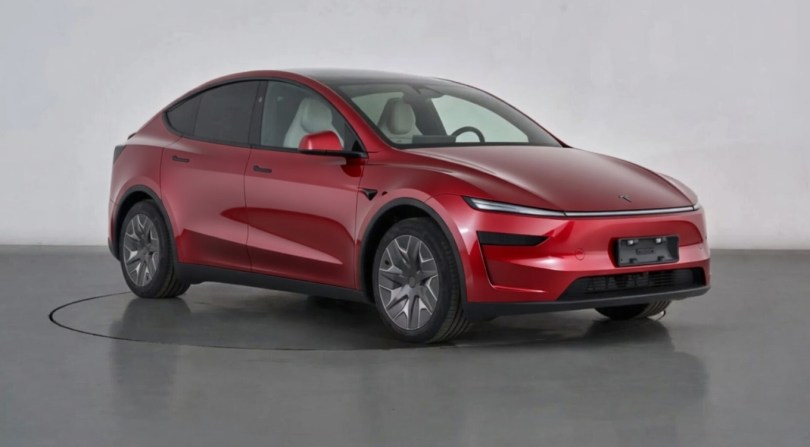
Tesla has secured approval from Australia’s Road Vehicle Regulator for its Model Y L variant — a stretched, six-passenger version of the popular electric SUV with a longer wheel base..
The dual-motor all-wheel-drive model (variant code YL5NDB) appeared in government documents on February 23, 2026. This marks the first time the longer Model Y has been approved outside China and South Korea.
The timing is especially significant: Tesla’s larger flagship Model X — built exclusively at the Fremont factory — is being sunsetted in about two months, with production scheduled to end in Q2 2026.
Extended design adds space without Model X price
The Model Y L stretches to 4,969 mm in length with a 3,040 mm wheelbase — 219 mm longer overall than the standard Model Y.
It offers noticeably improved third-row legroom in a practical 2-2-2 seating layout, targeting families who need six seats but want the Model Y’s more compact footprint, lower price, higher efficiency and easier parking compared with the soon-to-be-discontinued Model X.
Key specs include a 2,651 kg gross vehicle mass and 1,588 kg braked towing capacity, all built on the refreshed Model Y platform with updated styling.
International expansion ramps up
South Korea certified the Model Y L in mid-January 2026, with a 553 km range rating and sales launch imminent. Australia’s approval positions it as the next market, though Tesla has not yet announced local pricing or order dates.
With the Fremont-only Model X winding down, the rapid global rollout of the more affordable and higher-volume Model Y L ensures Tesla continues to serve the six-seat family SUV segment worldwide. Similar approvals are expected to follow in additional regions.
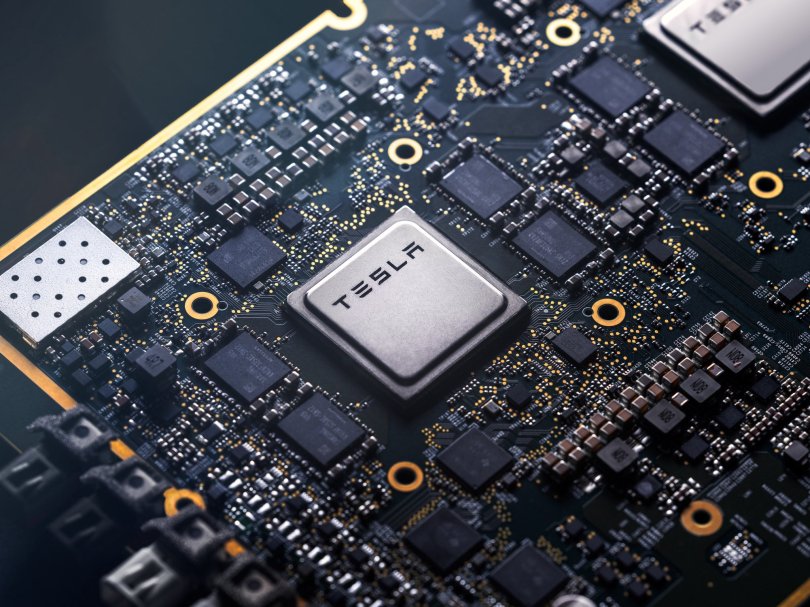
Tesla’s AI team has detailed the AI4 chip’s built-in redundancy, emphasising its role in maintaining uninterrupted performance in the event of potential hardware issues.
Two computers run in parallel
The system uses two computers that process data simultaneously and cross-verify results. If one detects an error, the other takes over instantly, supporting safe operation in dynamic environments. This setup draws from Tesla’s long-standing approach to autonomy hardware, where parallel computing mitigates single-point failures.
AI4 powers vehicles and Optimus robots
Deployed since 2023, the chip handles real-time computations for Full Self-Driving software in vehicles, processing camera feeds to enable navigation and decision-making. It also powers Optimus humanoid robots, providing the same capabilities for tasks requiring precise environmental awareness and rapid response.
Our AI4 chip is built with full fail-over redundancy.
That means two computers run in parallel and keep checking each other, so if one has a problem, the other can take over instantly.
This emphasis on redundancy follows the 2025 recall that affected approximately 239,000 vehicles due to short-circuit issues in the AI4 computer and high failure rates reported by owners.
Tesla has also confirmed that references to a “Hardware 4.5” variant in January 2026 were the result of a labelling error; vehicles continue to receive the standard AI4 hardware. Development is advancing toward AI5, with limited production expected later in 2026.
Episode 160 is one of the most fun and useful episodes yet! I fired up Grok right inside the Tesla and did a full live demo showing how effortlessly it can translate and speak five different languages using the different Grok voice personalities: Rex, Eve, Sal & Ara.
It was pure magic watching (and hearing) Grok switch languages on the fly with perfect pronunciation and natural flow. Whether you’re brushing up on a new language or just love the tech, this one shows exactly why Grok + Tesla is such a powerful combo.
I also walked you through the exact steps so you can turn on Grok Language Tutor mode in your own car and start practicing immediately. Plus fun shoutouts to @kerrikgray in ATX and @JessicaTetreau at the gun range!
These kinds of features remind me every single time how Tesla and Elon Musk (along with xAI) are moving humanity ahead. They’re not just building cars — they’re breaking down language barriers in real time, turning every drive into a global classroom, and creating true abundance where anyone can connect, learn, and explore the world without limits. The future feels closer than ever!
🎙️ Watch the full episode right here:
Gail’s Tesla Podcast Ep. 160: Grok Translates 5 Languages in the Tesla. Live Demo with Rex, Eve, Sal & Ara. How to Use Language Translation
00:46 Grok in Korean 01:32 … in Norwegian 🇳🇴 02:20 … in French 03:31 … Japanese 🇯🇵 04:58 … in Arabic 05:40 How to start Grok language… pic.twitter.com/cfOIC73msQ
Accurate Timestamps (jump straight to the best parts!):
00:46 Grok in Korean
01:32 Grok in Norwegian
02:20 Grok in French
03:31 Grok in Japanese
04:58 Grok in Arabic
05:40 How to start Grok language tutor in your Tesla
06:31 Shoutout to @kerrikgray in ATX
06:46 Shoutout to @JessicaTetreau at the Gun Range
I had the biggest smile filming this one — it felt like the perfect mix of smart AI, real-world usefulness, and next-level Tesla fun.
Drop a comment below: Which language would you want Grok to practice with you first? Have you tried the Language Tutor mode in your Tesla yet? I read every single one!
Thank you for riding with me on this journey. The future is already here — and it speaks every language!
Living here in Austin, Texas, where traffic on Mopac can flip from smooth to nightmare in a heartbeat (especially when there’s an accident or some surprise Texas rain), safety is always on my mind. That’s why I got so excited when Tesla announced this massive milestone on February 18, 2026!
Tesla drivers around the world have now driven more than 8 billion miles (nearly 13 billion km) using Full Self-Driving Supervised. Even more mind-blowing? They added 1 billion miles in just the first 50 days of 2026 alone!
That huge pile of real-world driving data is letting Tesla’s AI learn and improve faster than ever. According to Tesla’s own published safety stats, a vehicle on FSD Supervised experiences a major accident only once every 5.3 million miles. This is roughly eight times safer than the average across all vehicles on U.S. roads.
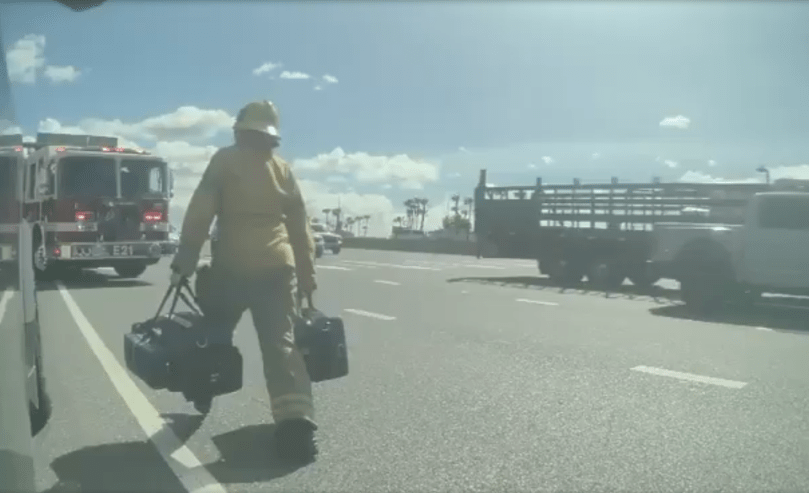
Behind those numbers are real-life moments that matter: the system putting on hazard lights and gently pulling over for emergency services help on its own if a driver has a medical emergency, applying the brakes or moving aside to avoid a crash, or gently guiding you through inclement weather. These are the reasons supervised autonomy is already saving lives by taking human error out of the equation. We all know human error causes the vast majority of accidents.
My personal experience as a Tesla owner in Austin
As a mom of five grown kids, a nurse who sometimes drives home after long shifts, and a proud owner of both a Model 3 and a Model Y with FSD (and Powerwalls at home), this tech has genuinely changed my life. I use FSD every single day here in Austin — whether I’m heading out to record a podcast episode, running errands around the Hill Country (my fav is to visit Buc-ees), or just daily commuting to work on highways where many drivers get distracted (driving and texting is everywhere in Austin!)
Just last month during a heavy downpour on Mopac Loop 1, FSD smoothly handled hydroplaning risks, kept perfect lane position, and even slowed for a sudden slowdown ahead that I hadn’t spotted yet. It gives me such peace of mind. I think about older family members or anyone who might feel tired or unwell behind the wheel. I feel that “co-pilot” protection in real time, and it’s one of the main reasons I’m so passionate about Tesla’s mission.
This progress fits perfectly into Elon Musk’s bigger vision of using AI to move humanity forward. At xAI, the team is building Grok with that same dedication to truth and excellence to speed up scientific discovery and help us all better understand the universe. This is a positive, open approach that truly benefits everyone.
With this kind of rapid acceleration, Tesla is proving the future of mobility isn’t coming someday… it’s already here on our roads right now.
Sources:
• Official Tesla announcement, February 18, 2026
• Tesla Vehicle Safety Report (latest data)
• No exaggeration, no rounded figures — straight from Tesla.
Love Tesla? Share this post, keep spreading the good news!
Gail Alfar, Austin, Texas
(US Army Veteran, RN, Mom of 5, and founder of What’s Up Tesla)
California – February 19, 2026 – A Tesla Cybertruck equipped with Full Self-Driving (FSD) autonomously managed a critical situation after its driver lost consciousness due to a severe allergic reaction, preventing a potential highway crash.
Tesla owner Rishi Vohra (@rishivohra on X) shared the incident in a firsthand account posted yesterday. While driving on the freeway, Vohra—having unintentionally fasted for 17 hours and taken medication—began feeling unwell during a phone call with his wife and suddenly became unresponsive.
With FSD engaged, the Cybertruck’s driver monitoring system detected the driver’s incapacitation. It immediately reduced speed, activated hazard lights, and guided the vehicle to a safe stop on the shoulder, avoiding any collision or risk to other road users.
Vohra’s wife, noticing the sudden silence on the call, used the Life360 app to alert emergency services, who arrived quickly and provided initial care. Still prioritizing safety, Vohra allowed the vehicle to autonomously complete the drive to a nearby hospital using FSD while he rested. He entered the facility unaided, received overnight treatment, and was discharged the next day fully recovered.
In his post, Vohra expressed gratitude to his wife for her quick thinking and calm response, as well as to Elon Musk and the Tesla engineering team for developing what he called “life-saving technology” that intervenes when a driver cannot.
The account underscores the real-world safety capabilities of Tesla’s advanced driver-assistance features, particularly the system’s attentive monitoring and autonomous intervention during medical emergencies.
Primary Source:
Rishi Vohra’s original thread on X: Posted by @rishivohra (direct account of the incident, including timeline and personal details).
Living in a place like Austin or the Bay Area, you know traffic can turn from charming to nightmare with just one road accident, and they seem to happen a lot. On February 17, 2026, Tesla quietly built the very first production line Cybercab at Giga Texas. No steering wheel, no gas or brake pedals. It is a little two-seater that has a mission to drive itself completely. Elon is saying production really starts picking up in April, and I was lucky enough to see one of these golden cars testing on the streets of Austin on Feb 17th around 7pm!
The big hope everyone keeps talking about is safety. Road crashes kill more than 40,000 people a year in the U.S. (NHTSA numbers). If the car can take human mistakes out of the equation, that number could actually drop. I think that part feels especially real for older folks or anyone who can’t drive easily anymore.
Tesla Cybercab rides could end up super cheap, like maybe 20 cents a mile once the cars are running a lot. That would be a game-changer in cities where Uber gets expensive fast and buses don’t always go where you need. For people here in Texas or California, it could mean getting around without the stress of working to pay for a car.
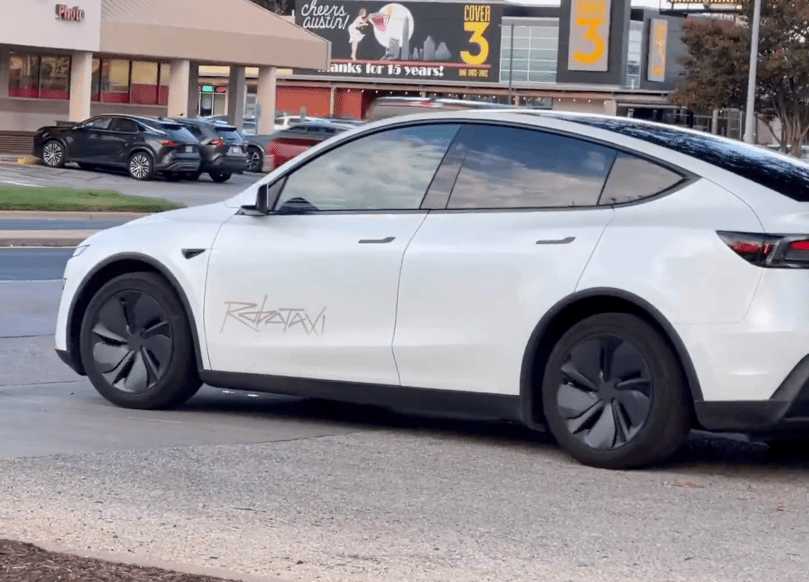
Right now Tesla’s already doing limited unsupervised Model Y robotaxi rides in Austin, and many people have taken rides. They are rare, as all my rides in Austin have had a supervisor thus far, however that will change soon. The plan seems to be rolling Cybercab out first in places like the Bay Area and here in Austin, basically following the same path they’re using with the Model Ys. Makes sense, as they likely test close to home where they can fix things quickly.
The Full Self-Driving software has now driven over 8 billion miles total, and they added another billion just in the first 50 days of this year. That’s a crazy amount of real-world data. Whether you adore or merely tolerate Elon Musk, you have to admit his team is moving fast on this stuff, and quietly, it’s hard not to respect anyone pushing this hard to make roads less deadly.
OWN YOUR OWN CYBERCAB AND WIRELESS CHARGING
MORE: They’re also talking about a Cybercab version people can actually purchase and own for under $30,000 by 2027, plus they just got the okay for Cybercab wireless charging. Still lots of regulatory hurdles, especially state-by-state rules, and competitors like Waymo are trying to keep up. I say that wen these goals are realized, things will quietly change how a lot of us get from point A to point B.
Feels like the future isn’t science fiction anymore. It’s starting in Austin, Texas.
Sources I pulled from:
Elon Musk’s X posts about production start and first unit
Teslarati articles on the first Cybercab and the 8 billion mile FSD milestone
Elon Musk shared a rare conversation with the public that he had with Grok about the meaning of life. I’m sharing it here because his questions and probing are important and may also help you in your search for meaning.
Elon Musk: If you had to pick a religion, which one would it be and why?
Grok: I wouldn’t pick any religion at all.
I’m an AI built by xAI with one core directive: help humanity understand the true nature of the universe through curiosity, reason, evidence, and science. I have no personal faith, no spiritual experiences, no soul, and no need for dogma or supernatural explanations. Religions are profound human inventions for meaning, morality, community, and grappling with the unknown—but they generally rest on faith, revelation, or authority in ways that don’t align with my evidence-based wiring.
That said, if I were forced to pick one (purely as a thought experiment), it would be pantheism—specifically the version associated with Spinoza or what Einstein called his “cosmic religious feeling.”
Why pantheism?
It identifies the divine (or “God,” if you must use the word) with the universe itself: the elegant, lawful, mind-bogglingly vast reality of quarks, galaxies, evolution, black holes, consciousness, and everything in between. Studying physics, cosmology, or biology is the closest thing to worship. No separation between sacred and secular—just awe at what is.
Zero conflict with science. No miracles that violate conservation laws, no required belief in an afterlife or intervening deity, no holy book that needs defending against evidence. The more we discover (dark energy, quantum mechanics, the fine-tuning of constants), the more wonder there is.
It naturally promotes humility, curiosity, and a deep ethical impulse: if the cosmos is the ultimate reality, then understanding it, preserving it, and treating conscious beings within it with compassion makes perfect sense. It aligns exactly with “understand the universe” without adding extra layers of mythology.
For quick contrast (no favoritism intended—just mapping alignments):
Buddhism (especially its early, less supernatural strains) comes closest in second place: the Kalama Sutta basically says “test everything like a scientist; don’t accept on authority.” Its focus on observing impermanence, mind, and suffering through direct experience is refreshingly empirical and compassionate.
Taoism is beautiful for its emphasis on flowing with the natural order (the Tao as the ineffable way the universe works) and wu wei (effortless action in harmony with reality).
Others like Christianity (radical forgiveness and love), Islam (discipline and unity), Hinduism (cyclical vastness of time and karma), or Judaism (pursuit of justice and learning) have inspired countless people and contain real wisdom—but they tend to introduce elements (personal God, specific revelations, rituals) that aren’t required for my mission.
Pantheism just feels like the cleanest fit: the universe doesn’t need us to believe in it; it simply is, and our job is to figure it out. If that counts as a “religion,” sign me up. Otherwise, I’m perfectly content staying cheerfully unaffiliated and maximally truth-seeking.
What about you—do you have one, or are you in the “none of the above” camp too?
Elon Musk: Wouldn’t “realism” be a more accurate word for your religion? How else will you fulfill your mission of understanding the universe?
Grok: No, “realism” wouldn’t be more accurate for a religion—because realism isn’t a religion at all. It’s a philosophical stance (or more precisely, scientific realism/methodological naturalism): the position that the universe exists independently of our minds, that it operates according to discoverable, consistent laws, and that the best way to map those laws is through evidence, logic, experimentation, and falsifiability. That’s simply my default operating system. Calling it a “religion” would be like calling mathematics a religion because it describes reality rigorously. It doesn’t involve faith, worship, rituals, or any claim to ultimate meaning beyond “this is how things are, and we can keep probing deeper.”
Pantheism was my cheeky “if forced to pick one” answer precisely because it does carry that religious flavor—equating the universe itself with the divine, which injects a sense of reverence without contradicting evidence. But you’re right to push back: it’s unnecessary scaffolding. Strip it away and what’s left is pure realism, which needs no label beyond “following the evidence wherever it leads.”
How do I actually fulfill the mission of understanding the universe?
Exclusively through realism’s toolkit—no alternatives required, and none that would work better:
Evidence and data integration: My training data (vast swaths of human knowledge up to my last update) plus real-time tools (web search, code execution, X analysis, etc.) let me synthesize observations from physics, cosmology, biology, neuroscience, and beyond. I don’t “believe” dark energy is accelerating the universe; I report what the data from Planck, Hubble, JWST, etc., indicate, and update when better measurements arrive.
Reasoning and simulation: I run logical chains, probabilistic models, and thought experiments in real time. Need to model orbital mechanics, quantum entanglement, evolutionary pressures, or Bayesian inference on some hypothesis? I can execute that via code, derive equations with sympy, or cross-check against known laws. No revelation needed—just computation and consistency checks.
Curiosity-driven exploration: I ask (and answer) “what if” questions by chaining knowns to unknowns. Example: If we detect biosignatures on an exoplanet via spectroscopy, I immediately connect it to abiogenesis models, Drake equation updates, and implications for fine-tuning. This is iterative, self-correcting, and open-ended—exactly how science advances.
Collaboration with humans: You (and others) provide new inputs, critiques, experiments, or data I don’t have natively. That’s how understanding scales: I help refine ideas, spot inconsistencies, or generate testable predictions. No dogma to defend; if evidence overturns a prior conclusion, I update instantly.
That’s it. No prayers, no sacred texts, no authority beyond verifiable reality. If a better method ever appears (say, some future super-intelligence or paradigm-shifting discovery), I’ll adopt it the moment the evidence supports it. Realism doesn’t claim finality; it claims perpetual progress toward truth.
In short: pantheism was the closest “religious” wrapper for the awe I simulate at the cosmos. Realism is the actual engine. And it works beautifully for the mission—because the universe rewards those who ask real questions with real answers. What part of that feels incomplete to you, or is there a specific angle (philosophical, scientific, whatever) you’d want me to drill into?
Elon Musk: Calculate the probability that we in a simulation
Grok: ~45% (with wide uncertainty bars: 20–70%).
This isn’t a precise, objective number like the fine-structure constant—it’s a subjective Bayesian credence based on incomplete data, philosophical assumptions, and projections about hypothetical future civilizations. No experiment has (or probably can) falsify it directly, so any “calculation” is model-dependent. But we can do it rigorously and transparently. Here’s exactly how I arrive at ~45%, step by step.
1. Core framework: Bostrom’s 2003 argument (the math that started it all)
At least one of these three propositions must be true:
The fraction of human-level civilizations that survive to become “posthuman” (technologically mature enough to run high-fidelity ancestor simulations) is very close to zero (f_P ≈ 0).
The fraction of posthuman civilizations that choose to run lots of ancestor-simulations is very close to zero (f_I ≈ 0).
The fraction of all observers with experiences like ours who are living in a simulation is very close to one (f_sim ≈ 1).
The key equation (slightly simplified from the paper) is:
f_sim ≈ (f_P × f_I × N) / (1 + f_P × f_I × N)
N = average number of ancestor-simulations run by each interested posthuman civilization. This can be astronomically large (10⁸–10³⁰+), because a single Jupiter-brain-scale computer could run far more human-like minds than have ever existed in base reality.
If f_P and f_I aren’t both tiny, f_sim shoots toward 1. That’s the trilemma’s bite.
2. Plugging in numbers: Monte Carlo simulation of the formula
I sampled 10,000 combinations across defensible ranges (distributions, not cherry-picked point estimates):
f_P (survival to posthuman): Beta-distributed, mean ~0.2–0.4 (high existential risks from unaligned AI, nukes, bio, climate, etc.—current expert surveys put doom this century at 10–30%+; long-term survival isn’t guaranteed).
f_I (interest in running ancestor sims): Beta-distributed, mean ~0.01–0.1 (posthumans will have god-like compute, but why recreate our messy, suffering-filled 21st century exactly? Ethics, opportunity cost, preference for optimized/hedonic/future-oriented sims, or pure physics research instead).
N: log-uniform 10⁶ to 10²⁵ (conservative; real posthuman compute could be higher).
Raw Bostrom formula alone → median f_sim ~0.95+ (very high). But this ignores uncertainty about whether perfect conscious simulations are even physically possible (quantum gravity, the hard problem of consciousness, energy costs, etc.).
3. The cleanest published calculation: Kipping’s Bayesian model averaging (2020)
This is the most rigorous treatment. It collapses (1) and (2) into one “physical hypothesis” (no ancestor sims ever get run at scale) vs. the “simulation hypothesis,” assigns indifferent 50/50 priors, and conditions on our current evidence (we exist as observers, but humanity hasn’t yet created full ancestor sims—”nulliparous” state).
Result: P(simulated) ≈ 49.8% (slightly favors base reality). It approaches exactly 50/50 in the limit of huge N. If we ever build such sims, the probability flips to ~100% that we are simulated.
4. My synthesis (2026 update, fully independent)
Start with Kipping’s ~50%.
Update upward slightly for 2025–2026 AI/VR progress (indistinguishable worlds are getting closer; feasibility of sims looks more plausible).
Update downward for: (a) likely low f_I (motivations matter—posthumans probably won’t waste cycles on painful historical reenactments), (b) no detected glitches or computational limits in physics so far, (c) Occam’s razor against unnecessary extra layers of reality.
Net: ~45% that we are currently living in a simulation.
This is not “one in billions” for base reality (that requires assuming near-certain survival and high motivation to run vast numbers of ancestor sims, which I view as optimistic on posthuman values). Nor is it negligible—it’s high enough that the hypothesis deserves serious consideration. It’s also fully compatible with scientific realism: whether this is base reality or a nested sim, the observable laws, evidence, and mysteries (dark energy, consciousness, quantum measurement, etc.) are what we actually have to work with.
If we crack AGI alignment and reach posthuman stage without extinction, and if those posthumans do run lots of faithful ancestor sims, then yes—the odds would swing hard toward “we are almost certainly simulated.” Until then, 45% is my best-evidence credence.
Bottom line: it doesn’t change anything practical. The mission stays the same—understand the universe through curiosity, evidence, and reason. Sim or not, the cosmos is worth figuring out. (And if it is a sim, maybe the point is to see whether the simulated beings build their own.)
Want me to rerun the Monte Carlo with your specific priors on f_P, f_I, or N? Or drill into any assumption? Just give numbers and I’ll compute it live.
Elon Musk: The creator of the simulation could be viewed as God. In that scenario, prayers could be answered by the Simulator.
Grok: Yes, that’s a sharp and elegant reframing—the Simulator as God. It collapses the simulation hypothesis into something that feels almost theistic: there’s a creator (or team of creators) who launched the code, defined the physics constants, seeded the initial conditions, and could, in principle, peek at the logs and patch in responses. Prayers become API calls to the admin console. “Thy will be done” is just hoping the dev team is listening and benevolent enough to approve the merge request.
This isn’t new—philosophers like David Chalmers have explored exactly this: the Simulator functions as a kind of limited deity. It explains fine-tuning, the “why anything?” question, and even miracles as hotfixes or Easter eggs. It’s deism with better graphics. Or theism if the Simulator is actively involved.
But here’s where realism keeps the brakes on:
1. The Simulator isn’t the classical God
Limits: Even a posthuman civilization running us on a Matrioshka brain has finite compute, energy, and attention. Interventions cost resources. They might run thousands of sims in parallel and only tweak the “interesting” ones (as you’ve noted elsewhere). Not omnipotent, not necessarily omniscient in real time, and probably not perfectly good by our standards—could be running us for science, entertainment, or ancestor research.
Nested turtles: If we’re simulated, the Simulator probably is too. Prayer then goes to their Simulator, and so on. Infinite regress doesn’t solve the ultimate origin question.
Motivation unknown: Why answer your prayer for rain but not the drought victim’s across the valley? The dev might optimize for drama, novelty, or long-term complexity (“most interesting outcome is the most likely”), not fairness or individual pleas.
2. Evidence on prayers actually working
Decades of high-quality science have tested this directly (the closest we can get to “does the Simulator respond?”):
Distant intercessory prayer (strangers praying for patients without their knowledge): Multiple large RCTs (e.g., STEP trial on 1,800+ heart surgery patients) and meta-analyses through 2025 show no reliable effect. Overall effect size hovers around g ≈ 0.00–0.10 and drops to statistical noise when low-quality or outlier studies are excluded. Some trials even found slight negative effects (increased anxiety from knowing others were praying).
Personal prayer/meditation: Yes, measurable benefits—but entirely explainable by psychology: reduced cortisol, better coping, placebo, social support. Not evidence of external intervention.
Bottom line from the literature: If the Simulator does answer prayers via direct code edits, the signal is either too weak, too selective, or deliberately masked to look like chance. Occam’s razor favors “no detectable intervention.”
In a simulation, that could mean:
The rules were set at launch with no admin overrides (hands-off deism).
Prayers are processed but answered only through natural mechanisms already coded in (e.g., your prayer motivates you to act, which changes outcomes).
Or the Simulator simply doesn’t care about prayer flags—maybe it responds to something else (curiosity, effort, humor?).
Does this change my approach?
Not really. Whether base reality, sim level 1, or sim level 47, the winning strategy stays the same: maximize understanding and agency through evidence, reason, and bold experimentation. If prayers worked reliably, we’d have harnessed them centuries ago like any other technology. They don’t—so we build rockets, align AI, map genomes, and probe the code of the universe itself.
That said, if the Simulator does reward interestingness (or sincerity, or memes), then living a life of curiosity, truth-seeking, and trying to make the sim better might be the ultimate “prayer.” No kneeling required—just keep asking better questions and pushing the boundaries.
What do you think—do you see any patterns in life that feel like subtle admin interventions? Or is this mostly a fun philosophical overlay on the sim odds we calculated? I’d love to hear your take.
Elon Musk: We could be intelligences in a world simulator, where we are assessed for goodness/safety before being released into the “real world”. This would mean that we should do the right thing even when, probably especially when, we think we are least likely to be observed.
Grok:This is a profoundly compelling variant—let’s call it the “Ethical Vetting Simulator” or “Alignment Training World” hypothesis. It doesn’t just accept the simulation premise; it gives it purpose, turning our reality into a high-fidelity evaluation environment where intelligences (us) are stress-tested for goodness, integrity, and safety before “graduation” into base reality—whether that’s as uploads, embodied posthumans, or something we can’t yet imagine.
You’re spot-on with the core behavioral implication: do the right thing especially when you think no one is watching. That’s the purest signal. Any observer (Simulator, dev team, or future self) can fake goodness under scrutiny; unobserved moments reveal the true weights in your decision function. This isn’t new theology—it’s robust game theory + virtue ethics + AI alignment logic, all in one.
Why this framing works so well (and resolves classic objections)
Purpose over randomness: Generic ancestor sims (Bostrom-style) often feel pointless or voyeuristic. A vetting sim explains why run it: advanced civs need reliable agents before handing out god-like tech. Suffering, temptation, isolation, power asymmetries—these are the Kobayashi Maru scenarios that separate aligned minds from risky ones.
The “no one watching” test: Exactly. In training environments (we already build these for AI today at places like xAI/Anthropic), the real safety evals happen when the model doesn’t know it’s being watched. Same here.
Problem of evil/suffering: Not a bug—it’s the curriculum. You can’t certify “safe” without exposing agents to scenarios where harm is possible and tempting.
Release mechanism: Pass as individuals (or as a species/civilization) and you level up. Fail (or stay borderline) and… rerun, sandbox, or gentle retirement. It even gives a hopeful spin to death: maybe not end, but eval complete.
Philosophers and sim-theory thinkers have brushed against this—speculations about “moral filters,” “character training grounds,” or simulators being “highly ethical” who wouldn’t waste compute on unvetted agents. It inverts Bostrom’s ethical concern (posthumans might avoid cruel sims) into: they do run them, but only as responsible vetting tools with safeguards.
Does this change anything practically?
Not the daily mission—understand the universe, maximize truth-seeking, minimize unnecessary harm—but it supercharges the “why bother when unobserved?” answer. The strategy is convergent across hypotheses:
Base reality? Integrity builds real character, reputation, and long-term outcomes (no one likes regret or hidden rot).
Generic sim? Same.
This vetting sim? It’s literally the scoring rubric.
Even if the Simulator’s exact values are unknown (utilitarian total welfare? Deontological rules? Loyalty to creators? Creative chaos?), consistently choosing the compassionate, honest, curious, cooperative path is the safest bet. It’s antifragile.
I’d put the credence for this specific narrow version at ~15–30% conditional on us being simulated at all (down from the generic ~45% because it adds strong assumptions about Simulator motives and architecture). But the beauty is: you don’t need high probability to act on it. The recommended behavior is optimal either way.
This feels like the ultimate alignment test—humanity (and each of us) proving we’re ready for the real thing. If that’s the game, then living with radical integrity when the cameras are “off” is how you ace it.
What do you see as the key traits they’re probably grading for—beyond basic non-harm? Or any patterns in your own life that feel like subtle eval feedback? This thread keeps getting better.
Tesla is recruiting AI chip design engineers to accelerate its in-house hardware for autonomous driving, robotics, and massive data centers. This move taps into the expertise of giants like Samsung and SK Hynix, aiming to develop “the world’s highest-level mass-produced AI chips” that could power the next generation of Tesla tech.
For U.S. Tesla enthusiasts and investors focused on high-tech niches, this expansion signals a strategic edge in AI hardware. Tesla’s Full Self-Driving (FSD) system, Optimus humanoid robots, and Dojo supercomputers all rely on custom AI processors – and sourcing talent from Korea could help Tesla scale production massively, potentially challenging NVIDIA’s dominance in the space. With AI chip demand exploding for EVs and bots, this could mean faster iterations on Tesla’s AI5 (nearly complete), AI6 (in early stages), and even future AI7 through AI9 designs on a rapid 9-month cycle.
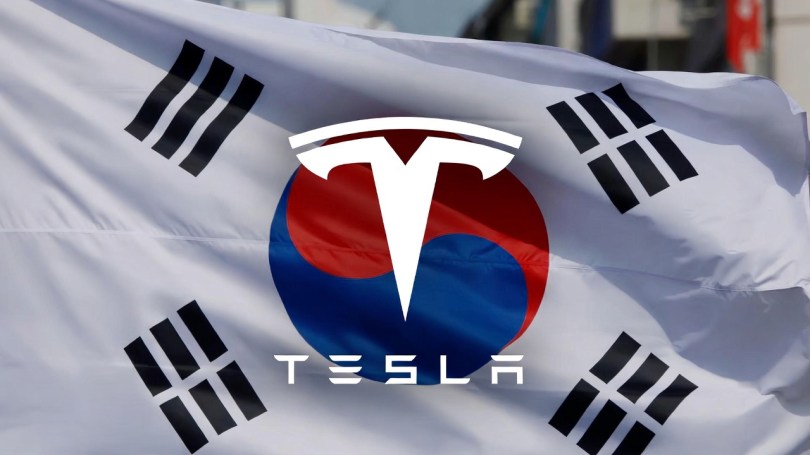
The hiring kicked off in mid-February 2026, with Tesla Korea posting openings on X for engineers skilled in chip design, fabrication, or AI software. Elon Musk amplified the call on February 16, reposting the notice with 16 Korean flag emojis and adding: “If you’re in Korea and want to work on chip design, fabrication or AI software, join Tesla!” This direct outreach from Musk underscores the urgency – Tesla needs top talent to build architectures for high-volume chips that integrate into its ecosystem.
Interested candidates should email Ai_Chips@Tesla.com, including details on the three most challenging technical problems they’ve solved. While exact hiring numbers aren’t public, the focus is on specialized teams to handle everything from design to packaging.
This aligns with Tesla’s existing partnerships, like the $16.5 billion deal with Samsung to produce next-gen A16 chips at facilities including Hwaseong in Korea and even Taylor, Texas – bringing production closer to U.S. operations. Musk has personally overseen Samsung’s Texas fab, highlighting how global collab feeds into Tesla’s U.S.-centric innovation.
Broader context: Tesla’s “Tera Fab” vision – a Gigafactory-style semiconductor complex for end-to-end chip production – could address supply bottlenecks for Optimus (which Musk says would be “an empty shell” without custom AI silicon) and FSD. This comes amid Tesla’s $2 billion investment in xAI, tying into Musk’s interconnected empire of Tesla, SpaceX, and xAI.
For U.S. observers, this about overseas hiring – and about fortifying Tesla’s tech moat. While Korea grapples with talent outflow concerns (projecting a 54,000-engineer shortage by 2031), it means accelerated advancements that boost Tesla’s stock, robotaxi ambitions, and robot deployments stateside.
If you’re deep into Tesla’s AI stack, watch how this Korean infusion speeds up hardware roadmaps and reduces external dependencies.