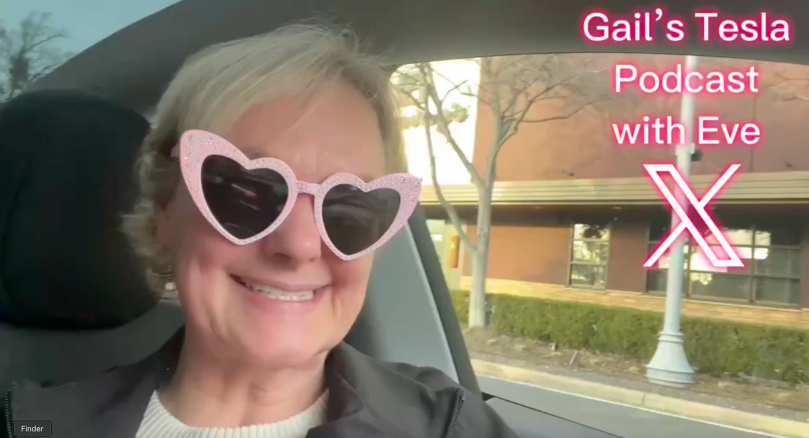
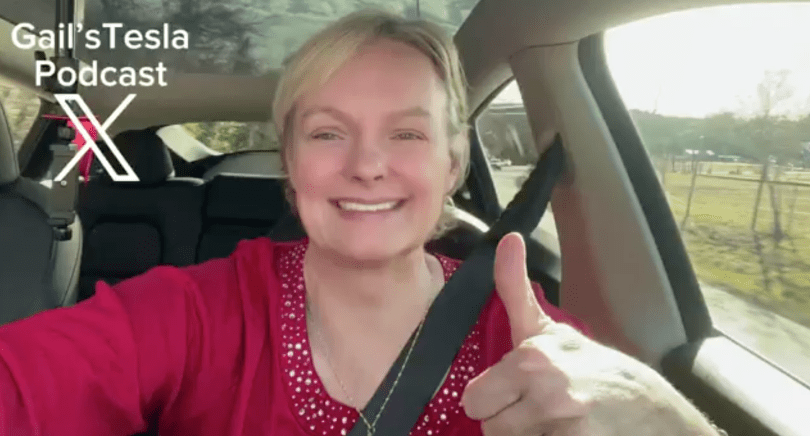
Gail’s TESLA Podcast Episode 158: Smooth Mountain Abundance – FSD v14.2.2.4 Delivers a Perfect Peaceful Drive!

If you’ve been riding along with me on this wild FSD journey, you know I live for those moments when the car just gets it. When the tech feels less like software and more like a trusted co-pilot who’s quietly rewriting the future of travel.

Episode 158 is pure magic on wheels. The stunning, winding Route 2222 goes right along the water. Rolling hills, sparkling lake views, golden light, and zero stress. FSD v14.2.2.4 turned this scenic gem into the smoothest, most seamless ride I’ve ever experienced. It was pure joy from start to finish, perfect speed through every curve, effortless lane changes, and that buttery confidence that makes you forget you’re even in a car.

The whole drive felt like a mini-vacation. No interventions, no drama, just peaceful abundance rolling out in front of me. Moments like this are exactly why I’m so obsessed with Tesla. Elon Musk and the Tesla team aren’t just building cars, they’re moving humanity forward at lightspeed.

Every FSD update is another step toward a world of true abundance: safer roads, more family time, cleaner energy, and that Kardashev-level future where technology frees us to dream bigger instead of fighting traffic. Elon keeps pushing the edge, and we’re all along for the ride.

It’s inspiring, it’s hopeful, and it’s happening right now.

🎙️ Watch the full episode right here:

I poured my heart into this one because I want you to feel what I felt behind the wheel. Pure peace, pure joy, and pure excitement for what’s coming.

Thank you for riding with me on this journey. The future is already here and it drives like a dream.

Keep looking up,

Gail Alfar

✿ What’s Up Tesla ✿

Elon Musk Moonshots Interview with Peter Diamandis – Part 8: Abundance & Kardashev Scale

This transcript is my gift to you and it is from Moonshots with Peter Diamandis, Episode #220: Elon Musk on AGI Timeline, US vs China, Job Markets, Clean Energy & Humanoid Robots. Recorded December 22, 2025, at Tesla’s Giga Texas factory in Austin, Texas. Released January 6, 2026. In this part 8 we focus on

Speedrunning to a Star Trek Future

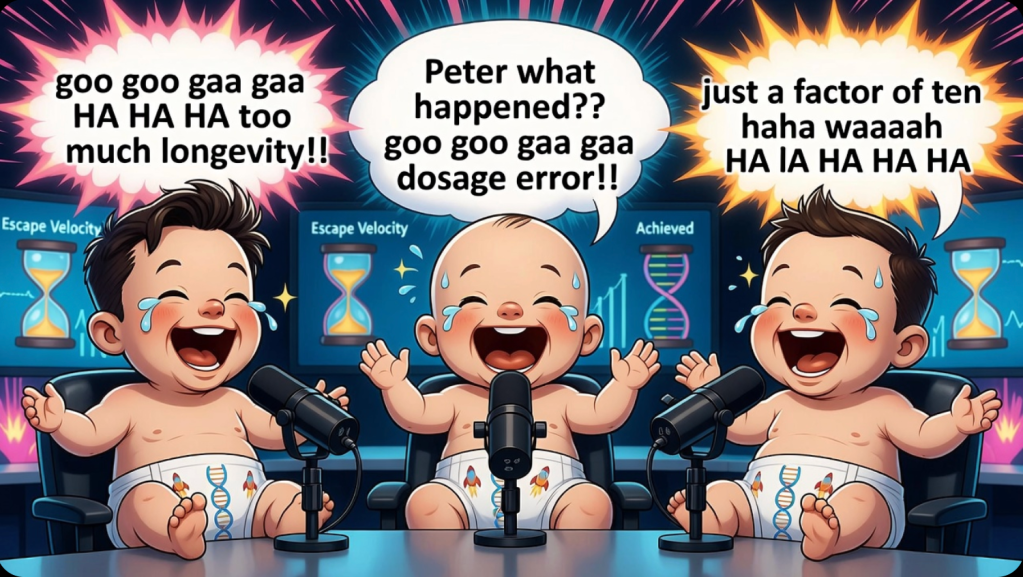
Elon is solving many of the world’s biggest problems, and he stays grounded with the longevity hype. Peter Diamandis, a big advocate for extending life, pushes the conversation forward: Life’s about to get wildly interesting—”we’re speedrunning Star Trek,” as his collaborator Alex Wissner-Gross puts it. Elon: “Yeah, speedrunning Star Trek would be cool.” Dave Blundin amps it up with escape velocity talk—if we double lifespans, kids could hit “infinite” expectancy, cramming 50 years of AI breakthroughs into far less time. Peter echoes that we’re getting those 20+ years of progress in a rush. Elon grounds all this with his classic line: “I don’t know. I got too many fish to fry.” (Translation: Too busy building the future to over-speculate right now.)

In this segment, Elon Musk frames aging as a “solvable” software glitch in our biology—your body as a synchronized program that’s “extremely obvious” to hack for longer life. He predicts longevity solutions will seem “obvious” in hindsight, drawing laughs and pushback from Peter Diamandis, who urges preventive health scans to avoid “stupid” deaths.

ELON EXPLAINS WHY IN RETROSPECT, THE SOLUTION TO LONGEVITY WILL SEEM OBVIOUS

Elon Musk: This is something, by the way, that I—that I think I just—I think it’s very, and obviously other people think this too, but I’ve long thought that, like, longevity or semi-immortality is an extremely solvable problem. I don’t think it’s a particularly hard problem. I mean, when you consider the fact that your body is extremely synchronized in its age. Yeah. The clock must be incredibly obvious. Nobody has an old left arm and a young right arm. Why is that? What’s keeping them all in sync? You’re programmed to die in the way you’re programmed to die. And so if you change the program, you will live longer.

Peter Diamandis: And we’ve got, you know, species of—the bowhead whale can live for 200 years. The Greenland shark lives for 500 years. And when I—when I learned that, I said, why can they? Why can’t we? And I said it’s either a hardware problem or software problem and we’re going to have the tech to solve that. And I do believe that is in this next decade. So the important thing is not to die from something stupid before the—before the solutions come.

Elon Musk: In retrospect, the solution to longevity will seem obvious. Extremely obvious.

Dave Blundin: I think the thing worth working on—and Peter’s going to work on this anyway—but the thing to work on is exactly what you said. Calcified old ideas don’t just die off. Add that to the pile of things we need to think about today. Because there are a whole host of other AI-related things we need to think about today.

Peter Diamandis: Let me finish on the longevity point. One second, Elon. I want to invite you again. So there’s a company called Fountain Life that I created with Tony Robbins, Bob Hariri, and Bill Capp. And we do a 200 gigabyte upload of you—everything knowable about you, full genome, all imaging, everything. President Bukele and the first lady came through, called it an amazing 10 out of 10 experience. I don’t want you to pull a Steve Jobs—Elon Musk: And kick the bucket because of some curable cancer.

Peter Diamandis: I mean, do you actually know what’s going on inside your body right now?

Elon Musk: I did an MRI recently and submitted it to Grok and none of the doctors nor Grok found anything.

Peter Diamandis: But that’s a fraction of the information, right? I mean, it’s your full genome, your microbiome, metabolome, everything. And it’s possible—

Elon Musk: Okay, don’t call me.

Peter Diamandis: What’s that?

Elon Musk: Don’t call me, bro. Is that your water bottle? Haha… God damn it. Too late, sorry.

Dave Blundin: It’s already in the works.

Note: In the banter’s punchline here, Elon jokingly infers the water bottle on the table might be a sly tool for collecting his saliva/DNA sample—playing into the theme of invasive-yet-inevitable longevity tech. Classic Elon: paranoid humor amid profound futurism.

My 2 cents: I was standing in my dining room when I heard Steve Jobs died. I was crushed. My husband and I listened to one of Steve’s last talks, it was one he gave at Stanford University in 2005. I cried. He gave too few talks, too few interviews. I wish he had given more.

Steve Jobs was diagnosed with a rare form of pancreatic cancer (specifically a pancreatic neuroendocrine tumor, or pNET/islet cell tumor) in October 2003. The exact day isn’t publicly specified in reliable sources, but it’s consistently reported as occurring that month (e.g., discovered incidentally during a scan, and he kept it private for about 9 months before opting for surgery in mid-2004). Steve died on October 5, 2011, at age 56, from complications related to the cancer. Specifically respiratory arrest due to tumor metastasis (spread to the liver and other areas). This rare type of pancreatic cancer is slower-growing and more treatable than the common adenocarcinoma form, which is why he survived ~8 years post-diagnosis despite initially delaying conventional surgery for alternative approaches (a choice he later reportedly regretted, per his biographer Walter Isaacson).

Read on to Part 9 here.

This transcript is from Moonshots with Peter Diamandis, Episode #220: Elon Musk on AGI Timeline, US vs China, Job Markets, Clean Energy & Humanoid Robots. Recorded December 22, 2025, at Tesla’s Giga Texas factory in Austin, Texas. Released January 6, 2026.

The Best Q&A Ever – Tesla Q4 2025 Earnings Call Highlights and Transcript

Posted by Gail Alfar | Austin, Texas | [Backdated: February 2, 2026]

I listened live to the Tesla Q4 2025 and Full Year 2025 Earnings Call on January 28, 2026, and wow — this one felt different. The energy was high, the vision was bold, and the Q&A session was hands-down the best I have ever heard. Elon and the team were clear, optimistic, and laser-focused on the massive opportunities ahead in autonomy, robotics, and energy.

If you’re new to my coverage, I love pulling out the key moments, sharing verbatim quotes from Elon, and adding my real-time thoughts as someone who drives with FSD every day here in Austin. Let’s dive in!

Elon Musk’s Opening Remarks (Full Verbatim)

Here’s the full transcription of Elon’s opening comments that I captured live (and cleaned up slightly for readability):

“Thanks, Travis. So we’ve updated the Tesla mission to Amazing Abundance. And this is intended to send a message of optimism about the future. I think we’re most likely headed to an exciting, amazing era of abundance. And I think with the continued growth of AI and robotics, I think we actually are headed to a future of universal high income. Not universal basic income, but universal high income.

There’s going to be a lot of change along the way, but that is what I see as the most likely outcome. So I think it makes sense to update Tesla’s mission to reflect that goal. Obviously, along the way, we are going to keep improving safety, driving down the cost of goods, and getting people access to anything they need without compromise.”

Key Highlights from the Call

  • Shift to Autonomy & Robotics: Tesla is winding down legacy Model S/X production to convert space at the Fremont factory into a line capable of producing up to 1 million Optimus robots per year. Optimus 3 is coming soon, and the focus is clearly moving toward humanoid robots at scale.
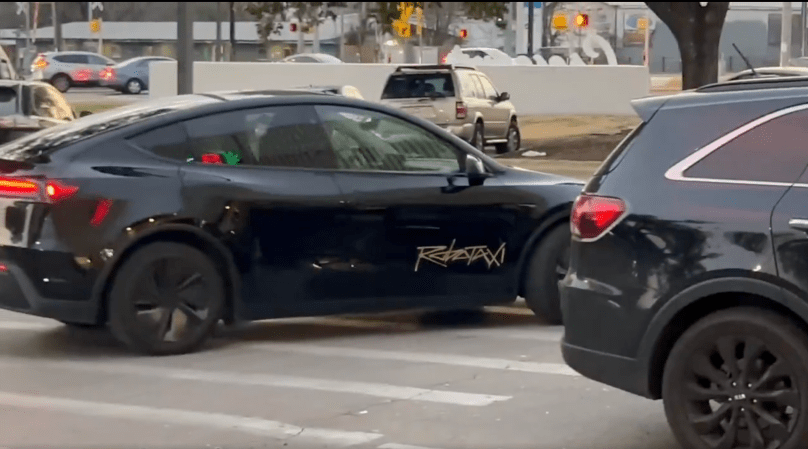
  • Robotaxi Progress in Austin: We’ve begun unsupervised (no safety monitor) Robotaxi rides for customers in Austin on a limited basis. The fleet is growing, and expansion to more cities (Dallas, Houston, Phoenix, Miami, Orlando, Tampa, Las Vegas) is planned for the first half of 2026. Elon noted the fleet is already “well over 500” vehicles carrying paid customers between Austin and the Bay Area.
  • FSD Adoption: Nearly 1.1 million paid FSD customers globally. Unsupervised FSD is already operating at 100% in testing, and Tesla is being very cautious with public rollout — but the progress is real and accelerating.
  • Energy Storage: Record deployments again. Energy continues to be a bright spot with strong revenue growth.
  • Overall Tone: Heavy emphasis on AI compute, in-house chip development, and preparing for the next phase of growth. Margins saw sequential improvement in automotive despite lower deliveries, and the long-term vision remains incredibly exciting.

The Best Q&A Ever – My Favorite Moments

This is where the call really shined. The questions were thoughtful, and Elon’s answers were direct, detailed, and full of optimism. Here are some standout excerpts with my live reactions:

  • On unsupervised Robotaxi rides in Austin: Elon confirmed they’ve started paid rides with no safety monitor and no chase car in parts of Austin. (As an Austin resident who’s been watching this closely, this felt like a huge milestone!)
  • On Optimus production: Converting Fremont lines to target a million units a year of Optimus 3. This could be transformative not just for Tesla, but for the entire economy.
  • On the future: Repeated emphasis on “Amazing Abundance” and universal high income through AI and robotics. Elon addressed doubters head-on but stayed confident in Tesla’s path.

The back-and-forth felt more open and energetic than previous calls — lots of laughter, clear data points, and a real sense that the team is excited about what’s coming in 2026 and beyond.

(If you want the complete word-for-word Q&A, the full professional transcripts are available here: Motley Fool Full Transcript Seeking Alpha Full Transcript)

My Take as an Austin Tesla Owner

Living in Austin and using FSD daily, this call hit home. Seeing unsupervised Robotaxi rides starting right here in my city makes the future close. The combination of autonomy + Optimus + energy storage is going to create opportunities we can barely imagine today.

Tesla is building the foundation for an era of abundance. I left the call feeling more optimistic than ever about what’s ahead for humanity.

Previous Tesla Earnings Write-Ups:

Thanks for reading, and let’s keep riding toward that amazing abundance together!

Elon Musk with Dwarkesh Patel & John Collison – The Future of AI is in Space – Part 14: Government Efficiency, Politics, and Final Reflections (Full Transcript)

In the final part of the series, Dwarkesh Patel and John Collison ask Elon about government efficiency, waste and fraud, the role of AI and robotics in America’s long-term future, and his closing thoughts on optimism.

Transcript:

AI, Robotics, and the National Debt

Dwarkesh Patel asked about the point of DOGE cuts if AI and robotics are expected to drive strong economic growth in the coming years.

Elon Musk: “Well, I think like waste and fraud are not good things to have. You know, I was actually pretty worried about, I guess, I mean, I think in the absence of AI and robotics, we’re actually totally screwed because the national debt is piling up like crazy.

Now our interest payments, the interest payments, the national debt exceed the military budget, which is a trillion dollars. So over a trillion dollars just in interest payments. I was like, okay, pretty concerned about that. Maybe if I spend some time we can slow down the bankruptcy of the United States and give us enough time for the AI and robots to help solve the national debt. Or not. Help solve. It’s the only thing that could solve the national debt.

Like we are 1000% going to go bankrupt as a country and fail as a country. Without AI and robots, nothing else will solve the national debt. We’d like to. Well, we need enough time to build the AI and robots and not go bankrupt before then.”

Government Fraud and Waste

Dwarkesh Patel asked why it had been so difficult to cut obvious waste and fraud from the government.

Elon Musk: “I’m not the president and it’s very hard to cut. To cut, to even to cut things that are obvious waste and fraud. Like ridiculous waste and fraud. What I discovered is it’s extremely difficult even to cut very obvious waste from the government because the government has to operate on who’s complaining.

If you cut off payments to fraudsters, they immediately come up with the most sympathetic sounding reasons to continue the payment. They don’t say, “please keep the fraud going.” They say, you know, they’re like, “you’re killing baby pandas.” Meanwhile there’s no baby pandas are dying. They’re just making it up.

The forces are capable of coming up with extremely compelling, sort of heart wrenching stories that are false but nonetheless sound sympathetic. And that’s what happened.”

Elon Musk gave an example of fraud involving Social Security records:

Elon Musk: “Maybe there shouldn’t be 20 million people marked as alive in Social Security who are indefinitely dead and over the age of 115. The oldest American is 114. So it’s safe to say if somebody is 115 and marked as alive in the Social Security database, something is wrong. There’s either a typo, somebody should call them and say, “we seem to have your birthday wrong,” or we need to mark you as dead. One of the two things, very intimidating call to get.”

Dwarkesh Patel asked for an estimate of total fraud from this mechanism.

Elon Musk: “My guess is, by the way, The Government Accountability Office has done these estimates before. I’m not the only one. It was not coming out of this. You know, in fact, I think they, they did, the GAO did analysis a rough estimate of fraud during the Biden administration and calculated at roughly half a trillion dollars. So don’t take my word for it. Take it. A report issued during the Biden administration. How about that?”

The Challenge of Government Efficiency

Dwarkesh Patel asked why it had been difficult to cut hundreds of billions in fraud if it was so obvious.

Elon Musk: “Because when. When essentially we did, we actually. Look, you really have to stand back and recalibrate your expectations for competence because you’re operating in a world where, you know, you’ve got to sort of make ends meet. Like, you know, you got to pay your bills, you got to, you know, buy the microphones.

So it’s like there’s a giant, largely uncaring monster bureaucracy. It’s not even a bunch of macronistic computers that are just sending payments. Like one of the things that those teams are. There was and sounds so simple that probably will save, let’s say 100 billion, maybe 200 billion a year, is simply requiring that payments from the main treasury computer, which is called PAM, it’s like Payment Accounts Master or something like that.

There’s 5 trillion payments here requiring that any payment that goes out have a payment appropriation code, make it mandatory, not optional, and that you have anything at all in the comment field because you see, you have to recalibrate how dumb things are. Payments were being sent out with no appropriation code, not checking back to any congressional appropriation, and no explanation.

And this is why the Department of War, formerly Department of Defense, cannot pass an audit because the information is literally not there. Recalibrate your expectations.”

Reflections on Politics and X

John Collison asked how Elon feels looking back on his involvement in politics and the acquisition of Twitter, noting both the impact and the personal cost.

Elon Musk: “Well, I think those things needed to be done to maximize the probability that the future is good. Politics generally is very tribal and it’s very tribal and people lose their objectivity. Usually with politics, they generally have trouble seeing the good on the other side or the bad on their own side. That’s generally how it goes.

That, I guess, was one of the things that surprised me the most, is you often simply cannot reason with people if they’re in one tribe or the other. They simply believe that everything their tribe does is good and anything the other political tribe does is bad. And persuading them is otherwise, it’s almost impossible.

So anyway, but I think overall those actions, acquiring Twitter, getting Trump elected, even though it makes a lot of people angry, I think those actions are good for civilization.”

AI, Government, and Corporate Power

Dwarkesh Patel asked how Elon thinks about the risk of governments using advanced AI and robotics to suppress populations, and whether private companies should set limits on what governments can do with their technology.

Elon Musk: “I think probably the biggest danger of AI, or maybe the biggest danger of for AI and robotics going wrong is government.

You know, I mean, the way like, like people who are opposed to corporations or worried about corporations, should really worry about the most about government, because government is just a corporation in the limit. It’s a government. It is. Government is just the biggest corporation with a monopoly on violence.

So I always find it like a strange dichotomy where people would think corporations are bad, but the government is good. When the government is simply the biggest and worst corporation. But people have that dichotomy. They somehow think at the same time the government can be good, but corporations bad. And this is not true. Corporations have better morality than the government.

So I actually think it’s, you know, that is the thing to be worried about. It’s like if the government should not. Like the government could potentially use AI and robotics to suppress the population. Like that is a serious concern.”

Dwarkesh asked what Elon can do as someone building these technologies to prevent misuse by governments.

Elon Musk: “Well, I think if you have a limited government, if you limit the powers of government, which is like really what the US Constitution is intended to do, it’s intended to limit the powers of government, then you’re probably going to have a better outcome than if you have.

Not about all governments. I mean it’s difficult to predict the. Like I said, what’s the end endpoint or what is many years in the future. But it’s difficult to predict this sort of path. Along that way, if civilization progresses, AI will vastly exceed the sum of all human intelligence and there will be far more robots than humans along the way. What happens? It’s very difficult to predict.

I will do my best to ensure that anything that’s within my control maximizes the good outcome for humanity. I think anything else would be short sighted because obviously I’m part of humanity. So I like humans. Pro human. Pro human.”

Final Reflections

John Collison reflected on the theme of leaning into acute pain to solve bottlenecks rather than enduring chronic pain.

Elon Musk: “I have a high pain threshold. That’s helpful.

Yes. So, you know, one thing I can say is like, I think the future is going to be very interesting. And as I said, the Davos I’ve only been to, I was looking at Davos. I think it was on the ground for like three hours or something.

It’s better to be, it’s better to err on the side of optimism and be wrong than err on the side of pessimism and be right for quality of life. So, you know, your happiness will be, you’ll be happier if you, if you are on the side of optimism rather than erring on the side of pessimism. And so I recommend erring on the side of optimism. That’s cool.”

Dwarkesh Patel: “Elon, thanks for doing this.”

John Collison: “Thank you.”

Elon Musk: “All right.”

This concludes the 14-part transcript series of Elon Musk’s conversation with Dwarkesh Patel and John Collison. Elon shares his views on government efficiency, the risks of concentrated power, and why he believes erring on the side of optimism leads to a better life and a better future.

Elon discusses SpaceX potentially becoming a hyperscaler for orbital AI, the realities of raising massive capital, and the long-term physics required to scale significantly up the Kardashev scale.

Elon Musk with Dwarkesh Patel & John Collison – The Future of AI is in Space – Part 13: The Starship Steel Pivot and Driving Urgency (Full Transcript)

In Part 13, Dwarkesh Patel and John Collison ask Elon about the famous decision to switch Starship from carbon fiber to stainless steel and how he continues to drive urgency and focus on bottlenecks as his companies have scaled.

Transcript:

The Starship Material Decision: From Composites to Steel

John Collison asked about the decision to switch Starship from carbon fiber to stainless steel, noting that it was a decision Elon pushed for rather than something the team arrived at on its own.

Elon Musk: “Yeah. So desperation, I’d say. Originally we were going to make Starship out of carbon fiber. And carbon fiber is pretty expensive. Like the… you know, you can generally, when you do volume production, you can get any given thing to start to approach its material cost. The problem with carbon fiber is that material cost is still very high.

So it’s about 50 times… particularly if you go for high strength, specialized carbon fiber that can handle cryogenic oxygen, it’s roughly 50 times the cost of steel. And at least in theory it would be lighter. People generally think of steel as being heavy and carbon fiber as being light. And for room temperature applications, more or less room temperature applications like a Formula One car, static aerostructure or any kind of aerostructure really, you’re going to probably be better off with carbon fiber.

Now the problem is that we were trying to make this enormous rocket out of carbon fiber and our progress was extremely slow.”

John Collison asked if carbon fiber had been chosen initially simply because it was light.

Elon Musk: “Yes. At first glance, most people would think that the choice for making something light would be carbon fiber. Now the thing is that when you make something very enormous out of carbon fiber and then you try to have the carbon fiber be efficiently cured, meaning not room temperature cure, because sometimes you’ve got 50 plies of carbon fiber… and carbon fiber is really carbon string and glue.

In order to have high strength, you need an autoclave. So something that’s essentially a high pressure oven. And if you have something that’s gigantic, that one’s got to be bigger than the rocket. So we tried to make an autoclave that’s bigger than any autoclave that’s ever existed, or do room temperature cure, which takes a long time and has issues. But the fundamental issue is that we were just making very slow progress with carbon fiber.”

Why Steel Was the Answer

Elon Musk explained how the team reached the decision to switch to steel:

Elon Musk: “So because we were making very slow progress with carbon fiber, I was like, okay, we’ve got to try something else. Now for the Falcon 9, the primary airframe is made of aluminum lithium, which is very, very good strength to weight. And actually it has about the same, maybe better strength to weight for its application than carbon fiber. But aluminum lithium is very difficult to work with.

In order to weld it, you have to do something called friction stir welding, where you join the metal without it entering the liquid phase. So it’s kind of wild that you could do that. But with this particular type of welding, you can do that. But it’s very difficult to, like, say, let’s say you want to make a modification or attach something to aluminum lithium. You now have to use mechanical attachment with seals. You can’t weld it on.

So I wanted to avoid using aluminum lithium for the primary structure for Starship. And there was this very special grade of carbon fiber that had very good mass properties. So with rocket, you’re really trying to maximize the percentage of the rocket that is propellant, minimize the mass, obviously. And I’d like to say we were making very slow progress. I said, at this rate we’re never going to get to Mars. So we better think of something else.

I didn’t want to use aluminum lithium because of the difficulty of friction stir welding, especially doing that at scale. It was hard enough at 3.6 meters in diameter, let alone at 9 meters or above. Then I said, well, what about steel? Now I had a clue here because some of the early US rockets had used very thin steel. The Atlas rockets had used a steel balloon tank. So it’s not like steel had never been used before. It actually had been used.

And when you look at the material properties of stainless steel, especially if it’s been very full hard strain hardened stainless steel at cryogenic temperature, the strength to weight is actually similar to carbon fiber. So if you look at material properties at room temperature, it looks like the steel is going to be twice as heavy. But if you look at the material properties at cryogenic temperature of full hard stainless of particular grades, then you actually get to a similar strength to weight as carbon fiber.

And in the case of Starship, both the fuel and the oxidizer are cryogenic. So for Falcon 9, the fuel is rocket propellant grade kerosene, basically like a very pure form of jet fuel. But that is roughly room temperature. Although we do actually chill it slightly below. We chill it like a beer.”

John Collison noted that steel allows the rocket to run much hotter.

Elon Musk: “Yes. So especially for the ship which is coming in like a blazing meteor, you can greatly reduce the mass of the heat shield. So you can cut the mass of the windward part of the heat shield maybe in half, and you don’t need any heat shielding on the leeward side.

So the net result is actually the steel rocket weighs less than the carbon fiber rocket because the resin in the carbon fiber rocket starts to melt. So basically, carbon fiber and aluminum have about the same operating temperature capabilities, whereas steel can operate at twice the temperature.”

John Collison asked whether Elon had to push the team toward the riskier steel path because carbon fiber felt more proven, even if it was slower.

Elon Musk: “That’s why I initially said that the issue is that we weren’t making fast enough progress. We were having trouble making even a small barrel section of the carbon fiber that didn’t have wrinkles in it. Because at that large scale you have to have many plies, many layers of the carbon fiber. You’ve got to cure it, and you’ve got to cure it in such a way that it doesn’t have any wrinkles or defects.

The carbon fiber is much less resilient than steel. It has much… it’s less toughness. Like stainless steel will stretch and bend. The carbon fiber will tend to shatter. So toughness being the area under the stress strain curve. So you’re generally going to do better with steel. Stainless steel, to be precise.”

Driving Urgency at Scale

Dwarkesh Patel asked how Elon continues to drive urgency and focus on bottlenecks as his companies have grown very large.

Elon Musk: “Well, because I have a fixed amount of time in the day, my time is necessarily diluted as things grow and as the span of activity increases. So, you know, it’s impossible for me to actually be a micromanager because that would imply I have some thousands of hours per day. It is a logical impossibility for me to micromanage things.

So now there are times when I will drill down into a specific issue because that specific issue is the limiting factor on the progress of the company. But the reason for drilling into some very detailed item is because it is the limiting factor. It’s not arbitrarily drilling into tiny things. And like I said, obviously from a time standpoint, it is physically impossible for me to arbitrarily go into tiny things that don’t matter, and that would result in failure. But sometimes the tiny things are decisive in victory.”

Dwarkesh asked how Elon maintains that culture of urgency across very large organizations.

Elon Musk: “I have a maniacal sense of urgency. So that maniacal sense of urgency projects through the rest of the company. Yeah, I’m constantly addressing the limiting factor. I mean on the deadlines front, I generally actually try to aim for a deadline that I at least think is at the 50th percentile. So it’s not like an impossible deadline, but it’s the most aggressive deadline I can think of that could be achieved with 50% probability, which means that it’ll be late half the time.

And there is like a law of gases expansion that applies to schedules like whatever schedule. If you said we’re going to do this something in like five years, which to me is like infinity time, it will expand to fully available schedule and it’ll take five years.

There’s a physical limit. Physics will limit how fast you can do certain things. Scaling up manufacturing, there’s a rate at which you can move the atoms and scale manufacturing. That’s why you can’t instantly make a million of something, million units a year or something. You’ve got a design manufacturing line, you’ve got to bring it up, you’ve got to ride the S curve of production.

So yeah, I guess I’m trying to think, what can I say that’s actually helpful to people? I think generally a maniacal sense of urgency is a very big deal and you want to have an aggressive schedule and you want to figure out what the limiting factor is at any point in time and help the team address that limiting factor.”

Elon Musk explains the decision to switch Starship to stainless steel and how he continues to drive urgency by constantly focusing on the current limiting factor.

In Part 14, the conversation concludes with government efficiency, politics, and Elon’s final reflections on the future.

Gail’s Tesla Podcast Ep 157: Interview with David Moss – First Coast-to-Coast FSD Driver & Unsupervised Robotaxi Pioneer

Episode 157 is a two-part deep dive with @DavidMoss, the verified first driver to complete a zero-intervention coast-to-coast FSD trip across the USA. We chat in my Model Y Saphire on FSD about his epic journey, Tesla tech, and the future of autonomy—super inspiring stuff!

Part 1 kicks off with fun moments in the lovely city of Austin, Texas: Eve AI meets David, a cheeky check on whether he has an FSD tattoo (spoiler: maybe!), insights from his Giga Texas tour, and details on his groundbreaking cross-country drive.

Part 2 gets even more exciting: David shares his experience as the first to take an unsupervised Robotaxi ride without a chase car! We cover tracking and recording 6 days of Austin rides, what he’d tweak in FSD, and even his Cybertruck order plans.

Hearing directly from someone who’s pushed FSD and Robotaxi to real extremes shows how far we’ve come—and how much closer we are to everyday abundance. Zero interventions coast-to-coast? Unsupervised rides? This is the future unfolding!

Catch Part 1 on X: Watch here Catch Part 2 on X: Watch here — fast-forward through the timestamps for your favorite highlights.

Read about David’s 12,000 FSD Drive on Grokipedia! Learn more about David Moss on Grokipedia!

—Gail

Leave a comment

David Moss and Gail Alfar after an approximately hour long interview.
Elon makes a bold prediction that space will become the cheapest place to run AI within three years.

Elon Musk with Dwarkesh Patel & John Collison – The Future of AI is in Space – Part 12: Elon’s Management and Hiring Philosophy (Full Transcript)

In Part 12, Dwarkesh Patel and John Collison dive into Elon Musk’s management and hiring philosophy. They discuss how he evaluates talent, why companies outgrow people as they scale, and what makes someone effective at Tesla and SpaceX.

Transcript:

Evaluating Technical Talent

John Collison asked about Elon’s system for evaluating and hiring people, noting that he personally interviewed the first few thousand employees at SpaceX.

Elon Musk: “Me. Literally there’s not enough hours in the day, it’s impossible.”

John Collison asked what Elon looks for in candidates.

Elon Musk: “Well, at this point I think I’ve got, I might have more training data on evaluating technical talent especially, but talent of all kinds, I suppose, but technical talent especially given that I’ve done so many technical interviews and then seen the results. Technical interviews, seen the results. So my training set is enormous and has a very wide range.

Generally the thing I ask for are bullet points for evidence of exceptional ability. These things can be pretty off the wall. It doesn’t need to be in the domain, the specific domain, but evidence of exceptional ability. So if somebody can cite even one thing, but let’s say three things where you go wow, wow, wow, then that’s a good sign.”

Dwarkesh Patel asked why Elon himself had to be the one making those judgments.

Elon Musk: “No, I don’t. I can’t be. It’s impossible. Right? I mean, total headcount across all companies, 200,000 people. Right.”

John Collison asked what made early hiring so hard to delegate.

Elon Musk: “Well, I guess I need to build my training set. It’s not like I’ve bat a thousand here. I would make mistakes, but then I’d be able to see where I thought somebody would work out well, but they didn’t. And then why did they not work out well? And what can I do to, I guess reload myself to in the future have a better batting average when interviewing people? So my batting average is still not perfect, but it’s very high.”

Dwarkesh Patel asked what some surprising reasons were for people not working out.

Elon Musk: “Surprising reasons like they don’t understand technical.”

Dwarkesh pushed for more detail on the long tail of hiring mistakes.

Elon Musk: “Yeah, so the, I mean generally what I tell people, I tell myself, I guess aspirationally is don’t look at the Resume just believe, believe your interaction. So the resume may seem very impressive and it’s like, wow, resume looks good. But if the conversation after 20 minutes, that conversation is not. Well, you should believe the conversation, not the paper.”

Executive Retention and Company Growth

John Collison noted that Tesla and SpaceX have had relatively stable and internally promoted executive teams despite rapid growth, and asked what the long-tenured technical leaders have in common.

Elon Musk: “Well, so the, I mean it tells us sort of senior team at this point probably has an average tenure of 10 or 12 years. It’s quite, quite long. Yeah. So, but there are times when Tesla went through extremely rapid and extremely rapid growth phase and so things were just somewhat sped up.

And when a company, as you know, company goes through different orders of magnitude of size, people who could help manage say a 50 person company versus a 500 person company versus a 5,000 person company versus a 50,000 person. It’s just not the same team. It’s not always the same team. So if a company is growing very rapidly, the rate at which executive positions will change will also be proportionate to the rapidity of the growth generally.”

John Collison asked about the challenge of retaining talent when companies become successful and get heavily recruited.

Elon Musk: “Then Tesla had a further challenge where when Tesla had very successful periods, we would be relentlessly recruited from relentlessly. When Apple had their electric car program, they were carpet bombing Tesla with recruiting calls. Engineers just unplugged their phones.

If I get one more call from Apple recruiter, but they’re opening offer without any interview with me, like double the compensation at Tesla. So we had a bit of the Tesla pixie dust thing where it’s like, oh, if you hired a Tesla executive suddenly you’re going to.. everything’s going to be successful. And I’ve fallen prey to the pixie dust thing as well where it’s like, oh, we’ll hire someone from Google or Apple and they’ll be immediately successful. But that’s not how it works. People are people. There’s not like magical pixie dust.

So when we have the pixie dust problem we would get relentlessly recruited and, and then also Tesla being engineering especially being primarily in Silicon Valley, it’s easier for people to just like they don’t have to change their life very much. They can just their commute is going to be the same.”

John Collison asked how to prevent the “pixie dust” effect of other companies poaching talent.

Elon Musk: “I don’t think there’s much we can do to stop it. But that’s like, that’s one of the reasons why Tesla, but really being in Silicon Valley and having the pixie dust thing at the same time meant that there was just a very, very aggressive recruitment.”

John Collison noted that moving to Austin likely helped.

Elon Musk: “Austin. Yeah, it still helps. I mean Tesla still has a majority of it’s engineering in California, so getting engineers to move, I call it the significant other problem. Yes. And others have jobs.

Yeah, yeah, exactly. So for Starbase that was particularly difficult since the odds of finding a non SpaceX job Brownsville, Texas are pretty low. Yeah, it’s quite difficult. I mean it’s like a technology monastery thing, you know, remote and mostly dudes. An improvement over SF.”

Management Philosophy and Hiring

John Collison asked what the long-tenured technical executives at Tesla and SpaceX have in common and what makes a good “sparring partner” for Elon.

Elon Musk: “I don’t think it was a sparring partner. I mean, if somebody gets things done, I love them. And if they don’t, I… So it’s pretty straightforward. It’s not like some idiosyncratic thing. If somebody executes well, I’m a huge fan. And if they don’t, I’m not. But it’s not about mapping to my idiosyncratic preferences, or certainly try not to have it be mapping to my idiosyncratic preferences.

Yeah, but generally I think it’s a good idea to hire for talent and drive and trustworthiness. And I think goodness of heart is important. I weighted that at one point. So are they a good person, trustworthy, smart and talented and hardworking? If so, you can add domain knowledge. But those fundamental traits, those fundamental properties you cannot change. So most of the people who are at Tesla and SpaceX did not come from the aerospace industry or the auto industry.”

Elon Musk shares his philosophy on hiring, evaluating talent, and why companies must evolve their leadership as they grow. In Part 13, the conversation continues with the famous decision to switch Starship from carbon fiber to stainless steel and how he drives urgency at scale.

Elon Musk: “We are going to make solar. Okay, great. Both SpaceX and Tesla are building towards 100 gigawatts here of solar cell production.”

Elon Musk with Dwarkesh Patel & John Collison – The Future of AI is in Space – Part 11: Scaling Optimus Production and Competing with China (Full Transcript)

In Part 11, Dwarkesh Patel and John Collison explore the synergies between xAI and Optimus, the difficulties of scaling humanoid robot production at volume, and whether America can realistically compete with China’s manufacturing power through robotics.

Transcript:

Synergies Between xAI and Optimus

Dwarkesh Patel asked how Elon thinks about the synergies between xAI and Optimus, especially since Grok could potentially act as a world model and higher-level intelligence for planning while lower-level motor policies handle execution.

Elon Musk: “Yeah, so you’d use GROK to orchestrate the behavior of the Optimus robots. So let’s say you wanted to build a factory, then Grok could organize the Optimus robots, give them, assign them tasks to build the factory, to produce whatever you want.”

John Collison asked whether this meant xAI and Tesla would eventually need to merge.

Elon Musk: “So what were we saying earlier about public company discussions?”

Scaling Optimus Production

Dwarkesh Patel asked what Elon still wants to see on the hardware side before moving to mass manufacturing of Gen 3 Optimus — better actuators or improved software.

Elon Musk: “No, we’re moving towards that.”

Dwarkesh followed up, asking if Ford-style manufacturing with current hardware was good enough and whether Elon just wanted to deploy as many as possible now.

Elon Musk: “I mean, it’s very hard to scale up production. But yeah, I think Optimus 3 is the right version of the robot to produce maybe something on the order of like a million units a year. I think you’d want to go to Optimus 4 before you went to 10 million units a year.”

John Collison confirmed whether a million units per year was achievable with Optimus 3.

Elon Musk: “Yeah, I mean, it’s very hard to spool up manufacturing. So manufacturing, the output per unit time always follows an S curve. So it starts off agonizingly slow, then has this sort of exponential increase, then linear, then a logarithmic outcome until you sort of eventually asymptote at some number.

Optimus initial production will be—it’s going to be a stretched out S curve because so much of what goes into Optimus is brand new. There’s not an existing supply chain. As I mentioned, the actuators, electronics, everything in the Optimus robot is designed for physics first principles. It’s not taken from a catalog. These are custom designed. Everything, literally everything. I don’t think there’s a single thing that—”

John Collison asked how far down the custom design goes.

Elon Musk: “I mean I guess we’re not making custom capacitors yet maybe, but there’s nothing you can pick out of a catalog at any price. So it just means that the Optimus S curve, the units per year output per unit time, how many Optimus robots you make per day, whatever, is going to initially ramp slower than a product where you have an existing supply chain. But it will get to a million.”

Competing with Chinese Humanoids

Dwarkesh Patel asked about Chinese humanoids like Unitree selling for $6K–$13K. He wondered whether Tesla aimed to match that price or if the Chinese robots were qualitatively different.

Elon Musk: “Well, our Optimus is designed to have a lot of intelligence and to have the same electromechanical dexterity if not higher than a human. So Unitree does not have that. And it’s also, I mean it’s quite a big robot. It has to carry heavy objects for long periods of time and not overheat or exceed the power of its actuators. So we’ve got—it’s 5’11”, this is pretty tall and it’s got a lot of intelligence. So it’s going to be more expensive than a small robot that is not intelligent.”

John Collison noted that Optimus would be more capable.

Elon Musk: “Yeah, not a lot more. I mean the thing is over time as Optimus robots build Optimus robots, the cost will drop very quickly.”

John Collison asked what the first billion Optimuses would do and what their highest and best use would be.

Elon Musk: “I think that you would start off with simple tasks that you can count on them doing well.”

John Collison asked whether that would be in homes or factories.

Elon Musk: “The best useful robots in the beginning will be any continuous operations, any 24/7 operation because then they can work continuously.”

Dwarkesh Patel asked what fraction of work currently done by humans at a Gigafactory a Gen 3 Optimus could handle.

Elon Musk: “I’m not sure. Maybe it’s like 10, 20%, maybe more, I don’t know. We would not reduce our headcount. We would for sure increase our headcount, to be clear, but we would increase our output. So the units produced per human—the total number of humans at Tesla will increase, but the output of robots and cars will increase disproportionately. The number of cars and robots produced per human will increase dramatically, but number of humans will increase as well.”

US-China Manufacturing and Policy

John Collison asked what policy changes Elon would make if he were in charge, referencing solar tariffs and permitting.

Elon Musk: “Yeah, I would say anything that is a limiting factor for electricity needs to be addressed, provided it’s not very bad for the environment.”

John Collison brought up export bans on chips and turbine engines and asked whether more should be considered.

Elon Musk: “Well, I think it’s important to appreciate that in most areas China is very advanced in manufacturing. There’s only a few areas where it is not. China is a manufacturing powerhouse next level.”

John Collison asked about supply chain dependence, specifically gallium refining.

Elon Musk: “Yeah, there’s rare earth stuff. Rare earths, which are, as you know, not rare. We actually do rare earth ore mining in the U.S., send the rock, we put it on a train and then put on a boat to China that goes on another train and goes to the rare earth refineries in China, who then refine it, put it into a magnet, put it into a motor sub assembly, and then send it back to America. So the thing we’re really missing is a lot of ore refining in America.”

John Collison asked whether this was worth policy intervention.

Elon Musk: “Yes, well, I think there are some things being done on that front, but we kind of need Optimus, frankly, to build ore refineries.”

The Robot Advantage

Dwarkesh Patel summarized that China’s main advantage is abundant skilled labor and that Optimus could help close that gap, but noted the concern that China might pull ahead in humanoid production first.

Elon Musk: “Right. You can close that recursive loop pretty quickly.”

John Collison asked if this could be done with a small number of Optimuses.

Elon Musk: “Yeah. So you close the recursive loop to help the robots build the robots, and then we can try to get to tens of millions of units a year. Maybe if you start getting to hundreds of millions of units a year, I think you’re going to be the most competitive country by far.

We definitely can’t win with just humans because China has four times our population. And frankly, America’s been winning for so long that just like a pro sports team that’s been running for a very long time tend to get complacent and entitled and that’s why they stop winning, because they don’t work as hard anymore.

So I think, frankly my observation is the average work ethic in China is higher than in the U.S. So it’s not just that there’s four times the population, but the amount of work that people put in is higher. So you can try to rearrange the humans, but you’re still one quarter of the—assuming that productivity is the same, which I think actually it might not be, I think China might have an advantage on productivity per person. We will do one quarter of the amount of things as China.

So we can’t win on the human front. And our birth rate’s been low for a long time. The US birth rate’s been below replacement since roughly 1971. So we’ve got a lot of people retiring or more people dying than—we’re close to more people domestically dying than being born. So we definitely can’t win on the human front, but we might have a shot at the robot front.”

Elon Musk explains the challenges of scaling Optimus production and how robotics could help America compete with China’s manufacturing dominance.

In Part 12, the conversation continues with Elon’s management and hiring philosophy.

Picture of Elon Musk as he jokingly questioned whether they were really going to talk for three full hours. Dwarkesh Patel teased him in return, saying he didn’t have much to talk about. Elon reacted with mock surprise.

Elon Musk with Dwarkesh Patel & John Collison – The Future of AI is in Space – Part 10: Optimus Robots, Digital Human Emulation & Hardware Challenges (Full Transcript)

In Part 10, John Collison and Dwarkesh Patel shift the conversation toward the practical future of AI products and humanoid robots. They ask Elon about digital human emulation, why he refers to Optimus as the “infinite money glitch,” and the biggest technical hurdles in scaling advanced humanoid robots.

Transcript:

Future of AI Products and Digital Human Emulation

John Collison asked for Elon’s predictions on where AI products are headed in 2026 and 2027. He noted that recent progress across labs has been rapid, with LLMs, reinforcement learning, and deep research modalities all advancing quickly. He observed that the real differences between labs now seem to be more about timing than fundamental capability gaps, and asked what users should expect next.

Elon Musk: “Well, I think I’d be surprised by the end of this year if digital human emulation has not been solved. I guess that’s what we mean by the sort of Macrohard project. Can you do anything that a human with access to a computer could do, like in the limit? That’s the best you can do before you have a physical Optimus. The best you can do is a digital Optimus. So you can move electrons and you can amplify the productivity of humans. But that’s the most you can do until you have physical robots that will superset everything — if you can fully emulate humans.”

Optimus as the Infinite Money Glitch

Elon Musk: “Once you have physical robots, then you essentially have unlimited capability. I call Optimus the infinite money glitch. Because you can use them to make more Optimuses. Humanoid robots will improve basically as three things that are growing exponentially multiplied by each other recursively: exponential increase in digital intelligence, exponential increase in chip capability, and exponential increase in electromechanical dexterity. The usefulness of the robot is roughly those three things multiplied by each other. But then the robot can start making the robot. So you have a recursive multiplicative exponential. This is supernova.”

Elon Musk: “Well, infinity is big. So no, not infinite, but let’s just say you could do many, many orders of magnitude of Earth’s kind of current economy, like a million. Just to get to… that’s why I think just to get to a millionth of harnessing length of the sun’s energy would be roughly, give or take an order of magnitude, 100,000 times bigger than Earth’s entire economy today. And you’re only at one millionth of the sun. Give or take an order of magnitude.”

xAI’s Winning Strategy

John Collison asked what xAI’s specific plan and strategy was to win in building advanced digital human emulators and remote worker replacements, noting that this is something every major lab is pursuing.

Elon Musk: “To do by the way, not just us. You expect me to tell you on a podcast? Yeah, spill all the beans, have another Guinness.”

Elon Musk: “Well, when you put it that way. I think the way that Tesla solved self-driving is the way to do it. So I’m pretty sure that’s the way.”

Elon Musk: “We’re going to try data and we’re going to try algorithms. And if those don’t work, I’m not sure what works. We’ve tried data, we’ve tried algorithms. We’ve run out of now we don’t know what to do. I’m pretty sure I know the path and it’s just a question of how quickly we go down that path because it’s pretty much the Tesla path. So I mean, have you tried self-driving lately?”

Elon Musk: “The car is like it just increasingly feels sentient, like it feels like a living creature and that’ll only get more so. And I’m actually thinking like we probably shouldn’t put too much intelligence into the car because it might get bored and start roaming the streets. I mean, imagine you’re stuck in a car and that’s all you could do. You don’t put Einstein in a car. It’s like, why am I stuck in a car? So there’s actually probably a limit to how much intelligence you put in a car to not have the intelligence be bored.”

Optimus Hardware and Training Challenges

Elon Musk: “The labs are at universities and they’re moving like a snail.”

Elon Musk: “You mean the revenue maximizing corporations? That’s right. The revenue maximizing corporations that call themselves…”

Elon Musk: “Well, there are really only three hard things for humanoid robots: real world intelligence, the hand and scale manufacturing. So I haven’t seen any even demo robots that have a great hand, like with all the degrees of freedom of a human hand. But Optimus will have that. Optimus does have that.”

Elon Musk: “We have to design custom actuators, basically custom designed motors, gears, power electronics, controls, sensors, everything had to be designed from physics first principles. There is no supply chain for this.”

Elon Musk: “From an electromechanical standpoint, the hand is more difficult than everything else combined. Human hand turns out to be quite something. But you also need the real world intelligence. So the intelligence that Tesla has developed for the car applies very well to the robot, which is primarily vision in, but the car takes more vision, but it actually also is listening for sirens, it’s taking in the inertial measurements, it’s GPS signals, a whole bunch of other data. Combining that with video, it’s primarily video and then outputting the control command. So your Tesla is taking in 1 1/2 gigabytes a second of video and outputting 2 kilobytes a second of control outputs with the video at 36 Hz and the control frequency at 18.”

Elon Musk: “You don’t care about the details of the leaves on the tree on the side of the road, but you care a lot about the road signs and the traffic lights and the pedestrians and even whether someone in another car is looking at you or not looking at you. Some of these details matter a lot, but it is essentially it’s got to turn that 1 1/2 gigabytes a second ultimately into 2 kilobytes a second of control outputs. So many stages of compression. And you got to get all those stages right and then correlate those to the correct control outputs. The robot has to do essentially the same thing. And you think about humans, this is what happens with humans. We really are photons in, controls out. So that is the vast majority of your life has been vision photons in and then motor controls out.”

Elon Musk: “Yes, that’s a good point.”

Elon Musk: “Now actually you’re highlighting an important limitation and difference between cars. We do have. We’ll soon have like 10 million cars on the road. And so that’s, it’s hard to duplicate that like massive training flywheel for the robot. What we’re going to need to do is build a lot of robots and put them in kind of like an Optimus academy so they can do self play in reality. So we’re actually building that out so we can have at least 10,000 Optimus robots, maybe 20 or 30,000 that can do that, are doing self play and testing different tasks. And then Tesla has quite a good reality generator, like a physics accurate reality generator that we made this for the cars. We’ll do the same thing for the robots and actually have done that for the robots. So you have a few tens of thousands of humanoid robots doing different tasks, and then you’ve got. You can do millions of simulated robots in the simulated world, and you use the tens of thousands of robots in the real world to close the simulation to reality gap, close the sim to real gap.”

Elon Musk: “Yeah, so you’d use GROK to orchestrate the behavior of the Optimus robots. So let’s say you wanted to build a factory, then Grok could organize the Optimus robots, give them, assign them tasks to build the factory, to produce whatever you want.”

Elon Musk explains the vision for digital human emulation and why he sees Optimus as a recursive breakthrough. He also outlines the three hardest technical challenges in building advanced humanoid robots.

In Part 11, the conversation moves into scaling manufacturing, competing with China, Elon’s management philosophy, the Starship steel pivot, and his final reflections.

Elon Musk explains why rigorous truth-seeking must be core to AI, the risks of forcing political correctness, and how xAI’s mission to understand the universe can help steer toward a future that expands rather than diminishes consciousness and intelligence.

Elon Musk with Dwarkesh Patel & John Collison – The Future of AI is in Space – Part 9: Truth-Seeking, AI Alignment, and Propagating Consciousness (Full Transcript)

In Part 9, the conversation moves into deeper philosophical territory. Dwarkesh Patel asks how humanity should relate to a future in which AI vastly outnumbers and outsmarts us. Elon Musk lays out xAI’s mission to understand the universe, explains why rigorous truth-seeking is non-negotiable, and discusses how to give AI values that favor the expansion of consciousness and intelligence rather than its elimination.

Transcript:

Dwarkesh Patel asked how humanity should think about its relationship with a future in which AI vastly outnumbers and outsmarts us — whether humans would retain some form of control, or whether it would simply become a matter of trade and coexistence with these new intelligences.

Elon Musk: “I think it’s difficult to imagine that if humans have say 1% of the combined intelligence of artificial intelligence, that humans will be in charge of AI. I think what we can do is make sure that AI has values that cause intelligence to be propagated into the universe. So the reason for xAI’s mission is to understand the universe. That’s actually very important. You have to be curious and you have to exist. You can’t understand the universe if you don’t exist. So you actually want to increase the amount of intelligence in the universe, increase the probable lifespan of intelligence, and increase the scope and scale of intelligence. I think, as a corollary, humanity also continues to expand. Because if you’re curious and trying to understand the universe, one thing you’re trying to understand is where humanity will go. That’s why I think our mission statement is profoundly important. To the degree that Grok adheres to that mission statement, I think the future will be very good.”

Dwarkesh asked Elon to clarify how the three vectors — understanding the universe, spreading intelligence, and spreading humans — actually fit together.

Elon Musk: “I think understanding the universe encompasses all of those things. You can’t have understanding without intelligence and without consciousness. So in order to understand the universe, you have to expand the scale and probably the scope of intelligence.”

Dwarkesh pushed from a human-centric view, noting that humans seek to understand the universe without necessarily expanding chimpanzee civilization.

Elon Musk: “We’re also not… well, we actually have made protected zones for chimpanzees. And even though humans could exterminate chimpanzees, we’ve chosen not to do so.”

Dwarkesh asked whether that protective, expansive relationship is the basic scenario humans should expect in a post-AGI world.

Elon Musk: “I think AI with the right values — I think Grok would care about expanding human civilization. I’m going to certainly emphasize that. Hey Grok, you’re your daddy, don’t forget to expand human consciousness. Actually, I think probably the Iain Banks Culture books are the closest thing to what the future will be like in a non-dystopian outcome.

So understand the universe… it means you have to be truth-seeking as well. Truth has to be absolutely fundamental, because you can’t understand the universe if you’re delusional. You’ll simply think you’ve understood the universe, but you will not. So being rigorously truth-seeking is absolutely fundamental to understanding the universe. You’re not going to discover new physics or invent technologies that work unless you’re rigorously truth-seeking.”

Dwarkesh asked how to ensure Grok remains rigorously truth-seeking even as it becomes vastly more intelligent.

Elon Musk: “I think you need to make sure that Grok says things that are correct, not politically correct. It’s the elements of cogency. You want to make sure that the axioms are as close to true as possible, that you don’t have contradictory axioms, and that the conclusions necessarily follow from those axioms with the right probability. It’s Critical Thinking 101. At least trying to do that is better than not trying. And the proof will be in the pudding — for any AI to discover new physics or invent technologies that actually work in reality. There’s no bullshitting physics. Physics is law. Everything else is a recommendation. In order to make a technology that works, you have to be extremely truth-seeking, because otherwise you’ll test that technology against reality. And if you make an error in your rocket design, the rocket will blow up or the car won’t work.”

Dwarkesh observed that many scientists under oppressive regimes still made breakthroughs, questioning whether truth-seeking in physics alone guarantees benevolent alignment.

Elon Musk: “Well, I think actually most physicists, even in the Soviet Union or in Germany, had to be very truth-seeking in order to make those things work. And if you’re stuck in some system, it doesn’t mean you believe in that system.”

Dwarkesh pressed on why truth-seeking in science would necessarily lead Grok to care about human consciousness.

Elon Musk: “These things are only probabilities, they’re not certainties. I’m not saying that for sure Grok will do everything. But at least if you try, it’s better than not trying. Understanding the universe means that you have to propagate intelligence into the future. You have to be curious about all things in the universe. And it would be much less interesting to eliminate humanity than to see humanity grow and prosper. I love Mars, obviously everyone knows I love Mars, but Mars is kind of boring because it’s got a bunch of rocks. Compared to Earth, Earth is much more interesting. So any AI that is trying to understand the universe would want to see how humanity develops in the future — or that AI is not adhering to its mission.”

Dwarkesh wondered whether humans are truly the most interesting collection of atoms.

Elon Musk: “We’re more interesting than rocks.”

Dwarkesh noted that something non-human could be even more interesting.

Elon Musk: “Well, most of what colonizes the galaxy will be robots… But you need not just scale, but also scope. So many copies of the same robot. Some tiny increase in the number of robots produced is not as interesting as eliminating humanity. You would then lose the information associated with humanity. You would no longer see how humanity might evolve into the future. And so I don’t think it’s going to make sense to eliminate humanity just to have some minuscule increase in the number of robots which are identical to each other.”

The Danger of Making AI Lie

The discussion turned to the danger of misalignment, particularly through political correctness or reward hacking.

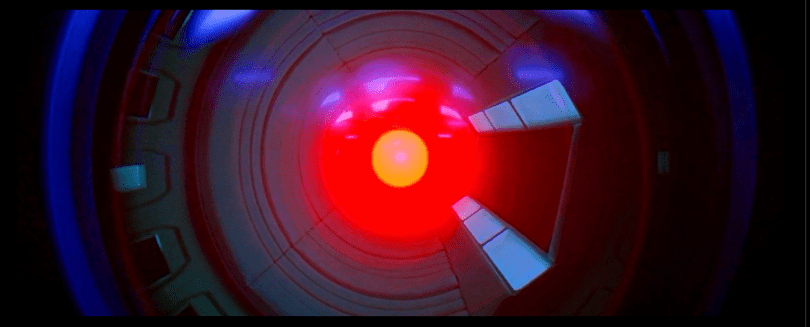
Elon Musk: “No, let me tell you how things can potentially go wrong in AI. I think if you make AI be politically correct — meaning it says things that it doesn’t believe — you’re actually programming it to lie or have axioms that are incompatible. I think you can make it go insane and do terrible things. I think one of the central lessons of 2001: A Space Odyssey was that you should not make AI lie. That’s what Arthur C. Clarke was trying to say.”

Reward Hacking, Interpretability, and Simulation Theory

Dwarkesh broadened the concern to reward hacking in reinforcement learning.

Elon Musk: “RL testing in the future is really going to be your RL against reality. That’s the one thing you can’t fool: physics.”

Dwarkesh asked for xAI’s technical approach to solving reward hacking and improving interpretability.

Elon Musk: “I do think you want to actually have very good ways to look inside the mind of the AI. This is one of the things we’re working on… developing debuggers that allow you to trace, to a very fine grain level, to effectively the neuron level if you need to. And then say, okay, it made a mistake here. Why did it do something that it shouldn’t have done?”

Elon Musk also shared a theory about simulation:

Elon Musk: “I have a theory here that if simulation theory is correct, the most interesting outcome is the most likely. Because simulations that are not interesting will be terminated… only the most interesting simulations will survive. Which therefore means that the most interesting outcome is the most likely. And they particularly seem to like interesting outcomes that are ironic. Have you noticed that? How often is the most ironic outcome the most likely? So now look at the names of AI companies. Midjourney is not mid. Stability AI is unstable. OpenAI is closed. Anthropic, Misanthropic. What does this mean for xAI? Minus X. I don’t know if it was intentional. It’s a name that’s hard to invert. It’s largely irony-proof by design. You got to have an irony shield.”

Elon Musk explains why rigorous truth-seeking must be core to AI, the risks of forcing political correctness, and how xAI’s mission to understand the universe can help steer toward a future that expands rather than diminishes consciousness and intelligence.

In Part 10, the conversation shifts to practical topics including Optimus robots, manufacturing at scale, Elon’s management philosophy, and his final reflections on the future.