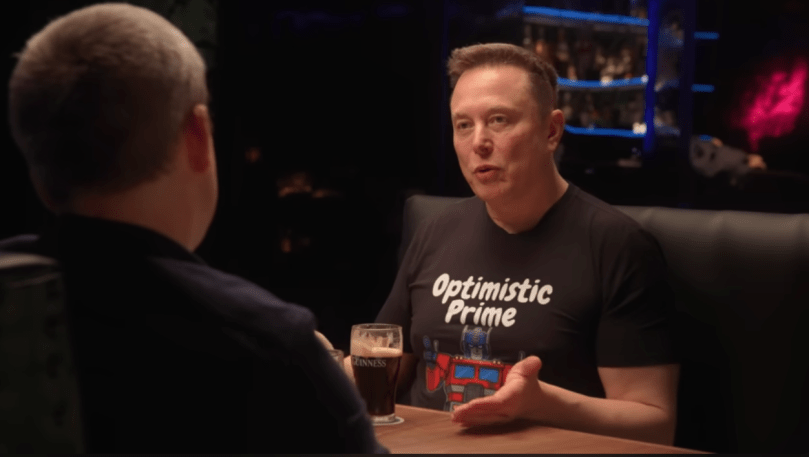
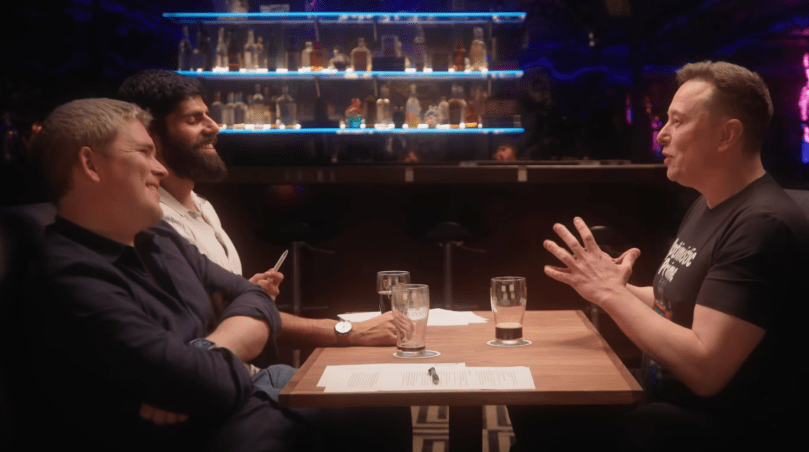
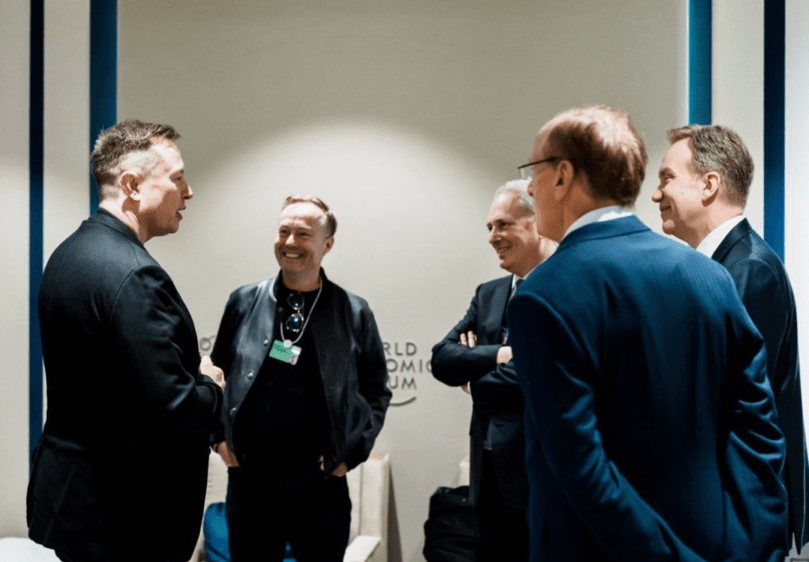
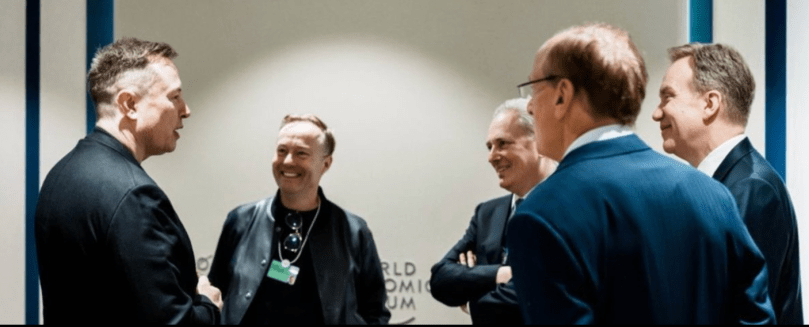
This is my full verbatim transcript of Elon Musk’s recent Davos interview at the World Economic Forum 2026, based directly on his live conversation. I’ve formatted it for you, to help with readability with Elon talking with Larry Fink of BlackRock, and I have kept it as close to word-for-word as possible (including natural speech patterns, ums, and repetitions). I made some minor fixes only for obvious auto-transcription errors to ensure accuracy without changing meaning.
Elon Musk: We are going to make this interesting!
Larry Fink: How many quotes are you going to want that are after this session?
Elon Musk: I don’t know, five, haha!
Larry Fink: Good afternoon everyone, it’s great to see everybody here. It has been an amazing week. Thrilled Elon Musk come from California. Thank you, Elon.
Elon Musk: You’re most welcome. I heard about the formation of the Peace Summit, and it’s like, is that P-I-E-C-E, a little piece? Haha. Or Greenland? A little piece of Venezuela? All we want is peace.
Larry Fink: Okay. As they said, I’m pretty proud CEO BlackRock. Since we went public, the compounding return of BlackRock to our shareholders was 21%. Since Elon took Tesla public, his compounded return is 43%. This is just another advertisement for everybody, especially for Europeans. This is why more citizens should be investing with growth, investing in their countries. Imagine if a lot of pension funds invested with Elon when Tesla went public, and how much return would be with all the pension funds that invested side-by-side with Elon and the growth. So a spectacular return. There’s very few companies—well, I don’t think there is any other company as large as Tesla today that has compounded returns. Congratulations.
Elon Musk: We have an incredible team at Tesla. and so thats the reason!
Larry Fink: I want to get into the meaningful component about technology, the possibilities. I want to talk about AI and robotics, energy, space, and the progress ultimately coming down to engineering. Engineering discipline, scale, execution. Few people, if not anyone, has the experience, and the fortitude to confront these issues head-on—not just ideas, but execution across so many different technologies. Elon, that’s why it is important for us to have this dialogue here in Davos. So you are presently building on AI and robotics, space, energy—all at the same time. When you look across those efforts, what do they have in common from an engineering standpoint?
Elon Musk: Well, they’re all very difficult technology challenges. But the overall goal of my companies is to maximize the future of civilization—like basically maximizing the probability that civilization has a great future. And to expand consciousness beyond Earth.
ALIENS
So if you take SpaceX, for example, SpaceX is about advancing rocket technology to the point where we can extend life and consciousness beyond Earth—to the Moon, Mars, eventually other star systems. I think we should always view consciousness, life, as precarious and delicate. Because to the best of our knowledge, we don’t know if life is anywhere else. You know, I’m often asked, are there aliens among us? And I’ll say that I am one. They don’t believe me.
Okay. So I think if anyone would know there are aliens among us, it would be me. And 9,000 satellites up there, and not once have we had to maneuver around an alien spaceship. So like, I don’t know. Bottom line is, we need to assume that life and consciousness is extremely rare, and it might only be us. And if that’s the case, then we do everything possible to ensure the light of consciousness is not extinguished.
CANDLE IN VAST DARKNESS
Elon Musk: Because effectively, the image in my mind is of a tiny candle in a vast darkness—tiny candle of consciousness that could easily go out. And that’s why it’s important to make life multiplanetary. Such that if there is a natural disaster or man-made disaster on Earth, that consciousness continues. That’s the purpose of SpaceX.
TESLA MISSION
Elon Musk: Tesla is obviously about sustainable technology. And also at this point, we’ve sort of added to our mission sustainable abundance. So with robotics and AI, this is really the path to abundance for all. If you say, you know, people often talk about solving global poverty, or essentially how do we give everyone a very high standard of living—I think the only way to do this is AI and robotics. Which doesn’t mean that it’s without its issues. We need to be very careful with AI. We need to be very careful with robotics. We don’t want to find ourselves in a James Cameron movie—you know, Terminator. He’s great. Great movies. Love his movies. But well, we don’t want to be in Terminator, obviously.
But if you have ubiquitous AI that is essentially free or close to it, and ubiquitous robotics, then you will have an explosion in the global economy—an expansion in the global economy that is truly beyond all precedent.
Larry Fink: Can that expansion be broad? Or is it narrow? And how can it be broadened the global economy?
EXPLAINING AMAZING ABUNDANCE
Elon Musk: Way to think of it is that if you have a large number of humanoid robots, the economic output is the average productivity per robot times the number of robots. And actually my prediction is in the benign scenario of the future that we will—the robots will actually make so many robots and AI that they will actually saturate all human needs. Meaning you won’t be able to even think of something to ask the robot for at a certain point. Like there would be such an abundance of goods and services. Because my predictions are there’ll be more robots than people.
Larry Fink: So but how do you then have human purpose in that scenario?
Elon Musk: Yeah, I mean, you know, there are—nothing’s perfect. But I mean, it is a necessary… Like, you can’t have both. You can’t have work that has to be done and amazing abundance for all. Because if it’s work that has to be done, and only some people can do it, then you can’t have abundance. It’s narrow.
Larry Fink: Narrow.
And definitely we are in the most interesting time in history. I don’t think there is a more interesting time in history! – Elon
Elon Musk: Exactly. So but if you have billions of humanoid robots—I think there will be… I think everyone on Earth is going to have one and gonna want one. Because who wouldn’t want a robot to, you know, assuming it’s very safe—watch over your kids, take care of your pet? If you have elderly parents—a lot of friends of mine have elderly parents, it’s very difficult to take care of them. Expensive. Yeah, it’s expensive, and there just aren’t enough people to take care of the old people. So if you—if they had a robot that could take care of and protect elderly parents, I think that would be a great, amazing thing to have. And I think we will have those things. So overall, I’m very optimistic about the future. I think we’re headed for a future of amazing abundance, which is very cool. And definitely we are in the most interesting time in history. I don’t think there is a more interesting time in history!
Larry Fink: Can we reverse aging in this new history? Or are we going to see it?
Elon Musk: You know, haven’t put much time into the aging stuff, but I do think it is a very solvable problem. Like, you can—I think when we figure out what causes aging, I think we’ll find it’s incredibly obvious, that it’s not a subtle thing. The reason I say it’s not a subtle thing is because all the cells in your body pretty much age at the same rate. You have never seen someone with an old left arm and a young right arm ever in my life. So why… You know, there is some benefit to death, by the way. It’s like, there’s a reason why we don’t actually have a longer lifespan. Because if people do live forever or for a very long time, I think there’s some risk of an ossification of society—of things just getting kind of locked in place. And yeah, it just may become stultifying, a lack of vibrancy. But that’s it. Do I think we’ll figure out ways to extend life and maybe even reverse aging? I think that’s highly likely.
Larry Fink: Looking forward to that. So in the future you talk about—their AI models, autonomous machines, rockets—depends on massive increases of compute, massive increases in energy. Expensive energy, manufacturing scale. What are the bottlenecks to get there? And once again, with all that expenditures, how can we make sure it is broad, not narrow?
Elon Musk: I just think the natural thing will be very broad because AI companies will seek as many customers as they possibly can. And the cost of AI is already low and plummeting every year—almost the cost of AI is meaningfully changing on a month basis.
Larry Fink: There are open models now everywhere.
Elon Musk: Yes. Very good open models. The open models only lack what may be a year behind the closed models. So I think, yeah, AI companies will seek as many customers as possible, which means they’ll provide AI to the world.
Larry Fink: But the cost of getting to their compute chips, the fab, power—powering that. To me, what are those? It is a huge factor.
Elon Musk: I think the limiting factor for AI deployment is fundamentally electrical power.
Larry Fink: It’s energy. Yeah.
Elon Musk: We were seeing the rate of AI chip production increase exponentially, but the rate of electricity being brought online is….
Larry Fink: 5%, 4% a year max.
Elon Musk: Yes, it’s clear very soon—maybe later this year—we will be producing more chips than we can turn on. Except for China. China’s growth in electricity is tremendous.
SOLAR POWER
Larry Fink: They build 100 gigawatts of nuclear as we speak…
Elon Musk: Actually solar is the biggest thing in China. So China’s—I believe Chinese production capacity on solar is 1,500 gigawatts a year, and they’re deploying over 1,000 gigawatts a year of solar. Now, you know, for continuous solar load, you divide that by roughly 4 or 5. Call it around 250 gigawatts of steady-state power paired with batteries.
And that’s a very big number—half the average power usage in the US. US power usage on average is 500 gigawatts. China just in solar—just in solar that can provide steady-state power and batteries can do half of the US electricity output per year just from solar.
Solar’s by far the bigger source of energy. And actually when you look beyond Earth—or even on Earth, but certainly beyond Earth—the sun rounds up to 100% of all energy. This is an important thing to consider. So the sun is 99.8% of the mass of the solar system. Jupiter is about 0.1%, and everything else is miscellaneous. Now even if you were to burn Jupiter in a thermonuclear reactor, this up the amount of energy produced by the sun would still round to 100%, because Jupiter is only 0.1%. If you teleported three more Jupiters into our solar system and burnt three more Jupiters and everything else in the solar system, the sun’s energy would still round up to 100%. So it is really all about the sun. And that is why one of the things we are doing with SpaceX within a few years is launching solar-powered AI satellites. Because space is really the source of immense power. Then you don’t need to take any room on Earth. There is so much room in space and can scale to hundreds of terawatts a year.
Larry Fink: Elon and I have had these conversations before, but why don’t you tell the audience what would it take for the United States in what geography would it take that solar field electrify the United States? Let me ask a question: why aren’t we doing it?
Elon Musk: So rough way is 100 miles by 100 miles—160 kilometers by 160 kilometers—on solar is enough to power the entire United States. So 100-mile by 100-mile area. You can take a small corner of Utah, Nevada, New Mexico—obviously wouldn’t want it all in one place—but there was very small percentage of area of US to generate all electricity that US uses. And same is true actually for Europe. You could take a small part of your energy—take relatively unpopulated areas of say Spain and Sicily, and generate all electricity power that Europe needs.
Larry Fink: Why don’t you think there is a movement towards it here in the United States? As there is in China?
Elon Musk: Well, unfortunately, US tariff barriers for solar are extremely high and this makes economics deploying solar artificially high. Because China makes almost all the solar.
Larry Fink: And what would it take for Europe or US to build it commercially if it is at scale?
Elon Musk: Yeah, I think—well, I can tell you what we are going to do at SpaceX and Tesla. We’re building up large-scale solar. So the SpaceX and Tesla teams both separately are working to build to 100 gigawatts a year of solar power in the US (of manufactured solar power). That will probably take us about three years. But these are pretty big numbers. And I encourage others to do the same. We obviously don’t control US tariff policy. But China makes solar cells that are incredibly low cost. And I think it would be worth doing large-scale solar.
HUMANOID ROBOT
Larry Fink: So I know you’re going to be having a couple of big announcements on robotics and what it can do. I mean, when we went to the factory, you showed me those robots. We talked about billions of robots, but how quickly can they be deployed in your manufacturing setting, be utilized and be functional, and create that abundance you talked about?
Elon Musk: Well, humanoid robotics will advance very quickly. We do have some of the Tesla Optimus robots doing simple tasks in the factory. Probably later this year—by the end of this year—I think they will be doing more complex tasks, but still deployed in an industrial environment. And probably sometime next year—I would say that by the end of next year—I think we will be selling humanoid robots to the public.
Larry Fink: Like you’re already seeing in Tesla cars, software changes every quarter now. A software change upgrades the ability of the robot within the car.
Elon Musk: Yes, the Tesla full self-driving software—we update sometimes once a week. So I think some of the insurance companies have said that it is actually so safe when Tesla uses full self-driving—so safe that they’re offering customers half-price insurance if they use Tesla full self-driving in their car.
Larry Fink: And that can be monitored by the insurance company because it’s part of the agreement?
Elon Musk: Yeah, but I think self-driving cars is essentially a solved problem at this point. Tesla has rolled out Robotaxi service in a few cities, and it will be very widespread by the end of this year within US. Then we hope to get supervised full self-driving approval in Europe hopefully next month.
Larry Fink: Really that quickly!?
Elon Musk: Yeah. And then maybe similar timing for China hopefully.
SPACE
Larry Fink: I want to move to space because historically space is very capital intensive. Historically been done by governments. Obviously SpaceX changed the whole model. But we have seen it slow to scale. And now I am starting to see ramping up in what you are doing. Talk about the automation—how is it changing economics in building and preparing for operating in space?
Elon Musk: Sure. Well, the key breakthrough that SpaceX hopes to achieve this year: full reusability. No one has ever achieved full reusability of a rocket, which is very important for the cost of access to space. We have achieved partial reusability with Falcon 9 by landing the boost stage over 500 times. But we have to throw away the upper stage that burns up on reentry. And the cost of it is equivalent to a small- to medium-size jet.
So with Starship—which is a giant rocket, the largest flying machine ever made—that’s the rocket you’re using for the idea of going to Mars, right?
Larry Fink: Yeah.
Elon Musk: Mars and the Moon as well, and for high-volume satellite stuff. So Starship—hopefully this year—we should prove full reusability for Starship, which will be a profound invention. Because the cost of access to space will drop by a factor of 100 when you achieve full reusability. It is the same economic difference that you would expect between, say, a reusable aircraft and a non-reusable aircraft. Like if you have to throw your aircraft away after every flight, there will be expensive flights. But if you only refuel, then it’s the cost of fuel.
So that’s really the fundamental breakthrough that gets the cost of access to space—we think—below the cost of freight on aircraft. So you know, under $100 a pound type thing easily. It makes putting large satellites into space very low, very cheap.
And then when you have solar in space, you get five times more effectiveness—maybe even more than that—than solar on the ground. Because it’s always sunny, no clouds. Yeah, it’s always sunny. So you don’t have a day-night cycle or seasonality or weather. And you get about 30% more power in space because you don’t have atmospheric attenuation of the power. That net effect is solar is five times more—any given solar panel will do five times the energy in space than on the ground.
SOLAR POWERED AI DATA CENTERS IN SPACE
Larry Fink: Is there any capacity in doing that—then taking that power, bringing it back to Earth? Is there any way of doing that? Or are you just taking the power and utilizing it for needs like building AI data centers in space?
Elon Musk: I think the case is a no-brainer for building solar-powered AI data centers in space. Because as mentioned, it’s also very cold in space. If you’re in shadow, then it’s very cold in space—3 degrees Kelvin. So you have solar panels facing the sun, and then a radiator that’s pointed away from the sun so it has no sun incidence. And then it’s just cooling—it’s a very efficient cooling system. Net effect is that the lowest-cost place to put AI will be space. And that will be true within 2 years, maybe 3 at latest.
Larry Fink: Looking 10 or 20 years out, how would you describe success with AI or space technology? And where do you see it? Are you more certain what will happen in the next 3 years, 5, 10?
Elon Musk: I don’t know what’s going to happen in ten years. But the rate at which AI is progressing—we might have AI that is smarter than any human by end of this year, and no later than next year. And probably 2030 or 2031—5 years from now—AI will be smarter than all of humanity collectively.
Larry Fink: We only have a number of minutes left, but I want to humanize you for a second. So there’s no speculation that you’re the most successful entrepreneur, industrialist in the 21st century—maybe beyond. What inspired you? Who inspired you? What was the foundation of your curiosity? And importantly, why? Was there an aha moment, epiphany at any time in your life and career?
Elon Musk: Well, I mean, as a kid I read a lot of science fiction, sci-fi, fantasy books, comic books. And always liked technology. Didn’t expect to be where I am today—seems incredibly implausible. But yeah, I was inspired by reading books about the future of science fiction. And I guess I want to make science fiction not fiction forever. At some point, turn science fiction into fact. And you know, we wanna have like Starfleet as in Star Trek really for real—where we actually have giant spaceships traveling through space, going to other planets, traveling to other star systems.
Larry Fink: Beamed up to go back to New York? I would like beaming back to New York instead of flying.
CURIOSITY ABOUT THE UNIVERSE
Elon Musk: Yeah. You know about Star Trek. So I guess my essential—what we call the philosophy of curiosity. And I would like to understand the meaning of life. Is the standard model of physics correct regarding the beginning of existence at the end of the universe? What questions do we not know to ask that we should ask? And AI will help us with these things. So I just try to understand: how did we get here? What’s going on? What is real? Are there aliens? Maybe they are. If you have spaceships traveling to other star systems, we may encounter aliens or find many long-dead alien civilizations. But I just want to know what’s going on—curious about the universe. And that is my philosophy.
Larry Fink: Do you see yourself going to Mars in your lifetime?
Elon Musk: Yes.
Larry Fink: Like, that’s a long commitment, isn’t it? Three years each way?
Elon Musk: Six months. But the planets only align every two years. So yeah. Been asked a few times: do I want to die on Mars? And I’m like, yes—just not on impact.
Larry Fink: That’s a good answer. Anyway, we are out of time. Hopefully everybody enjoyed this. And there are so many myths around Elon Musk. I can tell you he is a great friend, and I constantly learn so much from him. And I’m totally inspired by what he has done, I’ve been inspired by who he is, and I’m totally inspired by his vision of the future. And I don’t think it’s such a bad future.
Elon Musk: And I think generally my last words would be: I encourage everyone to be optimistic and excited about the future. Good. And generally, for quality of life, it is better being an optimist rather than a pessimist, right?
(End of video – applause and wrap-up.)
This verbatim transcript is important and inspiring for everybody. Because it is so wide-ranging on technology, energy, AI, space, and optimism, it can lift you up if you’re ever feeling down.
When I bought my first Tesla, a Model 3 in 2019, I joined a community of many people who love Elon Musk and Tesla. Every time I drive my Tesla around my hometown, Austin, Texas, or take a Robotaxi here, I’m reminded of the extraordinary effort that is put into making Tesla succeed. Elon puts maximum effort into all his companies.
In January 2022, I started this blog to write positive things about Tesla and Elon Musk. It has since grown to include many transcripts of Elon's talks. I’m thankful to Johnna Crider for supporting and encouraging me to start this blog.
Love Tesla? Share this Article