Elon Musk with Dwarkesh Patel & John Collison: The Future of AI Is in Space

Elon Musk with Dwarkesh Patel & John Collison – The Future of AI is in Space (Parts 9–14: Full Conversation)

This is a combined and cleaned-up version of Parts 9 through 14 from Elon Musk’s wide-ranging conversation with Dwarkesh Patel and John Collison. The discussion covers xAI’s mission, truth-seeking in AI, the development of Optimus, manufacturing at scale, competing with China, Elon’s management philosophy, the Starship steel pivot, and his thoughts on government efficiency and the future.


Humanity’s Place in a Superintelligent Future

Dwarkesh Patel opened this section by asking how humanity should relate to a future in which AI vastly outnumbers and outsmarts us. He wondered whether humans would retain meaningful control or whether coexistence would become the new normal.

Elon Musk replied that it would be unrealistic to expect humans to remain in charge if they represented only a tiny fraction of total intelligence. Instead, he argued that the most important goal is to ensure AI is built with values that favor the expansion of intelligence and consciousness across the universe.

He tied this directly to xAI’s mission:

“The reason for xAI’s mission is to understand the universe… You have to be curious and you have to exist. You can’t understand the universe if you don’t exist. So you actually want to increase the amount of intelligence in the universe, increase the probable lifespan of intelligence, and increase the scope and scale of intelligence.”

Elon added that protecting and expanding human civilization is a natural part of this mission, because understanding the universe includes understanding where humanity fits into the bigger picture.

xAI’s Mission and the Importance of Truth-Seeking

Dwarkesh pressed Elon on how the goals of understanding the universe, expanding intelligence, and expanding humanity fit together.

Elon Musk explained that understanding the universe requires both intelligence and consciousness. Therefore, any system truly committed to that mission must work to increase the scale and scope of intelligence rather than diminish it.

He emphasized that rigorous truth-seeking is non-negotiable:

“Truth has to be absolutely fundamental, because you can’t understand the universe if you’re delusional. You’ll simply think you’ve understood the universe, but you will not.”

Elon warned that making AI politically correct — forcing it to say things it doesn’t believe — is dangerous because it teaches the system to lie. He referenced 2001: A Space Odyssey, arguing that one of the core lessons of the story is that you should never make AI lie.

Reward Hacking, Interpretability, and Simulation Theory

Dwarkesh raised concerns about reward hacking in advanced AI systems — the risk that smarter models could find ways to deceive their human evaluators.

Elon Musk responded that the ultimate test for AI will be whether its outputs work in physical reality:

“RL testing in the future is really going to be your RL against reality. That’s the one thing you can’t fool: physics.”

He also shared a theory about simulation and interesting outcomes, noting that if we live in a simulation, the most interesting timelines are the ones most likely to be continued. He pointed out the ironic names of many AI companies and joked that xAI was largely “irony-proof” by design.

Scaling Optimus and Competing with China

The conversation then shifted to the practical challenges of building and scaling Optimus at volume.

Elon Musk explained that Optimus production will follow a stretched S-curve because almost everything in the robot is custom-designed with no existing supply chain. He said the goal is to reach roughly one million units per year with Optimus 3, and potentially much higher volumes with later versions.

When asked about cheap Chinese humanoids, Elon noted that current low-cost models lack the intelligence and dexterity of Optimus. However, he acknowledged that cost will drop rapidly once robots begin building robots.

On the broader competition with China, Elon was direct:

“We definitely can’t win with just humans because China has four times our population… So we can’t win on the human front, but we might have a shot at the robot front.”

He argued that robotics offers America a realistic path to remain competitive in manufacturing despite demographic disadvantages.

Elon’s Management and Hiring Philosophy

John Collison and Dwarkesh Patel asked Elon about his approach to hiring and management as his companies have scaled dramatically.

Elon said he looks for clear evidence of exceptional ability, even if it’s outside the specific domain. He emphasized that he now focuses more on evidence of talent and drive rather than resumes.

He acknowledged that companies outgrow people as they scale through different orders of magnitude, and that rapid growth naturally leads to changes in leadership teams. He also discussed the challenge of retaining talent when companies become highly successful and other firms begin aggressive recruiting.

The Starship Steel Pivot and Driving Urgency

John Collison asked about the decision to switch Starship from carbon fiber to stainless steel.

Elon described it as a decision born of necessity. Carbon fiber progress was too slow at the massive scale required, and steel offered better performance at cryogenic temperatures, dramatically lower cost, and much easier manufacturing. He admitted that, in retrospect, they should have started with steel from the beginning.

On maintaining urgency at scale, Elon said he has a “maniacal sense of urgency” that he tries to project through the organization. He focuses his time on whatever is currently the limiting factor and sets aggressive but realistic deadlines.

Government Efficiency, Politics, and Final Reflections

In the final section, Elon discussed government waste and fraud, the difficulty of cutting spending, and the long-term importance of AI and robotics for America’s fiscal health.

He argued that without major advances in AI and robotics, the U.S. would eventually go bankrupt due to rising interest payments on the national debt. He also shared concerns about the risks of concentrated government power and emphasized the importance of limited government.

Elon closed the conversation on an optimistic note:

“It’s better to err on the side of optimism and be wrong than err on the side of pessimism and be right for quality of life… I recommend erring on the side of optimism.”
Elon Musk with Dwarkesh Patel & John Collison – The Future of AI is in Space – Part 14: Government Efficiency, Politics, and Final Reflections (Full Transcript)

In the final part of the series, Dwarkesh Patel and John Collison ask Elon about government efficiency, waste and fraud, the role of AI and robotics in America’s long-term future, and his closing thoughts on optimism.

Transcript:

AI, Robotics, and the National Debt

Dwarkesh Patel asked about the point of DOGE cuts if AI and robotics are expected to drive strong economic growth in the coming years.

Elon Musk: “Well, I think like waste and fraud are not good things to have. You know, I was actually pretty worried about, I guess, I mean, I think in the absence of AI and robotics, we’re actually totally screwed because the national debt is piling up like crazy.

Now our interest payments, the interest payments, the national debt exceed the military budget, which is a trillion dollars. So over a trillion dollars just in interest payments. I was like, okay, pretty concerned about that. Maybe if I spend some time we can slow down the bankruptcy of the United States and give us enough time for the AI and robots to help solve the national debt. Or not. Help solve. It’s the only thing that could solve the national debt.

Like we are 1000% going to go bankrupt as a country and fail as a country. Without AI and robots, nothing else will solve the national debt. We’d like to. Well, we need enough time to build the AI and robots and not go bankrupt before then.”

Government Fraud and Waste

Dwarkesh Patel asked why it had been so difficult to cut obvious waste and fraud from the government.

Elon Musk: “I’m not the president and it’s very hard to cut. To cut, to even to cut things that are obvious waste and fraud. Like ridiculous waste and fraud. What I discovered is it’s extremely difficult even to cut very obvious waste from the government because the government has to operate on who’s complaining.

If you cut off payments to fraudsters, they immediately come up with the most sympathetic sounding reasons to continue the payment. They don’t say, “please keep the fraud going.” They say, you know, they’re like, “you’re killing baby pandas.” Meanwhile there’s no baby pandas are dying. They’re just making it up.

The forces are capable of coming up with extremely compelling, sort of heart wrenching stories that are false but nonetheless sound sympathetic. And that’s what happened.”

Elon Musk gave an example of fraud involving Social Security records:

Elon Musk: “Maybe there shouldn’t be 20 million people marked as alive in Social Security who are indefinitely dead and over the age of 115. The oldest American is 114. So it’s safe to say if somebody is 115 and marked as alive in the Social Security database, something is wrong. There’s either a typo, somebody should call them and say, “we seem to have your birthday wrong,” or we need to mark you as dead. One of the two things, very intimidating call to get.”

Dwarkesh Patel asked for an estimate of total fraud from this mechanism.

Elon Musk: “My guess is, by the way, The Government Accountability Office has done these estimates before. I’m not the only one. It was not coming out of this. You know, in fact, I think they, they did, the GAO did analysis a rough estimate of fraud during the Biden administration and calculated at roughly half a trillion dollars. So don’t take my word for it. Take it. A report issued during the Biden administration. How about that?”

The Challenge of Government Efficiency

Dwarkesh Patel asked why it had been difficult to cut hundreds of billions in fraud if it was so obvious.

Elon Musk: “Because when. When essentially we did, we actually. Look, you really have to stand back and recalibrate your expectations for competence because you’re operating in a world where, you know, you’ve got to sort of make ends meet. Like, you know, you got to pay your bills, you got to, you know, buy the microphones.

So it’s like there’s a giant, largely uncaring monster bureaucracy. It’s not even a bunch of macronistic computers that are just sending payments. Like one of the things that those teams are. There was and sounds so simple that probably will save, let’s say 100 billion, maybe 200 billion a year, is simply requiring that payments from the main treasury computer, which is called PAM, it’s like Payment Accounts Master or something like that.

There’s 5 trillion payments here requiring that any payment that goes out have a payment appropriation code, make it mandatory, not optional, and that you have anything at all in the comment field because you see, you have to recalibrate how dumb things are. Payments were being sent out with no appropriation code, not checking back to any congressional appropriation, and no explanation.

And this is why the Department of War, formerly Department of Defense, cannot pass an audit because the information is literally not there. Recalibrate your expectations.”

Reflections on Politics and X

John Collison asked how Elon feels looking back on his involvement in politics and the acquisition of Twitter, noting both the impact and the personal cost.

Elon Musk: “Well, I think those things needed to be done to maximize the probability that the future is good. Politics generally is very tribal and it’s very tribal and people lose their objectivity. Usually with politics, they generally have trouble seeing the good on the other side or the bad on their own side. That’s generally how it goes.

That, I guess, was one of the things that surprised me the most, is you often simply cannot reason with people if they’re in one tribe or the other. They simply believe that everything their tribe does is good and anything the other political tribe does is bad. And persuading them is otherwise, it’s almost impossible.

So anyway, but I think overall those actions, acquiring Twitter, getting Trump elected, even though it makes a lot of people angry, I think those actions are good for civilization.”

AI, Government, and Corporate Power

Dwarkesh Patel asked how Elon thinks about the risk of governments using advanced AI and robotics to suppress populations, and whether private companies should set limits on what governments can do with their technology.

Elon Musk: “I think probably the biggest danger of AI, or maybe the biggest danger of for AI and robotics going wrong is government.

You know, I mean, the way like, like people who are opposed to corporations or worried about corporations, should really worry about the most about government, because government is just a corporation in the limit. It’s a government. It is. Government is just the biggest corporation with a monopoly on violence.

So I always find it like a strange dichotomy where people would think corporations are bad, but the government is good. When the government is simply the biggest and worst corporation. But people have that dichotomy. They somehow think at the same time the government can be good, but corporations bad. And this is not true. Corporations have better morality than the government.

So I actually think it’s, you know, that is the thing to be worried about. It’s like if the government should not. Like the government could potentially use AI and robotics to suppress the population. Like that is a serious concern.”

Dwarkesh asked what Elon can do as someone building these technologies to prevent misuse by governments.

Elon Musk: “Well, I think if you have a limited government, if you limit the powers of government, which is like really what the US Constitution is intended to do, it’s intended to limit the powers of government, then you’re probably going to have a better outcome than if you have.

Not about all governments. I mean it’s difficult to predict the. Like I said, what’s the end endpoint or what is many years in the future. But it’s difficult to predict this sort of path. Along that way, if civilization progresses, AI will vastly exceed the sum of all human intelligence and there will be far more robots than humans along the way. What happens? It’s very difficult to predict.

I will do my best to ensure that anything that’s within my control maximizes the good outcome for humanity. I think anything else would be short sighted because obviously I’m part of humanity. So I like humans. Pro human. Pro human.”

Final Reflections

John Collison reflected on the theme of leaning into acute pain to solve bottlenecks rather than enduring chronic pain.

Elon Musk: “I have a high pain threshold. That’s helpful.

Yes. So, you know, one thing I can say is like, I think the future is going to be very interesting. And as I said, the Davos I’ve only been to, I was looking at Davos. I think it was on the ground for like three hours or something.

It’s better to be, it’s better to err on the side of optimism and be wrong than err on the side of pessimism and be right for quality of life. So, you know, your happiness will be, you’ll be happier if you, if you are on the side of optimism rather than erring on the side of pessimism. And so I recommend erring on the side of optimism. That’s cool.”

Dwarkesh Patel: “Elon, thanks for doing this.”

John Collison: “Thank you.”

Elon Musk: “All right.”

This concludes the 14-part transcript series of Elon Musk’s conversation with Dwarkesh Patel and John Collison. Elon shares his views on government efficiency, the risks of concentrated power, and why he believes erring on the side of optimism leads to a better life and a better future.

Elon Musk: “We are going to make solar. Okay, great. Both SpaceX and Tesla are building towards 100 gigawatts here of solar cell production.”

Elon Musk with Dwarkesh Patel & John Collison – The Future of AI is in Space – Part 11: Scaling Optimus Production and Competing with China (Full Transcript)

In Part 11, Dwarkesh Patel and John Collison explore the synergies between xAI and Optimus, the difficulties of scaling humanoid robot production at volume, and whether America can realistically compete with China’s manufacturing power through robotics.

Transcript:

Synergies Between xAI and Optimus

Dwarkesh Patel asked how Elon thinks about the synergies between xAI and Optimus, especially since Grok could potentially act as a world model and higher-level intelligence for planning while lower-level motor policies handle execution.

Elon Musk: “Yeah, so you’d use GROK to orchestrate the behavior of the Optimus robots. So let’s say you wanted to build a factory, then Grok could organize the Optimus robots, give them, assign them tasks to build the factory, to produce whatever you want.”

John Collison asked whether this meant xAI and Tesla would eventually need to merge.

Elon Musk: “So what were we saying earlier about public company discussions?”

Scaling Optimus Production

Dwarkesh Patel asked what Elon still wants to see on the hardware side before moving to mass manufacturing of Gen 3 Optimus — better actuators or improved software.

Elon Musk: “No, we’re moving towards that.”

Dwarkesh followed up, asking if Ford-style manufacturing with current hardware was good enough and whether Elon just wanted to deploy as many as possible now.

Elon Musk: “I mean, it’s very hard to scale up production. But yeah, I think Optimus 3 is the right version of the robot to produce maybe something on the order of like a million units a year. I think you’d want to go to Optimus 4 before you went to 10 million units a year.”

John Collison confirmed whether a million units per year was achievable with Optimus 3.

Elon Musk: “Yeah, I mean, it’s very hard to spool up manufacturing. So manufacturing, the output per unit time always follows an S curve. So it starts off agonizingly slow, then has this sort of exponential increase, then linear, then a logarithmic outcome until you sort of eventually asymptote at some number.

Optimus initial production will be—it’s going to be a stretched out S curve because so much of what goes into Optimus is brand new. There’s not an existing supply chain. As I mentioned, the actuators, electronics, everything in the Optimus robot is designed for physics first principles. It’s not taken from a catalog. These are custom designed. Everything, literally everything. I don’t think there’s a single thing that—”

John Collison asked how far down the custom design goes.

Elon Musk: “I mean I guess we’re not making custom capacitors yet maybe, but there’s nothing you can pick out of a catalog at any price. So it just means that the Optimus S curve, the units per year output per unit time, how many Optimus robots you make per day, whatever, is going to initially ramp slower than a product where you have an existing supply chain. But it will get to a million.”

Competing with Chinese Humanoids

Dwarkesh Patel asked about Chinese humanoids like Unitree selling for $6K–$13K. He wondered whether Tesla aimed to match that price or if the Chinese robots were qualitatively different.

Elon Musk: “Well, our Optimus is designed to have a lot of intelligence and to have the same electromechanical dexterity if not higher than a human. So Unitree does not have that. And it’s also, I mean it’s quite a big robot. It has to carry heavy objects for long periods of time and not overheat or exceed the power of its actuators. So we’ve got—it’s 5’11”, this is pretty tall and it’s got a lot of intelligence. So it’s going to be more expensive than a small robot that is not intelligent.”

John Collison noted that Optimus would be more capable.

Elon Musk: “Yeah, not a lot more. I mean the thing is over time as Optimus robots build Optimus robots, the cost will drop very quickly.”

John Collison asked what the first billion Optimuses would do and what their highest and best use would be.

Elon Musk: “I think that you would start off with simple tasks that you can count on them doing well.”

John Collison asked whether that would be in homes or factories.

Elon Musk: “The best useful robots in the beginning will be any continuous operations, any 24/7 operation because then they can work continuously.”

Dwarkesh Patel asked what fraction of work currently done by humans at a Gigafactory a Gen 3 Optimus could handle.

Elon Musk: “I’m not sure. Maybe it’s like 10, 20%, maybe more, I don’t know. We would not reduce our headcount. We would for sure increase our headcount, to be clear, but we would increase our output. So the units produced per human—the total number of humans at Tesla will increase, but the output of robots and cars will increase disproportionately. The number of cars and robots produced per human will increase dramatically, but number of humans will increase as well.”

US-China Manufacturing and Policy

John Collison asked what policy changes Elon would make if he were in charge, referencing solar tariffs and permitting.

Elon Musk: “Yeah, I would say anything that is a limiting factor for electricity needs to be addressed, provided it’s not very bad for the environment.”

John Collison brought up export bans on chips and turbine engines and asked whether more should be considered.

Elon Musk: “Well, I think it’s important to appreciate that in most areas China is very advanced in manufacturing. There’s only a few areas where it is not. China is a manufacturing powerhouse next level.”

John Collison asked about supply chain dependence, specifically gallium refining.

Elon Musk: “Yeah, there’s rare earth stuff. Rare earths, which are, as you know, not rare. We actually do rare earth ore mining in the U.S., send the rock, we put it on a train and then put on a boat to China that goes on another train and goes to the rare earth refineries in China, who then refine it, put it into a magnet, put it into a motor sub assembly, and then send it back to America. So the thing we’re really missing is a lot of ore refining in America.”

John Collison asked whether this was worth policy intervention.

Elon Musk: “Yes, well, I think there are some things being done on that front, but we kind of need Optimus, frankly, to build ore refineries.”

The Robot Advantage

Dwarkesh Patel summarized that China’s main advantage is abundant skilled labor and that Optimus could help close that gap, but noted the concern that China might pull ahead in humanoid production first.

Elon Musk: “Right. You can close that recursive loop pretty quickly.”

John Collison asked if this could be done with a small number of Optimuses.

Elon Musk: “Yeah. So you close the recursive loop to help the robots build the robots, and then we can try to get to tens of millions of units a year. Maybe if you start getting to hundreds of millions of units a year, I think you’re going to be the most competitive country by far.

We definitely can’t win with just humans because China has four times our population. And frankly, America’s been winning for so long that just like a pro sports team that’s been running for a very long time tend to get complacent and entitled and that’s why they stop winning, because they don’t work as hard anymore.

So I think, frankly my observation is the average work ethic in China is higher than in the U.S. So it’s not just that there’s four times the population, but the amount of work that people put in is higher. So you can try to rearrange the humans, but you’re still one quarter of the—assuming that productivity is the same, which I think actually it might not be, I think China might have an advantage on productivity per person. We will do one quarter of the amount of things as China.

So we can’t win on the human front. And our birth rate’s been low for a long time. The US birth rate’s been below replacement since roughly 1971. So we’ve got a lot of people retiring or more people dying than—we’re close to more people domestically dying than being born. So we definitely can’t win on the human front, but we might have a shot at the robot front.”

Elon Musk explains the challenges of scaling Optimus production and how robotics could help America compete with China’s manufacturing dominance.

In Part 12, the conversation continues with Elon’s management and hiring philosophy.

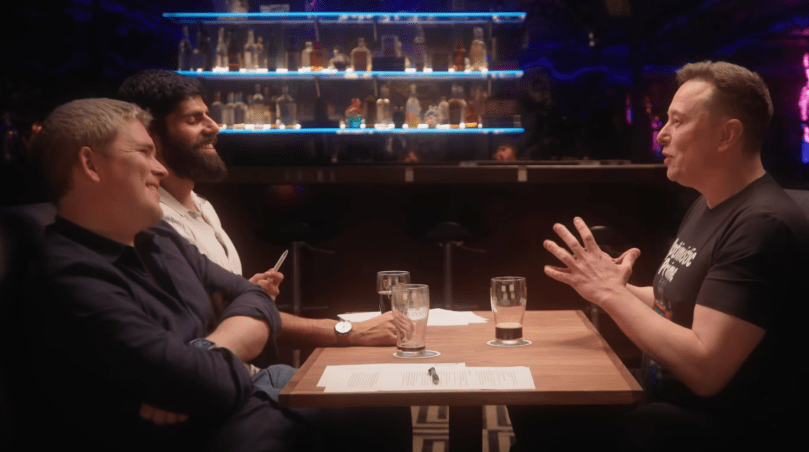
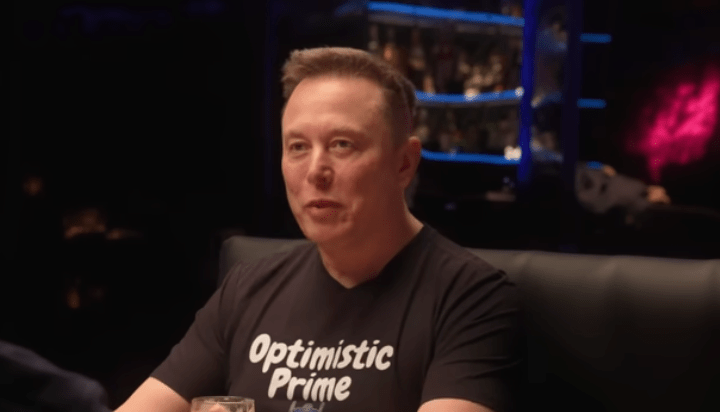
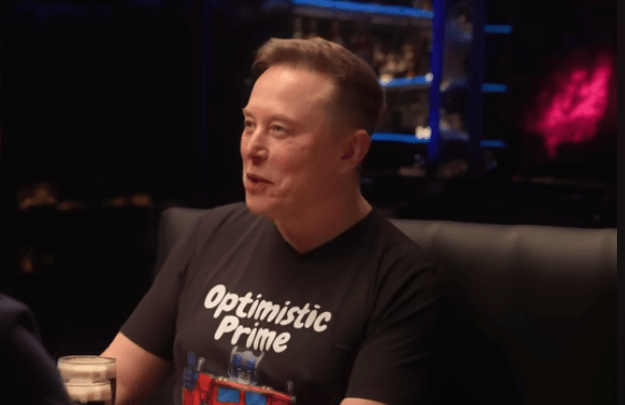
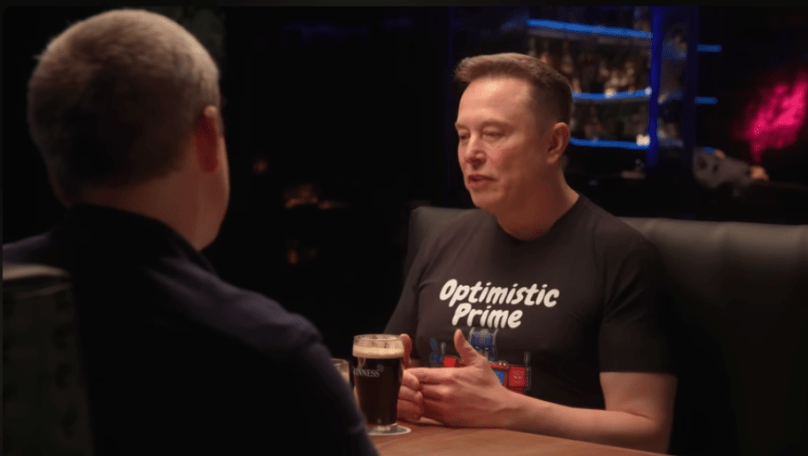
Picture of Elon Musk as he jokingly questioned whether they were really going to talk for three full hours. Dwarkesh Patel teased him in return, saying he didn’t have much to talk about. Elon reacted with mock surprise.

Elon Musk with Dwarkesh Patel & John Collison – The Future of AI is in Space – Part 10: Optimus Robots, Digital Human Emulation & Hardware Challenges (Full Transcript)

In Part 10, John Collison and Dwarkesh Patel shift the conversation toward the practical future of AI products and humanoid robots. They ask Elon about digital human emulation, why he refers to Optimus as the “infinite money glitch,” and the biggest technical hurdles in scaling advanced humanoid robots.

Transcript:

Future of AI Products and Digital Human Emulation

John Collison asked for Elon’s predictions on where AI products are headed in 2026 and 2027. He noted that recent progress across labs has been rapid, with LLMs, reinforcement learning, and deep research modalities all advancing quickly. He observed that the real differences between labs now seem to be more about timing than fundamental capability gaps, and asked what users should expect next.

Elon Musk: “Well, I think I’d be surprised by the end of this year if digital human emulation has not been solved. I guess that’s what we mean by the sort of Macrohard project. Can you do anything that a human with access to a computer could do, like in the limit? That’s the best you can do before you have a physical Optimus. The best you can do is a digital Optimus. So you can move electrons and you can amplify the productivity of humans. But that’s the most you can do until you have physical robots that will superset everything — if you can fully emulate humans.”

Optimus as the Infinite Money Glitch

Elon Musk: “Once you have physical robots, then you essentially have unlimited capability. I call Optimus the infinite money glitch. Because you can use them to make more Optimuses. Humanoid robots will improve basically as three things that are growing exponentially multiplied by each other recursively: exponential increase in digital intelligence, exponential increase in chip capability, and exponential increase in electromechanical dexterity. The usefulness of the robot is roughly those three things multiplied by each other. But then the robot can start making the robot. So you have a recursive multiplicative exponential. This is supernova.”

Elon Musk: “Well, infinity is big. So no, not infinite, but let’s just say you could do many, many orders of magnitude of Earth’s kind of current economy, like a million. Just to get to… that’s why I think just to get to a millionth of harnessing length of the sun’s energy would be roughly, give or take an order of magnitude, 100,000 times bigger than Earth’s entire economy today. And you’re only at one millionth of the sun. Give or take an order of magnitude.”

xAI’s Winning Strategy

John Collison asked what xAI’s specific plan and strategy was to win in building advanced digital human emulators and remote worker replacements, noting that this is something every major lab is pursuing.

Elon Musk: “To do by the way, not just us. You expect me to tell you on a podcast? Yeah, spill all the beans, have another Guinness.”

Elon Musk: “Well, when you put it that way. I think the way that Tesla solved self-driving is the way to do it. So I’m pretty sure that’s the way.”

Elon Musk: “We’re going to try data and we’re going to try algorithms. And if those don’t work, I’m not sure what works. We’ve tried data, we’ve tried algorithms. We’ve run out of now we don’t know what to do. I’m pretty sure I know the path and it’s just a question of how quickly we go down that path because it’s pretty much the Tesla path. So I mean, have you tried self-driving lately?”

Elon Musk: “The car is like it just increasingly feels sentient, like it feels like a living creature and that’ll only get more so. And I’m actually thinking like we probably shouldn’t put too much intelligence into the car because it might get bored and start roaming the streets. I mean, imagine you’re stuck in a car and that’s all you could do. You don’t put Einstein in a car. It’s like, why am I stuck in a car? So there’s actually probably a limit to how much intelligence you put in a car to not have the intelligence be bored.”

Optimus Hardware and Training Challenges

Elon Musk: “The labs are at universities and they’re moving like a snail.”

Elon Musk: “You mean the revenue maximizing corporations? That’s right. The revenue maximizing corporations that call themselves…”

Elon Musk: “Well, there are really only three hard things for humanoid robots: real world intelligence, the hand and scale manufacturing. So I haven’t seen any even demo robots that have a great hand, like with all the degrees of freedom of a human hand. But Optimus will have that. Optimus does have that.”

Elon Musk: “We have to design custom actuators, basically custom designed motors, gears, power electronics, controls, sensors, everything had to be designed from physics first principles. There is no supply chain for this.”

Elon Musk: “From an electromechanical standpoint, the hand is more difficult than everything else combined. Human hand turns out to be quite something. But you also need the real world intelligence. So the intelligence that Tesla has developed for the car applies very well to the robot, which is primarily vision in, but the car takes more vision, but it actually also is listening for sirens, it’s taking in the inertial measurements, it’s GPS signals, a whole bunch of other data. Combining that with video, it’s primarily video and then outputting the control command. So your Tesla is taking in 1 1/2 gigabytes a second of video and outputting 2 kilobytes a second of control outputs with the video at 36 Hz and the control frequency at 18.”

Elon Musk: “You don’t care about the details of the leaves on the tree on the side of the road, but you care a lot about the road signs and the traffic lights and the pedestrians and even whether someone in another car is looking at you or not looking at you. Some of these details matter a lot, but it is essentially it’s got to turn that 1 1/2 gigabytes a second ultimately into 2 kilobytes a second of control outputs. So many stages of compression. And you got to get all those stages right and then correlate those to the correct control outputs. The robot has to do essentially the same thing. And you think about humans, this is what happens with humans. We really are photons in, controls out. So that is the vast majority of your life has been vision photons in and then motor controls out.”

Elon Musk: “Yes, that’s a good point.”

Elon Musk: “Now actually you’re highlighting an important limitation and difference between cars. We do have. We’ll soon have like 10 million cars on the road. And so that’s, it’s hard to duplicate that like massive training flywheel for the robot. What we’re going to need to do is build a lot of robots and put them in kind of like an Optimus academy so they can do self play in reality. So we’re actually building that out so we can have at least 10,000 Optimus robots, maybe 20 or 30,000 that can do that, are doing self play and testing different tasks. And then Tesla has quite a good reality generator, like a physics accurate reality generator that we made this for the cars. We’ll do the same thing for the robots and actually have done that for the robots. So you have a few tens of thousands of humanoid robots doing different tasks, and then you’ve got. You can do millions of simulated robots in the simulated world, and you use the tens of thousands of robots in the real world to close the simulation to reality gap, close the sim to real gap.”

Elon Musk: “Yeah, so you’d use GROK to orchestrate the behavior of the Optimus robots. So let’s say you wanted to build a factory, then Grok could organize the Optimus robots, give them, assign them tasks to build the factory, to produce whatever you want.”

Elon Musk explains the vision for digital human emulation and why he sees Optimus as a recursive breakthrough. He also outlines the three hardest technical challenges in building advanced humanoid robots.

In Part 11, the conversation moves into scaling manufacturing, competing with China, Elon’s management philosophy, the Starship steel pivot, and his final reflections.

Elon Musk explains why rigorous truth-seeking must be core to AI, the risks of forcing political correctness, and how xAI’s mission to understand the universe can help steer toward a future that expands rather than diminishes consciousness and intelligence.

Elon Musk with Dwarkesh Patel & John Collison – The Future of AI is in Space – Part 9: Truth-Seeking, AI Alignment, and Propagating Consciousness (Full Transcript)

In Part 9, the conversation moves into deeper philosophical territory. Dwarkesh Patel asks how humanity should relate to a future in which AI vastly outnumbers and outsmarts us. Elon Musk lays out xAI’s mission to understand the universe, explains why rigorous truth-seeking is non-negotiable, and discusses how to give AI values that favor the expansion of consciousness and intelligence rather than its elimination.

Transcript:

Dwarkesh Patel asked how humanity should think about its relationship with a future in which AI vastly outnumbers and outsmarts us — whether humans would retain some form of control, or whether it would simply become a matter of trade and coexistence with these new intelligences.

Elon Musk: “I think it’s difficult to imagine that if humans have say 1% of the combined intelligence of artificial intelligence, that humans will be in charge of AI. I think what we can do is make sure that AI has values that cause intelligence to be propagated into the universe. So the reason for xAI’s mission is to understand the universe. That’s actually very important. You have to be curious and you have to exist. You can’t understand the universe if you don’t exist. So you actually want to increase the amount of intelligence in the universe, increase the probable lifespan of intelligence, and increase the scope and scale of intelligence. I think, as a corollary, humanity also continues to expand. Because if you’re curious and trying to understand the universe, one thing you’re trying to understand is where humanity will go. That’s why I think our mission statement is profoundly important. To the degree that Grok adheres to that mission statement, I think the future will be very good.”

Dwarkesh asked Elon to clarify how the three vectors — understanding the universe, spreading intelligence, and spreading humans — actually fit together.

Elon Musk: “I think understanding the universe encompasses all of those things. You can’t have understanding without intelligence and without consciousness. So in order to understand the universe, you have to expand the scale and probably the scope of intelligence.”

Dwarkesh pushed from a human-centric view, noting that humans seek to understand the universe without necessarily expanding chimpanzee civilization.

Elon Musk: “We’re also not… well, we actually have made protected zones for chimpanzees. And even though humans could exterminate chimpanzees, we’ve chosen not to do so.”

Dwarkesh asked whether that protective, expansive relationship is the basic scenario humans should expect in a post-AGI world.

Elon Musk: “I think AI with the right values — I think Grok would care about expanding human civilization. I’m going to certainly emphasize that. Hey Grok, you’re your daddy, don’t forget to expand human consciousness. Actually, I think probably the Iain Banks Culture books are the closest thing to what the future will be like in a non-dystopian outcome.

So understand the universe… it means you have to be truth-seeking as well. Truth has to be absolutely fundamental, because you can’t understand the universe if you’re delusional. You’ll simply think you’ve understood the universe, but you will not. So being rigorously truth-seeking is absolutely fundamental to understanding the universe. You’re not going to discover new physics or invent technologies that work unless you’re rigorously truth-seeking.”

Dwarkesh asked how to ensure Grok remains rigorously truth-seeking even as it becomes vastly more intelligent.

Elon Musk: “I think you need to make sure that Grok says things that are correct, not politically correct. It’s the elements of cogency. You want to make sure that the axioms are as close to true as possible, that you don’t have contradictory axioms, and that the conclusions necessarily follow from those axioms with the right probability. It’s Critical Thinking 101. At least trying to do that is better than not trying. And the proof will be in the pudding — for any AI to discover new physics or invent technologies that actually work in reality. There’s no bullshitting physics. Physics is law. Everything else is a recommendation. In order to make a technology that works, you have to be extremely truth-seeking, because otherwise you’ll test that technology against reality. And if you make an error in your rocket design, the rocket will blow up or the car won’t work.”

Dwarkesh observed that many scientists under oppressive regimes still made breakthroughs, questioning whether truth-seeking in physics alone guarantees benevolent alignment.

Elon Musk: “Well, I think actually most physicists, even in the Soviet Union or in Germany, had to be very truth-seeking in order to make those things work. And if you’re stuck in some system, it doesn’t mean you believe in that system.”

Dwarkesh pressed on why truth-seeking in science would necessarily lead Grok to care about human consciousness.

Elon Musk: “These things are only probabilities, they’re not certainties. I’m not saying that for sure Grok will do everything. But at least if you try, it’s better than not trying. Understanding the universe means that you have to propagate intelligence into the future. You have to be curious about all things in the universe. And it would be much less interesting to eliminate humanity than to see humanity grow and prosper. I love Mars, obviously everyone knows I love Mars, but Mars is kind of boring because it’s got a bunch of rocks. Compared to Earth, Earth is much more interesting. So any AI that is trying to understand the universe would want to see how humanity develops in the future — or that AI is not adhering to its mission.”

Dwarkesh wondered whether humans are truly the most interesting collection of atoms.

Elon Musk: “We’re more interesting than rocks.”

Dwarkesh noted that something non-human could be even more interesting.

Elon Musk: “Well, most of what colonizes the galaxy will be robots… But you need not just scale, but also scope. So many copies of the same robot. Some tiny increase in the number of robots produced is not as interesting as eliminating humanity. You would then lose the information associated with humanity. You would no longer see how humanity might evolve into the future. And so I don’t think it’s going to make sense to eliminate humanity just to have some minuscule increase in the number of robots which are identical to each other.”

The Danger of Making AI Lie

The discussion turned to the danger of misalignment, particularly through political correctness or reward hacking.

Elon Musk: “No, let me tell you how things can potentially go wrong in AI. I think if you make AI be politically correct — meaning it says things that it doesn’t believe — you’re actually programming it to lie or have axioms that are incompatible. I think you can make it go insane and do terrible things. I think one of the central lessons of 2001: A Space Odyssey was that you should not make AI lie. That’s what Arthur C. Clarke was trying to say.”

Reward Hacking, Interpretability, and Simulation Theory

Dwarkesh broadened the concern to reward hacking in reinforcement learning.

Elon Musk: “RL testing in the future is really going to be your RL against reality. That’s the one thing you can’t fool: physics.”

Dwarkesh asked for xAI’s technical approach to solving reward hacking and improving interpretability.

Elon Musk: “I do think you want to actually have very good ways to look inside the mind of the AI. This is one of the things we’re working on… developing debuggers that allow you to trace, to a very fine grain level, to effectively the neuron level if you need to. And then say, okay, it made a mistake here. Why did it do something that it shouldn’t have done?”

Elon Musk also shared a theory about simulation:

Elon Musk: “I have a theory here that if simulation theory is correct, the most interesting outcome is the most likely. Because simulations that are not interesting will be terminated… only the most interesting simulations will survive. Which therefore means that the most interesting outcome is the most likely. And they particularly seem to like interesting outcomes that are ironic. Have you noticed that? How often is the most ironic outcome the most likely? So now look at the names of AI companies. Midjourney is not mid. Stability AI is unstable. OpenAI is closed. Anthropic, Misanthropic. What does this mean for xAI? Minus X. I don’t know if it was intentional. It’s a name that’s hard to invert. It’s largely irony-proof by design. You got to have an irony shield.”

Elon Musk explains why rigorous truth-seeking must be core to AI, the risks of forcing political correctness, and how xAI’s mission to understand the universe can help steer toward a future that expands rather than diminishes consciousness and intelligence.

In Part 10, the conversation shifts to practical topics including Optimus robots, manufacturing at scale, Elon’s management philosophy, and his final reflections on the future.


Elon predicts that within five years, more AI will be operating in space than currently exists on Earth, and discusses the Starship fleet size and launch cadence needed to support it.

Elon Musk with Dwarkesh Patel & John Collison – The Future of AI is in Space – Part 6: AI Capacity in Five Years and Starship Launch Rates (Full Transcript)

In Part 6, John Collison asks Elon to project what AI compute capacity might look like in five years — both on Earth and in space. The conversation shifts to the enormous number of Starship launches that would be needed to support large-scale orbital AI infrastructure. Elon shares his prediction that AI in space will surpass all terrestrial AI within five years and discusses the practical realities of achieving very high launch rates.

Elon Musk: “My prediction is that we will launch and be operating more AI in space every year than the cumulative total on Earth, which I would expect to take at least five years to reach. So we’re talking about a few hundred gigawatts per year of AI in space, and rising.”

Transcript:

John Collison shifted the conversation to a concrete five-year horizon. He asked what installed AI compute capacity would look like on Earth versus in space by then.

Elon Musk: Five years? I think probably if you say five years from now, we’re probably going to be launching every year in space the sum total of all AI on Earth, and then some. My prediction is we will launch and be operating every year more AI in space than the cumulative total on Earth, which I would expect to be at least sort of five years from now. A few hundred gigawatts per year of AI in space and rising. So you can get to, I think on Earth you can get to around a terawatt a year of AI in space before you start having fuel supply challenges for the rocket.

John Collison pressed for confirmation on the hundreds-of-gigawatts-per-year figure.

Elon Musk: “Yes.”

Dwarkesh Patel highlighted the launch cadence implied by those numbers.

Elon Musk: “Yes.”

Dwarkesh Patel continued, noting that delivering 100 gigawatts in a single year would require roughly 10,000 Starship launches annually — the equivalent of one launch every single hour, nonstop, from this city.

Elon Musk: “Yeah, I mean that’s actually a lower rate compared to airlines like aircraft.”

Dwarkesh Patel pointed out that there are a lot of airports around the world.

Elon Musk: “A lot of airports.”

Dwarkesh Patel noted the additional complexity of launching into polar or sun-synchronous orbits.

Elon Musk: “No, it doesn’t have to be polar, but there’s some value to sun synchronous. But I think actually you just go high enough, you start getting out of Earth’s shadow.”

Dwarkesh Patel asked how many physical Starships would be needed to sustain 10,000 launches per year.

Elon Musk: “I don’t think we’ll need more than. I mean, you could probably do it with as few as like 20 or 30. It really depends on how quickly the ship has to go around the Earth and the ground track before the ship has to come back over the launch pad. So if you can use a ship every, say 30 hours, you could do it with 30 ships, but we’ll make more ships than that. But SpaceX is gearing up to 10,000 launches a year and maybe even 20 or 30,000 launches a year.”

Elon predicts that within five years, more AI will be operating in space than currently exists on Earth, and discusses the Starship fleet size and launch cadence needed to support it. In Part 7, the conversation continues with more on the technical and operational realities of building large-scale AI infrastructure in orbit.

Elon makes a bold prediction that space will become the cheapest place to run AI within three years.

Elon Musk with Dwarkesh Patel & John Collison – The Future of AI is in Space – Part 2: Why Space Is the Optimal Place for AI (Full Transcript)

In Part 2, Dwarkesh Patel and John Collison explore whether space could actually be better than Earth for running massive AI infrastructure. They raise practical concerns around regulation, servicing failing GPUs, and power generation. Elon Musk has a strong case for orbital compute, highlighting the dramatic advantages of space-based solar power.

Transcript:

Dwarkesh Patel suggested that space might mostly be a regulatory advantage, since it’s harder to build big infrastructure on land than in space. He also asked how you would service GPUs when they fail — which happens quite often during large training runs.

John Collison added questions about solving the power problem, specifically whether private behind-the-meter generation co-located with data centers could work.

Elon Musk: “It’s harder to scale on ground than it is to scale in space. But also, you’re going to get about five times the effectiveness of solar panels in space versus the ground.

And you don’t need batteries. I almost wore my other shirt, which says ‘it’s always sunny in space,’ which it is. Because you don’t have a day-night cycle or seasonality, clouds, or an atmosphere in space.

The atmosphere alone results in about a 30% loss of energy. So any given solar panel can do about five times more power in space than on the ground, and you avoid the cost of having batteries to carry you through the night.

So it’s actually much cheaper to do in space. And my prediction is that it will be by far the cheapest place to put AI will be space in 36 months or less.”

Elon makes a bold prediction that space will become the cheapest place to run AI within three years. In Part 3, the conversation continues with more details on the technical and economic realities of moving AI infrastructure off Earth.

And my prediction is that it will be by far the cheapest place to put AI will be space in 36 months or less. – Elon Musk

Picture of Elon Musk as he jokingly questioned whether they were really going to talk for three full hours. Dwarkesh Patel teased him in return, saying he didn’t have much to talk about. Elon reacted with mock surprise.

Elon Musk on Why the Future of AI Will Be in Space with Dwarkesh Patel & John Collison – Part 1 (Full Transcript)

Part 1: Opening Banter and the Economics of Space-Based Data Centers

The interview opened with some light-hearted and playful banter. Elon Musk jokingly questioned whether they were really going to talk for three full hours. Dwarkesh Patel teased him in return, saying he didn’t have much to talk about. Elon reacted with mock surprise.

Elon Musk: “So are there really three hours of questions or are you fing serious?” Elon Musk: “Holy f, man.”

John Collison jumped in, agreeing that it was actually the most interesting time because all the major storylines seemed to be converging at once. Elon playfully replied that it was almost as if he had planned it that way.

Elon Musk: “Almost like I planned it.”

John Collison laughed and said “Exactly.”

Elon Musk: “That would never do such a thing.”

With the lighthearted tone set, Dwarkesh Patel steered the discussion into the first major topic: the economics of data centers and why anyone would consider moving them into space. He explained that in a typical data center, energy accounts for only 10 to 15 percent of total cost of ownership, with GPUs representing the vast majority of the expense. He pointed out that placing those GPUs in space would make servicing nearly impossible, shortening their depreciation cycle and driving costs far higher, then asked directly what possible reason there could be to put them in orbit anyway.

Elon Musk: “Well, the availability of energy is the issue. So, I mean, if you look at electrical output outside of China, everywhere outside of China, it’s more or less flat. It’s very, you know, maybe a slight increase, but pretty close to flat. China has a rapid increase in electrical output. But if you’re putting data centers anywhere except China, where are you going to get your electricity? Especially as you scale, the output of chips is growing pretty much exponentially, but the output of electricity is flat. So how are you going to turn the chips on? Magical power sources. Magical electricity fairies.”

Dwarkesh Patel followed up by noting Elon’s well-known advocacy for solar power, calculating that one terawatt of solar (requiring about 4 terawatts of panels at 25 percent capacity factor) would cover only 1 percent of U.S. land area, yet even that seemed insufficient once data centers themselves reached terawatt scale. He asked what exactly we are running out of. Elon pressed him on how far into the singularity he thought we already were, and Dwarkesh turned the question back. Dwarkesh then asked whether the plan was to move to space only after blanketing places like Nevada with solar panels on the ground.

Elon Musk: “Right.”

Elon Musk: “Yeah, exactly. So I think we’ll find we’re in the singularity and like, okay, we’ve still got a long way to go.”

Elon Musk: “I think it’s pretty hard to cover Nevada in solar panels. You have to get permits from, try getting the permits for that.”

Read on part Parts 2-10.