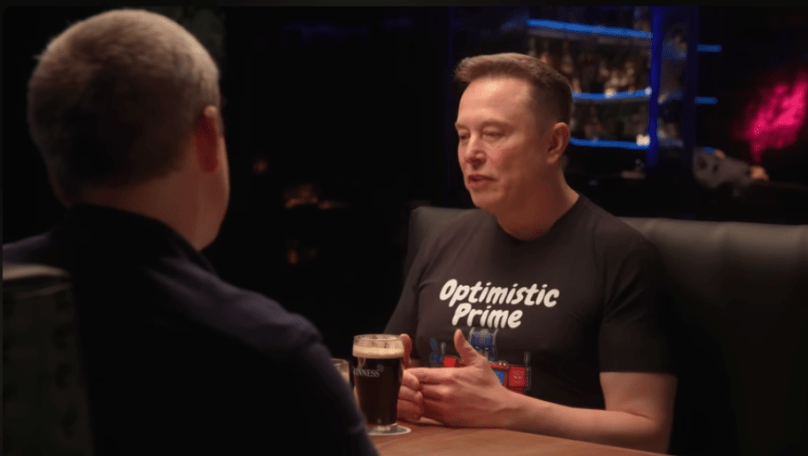
In Part 10, John Collison and Dwarkesh Patel shift the conversation toward the practical future of AI products and humanoid robots. They ask Elon about digital human emulation, why he refers to Optimus as the “infinite money glitch,” and the biggest technical hurdles in scaling advanced humanoid robots.
Transcript:
Future of AI Products and Digital Human Emulation
John Collison asked for Elon’s predictions on where AI products are headed in 2026 and 2027. He noted that recent progress across labs has been rapid, with LLMs, reinforcement learning, and deep research modalities all advancing quickly. He observed that the real differences between labs now seem to be more about timing than fundamental capability gaps, and asked what users should expect next.
Elon Musk: “Well, I think I’d be surprised by the end of this year if digital human emulation has not been solved. I guess that’s what we mean by the sort of Macrohard project. Can you do anything that a human with access to a computer could do, like in the limit? That’s the best you can do before you have a physical Optimus. The best you can do is a digital Optimus. So you can move electrons and you can amplify the productivity of humans. But that’s the most you can do until you have physical robots that will superset everything — if you can fully emulate humans.”
Optimus as the Infinite Money Glitch
Elon Musk: “Once you have physical robots, then you essentially have unlimited capability. I call Optimus the infinite money glitch. Because you can use them to make more Optimuses. Humanoid robots will improve basically as three things that are growing exponentially multiplied by each other recursively: exponential increase in digital intelligence, exponential increase in chip capability, and exponential increase in electromechanical dexterity. The usefulness of the robot is roughly those three things multiplied by each other. But then the robot can start making the robot. So you have a recursive multiplicative exponential. This is supernova.”
Elon Musk: “Well, infinity is big. So no, not infinite, but let’s just say you could do many, many orders of magnitude of Earth’s kind of current economy, like a million. Just to get to… that’s why I think just to get to a millionth of harnessing length of the sun’s energy would be roughly, give or take an order of magnitude, 100,000 times bigger than Earth’s entire economy today. And you’re only at one millionth of the sun. Give or take an order of magnitude.”
xAI’s Winning Strategy
John Collison asked what xAI’s specific plan and strategy was to win in building advanced digital human emulators and remote worker replacements, noting that this is something every major lab is pursuing.
Elon Musk: “To do by the way, not just us. You expect me to tell you on a podcast? Yeah, spill all the beans, have another Guinness.”
Elon Musk: “Well, when you put it that way. I think the way that Tesla solved self-driving is the way to do it. So I’m pretty sure that’s the way.”
Elon Musk: “We’re going to try data and we’re going to try algorithms. And if those don’t work, I’m not sure what works. We’ve tried data, we’ve tried algorithms. We’ve run out of now we don’t know what to do. I’m pretty sure I know the path and it’s just a question of how quickly we go down that path because it’s pretty much the Tesla path. So I mean, have you tried self-driving lately?”
Elon Musk: “The car is like it just increasingly feels sentient, like it feels like a living creature and that’ll only get more so. And I’m actually thinking like we probably shouldn’t put too much intelligence into the car because it might get bored and start roaming the streets. I mean, imagine you’re stuck in a car and that’s all you could do. You don’t put Einstein in a car. It’s like, why am I stuck in a car? So there’s actually probably a limit to how much intelligence you put in a car to not have the intelligence be bored.”
Optimus Hardware and Training Challenges
Elon Musk: “The labs are at universities and they’re moving like a snail.”
Elon Musk: “You mean the revenue maximizing corporations? That’s right. The revenue maximizing corporations that call themselves…”
Elon Musk: “Well, there are really only three hard things for humanoid robots: real world intelligence, the hand and scale manufacturing. So I haven’t seen any even demo robots that have a great hand, like with all the degrees of freedom of a human hand. But Optimus will have that. Optimus does have that.”
Elon Musk: “We have to design custom actuators, basically custom designed motors, gears, power electronics, controls, sensors, everything had to be designed from physics first principles. There is no supply chain for this.”
Elon Musk: “From an electromechanical standpoint, the hand is more difficult than everything else combined. Human hand turns out to be quite something. But you also need the real world intelligence. So the intelligence that Tesla has developed for the car applies very well to the robot, which is primarily vision in, but the car takes more vision, but it actually also is listening for sirens, it’s taking in the inertial measurements, it’s GPS signals, a whole bunch of other data. Combining that with video, it’s primarily video and then outputting the control command. So your Tesla is taking in 1 1/2 gigabytes a second of video and outputting 2 kilobytes a second of control outputs with the video at 36 Hz and the control frequency at 18.”
Elon Musk: “You don’t care about the details of the leaves on the tree on the side of the road, but you care a lot about the road signs and the traffic lights and the pedestrians and even whether someone in another car is looking at you or not looking at you. Some of these details matter a lot, but it is essentially it’s got to turn that 1 1/2 gigabytes a second ultimately into 2 kilobytes a second of control outputs. So many stages of compression. And you got to get all those stages right and then correlate those to the correct control outputs. The robot has to do essentially the same thing. And you think about humans, this is what happens with humans. We really are photons in, controls out. So that is the vast majority of your life has been vision photons in and then motor controls out.”
Elon Musk: “Yes, that’s a good point.”
Elon Musk: “Now actually you’re highlighting an important limitation and difference between cars. We do have. We’ll soon have like 10 million cars on the road. And so that’s, it’s hard to duplicate that like massive training flywheel for the robot. What we’re going to need to do is build a lot of robots and put them in kind of like an Optimus academy so they can do self play in reality. So we’re actually building that out so we can have at least 10,000 Optimus robots, maybe 20 or 30,000 that can do that, are doing self play and testing different tasks. And then Tesla has quite a good reality generator, like a physics accurate reality generator that we made this for the cars. We’ll do the same thing for the robots and actually have done that for the robots. So you have a few tens of thousands of humanoid robots doing different tasks, and then you’ve got. You can do millions of simulated robots in the simulated world, and you use the tens of thousands of robots in the real world to close the simulation to reality gap, close the sim to real gap.”
Elon Musk: “Yeah, so you’d use GROK to orchestrate the behavior of the Optimus robots. So let’s say you wanted to build a factory, then Grok could organize the Optimus robots, give them, assign them tasks to build the factory, to produce whatever you want.”
Elon Musk explains the vision for digital human emulation and why he sees Optimus as a recursive breakthrough. He also outlines the three hardest technical challenges in building advanced humanoid robots.
In Part 11, the conversation moves into scaling manufacturing, competing with China, Elon’s management philosophy, the Starship steel pivot, and his final reflections.
 whatsuptesla.com