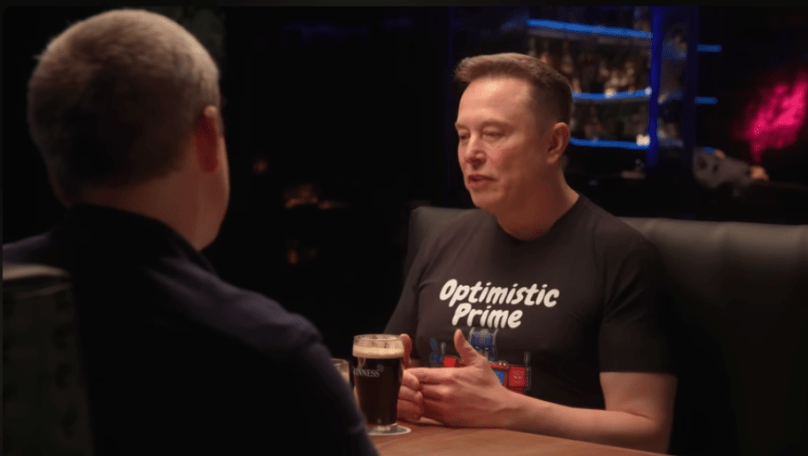
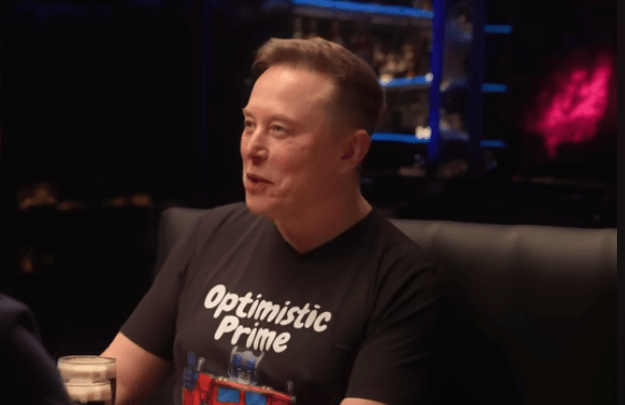
In Part 11, Dwarkesh Patel and John Collison explore the synergies between xAI and Optimus, the difficulties of scaling humanoid robot production at volume, and whether America can realistically compete with China’s manufacturing power through robotics.
Transcript:
Synergies Between xAI and Optimus
Dwarkesh Patel asked how Elon thinks about the synergies between xAI and Optimus, especially since Grok could potentially act as a world model and higher-level intelligence for planning while lower-level motor policies handle execution.
Elon Musk: “Yeah, so you’d use GROK to orchestrate the behavior of the Optimus robots. So let’s say you wanted to build a factory, then Grok could organize the Optimus robots, give them, assign them tasks to build the factory, to produce whatever you want.”
John Collison asked whether this meant xAI and Tesla would eventually need to merge.
Elon Musk: “So what were we saying earlier about public company discussions?”
Scaling Optimus Production
Dwarkesh Patel asked what Elon still wants to see on the hardware side before moving to mass manufacturing of Gen 3 Optimus — better actuators or improved software.
Elon Musk: “No, we’re moving towards that.”
Dwarkesh followed up, asking if Ford-style manufacturing with current hardware was good enough and whether Elon just wanted to deploy as many as possible now.
Elon Musk: “I mean, it’s very hard to scale up production. But yeah, I think Optimus 3 is the right version of the robot to produce maybe something on the order of like a million units a year. I think you’d want to go to Optimus 4 before you went to 10 million units a year.”
John Collison confirmed whether a million units per year was achievable with Optimus 3.
Elon Musk: “Yeah, I mean, it’s very hard to spool up manufacturing. So manufacturing, the output per unit time always follows an S curve. So it starts off agonizingly slow, then has this sort of exponential increase, then linear, then a logarithmic outcome until you sort of eventually asymptote at some number.
Optimus initial production will be—it’s going to be a stretched out S curve because so much of what goes into Optimus is brand new. There’s not an existing supply chain. As I mentioned, the actuators, electronics, everything in the Optimus robot is designed for physics first principles. It’s not taken from a catalog. These are custom designed. Everything, literally everything. I don’t think there’s a single thing that—”
John Collison asked how far down the custom design goes.
Elon Musk: “I mean I guess we’re not making custom capacitors yet maybe, but there’s nothing you can pick out of a catalog at any price. So it just means that the Optimus S curve, the units per year output per unit time, how many Optimus robots you make per day, whatever, is going to initially ramp slower than a product where you have an existing supply chain. But it will get to a million.”
Competing with Chinese Humanoids
Dwarkesh Patel asked about Chinese humanoids like Unitree selling for $6K–$13K. He wondered whether Tesla aimed to match that price or if the Chinese robots were qualitatively different.
Elon Musk: “Well, our Optimus is designed to have a lot of intelligence and to have the same electromechanical dexterity if not higher than a human. So Unitree does not have that. And it’s also, I mean it’s quite a big robot. It has to carry heavy objects for long periods of time and not overheat or exceed the power of its actuators. So we’ve got—it’s 5’11”, this is pretty tall and it’s got a lot of intelligence. So it’s going to be more expensive than a small robot that is not intelligent.”
John Collison noted that Optimus would be more capable.
Elon Musk: “Yeah, not a lot more. I mean the thing is over time as Optimus robots build Optimus robots, the cost will drop very quickly.”
John Collison asked what the first billion Optimuses would do and what their highest and best use would be.
Elon Musk: “I think that you would start off with simple tasks that you can count on them doing well.”
John Collison asked whether that would be in homes or factories.
Elon Musk: “The best useful robots in the beginning will be any continuous operations, any 24/7 operation because then they can work continuously.”
Dwarkesh Patel asked what fraction of work currently done by humans at a Gigafactory a Gen 3 Optimus could handle.
Elon Musk: “I’m not sure. Maybe it’s like 10, 20%, maybe more, I don’t know. We would not reduce our headcount. We would for sure increase our headcount, to be clear, but we would increase our output. So the units produced per human—the total number of humans at Tesla will increase, but the output of robots and cars will increase disproportionately. The number of cars and robots produced per human will increase dramatically, but number of humans will increase as well.”
US-China Manufacturing and Policy
John Collison asked what policy changes Elon would make if he were in charge, referencing solar tariffs and permitting.
Elon Musk: “Yeah, I would say anything that is a limiting factor for electricity needs to be addressed, provided it’s not very bad for the environment.”
John Collison brought up export bans on chips and turbine engines and asked whether more should be considered.
Elon Musk: “Well, I think it’s important to appreciate that in most areas China is very advanced in manufacturing. There’s only a few areas where it is not. China is a manufacturing powerhouse next level.”
John Collison asked about supply chain dependence, specifically gallium refining.
Elon Musk: “Yeah, there’s rare earth stuff. Rare earths, which are, as you know, not rare. We actually do rare earth ore mining in the U.S., send the rock, we put it on a train and then put on a boat to China that goes on another train and goes to the rare earth refineries in China, who then refine it, put it into a magnet, put it into a motor sub assembly, and then send it back to America. So the thing we’re really missing is a lot of ore refining in America.”
John Collison asked whether this was worth policy intervention.
Elon Musk: “Yes, well, I think there are some things being done on that front, but we kind of need Optimus, frankly, to build ore refineries.”
The Robot Advantage
Dwarkesh Patel summarized that China’s main advantage is abundant skilled labor and that Optimus could help close that gap, but noted the concern that China might pull ahead in humanoid production first.
Elon Musk: “Right. You can close that recursive loop pretty quickly.”
John Collison asked if this could be done with a small number of Optimuses.
Elon Musk: “Yeah. So you close the recursive loop to help the robots build the robots, and then we can try to get to tens of millions of units a year. Maybe if you start getting to hundreds of millions of units a year, I think you’re going to be the most competitive country by far.
We definitely can’t win with just humans because China has four times our population. And frankly, America’s been winning for so long that just like a pro sports team that’s been running for a very long time tend to get complacent and entitled and that’s why they stop winning, because they don’t work as hard anymore.
So I think, frankly my observation is the average work ethic in China is higher than in the U.S. So it’s not just that there’s four times the population, but the amount of work that people put in is higher. So you can try to rearrange the humans, but you’re still one quarter of the—assuming that productivity is the same, which I think actually it might not be, I think China might have an advantage on productivity per person. We will do one quarter of the amount of things as China.
So we can’t win on the human front. And our birth rate’s been low for a long time. The US birth rate’s been below replacement since roughly 1971. So we’ve got a lot of people retiring or more people dying than—we’re close to more people domestically dying than being born. So we definitely can’t win on the human front, but we might have a shot at the robot front.”
Elon Musk explains the challenges of scaling Optimus production and how robotics could help America compete with China’s manufacturing dominance.
In Part 12, the conversation continues with Elon’s management and hiring philosophy.