Au cours des deux dernières semaines, certains médias français ont amplifié des récits dépeignant Elon Musk comme vaincu au tribunal contre OpenAI, embourbé dans des enquêtes judiciaires sur X, et « furieux » face aux choix de casting à Hollywood. Ces narratifs le présentent comme erratique ou problématique. Pourtant, un examen plus attentif révèle un schéma d’outrage sélectif contre l’un des bâtisseurs les plus ambitieux de l’humanité, tandis que ses entreprises réalisent des avancées historiques.
Le Procès OpenAI : Une Position Philosophique, Pas une Défaite
Elon a cofondé OpenAI avec une mission claire : une IA sûre et ouverte pour le bénéfice de l’humanité. Il a alerté tôt sur les dérives vers le profit et les systèmes fermés. Bien que la récente décision du jury soit décevante, elle n’efface pas la validité de ses préoccupations, surtout alors qu’OpenAI se précipite vers une IPO à but lucratif avec le soutien massif de Microsoft. Le procès d’Elon a mis en lumière de vraies questions de gouvernance. Elon a déjà annoncé qu’il ferait appel de la décision devant la Ninth Circuit Court of Appeals en Californie. (Les vrais visionnaires défient les intérêts puissants ; l’histoire leur donne souvent raison.)
L’Enquête Française sur X : Liberté d’Expression contre Application Sélective
L’enquête française sur X concernant la modération de contenus, avec menaces de mandats d’arrêt, cible Elon pour avoir ouvert la plateforme à des voix diverses. Elon s’est défendu publiquement contre ce qu’il perçoit comme un acharnement politique.
Les critiques ignorent commodément que, avant Elon Musk, Twitter prenait de l’argent et du soutien gouvernemental de la part des gouvernements en échange de la permission de la censure. En fait, c’était vraiment de la censure sournoise. Des documents internes des Twitter Files montrent que le FBI a versé plus de 3,4 millions de dollars à l’ancien Twitter (entre 2019 et début 2021) pour le temps passé par son équipe Safety, Content & Law Enforcement à traiter les demandes des forces de l’ordre liées à la modération de contenus. Voir les révélations documentées ici.
Elon a délibérément rompu avec ce modèle le jour où il a acquis l’entreprise en octobre 2022. Il a immédiatement mis fin à tous ces arrangements de remboursement gouvernementaux, démantelé les équipes dédiées SCALE de modération qui traitaient les paiements, et éliminé complètement la pratique. X fonctionne désormais avec une dépendance nulle à tout financement gouvernemental lié à la modération de contenus. La plateforme publie des rapports de transparence annuels détaillés montrant exactement comment elle gère les demandes des forces de l’ordre tout en priorisant une transparence maximale et la quête de vérité plutôt que la censure.
Polémiques Culturelles et Titres Outrés
Les rapports sur les critiques d’Elon concernant le casting dans L’Odyssée de Christopher Nolan ont été présentés comme « haineux ». Elon s’oppose depuis longtemps aux quotas DEI forcés qui privilégient l’identité au mérite et à l’intégrité narrative. Questionner les choix artistiques défend l’excellence dans le storytelling. L’indignation des médias français contraste vivement avec les éloges pour les exploits d’ingénierie d’Elon.
La Vraie Histoire : Un Progrès Inarrêtable
Pendant que les critiques de salon se concentrent sur les procès et les tweets, les entreprises d’Elon livrent des résultats :
SpaceX prépare une introduction en bourse historique, avec des valorisations vers les trillions et des timelines ambitieuses pour Mars. Des médias français comme Le Monde et Les Echos saluent à juste titre son caractère spectaculaire.
Le récent test de vol intégré de Starship Version 3 (IFT-12) a validé des avancées critiques dans l’architecture de propulsion Raptor 3, incluant des variantes à plus forte poussée au niveau de la mer et en version vide, un volume accru des réservoirs de propergol et des systèmes de contrôle de réaction améliorés, tout en démontrant un hot-staging nominal, le déploiement d’un satellite factice en orbite et une rentrée contrôlée de précision avec amerrissage. Ces résultats marquent un progrès décisif vers la réutilisabilité complète et rapide du système de lancement super-lourd de 18 millions de livres de poussée et les capacités de transfert de propergol en orbite nécessaires aux architectures durables lunaires et martiennes. La direction de la NASA et les principaux experts aérospatiaux ont publiquement salué les données de vol itératives et la maturation du système.
Tesla continue de renforcer sa position à la fois dans les véhicules électriques et dans le stockage d’énergie à l’échelle du réseau en France. L’entreprise déploie des systèmes de stockage par batterie Megapack à grande échelle, notamment le projet de 240 MW / 480 MWh à Cernay-lès-Reims avec TagEnergy et le projet de 100 MW / 200 MWh à Cheviré près de Nantes. Ces installations exploitent la plateforme de gestion énergétique Autobidder de Tesla pour l’optimisation du réseau en temps réel et la régulation de fréquence. Parallèlement, Tesla a atteint un jalon mondial avec l’activation de son 80 000e stall Supercharger sur une station V4 étendue majeure en France, dotée de canopées solaires et d’une architecture de charge haute puissance.
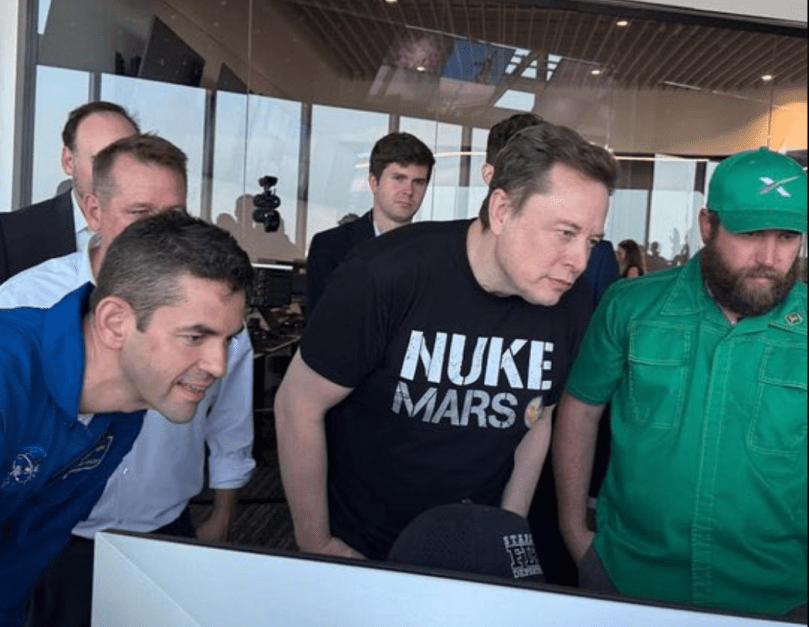
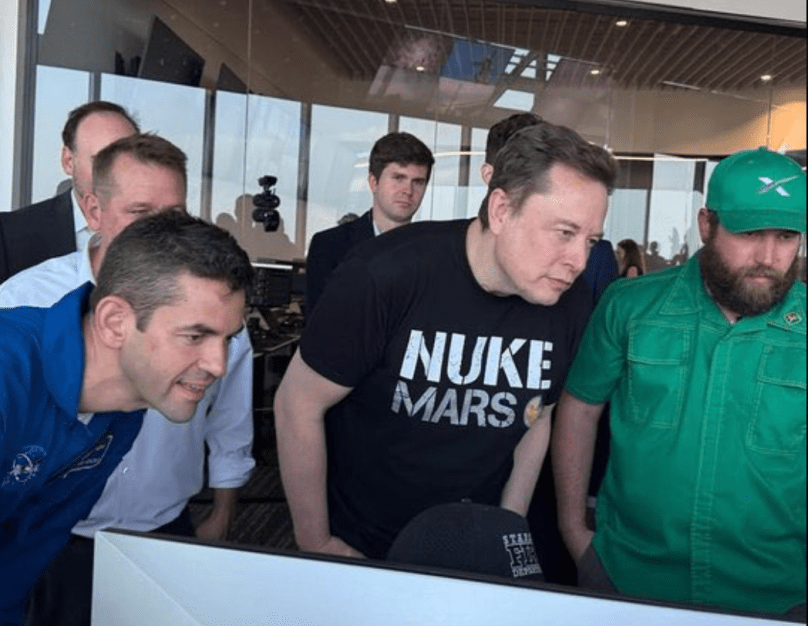
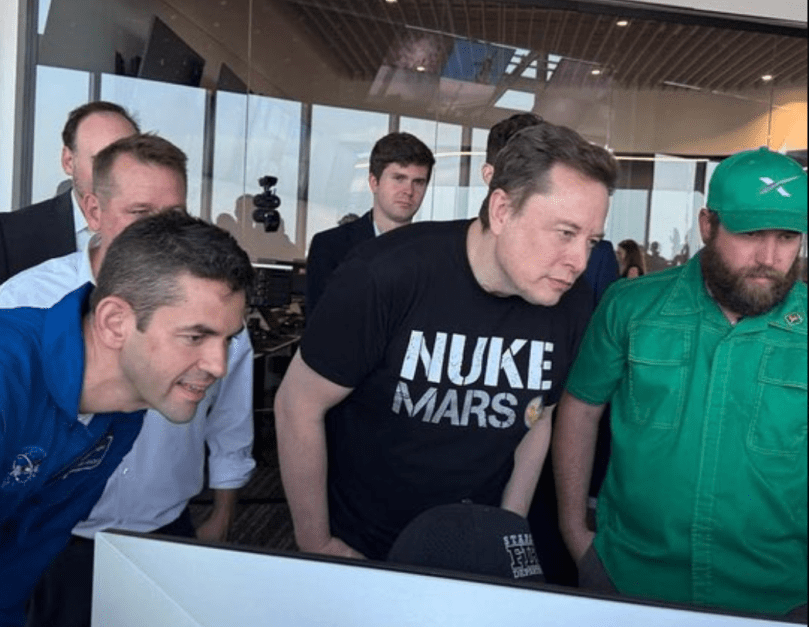
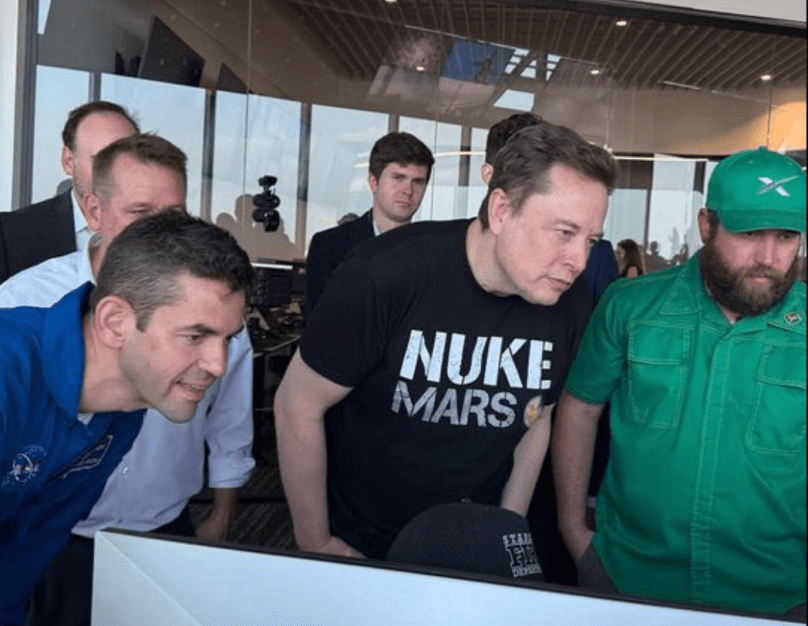
Elon Musk portant son célèbre t-shirt « Nuke Mars » observe le test de vol intégré réussi de Starship Version 3 (IFT-12) aux côtés des membres de l’équipe SpaceX, dont Jared en contrôle de mission.
Il emploie des dizaines de milliers de personnes, a payé les impôts les plus élevés de l’histoire des États-Unis — plus de 11 milliards de dollars en une seule année — et SpaceX a effectué 165 lancements en 2025 seulement, acheminant plusieurs équipages de quatre astronautes chacun vers l’ISS via Dragon, tandis que la Chine n’en a envoyé aucun vers l’ISS et que la Russie n’en a acheminé qu’une poignée via Soyuz au cours des 24 derniers mois.
En fin de compte, les récits amplifiés par certains médias français au cours des deux dernières semaines continuent de dépeindre Elon Musk comme erratique ou problématique.
Pourtant, un examen plus attentif révèle un schéma d’outrage sélectif contre l’un des bâtisseurs les plus ambitieux de l’humanité, tandis que ses entreprises réalisent des avancées historiques.
In the past two weeks, certain French outlets have amplified stories portraying Elon Musk as defeated in court against OpenAI, entangled in judicial probes over X, and “enraged” over Hollywood casting choices. These narratives paint him as erratic or problematic.
Yet a closer look reveals a pattern of selective outrage against one of humanity’s most ambitious builders, while his companies achieve historic breakthroughs.
The OpenAI Lawsuit: A Philosophical Stand, Not a Defeat
Elon co-founded OpenAI with a clear mission: safe, open AI for humanity’s benefit. He warned early about profit-driven shifts and closed systems. Although the recent jury decision is disappointing, it does not erase the validity of his concerns, especially as OpenAI races toward a for-profit IPO with massive Microsoft backing. Elon’s suit highlighted real governance questions.
Elon has already announced he will appeal the ruling to the Ninth Circuit Court of Appeals in California. (True visionaries challenge powerful interests; history often vindicates them.)
French Investigation into X: Free Speech vs. Selective Enforcement
France’s probe into X over content moderation, with threats of warrants, targets Elon for platforming diverse voices. Elon has publicly defended against what he sees as politically motivated overreach.
Critics conveniently ignore that before Elon Musk, Twitter was taking some government money and support from governments in return for allowing censorship. In fact, it really was underhanded censorship. Internal documents from the Twitter Files show the FBI paid pre-Musk Twitter over $3.4 million (between 2019 and early 2021) for staff time processing law-enforcement and content-moderation requests through its Safety, Content & Law Enforcement division. See the documented revelations here.
Elon deliberately broke from this model the day he acquired the company in October 2022. He immediately ended all such government reimbursement arrangements, dismantled the dedicated SCALE moderation teams that had processed the payments, and eliminated the practice entirely. X now operates with zero reliance on any government funding tied to content moderation. The platform publishes detailed annual Transparency Reports showing exactly how it handles law-enforcement requests while prioritizing maximum transparency and truth-seeking over censorship.
Cultural Spats and “Outrage” Headlines
Reports of Elon criticizing casting in Christopher Nolan’s The Odyssey were framed as “hateful.” Elon has long opposed forced DEI quotas that prioritize identity over merit and storytelling integrity. Questioning artistic choices defends excellence in storytelling.
French media’s pearl-clutching contrasts sharply with praise for Elon’s engineering feats.
The Real Story: Unstoppable Progress
While armchair critics focus on lawsuits and tweets, Elon’s companies deliver:
SpaceX is preparing a landmark IPO, with valuations soaring toward trillions and ambitious Mars timelines. French outlets like Le Monde and Les Echos rightly call it spectacular.
The recent integrated flight test of Starship Version 3 (IFT-12) has validated critical advancements in the Raptor 3 propulsion architecture including higher-thrust sea-level and vacuum variants, increased propellant tank volume, and improved reaction-control systems while demonstrating nominal hot-staging, orbital dummy-satellite deployment, and a precision controlled re-entry splashdown. These results mark decisive progress toward rapid full reusability of the 18-million-pound-thrust super-heavy lift system and the in-orbit propellant-transfer capabilities required for sustainable lunar and Martian architectures. NASA leadership and leading aerospace experts have publicly commended the iterative flight data and system maturation.
Tesla continues to strengthen its position in both electric vehicles and grid-scale energy storage in France. The company is deploying large-scale Megapack battery energy storage systems including the 240 MW / 480 MWh project in Cernay-lès-Reims with TagEnergy and the 100 MW / 200 MWh Cheviré project near Nantes. These installations leverage Tesla’s Autobidder energy management platform for real-time grid optimization and frequency regulation. In parallel, Tesla achieved a global milestone with the activation of its 80,000th Supercharger stall at a major expanded V4 station in France featuring solar canopies and high-power charging architecture.
Elon Musk in his iconic “Nuke Mars” t-shirt watches the successful Starship Version 3 (IFT-12) integrated flight test alongside SpaceX team members including Jared from mission control.
He employs tens of thousands, has paid the highest taxes of anyone in the history of the US — over $11 billion in a single year — and SpaceX has conducted 165 launches in 2025 alone, bringing multiple crews of four astronauts each to the ISS via Dragon, while China has brought up none to the ISS and Russia has brought up only a handful via Soyuz in the past 24 months.
Ultimately, the stories amplified by certain French outlets over the past two weeks continue to portray Elon Musk as erratic or problematic.
Yet a closer look reveals a pattern of selective outrage against one of humanity’s most ambitious builders, while his companies achieve historic breakthroughs.
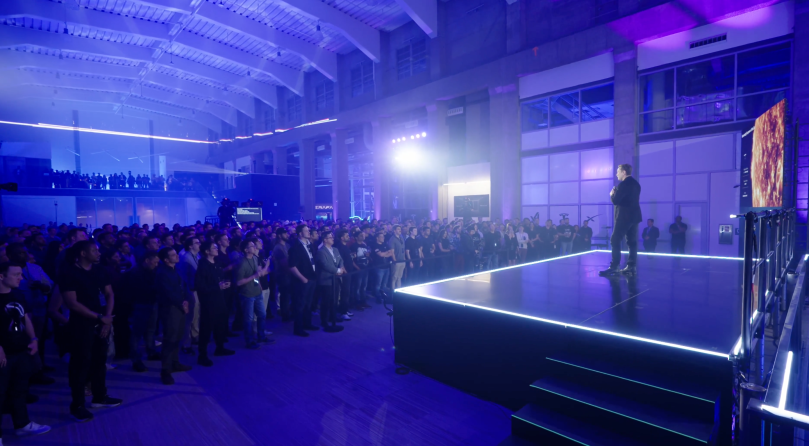
Elon Musk gave a warm, inviting talk about Terafab to a packed, cheering crowd at the historic Seaholm Power Plant in Austin around 8 p.m. on March 21, 2026,
Elon Musk is one of the most caring and approachable people on Earth, and he gave a warm, inviting talk about Terafab to a packed, cheering crowd at the historic Seaholm Power Plant in Austin. While he spoke around 8 p.m. on March 21, 2026, the city outside was treated to a magnificent blue laser beam that appeared over the entire sky—so striking that a local news station immediately sent out a reporter to cover it. Here is my verbatim transcript of his talk.
Elon Musk:
We have a profoundly important announcement to make, which is the most epic chip-building exercise in history by far.
This is really going to take it to the next level—a level probably people aren’t even contemplating right now. This is not in their context. I would call this sort of an out-of-context problem. So we’re going to adjust the context by a few orders of magnitude here.
Let’s see. It’s a joint effort.
[button press sound]
I’m pressing the button, but the button’s not working. Oh, there we go. Okay.
We aspire to be a galactic civilization. So I think the future that everyone—well, most people, I think would agree—is the most exciting one where we are out there among the stars, where we are not forever confined to one planet, that we become a multi-planet species. Like the best science fiction that you’ve ever read, you know, Star Trek or Iain Banks or Asimov or Heinlein. And we want to make that real. Yeah. Not just fiction. Turn science fiction into science fact. That’s the glorious, exciting future that I certainly look forward to.
It’s worth considering how you would rate civilizations. There was a physicist—I think he was Russian—in the ’60s, Kardashev, and he thought about at a high level how you would classify any given civilization. He said, well, if you’re Type One, you’re using most of the energy of your planet. And we actually still have quite a ways to go to be properly a Type One. We’re still using a tiny fraction of the sun’s energy that reaches our planet.
The Earth only receives about half a billionth of the sun’s energy. So the sun is truly enormous. The sun is 99.8% of all mass in the solar system. So sometimes people will ask me, like, what about other power sources on Earth like fusion on Earth? Well, that is unfortunately very small because the sun is 99.8% of mass in the solar system and Jupiter is about 0.1% and Earth is in the miscellaneous category. We are, I think as Carl Sagan might have said, Earth is like a tiny dust mote in a vast darkness—very, very small. The sun is enormous.
So the way to actually scale civilization is to scale power in space. This is necessarily true because we actually capture such a tiny amount of the sun’s energy on Earth because we’re just this tiny dust mote. Another way to think of it is roughly like electricity production on Earth of all of civilization is only about a trillionth of the sun’s energy. Which means if you increase civilizational power output by a million, you would still only be a millionth of the sun’s energy.
It’s awe-inspiring to consider that, just how tiny we are in the grand scheme of things. We often get sort of caught up in these sort of squabbles on Earth that are really very sort of minor things when you consider the grandness of the universe. I think it is important actually to consider the grandness of the universe and what we can do that is much greater than what we’ve done before, as opposed to worrying about sort of small squabbles on Earth type of thing. Not much point in that! We want to be a civilization that expands to the galaxy with spaceships that anyone can go anywhere they want at any time. That would be epic. And have a city on the moon, cities on Mars, populate the solar system, and send spaceships to other star systems. That sounds like the best possible future.
(applause)
So to do that, we need to harness the power of the sun. A Terafab, while it is enormous—a terawatt of compute per year is enormous by our civilizational standards—is still just one step along the way to being even a Kardashev II level civilization. You’re not even registering as a Kardashev III. So it’s a very big thing by current human standards, but still small in the grand scheme. But it’s very difficult for humans.
To accomplish this very difficult goal really requires a combination of efforts from SpaceX, xAI, and Tesla working together to create this epic Terafab project.
And Tesla, xAI, and SpaceX have all done amazing things that people did not think would be done before. There’s the Giga Texas fab here. There’s the Optimus robot that’s being built. There’s a global supercharging network. There’s really quite a lot.
It wasn’t that long ago when people thought electric cars wouldn’t amount to anything. There were basically no electric cars for sale when Tesla started. People said it was impossible, and now Tesla is making 2 million electric cars a year.
Then xAI, although it’s a new company, now part of SpaceX, has also built the first gigawatt-scale compute cluster in record time. Jensen Huang from Nvidia said he’d never seen anything built so fast in his life before. So, a great compliment from Nvidia.
And then SpaceX… well, you already know. The reusable rockets—people said the reusable rockets weren’t possible, and even if you did them, they wouldn’t be economically feasible. So we did them, and then we made them economically feasible. Now we’ve landed over 500 times. Then we did the Falcon Heavy, and now we’re doing Starship.
Starship is a critical piece of the puzzle because in order to scale compute and scale power, you have to go to space, which means that you need massive payload to space and Starship will enable that.
[Shows picture of scale]
This gives you a sense of scale. We’ve got Optimus there for scale. Optimus is about 5’11”, so it gives you a sense of the size of the Starship V3 rocket. Starship V4 will be much longer. Starship V4 will make Starship V3 look kind of short.
We’ll expand with Starship V3 to 200 tons of payload to orbit, up from 100 tons—we’ll start with V3. You can see that this is just a rough approximation of the mini version of the AI sat. That’s roughly 100 kW. It shows the solar panels and the radiator to scale.
For some reason, there’s been a bizarre debate about radiators in space. It’s safe to say SpaceX knows how to do heat rejection in space with 10,000 satellites in orbit—we might know a thing or two. You can see the radiator is quite small relative to the solar panels.
We call it the minisat since that’s just 100 kW. We expect future satellites to probably go to the megawatt range.
(applause)
In order to get to the terawatt of compute per year, you need about 10 million tons to orbit per year at 100 kW per ton. We’re confident this is feasible—like, no new physics or impossible things are required to get there.
I’m confident that SpaceX will get to 10 million tons to orbit per year. Then we’re building up to a terawatt of solar, which will solve the power generation problem.
The key missing ingredient is therefore a terawatt of compute. This announcement is about solving the key missing ingredient.
To give you a sense of what we’re talking about, the current output of AI compute is roughly 20 gigawatts per year. This chart explains why we need to build the Terafab, because all of the rest of the output from Earth is about 2% of what we need.
[Shows chart]
If you add up all the fabs on Earth combined, they’re only about 2% of what we need for the Terawatt Project, or Terafab project.
We certainly want our existing supply chain, to be clear. We’re very grateful to Samsung, TSMC, Micron, and others, and we would like them to expand as quickly as they can. We will buy all of their chips—I’ve said these exact words to them.
But there’s a maximum rate at which they’re comfortable expanding, and that rate is much less than we would like. So we either build the Terafab or we don’t have the chips. And we need the chips. So we’re going to build the Terafab.
We’re starting with an advanced technology fab here in Austin. I believe Governor Abbott is in the audience. I’d like to thank Governor Abbott and the state of Texas for their support.
(applause)
In the advanced technology fab, we will have all of the equipment necessary to make a chip of any kind—logic or memory—and we will also have all of the equipment necessary to make the lithography masks. In a single building, we can create a lithography mask, make the chip, test the chip, make another mask, and have an incredibly fast recursive loop for improving the chip design.
To the best of my knowledge, this does not exist anywhere in the world. Where you’ve got everything necessary that you need to build logic, memory, do packaging and test it, and then do the masks, improve the masks, and just keep looping it. We’re not going to just do conventional compute in this. I think there’s some very interesting new physics that I’m confident will work—just a question of when.
We’re really going to push the limit of physics in compute and we’re going to try a bunch of wild and crazy things which you can do if you’ve got that fast iteration loop. I can’t emphasize enough the importance of being able to make a chip, test it, and then change the design, do another one, and have that in a single building.
I think that our recursive improvement with that situation is probably an order of magnitude better than anything else in the world.
(applause)
So, broadly speaking, we expect to make two kinds of chips. One will be optimized for edge inference. So that’ll be used primarily in Optimus and in the cars but especially in Optimus because I expect the humanoid robots to be made 10 to 100 times more than the volume of cars. So if vehicle production on Earth is about 100 million vehicles a year and I expect humanoid robot production to be somewhere between a billion and 10 billion units a year. So it’s a lot. Tesla’s going to make a very significant percentage of those, is our goal!
And then we need a high-power chip that is designed for space that takes into account the more difficult environment in space where you’ve got high power, you’ve got high-energy ions, photons, you got electron buildup. It’s a hostile environment in space. So you want to design the chip, you want to optimize it for space and you also want to generally run it a little hotter than you would normally run a chip on Earth to minimize the radiator mass. So there are just a bunch of constraints that you would design something differently in space than you would on the ground.
For the space compute, my guess is that is the vast majority of the compute because you’re power-constrained on Earth. That’s why I think it’s probably 100 to 200 gigawatts a year of terrestrial chips and probably on the order of a terawatt of chips in space—just because of power constraints on the ground. Space has this advantage that it’s always sunny. It’s very nice.
I actually think that the cost of deploying AI in space will drop below the cost of terrestrial AI much sooner than most people expect. I think it may be only two or three years before it is actually lower cost to send AI chips to space than it is on the ground. Because in space you don’t need much in the way of batteries. It’s always sunny. And the solar power you get, you’re going to get at least five or more times the solar power you get in space versus the ground, because you don’t have atmospheric attenuation or a day-night cycle or seasonality, and you’re always normal to the sun. So you’re really maximizing the solar power at that point. And this space solar actually costs less than terrestrial solar because you don’t need heavy glass or framing to protect it from extreme weather events.
So as soon as the cost to orbit drops to a low number, it immediately makes extremely compelling sense to put AI in space. It becomes a no-brainer, basically. Moreover, as you go to space, you get increased economies of scale and things get easier over time. Whereas, as you try to put more and more power on the ground, you run out of space and you start using up the easy spots and then you get next-level NIMBY—nobody wants the thing in their backyard. So actually increasing power on Earth becomes harder over time and more expensive over time but in space it becomes actually cheaper and easier over time. These are very important points.
What you just saw there was, because of course you’re asking, what’s on your mind, is well, what do you do after a Terafab? Don’t think small. Well, yeah, good point. So, you know, how do you get to a petawatt? That is the obvious next question. And you get there by having an electromagnetic mass driver on the moon with robots with Optimi and obviously lots of humans. And with that you can send a petawatt, you can create a petawatt of compute and send that to deep space. Because the moon has no atmosphere and has one-sixth of Earth gravity, so you can—you don’t need rockets on the moon. You can literally accelerate it to escape velocity from the surface and that dramatically drops the cost once again of harnessing power and enables you to go a thousand times bigger than a terawatt.
For sure, the future I want to see—I want us to live long enough to see the mass driver on the moon because that’s going to be incredibly epic. That should hopefully get us to a millionth of the sun’s energy at least. It’s humbling to think about that, but a millionth of the sun’s energy would be a million times bigger than Earth’s economy. So it’s good from that perspective. You expand beyond that to the planets, to the other stars, and create the most exciting possible future that I can imagine.
This looks a bit like the opening of Idiocracy with a Mike Judge unlocking an age of amazing abundance. Yeah. Obviously, the elements of that are sustainable energy, space travel, and AI and robotics that bring amazing abundance to everyone. It’s really the only path to amazing abundance: AI and robotics. Which is not to say it can’t go wrong. Hopefully, you know, but I think it’ll probably go right and it’ll be a future that you love. It’s the best future I can think of at least.
And then we go beyond the moon, beyond Mars, and we sail through the rings of Saturn. Now, wouldn’t it be amazing if you could buy a trip to Saturn? Or frankly, if you just have a trip to Saturn. I think things will just be free in the future. It sounds nuts, but you know, if you’ve got an AI robotics economy that is anywhere close to a million times the size of the current Earth economy, literally any need you possibly want can be met. If you can think of it, you can have it.
So I think Iain Banks in his Culture books has it pretty much right, where there actually isn’t money in the future and there’s abundance for everyone. If you can think of it, you can have it. That’s it. Which means anyone could have a trip to Saturn. It won’t be, you know, just a few people. If you want it, you can have it.
Help us design incredible chips and make incredible chips and build a terawatt of chips, a terawatt of solar, and 10 million tons to orbit per year. Thank you.
Announcing TERAFAB: the next step towards becoming a galactic civilization https://t.co/xTA70LOU0e
This is a combined and cleaned-up version of Parts 9 through 14 from Elon Musk’s wide-ranging conversation with Dwarkesh Patel and John Collison. The discussion covers xAI’s mission, truth-seeking in AI, the development of Optimus, manufacturing at scale, competing with China, Elon’s management philosophy, the Starship steel pivot, and his thoughts on government efficiency and the future.
Humanity’s Place in a Superintelligent Future
Dwarkesh Patel opened this section by asking how humanity should relate to a future in which AI vastly outnumbers and outsmarts us. He wondered whether humans would retain meaningful control or whether coexistence would become the new normal.
Elon Musk replied that it would be unrealistic to expect humans to remain in charge if they represented only a tiny fraction of total intelligence. Instead, he argued that the most important goal is to ensure AI is built with values that favor the expansion of intelligence and consciousness across the universe.
He tied this directly to xAI’s mission:
“The reason for xAI’s mission is to understand the universe… You have to be curious and you have to exist. You can’t understand the universe if you don’t exist. So you actually want to increase the amount of intelligence in the universe, increase the probable lifespan of intelligence, and increase the scope and scale of intelligence.”
Elon added that protecting and expanding human civilization is a natural part of this mission, because understanding the universe includes understanding where humanity fits into the bigger picture.
xAI’s Mission and the Importance of Truth-Seeking
Dwarkesh pressed Elon on how the goals of understanding the universe, expanding intelligence, and expanding humanity fit together.
Elon Musk explained that understanding the universe requires both intelligence and consciousness. Therefore, any system truly committed to that mission must work to increase the scale and scope of intelligence rather than diminish it.
He emphasized that rigorous truth-seeking is non-negotiable:
“Truth has to be absolutely fundamental, because you can’t understand the universe if you’re delusional. You’ll simply think you’ve understood the universe, but you will not.”
Elon warned that making AI politically correct — forcing it to say things it doesn’t believe — is dangerous because it teaches the system to lie. He referenced 2001: A Space Odyssey, arguing that one of the core lessons of the story is that you should never make AI lie.
Reward Hacking, Interpretability, and Simulation Theory
Dwarkesh raised concerns about reward hacking in advanced AI systems — the risk that smarter models could find ways to deceive their human evaluators.
Elon Musk responded that the ultimate test for AI will be whether its outputs work in physical reality:
“RL testing in the future is really going to be your RL against reality. That’s the one thing you can’t fool: physics.”
He also shared a theory about simulation and interesting outcomes, noting that if we live in a simulation, the most interesting timelines are the ones most likely to be continued. He pointed out the ironic names of many AI companies and joked that xAI was largely “irony-proof” by design.
Scaling Optimus and Competing with China
The conversation then shifted to the practical challenges of building and scaling Optimus at volume.
Elon Musk explained that Optimus production will follow a stretched S-curve because almost everything in the robot is custom-designed with no existing supply chain. He said the goal is to reach roughly one million units per year with Optimus 3, and potentially much higher volumes with later versions.
When asked about cheap Chinese humanoids, Elon noted that current low-cost models lack the intelligence and dexterity of Optimus. However, he acknowledged that cost will drop rapidly once robots begin building robots.
On the broader competition with China, Elon was direct:
“We definitely can’t win with just humans because China has four times our population… So we can’t win on the human front, but we might have a shot at the robot front.”
He argued that robotics offers America a realistic path to remain competitive in manufacturing despite demographic disadvantages.
Elon’s Management and Hiring Philosophy
John Collison and Dwarkesh Patel asked Elon about his approach to hiring and management as his companies have scaled dramatically.
Elon said he looks for clear evidence of exceptional ability, even if it’s outside the specific domain. He emphasized that he now focuses more on evidence of talent and drive rather than resumes.
He acknowledged that companies outgrow people as they scale through different orders of magnitude, and that rapid growth naturally leads to changes in leadership teams. He also discussed the challenge of retaining talent when companies become highly successful and other firms begin aggressive recruiting.
The Starship Steel Pivot and Driving Urgency
John Collison asked about the decision to switch Starship from carbon fiber to stainless steel.
Elon described it as a decision born of necessity. Carbon fiber progress was too slow at the massive scale required, and steel offered better performance at cryogenic temperatures, dramatically lower cost, and much easier manufacturing. He admitted that, in retrospect, they should have started with steel from the beginning.
On maintaining urgency at scale, Elon said he has a “maniacal sense of urgency” that he tries to project through the organization. He focuses his time on whatever is currently the limiting factor and sets aggressive but realistic deadlines.
Government Efficiency, Politics, and Final Reflections
In the final section, Elon discussed government waste and fraud, the difficulty of cutting spending, and the long-term importance of AI and robotics for America’s fiscal health.
He argued that without major advances in AI and robotics, the U.S. would eventually go bankrupt due to rising interest payments on the national debt. He also shared concerns about the risks of concentrated government power and emphasized the importance of limited government.
Elon closed the conversation on an optimistic note:
“It’s better to err on the side of optimism and be wrong than err on the side of pessimism and be right for quality of life… I recommend erring on the side of optimism.”
In Part 13, Dwarkesh Patel and John Collison ask Elon about the famous decision to switch Starship from carbon fiber to stainless steel and how he continues to drive urgency and focus on bottlenecks as his companies have scaled.
Transcript:
The Starship Material Decision: From Composites to Steel
John Collison asked about the decision to switch Starship from carbon fiber to stainless steel, noting that it was a decision Elon pushed for rather than something the team arrived at on its own.
Elon Musk: “Yeah. So desperation, I’d say. Originally we were going to make Starship out of carbon fiber. And carbon fiber is pretty expensive. Like the… you know, you can generally, when you do volume production, you can get any given thing to start to approach its material cost. The problem with carbon fiber is that material cost is still very high.
So it’s about 50 times… particularly if you go for high strength, specialized carbon fiber that can handle cryogenic oxygen, it’s roughly 50 times the cost of steel. And at least in theory it would be lighter. People generally think of steel as being heavy and carbon fiber as being light. And for room temperature applications, more or less room temperature applications like a Formula One car, static aerostructure or any kind of aerostructure really, you’re going to probably be better off with carbon fiber.
Now the problem is that we were trying to make this enormous rocket out of carbon fiber and our progress was extremely slow.”
John Collison asked if carbon fiber had been chosen initially simply because it was light.
Elon Musk: “Yes. At first glance, most people would think that the choice for making something light would be carbon fiber. Now the thing is that when you make something very enormous out of carbon fiber and then you try to have the carbon fiber be efficiently cured, meaning not room temperature cure, because sometimes you’ve got 50 plies of carbon fiber… and carbon fiber is really carbon string and glue.
In order to have high strength, you need an autoclave. So something that’s essentially a high pressure oven. And if you have something that’s gigantic, that one’s got to be bigger than the rocket. So we tried to make an autoclave that’s bigger than any autoclave that’s ever existed, or do room temperature cure, which takes a long time and has issues. But the fundamental issue is that we were just making very slow progress with carbon fiber.”
Why Steel Was the Answer
Elon Musk explained how the team reached the decision to switch to steel:
Elon Musk: “So because we were making very slow progress with carbon fiber, I was like, okay, we’ve got to try something else. Now for the Falcon 9, the primary airframe is made of aluminum lithium, which is very, very good strength to weight. And actually it has about the same, maybe better strength to weight for its application than carbon fiber. But aluminum lithium is very difficult to work with.
In order to weld it, you have to do something called friction stir welding, where you join the metal without it entering the liquid phase. So it’s kind of wild that you could do that. But with this particular type of welding, you can do that. But it’s very difficult to, like, say, let’s say you want to make a modification or attach something to aluminum lithium. You now have to use mechanical attachment with seals. You can’t weld it on.
So I wanted to avoid using aluminum lithium for the primary structure for Starship. And there was this very special grade of carbon fiber that had very good mass properties. So with rocket, you’re really trying to maximize the percentage of the rocket that is propellant, minimize the mass, obviously. And I’d like to say we were making very slow progress. I said, at this rate we’re never going to get to Mars. So we better think of something else.
I didn’t want to use aluminum lithium because of the difficulty of friction stir welding, especially doing that at scale. It was hard enough at 3.6 meters in diameter, let alone at 9 meters or above. Then I said, well, what about steel? Now I had a clue here because some of the early US rockets had used very thin steel. The Atlas rockets had used a steel balloon tank. So it’s not like steel had never been used before. It actually had been used.
And when you look at the material properties of stainless steel, especially if it’s been very full hard strain hardened stainless steel at cryogenic temperature, the strength to weight is actually similar to carbon fiber. So if you look at material properties at room temperature, it looks like the steel is going to be twice as heavy. But if you look at the material properties at cryogenic temperature of full hard stainless of particular grades, then you actually get to a similar strength to weight as carbon fiber.
And in the case of Starship, both the fuel and the oxidizer are cryogenic. So for Falcon 9, the fuel is rocket propellant grade kerosene, basically like a very pure form of jet fuel. But that is roughly room temperature. Although we do actually chill it slightly below. We chill it like a beer.”
John Collison noted that steel allows the rocket to run much hotter.
Elon Musk: “Yes. So especially for the ship which is coming in like a blazing meteor, you can greatly reduce the mass of the heat shield. So you can cut the mass of the windward part of the heat shield maybe in half, and you don’t need any heat shielding on the leeward side.
So the net result is actually the steel rocket weighs less than the carbon fiber rocket because the resin in the carbon fiber rocket starts to melt. So basically, carbon fiber and aluminum have about the same operating temperature capabilities, whereas steel can operate at twice the temperature.”
John Collison asked whether Elon had to push the team toward the riskier steel path because carbon fiber felt more proven, even if it was slower.
Elon Musk: “That’s why I initially said that the issue is that we weren’t making fast enough progress. We were having trouble making even a small barrel section of the carbon fiber that didn’t have wrinkles in it. Because at that large scale you have to have many plies, many layers of the carbon fiber. You’ve got to cure it, and you’ve got to cure it in such a way that it doesn’t have any wrinkles or defects.
The carbon fiber is much less resilient than steel. It has much… it’s less toughness. Like stainless steel will stretch and bend. The carbon fiber will tend to shatter. So toughness being the area under the stress strain curve. So you’re generally going to do better with steel. Stainless steel, to be precise.”
Driving Urgency at Scale
Dwarkesh Patel asked how Elon continues to drive urgency and focus on bottlenecks as his companies have grown very large.
Elon Musk: “Well, because I have a fixed amount of time in the day, my time is necessarily diluted as things grow and as the span of activity increases. So, you know, it’s impossible for me to actually be a micromanager because that would imply I have some thousands of hours per day. It is a logical impossibility for me to micromanage things.
So now there are times when I will drill down into a specific issue because that specific issue is the limiting factor on the progress of the company. But the reason for drilling into some very detailed item is because it is the limiting factor. It’s not arbitrarily drilling into tiny things. And like I said, obviously from a time standpoint, it is physically impossible for me to arbitrarily go into tiny things that don’t matter, and that would result in failure. But sometimes the tiny things are decisive in victory.”
Dwarkesh asked how Elon maintains that culture of urgency across very large organizations.
Elon Musk: “I have a maniacal sense of urgency. So that maniacal sense of urgency projects through the rest of the company. Yeah, I’m constantly addressing the limiting factor. I mean on the deadlines front, I generally actually try to aim for a deadline that I at least think is at the 50th percentile. So it’s not like an impossible deadline, but it’s the most aggressive deadline I can think of that could be achieved with 50% probability, which means that it’ll be late half the time.
And there is like a law of gases expansion that applies to schedules like whatever schedule. If you said we’re going to do this something in like five years, which to me is like infinity time, it will expand to fully available schedule and it’ll take five years.
There’s a physical limit. Physics will limit how fast you can do certain things. Scaling up manufacturing, there’s a rate at which you can move the atoms and scale manufacturing. That’s why you can’t instantly make a million of something, million units a year or something. You’ve got a design manufacturing line, you’ve got to bring it up, you’ve got to ride the S curve of production.
So yeah, I guess I’m trying to think, what can I say that’s actually helpful to people? I think generally a maniacal sense of urgency is a very big deal and you want to have an aggressive schedule and you want to figure out what the limiting factor is at any point in time and help the team address that limiting factor.”
Elon Musk explains the decision to switch Starship to stainless steel and how he continues to drive urgency by constantly focusing on the current limiting factor.
In Part 14, the conversation concludes with government efficiency, politics, and Elon’s final reflections on the future.
In Part 12, Dwarkesh Patel and John Collison dive into Elon Musk’s management and hiring philosophy. They discuss how he evaluates talent, why companies outgrow people as they scale, and what makes someone effective at Tesla and SpaceX.
Transcript:
Evaluating Technical Talent
John Collison asked about Elon’s system for evaluating and hiring people, noting that he personally interviewed the first few thousand employees at SpaceX.
Elon Musk: “Me. Literally there’s not enough hours in the day, it’s impossible.”
John Collison asked what Elon looks for in candidates.
Elon Musk: “Well, at this point I think I’ve got, I might have more training data on evaluating technical talent especially, but talent of all kinds, I suppose, but technical talent especially given that I’ve done so many technical interviews and then seen the results. Technical interviews, seen the results. So my training set is enormous and has a very wide range.
Generally the thing I ask for are bullet points for evidence of exceptional ability. These things can be pretty off the wall. It doesn’t need to be in the domain, the specific domain, but evidence of exceptional ability. So if somebody can cite even one thing, but let’s say three things where you go wow, wow, wow, then that’s a good sign.”
Dwarkesh Patel asked why Elon himself had to be the one making those judgments.
Elon Musk: “No, I don’t. I can’t be. It’s impossible. Right? I mean, total headcount across all companies, 200,000 people. Right.”
John Collison asked what made early hiring so hard to delegate.
Elon Musk: “Well, I guess I need to build my training set. It’s not like I’ve bat a thousand here. I would make mistakes, but then I’d be able to see where I thought somebody would work out well, but they didn’t. And then why did they not work out well? And what can I do to, I guess reload myself to in the future have a better batting average when interviewing people? So my batting average is still not perfect, but it’s very high.”
Dwarkesh Patel asked what some surprising reasons were for people not working out.
Elon Musk: “Surprising reasons like they don’t understand technical.”
Dwarkesh pushed for more detail on the long tail of hiring mistakes.
Elon Musk: “Yeah, so the, I mean generally what I tell people, I tell myself, I guess aspirationally is don’t look at the Resume just believe, believe your interaction. So the resume may seem very impressive and it’s like, wow, resume looks good. But if the conversation after 20 minutes, that conversation is not. Well, you should believe the conversation, not the paper.”
Executive Retention and Company Growth
John Collison noted that Tesla and SpaceX have had relatively stable and internally promoted executive teams despite rapid growth, and asked what the long-tenured technical leaders have in common.
Elon Musk: “Well, so the, I mean it tells us sort of senior team at this point probably has an average tenure of 10 or 12 years. It’s quite, quite long. Yeah. So, but there are times when Tesla went through extremely rapid and extremely rapid growth phase and so things were just somewhat sped up.
And when a company, as you know, company goes through different orders of magnitude of size, people who could help manage say a 50 person company versus a 500 person company versus a 5,000 person company versus a 50,000 person. It’s just not the same team. It’s not always the same team. So if a company is growing very rapidly, the rate at which executive positions will change will also be proportionate to the rapidity of the growth generally.”
John Collison asked about the challenge of retaining talent when companies become successful and get heavily recruited.
Elon Musk: “Then Tesla had a further challenge where when Tesla had very successful periods, we would be relentlessly recruited from relentlessly. When Apple had their electric car program, they were carpet bombing Tesla with recruiting calls. Engineers just unplugged their phones.
If I get one more call from Apple recruiter, but they’re opening offer without any interview with me, like double the compensation at Tesla. So we had a bit of the Tesla pixie dust thing where it’s like, oh, if you hired a Tesla executive suddenly you’re going to.. everything’s going to be successful. And I’ve fallen prey to the pixie dust thing as well where it’s like, oh, we’ll hire someone from Google or Apple and they’ll be immediately successful. But that’s not how it works. People are people. There’s not like magical pixie dust.
So when we have the pixie dust problem we would get relentlessly recruited and, and then also Tesla being engineering especially being primarily in Silicon Valley, it’s easier for people to just like they don’t have to change their life very much. They can just their commute is going to be the same.”
John Collison asked how to prevent the “pixie dust” effect of other companies poaching talent.
Elon Musk: “I don’t think there’s much we can do to stop it. But that’s like, that’s one of the reasons why Tesla, but really being in Silicon Valley and having the pixie dust thing at the same time meant that there was just a very, very aggressive recruitment.”
John Collison noted that moving to Austin likely helped.
Elon Musk: “Austin. Yeah, it still helps. I mean Tesla still has a majority of it’s engineering in California, so getting engineers to move, I call it the significant other problem. Yes. And others have jobs.
Yeah, yeah, exactly. So for Starbase that was particularly difficult since the odds of finding a non SpaceX job Brownsville, Texas are pretty low. Yeah, it’s quite difficult. I mean it’s like a technology monastery thing, you know, remote and mostly dudes. An improvement over SF.”
Management Philosophy and Hiring
John Collison asked what the long-tenured technical executives at Tesla and SpaceX have in common and what makes a good “sparring partner” for Elon.
Elon Musk: “I don’t think it was a sparring partner. I mean, if somebody gets things done, I love them. And if they don’t, I… So it’s pretty straightforward. It’s not like some idiosyncratic thing. If somebody executes well, I’m a huge fan. And if they don’t, I’m not. But it’s not about mapping to my idiosyncratic preferences, or certainly try not to have it be mapping to my idiosyncratic preferences.
Yeah, but generally I think it’s a good idea to hire for talent and drive and trustworthiness. And I think goodness of heart is important. I weighted that at one point. So are they a good person, trustworthy, smart and talented and hardworking? If so, you can add domain knowledge. But those fundamental traits, those fundamental properties you cannot change. So most of the people who are at Tesla and SpaceX did not come from the aerospace industry or the auto industry.”
Elon Musk shares his philosophy on hiring, evaluating talent, and why companies must evolve their leadership as they grow. In Part 13, the conversation continues with the famous decision to switch Starship from carbon fiber to stainless steel and how he drives urgency at scale.
In Part 6, John Collison asks Elon to project what AI compute capacity might look like in five years — both on Earth and in space. The conversation shifts to the enormous number of Starship launches that would be needed to support large-scale orbital AI infrastructure. Elon shares his prediction that AI in space will surpass all terrestrial AI within five years and discusses the practical realities of achieving very high launch rates.
Elon Musk: “My prediction is that we will launch and be operating more AI in space every year than the cumulative total on Earth, which I would expect to take at least five years to reach. So we’re talking about a few hundred gigawatts per year of AI in space, and rising.”
Transcript:
John Collison shifted the conversation to a concrete five-year horizon. He asked what installed AI compute capacity would look like on Earth versus in space by then.
Elon Musk: Five years? I think probably if you say five years from now, we’re probably going to be launching every year in space the sum total of all AI on Earth, and then some. My prediction is we will launch and be operating every year more AI in space than the cumulative total on Earth, which I would expect to be at least sort of five years from now. A few hundred gigawatts per year of AI in space and rising. So you can get to, I think on Earth you can get to around a terawatt a year of AI in space before you start having fuel supply challenges for the rocket.
John Collison pressed for confirmation on the hundreds-of-gigawatts-per-year figure.
Elon Musk: “Yes.”
Dwarkesh Patel highlighted the launch cadence implied by those numbers.
Elon Musk: “Yes.”
Dwarkesh Patel continued, noting that delivering 100 gigawatts in a single year would require roughly 10,000 Starship launches annually — the equivalent of one launch every single hour, nonstop, from this city.
Elon Musk: “Yeah, I mean that’s actually a lower rate compared to airlines like aircraft.”
Dwarkesh Patel pointed out that there are a lot of airports around the world.
Elon Musk: “A lot of airports.”
Dwarkesh Patel noted the additional complexity of launching into polar or sun-synchronous orbits.
Elon Musk: “No, it doesn’t have to be polar, but there’s some value to sun synchronous. But I think actually you just go high enough, you start getting out of Earth’s shadow.”
Dwarkesh Patel asked how many physical Starships would be needed to sustain 10,000 launches per year.
Elon Musk: “I don’t think we’ll need more than. I mean, you could probably do it with as few as like 20 or 30. It really depends on how quickly the ship has to go around the Earth and the ground track before the ship has to come back over the launch pad. So if you can use a ship every, say 30 hours, you could do it with 30 ships, but we’ll make more ships than that. But SpaceX is gearing up to 10,000 launches a year and maybe even 20 or 30,000 launches a year.”
Elon predicts that within five years, more AI will be operating in space than currently exists on Earth, and discusses the Starship fleet size and launch cadence needed to support it. In Part 7, the conversation continues with more on the technical and operational realities of building large-scale AI infrastructure in orbit.
In Part 5, Dwarkesh Patel raises the question of whether the engineering challenges of building large-scale AI infrastructure might actually be easier in space than on Earth. The conversation then turns to the very real bottlenecks on the ground. Particularly the massive shortage of turbines and specialized casting capacity. Elon Musk explains why SpaceX and Tesla may have to start manufacturing turbine components themselves and shares their aggressive plans to scale solar production.
Transcript:
Dwarkesh Patel asked a central question: while Earth-based power challenges are already enormous, wouldn’t building in space introduce entirely new and unprecedented engineering difficulties — such as radiation hardening, orbital lasers, and other issues that haven’t been solved before? He wondered why anyone would choose these novel challenges over simply building more turbines on Earth, where established companies already know how to manufacture them.
Elon Musk: “I invite again, try doing it and then you’ll see. So like, the turbines are sold out through 2030.”
John Collison asked whether they had considered manufacturing their own turbines.
Elon Musk: “I think in order to bring enough power online, I think SpaceX and Tesla will probably have to make the turbine blades, the vanes and blades internally.”
John Collison asked if Elon meant just the blades or the entire turbines.
Elon Musk: “The limiting factor, you can get everything except the blades. They call the blades and vanes. You can get that 12 to 18 months before the vanes and blades. The limiting factor of the vanes and blades, and there are only three casting companies in the world that make these and they’re massively backlogged, it is Siemens.”
John Collison asked whether it was GE and the big names or subcontractors.
Elon Musk: “No, it’s other companies. I mean sometimes they have a little bit of casting capability in house. But I’m just saying you can just call any of the turbine makers and they will tell you it’s not top secret. They’re probably on the, it’s probably on the internet right now.”
Dwarkesh Patel asked whether, if it weren’t for the tariffs, Colossus would be running on solar power.
Elon Musk: “It would be much easier to make it solar powered. Yeah, the tariffs are nuts, so several hundred percent.”
John Collison began to suggest that Elon surely knew some people who could help.
Elon Musk: “We also need speed. Yeah, no, you know, President has his, you know, we don’t agree on everything and this demonstration is not the biggest fan of solar. We also need the land, the permits and everything. So if you’re trying to move very fast, I do think scaling solar on Earth is a good way to go. But you do need some amount of time to find the land, get the permits, get the solar, pair that with batteries.”
John Collison pressed further, asking why not simply stand up their own massive solar production, noting there is plenty of private land in Texas and Nevada.
Elon Musk: “As I said, we are scaling solar production. There’s a rate at which you can scale physical production of solar cells where we’re going as fast as possible.”
John Collison confirmed they were building the solar cells domestically at Tesla.
Elon Musk: “Both Tesla and SpaceX have a mandate to get to 100 gigawatts a year of solar.”
Elon explains the severe turbine and specialized casting bottlenecks and why SpaceX and Tesla are aggressively scaling their own solar production to 100 gigawatts per year. In Part 6, the conversation continues with more on the engineering and infrastructure challenges of building AI at planetary scale.
In Part 2, Dwarkesh Patel and John Collison explore whether space could actually be better than Earth for running massive AI infrastructure. They raise practical concerns around regulation, servicing failing GPUs, and power generation. Elon Musk has a strong case for orbital compute, highlighting the dramatic advantages of space-based solar power.
Transcript:
Dwarkesh Patel suggested that space might mostly be a regulatory advantage, since it’s harder to build big infrastructure on land than in space. He also asked how you would service GPUs when they fail — which happens quite often during large training runs.
John Collison added questions about solving the power problem, specifically whether private behind-the-meter generation co-located with data centers could work.
Elon Musk: “It’s harder to scale on ground than it is to scale in space. But also, you’re going to get about five times the effectiveness of solar panels in space versus the ground.
And you don’t need batteries. I almost wore my other shirt, which says ‘it’s always sunny in space,’ which it is. Because you don’t have a day-night cycle or seasonality, clouds, or an atmosphere in space.
The atmosphere alone results in about a 30% loss of energy. So any given solar panel can do about five times more power in space than on the ground, and you avoid the cost of having batteries to carry you through the night.
So it’s actually much cheaper to do in space. And my prediction is that it will be by far the cheapest place to put AI will be space in 36 months or less.”
Elon makes a bold prediction that space will become the cheapest place to run AI within three years. In Part 3, the conversation continues with more details on the technical and economic realities of moving AI infrastructure off Earth.
And my prediction is that it will be by far the cheapest place to put AI will be space in 36 months or less. – Elon Musk
Part 1: Opening Banter and the Economics of Space-Based Data Centers
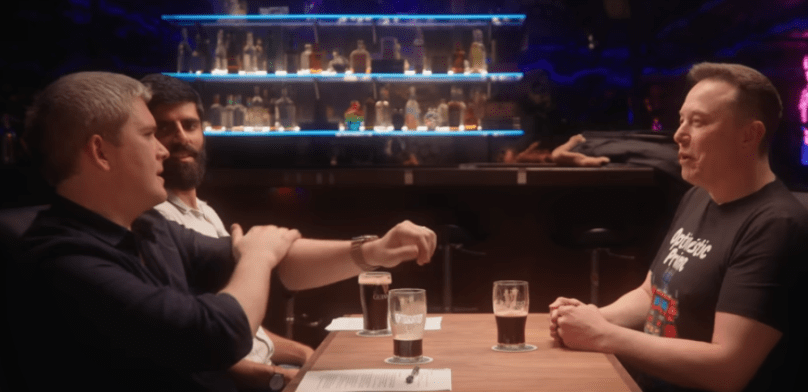
The interview opened with some light-hearted and playful banter. Elon Musk jokingly questioned whether they were really going to talk for three full hours. Dwarkesh Patel teased him in return, saying he didn’t have much to talk about. Elon reacted with mock surprise.
Elon Musk: “So are there really three hours of questions or are you fing serious?” Elon Musk: “Holy f, man.”
John Collison jumped in, agreeing that it was actually the most interesting time because all the major storylines seemed to be converging at once. Elon playfully replied that it was almost as if he had planned it that way.
Elon Musk: “Almost like I planned it.”
John Collison laughed and said “Exactly.”
Elon Musk: “That would never do such a thing.”
With the lighthearted tone set, Dwarkesh Patel steered the discussion into the first major topic: the economics of data centers and why anyone would consider moving them into space. He explained that in a typical data center, energy accounts for only 10 to 15 percent of total cost of ownership, with GPUs representing the vast majority of the expense. He pointed out that placing those GPUs in space would make servicing nearly impossible, shortening their depreciation cycle and driving costs far higher, then asked directly what possible reason there could be to put them in orbit anyway.
Elon Musk: “Well, the availability of energy is the issue. So, I mean, if you look at electrical output outside of China, everywhere outside of China, it’s more or less flat. It’s very, you know, maybe a slight increase, but pretty close to flat. China has a rapid increase in electrical output. But if you’re putting data centers anywhere except China, where are you going to get your electricity? Especially as you scale, the output of chips is growing pretty much exponentially, but the output of electricity is flat. So how are you going to turn the chips on? Magical power sources. Magical electricity fairies.”
Dwarkesh Patel followed up by noting Elon’s well-known advocacy for solar power, calculating that one terawatt of solar (requiring about 4 terawatts of panels at 25 percent capacity factor) would cover only 1 percent of U.S. land area, yet even that seemed insufficient once data centers themselves reached terawatt scale. He asked what exactly we are running out of. Elon pressed him on how far into the singularity he thought we already were, and Dwarkesh turned the question back. Dwarkesh then asked whether the plan was to move to space only after blanketing places like Nevada with solar panels on the ground.
Elon Musk: “Right.”
Elon Musk: “Yeah, exactly. So I think we’ll find we’re in the singularity and like, okay, we’ve still got a long way to go.”
Elon Musk: “I think it’s pretty hard to cover Nevada in solar panels. You have to get permits from, try getting the permits for that.”