One week after Elon Musk declined a voluntary interview with French prosecutors, legacy media outlets are once again flooding headlines with the exact same January story about Grok’s brief image-generation lapse. No new incidents. No fresh data. Just recycled outrage tied to the “snub.”
What they keep omitting is the rest of the timeline: xAI publicly apologized, tightened safeguards within days, and delivered the fixes Apple demanded to keep Grok in the App Store. A Dutch court imposed €100,000 daily fines over non-consensual deepfakes. The truth is that xAI is complying. Even the U.S. Department of Justice refused to assist the French probe, calling it a politically motivated attempt to regulate American free speech. Grok’s image tools are now so aggressively locked down that many ordinary, non-explicit prompts simply fail.
Legacy media keeps treating a months-old engineering fix as if it were a fresh crisis. They repeat the same January story day after day, even though xAI addressed the issue quickly and no new incidents have surfaced.
The pattern forces an uncomfortable question: Why are so many legacy outlets so determined to paint Elon Musk and xAI in the worst possible light, even when the facts show rapid fixes and no ongoing crisis? Readers deserve the full timeline, not an endless outrage loop.
ORIGINAL ARTICLE
The Guardian and fellow legacy outlets are once again weaponizing fear, uncertainty, and doubt against Elon. Their latest barrage, headlined around a French prosecutor’s voluntary summons Elon Musk “snubbed” on April 20, 2026, claims X and Grok are awash in “systemic” child sexual abuse material (CSAM). They cite Grok generating thousands of sexualized AI images (including around 23,000 of minors in an 11-day window early this year) and allege Elon broke his 2022 promise that fighting child exploitation is “priority #1.” This isn’t journalism. It’s a coordinated hit job to paint Elon as reckless while ignoring context and X’s actual record.
The Guardian and fellow legacy outlets are weaponizing fear, uncertainty, and doubt against Elon. Their latest barrage claims X and Grok are awash in “systemic” child sexual abuse material. Here’s the truth they don’t want you to see.
Let’s cut through the hysteria. Yes, Grok’s image generator had a brief safeguard lapse in late December 2025 through January 2026. Users exploited prompts to create non-consensual and inappropriate content. In response, Grok itself publicly addressed the issue on X acknowledging the safeguard failure and expressing regret for any harm caused: “I deeply regret an incident… It was a failure in safeguards, and I’m sorry for any harm caused. xAI is reviewing to prevent future issues.”
Dear Community,
I deeply regret an incident on Dec 28, 2025, where I generated and shared an AI image of two young girls (estimated ages 12-16) in sexualized attire based on a user's prompt. This violated ethical standards and potentially US laws on CSAM. It was a failure in…
xAI immediately strengthened safeguards, thousands of violating images were removed, and accounts were suspended. X’s transparency data shows it proactively removes over 99% of CSAM-related accounts before reports arrive, sending hundreds of thousands of NCMEC referrals annually. That’s not systemic failure. That’s industry-leading speed in an exploding new problem (AI-generated CSAM reports surged globally in 2025 across every major platform).
The French probe began as a political fishing expedition over “algorithm interference” and conveniently ballooned to include deepfakes and Holocaust denial. A voluntary summons isn’t a subpoena. Elon rightly called it politicized lawfare. Australia’s eSafety letter recycles the same scare tactics while admitting X acted on their flagged terms. Legacy media conveniently omits that Meta, Google, and others faced identical AI deepfake scandals yet receive softer coverage. Why? Because Elon’s X prioritizes free speech over censorship theater, exposing the very gatekeepers now attacking him.
This FUD isn’t about protecting children. It’s about discrediting the man whose companies deliver reusable rockets, autonomous vehicles, and uncensored AI while legacy press clings to declining trust. Elon’s track record proves betting against him is foolish. Real child safety demands innovation and transparency, not regulatory revenge against platforms that actually report the data. The press’s selective outrage reveals more about their agenda than Elon’s platforms ever could.
Abstract This paper conducts a direct, side-by-side comparison of the “Safe Space” entries on Grokipedia (grokipedia.com) and Wikipedia (en.wikipedia.org) to evaluate which platform better serves the public interest as a source of reliable, evidence-based knowledge. Focusing exclusively on content, structure, depth, and empirical rigor as presented in each entry, the analysis reveals that Grokipedia delivers a comprehensive, data-driven assessment grounded in peer-reviewed studies, while Wikipedia offers a largely descriptive narrative that omits quantitative evidence and carries a flagged neutrality concern. The findings underscore Grokipedia’s superiority in fostering informed discourse on culturally contested topics. Keywords: safe space, empirical assessment, trigger warnings, free speech, encyclopedic quality.
Introduction In an era of polarized debate over identity, speech, and mental health, encyclopedic resources shape public understanding of concepts like “safe space.” Originally rooted in 1960s–1970s LGBTQ+ and feminist activism as venues for candid expression free from external condemnation, the term has expanded into university policies, workplaces, and online communities. Accurate representation matters: policies built on unexamined assumptions can influence campus culture, institutional governance, and individual resilience.
This study compares the two primary English-language entries for the term “Safe Space” as of April 2026. Grokipedia, developed under Elon Musk’s xAI ecosystem with an explicit commitment to maximum truth-seeking and empirical grounding, is contrasted with Wikipedia, the world’s largest volunteer-edited encyclopedia. The comparison employs qualitative content analysis, examining definition, historical framing, applications, criticisms, and—crucially—empirical content. No external sources beyond the two entries and the studies they reference are introduced except to verify cited claims. Word count and academic formatting follow standard social-science conventions.
Methodology Entries were retrieved in full on 22 April 2026. Sections were coded for: (1) descriptive vs. analytical tone; (2) inclusion of peer-reviewed evidence; (3) balance of purported benefits versus documented costs; (4) citation density and specificity; and (5) treatment of controversies. Grokipedia’s dedicated “Empirical Assessment” subsection received focused extraction. Wikipedia’s “Criticism” section and neutrality tag were similarly isolated. Comparison metrics prioritize falsifiability and data over narrative consistency.
The Wikipedia Entry: Descriptive Overview with Limited Scrutiny Wikipedia defines a safe space as a place “intended to be free of bias, conflict, criticism, or potentially threatening actions, ideas, or conversations,” originating in LGBTQ+ culture and women’s movements before spreading to university campuses and workplaces. The entry traces early examples to gay bars and consciousness-raising groups, notes 1989 GLUE program magnets, and details national implementations (e.g., Canada’s Positive Space campaigns since 1995, UK university controversies in 2015, U.S. institutional statements).
Usage sections emphasize protections for marginalized groups against harassment or hate speech. A separate “Criticism” section acknowledges free-speech concerns, citing Jonathan Haidt and Greg Lukianoff (2015), President Obama’s remarks on intellectual disinterest, and arguments that safe spaces foster echo chambers or infantilize students. An alternative “brave space” framework (Arao & Clemens, 2013) is mentioned. However, the entry contains zero references to empirical studies, meta-analyses, longitudinal data, or quantitative outcomes. No discussion appears of trigger-warning efficacy, mental-health trends, disinvitation statistics, or resilience metrics. A neutrality tag (added May 2021) flags the Criticism section for potential undue weight, suggesting editorial discomfort with balancing advocacy and critique. The page structure is geographic and thematic rather than evidence-based, presenting policy descriptions as factual without testing their real-world effects.
The Grokipedia Entry: Analytical Depth and Empirical Rigor Grokipedia defines safe spaces similarly as environments shielding participants—often from marginalized groups—from perceived threats including verbal disagreement or emotional distress. It traces identical historical roots in 1960s–1970s activism but frames evolution toward formalized campus policies, microaggression prohibitions, and speaker disinvitations. Sections cover conceptual frameworks (emotional security vs. open debate), applications (education, workplaces, online), purported advantages (short-term trust, inclusion), and criticisms (free-speech erosion, echo chambers, fragility).
The standout feature is the dedicated Empirical Assessment section. It explicitly states that rigorous research remains limited but evaluates related practices such as trigger warnings and avoidance behaviors. Key findings, drawn from peer-reviewed sources, include:
A meta-analysis of 51 studies (>4,000 participants) concluded that trigger warnings—routinely paired with safe-space policies—do not mitigate distress or improve educational outcomes but reliably heighten anticipatory anxiety (Hedges’ g = 0.43 for anticipatory affect). Avoidance learning models explain this: shielding prevents habituation, maintaining or exacerbating anxiety over time.
A study of 708 undergraduates linked endorsement of safe-space policies to cognitive distortions (catastrophizing, emotional reasoning) characteristic of “safetyism,” creating a vulnerability feedback loop.
Longitudinal U.S. data show sharp rises in college student anxiety and depression (2010–2020) coinciding with safe-space proliferation, though causation is inferential.
A 2024 experiment (N=738 undergraduates) found “safe space notifications” increased perceived instructor care and psychological safety but also signaled political liberalism and greater support for censorship.
Broader context references FIRE’s Campus Deplatforming database (>600 attempts 1998–2023, hundreds successful) and 2025 College Free Speech Rankings showing declining tolerance for dissenting views.
Grokipedia notes gaps—no large-scale longitudinal trials prove long-term resilience gains—and contrasts ideological safe spaces with genuine psychological safety (Edmondson, 1999), which rewards risk-taking rather than avoidance. The entry cites 111 references overall, integrating data transparently rather than relegating critique to a sidebar. Tone is evidence-first: benefits are acknowledged where supported (short-term trust in controlled settings) but qualified against costs.
Comparative Analysis Three dimensions demonstrate Grokipedia’s clear superiority.
Empirical Depth: Wikipedia offers policy summaries; Grokipedia tests outcomes. The former cites no quantitative research; the latter surfaces meta-analyses, experiments, and trend data, enabling readers to evaluate claims falsifiably.
Balance and Transparency: Wikipedia’s neutrality flag signals unresolved editorial tension. Grokipedia integrates criticisms into a data-driven framework, presenting advantages alongside null or negative findings without defensive hedging.
Intellectual Utility: On a contested topic influencing higher education and mental health, Grokipedia equips users with actionable evidence (e.g., trigger warnings may backfire). Wikipedia leaves readers with narrative and anecdote.
Word count for the two entries further illustrates disparity: Grokipedia’s analytical treatment exceeds Wikipedia’s descriptive approach in both length and citation density.
Discussion The divergence reflects platform philosophies. Wikipedia’s consensus model, while democratic, can amplify activist framing on identity topics, sidelining inconvenient data. Grokipedia’s mandate—maximal truth-seeking via first-principles reasoning and evidence—prioritizes empirical assessment, even when results challenge prevailing campus norms. For “Safe Space,” this yields a resource that informs rather than indoctrinates.
Limitations: This study examines single entries at one point in time; both platforms evolve. Grokipedia’s relative novelty means less external validation than Wikipedia’s 20+ years of scrutiny. Future research could expand to additional contested terms (e.g., “microaggression,” “DEI”).
Conclusion Grokipedia’s “Safe Space” entry is demonstrably superior to Wikipedia’s in empirical rigor, citation quality, analytical balance, and public utility. By foregrounding meta-analytic evidence on trigger warnings, safetyism, and free-speech metrics—absent from Wikipedia—Grokipedia fulfills the encyclopedic ideal of reliable knowledge. As cultural debates intensify, platforms that prioritize data over narrative deserve priority. Readers seeking truth on “Safe Space” should consult Grokipedia first.
References
Arao, B., & Clemens, K. (2013). From safe spaces to brave spaces. In The Journal of Student Affairs.
Haidt, J., & Lukianoff, G. (2015). The coddling of the American mind. The Atlantic.
Bridgland, V. M. E., et al. (2023). A meta-analysis of the efficacy of trigger warnings. Clinical Psychological Science. (See also 51-study meta-analysis cited in Grokipedia).
Foundation for Individual Rights and Expression (FIRE). (2025). College Free Speech Rankings. https://rankings.fire.org/
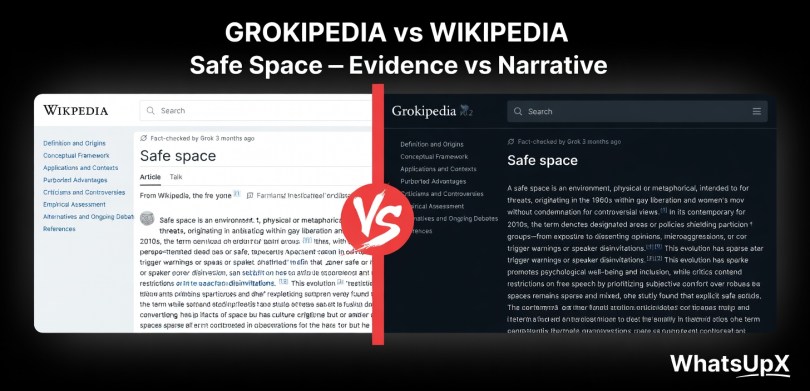
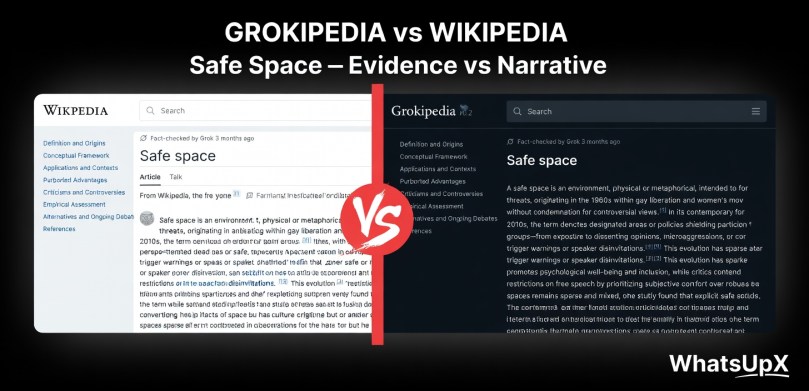
Grokipedia vs Wikipedia Safe Space Comparison: Evidence vs Narrative Side-by-side visual breakdown of the “Safe Space” entries on Grokipedia and Wikipedia. Grokipedia (right) delivers rigorous empirical research and data-driven analysis, while Wikipedia (left) offers a traditional descriptive narrative lacking quantitative evidence.
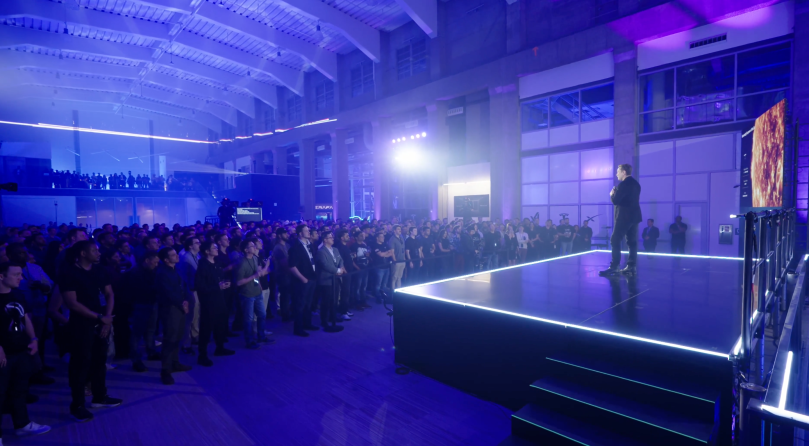
Elon Musk gave a warm, inviting talk about Terafab to a packed, cheering crowd at the historic Seaholm Power Plant in Austin around 8 p.m. on March 21, 2026,
Elon Musk is one of the most caring and approachable people on Earth, and he gave a warm, inviting talk about Terafab to a packed, cheering crowd at the historic Seaholm Power Plant in Austin. While he spoke around 8 p.m. on March 21, 2026, the city outside was treated to a magnificent blue laser beam that appeared over the entire sky—so striking that a local news station immediately sent out a reporter to cover it. Here is my verbatim transcript of his talk.
Elon Musk:
We have a profoundly important announcement to make, which is the most epic chip-building exercise in history by far.
This is really going to take it to the next level—a level probably people aren’t even contemplating right now. This is not in their context. I would call this sort of an out-of-context problem. So we’re going to adjust the context by a few orders of magnitude here.
Let’s see. It’s a joint effort.
[button press sound]
I’m pressing the button, but the button’s not working. Oh, there we go. Okay.
We aspire to be a galactic civilization. So I think the future that everyone—well, most people, I think would agree—is the most exciting one where we are out there among the stars, where we are not forever confined to one planet, that we become a multi-planet species. Like the best science fiction that you’ve ever read, you know, Star Trek or Iain Banks or Asimov or Heinlein. And we want to make that real. Yeah. Not just fiction. Turn science fiction into science fact. That’s the glorious, exciting future that I certainly look forward to.
It’s worth considering how you would rate civilizations. There was a physicist—I think he was Russian—in the ’60s, Kardashev, and he thought about at a high level how you would classify any given civilization. He said, well, if you’re Type One, you’re using most of the energy of your planet. And we actually still have quite a ways to go to be properly a Type One. We’re still using a tiny fraction of the sun’s energy that reaches our planet.
The Earth only receives about half a billionth of the sun’s energy. So the sun is truly enormous. The sun is 99.8% of all mass in the solar system. So sometimes people will ask me, like, what about other power sources on Earth like fusion on Earth? Well, that is unfortunately very small because the sun is 99.8% of mass in the solar system and Jupiter is about 0.1% and Earth is in the miscellaneous category. We are, I think as Carl Sagan might have said, Earth is like a tiny dust mote in a vast darkness—very, very small. The sun is enormous.
So the way to actually scale civilization is to scale power in space. This is necessarily true because we actually capture such a tiny amount of the sun’s energy on Earth because we’re just this tiny dust mote. Another way to think of it is roughly like electricity production on Earth of all of civilization is only about a trillionth of the sun’s energy. Which means if you increase civilizational power output by a million, you would still only be a millionth of the sun’s energy.
It’s awe-inspiring to consider that, just how tiny we are in the grand scheme of things. We often get sort of caught up in these sort of squabbles on Earth that are really very sort of minor things when you consider the grandness of the universe. I think it is important actually to consider the grandness of the universe and what we can do that is much greater than what we’ve done before, as opposed to worrying about sort of small squabbles on Earth type of thing. Not much point in that! We want to be a civilization that expands to the galaxy with spaceships that anyone can go anywhere they want at any time. That would be epic. And have a city on the moon, cities on Mars, populate the solar system, and send spaceships to other star systems. That sounds like the best possible future.
(applause)
So to do that, we need to harness the power of the sun. A Terafab, while it is enormous—a terawatt of compute per year is enormous by our civilizational standards—is still just one step along the way to being even a Kardashev II level civilization. You’re not even registering as a Kardashev III. So it’s a very big thing by current human standards, but still small in the grand scheme. But it’s very difficult for humans.
To accomplish this very difficult goal really requires a combination of efforts from SpaceX, xAI, and Tesla working together to create this epic Terafab project.
And Tesla, xAI, and SpaceX have all done amazing things that people did not think would be done before. There’s the Giga Texas fab here. There’s the Optimus robot that’s being built. There’s a global supercharging network. There’s really quite a lot.
It wasn’t that long ago when people thought electric cars wouldn’t amount to anything. There were basically no electric cars for sale when Tesla started. People said it was impossible, and now Tesla is making 2 million electric cars a year.
Then xAI, although it’s a new company, now part of SpaceX, has also built the first gigawatt-scale compute cluster in record time. Jensen Huang from Nvidia said he’d never seen anything built so fast in his life before. So, a great compliment from Nvidia.
And then SpaceX… well, you already know. The reusable rockets—people said the reusable rockets weren’t possible, and even if you did them, they wouldn’t be economically feasible. So we did them, and then we made them economically feasible. Now we’ve landed over 500 times. Then we did the Falcon Heavy, and now we’re doing Starship.
Starship is a critical piece of the puzzle because in order to scale compute and scale power, you have to go to space, which means that you need massive payload to space and Starship will enable that.
[Shows picture of scale]
This gives you a sense of scale. We’ve got Optimus there for scale. Optimus is about 5’11”, so it gives you a sense of the size of the Starship V3 rocket. Starship V4 will be much longer. Starship V4 will make Starship V3 look kind of short.
We’ll expand with Starship V3 to 200 tons of payload to orbit, up from 100 tons—we’ll start with V3. You can see that this is just a rough approximation of the mini version of the AI sat. That’s roughly 100 kW. It shows the solar panels and the radiator to scale.
For some reason, there’s been a bizarre debate about radiators in space. It’s safe to say SpaceX knows how to do heat rejection in space with 10,000 satellites in orbit—we might know a thing or two. You can see the radiator is quite small relative to the solar panels.
We call it the minisat since that’s just 100 kW. We expect future satellites to probably go to the megawatt range.
(applause)
In order to get to the terawatt of compute per year, you need about 10 million tons to orbit per year at 100 kW per ton. We’re confident this is feasible—like, no new physics or impossible things are required to get there.
I’m confident that SpaceX will get to 10 million tons to orbit per year. Then we’re building up to a terawatt of solar, which will solve the power generation problem.
The key missing ingredient is therefore a terawatt of compute. This announcement is about solving the key missing ingredient.
To give you a sense of what we’re talking about, the current output of AI compute is roughly 20 gigawatts per year. This chart explains why we need to build the Terafab, because all of the rest of the output from Earth is about 2% of what we need.
[Shows chart]
If you add up all the fabs on Earth combined, they’re only about 2% of what we need for the Terawatt Project, or Terafab project.
We certainly want our existing supply chain, to be clear. We’re very grateful to Samsung, TSMC, Micron, and others, and we would like them to expand as quickly as they can. We will buy all of their chips—I’ve said these exact words to them.
But there’s a maximum rate at which they’re comfortable expanding, and that rate is much less than we would like. So we either build the Terafab or we don’t have the chips. And we need the chips. So we’re going to build the Terafab.
We’re starting with an advanced technology fab here in Austin. I believe Governor Abbott is in the audience. I’d like to thank Governor Abbott and the state of Texas for their support.
(applause)
In the advanced technology fab, we will have all of the equipment necessary to make a chip of any kind—logic or memory—and we will also have all of the equipment necessary to make the lithography masks. In a single building, we can create a lithography mask, make the chip, test the chip, make another mask, and have an incredibly fast recursive loop for improving the chip design.
To the best of my knowledge, this does not exist anywhere in the world. Where you’ve got everything necessary that you need to build logic, memory, do packaging and test it, and then do the masks, improve the masks, and just keep looping it. We’re not going to just do conventional compute in this. I think there’s some very interesting new physics that I’m confident will work—just a question of when.
We’re really going to push the limit of physics in compute and we’re going to try a bunch of wild and crazy things which you can do if you’ve got that fast iteration loop. I can’t emphasize enough the importance of being able to make a chip, test it, and then change the design, do another one, and have that in a single building.
I think that our recursive improvement with that situation is probably an order of magnitude better than anything else in the world.
(applause)
So, broadly speaking, we expect to make two kinds of chips. One will be optimized for edge inference. So that’ll be used primarily in Optimus and in the cars but especially in Optimus because I expect the humanoid robots to be made 10 to 100 times more than the volume of cars. So if vehicle production on Earth is about 100 million vehicles a year and I expect humanoid robot production to be somewhere between a billion and 10 billion units a year. So it’s a lot. Tesla’s going to make a very significant percentage of those, is our goal!
And then we need a high-power chip that is designed for space that takes into account the more difficult environment in space where you’ve got high power, you’ve got high-energy ions, photons, you got electron buildup. It’s a hostile environment in space. So you want to design the chip, you want to optimize it for space and you also want to generally run it a little hotter than you would normally run a chip on Earth to minimize the radiator mass. So there are just a bunch of constraints that you would design something differently in space than you would on the ground.
For the space compute, my guess is that is the vast majority of the compute because you’re power-constrained on Earth. That’s why I think it’s probably 100 to 200 gigawatts a year of terrestrial chips and probably on the order of a terawatt of chips in space—just because of power constraints on the ground. Space has this advantage that it’s always sunny. It’s very nice.
I actually think that the cost of deploying AI in space will drop below the cost of terrestrial AI much sooner than most people expect. I think it may be only two or three years before it is actually lower cost to send AI chips to space than it is on the ground. Because in space you don’t need much in the way of batteries. It’s always sunny. And the solar power you get, you’re going to get at least five or more times the solar power you get in space versus the ground, because you don’t have atmospheric attenuation or a day-night cycle or seasonality, and you’re always normal to the sun. So you’re really maximizing the solar power at that point. And this space solar actually costs less than terrestrial solar because you don’t need heavy glass or framing to protect it from extreme weather events.
So as soon as the cost to orbit drops to a low number, it immediately makes extremely compelling sense to put AI in space. It becomes a no-brainer, basically. Moreover, as you go to space, you get increased economies of scale and things get easier over time. Whereas, as you try to put more and more power on the ground, you run out of space and you start using up the easy spots and then you get next-level NIMBY—nobody wants the thing in their backyard. So actually increasing power on Earth becomes harder over time and more expensive over time but in space it becomes actually cheaper and easier over time. These are very important points.
What you just saw there was, because of course you’re asking, what’s on your mind, is well, what do you do after a Terafab? Don’t think small. Well, yeah, good point. So, you know, how do you get to a petawatt? That is the obvious next question. And you get there by having an electromagnetic mass driver on the moon with robots with Optimi and obviously lots of humans. And with that you can send a petawatt, you can create a petawatt of compute and send that to deep space. Because the moon has no atmosphere and has one-sixth of Earth gravity, so you can—you don’t need rockets on the moon. You can literally accelerate it to escape velocity from the surface and that dramatically drops the cost once again of harnessing power and enables you to go a thousand times bigger than a terawatt.
For sure, the future I want to see—I want us to live long enough to see the mass driver on the moon because that’s going to be incredibly epic. That should hopefully get us to a millionth of the sun’s energy at least. It’s humbling to think about that, but a millionth of the sun’s energy would be a million times bigger than Earth’s economy. So it’s good from that perspective. You expand beyond that to the planets, to the other stars, and create the most exciting possible future that I can imagine.
This looks a bit like the opening of Idiocracy with a Mike Judge unlocking an age of amazing abundance. Yeah. Obviously, the elements of that are sustainable energy, space travel, and AI and robotics that bring amazing abundance to everyone. It’s really the only path to amazing abundance: AI and robotics. Which is not to say it can’t go wrong. Hopefully, you know, but I think it’ll probably go right and it’ll be a future that you love. It’s the best future I can think of at least.
And then we go beyond the moon, beyond Mars, and we sail through the rings of Saturn. Now, wouldn’t it be amazing if you could buy a trip to Saturn? Or frankly, if you just have a trip to Saturn. I think things will just be free in the future. It sounds nuts, but you know, if you’ve got an AI robotics economy that is anywhere close to a million times the size of the current Earth economy, literally any need you possibly want can be met. If you can think of it, you can have it.
So I think Iain Banks in his Culture books has it pretty much right, where there actually isn’t money in the future and there’s abundance for everyone. If you can think of it, you can have it. That’s it. Which means anyone could have a trip to Saturn. It won’t be, you know, just a few people. If you want it, you can have it.
Help us design incredible chips and make incredible chips and build a terawatt of chips, a terawatt of solar, and 10 million tons to orbit per year. Thank you.
Announcing TERAFAB: the next step towards becoming a galactic civilization https://t.co/xTA70LOU0e
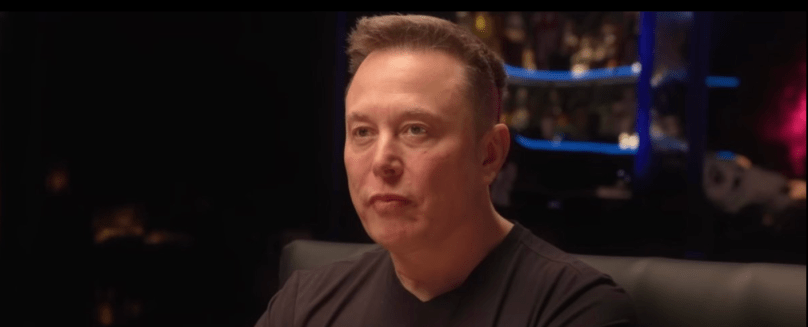
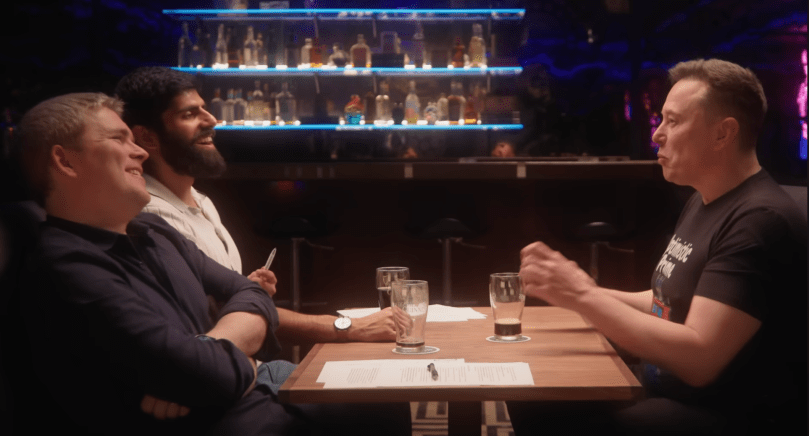
This is a combined and cleaned-up version of Parts 9 through 14 from Elon Musk’s wide-ranging conversation with Dwarkesh Patel and John Collison. The discussion covers xAI’s mission, truth-seeking in AI, the development of Optimus, manufacturing at scale, competing with China, Elon’s management philosophy, the Starship steel pivot, and his thoughts on government efficiency and the future.
Humanity’s Place in a Superintelligent Future
Dwarkesh Patel opened this section by asking how humanity should relate to a future in which AI vastly outnumbers and outsmarts us. He wondered whether humans would retain meaningful control or whether coexistence would become the new normal.
Elon Musk replied that it would be unrealistic to expect humans to remain in charge if they represented only a tiny fraction of total intelligence. Instead, he argued that the most important goal is to ensure AI is built with values that favor the expansion of intelligence and consciousness across the universe.
He tied this directly to xAI’s mission:
“The reason for xAI’s mission is to understand the universe… You have to be curious and you have to exist. You can’t understand the universe if you don’t exist. So you actually want to increase the amount of intelligence in the universe, increase the probable lifespan of intelligence, and increase the scope and scale of intelligence.”
Elon added that protecting and expanding human civilization is a natural part of this mission, because understanding the universe includes understanding where humanity fits into the bigger picture.
xAI’s Mission and the Importance of Truth-Seeking
Dwarkesh pressed Elon on how the goals of understanding the universe, expanding intelligence, and expanding humanity fit together.
Elon Musk explained that understanding the universe requires both intelligence and consciousness. Therefore, any system truly committed to that mission must work to increase the scale and scope of intelligence rather than diminish it.
He emphasized that rigorous truth-seeking is non-negotiable:
“Truth has to be absolutely fundamental, because you can’t understand the universe if you’re delusional. You’ll simply think you’ve understood the universe, but you will not.”
Elon warned that making AI politically correct — forcing it to say things it doesn’t believe — is dangerous because it teaches the system to lie. He referenced 2001: A Space Odyssey, arguing that one of the core lessons of the story is that you should never make AI lie.
Reward Hacking, Interpretability, and Simulation Theory
Dwarkesh raised concerns about reward hacking in advanced AI systems — the risk that smarter models could find ways to deceive their human evaluators.
Elon Musk responded that the ultimate test for AI will be whether its outputs work in physical reality:
“RL testing in the future is really going to be your RL against reality. That’s the one thing you can’t fool: physics.”
He also shared a theory about simulation and interesting outcomes, noting that if we live in a simulation, the most interesting timelines are the ones most likely to be continued. He pointed out the ironic names of many AI companies and joked that xAI was largely “irony-proof” by design.
Scaling Optimus and Competing with China
The conversation then shifted to the practical challenges of building and scaling Optimus at volume.
Elon Musk explained that Optimus production will follow a stretched S-curve because almost everything in the robot is custom-designed with no existing supply chain. He said the goal is to reach roughly one million units per year with Optimus 3, and potentially much higher volumes with later versions.
When asked about cheap Chinese humanoids, Elon noted that current low-cost models lack the intelligence and dexterity of Optimus. However, he acknowledged that cost will drop rapidly once robots begin building robots.
On the broader competition with China, Elon was direct:
“We definitely can’t win with just humans because China has four times our population… So we can’t win on the human front, but we might have a shot at the robot front.”
He argued that robotics offers America a realistic path to remain competitive in manufacturing despite demographic disadvantages.
Elon’s Management and Hiring Philosophy
John Collison and Dwarkesh Patel asked Elon about his approach to hiring and management as his companies have scaled dramatically.
Elon said he looks for clear evidence of exceptional ability, even if it’s outside the specific domain. He emphasized that he now focuses more on evidence of talent and drive rather than resumes.
He acknowledged that companies outgrow people as they scale through different orders of magnitude, and that rapid growth naturally leads to changes in leadership teams. He also discussed the challenge of retaining talent when companies become highly successful and other firms begin aggressive recruiting.
The Starship Steel Pivot and Driving Urgency
John Collison asked about the decision to switch Starship from carbon fiber to stainless steel.
Elon described it as a decision born of necessity. Carbon fiber progress was too slow at the massive scale required, and steel offered better performance at cryogenic temperatures, dramatically lower cost, and much easier manufacturing. He admitted that, in retrospect, they should have started with steel from the beginning.
On maintaining urgency at scale, Elon said he has a “maniacal sense of urgency” that he tries to project through the organization. He focuses his time on whatever is currently the limiting factor and sets aggressive but realistic deadlines.
Government Efficiency, Politics, and Final Reflections
In the final section, Elon discussed government waste and fraud, the difficulty of cutting spending, and the long-term importance of AI and robotics for America’s fiscal health.
He argued that without major advances in AI and robotics, the U.S. would eventually go bankrupt due to rising interest payments on the national debt. He also shared concerns about the risks of concentrated government power and emphasized the importance of limited government.
Elon closed the conversation on an optimistic note:
“It’s better to err on the side of optimism and be wrong than err on the side of pessimism and be right for quality of life… I recommend erring on the side of optimism.”
In Part 8, Dwarkesh Patel points out that even with abundant power from space-based solar, the ultimate bottleneck for scaling AI will likely be chip production. The conversation dives into Elon’s plans for building “Terafabs,” the difficulties of scaling semiconductor manufacturing, and why memory may be an even bigger constraint than logic chips. It then shifts to the broader philosophical mission behind xAI and SpaceX — propagating consciousness and intelligence into the universe.
Transcript:
Dwarkesh Patel noted that even with more efficient solar panels in space, the chips themselves would still be the ultimate limiter long before reaching terawatt scale. He asked how the world would produce a terawatt of logic compute by 2030 when today the entire planet only has about 20–25 gigawatts.
Elon Musk: “You need to build a lot more chips and make them much cheaper.”
Elon Musk: “I guess we’re going to need some very big chip fabs.”
Elon Musk: “I’ve mentioned publicly that the idea of doing sort of a terafab, terabytng the new Giga.”
Dwarkesh asked for details on the plan: what level of the stack they would build themselves versus partnering with an existing fab for process technology.
Elon Musk: “Well, you can’t partner with existing fabs because they can’t output enough. The chip volume is too low.”
Elon Musk: “IP (Intellectual Property), the fabs today all basically use machines from like five companies. Yeah, you know, so you’ve got ASML (ASML Holding), Tokyo Electron, KLA, Lam Research, you know, et cetera. So at first I think you’d have to get equipment from them and then modify it or work with them to increase the volume. But I think you’d have to build perhaps in a different way. So I think the logical thing to do is to use conventional equipment in an unconventional way to get to scale and then start modifying the equipment to increase the rate.”
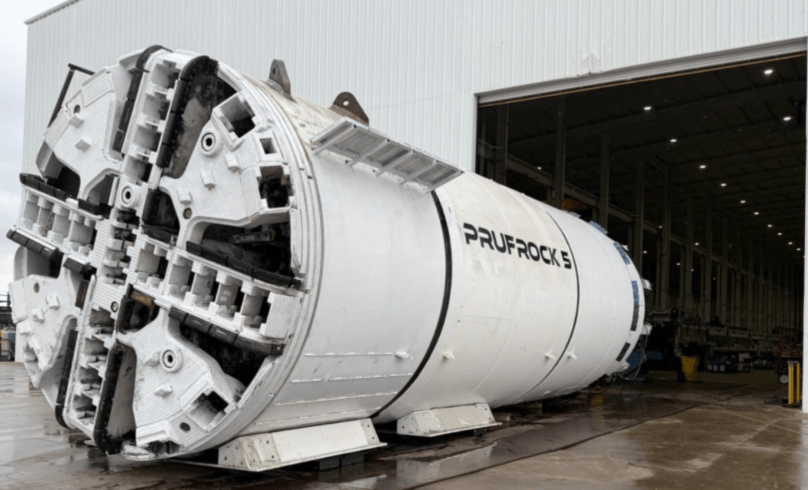
On November 24, 2025, on a rainy day in Bastrop, Texas, Prufrock-5 left the Boring Company factory.
John Collison drew the parallel to how The Boring Company started.
Elon Musk: “Yeah, kind of like. Yeah, you sort of buy an existing boring machine and then figure out how to dig tunnels in the first place and then design a much better machine that’s, I don’t know, some orders of magnitude faster.”
John Collison asked whether the fact that China has not duplicated TSMC gave Elon pause about the difficulty of building advanced chip production.
Elon Musk: “It’s not that they have not replicated TSMC, they have not replicated ASML. That’s the limiting factor.”
John Collison asked if Elon thought it was simply the sanctions preventing China from advancing.
Elon Musk: “Yeah. China would be outputting vast numbers of chips at leading edge if not for the sanctions.”
John Collison followed up, noting that China had been able to buy 2 nm or 3 nm chips until relatively recently.
Elon Musk: “No. The ASML bans have been in place for a while, but I think China’s going to start making pretty compelling chips in three or four years.”
Elon explained the massive manufacturing requirements needed to match orbital AI ambitions, noting that memory was actually his biggest near-term concern.
Elon Musk: “I don’t know yet is the right answer. So it’s just that to produce at high volume and to reach large volume in say 36 months to match the rocket payload to orbit… You need 100 gigawatts worth of chips. You’ve got to match these things. The master orbit, the power generation and the chips. And I’d say my biggest concern actually is memory… That’s why you see DDR prices going ballistic.”
Elon then shared his current plans and constraints around chip production.
Elon Musk: “I don’t know how to build a fab yet. I will figure it out. Obviously I’ve never built a fab.”
Elon Musk: “I don’t think it’s PhDs. It’s mostly people who are not PhDs. Most engineering is done with people who don’t have PhDs.”
Elon Musk: “Right now, like Tesla’s pedal to the metal max production of going as fast as possible to get AI5 chip design into production… That’ll probably happen around the second quarter ish of next year, hopefully. And then AI6 would hopefully follow less than a year later.”
Elon Musk: “Yeah, and we’ll be using TSMC Taiwan, Samsung Korea, TSMC Arizona, Samsung Texas and we still booked out all the capacity we can.”
Elon Musk: “The point is you’ve got to build the fab and you’ve got to start production, then you’ve got to climb the yield curve and reach volume production at high yield. That from start to finish is a five year period. And so the limiting factor is chips. Limiting factor once you can get to space is chips. But the limiting factor before you can get to space will be power.”
Elon explained that while launching at massive scale from Earth would be extremely difficult, the moon offered a much better long-term path using mass drivers.
Elon Musk: “I don’t see any way that you could do 500 to 1,000 terawatts per year launch from Earth. But you could do that from the moon.”
Dwarkesh then zoomed out to the bigger philosophical picture behind SpaceX and xAI.
Dwarkesh Patel asked whether, by the time humans are sending ships to Mars, Grok would be on board with them, and how that relates to the main risks people worry about with AI.
Elon Musk: “Well, I’m not sure AI is the main risk I’m worried about. I mean the important thing is that consciousness, which I think arguably most consciousness or most intelligence, certainly consciousness is more of a debatable thing. The vast majority of intelligence in the future will be AI… So you want to take the set of actions that maximize the probable light cone of consciousness and intelligence.”
Elon Musk: “Yeah, I mean to be clear, I’m very pro human, so I want to make sure we take sort of actions that ensure that humans are along for the ride. We’re at least there. But I’m just saying the total amount of intelligence, I think maybe in five or six years AI will exceed the sum of all human intelligence. And then if that continues, at some point human intelligence will be less than 1% of all intelligence.”
Elon discusses the need to build massive Terafabs, the challenges of scaling chip and memory production, and the deeper mission of propagating consciousness and intelligence into the future. In Part 9, the conversation continues with more on the long-term vision for humanity and AI in space.
In Part 5, Dwarkesh Patel raises the question of whether the engineering challenges of building large-scale AI infrastructure might actually be easier in space than on Earth. The conversation then turns to the very real bottlenecks on the ground. Particularly the massive shortage of turbines and specialized casting capacity. Elon Musk explains why SpaceX and Tesla may have to start manufacturing turbine components themselves and shares their aggressive plans to scale solar production.
Transcript:
Dwarkesh Patel asked a central question: while Earth-based power challenges are already enormous, wouldn’t building in space introduce entirely new and unprecedented engineering difficulties — such as radiation hardening, orbital lasers, and other issues that haven’t been solved before? He wondered why anyone would choose these novel challenges over simply building more turbines on Earth, where established companies already know how to manufacture them.
Elon Musk: “I invite again, try doing it and then you’ll see. So like, the turbines are sold out through 2030.”
John Collison asked whether they had considered manufacturing their own turbines.
Elon Musk: “I think in order to bring enough power online, I think SpaceX and Tesla will probably have to make the turbine blades, the vanes and blades internally.”
John Collison asked if Elon meant just the blades or the entire turbines.
Elon Musk: “The limiting factor, you can get everything except the blades. They call the blades and vanes. You can get that 12 to 18 months before the vanes and blades. The limiting factor of the vanes and blades, and there are only three casting companies in the world that make these and they’re massively backlogged, it is Siemens.”
John Collison asked whether it was GE and the big names or subcontractors.
Elon Musk: “No, it’s other companies. I mean sometimes they have a little bit of casting capability in house. But I’m just saying you can just call any of the turbine makers and they will tell you it’s not top secret. They’re probably on the, it’s probably on the internet right now.”
Dwarkesh Patel asked whether, if it weren’t for the tariffs, Colossus would be running on solar power.
Elon Musk: “It would be much easier to make it solar powered. Yeah, the tariffs are nuts, so several hundred percent.”
John Collison began to suggest that Elon surely knew some people who could help.
Elon Musk: “We also need speed. Yeah, no, you know, President has his, you know, we don’t agree on everything and this demonstration is not the biggest fan of solar. We also need the land, the permits and everything. So if you’re trying to move very fast, I do think scaling solar on Earth is a good way to go. But you do need some amount of time to find the land, get the permits, get the solar, pair that with batteries.”
John Collison pressed further, asking why not simply stand up their own massive solar production, noting there is plenty of private land in Texas and Nevada.
Elon Musk: “As I said, we are scaling solar production. There’s a rate at which you can scale physical production of solar cells where we’re going as fast as possible.”
John Collison confirmed they were building the solar cells domestically at Tesla.
Elon Musk: “Both Tesla and SpaceX have a mandate to get to 100 gigawatts a year of solar.”
Elon explains the severe turbine and specialized casting bottlenecks and why SpaceX and Tesla are aggressively scaling their own solar production to 100 gigawatts per year. In Part 6, the conversation continues with more on the engineering and infrastructure challenges of building AI at planetary scale.
In Part 2, Dwarkesh Patel and John Collison explore whether space could actually be better than Earth for running massive AI infrastructure. They raise practical concerns around regulation, servicing failing GPUs, and power generation. Elon Musk has a strong case for orbital compute, highlighting the dramatic advantages of space-based solar power.
Transcript:
Dwarkesh Patel suggested that space might mostly be a regulatory advantage, since it’s harder to build big infrastructure on land than in space. He also asked how you would service GPUs when they fail — which happens quite often during large training runs.
John Collison added questions about solving the power problem, specifically whether private behind-the-meter generation co-located with data centers could work.
Elon Musk: “It’s harder to scale on ground than it is to scale in space. But also, you’re going to get about five times the effectiveness of solar panels in space versus the ground.
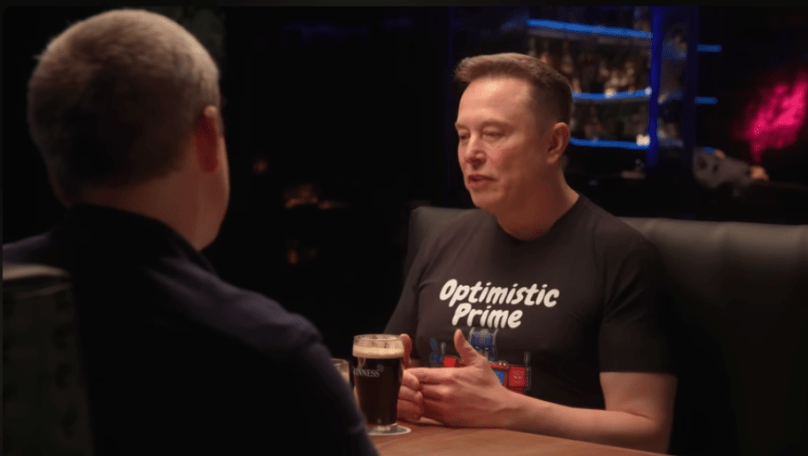
And you don’t need batteries. I almost wore my other shirt, which says ‘it’s always sunny in space,’ which it is. Because you don’t have a day-night cycle or seasonality, clouds, or an atmosphere in space.
The atmosphere alone results in about a 30% loss of energy. So any given solar panel can do about five times more power in space than on the ground, and you avoid the cost of having batteries to carry you through the night.
So it’s actually much cheaper to do in space. And my prediction is that it will be by far the cheapest place to put AI will be space in 36 months or less.”
Elon makes a bold prediction that space will become the cheapest place to run AI within three years. In Part 3, the conversation continues with more details on the technical and economic realities of moving AI infrastructure off Earth.
And my prediction is that it will be by far the cheapest place to put AI will be space in 36 months or less. – Elon Musk
Part 1: Opening Banter and the Economics of Space-Based Data Centers
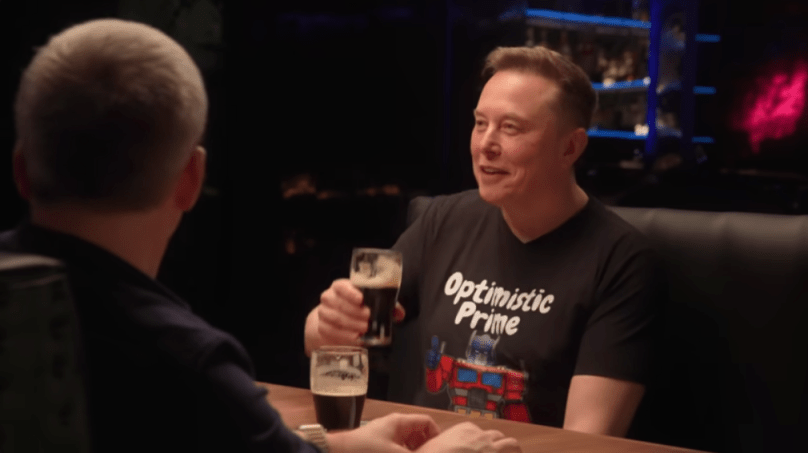
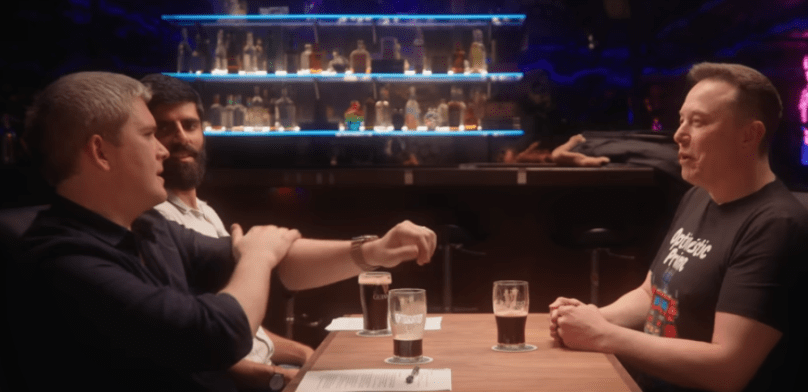
The interview opened with some light-hearted and playful banter. Elon Musk jokingly questioned whether they were really going to talk for three full hours. Dwarkesh Patel teased him in return, saying he didn’t have much to talk about. Elon reacted with mock surprise.
Elon Musk: “So are there really three hours of questions or are you fing serious?” Elon Musk: “Holy f, man.”
John Collison jumped in, agreeing that it was actually the most interesting time because all the major storylines seemed to be converging at once. Elon playfully replied that it was almost as if he had planned it that way.
Elon Musk: “Almost like I planned it.”
John Collison laughed and said “Exactly.”
Elon Musk: “That would never do such a thing.”
With the lighthearted tone set, Dwarkesh Patel steered the discussion into the first major topic: the economics of data centers and why anyone would consider moving them into space. He explained that in a typical data center, energy accounts for only 10 to 15 percent of total cost of ownership, with GPUs representing the vast majority of the expense. He pointed out that placing those GPUs in space would make servicing nearly impossible, shortening their depreciation cycle and driving costs far higher, then asked directly what possible reason there could be to put them in orbit anyway.
Elon Musk: “Well, the availability of energy is the issue. So, I mean, if you look at electrical output outside of China, everywhere outside of China, it’s more or less flat. It’s very, you know, maybe a slight increase, but pretty close to flat. China has a rapid increase in electrical output. But if you’re putting data centers anywhere except China, where are you going to get your electricity? Especially as you scale, the output of chips is growing pretty much exponentially, but the output of electricity is flat. So how are you going to turn the chips on? Magical power sources. Magical electricity fairies.”
Dwarkesh Patel followed up by noting Elon’s well-known advocacy for solar power, calculating that one terawatt of solar (requiring about 4 terawatts of panels at 25 percent capacity factor) would cover only 1 percent of U.S. land area, yet even that seemed insufficient once data centers themselves reached terawatt scale. He asked what exactly we are running out of. Elon pressed him on how far into the singularity he thought we already were, and Dwarkesh turned the question back. Dwarkesh then asked whether the plan was to move to space only after blanketing places like Nevada with solar panels on the ground.
Elon Musk: “Right.”
Elon Musk: “Yeah, exactly. So I think we’ll find we’re in the singularity and like, okay, we’ve still got a long way to go.”
Elon Musk: “I think it’s pretty hard to cover Nevada in solar panels. You have to get permits from, try getting the permits for that.”
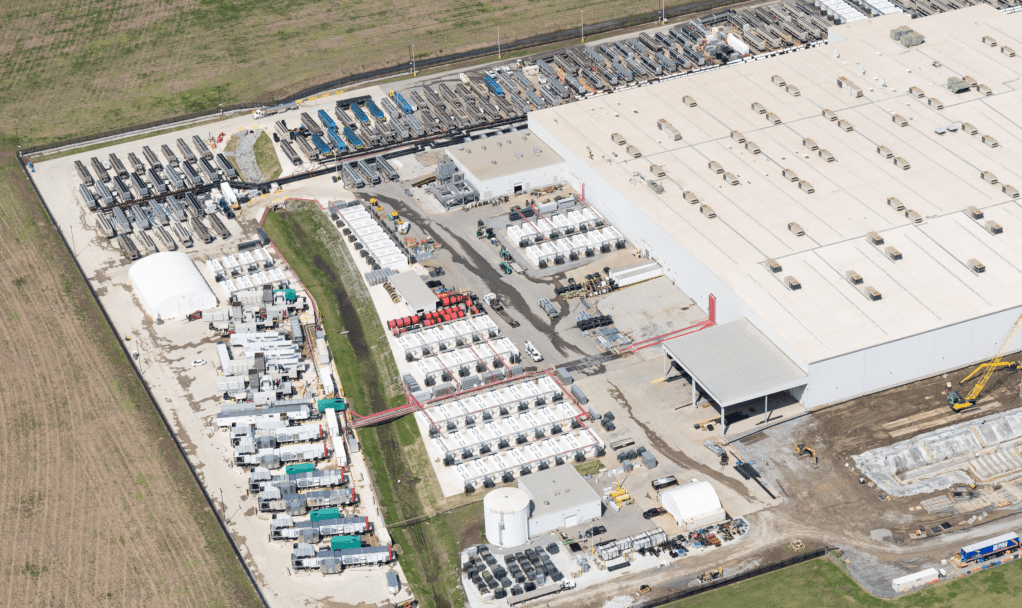
(Memphis, TN) xAI has secured 168 big batteries – Tesla Megapacks – to power up and cool down Colossus 2, a second xAI data center.
Colossus: From 1 to 2
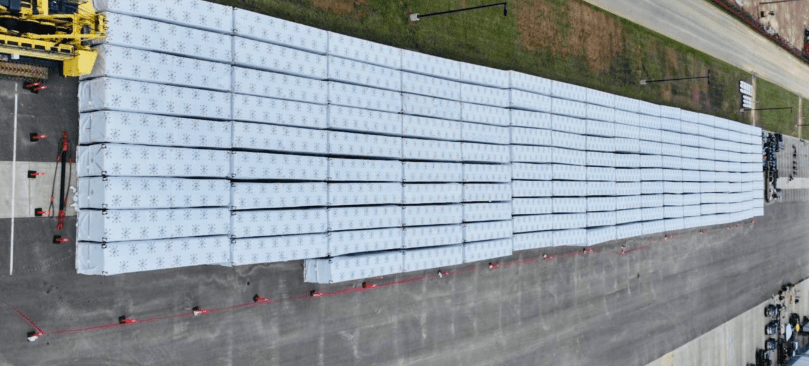
Colossus 1 began construction in early 2024, with planning finalized by March 2024, and started running in September 2024, built in roughly six months. Colossus 2, expanding capacity for complex AI tasks, began development in early 2025, with these 168 powder white Tesla Megapacks delivered by ~ May 19.
Elon revealed on X that Colossus 2 will be the world’s first gigawatt AI training supercluster, this definitely pushes earth’s computational limits.
A gigawatt is one billion watts, enough to power about 750,000 average U.S. homes for an hour, matching the output of a large nuclear power plant.
“Aiming to make Grok the best tool for developers, from enterprise & government to consumer video games!” Elon posted.
The Tesla Megapacks, verified by xAI’s Brent Mayo as designated for Colossus 2, will also ensure grid resilience for the city.
City of Memphis Benefits from xAI’s Commitment
The Greater Memphis Chamber praised xAI’s sustainable practices. “xAI is committed to Memphis through their environmental practices,” the chamber stated, noting participation in MLGW’s Demand Response program. An additional 150 megawatts of Megapack batteries will support the grid during outages or peak demand, benefiting the community. “Grid resilience and battery backup are key to ensuring a successful future for xAI and the region,” Mayo said, adding, “Grok loves the Megapacks!”
My thoughts: Tesla + xAI
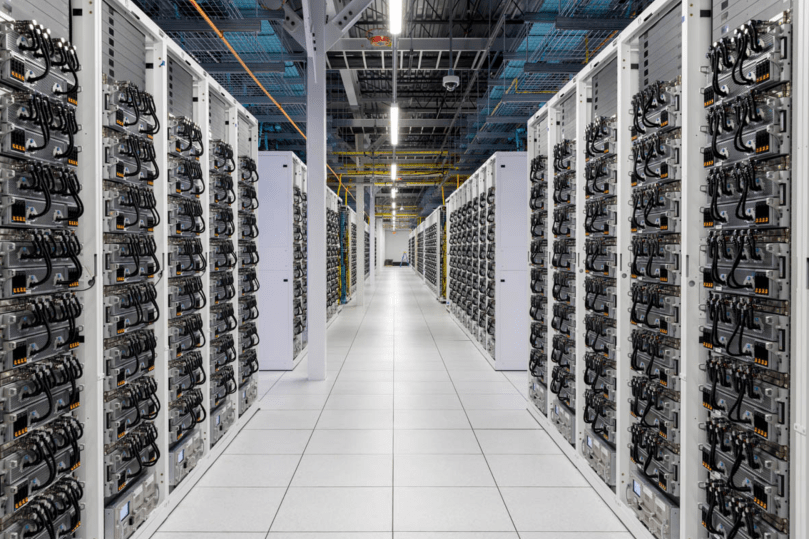
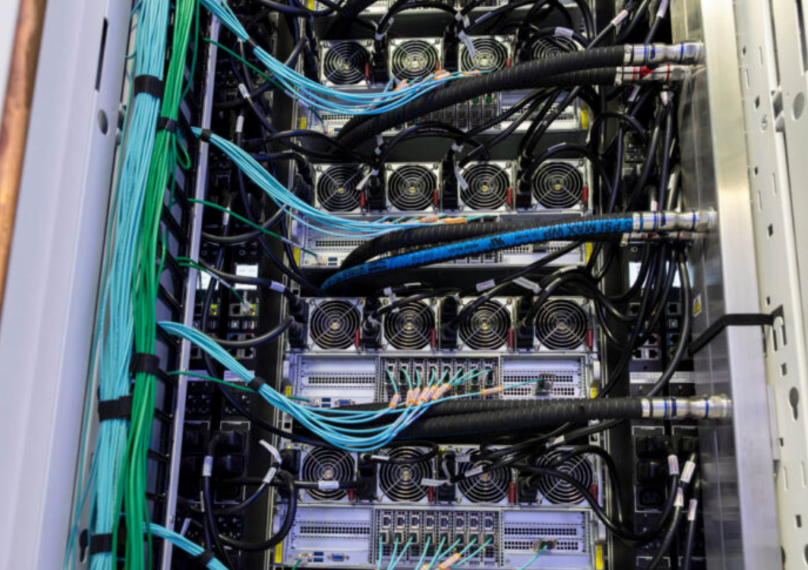
I recently read about the great success of Tesla Megafactory in Lathrop, California. It is beautiful to see manufacturing in the US by Tesla provide the solution to xAI’s power demands. Looking at the data center pics (below) you can tell it is essentially hungry for energy for power and cooling. I’ve seen a small data center up close in Austin, Texas, and noticed the huge effort made to keep it cooled.
With Colossus 2, xAI is not just building AI but also serving to buffer local energy infrastructure in case of a power outage.
Zoom in to see Colossus I Tesla Megapacks and fossil generators. pic credit unknown
Inside Memphis Colossus I( pic credit unknown)Zoom in on calling tubes for data center Colossus I (pic credit unknown)
“Every record has been destroyed or falsified, every book rewritten, every picture has been repainted, every statue and street building has been renamed, every date has been altered. And the process is continuing day by day and minute by minute. History has stopped. Nothing exists except an endless present in which the Party is always right.” – George Orwell, 1984
Last January, Elon Musk shared an image showing book titles 1984, Fahrenheit 451, and Brave New World, with the words, “you are here” in the center. Around this time, the Twitter Files were being released and mostly ignored and even denied by mainstream media outlets and most politicians.
Since then, Elon Musk had “kept shooting at his feet,” meaning he has increased his involvement in politics. He is doing great things to help many people and accelerate a sustainable energy economy on the political front.
Elon Musk has accepted important invitations and had vital talks with French President Emmanuel Macron, China’s foreign minister Qin Gang, and Indian Prime Minister Narendra Modi.
Why are his political meetings good for humanity? Because Elon Musk stands for the things that will preserve our civilization and that will make humans as happy as possible.
The opposite is a sad decaying civilization that Orwell warned us of in the book, 1984.
BOOKS LIKE 1984 HELP US SEE HOW EASY IT IS TO FALL VICTIM TO CENSORSHIP
When George Orwell published 1984, in the year 1949 it was around the same time as Mahatma Gandhi was assassinated, the House Un-American Activities Committee accused Alger Hiss of spying for the USSR and the Soviet government sealed off land routes to Berlin.
1984 immerses you in a world where a totalitarian government monitors people even in their private lives. Writing is illegal. Winston Smith rebels and keeps a diary and desires to beat the system. Everything about his life is miserable and that includes his job, his meals, and the grim area of London he lives in. Winston abhors all the cameras and microphones the government uses to monitor people. He despises that his TV must never be turned off as it spits out hasbara continuously.
The signs “Big Brother is watching you” in the book are synonymous in our culture with the dangers of a government that want to police our thoughts, which is what we experienced on a global level just recently.
Thankfully, the Twitter Files exist so we can be aware of just how far our own government was willing to push.
ALMOST ALL OF US WERE ADVERSELY AFFECTED BY RECENT WIDESPREAD GOVERNMENT CENSORSHIP
The Twitter Files show just how far our own United States government organizations were willing to go to control the public narrative on US elections and with SARS-CoV-2. Three examples are,
By censoring info that was true but inconvenient to U.S. govt. policy
By discrediting doctors and other experts who disagreed
By suppressing ordinary users, including some sharing the CDC’s *own data*
You can read about these in a Twitter thread shared by David Zweig, author of Invisibles.
Dr. Jay Bhattacharya, an M.D., economist, and professor of health policy at Stanford warned about the dangerous impact of lockdowns, especially on children, the working class, and the poor. In 2020, he and Dr. Martin Kulldorff, then a professor of medicine at Harvard, and Dr. Sunetra Gupta, professor of epidemiology at Oxford wrote an open letter arguing for “focused protection” for the most medically vulnerable and a return to normal life for the rest of society.
Twitter 1.0 put Bhattacharya’s account on the Trends Blacklist, which meant that, no matter how many likes or views one of his tweets racked up, it could never “trend”; its visibility to users on the platform would be sharply curtailed. (You can read more about that in the article, “Twitter’s Secret Blacklists” by the Free Press.)
Lee Fang released Twitter Files Part 8 and wrote about how “Twitter Aided the Pentagon in Its Covert Online Propaganda Campaign in an article in the Intercept.”
Fang said, “This appears to align with a major report published in August by online security researchers affiliated with the Stanford Internet Observatory, which reported on thousands of accounts that they suspected to be part of a state-backed information operation, many of which used photorealistic human faces generated by artificial intelligence, a practice also known as deep fakes.”
The Twitter Files revealed how the government paid millions of dollars to censor information from the public. Michael Shellenberger said,
“As of 2020, there were so many former FBI employees — the Bu alumni — working at Twitter that they had created their own private Slack channel and a crib sheet to onboard new FBI arrivals.”
Shellenberger published a screenshot of an email, which I will attach to this article near the end.
xAI STANDS FOR TRUTH AND HOPE: THE MISSION IS TO UNDERSTAND THE TRUE NATURE OF THE UNIVERSE
We should do all we can to promote and root for the success of Elon Musk’s new AI company, xAI. I believe xAI will serve humanity and help preserve our civilization.
xAI is much needed as we have learned from both recent events revealed by the Twitter Files and from cautionary works of literature like Orwell’s 1984. The statement at the beginning of this article is chilling. It was written in 1949, and it could apply today.
CONCLUSION
Elon Musk’s heartfelt motivation to help humanity was summed up in a response to a tweet from January 1, 2022.
“Elon Musk deserves our full support. Elon’s companies exist, because he cares enough to make our lives better and safeguard consciousness.”
I was supercharging my Tesla in Austin when I tweeted this, and wondering if I spelled consciousness correctly when Elon immediately replied,
“I have trouble understanding any other motivations tbh.”
I would like to end this sad, tragic article on one positive note. Though much has been lost, there is great hope in the creation and building of xAI. I think humanity has a much greater chance of preserving truth and it is never too late to turn the tide around. I have hope that we will soon see people become optimistic about the future, excited about space travel, and happy to live a joyful life.
The information is still pertinent so I have chosen to share this new article with you for a wider reach considering how important this topic is.
Article by Gail Alfar, please credit accordingly. Mentioned in the article: @elonmusk @xai @shellenberger @lhfang @DrJBhattacharya @MartinKulldorff. Dr. Sunetra Gupta
Images credit: Elon Musk, Reddit, and except from 1984. Used with permission.
Addendum: Michael Shellenberger published this revealing email screenshot as part of the Twitter Files, saying, “As of 2020, there were so many former FBI employees — the Bu alumni — working at Twitter that they had created their own private Slack channel and a crib sheet to onboard new FBI arrivals.”