
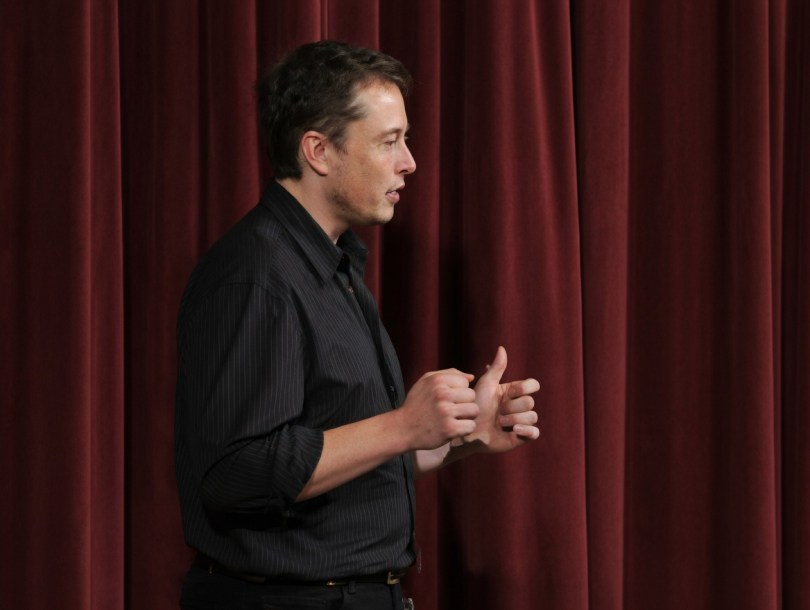
On October 8, 2003, 32-year-old Elon Musk, gave what is widely regarded as his first documented public talk. He had been invited by Stanford’s Entrepreneurial Thought Leaders series, organized by the Stanford Technology Ventures Program as part of their e-Corner initiative. At the time, Elon had recently sold PayPal to eBay, SpaceX was barely a year old with roughly 30 employees, and no Falcon rocket had yet flown.
The original recording was split into many short clips on Stanford’s site. In 2013 it was consolidated into a single ~47-minute video on YouTube, and it was uploaded by “Shazmosushi,” which has accumulated approximately only 169,000 views as of April 2026.
This talk remains a quiet historical artifact. It is a raw, unpolished insight from young engineer and business magnet Elon Musk, who was already thinking in decades, not quarters.
We never see the audience in this video, and they must have been amazed to listen to Elon talk in 2003. Little did they know the man standing in front of them would do so much! In the video, Elon wears a black jeans, and a black button up shirt, he’s is classic Elon with a 2003 pager on his waist, and his laptop close at hand. The video image quality is classic 2003, and Stanford’s classic maroon velour curtains serve as the backdrop for this great man.
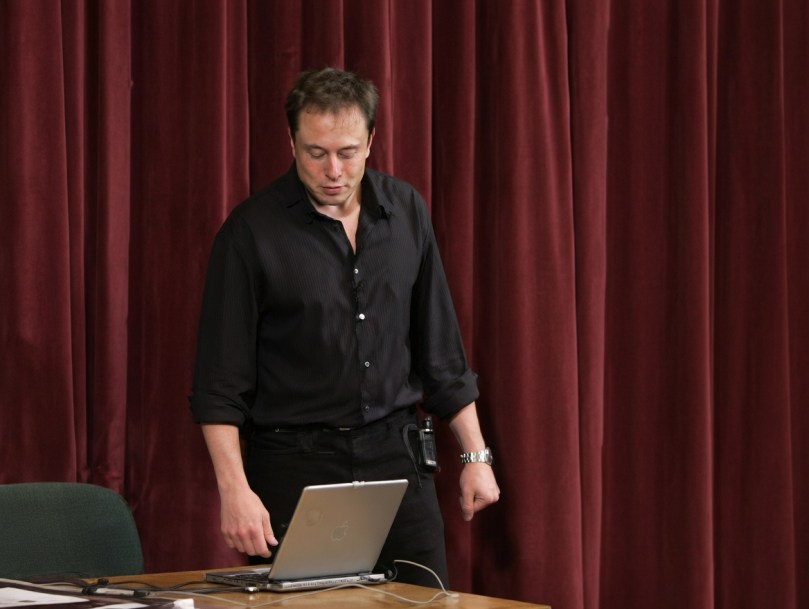
Elon Musk stands at the podium during his rarely seen 2003 Stanford talk. At the time, SpaceX was only one year old and no Falcon rocket had flown yet. Screen grab from the original recording, enhanced for clarity by Grok Imagine.
Elon’s full talk
I’ll try to make this as interesting as possible. If you like space, you’ll like this talk.
My background in brief: I’ll talk a little bit about Zip2 and PayPal, and then mostly about space and what we’re doing in space.
I originally came to California to do energy physics at Stanford. I ended up deferring in 1995 and putting that on hold to start Zip2. In 1995 it wasn’t at all clear that the internet was going to be a big commercial thing. In fact, most of the venture capitalists that I talked to hadn’t even heard of the internet, which sounds bizarre on Sand Hill Road.
I wanted to do something and I thought it would be a pretty huge thing. I thought it was one of those things that only came along once in a very long while. So I got a deferment at Stanford. I thought I’d give it a couple of quarters and if it didn’t work out — which I thought it probably wouldn’t — then I’d come back to school.
When I talked to my professor and told him this, he said, “Well I don’t think you’ll be coming back.” And that was the last conversation I had with him.
There weren’t a lot of ways to get involved with the internet in 1995 that I could think of, other than to start a company, because there weren’t a lot of companies to go and work for apart from Netscape, maybe one or two others.
I didn’t have any money, so I thought we had to make something that was going to return money very quickly. We thought the media industry would need help converting its content from print media to electronic, and they clearly had money. If we could find a way to help them move their media to the internet that would be an obvious way of generating revenue. There was no advertising revenue on the internet at the time.
That was really the basis of Zip2. We ended up building quite a bit of software for the media industry, primarily the print media industry. We had as investors and customers Hearst Corporation, Knight Ridder, and most of the major US print publishers. We built that up and then we had the opportunity to sell to Compaq in early 1999 and basically took that offer. It was for a little over 300 million dollars in cash. And that’s a currency I highly recommend.
After that I wanted to do something more. Post the sale — in fact immediately post the sale — I didn’t really take any time off. I was trying to think of where the opportunities remained on the internet, and it seemed to me that there hadn’t been a lot of innovation in the financial services sector.
When you think about it, money is low bandwidth. You don’t need some sort of big infrastructure improvement to do things with it. It’s really just an entry in a database. The paper form of money is really only a small percentage of all the money that’s out there. So it should lend itself to innovation on the internet.
We thought of a couple of different things we could do. One was to combine all of somebody’s financial services needs into one website so you could have banking, brokerage, insurance and all sorts of things in one place. That was actually quite a difficult problem to solve, but we solved most of the issues associated with that.
Then we had a little feature which took us about a day: the ability to email money from one customer to another. You can type in an email address or actually any unique identifier and transfer funds or conceivably stocks or mutual funds or whatever from one account holder to another. If you try to transfer money to somebody who didn’t have an account in the system it would then forward an email to them saying hey why don’t you sign up and open an account.
Whenever we demonstrated these two sets of features we’d say this was a feature that took us a lot of effort to do and look how you can see your bank statement and your mutual funds and insurance and all that — it’s all on one page and look how convenient that is — and people go “ho hum.” And then we’d say and by the way we have this feature where you can enter somebody’s email address and transfer funds and they go “wow.” So we focused the company’s business on email payments.
In the early going the company was called X.com and then there was another company called Confinity which had actually also started out from a different area. They started off with Palm Pilot cryptography and then they had as a demo application the ability to beam token payments from one Palm Pilot to another by the infrared port. Then they had a website which is called PayPal where you would reconcile the beamed payments. What they found was that the website portion was actually far more interesting to people than the Palm Pilot cryptography was, so they started leaning their business in that direction.
In basically early 2000 X.com acquired Confinity and then about a year later we ended up changing the company’s name to PayPal. And that’s kind of how the approximate evolution of the company went.
And so just about every sector of technology improved. Why has this not improved? So I started looking into that. Initially I thought perhaps it’s a question of funding, and that funding can be garnered by really marshaling public support. So I thought one way to get the public excited about space would be to do maybe a privately funded robotic mission to Mars.
We figured out a mission that would cost about fifteen to twenty million dollars, which isn’t a lot of money, but it’s about a tenth of what a low-cost NASA mission would be. The idea was called Mars Oasis, where we would put a small robotic lander on the surface of Mars with seeds and dehydrated nutrients. They would hydrate upon landing, and you’d have plants growing in Martian radiation and gravity conditions. You’d also be maintaining essentially a life support system on the surface of Mars.
This would be interesting to the public because they tend to respond to precedents and superlatives, and this would be the furthest that life’s ever traveled and the first life on Mars. So pretty significant.
When I started looking at launch vehicles, the lowest-cost vehicle in the US is the Boeing Delta II, which costs about fifty million dollars, and that’s a bit steep for what we were trying to do. So I made three visits to Moscow, to Russia, to look at buying a Russian launch vehicle. It’s actually pretty interesting going to Moscow to negotiate for a refurbished ICBM. On the range of interesting experiences, that’s pretty far out there. We actually did get to a deal, but there were so many complications associated with the deal that I wasn’t comfortable with the risks associated with it.
When I got back from the third trip, I thought, why is it the Russians can build these low-cost launch vehicles? It’s not like we drive Russian cars, fly Russian planes, or have Russian kitchen appliances. When’s the last time you bought something Russian that wasn’t vodka? I think the US is a pretty competitive place and we should be able to build a cost-efficient launch vehicle.
So I put together a feasibility study which consisted of engineers that have been involved with all the major launch vehicle developments over the last three decades. We iterated over a number of Saturdays in the beginning of last year to figure out what would be the smartest way to approach this problem of not just launch cost but also launch reliability. And we came up with a default design.
That actually turned out to be fortunate timing — that feasibility study finished up right around the time that we agreed to sell PayPal to eBay. So coincident with that sale, I moved down to LA where there’s actually the biggest concentration of aerospace industry in the world. It’s actually the biggest industry in southern California, much bigger than entertainment or anything else. I was living in Palo Alto for about nine years before that.
Anyway, so just to talk a little broadly about space and where things are today… Obviously US government manned exploration is not in a great place. We’ve got the three remaining shuttles grounded. It looks like first flight might only be a year from now, if that. And we’ve got a vehicle that is incredibly expensive and really quite dangerous. It’s got a side-mounted crew compartment, so if there’s an explosion, that’s basically instant death. You’ve got solid rocket boosters which once you light them you can’t turn them off. There’s something fundamentally dangerous about pre-mixing your fuel and oxidizer, I think. And then you’ve got wings and control surfaces — when you re-enter you’ve got to maintain a precise angle of attack; even a momentary variance in that can break the whole vehicle apart. And of course it’s got no escape system, so if anything does go wrong, you’re toast.
You’ve got a cost that is really pretty hard to fathom. The shuttle program, when you add up all the pieces, is about four billion a year. And so you can divide four billion by the number of flights and that’ll tell you what the cost is. If there’s say four flights a year, which they haven’t been for a while, then you’re talking about a billion dollars a flight.
The plans for the future are, obviously we’ve got to continue building the space station, so we’re going to keep flying the Shuttle, but I think it’s probably going to be the minimum number of Shuttle flights that we need to launch. The long-term plans are to build something called orbital space plane — or “safe plane” in quotes, because one of the options is a capsule, so it should be called maybe orbital space thing. But the basic idea is to have something that’s hopefully a little cheaper and a lot safer than the Space Shuttle. In particular, it’s going to have an escape system so if something does go wrong, you can abort to safety.
The downside is that it’s still, while it might be a little cheaper, still going to be pretty darn expensive. Estimated cost per flight of the orbital space plane is somewhere in the region of three hundred to four hundred million dollars a flight, and of that amount, two hundred million dollars alone goes to Boeing for the Delta IV Heavy expendable booster. And it’s a fifteen billion dollar development effort expected to be completed in nine or ten years now. Typically things have not been under budget and under time, so it’s unlikely, given historical precedent, that it will stay within fifteen billion dollars and the 2012 timeline.
A bit about what’s going on elsewhere in the world… In Russia, the Soyuz is our only access to the space station. It’s considerably cheaper, considerably safer. The Soyuz has a very good track record. Its crew is top-mounted, it has an escape system, there are no wings or control surfaces to go wrong. Overall, it’s a pretty good system. And the estimated costs are about sixty million dollars a flight, which is an order of magnitude or two less than the Space Shuttle. The thing that constrains them, obviously, is the weakness of the Russian economy. It’s very hard for them to embark on ambitious programs with an economy the size of Belgium.
China is probably the most interesting thing that’s going on in space. This month China is expected to launch their first person into space. They will become only the third country ever to put someone in orbit, and they’ve put a lot of money and effort into this program. If anything serves as a spur for human space exploration, it is likely to be China’s ambitions in space, and hopefully a sense in America that we want to at least keep up with China. And they have grand ambitions beyond just low Earth orbit. They are planning on setting up a space station, putting a base on Mars, and eventually sending humans to Mars.
So what’s happening in the US that I think might ultimately surpass all of that stuff is entrepreneurial space activities, where things are led by small teams of very smart people who are just trying to make things better and cheaper. And that’s what’s exciting.
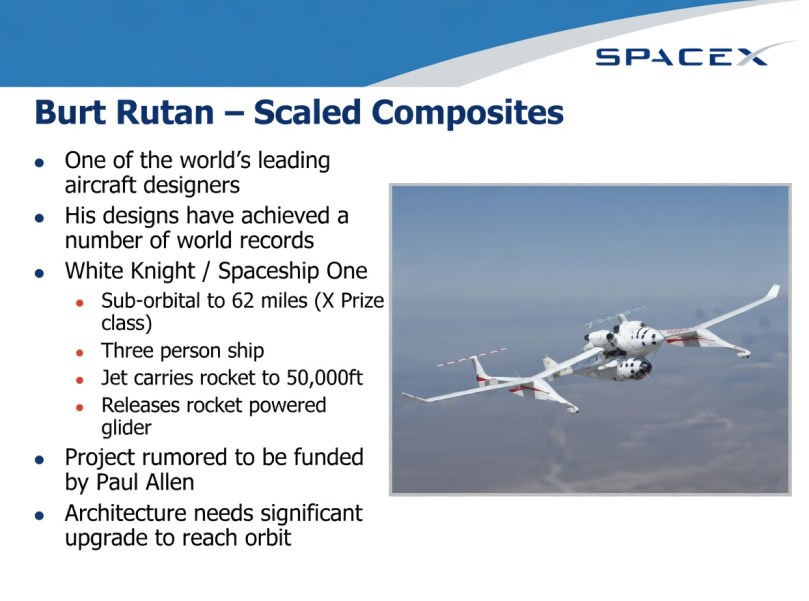
At this point in the talk (~19:05), Elon Musk discusses early private space companies and specifically highlights Burt Rutan’s work with Scaled Composites.
So in particular, what we’re trying to do at SpaceX is to try to make launch vehicles that are significantly more cost-effective. And the reason that launch costs are so high is not because of physics. The physics of putting something into orbit is not that hard. It’s really just a question of energy. The reason they’re expensive is because of the way that the industry is structured.
So what we’re doing at SpaceX is we have a very small team. I think right now we have about 30 people. And we don’t have any lawyers or accountants or anything like that. We just have engineers and technicians. And we’re trying to do everything in-house as much as possible. So we’re not outsourcing very much. And the idea is to try to simplify the design of the vehicle as much as possible and to use first principles thinking to figure out what the real cost of a launch vehicle should be.
If you look at what it costs to build a rocket, the raw materials — aluminum, titanium, copper, etc. — if you were to buy those materials at market rates and just melt them down, the cost of the materials is actually quite low. It’s on the order of a couple percent of the cost of the launch vehicle. And so the question is, why is everything else so expensive? And the answer is really just overhead and inefficiency in the way things are done. So by simplifying the design and doing vertical integration — basically building almost everything ourselves — we think we can bring the cost down dramatically.
Our first vehicle is called Falcon 1. It’s a small vehicle. It can put about a thousand pounds into low Earth orbit. And the price point we’re targeting is about six million dollars for that. Which is roughly a factor of ten less than what a comparable vehicle would cost today. And we’re trying to get to orbit with that vehicle this year, hopefully. The next step after that would be Falcon 5 and then Falcon 9, which would be able to put much larger payloads into orbit and eventually carry humans.
And the long-term goal is to make life multiplanetary. I think that’s really the most important thing we can do to ensure the long-term survival of humanity. And I think that if we can reduce the cost of getting to orbit by a factor of ten or more, that opens up a lot of possibilities that currently don’t exist.
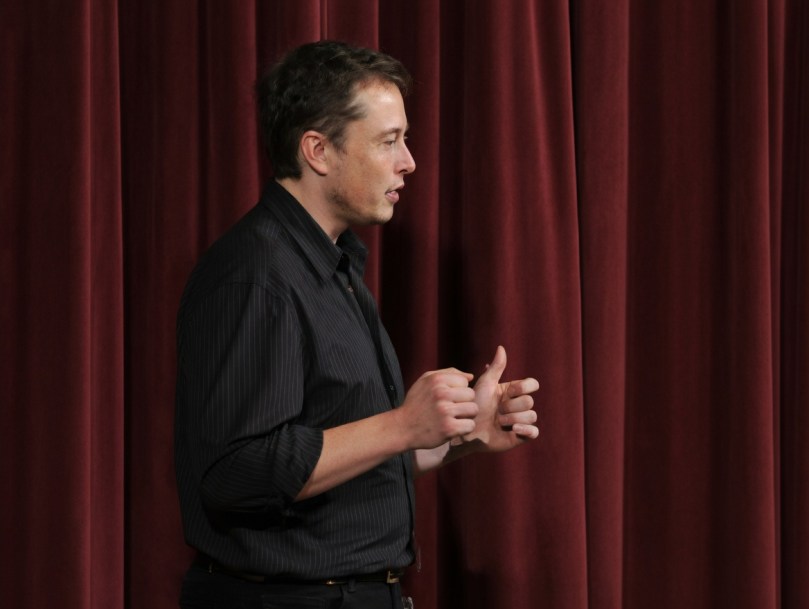
Profile view of Elon Musk passionately explaining his ideas at his first documented public talk at Stanford University in 2003. Just 32 years old, he was already thinking in decades. Original screen grab enhanced for clarity using Grok Imagine.
Q&A portion begins
Audience question: Why is it so expensive to send something into space?
Musk: Well, let me tell you what makes a rocket hard. The energy and the velocity required to get into orbit is so substantial that compared to say a car or even a plane, you have almost no margin to play with. Typically, a launch vehicle will get about two percent of its liftoff mass to orbit. And that’s the case for Falcon as well. So if you can only get two percent of what your rocket weighs to begin with to orbit, you can see that you have to be extremely efficient in every respect. You have to have very high performance engines, very light structures, and you have to be very careful about the margins that you use.
And so that’s why it’s difficult. It’s not that the physics is impossible — it’s just that the margins are so thin that if you make any mistake at all, you don’t make it to orbit. And historically, the aerospace industry has been very risk-averse, which has led to a lot of conservatism in design and a lot of overhead.
Audience question: So how does that compare with PayPal? I mean, PayPal you had to deal with banks and all that kind of stuff, which is also regulated. How is that different?
Musk: Well, with PayPal it was very difficult to get the banks to cooperate. In fact, we had a lot of trouble with that. But ultimately the regulatory environment for financial services is actually pretty friendly compared to aerospace. The aerospace industry is heavily regulated and there are a lot of export controls and ITAR restrictions. So it’s quite a bit more difficult in that respect.
Audience question: What qualities do you look for in an entrepreneur?
Musk: I think the most important thing is to have a very strong sense of what’s important and what’s not important—what’s the real problem that needs to be solved. A lot of people will work on things that are tangential or not really central to the problem. So having a very clear sense of what the key issues are and focusing on those is critical. Also, just a very strong drive and willingness to work extremely hard. Starting a company is not for the faint of heart. It’s very difficult.
Audience question: Can you talk a little bit more about the cost structure and how you’re reducing costs?
Musk: Sure. Our approach is really to make this a solid sound business and so I’ve predicated that the strategic plan on a known market—something that we know for a fact exists—which is the need to put small to medium-sized satellites into orbit. And so that’s what we’re going after initially, and then with that as a kind of a revenue base we will move into the human transportation market. So the long-term aims of the company are definitely human transportation. I think the smart strategy is to first go for cargo delivery, essentially satellite delivery. And our eventual great path is to build the successor to Saturn V—build a super heavy lift vehicle that could be used for setting up a moon base or doing a Mars mission.
But right now we’re focused on Falcon 1 and then Falcon 5 and Falcon 9. And the way we’re reducing costs is really by doing a lot of vertical integration—building almost everything in-house—and simplifying the design as much as possible. We have about 30 people right now, and we don’t have any lawyers or accountants or anything like that. We just have engineers and technicians. And we’re trying to do everything ourselves as much as possible. So we’re not outsourcing very much. And the idea is to try to simplify the design of the vehicle as much as possible and to use first principles thinking to figure out what the real cost of a launch vehicle should be.
If you look at what it costs to build a rocket—the raw materials, aluminum, titanium, copper, etc.—if you were to buy those materials at market rates and just melt them down, the cost of the materials is actually quite low. It’s on the order of a couple percent of the cost of the launch vehicle. And so the question is, why is everything else so expensive? And the answer is really just overhead and inefficiency in the way things are done. So by simplifying the design and doing vertical integration—basically building almost everything ourselves—we think we can bring the cost down dramatically.
We also have a philosophy of making a lot of small innovations rather than trying to do one big innovation. So there are hundreds of small things that we do to reduce cost and improve reliability. We’re also not patenting very much because we think that patents are not that useful in this industry—people just copy them anyway—and it’s better to keep things as trade secrets.
Audience question: What about space mining or solar power satellites?
Musk: I think those are interesting ideas but probably not near-term opportunities. The big opportunity I see is in making life multiplanetary—setting up a base on the Moon and eventually on Mars. That’s really the long-term goal. And to do that we need to reduce the cost of getting to orbit by at least an order of magnitude.
Audience question: What about working with the government? Are there any plans to work with NASA or the military?
Musk: Yeah, we’re actually working with NASA right now on some small contracts, and we’re also talking to the military. The government is a big customer in space, so it makes sense to work with them. But we want to keep our focus on reducing costs dramatically so that we can open up new markets that don’t even exist today.
Audience question: How do you deal with ITAR restrictions? It seems like they prevent you from hiring the best people if they’re not U.S. citizens.
Musk: ITAR is a real pain. It’s one of the biggest challenges we face. We basically can’t hire non-U.S. citizens for a lot of the core engineering work, which limits the talent pool. It’s frustrating because talent is global, but the regulations are very strict. We’re in LA partly because that’s where the biggest aerospace talent pool is in the U.S., so we can find the people we need who are already citizens or green-card holders.
Audience question: Can you talk more about reusability? Is that part of the plan for Falcon?
Musk: Yes, reusability is absolutely critical for the long term. Right now Falcon 1 is expendable, but we’re already thinking about how to make future vehicles reusable. The physics works — it’s just a question of engineering it right. If you can recover and reuse the first stage, that changes the economics completely. It’s one of the biggest levers we have for reducing costs by an order of magnitude or more. We’re not there yet, but it’s definitely on the roadmap.
Audience question: Why do you think making life multiplanetary is so important?
Musk: I think it’s the most important thing we can do to ensure the long-term survival of consciousness and humanity. Right now we’re a single-planet species, and that makes us vulnerable. An asteroid impact, a supervolcano, a nuclear war — any of those could wipe us out. Becoming multiplanetary makes us a spacefaring civilization and greatly increases the probability that consciousness will continue. It’s not about colonizing Mars tomorrow; it’s about laying the foundation so that in the future it becomes possible.
So that’s really the long-term vision for SpaceX. We’re starting small with Falcon 1, but the ultimate goal is to make humanity multiplanetary. I appreciate you all coming out and listening. Thank you very much.
(Applause)
End of the lecture.
Full Verbatim Transcript – Elon Musk’s October 8, 2003 Stanford Entrepreneurial Thought Leaders Lecture. This transcript has been cross-checked against the video’s auto-generated captions and manually corrected for obvious speech-recognition errors (especially proper names and technical terms).
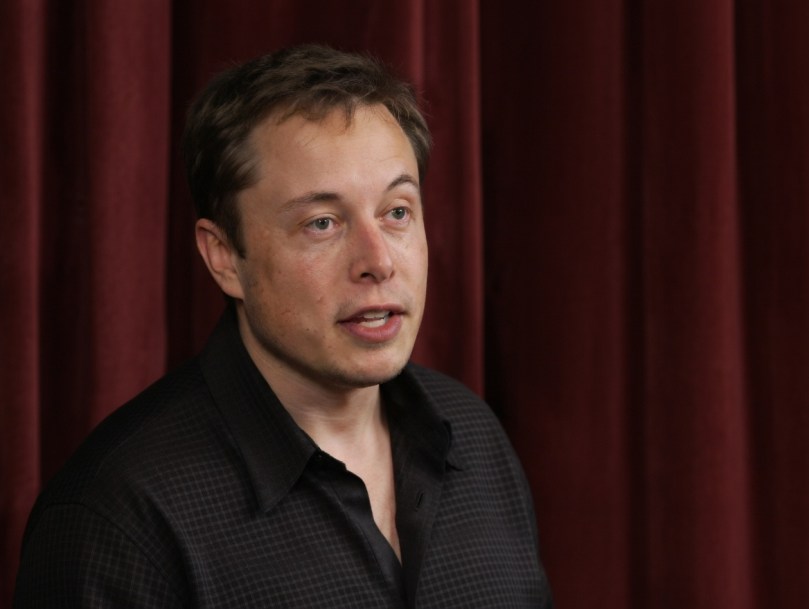
Close-up of 32-year-old Elon Musk as he shares his vision during the 2003 Stanford Entrepreneurial Thought Leaders event. A raw, unpolished look at the future founder of SpaceX and Tesla. Enhanced with Grok Imagine for better clarity.
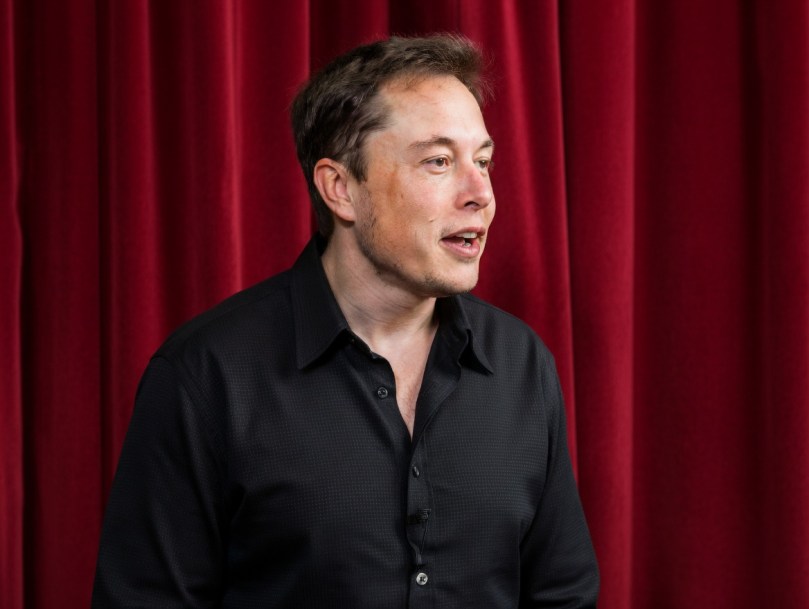
32-year-old Elon Musk during his October 8, 2003 Entrepreneurial Thought Leaders lecture at Stanford. This historical moment captures Elon shortly after selling PayPal, with SpaceX still in its earliest days. Image enhanced for clarity using Grok Imagine.
 whatsuptesla.com