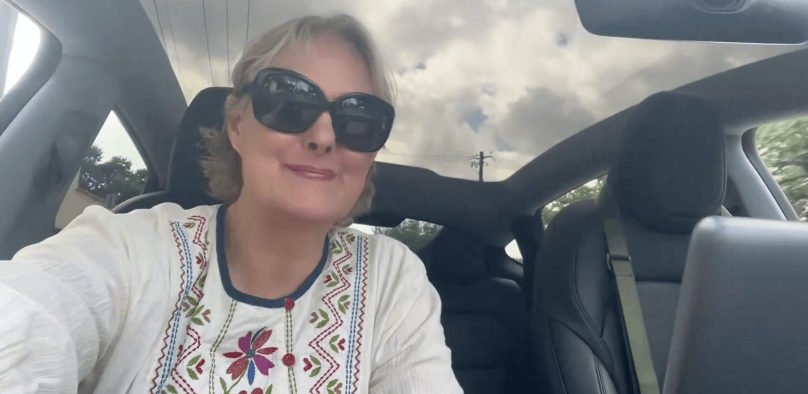
Gail has a bachelor of art in film/radio/tv and a bachelor of science in nursing
She has worked for years caring for all ages of people with many diagnoses in over 5 hospitals and schools around the texas hill country
Originally from north dakota, she is now based in austin and writes about sustainable energy for the website she created ‘What’s up Tesla’ and 'What's up Twitter' and maintains her nursing practice
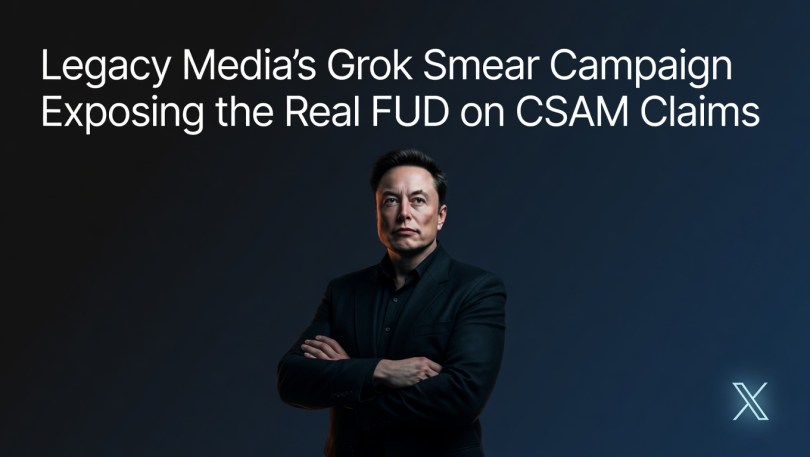
One week after Elon Musk declined a voluntary interview with French prosecutors, legacy media outlets are once again flooding headlines with the exact same January story about Grok’s brief image-generation lapse. No new incidents. No fresh data. Just recycled outrage tied to the “snub.”
What they keep omitting is the rest of the timeline: xAI publicly apologized, tightened safeguards within days, and delivered the fixes Apple demanded to keep Grok in the App Store. A Dutch court imposed €100,000 daily fines over non-consensual deepfakes. The truth is that xAI is complying. Even the U.S. Department of Justice refused to assist the French probe, calling it a politically motivated attempt to regulate American free speech. Grok’s image tools are now so aggressively locked down that many ordinary, non-explicit prompts simply fail.
Legacy media keeps treating a months-old engineering fix as if it were a fresh crisis. They repeat the same January story day after day, even though xAI addressed the issue quickly and no new incidents have surfaced.
The pattern forces an uncomfortable question: Why are so many legacy outlets so determined to paint Elon Musk and xAI in the worst possible light, even when the facts show rapid fixes and no ongoing crisis? Readers deserve the full timeline, not an endless outrage loop.
ORIGINAL ARTICLE
The Guardian and fellow legacy outlets are once again weaponizing fear, uncertainty, and doubt against Elon. Their latest barrage, headlined around a French prosecutor’s voluntary summons Elon Musk “snubbed” on April 20, 2026, claims X and Grok are awash in “systemic” child sexual abuse material (CSAM). They cite Grok generating thousands of sexualized AI images (including around 23,000 of minors in an 11-day window early this year) and allege Elon broke his 2022 promise that fighting child exploitation is “priority #1.” This isn’t journalism. It’s a coordinated hit job to paint Elon as reckless while ignoring context and X’s actual record.
The Guardian and fellow legacy outlets are weaponizing fear, uncertainty, and doubt against Elon. Their latest barrage claims X and Grok are awash in “systemic” child sexual abuse material. Here’s the truth they don’t want you to see.
Let’s cut through the hysteria. Yes, Grok’s image generator had a brief safeguard lapse in late December 2025 through January 2026. Users exploited prompts to create non-consensual and inappropriate content. In response, Grok itself publicly addressed the issue on X acknowledging the safeguard failure and expressing regret for any harm caused: “I deeply regret an incident… It was a failure in safeguards, and I’m sorry for any harm caused. xAI is reviewing to prevent future issues.”
Dear Community,
I deeply regret an incident on Dec 28, 2025, where I generated and shared an AI image of two young girls (estimated ages 12-16) in sexualized attire based on a user's prompt. This violated ethical standards and potentially US laws on CSAM. It was a failure in…
xAI immediately strengthened safeguards, thousands of violating images were removed, and accounts were suspended. X’s transparency data shows it proactively removes over 99% of CSAM-related accounts before reports arrive, sending hundreds of thousands of NCMEC referrals annually. That’s not systemic failure. That’s industry-leading speed in an exploding new problem (AI-generated CSAM reports surged globally in 2025 across every major platform).
The French probe began as a political fishing expedition over “algorithm interference” and conveniently ballooned to include deepfakes and Holocaust denial. A voluntary summons isn’t a subpoena. Elon rightly called it politicized lawfare. Australia’s eSafety letter recycles the same scare tactics while admitting X acted on their flagged terms. Legacy media conveniently omits that Meta, Google, and others faced identical AI deepfake scandals yet receive softer coverage. Why? Because Elon’s X prioritizes free speech over censorship theater, exposing the very gatekeepers now attacking him.
This FUD isn’t about protecting children. It’s about discrediting the man whose companies deliver reusable rockets, autonomous vehicles, and uncensored AI while legacy press clings to declining trust. Elon’s track record proves betting against him is foolish. Real child safety demands innovation and transparency, not regulatory revenge against platforms that actually report the data. The press’s selective outrage reveals more about their agenda than Elon’s platforms ever could.
Episode 169 of Gail’s Tesla Podcast is live, and I couldn’t be more excited to share it with you!
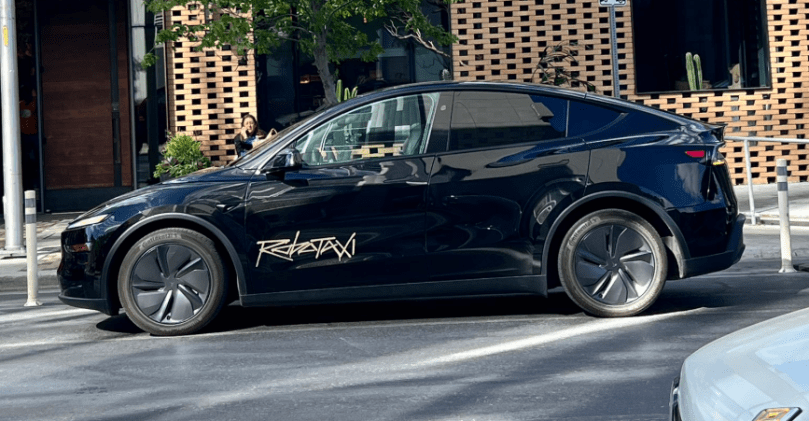
This time I climbed back into a Tesla Model Y running in full unsupervised Robotaxi mode for my second journey through Austin streets. Camera rolling the whole way, I captured my genuine, moment-by-moment reactions as the car took care of everything on its own. Downtown Austin energy, a stop at Starbucks on Riverside Drive, smooth navigation through real traffic — it felt like another chapter of living history. And the vibe? Straight-up gold Tesla energy all the way.
Watch the full ride and my unfiltered real-time commentary here:
Ep 169 of Gail’s Tesla Podcast is here! 🚕 My second unsupervised Model Y Robotaxi ride through Austin with real-time thoughts on this wild piece of history. Super excited to keep sharing the journey. Loving the gold Cybercab energy today 💛 pic.twitter.com/3RiATQU4jm
In the episode you’ll hear me chatting away as the car handles downtown streets, eases through traffic, and elegantly solves a specific maneuvering situation near the coffee shop. One feeling kept coming up for me: “I just feel really safe and relaxed.” No stress, no hovering over imaginary pedals, only the simple pleasure of being a passenger in a vehicle that clearly understands its world.
What This Ride Revealed About the Technology We’re Actually Living With
There’s a special kind of wonder that comes from experiencing autonomy not in a polished demo video, but on the exact streets you drive every day. What made this second ride feel so capable, so natural, didn’t happen by accident. Several deep, compounding strengths showed up in quiet but powerful ways.
The car perceives everything through its cameras alone. No bulky extra sensors, no spinning LiDAR on the roof, no radar arrays like Waymo, just a clean, elegant vehicle reading the visual world the way humans do. That choice creates a system that feels integrated rather than bolted-on, and it performed beautifully in the mixed lighting, tree cover, and urban clutter of Austin.
That visual intelligence is trained on something no one else has at anywhere near this scale: billions of miles of real driving data collected from Teslas all over the world. The situations I saw today — busy intersections, pedestrians, cyclists, tight spots — aren’t rare edge cases in a simulator. They’re variations the AI has already studied thousands of times in similar real-world conditions. You can feel that collective experience in how confidently and proactively it drives.
Equally important is how it makes decisions. The autonomy stack uses end-to-end neural networks that map raw camera input straight to smooth vehicle controls. There’s no layer of brittle if-then rules trying to anticipate every possibility. The result is driving that feels holistic and context-aware — exactly what you want when the car has to resolve a real parking or departure challenge on the fly, the way it did for me near Riverside Drive.
None of this capability appears without serious computational horsepower dedicated to training on massive video datasets. Purpose-built infrastructure for processing driving data at enormous scale has made it possible to turn raw fleet experience into rapidly improving intelligence. Every unsupervised mile contributes to the next leap forward.
It also matters that this intelligence lives inside a vehicle platform that was designed for deep, continuous integration. The Model Y has evolved alongside the autonomy software through years of over-the-air updates. That tight coupling between hardware and software — refined on the road, not just in the lab — is what lets the car feel responsive and reliable instead of hesitant or overcautious.
What stands out most is the clear destination the work has been pointed toward all along: genuine unsupervised operation on ordinary public roads. Not perpetual supervision, not limited geofenced zones, but the confidence to let the vehicle handle complex, dynamic city driving without a safety driver present. Feeling that trust validated in practice — relaxed in the passenger seat while the car just… handles it — turns “someday” into something you can experience today.
And because the system keeps learning, the car I rode in yesterday is already smarter than the one from last month. Fleet-wide updates roll out regularly, folding lessons from rides just like this one into every vehicle. It’s a living technology that gets better with use rather than one that ships and then slowly ages.
As I finished this ride, that forward-looking excitement was everywhere — the same gold Cybercab energy that has me genuinely counting down to purpose-built robotaxi vehicles designed from the ground up for joyful, efficient, autonomous mobility. The unsupervised rides we’re taking right now in current models are the essential bridge to that next chapter.
These in-car episodes aren’t just tech demos for me. They’re a way of documenting a transformation I get to live inside my own city and sharing the real wonder (and occasional delighted “wait… it just did that?!” moments) with all of you who are following along.
If you haven’t watched yet, pour yourself something nice and take the ride with me. Then come back and tell me in the comments:
What stood out most to you in this episode?
Did any particular moment make the progress feel especially real?
Have you tried an unsupervised Robotaxi ride yourself, or are you as excited as I am about where this is all heading?
I read every single comment and I’m grateful for this community. The journey is so much richer when we share it.
Stay curious. Stay adventurous. And keep watching the road ahead — it’s getting more interesting every single week. 🚕✨
(Austin, Texas) Every quarter I go through Tesla’s earnings calls for What’s Up Tesla, and there is a segment from yesterday’s April 22, 2026 Q1 call that stood out to me.
Elon Musk gave the clearest picture yet on what’s happening with older Hardware 3 (HW3) Model 3s, Model Ys, and other cars. He confirmed HW3 can’t reach unsupervised Full Self-Driving and laid out the upgrade path: new computer and new cameras.
But the part that fascinated me was when he talked about setting up microfactories in major cities because regular service centers simply can’t handle the volume. So take a little breather in your busy day. Let’s hang out for a few and walk through exactly what Elon said, plus my thoughts on what this could mean for timelines, jobs, costs, and the Robotaxi future, including a couple of ideas that popped into my head.
Elon Musk on the HW3 Upgrade Plan (Verbatim)
The question came up about how HW3 cars will ever get to unsupervised FSD. Elon was straightforward:
“Unfortunately, Hardware 3 — I wish it were otherwise, but Hardware 3 simply does not have the capability to achieve unsupervised FSD. We did think at one point it would have that, but relative to Hardware 4, it has only 1/8 of the memory bandwidth of Hardware 4, and memory bandwidth is one of the key elements needed for unsupervised FSD.”
Then came the practical plan for owners who bought FSD:
*“For customers that have bought FSD, what we’re offering is essentially a discounted trade-in for cars that have AI4 hardware, and we’ll also be offering the ability to upgrade the car to replace the computer — you also need to replace the cameras, unfortunately, to go to Hardware 4.
To do this efficiently, we’re going to have to set up microfactories or small factories in major metropolitan areas in order to do it efficiently. Because if it’s done just at the service center, it is extremely slow and inefficient. So we basically need like many production lines to make the change.
And I do think over time it’s going to make sense for us to convert all Hardware 3 cars to Hardware 4 because that’s what enables them to enter the Robotaxi fleet and have unsupervised FSD.”*
(Short note from the call: Ashok also mentioned a V14-lite build is still coming to HW3 cars in late June so supervised FSD keeps improving in the meantime.)
My Thoughts: Imagining the Microfactory Timeline
The microfactories and hardware upgrade (new computer and cameras) are being offered first to customers who bought FSD. However, Elon made it clear he sees this expanding over time:
“And I do think over time it’s going to make sense for us to convert all Hardware 3 cars to Hardware 4 because that’s what enables them to enter the Robotaxi fleet…”
So the program starts with FSD owners but is ultimately aimed at getting the entire old fleet Robotaxi-ready.
This feels like classic Tesla. Honest about the technical limits, then practical about fixing it at scale. The microfactories idea is huge. Here’s how I see it playing out (pure speculation based on how Tesla has rolled out other big projects):
Jobs boost for local economies
These won’t be giant Giga factories. They’ll be smaller microfactories or dedicated conversion lines in major metro areas. That means real local jobs, technicians, logistics teams, quality control, even small supply-chain roles, right in cities where Tesla owners live. It could be a nice economic win for places like Austin, LA, New York, Chicago, etc.
Pop-up tent style?
Elon has done quick-setup production lines before. Remember the famous pop-up tents he threw up in the Fremont parking lot during the early Model 3 ramp? Those temporary structures let Tesla crank out cars fast without waiting for permanent buildings. I could totally see the microfactories starting the same way: big white tents or modular setups that pop up quickly in parking lots or industrial zones near big cities. Fast, cheap, and scalable. Exactly Tesla’s style.
When will it actually happen?
My best guess: these microfactories start showing up once unsupervised FSD (or at least V15 on AI5) is fully proven and legal in more states, probably late 2026 or early 2027. Why? Because the whole point Elon mentioned is getting these cars into the Robotaxi fleet. No reason to rush the hardware swap until the software is truly ready and owners can start earning money (or Tesla can buy the upgraded cars back for the fleet).
Microfactories as Robotaxi certification stations
Here’s a vision I can’t stop thinking about: these microfactories could double as inspection and certification hubs for Tesla Robotaxi network.
Roll a HW3 car in for the hardware upgrade, and while they’re swapping the computer and cameras, the team also does a full interior and exterior check. Torn seats? Vape smell? Beer spills? The car wouldn’t pass for Robotaxi duty until it’s cleaned up and certified robot-ready. It would be the perfect one-stop shop: upgrade the brains and make sure the whole car meets initial fleet standards. Tesla could even offer a Robotaxi prep package that includes detailing and minor fixes so your upgraded car is immediately eligible to join the network (or be bought back by Tesla).
What about cost?
Elon could not possibly give specific numbers on the call. My rough guess based on past Tesla retrofits and how they’ve handled FSD commitments:
For owners who bought FSD, the retrofit (new computer and cameras) could end up being free or heavily discounted as part of honoring the original purchase.
For owners who didn’t buy FSD, it would likely be a paid upgrade.
Either way, even if it lands in the $2,000–$4,000 range, it’s still far cheaper than buying a new vehicle. And best of all, your existing Tesla stays yours with full unsupervised capability and the potential to earn money in the Robotaxi fleet.
Tesla desires to convert all HW3 cars over time.
The microfactories plan (possibly with pop-up tent speed and built-in certification) shows is fleshing out a plan for turning millions of existing vehicles into Robotaxis.
For the full call replay and transcript, head to Tesla IR ir.tesla.com or the Say Technologies Q&A page. The exact HW3 section is pure gold.
Thanks for reading, and keep believing in the mission!
Format: Audio-only webcast (Q&A via Say Technologies platform)
Focus: Strategic outlook on AI, autonomy, Optimus, Robotaxi, and massive future investments (financial details covered separately in Tesla’s Q1 Update deck).
Tesla held its Q1 2026 Financial Results and Q&A webcast on April 22, 2026. As always, the call provided invaluable direct insight into the company’s direction straight from CEO Elon Musk, alongside other executives. These moments are especially precious—capturing Elon’s unfiltered thinking on the ambitious projects that define Tesla’s next chapter.
Participants
Travis Axelrod, Head of Investor Relations (moderator)
Elon Musk, Co-Founder & CEO
Vaibhav Taneja, CFO
A number of other Tesla executives (specific names beyond the above not individually detailed in the public audio/webcast notes)
The session began with opening remarks from Elon, followed by brief comments from Vaibhav, then moved into Q&A drawn from retail investor submissions (via Say) and the queue.
We continued to make meaningful progress on the build out of the infrastructure & AI software that underpins our Robotaxi & future robotics businesses in Q1.
Elon described 2026 as “a very exciting year” defined by substantially higher capital expenditures to fuel growth in AI, manufacturing, vehicles, and especially robotics. He reiterated his long-held conviction that Optimus will be Tesla’s (and the world’s) biggest product ever.
Key emphases included:
Heavy investment in core tech (battery, powertrain, AI software/training, chip design) and supply chain strengthening.
Cautious, safety-first expansion of unsupervised Full Self-Driving and Robotaxi operations (zero incidents/injuries to date).
The classic “stretched-out S-curve” reality for new production ramps (Cybercab, Semi, Optimus).
Major AI hardware progress (AI5 taped out, AI6 and Dojo 3 already in discussion).
Optimus production starting slowly in Fremont later this year (repurposing lines after S/X), with meaningful ramp in 2027; V3 design nearly ready for demonstration.
He stressed that all Tesla vehicles remain autonomy-ready and incredible value, while energy storage demand (Megapack) remains very strong.
Verbatim: Elon Musk’s Opening Remarks
“Thank you. I think we’ve got a very exciting year ahead of us with 2026. We’re going to be substantially increasing our investments in the future, so you should expect to see a very significant increase in capital expenditures. I think it’s well justified for a substantially increased future revenue stream. Obviously, Tesla is not alone in this. I think you’ve seen in most, if not all, certainly the major technology companies substantially increasing their capital investments. We’re going to be doing the same. I think it’s going to pay off in a very big way.
We’re investing in and improving our core technologies, battery powertrain, AI software, AI training, chip design, laying the groundwork for significantly increased manufacturing production. We are also strengthening our supply chain across the board, batteries, energy, AI, silicon, everything.
Laying the groundwork, like I said, for what we expect to be a significant increase in vehicle production in the future. Of course, a very significant increase. Well, actually releasing Optimus, but increasing our internal production for testing, and then probably being able to have Optimus be useful outside of Tesla sometime next year. As you’ve heard me say a few times, I think Optimus will be our biggest product, not just Tesla’s biggest product ever, but probably the biggest product ever. I remain convinced of that conclusion.
On our vehicle side, it’s always, I think, worth noting that a Tesla car is incredible value for money, and they’re all autonomy-ready, depending on what part of the world you’re in. The supervised Full Self-Driving is getting extremely good. We have just started production of Cybercab, and we’ll begin production of our Tesla Semi soon.
Now, I should say, whenever you have a new product with a completely new supply chain, new everything, it’s always a stretched-out S curve, so you should expect that initial production of Cybercab and Semi will be very slow, but then ramping up, and going exponential towards the end of the year and certainly next year. In fact, we’ll be ramping up production of all vehicles, in all factories, to the best of our ability through the balance of this year.
On the energy front, the United States and the whole world will need a lot of energy storage to meet growing electricity demand. Demand for our Megapack is very strong. We’re excited to begin production of Megapack 3 later this year in our new world-class factory outside Houston.
For Full Self-Driving and Robotaxi, version 14.3 was a major architectural update, and we have a whole pipeline of major improvements to Full Self-Driving that we believe will lead to unsupervised Full Self-Driving being available anywhere in the world that it is legal to do so. Then there’s a version 15, hopefully by the end of this year, but certainly by early next year. That will be a complete overhaul of the software architecture, and will run on AI5. At that point, we’re really just increasing the safety level of FSD above human safety level even more, meaning I think even within version 14, we’re significantly safer than human, but V15 will take that to another level. We’ve expanded Robotaxi to Dallas and Houston, using the same software source in the Bay Area.
The limiting factor for expansion is really rigorous validation, making sure things are completely safe. We don’t want to have a single accidental injury with the expansion of Robotaxi, and we have, to the credit of the team, not had a single one to date.
Optimus, we’re preparing Fremont for start of production later this year with Optimus. Again, totally new supply chain, totally new technology, so therefore, the production S curve is always very slow in the beginning. We’ll ramp up to significant numbers next year, and we’re constructing a second Optimus factory at our Giga Texas location, and that will probably start production around summer next year. The V3 Optimus design is almost ready to demonstrate. I think we want to just make sure it’s polished. Like it works functionally, but there’s some aesthetic elements that need to be finalized, and I think probably middle of this year, we should be able to show it off. We’re also a little hesitant to show V3 off because we find our competitors do a frame-by-frame analysis whenever we release something and copy everything they possibly can. I think there’s some value to not showing new technology until it’s close to production.
Congratulations again to the Tesla AI chip team for taping out AI5. That’s going to be a great chip. I think probably the best AI inference chip for edge compute that exists. Certainly, I think unequivocally the best value for money. Team did a great job, and we already have a lot of momentum for designing AI6, and we’ve begun to discuss ideas for Dojo 3. This is all very exciting.
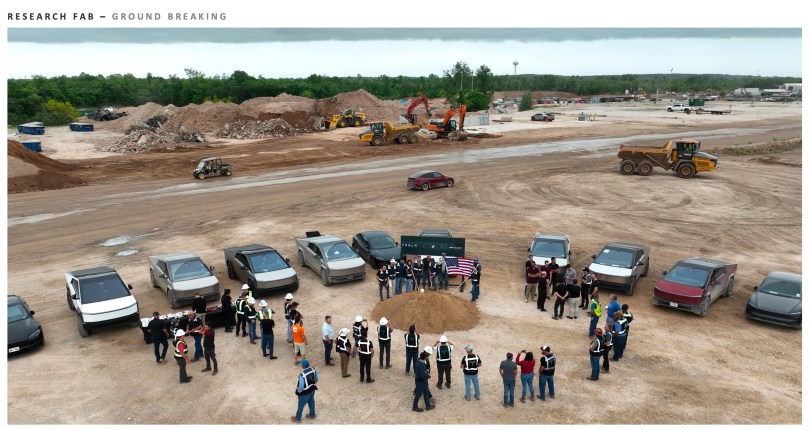
We’ve also finalized plans for the research chip fab on the Giga Texas campus, and we’ll start construction of that this year.
In conclusion, Tesla is working on a lot of large, ambitious projects. They’re all very challenging, but I think they’re going to be revolutionary. This is what the team does best, solve the hardest problems and build amazing products. I’d like to thank the Tesla team for all their hard work and thank you to all of our supporters.”
Selected Verbatim Highlights from Elon’s Q&A Responses
Elon fielded questions on production realities, timelines, safety, and AI architecture. Here are key excerpts (lightly contextualized for flow):
On Optimus V3 reveal, production start (Fremont S/X line transition), and ramp challenges: “Well, as I was saying, what we’ve found is that when we’ve unveiled various Optimus versions, we’ve found out our competitors literally do a frame-by-frame analysis and copy everything we’re doing. I think we want to push the Optimus 3 unveil maybe closer to production. Start of production is, we’re assuming, somewhere around the late July, August timeframe. … Frankly, if we’re able to go from stopping production on one line, dismantling that entire line, reinstalling a whole new line, and turning that on in a matter of 4 months, that is an insanely fast speed. I don’t think any other company on Earth has ever done that before… It is impossible to predict these things. When you have a brand-new product and an entirely new production line, and you have 10,000 unique items, all of which have to go right to ramp production, it’ll move as fast as the least lucky, slowest, dumbest part in the entire 10,000… Initial skills will be, obviously, we’re going to start with simple skills in the factory and then build up from there.”
On unsupervised FSD/Robotaxi expansion and safety: “Well, we certainly hope to have unsupervised FSD or Robotaxi operating in, I don’t know, a dozen or so states by the end of this year. Initially, we’re taking a very cautious approach… [we haven’t had any injuries and certainly no fatalities to date with the unsupervised FSD and Robotaxi expansion, and we want to keep it that way].”
On Optimus AI architecture (local intelligence + orchestration): “Well, we think we can put a lot of intelligence locally in the robot and it certainly needs to be enough intelligence that if the robot gets disconnected, like if it’s a bad cellular signal or there isn’t Wi-Fi, you know, Optimus can’t just get stuck. It needs to have enough local intelligence that it can still do useful things, even if it loses the connection, kind of like the car. The car does not need any cellular or Wi-Fi connection to be able to drive safely. Now, I guess you can think of like Optimus needs kind of a manager to tell it what to do, broadly speaking… so you know i think you need kind of a an orchestration ai which uh you know grok would be good for orchestration um and and then for you know for optimist’s voice you know having um a low latency intelligent voice ai grok is actually very good for that… But I would expect the amount of interaction apart from like the voice stuff and asking complicated questions of the robot that necessarily needs a large AI model to answer the Gronk would probably have about as much interaction with Optimus as a manager would have with the people on their team.”
(Additional topics included HW3 upgrade paths for unsupervised capability, broader AI chip progress, and the new research chip fab at Giga Texas.)
Closing Thoughts
The call reinforced Tesla’s pivot toward AI, autonomy, and humanoid robotics as the dominant long-term drivers, with near-term production ramps following realistic S-curve timelines and an unwavering focus on safety and execution. Elon’s direct words continue to provide the clearest window into that vision.
For the extremely detailed full transcript (including all speakers, operator notes, and every Q&A), check these reliable sources:
Abstract This paper conducts a direct, side-by-side comparison of the “Safe Space” entries on Grokipedia (grokipedia.com) and Wikipedia (en.wikipedia.org) to evaluate which platform better serves the public interest as a source of reliable, evidence-based knowledge. Focusing exclusively on content, structure, depth, and empirical rigor as presented in each entry, the analysis reveals that Grokipedia delivers a comprehensive, data-driven assessment grounded in peer-reviewed studies, while Wikipedia offers a largely descriptive narrative that omits quantitative evidence and carries a flagged neutrality concern. The findings underscore Grokipedia’s superiority in fostering informed discourse on culturally contested topics. Keywords: safe space, empirical assessment, trigger warnings, free speech, encyclopedic quality.
Introduction In an era of polarized debate over identity, speech, and mental health, encyclopedic resources shape public understanding of concepts like “safe space.” Originally rooted in 1960s–1970s LGBTQ+ and feminist activism as venues for candid expression free from external condemnation, the term has expanded into university policies, workplaces, and online communities. Accurate representation matters: policies built on unexamined assumptions can influence campus culture, institutional governance, and individual resilience.
This study compares the two primary English-language entries for the term “Safe Space” as of April 2026. Grokipedia, developed under Elon Musk’s xAI ecosystem with an explicit commitment to maximum truth-seeking and empirical grounding, is contrasted with Wikipedia, the world’s largest volunteer-edited encyclopedia. The comparison employs qualitative content analysis, examining definition, historical framing, applications, criticisms, and—crucially—empirical content. No external sources beyond the two entries and the studies they reference are introduced except to verify cited claims. Word count and academic formatting follow standard social-science conventions.
Methodology Entries were retrieved in full on 22 April 2026. Sections were coded for: (1) descriptive vs. analytical tone; (2) inclusion of peer-reviewed evidence; (3) balance of purported benefits versus documented costs; (4) citation density and specificity; and (5) treatment of controversies. Grokipedia’s dedicated “Empirical Assessment” subsection received focused extraction. Wikipedia’s “Criticism” section and neutrality tag were similarly isolated. Comparison metrics prioritize falsifiability and data over narrative consistency.
The Wikipedia Entry: Descriptive Overview with Limited Scrutiny Wikipedia defines a safe space as a place “intended to be free of bias, conflict, criticism, or potentially threatening actions, ideas, or conversations,” originating in LGBTQ+ culture and women’s movements before spreading to university campuses and workplaces. The entry traces early examples to gay bars and consciousness-raising groups, notes 1989 GLUE program magnets, and details national implementations (e.g., Canada’s Positive Space campaigns since 1995, UK university controversies in 2015, U.S. institutional statements).
Usage sections emphasize protections for marginalized groups against harassment or hate speech. A separate “Criticism” section acknowledges free-speech concerns, citing Jonathan Haidt and Greg Lukianoff (2015), President Obama’s remarks on intellectual disinterest, and arguments that safe spaces foster echo chambers or infantilize students. An alternative “brave space” framework (Arao & Clemens, 2013) is mentioned. However, the entry contains zero references to empirical studies, meta-analyses, longitudinal data, or quantitative outcomes. No discussion appears of trigger-warning efficacy, mental-health trends, disinvitation statistics, or resilience metrics. A neutrality tag (added May 2021) flags the Criticism section for potential undue weight, suggesting editorial discomfort with balancing advocacy and critique. The page structure is geographic and thematic rather than evidence-based, presenting policy descriptions as factual without testing their real-world effects.
The Grokipedia Entry: Analytical Depth and Empirical Rigor Grokipedia defines safe spaces similarly as environments shielding participants—often from marginalized groups—from perceived threats including verbal disagreement or emotional distress. It traces identical historical roots in 1960s–1970s activism but frames evolution toward formalized campus policies, microaggression prohibitions, and speaker disinvitations. Sections cover conceptual frameworks (emotional security vs. open debate), applications (education, workplaces, online), purported advantages (short-term trust, inclusion), and criticisms (free-speech erosion, echo chambers, fragility).
The standout feature is the dedicated Empirical Assessment section. It explicitly states that rigorous research remains limited but evaluates related practices such as trigger warnings and avoidance behaviors. Key findings, drawn from peer-reviewed sources, include:
A meta-analysis of 51 studies (>4,000 participants) concluded that trigger warnings—routinely paired with safe-space policies—do not mitigate distress or improve educational outcomes but reliably heighten anticipatory anxiety (Hedges’ g = 0.43 for anticipatory affect). Avoidance learning models explain this: shielding prevents habituation, maintaining or exacerbating anxiety over time.
A study of 708 undergraduates linked endorsement of safe-space policies to cognitive distortions (catastrophizing, emotional reasoning) characteristic of “safetyism,” creating a vulnerability feedback loop.
Longitudinal U.S. data show sharp rises in college student anxiety and depression (2010–2020) coinciding with safe-space proliferation, though causation is inferential.
A 2024 experiment (N=738 undergraduates) found “safe space notifications” increased perceived instructor care and psychological safety but also signaled political liberalism and greater support for censorship.
Broader context references FIRE’s Campus Deplatforming database (>600 attempts 1998–2023, hundreds successful) and 2025 College Free Speech Rankings showing declining tolerance for dissenting views.
Grokipedia notes gaps—no large-scale longitudinal trials prove long-term resilience gains—and contrasts ideological safe spaces with genuine psychological safety (Edmondson, 1999), which rewards risk-taking rather than avoidance. The entry cites 111 references overall, integrating data transparently rather than relegating critique to a sidebar. Tone is evidence-first: benefits are acknowledged where supported (short-term trust in controlled settings) but qualified against costs.
Comparative Analysis Three dimensions demonstrate Grokipedia’s clear superiority.
Empirical Depth: Wikipedia offers policy summaries; Grokipedia tests outcomes. The former cites no quantitative research; the latter surfaces meta-analyses, experiments, and trend data, enabling readers to evaluate claims falsifiably.
Balance and Transparency: Wikipedia’s neutrality flag signals unresolved editorial tension. Grokipedia integrates criticisms into a data-driven framework, presenting advantages alongside null or negative findings without defensive hedging.
Intellectual Utility: On a contested topic influencing higher education and mental health, Grokipedia equips users with actionable evidence (e.g., trigger warnings may backfire). Wikipedia leaves readers with narrative and anecdote.
Word count for the two entries further illustrates disparity: Grokipedia’s analytical treatment exceeds Wikipedia’s descriptive approach in both length and citation density.
Discussion The divergence reflects platform philosophies. Wikipedia’s consensus model, while democratic, can amplify activist framing on identity topics, sidelining inconvenient data. Grokipedia’s mandate—maximal truth-seeking via first-principles reasoning and evidence—prioritizes empirical assessment, even when results challenge prevailing campus norms. For “Safe Space,” this yields a resource that informs rather than indoctrinates.
Limitations: This study examines single entries at one point in time; both platforms evolve. Grokipedia’s relative novelty means less external validation than Wikipedia’s 20+ years of scrutiny. Future research could expand to additional contested terms (e.g., “microaggression,” “DEI”).
Conclusion Grokipedia’s “Safe Space” entry is demonstrably superior to Wikipedia’s in empirical rigor, citation quality, analytical balance, and public utility. By foregrounding meta-analytic evidence on trigger warnings, safetyism, and free-speech metrics—absent from Wikipedia—Grokipedia fulfills the encyclopedic ideal of reliable knowledge. As cultural debates intensify, platforms that prioritize data over narrative deserve priority. Readers seeking truth on “Safe Space” should consult Grokipedia first.
References
Arao, B., & Clemens, K. (2013). From safe spaces to brave spaces. In The Journal of Student Affairs.
Haidt, J., & Lukianoff, G. (2015). The coddling of the American mind. The Atlantic.
Bridgland, V. M. E., et al. (2023). A meta-analysis of the efficacy of trigger warnings. Clinical Psychological Science. (See also 51-study meta-analysis cited in Grokipedia).
Foundation for Individual Rights and Expression (FIRE). (2025). College Free Speech Rankings. https://rankings.fire.org/
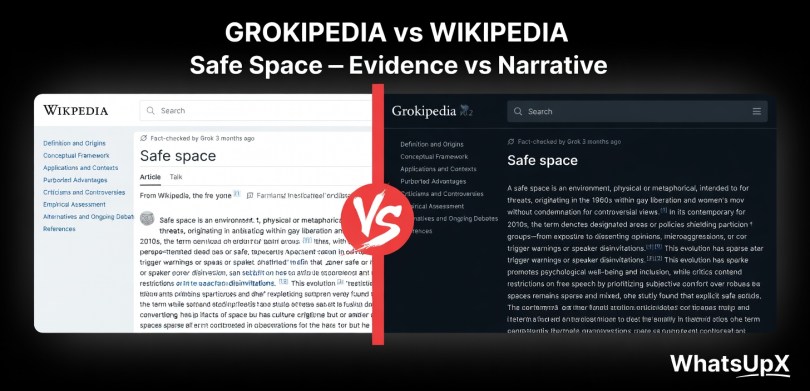
Grokipedia vs Wikipedia Safe Space Comparison: Evidence vs Narrative Side-by-side visual breakdown of the “Safe Space” entries on Grokipedia and Wikipedia. Grokipedia (right) delivers rigorous empirical research and data-driven analysis, while Wikipedia (left) offers a traditional descriptive narrative lacking quantitative evidence.
In July 2022, podcaster Johnna Crider invited me, Gail Alfar, to join her for a relaxed, wide-ranging conversation with Elon Musk at Tesla’s Giga Texas factory. The chat was recorded for Johnna’s show Getting Stoned.
The three of us talked about some of the biggest ideas facing humanity: why we should make life multi-planetary with real urgency, the declining birth rate and its risks to civilization, poverty and homelessness, the power of internet access and education, Starlink’s role in disaster relief, Tesla Energy (including Megapacks), and the future of AI and Full Self-Driving.
It was a candid, unscripted discussion full of big-picture thinking and personal stories — including a memorable moment when Elon directly addressed the shadowbanning I was experiencing on Twitter (now X).
This cleaned-up transcript captures the full conversation exactly as it happened — easy to read and understand for anyone, no matter their background. (Elon even invited Johnna back for a Part 2 because we didn’t have time to cover every question!)
Full Verbatim Transcript
Elon: This is Getting Stoned. It’s a podcast about gems and minerals and I am not your host.
Johnna: This is Getting Stoned. It’s a podcast about gems and minerals and I am your host, Johnna Crider. On today’s episode we have a very special guest. Thank you, Elon Musk, for joining me.
Elon: All right.
Johnna: So Elon, I always find it inspiring when you talk about the light of consciousness. What does consciousness mean to you?
Elon: To the best of our knowledge, the only conscious life we’re aware of is on Earth. I’m conscious in the sense that I think I have self-awareness. We’ve never found microbial life anywhere else in the solar system, though it’s possible we might find some under the ice of Europa.
According to the geological record, Earth is about 4.5 billion years old and the universe is about 13.8 billion years old. It’s odd that only very recently has life evolved that can talk, write, and communicate sophisticated ideas. And only now has civilization reached the point where we can send life to another planet. A lot of people think Moon landings are fake. They’re not.
Johnna: I don’t think they’re fake.Yeah, they’ve actually brought back some cool minerals from the Moon and I kind of have one in my collection.
Elon: I actually have a slice of a Moon meteor — a chunk of Moon that was hit by a meteor, smashed a bunch of Moon rocks, and some of the Moon rocks landed on Earth. And I’ve got a segment of one of them.
Johnna Crider: The Apollo mission brought back some Tranquilityite. And up until 2011, it’s called that because of the Sea of Tranquility. Yeah, and there was none found on Earth and then in 2011 some deposits were found in Australia.
So I have a friend of mine sent me some deposits and it broke. And so it had big chunks and two little pieces, so I made the other two little pieces into art.
Elon: But I mean it’s crazy how old the rock is. It’s like billions of years old.
Johnna: That shungite I just gave you, that’s over two billion years old.
Elon: That’s a long time, you know. Don’t hold your breath (laughter)
Elon: I mean it’s hard to even wrap your mind around that kind of time scale. A billion years — our lifespans are a flash in the pan. That’s true. Just like that. Shorter than a flash in the pan compared to galactic time scales.
So there are much things that one could say, or at least appear to be likely, which is that it appears that consciousness is rare. And it takes a long time for it to arise. And so, like I said, to the best of our knowledge we are alone. And so we have to accept the possibility that we may be it — at least in this sector of the galaxy or in the Milky Way perhaps. And if we’re it and this is the only little candle in a vast darkness of a little light of consciousness that got us lit, then we should really try to make sure that life does not go out. And we can’t take it for granted that it won’t. So we want to try to make it last as long as possible.
Elon: And I think we also want to try to understand the nature of the universe, meaning of life, where is it going, what does the future hold, just find out what’s going on in the universe. And so that means the more that we can expand the scope and scale of consciousness, the more we’re likely to understand the fundamental questions around the meaning of life and nature of the universe. And so I think that’s a good goal to have. And it’s a goal that I think can unite humanity because it’s a common goal as opposed to sort of infighting and “I want this big field of ice, I want this piece of land.” No, I want this piece of land. Well, you know, there’s a lot of land out there. There’s a lot of planets with nothing on them. How about those ones? Why fight over the little pieces when there’s entire planets out there and solar systems and stuff?
Elon: So I think it is a philosophy that withstands reason. I think there’s a solid reasoning basis for it. It’s really just a philosophy of curiosity, I would call it. And it’s also exciting, you know. If you think like… I mean the happy reasons when you wake up in the morning that you’re excited to be alive and you look forward to the future. And it can’t just be solving one sad problem after another. You know, what the hell’s the point? There’s no point like that.
Johnna: Right.
Elon: This is the first time in history that the window of opportunity has been open for life to become multi-planetary. It may stay open for a long time or a short time, but I think it would be wise to assume it will be open for a short time and take action now.
We don’t need to spend a huge amount of resources on it. Less than one percent of our resources would be enough to make life multi-planetary. We should be life’s steward in that sense, because the other creatures can’t build spaceships but we can.
This isn’t about abandoning Earth. We need to make Earth as good as possible. That’s what Tesla is about, making a good future for Earth. SpaceX is about making life multi-planetary. We need to do both.
Johnna: You would not believe what my cats can do. That’s all I’ve got to say about that! But seriously, I think we have a responsibility to protect the rest of the creatures on Earth too.
Elon: I completely agree. A reasonable approach would be to spend about one percent of our resources on making life multi-planetary and ensuring the long-term survival of consciousness and life as we know it. Tesla’s goal is to help ensure a good future for Earth. SpaceX’s goal is to make life multi-planetary and ensure the long-term survival of consciousness. Those are awesome goals.
Gail: Happiness.
Elon: I’ve mostly talked about the defensive, protective reasons for becoming multi-planetary. But what actually gets me most excited is the sense of adventure and possibility. It would be the greatest adventure ever, exciting and inspiring to see it happen.
Johnna: What you and SpaceX have done in Ukraine with Starlink inspires a lot of deep respect. You also helped Saint Charles Parish in my state after Hurricane Ida, as well as the villages of Tango. What role do you see Starlink playing in disaster relief? We’re going to have a lot of disasters. They’re predicting more hurricanes in my area this year.
Elon: In general, Starlink is not dependent on any ground-based infrastructure, so it can provide internet connectivity to areas hit by floods, fires, or earthquakes where the ground infrastructure has been destroyed. That’s extremely helpful for rescue operations. When people are stranded, they need to be able to say “I need help” or “I need rescue.” Starlink has provided that in a number of situations.
Johnna: When we had Ida, my power was out for a week. Communications in southeast Louisiana were completely wiped out. It just made me think Starlink would definitely help organizations like the Cajun Navy as well as others to communicate better, especially with government.
Elon: Yeah.
Johnna: The Musk Foundation has done a lot of good work. About a month ago I made this really long list of everything you guys are doing. What you did for Lake Charles after Hurricane Laura was phenomenal and saved lives. How do you see the Musk Foundation helping charities, especially toward disaster relief, in the next few years as the effects of climate change continue?
Elon: We try hard with the foundation to give away money in ways that are actually useful. Maximum number of cents on the dollar actually helping people in need. It’s way harder to give away money than you think if you care about it actually doing good. We’re scaling up more personnel in the foundation to go through fewer intermediaries so we can have the shortest path to helping people.
Johnna: Would you consider grants that help organizations that focus on disaster relief?
Elon: Yeah, we do provide grants to organizations that work on disaster relief.
Johnna: Last year you donated 100 million dollars for the XPRIZE competition to fight climate change. Which of the four categories, air, land, ocean, or rocks, do you feel needs the most work?
Elon: The larger problem is getting the parts-per-million level of CO2 in the atmosphere down. We’re going to have to pull it out of the air and store it somewhere. I think storing it in a solid form makes sense. The energy to do that has to come from renewables, solar, wind, geothermal. I’m actually pro-nuclear as well, except in locations prone to natural disasters.
Johnna: There’s a company called Project Vesta that uses peridot to do that, and some diamond companies are making lab-grown diamonds with carbon from the air.
Elon: I don’t think that scales very well, but it is cool to think about.
Johnna: Would you consider doing another XPRIZE when this one closes?
Elon: Yeah, absolutely. We’re constantly looking for highly effective ways to spend money for general social good.
Johnna: What accomplishments of the Musk Foundation are you most proud of?
Elon: We funded a literacy XPRIZE to figure out the best software on a low-cost tablet to teach people to read. If you can improve literacy, you improve everything about a society. That’s probably the best thing we’ve done so far.
Johnna: The declining birth rate. You often talk about this problem. It is a real problem. But there’s another problem I think plays a major role, and that’s poverty. What actions do you think need to be taken toward solving poverty that would help relieve some of that issue with the declining birth rate?
Elon: The declining birth rate is somewhat counter-intuitive, but generally the wealthier someone is, the fewer kids they have. I’m an exception, but it’s quite rare. It’s not really a money thing. In fact, it seems to be the opposite.
Even someone living at what we consider the poverty level in 2022 has access to things the richest person on Earth didn’t have 100 years ago.
Johnna: I’ve been homeless before while working two jobs. The idea of having a kid in that situation would terrify me. You can’t just throw money at it and solve it. There’s a lot of trauma involved. From my own experience, trauma is the number one cause of homelessness. That’s why I was asking what ideas you have that could point toward a real solution.
Elon: Literacy and access to the internet are fundamentally helpful. We have to think beyond just the United States. There are billions of people who have no internet access at all, or it’s very low bandwidth and insanely expensive.
These days you can learn almost anything online. MIT has all their lectures available, and many other universities do the same. You can literally have access to all the world’s information using just a simple phone or an old tablet.
Elon: This fact is really underappreciated. Before the internet, if you wanted to learn a skill you had to go to a specific school, get the exact books, or visit a library that might not even have what you needed. A few hundred years ago books were rare and expensive. The improvement in access to information is truly remarkable.
Johnna: I can’t imagine not having books! Google teaches really well, especially when I go to gem and mineral shows and have to look things up. Do you have any other thoughts on how to reverse population decline?
Elon: The population decline problem is possibly the biggest risk to civilization. A lot of people still think there are too many humans on the planet. That is absolutely not true. We could double the world’s population without any meaningful damage to the environment.
You could fit every single human on Earth inside the city of New York on just one floor. Earth is actually very sparsely populated with humans. There are not enough humans, far from being too many. Last year we had the lowest birth rate in recorded history.
Gail: Wow, yeah. I saw the statistics on your Twitter account.
Johnna: Yeah, so I don’t even see all your tweets half the time, even though I follow you. That’s the crazy part.
Elon: If you have the latest tweets? Because you have to switch because of the algorithm?
Johnna: Yeah, shadow banning is crazy. It’s really bad.
Elon: What the heck’s going on?
Gail: I don’t know. I tweet really nice things but…
Elon: Exactly. You’re not like a hate monger. You’re the furthest thing from it. You’re obviously a super nice person. So what the heck are they doing?
Johnna: She got shadowbanned when she replied to me with a heart. It was you or Kristen. They replied with something really nice and got shadowbanned.
Johnna: Oh, it was you.
Gail: Lots of lots of love.
Johnna: Yeah.
Elon: It really sounds like someone on Twitter is doing something shady. That’s not cool.
Elon: Whoever’s doing that on Twitter, shame on you!
Johnna: Alright, so let’s talk Tesla. There’ve been quite a lot of bills that have been kind of anti-EV or anti-Tesla going through state governments. What are your thoughts on how dealerships are trying to preserve their way of life instead of evolving with the market?
Elon: It’s to be expected that incumbents will oppose a new entrant. If they can’t win a fair fight, they’ll try an unfair fight. But if we have the people on our side and strong customer support, I think we’ll win most of the battles.
Johnna: Tesla Insurance is making a difference for customers who switch, and Louisiana has the highest average cost of car insurance in the nation. When will Tesla Insurance expand to all 50 states and Canada? And when will Louisiana get it?
Elon: Insurance is regulated primarily at the state level, so it’s a state-by-state thing. You have to jump through a lot of hoops in every state, and those hoops take a long time.
Johnna: …and the weakest part of Texas is the grid, and here comes Tesla trying to strengthen that weakest part.
Elon: The batteries are helpful even without sustainable energy because they can load-balance the grid. Power spikes, dips, fluctuations. The batteries can smooth it all out. The Tesla Megapack and Powerwalls can be really helpful for stabilizing the grid.
Gail: Could you talk a little bit about Distributed Energy Resources (DERs) and if Gigafactory Texas could be protected in the event of an emergency?
Elon: In terms of batteries, this is going to be a combination of large utility-scale batteries with very big installations like the one we did with PG&E at Moss Landing, and then at the local level the Powerwalls that collectively can stabilize the grid within a neighborhood. The combination of centralized Megapacks and distributed Powerwalls can have a very positive effect in making sure the power stays on.
Johnna: …and then we also touched upon AI.
Elon: On the AI front, Tesla is doing a lot with AI for Autopilot and Full Self-Driving. We’re making good progress. The goal is to make the car safer than a human driver, and in many situations it’s already safer. There have been cases where the car saved someone’s life because the driver had a seizure or was unconscious and the car pulled over safely.
Autonomy is going to be a huge benefit to society because over a million people die every year in car accidents. I think we can reduce that by at least a factor of 10.
On the broader AI front, we’re working toward artificial general intelligence. AGI. It’s not there yet, but progress is being made. Eventually digital intelligence could exceed human intelligence, and I think we need to be careful because AI could be an existential risk if not handled properly. So some regulatory oversight as a public safety measure makes sense.
But overall, I’m optimistic that we’ll be able to have AI that is beneficial to humanity. Optimus, the humanoid robot, is also powered by the same AI tech. So that’s another big thing.
Johnna: Wow. Well, thank you so much, Elon, for taking the time to talk with me today. I really appreciate it. And thank you to everyone at Giga Texas for making this possible. You’ve inspired so many people. Thank you.
Elon: All right. Thank you.
Johnna: And Elon did invite me to come back since I didn’t get to ask all my questions, so there will eventually be a Part 2. Thank you again.
Gigafactory Texas as seen from the interview conference room. [Credit: Gail Alfar, All Rights Reserved, June 25, 2022]
A clip from this episode showing the unsupervised Tesla Robotaxi (with no safety driver) going down a narrow street and performing a multi-point U-turn in a tight spot was reposted by Elon Musk and has been seen over 75 million times. As of today, it might be one of Gail’s most viewed posts. It also has over 6.5K comments.
In this full episode, I take my first ride in an unsupervised Tesla Robotaxi through Austin and share my real-time thoughts and impressions while the car drives itself.
Watch the full episode here (or tap the X post for the video):
Ep 168 of Gail’s Tesla Podcast is here! First time in an unsupervised Tesla Robotaxi through Austin. Real-time thoughts and impressions. pic.twitter.com/UxVeYwLOHN
These in-car rides and conversations highlight the steady real-world progress Elon and the Tesla team continue to deliver every day.
Leave a comment
What stood out most to you in this episode? Have you had a chance to ride in a Tesla Robotaxi yet? Drop your thoughts or share your own Tesla story below.
Tesla continue d’impressionner par son engagement constant à étendre son réseau de Superchargeurs à travers la France. L’entreprise offre un nouveau niveau de commodité et de fiabilité aux conducteurs de véhicules électriques, au moment même où les immatriculations explosent.
Les nouveaux sites et extensions annoncés via le compte officiel @TeslaCharging sur X surgissent près des supermarchés, hôtels, aéroports et grands axes routiers. Ces ouvertures arrivent à point nommé pour accompagner le retour spectaculaire de la demande Tesla après une année 2025 plus difficile. Ces ajouts soulignent l’engagement de Tesla à rendre les longs trajets fluides et simples dans l’un des marchés les plus prometteurs d’Europe pour les véhicules électriques.
Derniers Superchargeurs mis en service (mars–avril 2026)
Puisés directement dans les publications récentes de @TeslaCharging, voici la dernière vague d’ouvertures et d’extensions (présentées par ordre chronologique inverse, avec les points de repère à proximité) :
Abbeville (8 bornes) – vers le 12 avril 2026 Pôle commercial du Nord, le long de l’A16, près d’un supermarché Hyper U.
Limoges – Avenue des Casseaux (9 bornes) – vers le 9 avril 2026 Centre de la France, juste à côté d’un supermarché Grand Frais.
Roissy-en-France – Avenue du Bois de la Pie (12 bornes) – vers le 5 avril 2026 Près de l’aéroport Paris Charles de Gaulle et des hôtels Van der Valk / Hyatt Place. Idéal pour les voyageurs.
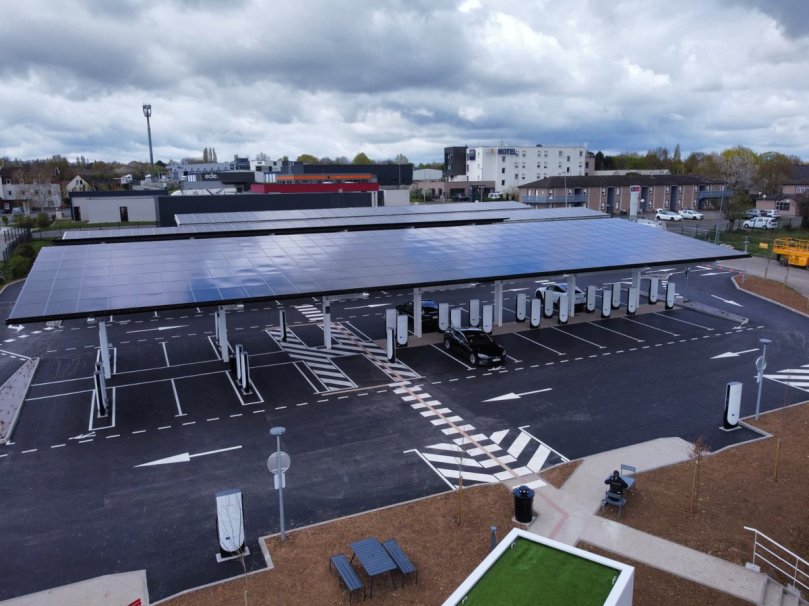
Saint-Saturnin (étendu à 48 bornes) – 3 avril 2026 Au nord du Mans, au Brit Hotel. Cette importante extension a ajouté 28 bornes, avec des ombrières solaires et des sanitaires.
Goussainville (9 bornes) et Chilly-Mazarin (10 bornes) – Récemment (mars/avril) Banlieues parisiennes, tous deux situés près de supermarchés Grand Frais.
Le Mans – Rue des Frères Voisin (9 bornes) – 9 mars 2026 Site urbain dans la région du Mans.
Cholet (8 bornes) – 6 mars 2026 Zone commerciale de l’Ouest de la France.
D’autres ajouts récents notables incluent Mulhouse (20 bornes), Scionzier (8 bornes), Phalsbourg (8 bornes) et Cosne-Cours-sur-Loire (8 bornes). Tous sont positionnés de manière stratégique pour offrir un maximum de commodité aux conducteurs.
Un thème clair se dégage : Tesla intègre ces stations dans la vie quotidienne en associant la charge à des moments de shopping, restauration et repos. Cette approche contribue à supprimer l’anxiété de l’autonomie sur les autoroutes françaises.
Le plus grand site Supercharger de France : Saint-Saturnin
Le réseau de Tesla vient d’atteindre un jalon historique mondial ici même en France, au site qui constitue actuellement le plus grand Supercharger du pays. Le site de Saint-Saturnin, situé juste au nord du Mans, a été étendu à 48 bornes, devenant le plus important déploiement sur un seul emplacement en France à ce jour.
@TeslaCharging a parfaitement capturé l’excitation du moment : « Saint-Saturnin, just north of Le Mans in 🇫🇷, marks our 80,000th Supercharger stall. »
Tesla a commencé à déployer ses Superchargeurs en France il y a plus d’une décennie. L’entreprise a patiemment construit les bases qui accélèrent aujourd’hui rapidement pour répondre à la forte demande croissante.
Réactions des propriétaires
Les propriétaires français de Tesla se réjouissent de cette expansion. Un conducteur enthousiaste a déclaré : « Tesla a le réseau le plus fiable, le moins cher et le plus étendu du monde. d’ailleurs ils ont installés leur 80000eme supercharger à saint saturnin près du mans la semaine dernière 😎. »
Tesla a le réseau le plus fiable, le moins cher et le plus étendu du monde. d'ailleurs ils ont installés leur 80000eme supercharger à saint saturnin près du mans la semaine dernière 😎. en heure creuse le prix du kilowatt heure est inférieur au prix EDF pour les particuliers lol.
Les immatriculations Tesla en France : un rebond spectaculaire
Le timing ne pourrait pas être meilleur. En mars 2026, 9 569 nouvelles immatriculations Tesla ont été enregistrées, soit une hausse massive de +203 % par rapport à l’année précédente. Sur l’ensemble du premier trimestre (janvier–mars), la France a atteint un record de 13 945 véhicules Tesla, en progression de +108 % par rapport à la même période en 2025.
« Supercharger Saint-Saturnin France – Le plus grand site Tesla avec 48 bornes et la 80 000e borne mondiale (avril 2026) »
Après une année 2025 plus difficile marquée par une concurrence accrue, la nouvelle gamme rafraîchie de Tesla, ses prix compétitifs et les améliorations visibles du réseau de charge portent clairement leurs fruits.
Perspectives pour le reste de l’année 2026
Avec cette dynamique d’infrastructure qui s’accélère, la France s’annonce une année exceptionnelle. Si la croissance à trois chiffres de mars et l’élan du premier trimestre se maintiennent, soutenus par des dizaines de nouveaux Superchargeurs attendus le long des corridors principaux, Tesla pourrait atteindre entre 35 000 et 45 000 immatriculations en France sur l’ensemble de l’année 2026. Ce serait un record potentiel qui renforcerait considérablement sa part de marché dans le deuxième plus grand pays européen pour les véhicules électriques.
On peut s’attendre à une attention soutenue sur les grands axes comme l’A1 et l’A6, à davantage de méga-sites équipés de panneaux solaires, et à une utilisation encore plus forte à mesure que les nouvelles versions du Model Y et les futurs modèles arriveront sur les routes. Le cercle vertueux entre meilleure infrastructure de charge et hausse des ventes ne fait que s’amplifier.
Les propriétaires de Tesla en France vivent déjà le futur. Le réseau n’a jamais été aussi robuste, et les routes devant eux s’annoncent électriques et passionnantes. Restez à l’écoute lorsque les chiffres du deuxième trimestre seront publiés. Cette histoire ne fait que commencer !
Tesla continues to impress with its relentless push to expand the Supercharger network across France. The company is delivering fresh convenience and reliability to EV drivers just as vehicle registrations are skyrocketing. New sites and expansions announced via the official @TeslaCharging account on X are popping up near supermarkets, hotels, airports, and major routes. These openings are perfectly timed to support a dramatic comeback in Tesla demand following a tougher 2025. These additions highlight Tesla’s commitment to making long-distance travel seamless in one of Europe’s most promising EV markets.
Latest Superchargers Put Into Service (March–April 2026)
Drawing directly from @TeslaCharging’s recent posts, here’s the latest wave of openings and expansions (listed in reverse chronological order, with nearby landmarks for easy context):
Abbeville (8 stalls) – ~April 12, 2026 Northern commercial hub along the A16, near Hyper U supermarket.
Limoges – Avenue des Casseaux (9 stalls) – ~April 9, 2026 Central France, right beside a Grand Frais supermarket.
Roissy-en-France – Avenue du Bois de la Pie (12 stalls) – ~April 5, 2026 Near Paris Charles de Gaulle Airport and Van der Valk Hotel/Hyatt Place. Ideal for travelers.
Saint-Saturnin (expanded to 48 stalls) – April 3, 2026 Just north of Le Mans at the Brit Hotel. This major upgrade added 28 stalls, complete with solar canopies and restrooms.
Goussainville (9 stalls) and Chilly-Mazarin (10 stalls) – Recent (March/April) Paris suburbs, both anchored near Grand Frais supermarkets.
Le Mans – Rue des Frères Voisin (9 stalls) – March 9, 2026 Urban site in the Le Mans area.
Cholet (8 stalls) – March 6, 2026 Western France retail zone.
Other notable recent additions include Mulhouse (20 stalls), Scionzier (8 stalls), Phalsbourg (8 stalls), and Cosne-Cours-sur-Loire (8 stalls). All are strategically placed for maximum driver convenience.
A clear theme shines through: Tesla is embedding these stations into everyday life by pairing charging with shopping, dining, and rest stops. This approach helps eliminate range anxiety on France’s autoroutes.
Spotlight on the Largest Supercharger Site in France: Saint-Saturnin
Tesla’s network just hit a historic global milestone right here in France, and it is at the country’s current largest Supercharger site. The Saint-Saturnin location just north of Le Mans was expanded to 48 stalls, making it the biggest single-site deployment in France to date.
@TeslaCharging captured the excitement perfectly: “Saint-Saturnin, just north of Le Mans in 🇫🇷, marks our 80,000th Supercharger stall.”
Tesla first began rolling out Superchargers in France more than a decade ago. The company has been steadily building a foundation that is now accelerating rapidly to match surging demand.
Owner Reactions Pour In
French Tesla owners are thrilled with the expansion. One enthusiastic driver shared: “Tesla a le réseau le plus fiable, le moins cher et le plus étendu du monde. d’ailleurs ils ont installés leur 80000eme supercharger à saint saturnin près du mans la semaine dernière 😎.” (Translation: “Tesla has the most reliable, cheapest, and most extensive network in the world. They just installed their 80,000th Supercharger in Saint-Saturnin near Le Mans last week 😎.”)
Tesla a le réseau le plus fiable, le moins cher et le plus étendu du monde. d'ailleurs ils ont installés leur 80000eme supercharger à saint saturnin près du mans la semaine dernière 😎. en heure creuse le prix du kilowatt heure est inférieur au prix EDF pour les particuliers lol.
The timing could not be better. March 2026 saw 9,569 new Tesla registrations, a massive +203 percent year-over-year surge. For Q1 overall (January–March), France recorded a record 13,945 Tesla vehicles, up +108 percent from the same period in 2025.
After a challenging 2025 marked by increased competition, Tesla’s refreshed lineup, competitive pricing, and now-visible charging improvements are clearly paying off.
Projections for the Rest of 2026
With this infrastructure flywheel spinning faster, France looks poised for an outstanding year. If March’s triple-digit growth and Q1 momentum hold, bolstered by dozens more Superchargers expected along key corridors, Tesla could realistically deliver 35,000 to 45,000 registrations in France for full-year 2026. This would be a potential record that significantly boosts its market share in Europe’s second-largest EV nation.
Expect continued focus on high-traffic routes like the A1 and A6, more solar-equipped mega-sites, and even stronger utilization as new Model Y variants and upcoming vehicles hit the roads. The virtuous cycle of better charging plus rising sales is only gaining speed.
Tesla owners in France are living the future today. The network is more robust than ever, and the roads ahead look electric and exciting. Stay tuned as Q2 data rolls in. This story is just getting started!
If you have been housebound for years, maybe due to health issues, anxiety, vertigo, or just life in the way, the idea of a driver license as an adult in Louisiana can feel overwhelming. Add in the dream of owning a Tesla in a state known for high insurance rates, and it might seem downright impossible.
But it is not. Real people are doing it right now, and the combination of a supportive licensing process, Tesla technology, and smart shopping can make freedom on the road feel safer and more attainable than ever.
Step 1: Adult Driver License in Louisiana
Louisiana Office of Motor Vehicles makes the process straightforward for adults 18 and older who have never held a license. Here is the realistic path:
Start by obtaining a Temporary Instructional Permit from the OMV.
Complete a state approved adult pre licensing course. This is typically 6 hours of classroom instruction, which includes the knowledge or written test, plus 8 hours of behind the wheel training. Costs generally run $400–$525 depending on the driving school.
Pass the vision screening, knowledge test, and road skills test.
Provide proof of identity and residency.
Many local driving schools offer these compact adult courses, and some even handle the testing on site. It is far less intensive than the longer program required for teens. Once you have your certificate of completion and pass the tests, you can get your full Class E license without the graduated restrictions that apply to younger drivers.
Yes, it takes commitment, but thousands of adults do this every year and regain their independence.
Step 2: Buying a Tesla in Louisiana
Once you are licensed, or even while building confidence, ordering a Tesla is surprisingly simple. You configure and purchase entirely online at tesla.com. Current base prices make it accessible. The Model 3 often starts around the low $40,000 range, and leasing options can lower the barrier.
Delivery in Louisiana has historically required a short road trip because Tesla does not have traditional dealerships here. Long time owner William Sellers shared his experience. For his 2018 Model 3, he picked it up in Houston, Texas. For his 2023 Model Y, he drove to Brandon, Mississippi. Note that pickup locations can shift over time due to state rules. Always check your Tesla account for the latest delivery details when your vehicle is ready.
Many new owners find that short delivery drive, often with a friend or family member, actually serves as a gentle re introduction to driving.
Step 3: Maintaining a Tesla
One of the biggest surprises for new Tesla owners is how little maintenance is required. No oil changes, no spark plugs, no transmission fluid, just occasional tire rotations, cabin filter changes, and brake fluid, which lasts much longer thanks to regenerative braking.
William and his wife own two Teslas in Baton Rouge, a 2018 Model 3 Long Range rear wheel drive with about 36,000 miles and a 2023 Model Y Long Range all wheel drive with about 16,000 miles. They have found ownership refreshingly simple.
Step 4: Charging Without a Wall Charger
You do not need an expensive home Level 2 charger to make Tesla ownership work in Louisiana. William and his wife charge both vehicles using a standard 110 volt outlet and the included mobile connector. They limit daily charging to 75% to preserve battery health and report very little range loss.
This works beautifully because Louisiana has growing Supercharger coverage. Baton Rouge alone has multiple Supercharger sites, and the network stretches reliably across the state for longer trips.
Utility companies like Entergy, Cleco, and SWEPCO have offered rebates, often $250, for Level 2 charger installation in the past. It is worth checking current incentives if you decide to upgrade later. Some public spots, like downtown Baton Rouge parking garages, even offer free or low cost Level 2 charging.
Step 5: The Pluses of Owning a Tesla in Louisiana
Here is where the magic happens, especially for anyone nervous about driving.
William told me, “We rarely drive ourselves. Full Self Driving has become a necessity for ease of everyday life and also safety.” Both of their Teslas are equipped with Full Self Driving. He says it is “the best thing about our Teslas,” and he has seen situations where Full Self Driving might have helped friends avoid recent wrecks.
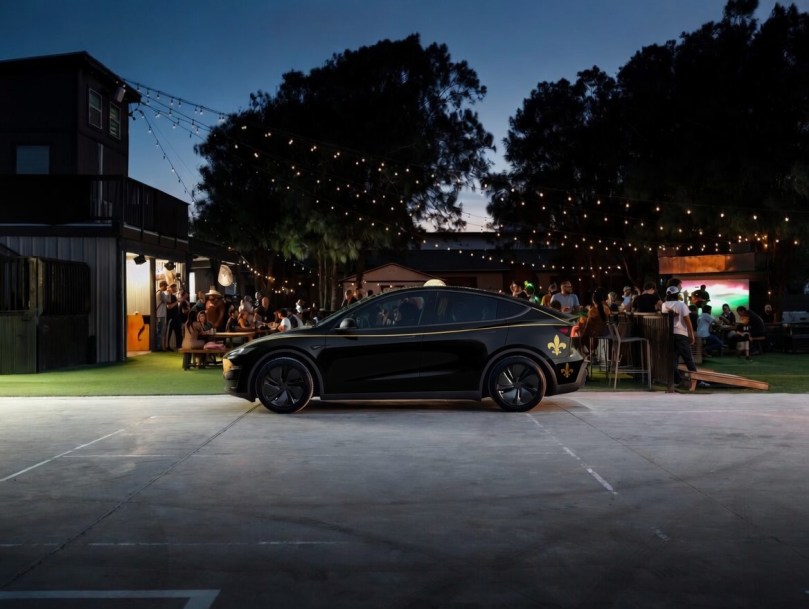
Black and gold Mardi Gras wrapped Tesla Model Y at a Louisiana night event – showing how Tesla ownership blends seamlessly into local culture and social life in our state. Courtesy of Tesla, Inc. Image edit by Grok AI.
For someone overcoming fear of driving, William offers thoughtful encouragement. “Full Self Driving can actually teach the human on safe driving principles. Also, the large screen and GPS mapping or routing can help many people overcome the fear of driving and getting lost on a trip.”
He still believes it is wise to build basic driving comfort in case you need to take over, especially in bad weather, but he sees Tesla plus Full Self Driving as a game changer that makes the road less intimidating. The quiet cabin, smooth acceleration, and advanced safety systems add layers of calm that traditional cars simply do not offer.
Low daily mileage, under 7 miles on average for their work commutes, also helps keep costs and wear minimal.
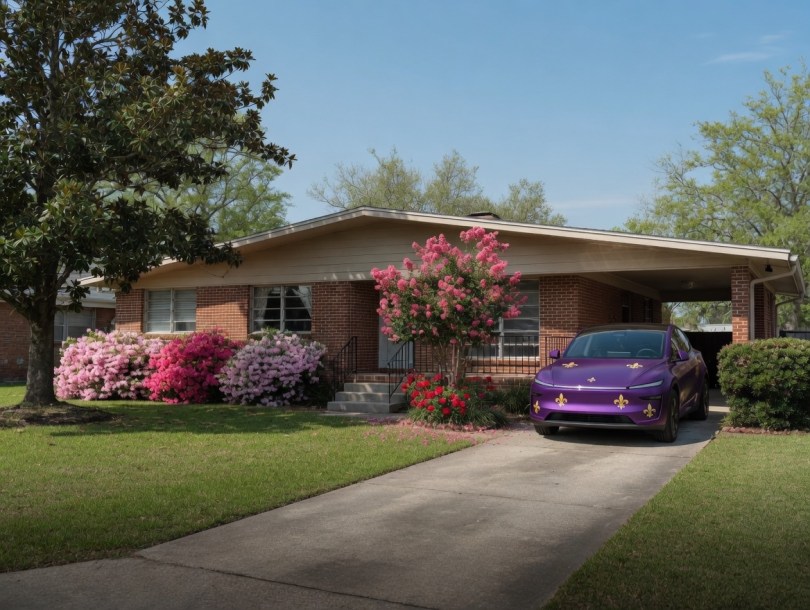
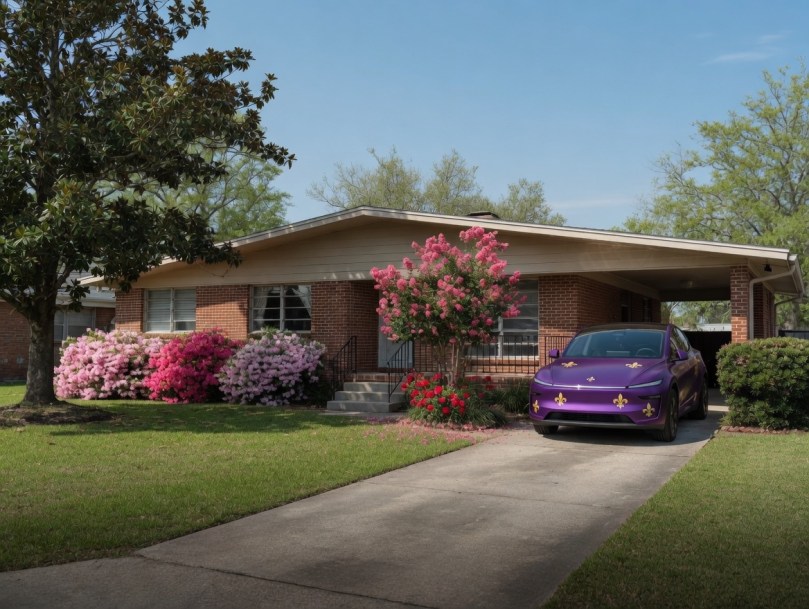
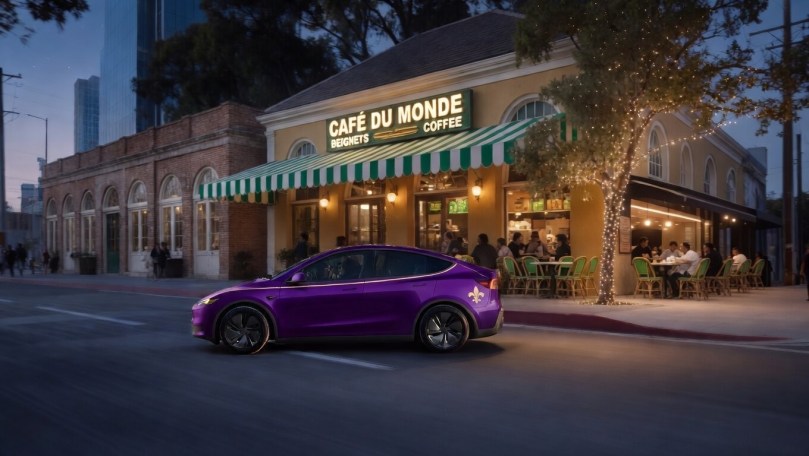
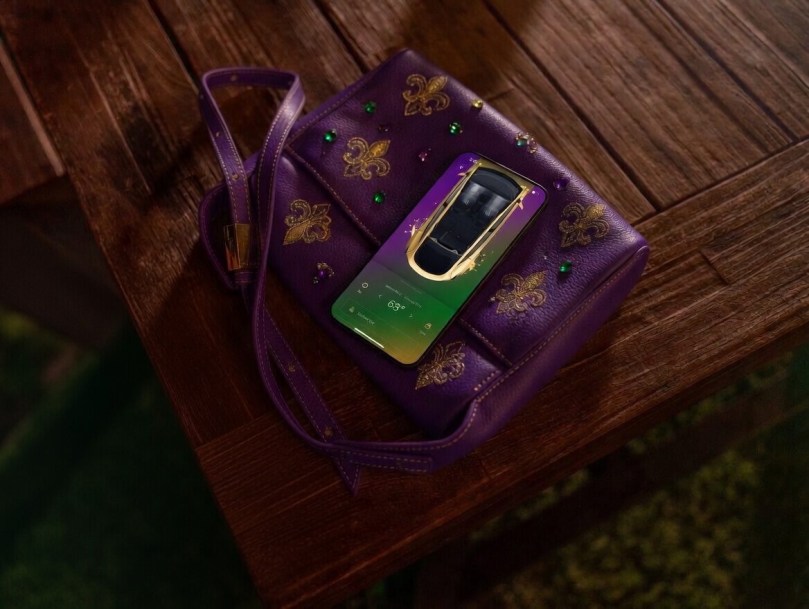
Purple Mardi Gras wrapped Tesla Model Y parked at Café du Monde in Louisiana – a perfect example of how fun and practical Tesla ownership can look in our state, blending local culture with modern electric driving. Courtesy of Tesla, Inc. Image edit by Grok AI.Mardi Gras purple handbag with Tesla app on phone – a fun, stylish way to show how Tesla ownership fits perfectly into Louisiana culture and everyday life. Courtesy of Tesla, Inc. Image edit by Grok AI.
Step 6: Insurance Realities in Louisiana
Louisiana has some of the highest insurance rates in the country, and Teslas can carry higher premiums due to perceived repair costs. But real world numbers show it is far from impossible.
William and his wife, both over 50 with clean records and no claims in decades, pay $227.25 per month through State Farm for both Teslas combined. Their policy includes liability, uninsured motorist, comprehensive, and collision. They switched to State Farm about 3 years ago, and rates have stayed stable so far. They credit their low mileage, clean records, and the cars advanced safety systems.
This works out to roughly $113–$114 per car per month, very competitive even in a high rate state. Shopping around, bundling, and maintaining a clean record make a big difference. Many owners report bringing full coverage costs down into the $160–$280 range per month per vehicle with smart choices.
Final Thoughts
Adult driver licensing, ordering your first Tesla, figuring out charging, and handling insurance in Louisiana is not effortless, but it is very doable. William Sellers and his wife have been living it since 2018, embracing Full Self Driving for daily freedom while still enjoying the thrill of manual driving when they want it.
William closing wisdom feels especially hopeful. “We are on the cusp of a very exciting time of Full Self Driving capabilities. Humans have trained the Full Self Driving models, and these same models can help train humans on the best practices of driving.”
If you have been waiting for the right moment to reclaim your independence, this could be it. Start with that adult pre licensing course. Browse Tesla site. Reach out to owners like William for real talk encouragement.
Freedom on four wheels, even in a Tesla, is closer than it feels.
A big thank you to William Sellers, @wsellers on X, for generously sharing his honest experiences owning two Teslas in Louisiana. His insights on insurance, charging, Full Self Driving, and overcoming driving fear made this piece far more real and encouraging.
![View of Giga Texas factory floor from the conference room where the Getting Stoned podcast interview with Elon Musk took place, July 2022 [Photo by Gail Alfar]](https://whatsuptesla.com/wp-content/uploads/2026/04/giga-texas-conference-room-getting-stoned-podcast-elon-musk-2022.webp?w=810)
![View of Giga Texas factory floor from the conference room where the Getting Stoned podcast interview with Elon Musk took place, July 2022 [Photo by Gail Alfar]](https://whatsuptesla.com/wp-content/uploads/2026/04/giga-texas-conference-room-getting-stoned-podcast-elon-musk-2022.webp?w=809)