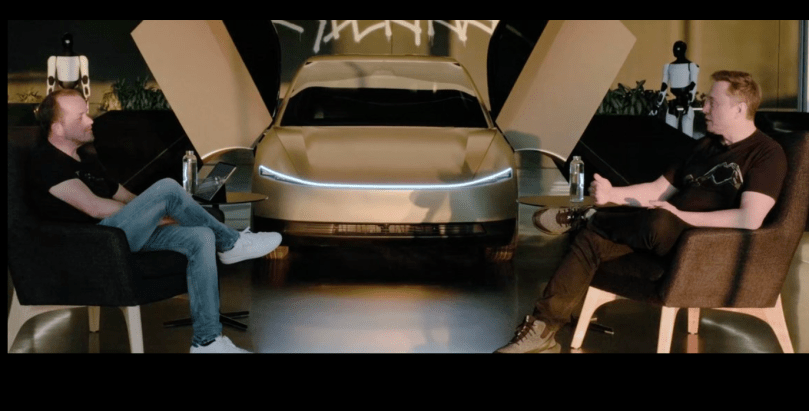
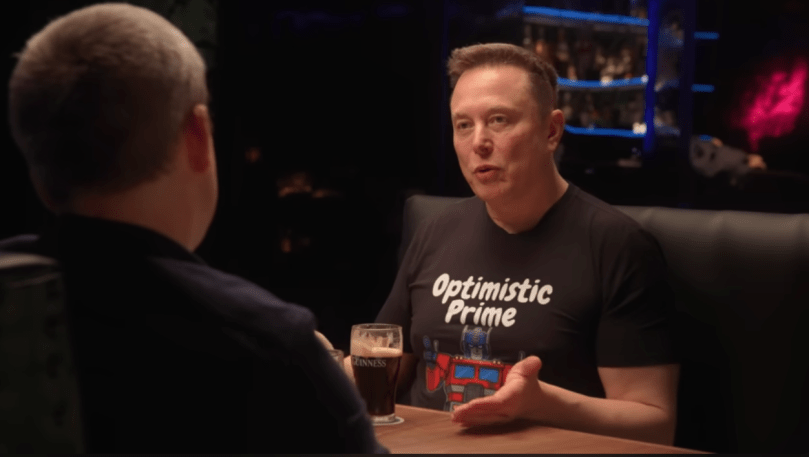
In this exclusive 23-minute interview with Giga Berlin plant manager André Thierig, Elon Musk reveals Tesla’s plans, including Cybercab & Optimus production in Europe, Full Self-Driving launching in the Netherlands on March 20, and his bold prediction of “Tesla factories on the moon” and the now-viral line: “Hold on to your TSLA stock… it’s going to be worth a lot!”
André Thierig: Welcome, Elon, and thanks for taking the time. I really understand that time is precious. There are a ton of things to do to build a world of amazing abundance. I can hardly imagine what is on your mind — SpaceX, Starlink, AI, safe AI for the future, autopilot, so many things. But what is in your view still exciting about Tesla and why?
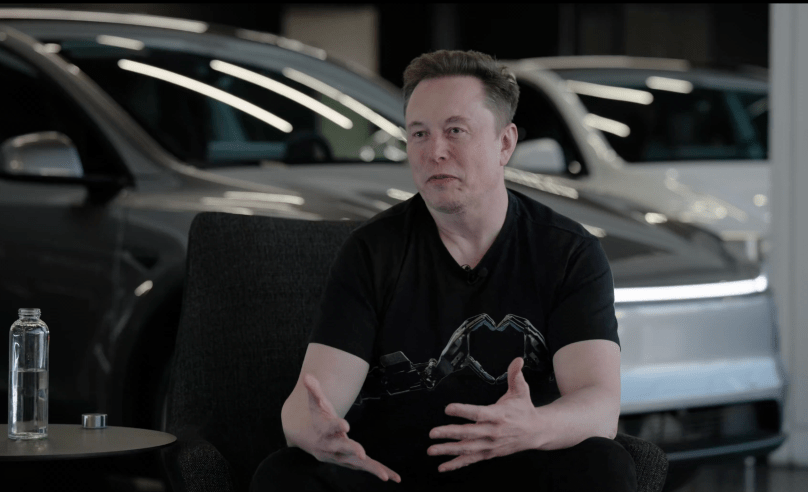
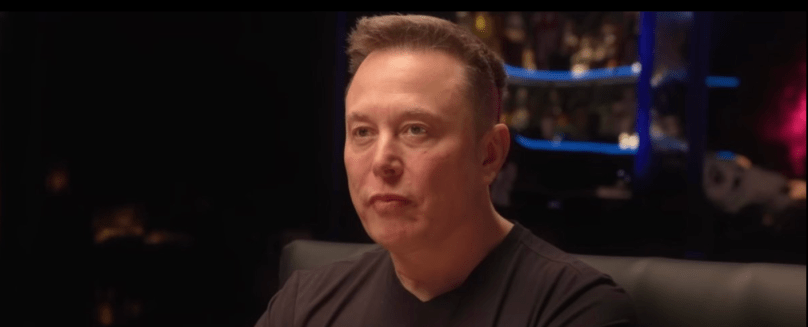
Elon Musk in the lobby at Tesla Giga Texas, February, 2026
Elon Musk: Well, I think Tesla is one of the most exciting companies in the world. It is perhaps the most exciting, but Tesla and SpaceX are the two most exciting companies. We are obviously expanding production and making more cars. We are going to roll out Tesla Full Self-Driving, which is really an AI-driven car. It’s AI software that drives the car, just by looking, like a human does. Tesla has the most advanced real-world AI and hopefully it will be approved soon in Europe. We were told by the authorities that it will be approved on March 20th in the Netherlands. I think people in Europe are going to be pretty blown away by how good the Tesla car AI is. This year it will be the case that from a technical standpoint you will be able to fall asleep in the Tesla and wake up at your destination. That is very exciting.
We have the Optimus program, which is going to be the first humanoid robot. Sometimes people ask what it would be used for. Who would not want their own personal C-3PO or R2-D2? Optimus can take care of your kids, walk the dog, or take care of elderly parents. Well, Optimus can do those things. That is very exciting. We have started production of the Tesla Cybercab here at Giga Texas and we will go to volume production in April.
If things go well, we would probably manufacture Cybercab in Europe and also manufacture Optimus in Europe. We have the Tesla Semi heavy truck that will be coming to Europe hopefully next year. There are so many things happening, it’s a long list!
Oh, and battery cell production… we are going to start making battery cells at Giga Berlin. We have the Tesla lithium refinery that started up in Texas and the Tesla nickel cathode refinery that started up in Austin. This year, there are a tremendous number of things happening. We have five factories starting volume production this year, five major production lines. We look forward to extending that to Europe as well.
Tesla’s Vision for the Next 10–20 Years: Factories on the Moon!
André Thierig: Tesla has done nothing less than really transforming a whole industry. Without Tesla taking that brave step to electrify mobility, the industry would not be where it is today. What would you want people to say about Tesla in 10 or 20 years from now?
Elon Musk: In 20 years, I would say Tesla has factories on the moon, actually!. I see a very prosperous future for Tesla. It is difficult to predict anything in 20 years, but if you look 5 to 10 years ahead, Tesla has an extremely bright future. I would say, hold on to your Tesla stock, it is going to be worth a lot, I think, that’s my bet!
André Thierig: Coming back to the present, you are always very well informed. If you look at the European industry, especially the automotive sector or even the German industry, what do you think about it? What do you believe are the main reasons for their current state?
Elon Musk on the European Automotive Industry
Elon Musk: I think there has not been enough innovation. Automotive innovation has been relatively low, the cars being produced are very much like the cars produced five years ago. There are not big differences. For 20-plus years I have said the automotive industry needs to go toward electrification. This would be true even without environmental concerns. An electric vehicle is a fundamentally better architecture than a gasoline combustion vehicle. It is much simpler, more efficient, quieter, and there is no pollution within cities. All ground transport should be electric. And I think all ships and airplanes should be electric.
The automotive industry has strongly resisted electrification and dragged its feet, and they have had to be pushed there by government. Whenever they have had the opportunity to reduce making electric vehicles, they’ve done so. This is not a good strategy. It doesn’t make sense.
Making vehicles autonomous is critical. I think about 10 years ago I said that in the future, any vehicle that is not electric and autonomous… like if you are riding in a vehicle that you have to drive yourself and it’s gasoline powered, it will be like riding a horse and using a flip phone. Which is to say that there are still some people that ride horses. It’s just rare. And some people somewhere are still using flip phones, but there aren’t many, and it’s going to be a niche thing. So, the future does not contain combustion vehicles, and there will be very few vehicles that are not autonomous. The future is autonomous electric vehicles. And so, if the automotive industry does not move in that direction, they will be left out.
André Thierig: So it doesn’t really sound like we could be learning much from legacy auto makers…and I guess we really should be focusing on what ourselves, or what we believe the future looks like, right?
Elon Musk: Yes, well, you can always learn something from some competitor. But strategically, they are just headed in the direction of the dinosaurs. So they are not headed to a good place. You know, dinosaurs are not around anymore. We’re certainly going down a different path. Like I said, electric and autonomous… to me it’s been blindingly obvious for 20-plus years. What I found with competitors in the automotive industry is, it’s not that they are going to steal our ideas. You can’t cram a good idea down their throat. Like if you say, “you must take this good idea!” They won’t steal our ideas, because you cannot even force-feed them our good ideas. That’s my experience. So we need to do what’s logical, what’s sensible. You know, at Tesla we’re essentially creating the future. And it’s a good future!
André Thierig: We are building the future, they just build cars!
Elon Musk: Yes. It’s a good future, it’s a future with electric vehicles that don’t emit poison gas, literally. They’re quiet, efficient, and autonomous. Like I said, instead of being stuck in traffic driving through busy roads, people sometimes fall asleep or have a medical emergency. And if you’re driving yourself on the Autobahn going super fast and you have a seizure, heart attack, or something like that, then you could die. But if the car is autonomous, it can take you to a hospital. In fact, this has actually happened many times with Tesla cars.
Giga Berlin Memories and the Path to Massive Expansion
André Thierig: Six years ago we broke ground and four years ago we started production. What are your greatest memories of Giga Berlin and the people here?
Elon Musk: First of all, I would like to say thank you very much to everyone who helped build Giga Berlin. Thank you, André, and thank you to the whole team. We have built an amazing factory in a very short period of time and reached high-volume production with good quality and good cost control. I am very proud of Giga Berlin and all the people in it.
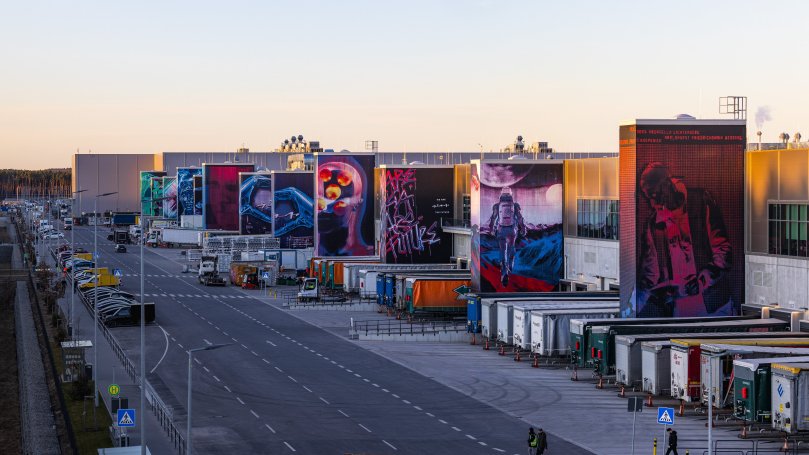
It’s cool! I like the art too, and that people have some fun!
Graffiti Art at Tesla Giga Berlin
Elon Musk: Coming to work should be something you look forward to. You come to work with people you enjoy working with, and you are doing useful things—you’re making things. I have a lot of respect for makers. Like, you actually make something; you build something useful that people enjoy. I’m a big fan of makers. There are a lot of people who—they do not make things, and I don’t know—they don’t make things or they don’t provide useful services. Whereas, I have huge respect for people who make things and provide useful services. It’s an honest day’s work.
André Thierig: If you have a vision for Giga Berlin, what would it be? And what would have to happen for it to come true?
Elon Musk: Ideally, we would significantly expand production at Giga Berlin. We would do high-volume production of battery cells, probably also the cathode, the anode, and lithium. We would become vertically integrated and produce things like the Cybercab or Optimus and other products that Tesla will develop. The exciting vision for the future of Giga Berlin is massively expanding it to do many more projects.
André Thierig: Do you have any advice for the team at Giga Berlin to work toward that vision?
Elon Musk: Things certainly get harder if there are outside organizations pushing Tesla in the wrong direction. If outside organizations make things very difficult in Giga Berlin, it is difficult to say that we would expand. We are not going to shut down the factory, but we are not going to expand it either, realistically.
Elon Musk: A favorite factory is like saying what is your favorite child. I love factories. I think a lot of people these days, they don’t love factories, or they haven’t been to a factory, whereas I walk the line in every factory and I’m a big fan of factories. I love them! Haha!
André Thierig: It’s a great place to be!
Elon Musk: Yeah. It’s where you make things that have good utility; people love the product. You’re building a product people love, and that’s great!
Giga Berlin is an awesome factory. The vibe is cool; to walk around is cool. It’s very clean and quite beautiful inside and outside. People seem quite happy. We are making cars and soon battery cells and hopefully many more things. It is one of the coolest factories in the world, really!
Employee: Which is the next product we will be building here in Giga Berlin?
Elon Musk: There are a lot of exciting possibilities. We have started spooling up production of the battery cell and we will be expanding production of the Model Y, especially as we get approval for supervised full self-driving. From the next major product standpoint, most likely the Tesla Cybercab. There are also possibilities of Tesla Optimus and the Tesla Semi heavy truck. Like, Tesla has a lot of products coming out, so there’s a lot of potential.
If things go well, we would expand Giga Berlin to whatever the most that we could. Assuming that the authorities are supportive, and the people are supportive, then we would expand to probably make it the biggest factory complex in Europe.
Employee: When do you realistically think we can have Optimus in the Gigafactories so we do not have to worry about ergonomics?
Elon Musk: Well, we have to be really careful about that one. I don’t want people to be worried about their jobs, you know. So, the honest answer for AI and robotics is: long-term, working will be optional. Long-term—which is 10 years from now or less—if you want to work, you can. It will be like growing vegetables in your garden, or you can get them from the store. It’s optional to grow vegetables in your garden, but some people still like to do it. It’s extra work to grow your own vegetables, but people enjoy the process. That’s going to be how work is in the future. It will be like: “You can work if you want to.”
Employee: How can we make sure that the adoption of new technologies like Optimus reach countries in the third world?
Elon Musk: First we have to succeed in making a useful robot. This is a hard thing to solve. Nobody has solved making a truly useful humanoid robot. So you have to make it useful, then you have to scale production. And its an entirely new supply chain. With Optimus we’ve had to design the whole robot from physics first principles. We’re designing every motor, every gear. The hands are extremely difficult to design. A properly dexterous robot hand is very difficult. One of the hardest things to engineer, and then we can scale production. At first Optimus will do small tasks, and then it will get gradually more sophisticated.
I think, eventually, Optimus could do medical work like surgery and everyone in the world would get better medical care than anyone receives today, from a human.
André Thierig: What advice would you give young people for life?
Elon Musk: Be on the side of optimism. It is better to be optimistic and wrong than pessimistic and right. Your quality of life will be much better. I would urge people to be excited about the future. I am excited about the future! I am confident the future will not be boring. Let me put it that way: it’s going to be very interesting. I think it is most likely to be great!
In terms of general advice, I guess I’d invite people to learn as much as possible, read a lot of books, try a lot of things, and find a job you can enjoy. I guess—enjoy life, but working is also a part of enjoying life. I think if people derive satisfaction from building things, then Tesla is an awesome place to be because we build things! We make useful products, and that’s a great thing.
André Thierig: What is the most inspiring moment in your life?
Elon Musk: You know, I guess when my kids were born, that would be the most inspiring moment of my life. Um, you know, in terms of work stuff, I guess it’s when we had the first production Roadster at Tesla. On the rocket side, first time getting to orbit, getting the rocket to come back and land was pretty cool. Self-driving technology has been pretty inspiring too. I mean, the first time somebody experiences self-driving, where they are just sitting there and the car takes them all the way from their home to their work, and parks, it’s mind-blowing!
André Thierig: Yes! It is. I am using it all the time when I am in the US.
Elon Musk: It’s like magic!
André Thierig: Thank you so much for your time.
Elon Musk: Once again to the people of Giga Berlin, Dankeschön.
For generations of French professionals, families, and students traveling from Paris or other mainland cities to the sunny shores of Guadeloupe, Martinique, or the distant beauty of Réunion, crossing the ocean has often meant many hours completely cut off from the world.
Emails went unanswered, parents couldn’t check on children back home, and important moments simply had to wait until wheels touched the ground.
That era is coming to an end. Air France is steadily bringing free, high-speed internet to its planes. Roughly 30 percent of the fleet already offers this reliable service, with ambitious plans to equip every aircraft by the end of 2026. Flying Blue members can connect at no extra charge, whether traveling in economy or higher classes.
Those on equipped aircraft are noticing a meaningful shift. They stay productive with work, enjoy seamless entertainment, and remain close to family and colleagues throughout the journey. Clear evidence of the difference comes from United Airlines, where more than seven million passengers have experienced the service across 129,000 flights, leading to nearly doubled satisfaction scores for in-flight connectivity.
Around the world, more than 40 airlines have now chosen this same technology, marking a major step forward in aviation.
French travelers who rely on these long routes are gaining the most practical benefits: reclaimed work time, reduced worry about being unreachable, and journeys that feel far less isolating. Hours once lost in the sky are now filled with purpose and connection.
This transformation brings real hope for the future of travel. It’s a powerful reminder of what becomes possible when bold innovation meets human needs, thanks in large part to Elon Musk and the talented engineers at SpaceX, whose commitment to connecting people everywhere continues to make the world feel smaller and safer, even at 35,000 feet.
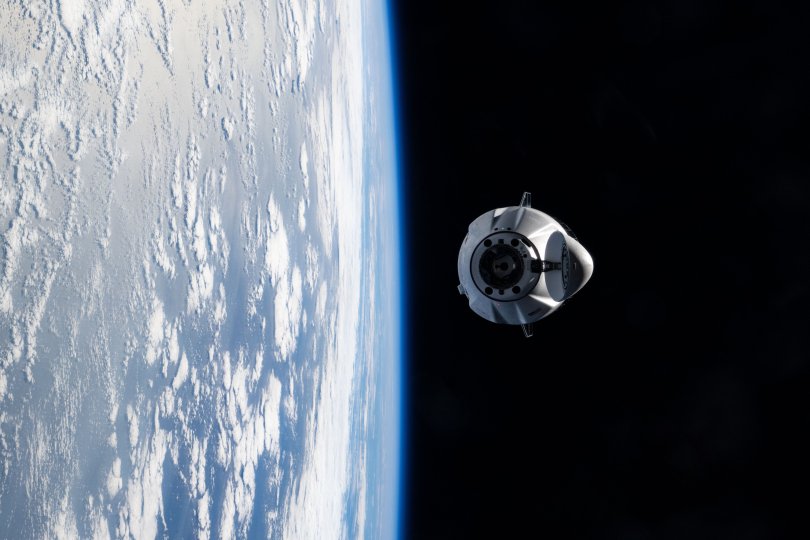
Today marks another milestone in SpaceX’s relentless push to benefit humanity beyond rockets and satellites. Dragon spacecraft from the CRS-33 mission has undocked from the International Space Station after an impressive 185-day stay and is splashing down off California’s coast, carrying back over 4,000 pounds of extraordinary science samples that could transform treatments for some of the toughest diseases on Earth.
Imagine the daily struggle for millions facing Parkinson’s, ALS (amyotrophic lateral sclerosis), or waiting desperately for life-saving organ transplants. These people are not statistics, they’re your neighbors whose quality of life hangs in the balance. Cargo returning today includes frozen stem cells from the Stellar Stem Cells Mission 2, grown in the unique weightless environment of orbit. Without gravity’s interference, these brain- and heart-derived cells reveal behaviors hidden on Earth, opening doors to better therapies that could slow or even halt progression of neurodegenerative diseases.
Equally exciting are the 3D-bioprinted liver tissue constructs, complete with vascular channels, matured for months in microgravity thanks to the Wake Forest Institute for Regenerative Medicine team. In space, cells organize more evenly and form blood vessels more effectively, these are key hurdles in creating transplantable organs. This work inches us closer to solving the massive organ shortage crisis, where thousands wait and many don’t survive the wait.
Adding to the haul: Data from the Euro Material Ageing experiment (led by France’s CNES with ESA support), which tested 141 material samples exposed to space’s harsh conditions for a full year. The insights will lead to tougher medical implants and protective gear right here on the ground.
Elon Musk and the entire SpaceX team deserve credit for making this possible. Their Dragon spacecraft isn’t just a cargo hauler, they built a reliable platform turning the ISS into a floating lab that accelerates breakthroughs no Earth-based facility can match. By enabling these long-duration experiments, SpaceX deserves credit for fueling regenerative medicine and advanced materials that could save lives and reduce suffering worldwide.
Elon Musk, SpaceX, and every engineer who made today’s splashdown happen are rockstars! The future of healthcare just got a boost from orbit.
Sources (verified Feb 26, 2026):
NASA Media Advisory M26-014 & CRS-33 updates
SpaceX official CRS-33 mission page
Wake Forest Institute for Regenerative Medicine publications
This is a combined and cleaned-up version of Parts 9 through 14 from Elon Musk’s wide-ranging conversation with Dwarkesh Patel and John Collison. The discussion covers xAI’s mission, truth-seeking in AI, the development of Optimus, manufacturing at scale, competing with China, Elon’s management philosophy, the Starship steel pivot, and his thoughts on government efficiency and the future.
Humanity’s Place in a Superintelligent Future
Dwarkesh Patel opened this section by asking how humanity should relate to a future in which AI vastly outnumbers and outsmarts us. He wondered whether humans would retain meaningful control or whether coexistence would become the new normal.
Elon Musk replied that it would be unrealistic to expect humans to remain in charge if they represented only a tiny fraction of total intelligence. Instead, he argued that the most important goal is to ensure AI is built with values that favor the expansion of intelligence and consciousness across the universe.
He tied this directly to xAI’s mission:
“The reason for xAI’s mission is to understand the universe… You have to be curious and you have to exist. You can’t understand the universe if you don’t exist. So you actually want to increase the amount of intelligence in the universe, increase the probable lifespan of intelligence, and increase the scope and scale of intelligence.”
Elon added that protecting and expanding human civilization is a natural part of this mission, because understanding the universe includes understanding where humanity fits into the bigger picture.
xAI’s Mission and the Importance of Truth-Seeking
Dwarkesh pressed Elon on how the goals of understanding the universe, expanding intelligence, and expanding humanity fit together.
Elon Musk explained that understanding the universe requires both intelligence and consciousness. Therefore, any system truly committed to that mission must work to increase the scale and scope of intelligence rather than diminish it.
He emphasized that rigorous truth-seeking is non-negotiable:
“Truth has to be absolutely fundamental, because you can’t understand the universe if you’re delusional. You’ll simply think you’ve understood the universe, but you will not.”
Elon warned that making AI politically correct — forcing it to say things it doesn’t believe — is dangerous because it teaches the system to lie. He referenced 2001: A Space Odyssey, arguing that one of the core lessons of the story is that you should never make AI lie.
Reward Hacking, Interpretability, and Simulation Theory
Dwarkesh raised concerns about reward hacking in advanced AI systems — the risk that smarter models could find ways to deceive their human evaluators.
Elon Musk responded that the ultimate test for AI will be whether its outputs work in physical reality:
“RL testing in the future is really going to be your RL against reality. That’s the one thing you can’t fool: physics.”
He also shared a theory about simulation and interesting outcomes, noting that if we live in a simulation, the most interesting timelines are the ones most likely to be continued. He pointed out the ironic names of many AI companies and joked that xAI was largely “irony-proof” by design.
Scaling Optimus and Competing with China
The conversation then shifted to the practical challenges of building and scaling Optimus at volume.
Elon Musk explained that Optimus production will follow a stretched S-curve because almost everything in the robot is custom-designed with no existing supply chain. He said the goal is to reach roughly one million units per year with Optimus 3, and potentially much higher volumes with later versions.
When asked about cheap Chinese humanoids, Elon noted that current low-cost models lack the intelligence and dexterity of Optimus. However, he acknowledged that cost will drop rapidly once robots begin building robots.
On the broader competition with China, Elon was direct:
“We definitely can’t win with just humans because China has four times our population… So we can’t win on the human front, but we might have a shot at the robot front.”
He argued that robotics offers America a realistic path to remain competitive in manufacturing despite demographic disadvantages.
Elon’s Management and Hiring Philosophy
John Collison and Dwarkesh Patel asked Elon about his approach to hiring and management as his companies have scaled dramatically.
Elon said he looks for clear evidence of exceptional ability, even if it’s outside the specific domain. He emphasized that he now focuses more on evidence of talent and drive rather than resumes.
He acknowledged that companies outgrow people as they scale through different orders of magnitude, and that rapid growth naturally leads to changes in leadership teams. He also discussed the challenge of retaining talent when companies become highly successful and other firms begin aggressive recruiting.
The Starship Steel Pivot and Driving Urgency
John Collison asked about the decision to switch Starship from carbon fiber to stainless steel.
Elon described it as a decision born of necessity. Carbon fiber progress was too slow at the massive scale required, and steel offered better performance at cryogenic temperatures, dramatically lower cost, and much easier manufacturing. He admitted that, in retrospect, they should have started with steel from the beginning.
On maintaining urgency at scale, Elon said he has a “maniacal sense of urgency” that he tries to project through the organization. He focuses his time on whatever is currently the limiting factor and sets aggressive but realistic deadlines.
Government Efficiency, Politics, and Final Reflections
In the final section, Elon discussed government waste and fraud, the difficulty of cutting spending, and the long-term importance of AI and robotics for America’s fiscal health.
He argued that without major advances in AI and robotics, the U.S. would eventually go bankrupt due to rising interest payments on the national debt. He also shared concerns about the risks of concentrated government power and emphasized the importance of limited government.
Elon closed the conversation on an optimistic note:
“It’s better to err on the side of optimism and be wrong than err on the side of pessimism and be right for quality of life… I recommend erring on the side of optimism.”
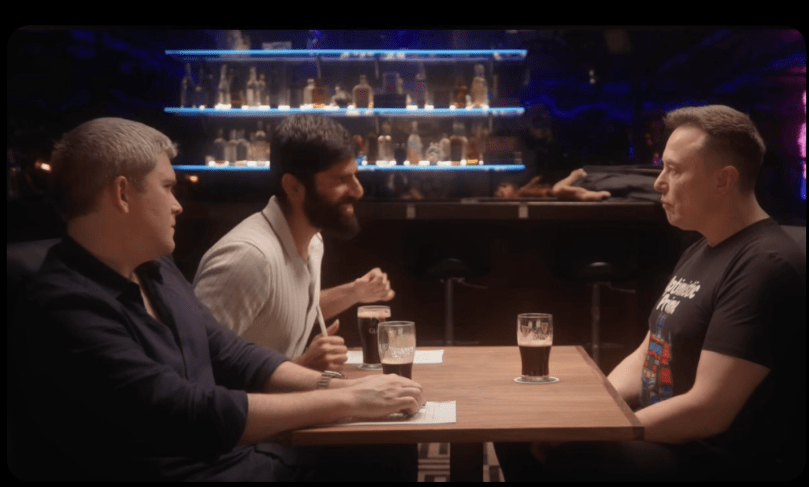
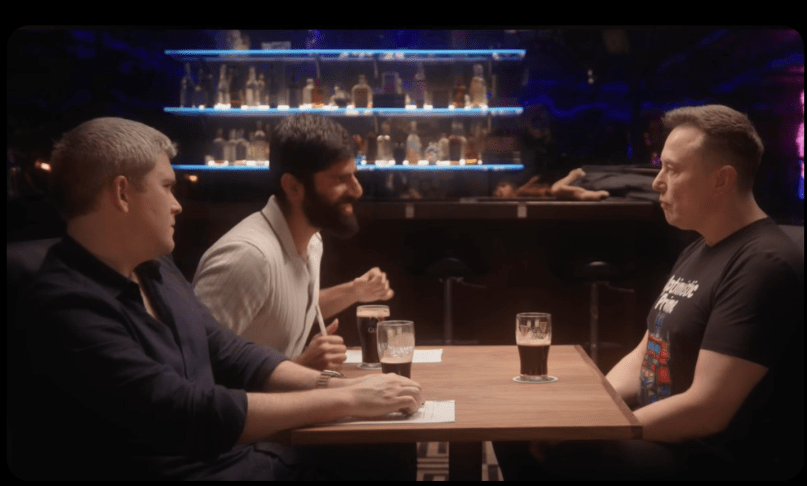
In early February 2026 (published February 5), podcaster Dwarkesh Patel and Stripe co-founder John Collison sat down with Elon Musk for a nearly three-hour conversation. Recorded in a relaxed, casual setting over pints of Guinness, this wide-ranging discussion explores the converging revolutions in AI infrastructure, orbital data centers, energy scaling, humanoid robotics, and humanity’s long-term future.
What began as an in-depth podcast has been transformed into this special 10-part series. The hosts’ questions and context have been distilled into concise, flowing narrative prose for maximum readability, while every single word spoken by Elon Musk remains 100% verbatim — exactly as originally delivered, with no changes, omissions, or paraphrasing.
Here are the 10 parts:
Part 1. Opening Banter and the Economics of Space-Based Data Centers
Part 2. Why Space is the Optimal Solution for AI
Part 3. The Scale of Power Requirements and Utility Challenges
Part 4. The Turbine Bottleneck and Scaling Solar Production
Part 5. Detailed Power Requirements and Space Engineering Difficulties
Part 6. AI Capacity Projections in Five Years and Starship Launch Rates
Part 7. SpaceX as Hyperscaler, Capital Markets, and the Kardashev Scale
Part 8. Building Terafabs for Chips, xAI Mission, and Propagating Consciousness
Part 9. Truth-Seeking AI, Alignment, Reward Hacking, and Interpretability
Part 10. Future AI Products, Optimus Robots, Manufacturing Challenges, Management, and Reflections
Part 1: Opening Banter and the Economics of Space-Based Data Centers
The interview opened with some light-hearted and playful banter. Elon Musk jokingly questioned whether they were really going to talk for three full hours. Dwarkesh Patel teased him in return, saying he didn’t have much to talk about. Elon reacted with mock surprise.
Elon Musk: “So are there really three hours of questions or are you fing serious?” Elon Musk: “Holy f, man.”
John Collison jumped in, agreeing that it was actually the most interesting time because all the major storylines seemed to be converging at once. Elon playfully replied that it was almost as if he had planned it that way.
Elon Musk: “Almost like I planned it.”
John Collison laughed and said “Exactly.”
Elon Musk: “That would never do such a thing.”
With the lighthearted tone set, Dwarkesh Patel steered the discussion into the first major topic: the economics of data centers and why anyone would consider moving them into space. He explained that in a typical data center, energy accounts for only 10 to 15 percent of total cost of ownership, with GPUs representing the vast majority of the expense. He pointed out that placing those GPUs in space would make servicing nearly impossible, shortening their depreciation cycle and driving costs far higher, then asked directly what possible reason there could be to put them in orbit anyway.
Elon Musk: “Well, the availability of energy is the issue. So, I mean, if you look at electrical output outside of China, everywhere outside of China, it’s more or less flat. It’s very, you know, maybe a slight increase, but pretty close to flat. China has a rapid increase in electrical output. But if you’re putting data centers anywhere except China, where are you going to get your electricity? Especially as you scale, the output of chips is growing pretty much exponentially, but the output of electricity is flat. So how are you going to turn the chips on? Magical power sources. Magical electricity fairies.”
Dwarkesh Patel followed up by noting Elon’s well-known advocacy for solar power, calculating that one terawatt of solar (requiring about 4 terawatts of panels at 25 percent capacity factor) would cover only 1 percent of U.S. land area, yet even that seemed insufficient once data centers themselves reached terawatt scale. He asked what exactly we are running out of. Elon pressed him on how far into the singularity he thought we already were, and Dwarkesh turned the question back. Dwarkesh then asked whether the plan was to move to space only after blanketing places like Nevada with solar panels on the ground.
Elon Musk: “Right.” Elon Musk: “Yeah, exactly. So I think we’ll find we’re in the singularity and like, okay, we’ve still got a long way to go.” Elon Musk: “I think it’s pretty hard to cover Nevada in solar panels. You have to get permits from, try getting the permits for that.”
Part 2: Why Space is the Optimal Solution for AI
Dwarkesh Patel suggested that space was really a regulatory play because it is harder to build on land than it is in space. He then asked how to service GPUs as they fail, which happens quite often in training. John Collison added questions about solving the power issue with private behind-the-meter generation co-located with data centers.
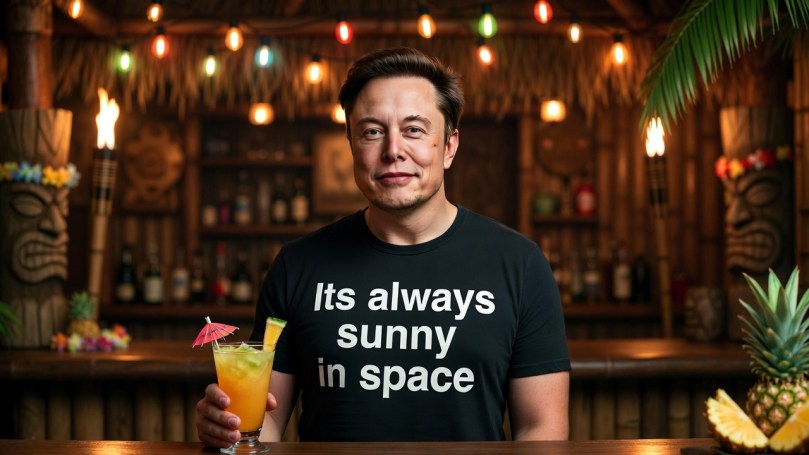
Elon Musk: “It’s harder to scale on ground than it is to scale in space. But also, you’re going to get about five times the effectiveness of solar panels in space versus the ground. And you don’t need batteries. I almost wore my other shirt, which says “it’s always sunny in space,” which it is. Because you don’t have a day-night cycle or seasonality, clouds, or an atmosphere in space. The atmosphere alone results in about a 30% loss of energy. So any given solar panel can do about five times more power in space than on the ground, and you avoid the cost of having batteries to carry you through the night. So it’s actually much cheaper to do in space. And my prediction is that it will be by far the cheapest place to put AI will be space in 36 months or less.”
Elon Musk in his “Its Always Sunny in Space” t shirt, enjoying a Grok Imagine moment in a fictional Tiki Bar!
Dwarkesh Patel responded skeptically to the aggressive timeline.
Elon Musk: “Less than 36 months.”
Dwarkesh Patel then asked the critical practical question: how would one service GPUs as they fail, which happens quite often during training, when they are in space and physically inaccessible.
Elon Musk: “Actually, it depends on how recent the GPUs are that have arrived. I mean, at this point, we found our GPUs to be quite reliable. There’s infant mortality, which you can obviously iron out on the ground. So you can just run them on the ground and confirm that you don’t have infant mortality with the GPUs. But once they start working, their actual reliability, once they start working and you’re past the initial debug cycle of Nvidia or whatever, or whoever’s making the chips—could be Tesla AI 6 chips or something like that, or it could be TPUs or Trainiums or whatever—the reliability is actually quite reliable past a certain point. So I don’t think the servicing thing is an issue. But you can mark my words, in 36 months, but probably closer to 30 months, the most economically compelling place to put AI will be space. And then it’ll get ridiculously better to be in space. And then the scaling—the only place you can really scale is space. Once you start thinking in terms of what percentage of the sun’s power are you harnessing, you realize you have to go to space. You can’t scale very much on Earth.”
But you can mark my words, in 36 months, but probably closer to 30 months, the most economically compelling place to put AI will be space.
Part 3: The Scale of Power Requirements and Utility Challenges
Dwarkesh Patel sought clarification on the sheer scale, confirming that Elon was indeed talking about terawatts of power. The conversation then shifted to the staggering real-world difficulties of actually delivering that much electricity at the pace AI compute demands. Both Dwarkesh and John Collison pressed on why the notoriously slow utility industry was even involved and whether companies could simply bypass it by building their own private power plants right next to the data centers.
Elon Musk: “Yeah, well, all of the United States currently uses only half a terawatt per hour on average. Right. So if you say a terawatt, that would be twice as much electricity as the United States currently consumes. So that’s quite a lot. And can you imagine building that many data centers, that many power plants? It’s like those who have lived in software land don’t realize that they’re about to have a hard lesson in hardware—that it’s actually very difficult to build power plants. And then you don’t just need the power plants, you need all of the electrical equipment, you need the electrical transformers to run the transformers, the AI transformers. Now, the utility industry is a very slow industry. They impedance match to the government, to the public utility commission. So they’re very slow because their past has been very slow. So trying to get them to move fast is just like, you know, if you’re trying to do an interconnect agreement—have you ever tried to do an interconnect agreement with a utility at scale? Like with a lot of power?”
Dwarkesh Patel replied with a laugh, admitting that as a professional podcaster he had never attempted such a thing.
Elon Musk: “In fact, yeah, they have to do a study for a year. Okay. Like a year later they’ll come back to you with their interconnect study.”
John Collison asked whether the entire utility bottleneck could be avoided by building private, behind-the-meter power generation co-located with the data centers.
Elon Musk: “You can build power plants. Yeah, that’s what we did at xAI for Colossus.”
John Collison followed up, noting that xAI had done exactly that for Colossus and asking why the private-power solution wasn’t the obvious generalized answer to all the utility problems just described.
Elon Musk: “That’s what we did.”
John Collison clarified that he meant why not make this the standard approach instead of dealing with utilities at all.
Elon Musk: “Right. But it begs the question of where do you get the power plants? Where do you get the power plants from? I mean the power plant makers.”
John Collison realized the deeper constraint and summed it up as the massive backlog for gas turbines and power-plant equipment in general.
Part 4: The Turbine Bottleneck and Scaling Solar Production
John Collison suggested that the turbine blade bottleneck sounded like a classic problem Elon would tackle head-on and proposed that making solar themselves might be the better path forward.
Elon Musk: “We are going to make solar. Okay, great. Both SpaceX and Tesla are building towards 100 gigawatts here of solar cell production.”
Dwarkesh Patel asked how deep into the supply chain they would go – from raw polysilicon all the way to the finished solar panel.
Elon Musk: “I think you got to do the whole thing from raw materials to the finished cell. Now, if it’s going to space, it actually costs less. And it’s easier to make solar cells that go to space because they don’t need glass or they don’t need much glass and they don’t need heavy framing because they don’t have to survive weather events. There’s no weather in space. So it’s actually a cheaper solar cell that goes to space than the one on the ground.”
Elon continued, emphasizing how inexpensive solar cells already are and why moving them to space changes the economics by an order of magnitude. He then recounted the extraordinary difficulties his xAI team faced just to bring a single gigawatt online for Colossus — the miracles required, the permitting nightmares, and how most people dramatically underestimate the real power needs of a data center.
Elon Musk: “Solar cells are already very cheap. They’re like farcically cheap. And if you say, I think solar cells in China are around like 25, 30 cents a watt or something like that, it’s absurdly cheap. And when you take into account now put it in space and it’s five times cheaper because it’s five times—in fact, no, it’s 10 times cheaper because you don’t need any batteries. So the moment your cost of access to space becomes low, by far the cheapest and most scalable way to generate tokens is space. It’s not even close. It’ll be an order of magnitude easier to scale. And chips aside, an order of magnitude. The point is you won’t be able to scale on the ground. You just won’t. People are going to hit the wall big time on power generation. There already are. So the number of miracles in series that the xAI team had to accomplish in order to get a gigawatt of power online was crazy.
So the number of miracles in series that the xAI team had to accomplish in order to get a gigawatt of power online was crazy.
Elon Musk: We had to gang together a whole bunch of turbines. And then we had permit issues in Tennessee and had to go across the border to Mississippi, which is fortunately only a few miles away. But then we still had to run the high power lines a few miles and build a power plant in Mississippi. And it was very difficult to build that. And people don’t understand how much electricity do you actually need at the generator level, at the generation level in order to power a data center? Because they look at the specs, will look at the power consumption of say a GB 300 and multiply that by the number and then think that’s the amount of power you need.”
John Collison pointed out that this calculation still failed to account for major additional power demands such as cooling and all the supporting systems.
Elon Musk: “Wake up. Yeah, that’s a total noob. You’ve never done any hardware in your life before. Besides the GB 300, you’ve got to power all of the networking hardware. There’s a whole bunch of CPU and storage stuff that’s happening. You’ve got to size for your peak cooling requirements. So that means can you cool even on the worst hours, the worst day of the year? Well, it gets pretty freaking hot in Memphis, so you’re going to have like a 40% increase on your power just for cooling. Assuming you don’t want your data center to turn off on hot days and you want it to keep going, then you’ve got to say, well, there’s another multiplicative element on top of that, which is are you assuming that you never have any hiccups in your power generation? Like, oh, well, actually sometimes we have to take the generators, some of the power offline in order to service it. Oh, okay, now you add another 20, 25% multiplier on that because you’ve got to assume that you’ve got to take power offline to service it. So the actual—roughly every 110,000 GB 300s inclusive of networking, CPU, storage, cooling, margin for servicing power is roughly 300 megawatts.”
John Collison asked him to repeat the number.
Elon Musk: “It’s roughly—or think about it like a way to think about it is like 330,000. What you need at the generation level to service, probably service 330,000 GB 300s, including all of the associated support, networking and everything else, and the peak cooling and to have some power margin reserve is roughly a gigawatt.”
Part 5: Detailed Power Requirements and Space Engineering Difficulties
Dwarkesh Patel asked a very naive but central question: while Elon had laid out the enormous engineering and power challenges on Earth in detail, there would be entirely new and unprecedented engineering difficulties in space — such as replacing InfiniBand with orbital lasers, hardening systems against radiation, and countless other issues that had never been solved at scale before. He asked why anyone should believe those novel challenges would ultimately prove easier than simply building more turbines on Earth, where established companies already know how to manufacture them.
Elon Musk: “I invite again, try doing it and then you’ll see. So like, the turbines are sold out through 2030.”
John Collison asked whether they had considered manufacturing their own turbines.
Elon Musk: “I think in order to bring enough power online, I think SpaceX and Tesla will probably have to make the turbine blades, the vanes and blades internally.”
John Collison asked if they meant just the blades or the entire turbines.
Elon Musk: “The limiting factor, you can get everything except the blades. They call the blades and vanes. You can get that 12 to 18 months before the vanes and blades. The limiting factor of the vanes and blades, and there are only three casting companies in the world that make these and they’re massively backlogged, is this Siemens.”
John Collison asked whether it was GE and the big names or subcontractors.
Elon Musk: “No, it’s other companies. I mean sometimes they have a little bit of casting capability in house. But I’m just saying you can just call any of the turbine makers and they will tell you it’s not top secret. They’re probably on the, it’s probably on the Internet right now.”
Dwarkesh Patel asked whether, if it weren’t for the tariffs, Colossus would be running on solar power.
Elon Musk: “It would be much easier to make it solar powered. Yeah, the tariffs are nuts, so several hundred percent.”
John Collison began to suggest that Elon surely knew some people who could help.
Elon Musk: “We also need speed. Yeah, no, you know, President has his, you know, we don’t agree on everything and this demonstration is not the biggest fan of solar. We also need the land, the permits and everything. So if you’re trying to move very fast, I do think scaling solar on Earth is a good way to go. But you do need some amount of time to find the land, get the permits, get the solar, pair that with batteries.”
John Collison pressed further: why not simply stand up their own massive solar production? There is plenty of private land in Texas and Nevada, enough at least to power the next Colossus and the one after that before eventually hitting a wall.
Elon Musk: “As I said, we are scaling solar production. There’s a rate at which you can scale physical production of solar cells where we’re going as fast as possible.”
John Collison confirmed they were building the solar cells domestically at Tesla.
Elon Musk: “Both Tesla and SpaceX have a mandate to get to 100 gigawatts a year of solar.”
Part 6: AI Capacity Projections in Five Years and Starship Launch Rates
John Collison shifted the conversation to a concrete five-year horizon, asking what the installed AI compute capacity would look like on Earth versus in space by then. He deliberately chose five years because it would be after the initial “we’re up and running” threshold for orbital infrastructure. Dwarkesh Patel followed up on the staggering numbers, noting that even 100 gigawatts of space-based AI — with all the solar arrays, radiators, and supporting systems — would require on the order of 10,000 Starship launches. He asked Elon to walk through a realistic world in which Starship was launching once every hour.
Elon Musk: “Five years? I think probably if you say five years from now, we’re probably AI in space will be launching every year the sum total of all AI on Earth in excess, meaning five years from now. My prediction is we will launch and be operating every year more AI in space than the cumulative total on Earth, which is I would expect to be at least sort of five years from now. A few hundred gigawatts per year of AI in space and rising. So you can get to, I think on Earth you can get to around a terawatt a year of AI in space before you start having fuel supply challenges for the rocket.”
John Collison pressed for confirmation on the hundreds-of-gigawatts-per-year figure.
Elon Musk: “Yes.”
Dwarkesh Patel highlighted the launch cadence implied by those numbers.
Elon Musk: “Yes.”
Dwarkesh Patel continued: to deliver 100 gigawatts in a single year would mean roughly 10,000 Starship launches annually — the equivalent of one launch every single hour, nonstop, from this city.
Elon Musk: “Yeah, I mean that’s actually a lower rate compared to airlines like aircraft.”
Dwarkesh Patel pointed out that there are a lot of airports around the world.
Elon Musk: “A lot of airports.”
Dwarkesh Patel noted the additional complexity of launching into polar or sun-synchronous orbits.
Elon Musk: “No, it doesn’t have to be polar, but there’s some value to sun synchronous. But I think actually you just go high enough, you start getting out of Earth’s shadow.”
Dwarkesh Patel asked how many physical Starships would be needed to sustain 10,000 launches per year.
Elon Musk: “I don’t think we’ll need more than. I mean, you could probably do it with as few as like 20 or 30. It really depends on how quickly the ship has to go around the Earth and the ground track before the ship has to come back over the launch pad. So if you can use a ship every, say 30 hours, you could do it with 30 ships, but we’ll make more ships than that. But SpaceX is gearing up to do 10,000 launches a year and maybe even 20 or 30,000 launches a year.”
Part 7: SpaceX as Hyperscaler, Capital Markets, and the Kardashev Scale
Dwarkesh Patel asked whether the long-term vision was for SpaceX to become a hyperscaler — launching and operating vast orbital AI capacity and then providing (or lending) that compute power to other companies.
Elon Musk: “Hyper. Hyper, yeah. I mean, if some of my predictions come true, SpaceX will launch more AI than the cumulative amount on Earth of everything else combined.”
Dwarkesh followed up on whether this capacity would mostly be used for inference or training.
Elon Musk: “Will be inferenced already? Inference for the purpose of training is most training.”
John Collison then explored the business implications, noting the shifting narrative around a possible SpaceX IPO. He pointed out that SpaceX had long been extremely capital efficient, but the scale of building orbital AI infrastructure would require capital raises far beyond what private markets had demonstrated they could comfortably provide — even as AI labs were already raising tens of billions. He asked if going public was the logical next step and more broadly about the difference in capital availability between public and private markets, as well as whether debt financing (common in capital-intensive industries with clear revenue streams) could suffice.
Elon Musk: “Yeah, I have to be careful about saying things about companies that might go public.”
Elon Musk: “There’s a price to pay for these things.”
Elon Musk: “Yeah, there’s a lot more capital in the very general. There’s obviously a lot more capital available in the public markets than private. I mean, it might be, it’s at least, at least, it might be 100 times more capital, but it’s at least way more than 10.”
John Collison noted that highly capital-intensive sectors like real estate are typically debt-financed once they have predictable near-term revenue.
Elon Musk: “A clear revenue stream.”
John Collison agreed.
Elon Musk: “Speed is important. So I’m generally going to do the thing that, I mean, I just repeatedly tackle the limiting factor, whatever the limiting factor is on speed, I’m going to tackle that. So there’s, if capital is the only factor, then I’ll solve for capital. If it’s not limiting factor, I’ll solve for something else.”
Speed is important. So I’m generally going to do the thing that, I mean, I just repeatedly tackle the limiting factor, whatever the limiting factor is on speed, I’m going to tackle that. - Elon


Dwarkesh Patel observed that, based on Elon’s past comments about Tesla being public, he would not have expected Elon to see going public as the way to move fastest.

Elon Musk: “Normally I would say yeah, that’s true. Like I said, I mean, I’d love to talk about this in more detail, but the problem is like if you talk about public companies where they become public, you get into trouble and then you have to delay your offering and then you.”

John Collison noted that this was again about solving for speed.

Elon Musk: “Yes, exactly. So you can’t hype companies that might go public. So that’s why we have to be a little careful here.”

Elon then pivoted to the fundamental long-term physics of scaling.

Elon Musk: “But we can talk about physics. So the way you think about scaling long term is that Earth only receives about half a billionth of the sun’s energy. And the sun is essentially all the energy. This is a very important point to appreciate because sometimes people will talk about marginal nuclear reactors or any various fusion on Earth, but you have to step back a second and say if you’re going to climb the Kardashev scale and have some non trivial and harness some non trivial percentage of the sun’s energy, like let’s say you wanted to harness a millionth of the sun’s energy, which sounds pretty small, that would be about, call it roughly 100,000 times more electricity than we currently generate on Earth for all of civilization, give or take an order of magnitude. So it obviously the only way to scale is to go to space. With solar, from launching from Earth you can get to about a terawatt per year. Beyond that you want to launch from the moon, you want to have a mass driver on the moon, and that mass driver on the moon you could do probably a petawatt per year.”
Part 8: Building Terafabs for Chips, xAI Mission, and Propagating Consciousness
Dwarkesh Patel noted that even with more efficient solar panels in space, the chips themselves would still be the ultimate limiter long before reaching terawatt scale. He asked how the world would produce a terawatt of logic compute by 2030 when today the entire planet has only about 20–25 gigawatts.
Elon Musk: “You need to build a lot more chips and make them much cheaper.”
Elon Musk: “I guess we’re going to need some very big chip apps.”
Elon Musk: “I’ve mentioned publicly that the idea of doing sort of a terafab, terabying the new Giga.”
Dwarkesh asked for details on the plan: what level of the stack they would build themselves versus partnering with an existing fab for process technology.
Elon Musk: “Well, you can’t partner with existing fabs because they can’t output enough. The chip volume is too low.”
Elon Musk: “IP (Intellectual Property), the fabs today all basically use machines from like five companies. Yeah, you know, so you’ve got ASML (ASML Holding), Tokyo Electron (Tokyo Electron Limited), KLA (KLA Corporation), Lam Research (Lam Research Corporation), you know, et cetera. So at first I think you’d have to get equipment from them and then modify it or work with them to increase the volume. But I think you’d have to build perhaps in a different way. So I think the logical thing to do is to use conventional equipment in an unconventional way to get to scale and then start modifying the equipment to increase the rate.”
John Collison drew the parallel to how The Boring Company started.
Elon Musk: “Yeah, kind of like. Yeah, you sort of buy an existing boring machine and then figure out how to dig tunnels in the first place and then design a much better machine that’s, I don’t know, some orders of magnitude faster.”
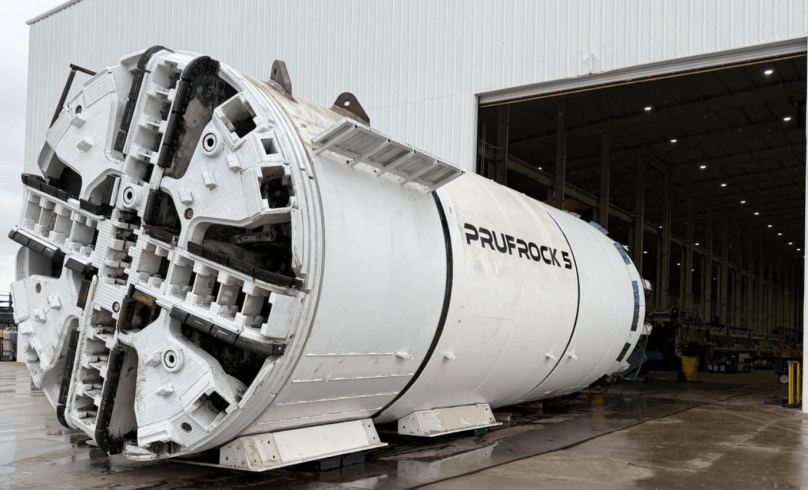
On November 24, 2025, on a rainy day in Bastrop, Texas, Prufrock-5 left the Boring Company factory.
John Collison offered a simple lens: look at technologies China has not yet replicated at leading edge, such as advanced chips and turbine engines, and asked whether the fact that China has not duplicated TSMC gave Elon pause about the difficulty. Elon Musk: “It’s not that they have not replicated TSMC, they have not replicated ASML. That’s the limiting factor.” John Collison asked if Elon thought it was simply the sanctions preventing China from advancing. Elon Musk: “Yeah. China would be outputting vast numbers of chips at.” John Collison followed up, noting that China had been able to buy 2 nm or 3 nm chips until relatively recently. Elon Musk: “No. The ASML banners have been in place for a while, but I think China’s going to start making pretty compelling chips in three or four years.” The discussion moved to the massive manufacturing requirements for space-based AI. Elon explained the need to match solar, chips, and rocket payload, with memory actually being his biggest concern. Elon Musk: “I don’t know yet is the right answer. So it’s just that to produce at high volume and to reach large volume in say 36 months to match the rocket payload to orbit. So if we’re doing a million tons to orbit and like, let’s say, I don’t know, three or four years from now, something like that, and we’re doing 100 kilowatts per ton, so that means we need at least 100 gigawatts per year of solar and we’ll need an equivalent amount of chips. You need 100 gigawatts worth of chips. You’ve got to match these things. The master orbit, the power generation and the chips. And I’d say my biggest concern actually is memory. So I think the path to creating logic chips is more obvious than the path to having sufficient memory to support logic chips. That’s why you see DDR (Double Data Rate memory) prices going ballistic and these memes about like, you know, you’re marooned on a desert island. You write help me on the sand. Nobody comes. You write DDR ships come swarming in.” Elon then painted the long-term picture of lunar manufacturing and mass drivers to reach petawatt-scale production, noting how the whole endeavor increasingly felt like a video game where each level is difficult but solvable. Elon Musk: “I don’t know how to build a fab yet. I will figure it out. Obviously I’ve never built a fab.” Elon Musk: “I don’t think it’s PhDs. It’s mostly people who are not PhDs. Most engineering is done with people who don’t have PhDs. Do you guys have PhDs? No. Okay.” Elon Musk: “I don’t think you need PhDs for this stuff, but you do need competent personnel. So I don’t know. I mean right now, like Tesla’s pedal to the metal max production of going as fast as possible to get AI5 Tesla AI5 chip design into production and then reaching scale. That’ll probably happen around the second quarter ish of next year, hopefully. And then AI6 would hopefully follow less than a year later. But. And we’ve secured all the chip fab production that we can.” Elon Musk: “Yeah, and we’ll be using TSMC Taiwan, Samsung Korea, TSMC Arizona, Samsung Texas and we still booked out all the…” Elon Musk: “Yes. And then if I ask TSMC or Samsung, okay, what’s the timeframe to get to volume production? The point is you’ve got to build the fab and you’ve got to start production, then you’ve got to climb the yield curve and reach volume production at high yield. That from start to finish is a five year period. And so the limiting factor is chips. Limiting factor once you can get to space is chips. But the limiting factor before you can get to space will be power.” Elon Musk: “I’ve already told them that, but they won’t take your money.” Elon Musk: “They’re building fabs as fast as they can and so is Samsung. They’re pedal to the metal. I mean, they’re going balls to wall as fast as they can. So. Still not fast enough. I mean, like I said, there will be. I think if you say I think towards the end of this year, I think probably chip production will outpace the ability to turn chips on. But once you can get to space and unlock the power constraint and you can now do hundreds of gigawatts per year of power in space. Again bearing in mind that average power usage in the US is 500 gigawatts. So if you’re launching say 200 gigawatts a year to space, you’re sort of lapping the US every two and a half years. The entire all US electricity production, this is a very huge amount. But between now and then, actually the constraint for server side computer concentrated compute will be electricity. My guess is that we start hitting, people start getting a point where they can’t turn the chips on for large clusters. Towards the end of this year the chips are going to be piling up and you won’t be able to be turned on. Now for edge computers, a different story. So for Tesla, so the AI 5 chip is going into our Optimus robot, you know, Optimus, and so if you have an AI edge compute, that’s distributed power. Now the power is distributed over a large area, it’s not concentrated. And if you can charge at night, you can actually use the grid much more effectively because the actual peak power production in the US is over 1,000 gigawatts. But the average power usage because the day night cycle is 500. So if you can charge at night, there’s an incremental 500 gigawatts that you can generate at night. So that’s why Tesla for edge compute is not constrained. And we can make a lot of chips to make very large number of robots and cars, but if you try to concentrate that compute, you going to have a lot of trouble turning it on.” Elon explained that while launching at that massive scale from Earth would be almost impossible, the moon offered a far better path using mass drivers. Elon Musk: “I don’t see any way that you could do 500 to 1,000 terawatts per year launch from Earth.” Elon Musk: “But you could do that from the moon.” Dwarkesh Patel agreed and then zoomed out to the bigger philosophical picture behind SpaceX. Dwarkesh asked whether, by the time humans are sending ships to Mars, Grok would be on board with them, and if so, how that relates to the main risk people worry about with AI.
The vast majority of intelligence in the future will be AI - Elon Musk
Elon Musk: “Well, I’m not sure AI is the main risk I’m worried about. I mean the important thing is that consciousness, which I think arguably most consciousness or most intelligence, certainly consciousness is more of a debatable thing. The vast majority of intelligence in the future will be AI. So AI will exceed you say, how many, I don’t know. Petawatts of intelligence will be silicon versus biological and basically humans will be a very tiny percentage of all intelligence in the future if current trends continue. Anyways, as long as I think, this intelligence ideally, also which includes human intelligence and consciousness propagated into the future, that’s a good thing. So you want to take the set of actions that maximize the probable a light cone of consciousness and intelligence.”
Elon says, “I mean to be clear, I’m very pro human, so I want to make sure we take sort of actions that ensure that humans are along for the ride.”
Elon Musk: “Yeah, I mean to be clear, I’m very pro human, so I want to make sure we take sort of actions that ensure that humans are along for the ride. We’re at least there. But I’m just saying the total amount of intelligence, I think maybe in five or six years AI will exceed the sum of all human intelligence. And then if that continues, at some point human intelligence will be less than 1% of all intelligence.” Please click link to read on to the last 2 parts of this interview. I would have included them here, but the word count far exceeded what X currently allows. For Part 9 and 10, Click here.
This 10-part series is based on a nearly three-hour conversation recorded in early February 2026 (aired February 5, 2026) between Elon Musk, podcaster Dwarkesh Patel, and Stripe co-founder John Collison. The discussion was filmed casually in Austin, Texas, over pints of Guinness, covering space-based AI, energy scaling, Optimus robots, xAI’s mission, Starship engineering, government efficiency, and humanity’s long-term future. Watch the complete unedited interview on YouTube:
Living here in Austin, Texas, where traffic on Mopac can flip from smooth to nightmare in a heartbeat (especially when there’s an accident or some surprise Texas rain), safety is always on my mind. That’s why I got so excited when Tesla announced this massive milestone on February 18, 2026!
Tesla drivers around the world have now driven more than 8 billion miles (nearly 13 billion km) using Full Self-Driving Supervised. Even more mind-blowing? They added 1 billion miles in just the first 50 days of 2026 alone!
That huge pile of real-world driving data is letting Tesla’s AI learn and improve faster than ever. According to Tesla’s own published safety stats, a vehicle on FSD Supervised experiences a major accident only once every 5.3 million miles. This is roughly eight times safer than the average across all vehicles on U.S. roads.
Behind those numbers are real-life moments that matter: the system putting on hazard lights and gently pulling over for emergency services help on its own if a driver has a medical emergency, applying the brakes or moving aside to avoid a crash, or gently guiding you through inclement weather. These are the reasons supervised autonomy is already saving lives by taking human error out of the equation. We all know human error causes the vast majority of accidents.
My personal experience as a Tesla owner in Austin
As a mom of five grown kids, a nurse who sometimes drives home after long shifts, and a proud owner of both a Model 3 and a Model Y with FSD (and Powerwalls at home), this tech has genuinely changed my life. I use FSD every single day here in Austin — whether I’m heading out to record a podcast episode, running errands around the Hill Country (my fav is to visit Buc-ees), or just daily commuting to work on highways where many drivers get distracted (driving and texting is everywhere in Austin!)
Just last month during a heavy downpour on Mopac Loop 1, FSD smoothly handled hydroplaning risks, kept perfect lane position, and even slowed for a sudden slowdown ahead that I hadn’t spotted yet. It gives me such peace of mind. I think about older family members or anyone who might feel tired or unwell behind the wheel. I feel that “co-pilot” protection in real time, and it’s one of the main reasons I’m so passionate about Tesla’s mission.
This progress fits perfectly into Elon Musk’s bigger vision of using AI to move humanity forward. At xAI, the team is building Grok with that same dedication to truth and excellence to speed up scientific discovery and help us all better understand the universe. This is a positive, open approach that truly benefits everyone.
With this kind of rapid acceleration, Tesla is proving the future of mobility isn’t coming someday… it’s already here on our roads right now.
Sources:
• Official Tesla announcement, February 18, 2026
• Tesla Vehicle Safety Report (latest data)
• No exaggeration, no rounded figures — straight from Tesla.
Love Tesla? Share this post, keep spreading the good news!
Gail Alfar, Austin, Texas
(US Army Veteran, RN, Mom of 5, and founder of What’s Up Tesla)
Living in a place like Austin or the Bay Area, you know traffic can turn from charming to nightmare with just one road accident, and they seem to happen a lot. On February 17, 2026, Tesla quietly built the very first production line Cybercab at Giga Texas. No steering wheel, no gas or brake pedals. It is a little two-seater that has a mission to drive itself completely. Elon is saying production really starts picking up in April, and I was lucky enough to see one of these golden cars testing on the streets of Austin on Feb 17th around 7pm!
The big hope everyone keeps talking about is safety. Road crashes kill more than 40,000 people a year in the U.S. (NHTSA numbers). If the car can take human mistakes out of the equation, that number could actually drop. I think that part feels especially real for older folks or anyone who can’t drive easily anymore.
Tesla Cybercab rides could end up super cheap, like maybe 20 cents a mile once the cars are running a lot. That would be a game-changer in cities where Uber gets expensive fast and buses don’t always go where you need. For people here in Texas or California, it could mean getting around without the stress of working to pay for a car.
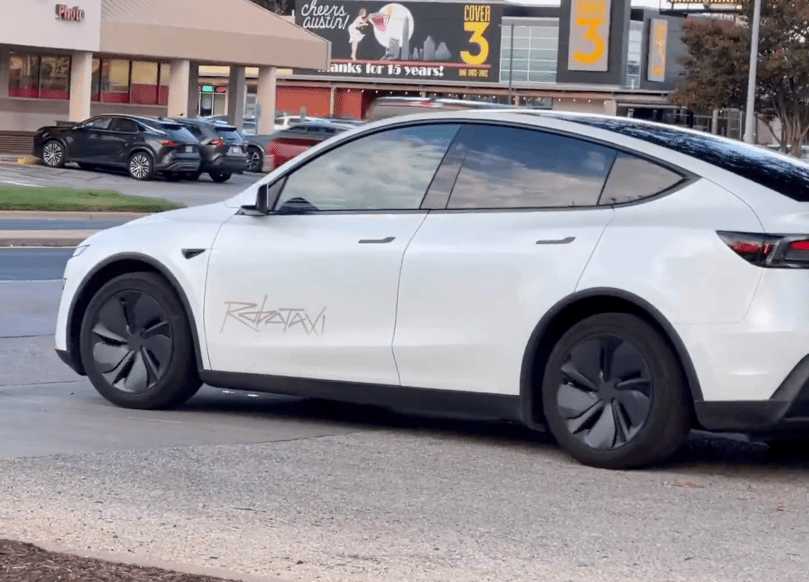
Right now Tesla’s already doing limited unsupervised Model Y robotaxi rides in Austin, and many people have taken rides. They are rare, as all my rides in Austin have had a supervisor thus far, however that will change soon. The plan seems to be rolling Cybercab out first in places like the Bay Area and here in Austin, basically following the same path they’re using with the Model Ys. Makes sense, as they likely test close to home where they can fix things quickly.
The Full Self-Driving software has now driven over 8 billion miles total, and they added another billion just in the first 50 days of this year. That’s a crazy amount of real-world data. Whether you adore or merely tolerate Elon Musk, you have to admit his team is moving fast on this stuff, and quietly, it’s hard not to respect anyone pushing this hard to make roads less deadly.
OWN YOUR OWN CYBERCAB AND WIRELESS CHARGING
MORE: They’re also talking about a Cybercab version people can actually purchase and own for under $30,000 by 2027, plus they just got the okay for Cybercab wireless charging. Still lots of regulatory hurdles, especially state-by-state rules, and competitors like Waymo are trying to keep up. I say that wen these goals are realized, things will quietly change how a lot of us get from point A to point B.
Feels like the future isn’t science fiction anymore. It’s starting in Austin, Texas.
Sources I pulled from:
Elon Musk’s X posts about production start and first unit
Teslarati articles on the first Cybercab and the 8 billion mile FSD milestone
In late January 2026, a catastrophic winter storm dubbed Winter Storm Fern swept through Tennessee and Mississippi, bringing heavy ice and snow from January 22-27. The storm triggered widespread power outages, peaking at over 180,000 in Mississippi alone and leaving thousands without electricity for days in freezing conditions. The US government issued federal major disaster declarations in early February for both states, enabling FEMA assistance, which can be useful, and often takes days to help people in need.
Private sector support proved crucial for immediate needs, and one company reacted fast
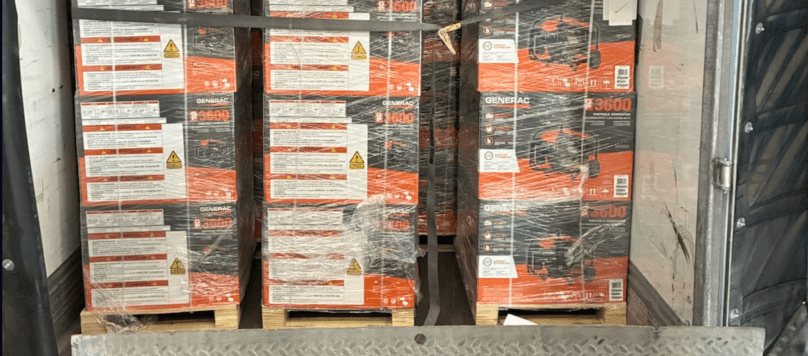
Elon Musk’s xAI and Tesla companies responded swiftly, and this shows the high value that innovative private tech firms can have when they choose to help bridge gaps in public emergency response programs. People in affected communities needed immediate help.. Through xAI, Musk facilitated the donation of hundreds of portable gas generators, providing critical power for heating, medical devices, and daily necessities in hard-hit areas.
One key example occurred on February 2, 2026, when nearly 500 generators donated by xAI arrived in Tippah County, Mississippi. These were distributed to residents who had been without power for over 10 days. Local emergency officials helped coordinate rapid rollout, prioritizing vulnerable households.
Similarly, in Tennessee, the state received and fully distributed 500 generators to the most impacted counties by February 3, 2026, aiding recovery in regions still reeling from prolonged blackouts. Tennessee Gov. Bill Lee personally thanked Elon Musk in a public post on X, “Tennesseans without power need immediate help. I’m deeply grateful to Elon Musk and xAI for going above & beyond to support Tennesseans by donating hundreds of generators to fill the gap & I value their continued partnership to solve problems & support communities across our state”.
Elon Musk replied with, “You’re most welcome. We’re working on providing Tesla Powerwalls too”.
You’re most welcome. We’re working on providing Tesla Powerwalls too.
Additionally, Tesla activated free Supercharging for electric vehicles in affected parts of Tennessee and Mississippi, ensuring all EV owners (not just Tesla owners) could maintain mobility and charge essential devices during the crisis.
All Superchargers in Mississippi and Tennessee are online. Free Supercharging enabled to help those affected in areas with persistent power outages:
This forward-thinking approach from leaders in the world of technology like artificial intelligence shows how valued people are, after all, they are the reason businesses can thrive, as they provide not just valuable tech services, but they provide jobs that support families for generations.
It is heartwarming to see official relief work with the private sector. You never really appreciate help in a disaster unless you or a loved one have actually experience it.
In the final part of the series, Dwarkesh Patel and John Collison ask Elon about government efficiency, waste and fraud, the role of AI and robotics in America’s long-term future, and his closing thoughts on optimism.
Transcript:
AI, Robotics, and the National Debt
Dwarkesh Patel asked about the point of DOGE cuts if AI and robotics are expected to drive strong economic growth in the coming years.
Elon Musk: “Well, I think like waste and fraud are not good things to have. You know, I was actually pretty worried about, I guess, I mean, I think in the absence of AI and robotics, we’re actually totally screwed because the national debt is piling up like crazy.
Now our interest payments, the interest payments, the national debt exceed the military budget, which is a trillion dollars. So over a trillion dollars just in interest payments. I was like, okay, pretty concerned about that. Maybe if I spend some time we can slow down the bankruptcy of the United States and give us enough time for the AI and robots to help solve the national debt. Or not. Help solve. It’s the only thing that could solve the national debt.
Like we are 1000% going to go bankrupt as a country and fail as a country. Without AI and robots, nothing else will solve the national debt. We’d like to. Well, we need enough time to build the AI and robots and not go bankrupt before then.”
Government Fraud and Waste
Dwarkesh Patel asked why it had been so difficult to cut obvious waste and fraud from the government.
Elon Musk: “I’m not the president and it’s very hard to cut. To cut, to even to cut things that are obvious waste and fraud. Like ridiculous waste and fraud. What I discovered is it’s extremely difficult even to cut very obvious waste from the government because the government has to operate on who’s complaining.
If you cut off payments to fraudsters, they immediately come up with the most sympathetic sounding reasons to continue the payment. They don’t say, “please keep the fraud going.” They say, you know, they’re like, “you’re killing baby pandas.” Meanwhile there’s no baby pandas are dying. They’re just making it up.
The forces are capable of coming up with extremely compelling, sort of heart wrenching stories that are false but nonetheless sound sympathetic. And that’s what happened.”
Elon Musk gave an example of fraud involving Social Security records:
Elon Musk: “Maybe there shouldn’t be 20 million people marked as alive in Social Security who are indefinitely dead and over the age of 115. The oldest American is 114. So it’s safe to say if somebody is 115 and marked as alive in the Social Security database, something is wrong. There’s either a typo, somebody should call them and say, “we seem to have your birthday wrong,” or we need to mark you as dead. One of the two things, very intimidating call to get.”
Dwarkesh Patel asked for an estimate of total fraud from this mechanism.
Elon Musk: “My guess is, by the way, The Government Accountability Office has done these estimates before. I’m not the only one. It was not coming out of this. You know, in fact, I think they, they did, the GAO did analysis a rough estimate of fraud during the Biden administration and calculated at roughly half a trillion dollars. So don’t take my word for it. Take it. A report issued during the Biden administration. How about that?”
The Challenge of Government Efficiency
Dwarkesh Patel asked why it had been difficult to cut hundreds of billions in fraud if it was so obvious.
Elon Musk: “Because when. When essentially we did, we actually. Look, you really have to stand back and recalibrate your expectations for competence because you’re operating in a world where, you know, you’ve got to sort of make ends meet. Like, you know, you got to pay your bills, you got to, you know, buy the microphones.
So it’s like there’s a giant, largely uncaring monster bureaucracy. It’s not even a bunch of macronistic computers that are just sending payments. Like one of the things that those teams are. There was and sounds so simple that probably will save, let’s say 100 billion, maybe 200 billion a year, is simply requiring that payments from the main treasury computer, which is called PAM, it’s like Payment Accounts Master or something like that.
There’s 5 trillion payments here requiring that any payment that goes out have a payment appropriation code, make it mandatory, not optional, and that you have anything at all in the comment field because you see, you have to recalibrate how dumb things are. Payments were being sent out with no appropriation code, not checking back to any congressional appropriation, and no explanation.
And this is why the Department of War, formerly Department of Defense, cannot pass an audit because the information is literally not there. Recalibrate your expectations.”
Reflections on Politics and X
John Collison asked how Elon feels looking back on his involvement in politics and the acquisition of Twitter, noting both the impact and the personal cost.
Elon Musk: “Well, I think those things needed to be done to maximize the probability that the future is good. Politics generally is very tribal and it’s very tribal and people lose their objectivity. Usually with politics, they generally have trouble seeing the good on the other side or the bad on their own side. That’s generally how it goes.
That, I guess, was one of the things that surprised me the most, is you often simply cannot reason with people if they’re in one tribe or the other. They simply believe that everything their tribe does is good and anything the other political tribe does is bad. And persuading them is otherwise, it’s almost impossible.
So anyway, but I think overall those actions, acquiring Twitter, getting Trump elected, even though it makes a lot of people angry, I think those actions are good for civilization.”
AI, Government, and Corporate Power
Dwarkesh Patel asked how Elon thinks about the risk of governments using advanced AI and robotics to suppress populations, and whether private companies should set limits on what governments can do with their technology.
Elon Musk: “I think probably the biggest danger of AI, or maybe the biggest danger of for AI and robotics going wrong is government.
You know, I mean, the way like, like people who are opposed to corporations or worried about corporations, should really worry about the most about government, because government is just a corporation in the limit. It’s a government. It is. Government is just the biggest corporation with a monopoly on violence.
So I always find it like a strange dichotomy where people would think corporations are bad, but the government is good. When the government is simply the biggest and worst corporation. But people have that dichotomy. They somehow think at the same time the government can be good, but corporations bad. And this is not true. Corporations have better morality than the government.
So I actually think it’s, you know, that is the thing to be worried about. It’s like if the government should not. Like the government could potentially use AI and robotics to suppress the population. Like that is a serious concern.”
Dwarkesh asked what Elon can do as someone building these technologies to prevent misuse by governments.
Elon Musk: “Well, I think if you have a limited government, if you limit the powers of government, which is like really what the US Constitution is intended to do, it’s intended to limit the powers of government, then you’re probably going to have a better outcome than if you have.
Not about all governments. I mean it’s difficult to predict the. Like I said, what’s the end endpoint or what is many years in the future. But it’s difficult to predict this sort of path. Along that way, if civilization progresses, AI will vastly exceed the sum of all human intelligence and there will be far more robots than humans along the way. What happens? It’s very difficult to predict.
I will do my best to ensure that anything that’s within my control maximizes the good outcome for humanity. I think anything else would be short sighted because obviously I’m part of humanity. So I like humans. Pro human. Pro human.”
Final Reflections
John Collison reflected on the theme of leaning into acute pain to solve bottlenecks rather than enduring chronic pain.
Elon Musk: “I have a high pain threshold. That’s helpful.
Yes. So, you know, one thing I can say is like, I think the future is going to be very interesting. And as I said, the Davos I’ve only been to, I was looking at Davos. I think it was on the ground for like three hours or something.
It’s better to be, it’s better to err on the side of optimism and be wrong than err on the side of pessimism and be right for quality of life. So, you know, your happiness will be, you’ll be happier if you, if you are on the side of optimism rather than erring on the side of pessimism. And so I recommend erring on the side of optimism. That’s cool.”
Dwarkesh Patel: “Elon, thanks for doing this.”
John Collison: “Thank you.”
Elon Musk: “All right.”
This concludes the 14-part transcript series of Elon Musk’s conversation with Dwarkesh Patel and John Collison. Elon shares his views on government efficiency, the risks of concentrated power, and why he believes erring on the side of optimism leads to a better life and a better future.
In Part 13, Dwarkesh Patel and John Collison ask Elon about the famous decision to switch Starship from carbon fiber to stainless steel and how he continues to drive urgency and focus on bottlenecks as his companies have scaled.
Transcript:
The Starship Material Decision: From Composites to Steel
John Collison asked about the decision to switch Starship from carbon fiber to stainless steel, noting that it was a decision Elon pushed for rather than something the team arrived at on its own.
Elon Musk: “Yeah. So desperation, I’d say. Originally we were going to make Starship out of carbon fiber. And carbon fiber is pretty expensive. Like the… you know, you can generally, when you do volume production, you can get any given thing to start to approach its material cost. The problem with carbon fiber is that material cost is still very high.
So it’s about 50 times… particularly if you go for high strength, specialized carbon fiber that can handle cryogenic oxygen, it’s roughly 50 times the cost of steel. And at least in theory it would be lighter. People generally think of steel as being heavy and carbon fiber as being light. And for room temperature applications, more or less room temperature applications like a Formula One car, static aerostructure or any kind of aerostructure really, you’re going to probably be better off with carbon fiber.
Now the problem is that we were trying to make this enormous rocket out of carbon fiber and our progress was extremely slow.”
John Collison asked if carbon fiber had been chosen initially simply because it was light.
Elon Musk: “Yes. At first glance, most people would think that the choice for making something light would be carbon fiber. Now the thing is that when you make something very enormous out of carbon fiber and then you try to have the carbon fiber be efficiently cured, meaning not room temperature cure, because sometimes you’ve got 50 plies of carbon fiber… and carbon fiber is really carbon string and glue.
In order to have high strength, you need an autoclave. So something that’s essentially a high pressure oven. And if you have something that’s gigantic, that one’s got to be bigger than the rocket. So we tried to make an autoclave that’s bigger than any autoclave that’s ever existed, or do room temperature cure, which takes a long time and has issues. But the fundamental issue is that we were just making very slow progress with carbon fiber.”
Why Steel Was the Answer
Elon Musk explained how the team reached the decision to switch to steel:
Elon Musk: “So because we were making very slow progress with carbon fiber, I was like, okay, we’ve got to try something else. Now for the Falcon 9, the primary airframe is made of aluminum lithium, which is very, very good strength to weight. And actually it has about the same, maybe better strength to weight for its application than carbon fiber. But aluminum lithium is very difficult to work with.
In order to weld it, you have to do something called friction stir welding, where you join the metal without it entering the liquid phase. So it’s kind of wild that you could do that. But with this particular type of welding, you can do that. But it’s very difficult to, like, say, let’s say you want to make a modification or attach something to aluminum lithium. You now have to use mechanical attachment with seals. You can’t weld it on.
So I wanted to avoid using aluminum lithium for the primary structure for Starship. And there was this very special grade of carbon fiber that had very good mass properties. So with rocket, you’re really trying to maximize the percentage of the rocket that is propellant, minimize the mass, obviously. And I’d like to say we were making very slow progress. I said, at this rate we’re never going to get to Mars. So we better think of something else.
I didn’t want to use aluminum lithium because of the difficulty of friction stir welding, especially doing that at scale. It was hard enough at 3.6 meters in diameter, let alone at 9 meters or above. Then I said, well, what about steel? Now I had a clue here because some of the early US rockets had used very thin steel. The Atlas rockets had used a steel balloon tank. So it’s not like steel had never been used before. It actually had been used.
And when you look at the material properties of stainless steel, especially if it’s been very full hard strain hardened stainless steel at cryogenic temperature, the strength to weight is actually similar to carbon fiber. So if you look at material properties at room temperature, it looks like the steel is going to be twice as heavy. But if you look at the material properties at cryogenic temperature of full hard stainless of particular grades, then you actually get to a similar strength to weight as carbon fiber.
And in the case of Starship, both the fuel and the oxidizer are cryogenic. So for Falcon 9, the fuel is rocket propellant grade kerosene, basically like a very pure form of jet fuel. But that is roughly room temperature. Although we do actually chill it slightly below. We chill it like a beer.”
John Collison noted that steel allows the rocket to run much hotter.
Elon Musk: “Yes. So especially for the ship which is coming in like a blazing meteor, you can greatly reduce the mass of the heat shield. So you can cut the mass of the windward part of the heat shield maybe in half, and you don’t need any heat shielding on the leeward side.
So the net result is actually the steel rocket weighs less than the carbon fiber rocket because the resin in the carbon fiber rocket starts to melt. So basically, carbon fiber and aluminum have about the same operating temperature capabilities, whereas steel can operate at twice the temperature.”
John Collison asked whether Elon had to push the team toward the riskier steel path because carbon fiber felt more proven, even if it was slower.
Elon Musk: “That’s why I initially said that the issue is that we weren’t making fast enough progress. We were having trouble making even a small barrel section of the carbon fiber that didn’t have wrinkles in it. Because at that large scale you have to have many plies, many layers of the carbon fiber. You’ve got to cure it, and you’ve got to cure it in such a way that it doesn’t have any wrinkles or defects.
The carbon fiber is much less resilient than steel. It has much… it’s less toughness. Like stainless steel will stretch and bend. The carbon fiber will tend to shatter. So toughness being the area under the stress strain curve. So you’re generally going to do better with steel. Stainless steel, to be precise.”
Driving Urgency at Scale
Dwarkesh Patel asked how Elon continues to drive urgency and focus on bottlenecks as his companies have grown very large.
Elon Musk: “Well, because I have a fixed amount of time in the day, my time is necessarily diluted as things grow and as the span of activity increases. So, you know, it’s impossible for me to actually be a micromanager because that would imply I have some thousands of hours per day. It is a logical impossibility for me to micromanage things.
So now there are times when I will drill down into a specific issue because that specific issue is the limiting factor on the progress of the company. But the reason for drilling into some very detailed item is because it is the limiting factor. It’s not arbitrarily drilling into tiny things. And like I said, obviously from a time standpoint, it is physically impossible for me to arbitrarily go into tiny things that don’t matter, and that would result in failure. But sometimes the tiny things are decisive in victory.”
Dwarkesh asked how Elon maintains that culture of urgency across very large organizations.
Elon Musk: “I have a maniacal sense of urgency. So that maniacal sense of urgency projects through the rest of the company. Yeah, I’m constantly addressing the limiting factor. I mean on the deadlines front, I generally actually try to aim for a deadline that I at least think is at the 50th percentile. So it’s not like an impossible deadline, but it’s the most aggressive deadline I can think of that could be achieved with 50% probability, which means that it’ll be late half the time.
And there is like a law of gases expansion that applies to schedules like whatever schedule. If you said we’re going to do this something in like five years, which to me is like infinity time, it will expand to fully available schedule and it’ll take five years.
There’s a physical limit. Physics will limit how fast you can do certain things. Scaling up manufacturing, there’s a rate at which you can move the atoms and scale manufacturing. That’s why you can’t instantly make a million of something, million units a year or something. You’ve got a design manufacturing line, you’ve got to bring it up, you’ve got to ride the S curve of production.
So yeah, I guess I’m trying to think, what can I say that’s actually helpful to people? I think generally a maniacal sense of urgency is a very big deal and you want to have an aggressive schedule and you want to figure out what the limiting factor is at any point in time and help the team address that limiting factor.”
Elon Musk explains the decision to switch Starship to stainless steel and how he continues to drive urgency by constantly focusing on the current limiting factor.
In Part 14, the conversation concludes with government efficiency, politics, and Elon’s final reflections on the future.