
Austin, Texas
Recently, the BBC, Bloomberg, CNBC, Fortune, and many others published articles falsely claiming that Tesla is not the world’s largest EV maker. The problem is, they counted in Hybrids by BYD which is misleading. I’ll explain why.
Facts in the Numbers
Tesla produced 1,845,985 EVs in 2023.
BYD produced 1,598,571 EVs in 2023.
Because BYD produced 1,444,091 Hybrid cars, the media ridiculously claimed Elon Musk was “losing his crown.”
First, there is no race against other EV makers, and second, Tesla’s competition is composed of gasoline cars.
To set the record straight I wanted to write to correct the misleading headlines. In this article, we’ll look at why hybrids are not EVs, and should not be counted as so.
1. Power Source
Hybrid vehicles use both a gasoline engine and an electric motor, while EVs run solely on electricity. You’ll never have to stop at a gas station again when you drive an EV. I power my Tesla Model Y with electricity at my home charger, at Superchargers, and destination chargers on trips. In contrast, if you buy a Toyota RAV4 Hybrid, you will be required to fill up at a gas station.
2. Fuel Efficiency. Huge Difference.
EVs have far greater fuel-efficiency than hybrids, as they don’t use any gasoline. Last Sept, I wrote about MPGe in another article, “What is MPGe? Everything You Need to Know.” MPGe is short for “Miles Per Gallon of Gasoline Equivalent” or “Miles Per Gallon Equivalent,” and it is used to compare the energy consumption of an electric vehicle to a traditional combustion engine car. The MPGe tells you the distance an EV can travel on the energy equivalent of one gallon of gasoline.
A Tesla Model 3 has an EPA-estimated MPGe of 140 city and 124 highway. In contrast, the Toyota RAV4 Hybrid achieves 41 city and 38 highway MPG according to EPA estimates.
3. Emissions
EVs produce zero tailpipe emissions, helping make cities, suburban areas, and the roads connecting them have cleaner air. Hybrids, unfortunately, produce emissions due to their gasoline engines. Tesla released their 2022 Impact Report, in April 2023 and it states “We make products that displace fossil fuel alternatives. In 2022, our customers avoided releasing about 13.4 million metric tons of CO2e into our atmosphere.”
Hybrids cannot claim this.
4. Charging
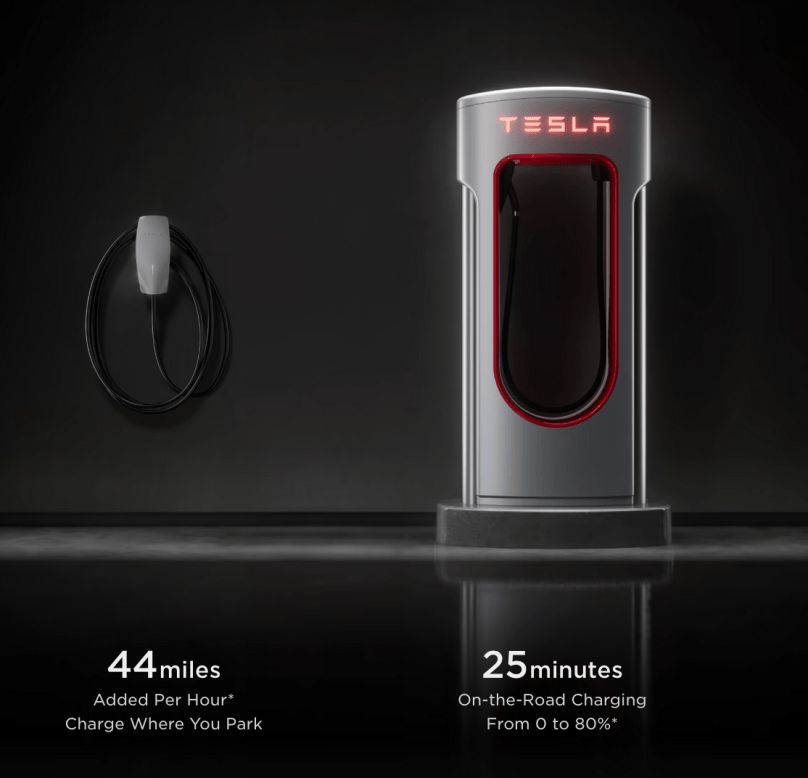
EVs have access to charging infrastructure, while most hybrids are never plugged in, unless its to a gas pump! There is an extensive charging network available to owners of EVs. If your EV choice is not a Tesla, you can still use the Tesla Supercharging Network if needed with a simple adapter. The North American Charging Standard (NACS) is for everybody.
5. Maintenance
EVs have fewer moving parts and require less maintenance than hybrids, which still have the maintenance requirements of a traditional gasoline engine. My main concerns about maintenance are filling the reservoir with wiper fluid and keeping the tires in good shape. This is a welcome relief after years of owning combustion engine cars with many more complications.
With Hybrids, you have to maintain them as you would a gas car, with the addition of a small, inefficient, electric motor. Not optimal.
6. Performance
EVs have instant torque and smooth acceleration, while hybrids have more traditional performance characteristics due to their gasoline engines.

7. Noise
EVs are generally quieter than hybrids, as they do not have a gasoline engine running.
8. Joy Factor
One of the most significant differences between hybrid and electric vehicles is the joy they bring to their owners. Electric vehicles, like my beloved Tesla Model 3, offer a pleasurable driving experience that is smooth, silent, and exhilarating.
The instant torque, rapid acceleration, and seamless performance of EVs make every drive feel special, while the reduced environmental impact and lower operating costs can provide a sense of satisfaction and pride in the vehicle. In short, electric vehicles have a certain “joy factor” that can make driving an absolute pleasure.
My thoughts
My opinion is that hybrids are just gasoline cars with fancy hybrid logos. They may have small electric motors inside, and sadly those motors offer little incentive for their owners to use them. Point 8 — Joy Factor — is, for me, something I experience every day. I truly love all aspects of my Model 3. I did not include in this list how incredible the autonomous software is as that is a topic that deserves another full article. Tesla FSD beta has been a true thrill, and no hybrid has that!
Gail Alfar, author. Exclusive to Gail Alfar, 2024 – All Rights Reserved. My goal as an author and podcaster is to support Tesla (the most American vehicle manufacturer) and Elon Musk in both making life better on Earth for humans and becoming a space-fairing civilization.
FOR MEDIA USE ONLY News media is welcome to use my material in connection with a story or article. By downloading any content I create, you understand and hereby agree and represent that: (1) you are a member of the news media; (2) use of the content is in connection with a story or an article appearing in newspapers, periodicals, digital publications or television; (3) all images and rights thereto remain the property Gail Alfar.; and (4) use of the image is not for publication covers, advertising, promotion or otherwise for commercial purposes. Furthermore, use of any and all images and content appearing on this page must each include the notice “Courtesy of Gail Alfar” Use of materials copied from this website is at your own risk. You must obtain prior written consent from Gail Alfar for uses that exceed the above parameters.
 whatsuptesla.com
I agree with you 80%. You never mentioned anything about a plug-in hybrid.
I have had 3 all electric, 2 plug-in hybrid and 1 hybrid. I am also able to charge at home.
As for gas usage I use very little. One year I used a total of 6 gallons of gasoline.
We use the all electric mostly around town. The plug-in hybrid is used mostly for short trips to stay on electric but if need be we will have the range extension necessary with gasoline. Traveling with an EV you need to stay on well traveled highway’s or in larger cities. Not all parts of the United States are set up for charging. I’m in Minnesota, most of the larger charging networks are not installing fast charging locations here. Go outstate and they are non-existent. Tesla has a few charging locations in the state all on major roadways. I did have a 2021 Tesla, model S Refresh and liked the car but it had some inconvenient features that my wife didn’t like. Mostly the distraction from driving in order to use the touch screen. When you get older you will see what I mean. Your response time is slower while using the touch screen. Plus the turn signals are a pain. As you turn the steering wheel the location of your turn signals have moved. I see some driving schools over in a European country are banning the use of Tesla’s because of this feature.
Don’t get me wrong. I love EV’s. The technology is great. Car safety is great if used as it is designed.
Have a good day.
Dan Dillon
PS: Batteries are good but we need to design a distribution for hydrogen. That’s renewable hydrogen not made from oil.
LikeLike