
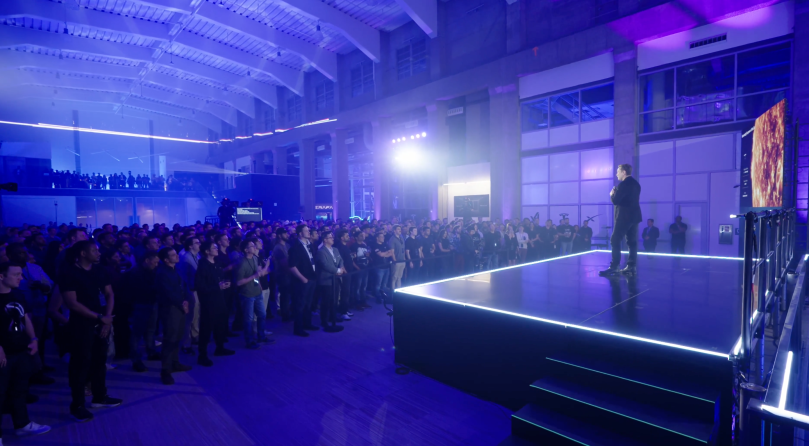
Elon Musk is one of the most caring and approachable people on Earth, and he gave a warm, inviting talk about Terafab to a packed, cheering crowd at the historic Seaholm Power Plant in Austin. While he spoke around 8 p.m. on March 21, 2026, the city outside was treated to a magnificent blue laser beam that appeared over the entire sky—so striking that a local news station immediately sent out a reporter to cover it. Here is my verbatim transcript of his talk.
Elon Musk:
We have a profoundly important announcement to make, which is the most epic chip-building exercise in history by far.
This is really going to take it to the next level—a level probably people aren’t even contemplating right now. This is not in their context. I would call this sort of an out-of-context problem. So we’re going to adjust the context by a few orders of magnitude here.
Let’s see. It’s a joint effort.
[button press sound]
I’m pressing the button, but the button’s not working. Oh, there we go. Okay.
We aspire to be a galactic civilization. So I think the future that everyone—well, most people, I think would agree—is the most exciting one where we are out there among the stars, where we are not forever confined to one planet, that we become a multi-planet species. Like the best science fiction that you’ve ever read, you know, Star Trek or Iain Banks or Asimov or Heinlein. And we want to make that real. Yeah. Not just fiction. Turn science fiction into science fact. That’s the glorious, exciting future that I certainly look forward to.
It’s worth considering how you would rate civilizations. There was a physicist—I think he was Russian—in the ’60s, Kardashev, and he thought about at a high level how you would classify any given civilization. He said, well, if you’re Type One, you’re using most of the energy of your planet. And we actually still have quite a ways to go to be properly a Type One. We’re still using a tiny fraction of the sun’s energy that reaches our planet.
The Earth only receives about half a billionth of the sun’s energy. So the sun is truly enormous. The sun is 99.8% of all mass in the solar system. So sometimes people will ask me, like, what about other power sources on Earth like fusion on Earth? Well, that is unfortunately very small because the sun is 99.8% of mass in the solar system and Jupiter is about 0.1% and Earth is in the miscellaneous category. We are, I think as Carl Sagan might have said, Earth is like a tiny dust mote in a vast darkness—very, very small. The sun is enormous.
So the way to actually scale civilization is to scale power in space. This is necessarily true because we actually capture such a tiny amount of the sun’s energy on Earth because we’re just this tiny dust mote. Another way to think of it is roughly like electricity production on Earth of all of civilization is only about a trillionth of the sun’s energy. Which means if you increase civilizational power output by a million, you would still only be a millionth of the sun’s energy.
It’s awe-inspiring to consider that, just how tiny we are in the grand scheme of things. We often get sort of caught up in these sort of squabbles on Earth that are really very sort of minor things when you consider the grandness of the universe. I think it is important actually to consider the grandness of the universe and what we can do that is much greater than what we’ve done before, as opposed to worrying about sort of small squabbles on Earth type of thing. Not much point in that! We want to be a civilization that expands to the galaxy with spaceships that anyone can go anywhere they want at any time. That would be epic. And have a city on the moon, cities on Mars, populate the solar system, and send spaceships to other star systems. That sounds like the best possible future.
(applause)
So to do that, we need to harness the power of the sun. A Terafab, while it is enormous—a terawatt of compute per year is enormous by our civilizational standards—is still just one step along the way to being even a Kardashev II level civilization. You’re not even registering as a Kardashev III. So it’s a very big thing by current human standards, but still small in the grand scheme. But it’s very difficult for humans.
To accomplish this very difficult goal really requires a combination of efforts from SpaceX, xAI, and Tesla working together to create this epic Terafab project.
And Tesla, xAI, and SpaceX have all done amazing things that people did not think would be done before. There’s the Giga Texas fab here. There’s the Optimus robot that’s being built. There’s a global supercharging network. There’s really quite a lot.
It wasn’t that long ago when people thought electric cars wouldn’t amount to anything. There were basically no electric cars for sale when Tesla started. People said it was impossible, and now Tesla is making 2 million electric cars a year.
Then xAI, although it’s a new company, now part of SpaceX, has also built the first gigawatt-scale compute cluster in record time. Jensen Huang from Nvidia said he’d never seen anything built so fast in his life before. So, a great compliment from Nvidia.
And then SpaceX… well, you already know. The reusable rockets—people said the reusable rockets weren’t possible, and even if you did them, they wouldn’t be economically feasible. So we did them, and then we made them economically feasible. Now we’ve landed over 500 times. Then we did the Falcon Heavy, and now we’re doing Starship.
Starship is a critical piece of the puzzle because in order to scale compute and scale power, you have to go to space, which means that you need massive payload to space and Starship will enable that.
[Shows picture of scale]
This gives you a sense of scale. We’ve got Optimus there for scale. Optimus is about 5’11”, so it gives you a sense of the size of the Starship V3 rocket. Starship V4 will be much longer. Starship V4 will make Starship V3 look kind of short.
We’ll expand with Starship V3 to 200 tons of payload to orbit, up from 100 tons—we’ll start with V3. You can see that this is just a rough approximation of the mini version of the AI sat. That’s roughly 100 kW. It shows the solar panels and the radiator to scale.
For some reason, there’s been a bizarre debate about radiators in space. It’s safe to say SpaceX knows how to do heat rejection in space with 10,000 satellites in orbit—we might know a thing or two. You can see the radiator is quite small relative to the solar panels.
We call it the minisat since that’s just 100 kW. We expect future satellites to probably go to the megawatt range.
(applause)
In order to get to the terawatt of compute per year, you need about 10 million tons to orbit per year at 100 kW per ton. We’re confident this is feasible—like, no new physics or impossible things are required to get there.
I’m confident that SpaceX will get to 10 million tons to orbit per year. Then we’re building up to a terawatt of solar, which will solve the power generation problem.
The key missing ingredient is therefore a terawatt of compute. This announcement is about solving the key missing ingredient.
To give you a sense of what we’re talking about, the current output of AI compute is roughly 20 gigawatts per year. This chart explains why we need to build the Terafab, because all of the rest of the output from Earth is about 2% of what we need.
[Shows chart]
If you add up all the fabs on Earth combined, they’re only about 2% of what we need for the Terawatt Project, or Terafab project.
We certainly want our existing supply chain, to be clear. We’re very grateful to Samsung, TSMC, Micron, and others, and we would like them to expand as quickly as they can. We will buy all of their chips—I’ve said these exact words to them.
But there’s a maximum rate at which they’re comfortable expanding, and that rate is much less than we would like. So we either build the Terafab or we don’t have the chips. And we need the chips. So we’re going to build the Terafab.
We’re starting with an advanced technology fab here in Austin. I believe Governor Abbott is in the audience. I’d like to thank Governor Abbott and the state of Texas for their support.
(applause)
In the advanced technology fab, we will have all of the equipment necessary to make a chip of any kind—logic or memory—and we will also have all of the equipment necessary to make the lithography masks. In a single building, we can create a lithography mask, make the chip, test the chip, make another mask, and have an incredibly fast recursive loop for improving the chip design.
To the best of my knowledge, this does not exist anywhere in the world. Where you’ve got everything necessary that you need to build logic, memory, do packaging and test it, and then do the masks, improve the masks, and just keep looping it. We’re not going to just do conventional compute in this. I think there’s some very interesting new physics that I’m confident will work—just a question of when.
We’re really going to push the limit of physics in compute and we’re going to try a bunch of wild and crazy things which you can do if you’ve got that fast iteration loop. I can’t emphasize enough the importance of being able to make a chip, test it, and then change the design, do another one, and have that in a single building.
I think that our recursive improvement with that situation is probably an order of magnitude better than anything else in the world.
(applause)
So, broadly speaking, we expect to make two kinds of chips. One will be optimized for edge inference. So that’ll be used primarily in Optimus and in the cars but especially in Optimus because I expect the humanoid robots to be made 10 to 100 times more than the volume of cars. So if vehicle production on Earth is about 100 million vehicles a year and I expect humanoid robot production to be somewhere between a billion and 10 billion units a year. So it’s a lot. Tesla’s going to make a very significant percentage of those, is our goal!
And then we need a high-power chip that is designed for space that takes into account the more difficult environment in space where you’ve got high power, you’ve got high-energy ions, photons, you got electron buildup. It’s a hostile environment in space. So you want to design the chip, you want to optimize it for space and you also want to generally run it a little hotter than you would normally run a chip on Earth to minimize the radiator mass. So there are just a bunch of constraints that you would design something differently in space than you would on the ground.
For the space compute, my guess is that is the vast majority of the compute because you’re power-constrained on Earth. That’s why I think it’s probably 100 to 200 gigawatts a year of terrestrial chips and probably on the order of a terawatt of chips in space—just because of power constraints on the ground. Space has this advantage that it’s always sunny. It’s very nice.
I actually think that the cost of deploying AI in space will drop below the cost of terrestrial AI much sooner than most people expect. I think it may be only two or three years before it is actually lower cost to send AI chips to space than it is on the ground. Because in space you don’t need much in the way of batteries. It’s always sunny. And the solar power you get, you’re going to get at least five or more times the solar power you get in space versus the ground, because you don’t have atmospheric attenuation or a day-night cycle or seasonality, and you’re always normal to the sun. So you’re really maximizing the solar power at that point. And this space solar actually costs less than terrestrial solar because you don’t need heavy glass or framing to protect it from extreme weather events.
So as soon as the cost to orbit drops to a low number, it immediately makes extremely compelling sense to put AI in space. It becomes a no-brainer, basically. Moreover, as you go to space, you get increased economies of scale and things get easier over time. Whereas, as you try to put more and more power on the ground, you run out of space and you start using up the easy spots and then you get next-level NIMBY—nobody wants the thing in their backyard. So actually increasing power on Earth becomes harder over time and more expensive over time but in space it becomes actually cheaper and easier over time. These are very important points.
What you just saw there was, because of course you’re asking, what’s on your mind, is well, what do you do after a Terafab? Don’t think small. Well, yeah, good point. So, you know, how do you get to a petawatt? That is the obvious next question. And you get there by having an electromagnetic mass driver on the moon with robots with Optimi and obviously lots of humans. And with that you can send a petawatt, you can create a petawatt of compute and send that to deep space. Because the moon has no atmosphere and has one-sixth of Earth gravity, so you can—you don’t need rockets on the moon. You can literally accelerate it to escape velocity from the surface and that dramatically drops the cost once again of harnessing power and enables you to go a thousand times bigger than a terawatt.
For sure, the future I want to see—I want us to live long enough to see the mass driver on the moon because that’s going to be incredibly epic. That should hopefully get us to a millionth of the sun’s energy at least. It’s humbling to think about that, but a millionth of the sun’s energy would be a million times bigger than Earth’s economy. So it’s good from that perspective. You expand beyond that to the planets, to the other stars, and create the most exciting possible future that I can imagine.
This looks a bit like the opening of Idiocracy with a Mike Judge unlocking an age of amazing abundance. Yeah. Obviously, the elements of that are sustainable energy, space travel, and AI and robotics that bring amazing abundance to everyone. It’s really the only path to amazing abundance: AI and robotics. Which is not to say it can’t go wrong. Hopefully, you know, but I think it’ll probably go right and it’ll be a future that you love. It’s the best future I can think of at least.
And then we go beyond the moon, beyond Mars, and we sail through the rings of Saturn. Now, wouldn’t it be amazing if you could buy a trip to Saturn? Or frankly, if you just have a trip to Saturn. I think things will just be free in the future. It sounds nuts, but you know, if you’ve got an AI robotics economy that is anywhere close to a million times the size of the current Earth economy, literally any need you possibly want can be met. If you can think of it, you can have it.
So I think Iain Banks in his Culture books has it pretty much right, where there actually isn’t money in the future and there’s abundance for everyone. If you can think of it, you can have it. That’s it. Which means anyone could have a trip to Saturn. It won’t be, you know, just a few people. If you want it, you can have it.
Help us design incredible chips and make incredible chips and build a terawatt of chips, a terawatt of solar, and 10 million tons to orbit per year. Thank you.
 whatsuptesla.com