
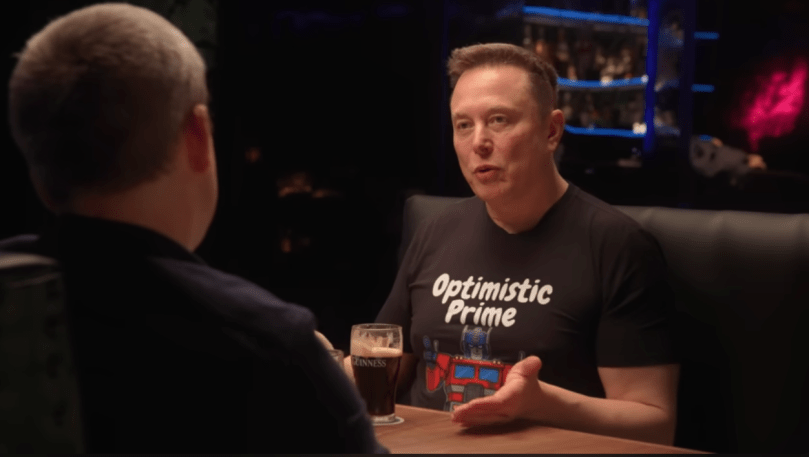
In Part 7, the conversation turns to whether SpaceX could evolve into a hyperscaler — building and operating vast orbital AI infrastructure and potentially providing compute power to others. John Collison and Dwarkesh Patel explore the capital requirements, the possibility of going public, and the deeper physics of long-term energy scaling. Elon shares his thoughts on speed as the ultimate constraint and what it would actually take to move significantly up the Kardashev scale.
Transcript:
Dwarkesh Patel asked whether the long-term vision was for SpaceX to become a hyperscaler — launching and operating vast orbital AI capacity and then providing (or lending) that compute power to other companies.
Elon Musk: “Hyper. Hyper, yeah. I mean, if some of my predictions come true, SpaceX will launch more AI than the cumulative amount on Earth of everything else combined.”
Dwarkesh followed up on whether this capacity would mostly be used for inference or training.
Elon Musk: “Will be inference already? Inference for the purpose of training is most training.”
John Collison then explored the business implications, noting the shifting narrative around a possible SpaceX IPO. He pointed out that SpaceX had long been extremely capital efficient, but the scale of building orbital AI infrastructure would require capital raises far beyond what private markets had demonstrated they could comfortably provide — even as AI labs were already raising tens of billions. He asked if going public was the logical next step and more broadly about the difference in capital availability between public and private markets, as well as whether debt financing could suffice.
Elon Musk: “Yeah, I have to be careful about saying things about companies that might go public.”
Elon Musk: “There’s a price to pay for these things.”
Elon Musk: “Yeah, there’s a lot more capital in the very general. There’s obviously a lot more capital available in the public markets than private. I mean, it might be, it’s at least, at least, it might be 100 times more capital, but it’s at least way more than 10.”
John Collison noted that highly capital-intensive sectors like real estate are typically debt-financed once they have predictable near-term revenue.
Elon Musk: “A clear revenue stream.”
John Collison agreed.
Elon Musk: “Speed is important. So I’m generally going to do the thing that, I mean, I just repeatedly tackle the limiting factor, whatever the limiting factor is on speed, I’m going to tackle that. So there’s, if capital is the only factor, then I’ll solve for capital. If it’s not limiting factor, I’ll solve for something else.”
Dwarkesh Patel observed that, based on Elon’s past comments about Tesla being public, he would not have expected Elon to see going public as the way to move fastest.
Elon Musk: “Normally I would say yeah, that’s true. Like I said, I mean, I’d love to talk about this in more detail, but the problem is like if you talk about public companies where they become public, you get into trouble and then you have to delay your offering and then you.”
John Collison noted that this was again about speed.
Elon Musk: “Yes, exactly. So you can’t hype companies that might go public. So that’s why we have to be a little careful here.”
Elon then pivoted to the fundamental long-term physics of scaling.
Elon Musk: “But we can talk about physics. So the way you think about scaling long term is that Earth only receives about half a billionth of the sun’s energy. And the sun is essentially all the energy. And this is a very important point to appreciate because sometimes people will talk about marginal nuclear reactors or any various fusion on Earth, but you have to step back a second and say if you’re going to climb the Kardashev scale and have some non trivial and harness some non trivial percentage of the sun’s energy, like let’s say you wanted to harness a millionth or a millionth of the sun’s energy, which sounds pretty small, that would be about, call it roughly 100,000 times more electricity than we currently generate on Earth for all of civilization, give or take an order of magnitude. So it obviously the only way to scale is to go to space. With solar, from launching from Earth you can get to about a terawatt per year. Beyond that you want to launch from the moon, you want to have a mass driver on the moon, and that mass driver on the moon you could do probably a petawatt per year.”
Elon discusses SpaceX potentially becoming a hyperscaler for orbital AI, the realities of raising massive capital, and the long-term physics required to scale significantly up the Kardashev scale. In Part 8, the conversation continues with more on the engineering and strategic path forward.

